
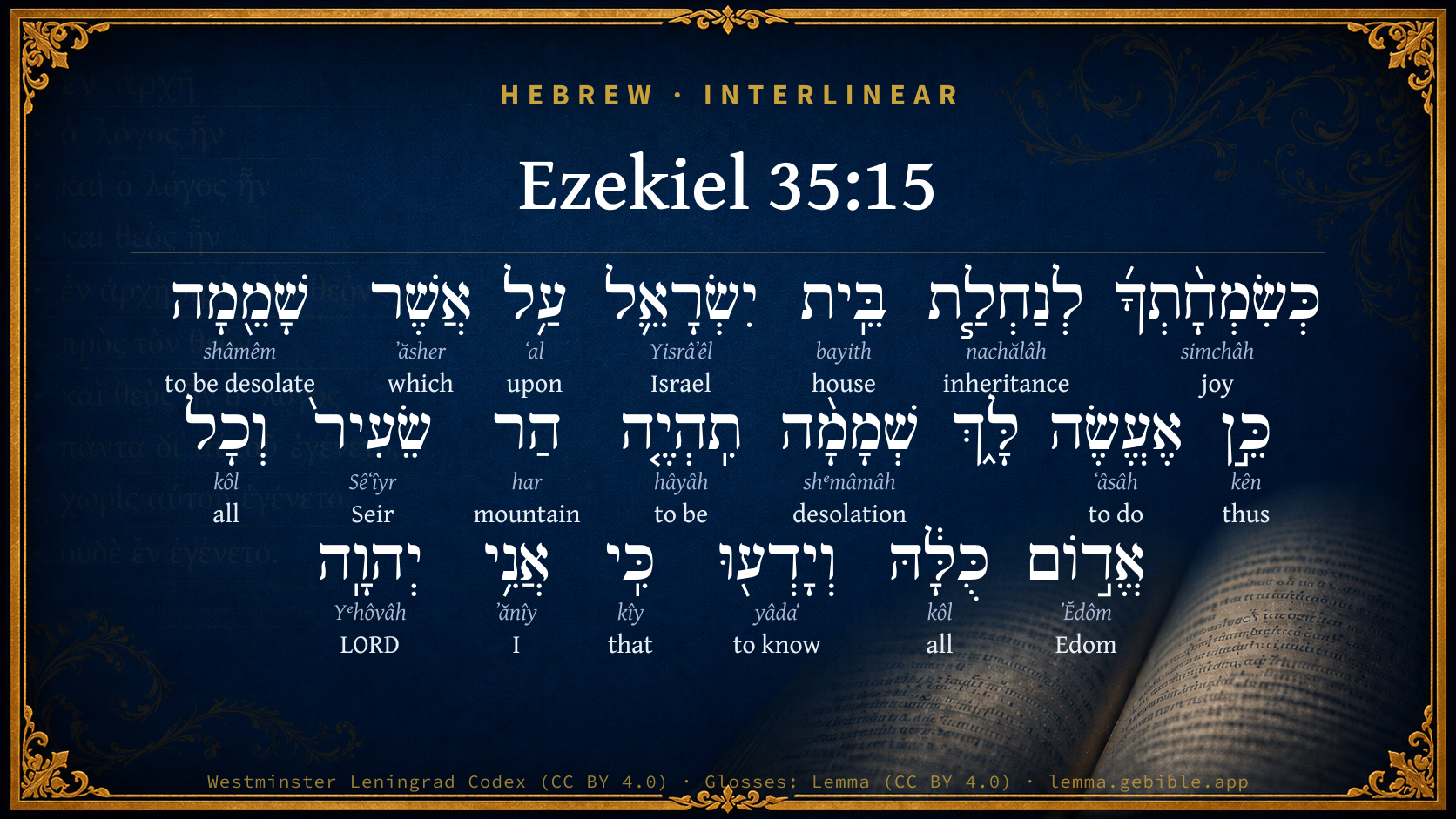
Ezekiel 35:15

Hebrew (Westminster Leningrad Codex) Ezekiel 35:15 appears in the Hebrew Old Testament. The text above is from the Westminster Leningrad Codex. Each word links to its Strong’s number, a concise gloss, and parsing drawn from the Open Scriptures Hebrew Bible morphology. Click any word for its full Brown-Driver-Briggs (BDB) entry.
Download image
Cite this verse

Ezekiel 35:15 (World English Bible). Public Domain. Lemma interlinear Bible study tool, https://lemma.gebible.app/v/ezekiel/35/15.

Show BibTeX & RIS
BibTeX
RIS
English Translation
As you did rejoice over the inheritance of the house of Israel, because it was desolate, so will I do to you: you shall be desolate, Mount Seir, and all Edom, even all of it; and they shall know that I am Yahweh.
World English Bible · Public Domain
Download a study sheet

One document with this verse’s original text, its word-by-word gloss line, the meaning frame, cross-references with their text, attributed commentary, and full source and license credits — printable, and it pastes into notes with its structure intact.

This verse Autodidact and up

Study sheet (.html) Plain text (.txt)

A passage Seminary Student

Up to 50 verses in one chapter. A passage sheet keeps up to 6 commentary sources and 12 cross-references per verse, in the order this page ranks them, and says so on the sheet whenever that leaves anything out. Ask for a single verse and you get the Autodidact verse sheet above.

Everything on this page stays free to read, with no account — the sheet is a download of what is already on screen, not access to it.

Want to remove ads? Support Godless Engineer
Compare translations 3

The same verse in 3 English versions, stacked beneath the original-language interlinear above. Click any original word for its lexicon entry.

Each is an independent rendering of the whole verse — the interlinear is not word-aligned to these translations.

Highlighted words mark where these versions differ — a whole-verse word diff, not a word-by-word alignment.

  • World English Bible Public Domain
    As you did rejoice over the inheritance of the house of Israel, because it was desolate, so will I do to you: you shall be desolate, Mount Seir, and all Edom, even all of it; and they shall know that I am Yahweh.
  • King James Version Public Domain
    As thou didst rejoice at the inheritance of the house of Israel, because it was desolate, so will I do unto thee: thou shalt be desolate, O mount Seir, and all Idumea, even all of it: and they shall know that I am the LORD.
  • unfoldingWord Literal Text CC BY-SA 4.0
    As you rejoiced over the inheritance of the people of Israel because of its desolation, I will do the same to you. You will become a desolation, Mount Seir, and all of Edom—all of it! Then they will know that I am Yahweh.’”

unfoldingWord Literal Text — © unfoldingWord, licensed CC BY-SA 4.0. Word-aligned USFM3 via Door43 (git.door43.org/unfoldingWord/en_ult).

Versions to compare (up to 4)

3 of 4 selected

Show all 18 translations

Every available English version of this verse, each an independent rendering of the whole verse.

  • World English Bible Public Domain
    As you did rejoice over the inheritance of the house of Israel, because it was desolate, so will I do to you: you shall be desolate, Mount Seir, and all Edom, even all of it; and they shall know that I am Yahweh.
  • Berean Standard Bible Public Domain
    As you rejoiced when the inheritance of the house of Israel became desolate, so will I do to you. You will become a desolation, O Mount Seir, and so will all of Edom. Then they will know that I am the LORD.
  • Majority Standard Bible Public Domain
    As you rejoiced when the inheritance of the house of Israel became desolate, so will I do to you. You will become a desolation, O Mount Seir, and so will all of Edom. Then they will know that I am the LORD.
  • King James Version Public Domain
    As thou didst rejoice at the inheritance of the house of Israel, because it was desolate, so will I do unto thee: thou shalt be desolate, O mount Seir, and all Idumea, even all of it: and they shall know that I am the LORD.
  • American Standard Version (1901) Public Domain
    As thou didst rejoice over the inheritance of the house of Israel, because it was desolate, so will I do unto thee: thou shalt be desolate, O mount Seir, and all Edom, even all of it; and they shall know that I am Jehovah.
  • Revised Version (1885) Public Domain
    As thou didst rejoice over the inheritance of the house of Israel, because it was desolate, so will I do unto thee: thou shalt be desolate, O mount Seir, and all Edom, even all of it: and they shall know that I am the LORD.
  • Geneva Bible (1599) Public Domain
    As thou diddest reioyce at the inheritance of the house of Israel, because it was desolate, so will I doe vnto thee: thou shalt be desolate, O mount Seir, and all Idumea wholly, and they shall know, that I am the Lord.
  • Douay-Rheims (1899) Public Domain
    As thou best rejoiced over the inheritance of the house of Israel, because it was laid waste, so will I do to thee: thou shalt be laid waste, O mount Seir, and all Idumea: and they shall know that I am the Lord.
  • Young's Literal Translation Public Domain
    According to thy joy at the inheritance of the house of Israel because of desolation, So I do to thee -- a desolation thou art, O mount Seir, and all Edom -- all of it, And they have known that I `am' Jehovah!
  • Literal Standard Version CC BY-SA 4.0
    According to your joy at the inheritance of the house of Israel because of desolation, || So I do to you—you are a desolation, || O Mount Seir, and all Edom—all of it, || And they have known that I [am] YHWH!”
  • Unlocked Literal Bible CC BY-SA 4.0
    As you rejoiced over the inheritance of the people of Israel because of its desolation, I will do the same to you. You will become a desolation, Mount Seir, and all of Edom—all of it! Then they will know that I am Yahweh.'”
  • unfoldingWord Literal Text CC BY-SA 4.0
    As you rejoiced over the inheritance of the people of Israel because of its desolation, I will do the same to you. You will become a desolation, Mount Seir, and all of Edom—all of it! Then they will know that I am Yahweh.’”
  • Darby Bible Public Domain
    As thou didst rejoice at the inheritance of the house of Israel, because it was desolated, so will I do unto thee: thou shalt be a desolation, O mount Seir, and all Edom, the whole of it: and they shall know that I [am] Jehovah.
  • World Messianic Bible Public Domain
    As you rejoiced over the inheritance of the house of Israel because it was desolate, so I will do to you. You will be desolate, Mount Seir, and all Edom, even all of it. Then they will know that I am the LORD.’”
  • Webster's Bible Public Domain
    As thou didst rejoice at the inheritance of the house of Israel, because it was desolate, so will I do to thee: thou shalt be desolate, O mount Seir, and all Edom, even all of it: and they shall know that I am the LORD.
  • Free Bible Version CC BY-SA 4.0
    Just as you celebrated when Israel was destroyed, I will do the same to you. Mount Seir, you will become a wasteland, and so will the rest of Edom. Then they will acknowledge that I am the Lord.”
  • Bible in Basic English Public Domain
    You will become a waste, O Mount Seir, and all Edom, even all of it: and you will be certain that I am the Lord.
  • JPS Tanakh (1917) Public Domain
    As thou didst rejoice over the inheritance of the house of Israel, because it was desolate, so will I do unto thee; thou shalt be desolate, O mount Seir, and all Edom, even all of it; and they shall know that I am the LORD.

Literal Standard Version (2020), Covenant Press — licensed CC BY-SA 4.0. Text via the HelloAO Bible API (eBible.org). Unlocked Literal Bible (unfoldingWord) — licensed CC BY-SA 4.0. Text via the HelloAO Bible API (eBible.org). unfoldingWord Literal Text — © unfoldingWord, licensed CC BY-SA 4.0. Word-aligned USFM3 via Door43 (git.door43.org/unfoldingWord/en_ult). Free Bible Version, Dr. Jonathan Gallagher — licensed CC BY-SA 4.0. Text via the HelloAO Bible API (eBible.org).

Word by word

More ways to search: Search by grammar → Find every occurrence → Compare this word →

Practice this passage: Drill this verse → Learn its vocabulary →

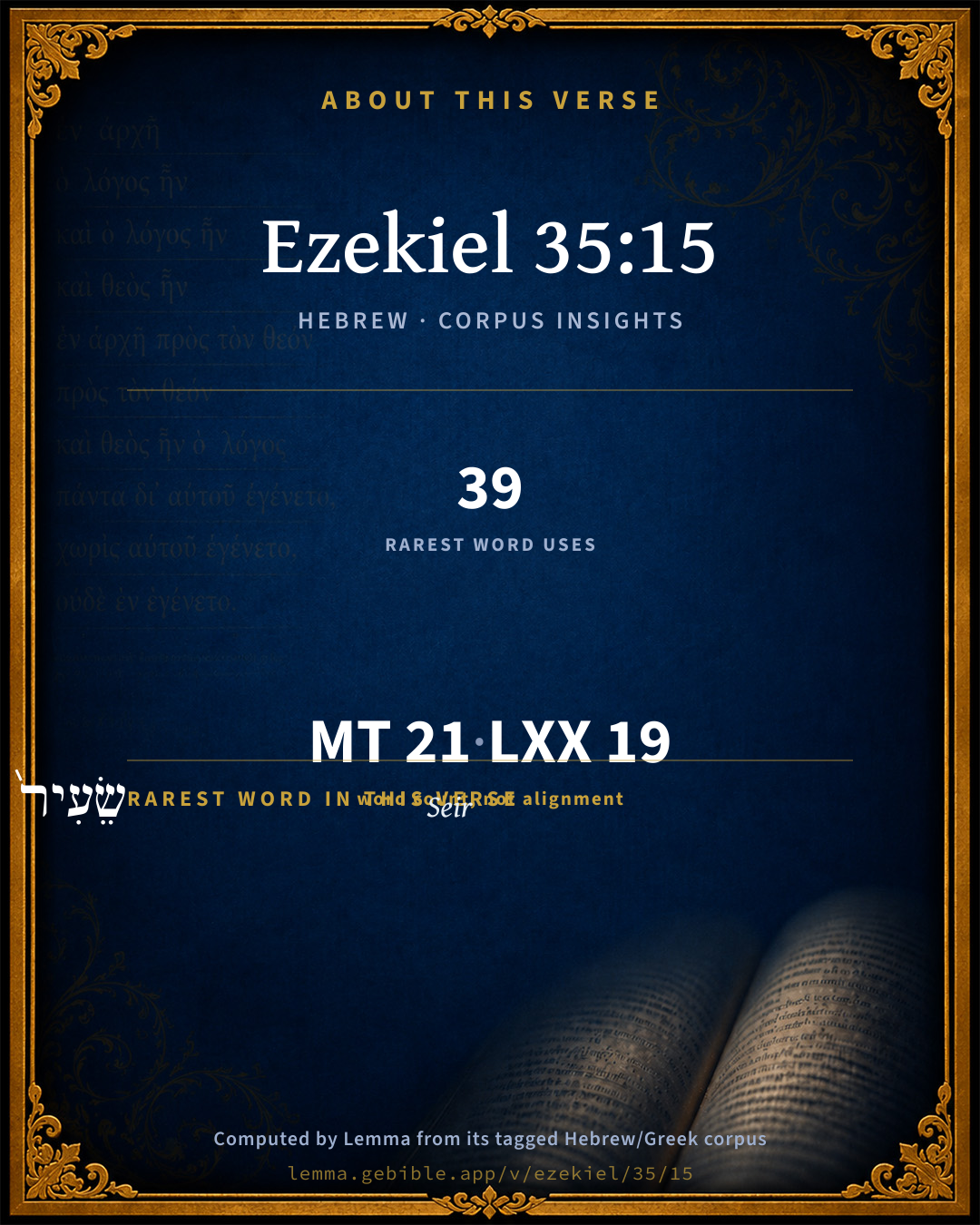
שֵׂעִיר֙
Sêʻîyr
H8165
“Seir”
Noun, Proper
Part of Speech
Noun
Type
Proper
Full BDB Definition

Origin: formed like H8163

TWOT: 2274h , 2274g

Seir = "hairy" or " shaggy" - patriarch of the Horites, the inhabitants of Edom before the descendants of Esau, the Edomites (noun proper masculine) - the land of Edom, south of the Dead Sea (noun proper territorial) - a mountain range in Edom extending from the Dead Sea to the Elanitic Gulf (noun proper mountain) - apparently also called 'Mount Seir' and extending most of the distance of the mountain range itself - a mountain in northern Judah lying westward from Kirjath-jearim (noun proper mountain)
  1. כְּשִׂמְחָ֨תְךָ֜ simchâh H8057 “like/as · joy · your” Preposition + Noun, Common, Feminine, Singular, Construct + Suffix, Personal, 2nd Person, Masculine, Singular
  2. לְנַחְלַ֧ת nachălâh H5159 “to/for · inheritance of” Preposition + Noun, Common, Feminine, Singular, Construct
  3. בֵּֽית bayith H1004 “house of” Noun, Common, Masculine, Singular, Construct
  4. יִשְׂרָאֵ֛ל Yisrâʼêl H3478 “Israel” Noun, Proper
  5. עַ֥ל ʻal H5921 “upon” Preposition
  6. אֲשֶׁר ʼăsher H834 “which” Particle, Relative
  7. שָׁמֵ֖מָה shâmêm H8074 “to be desolate” Verb, Qal, Perfect, 3rd Person, Feminine, Singular
  8. כֵּ֣ן kên H3651 “thus” Particle, Demonstrative
  9. אֶעֱשֶׂה ʻâsâh H6213 “to do” Verb, Qal, Imperfect, 1st Person, Common, Singular
  10. שְׁמָמָ֨ה shᵉmâmâh H8077 “desolation” Noun, Common, Feminine, Singular, Absolute
  11. תִֽהְיֶ֤ה hâyâh H1961 “to be” Verb, Qal, Imperfect, 2nd Person, Masculine, Singular
  12. הַר har H2022 “mountain of” Noun, Common, Masculine, Singular, Construct
  13. וְכָל kôl H3605 “and · all of” Conjunction + Noun, Common, Masculine, Singular, Construct
  14. אֱד֣וֹם ʼĔdôm H123 “Edom” Noun, Proper
  15. כֻּלָּ֔הּ kôl H3605 “all · her” Noun, Common, Masculine, Singular, Construct + Suffix, Personal, 3rd Person, Feminine, Singular
  16. וְיָדְע֖וּ yâdaʻ H3045 “and · to know” Conjunction + Verb, Qal, Sequential Perfect, 3rd Person, Common, Plural
  17. כִּֽי kîy H3588 “that” Conjunction
  18. אֲנִ֥י ʼănîy H589 “I” Pronoun, Personal, 1st Person, Common, Singular
  19. יְהוָֽה Yᵉhôvâh H3068 “LORD” Noun, Proper

About this verse

These counts appear in no published source. They are computed here, from the morphology-tagged text and Lemma’s own curated glosses. What Lemma adds →

21
words
19
distinct lemmas
Prophets
section

Shared distinctive vocabulary

שֵׂעִיר֙ Seir H8165 occurs in 38 verses of the Hebrew Bible. Also found in:

Grammatical profile

  • 4 verbs
  • 11 nouns
  • 1 pronoun
  • 2 prepositions
  • 1 conjunction
  • 2 particles

Verb forms

  • שָׁמֵ֖מָה Qal · Perfect
  • אֶעֱשֶׂה Qal · Imperfect
  • תִֽהְיֶ֤ה Qal · Imperfect
  • וְיָדְע֖וּ Qal · Sequential Perfect

Repetition

A word recurs within this verse — often emphatic in Hebrew:

  • וְכָל all H3605 ×2

Hebrew & Septuagint length

In English translation the verse runs 43 words from the Hebrew and 27 from the Septuagint (LXX English) — the Septuagint runs noticeably shorter here. See the side-by-side →

A rough comparison of the two English renderings, which tokenize alike — not a word-level alignment.

Word counts can differ between the Hebrew and the Greek without any difference in meaning — e.g. the Hebrew direct-object marker אֵת has no separate Greek word, and Greek often adds the article ὁ.

In the original languages it is 21 Hebrew tokens and 19 Greek tokens — but the two are counted differently (Hebrew bundles its prefixes and suffixes into one token; the Greek is in lemma form), so that isn’t a like-for-like length.

Cross-references

12

Topical passages linked to Ezekiel 35:15 in the Treasury of Scripture Knowledge — connected by theme and wording, ordered by reader-vote popularity; previews shown in the World English Bible.

  • Isaiah 34:5–6 For my sword has drunk its fill in the sky: behold, it shall come down on Edom, and on the people of my curse, to judgment.
  • Lamentations 4:21 Rejoice and be glad, daughter of Edom, that dwell in the land of Uz: The cup shall pass through to you also; you shall be drunken, and shall make yourself naked.
  • Ezekiel 35:3–4 and tell it, Thus says the Lord Yahweh: Behold, I am against you, Mount Seir, and I will stretch out my hand against you, and I will make you a desolation and an astonishment.
  • Psalms 137:7 Remember, Yahweh, against the children of Edom, The day of Jerusalem; Who said, "Raze it! Raze it even to its foundation!"
  • Obadiah 1:12 But don't look down on your brother in the day of his disaster, and don't rejoice over the children of Judah in the day of their destruction. Don't speak proudly in the day of distress.
  • Obadiah 1:15 For the day of Yahweh is near all the nations! As you have done, it will be done to you. Your deeds will return upon your own head.
  • Proverbs 17:5 Whoever mocks the poor reproaches his Maker. He who is glad at calamity shall not be unpunished.
  • Jeremiah 50:11 Because you are glad, because you rejoice, O you who plunder my heritage, because you are wanton as a heifer that treads out [the grain], and neigh as strong horses;
  • Ezekiel 35:9 I will make you a perpetual desolation, and your cities shall not be inhabited; and you shall know that I am Yahweh.
  • Ezekiel 36:2–5 Thus says the Lord Yahweh: Because the enemy has said against you, Aha! and, The ancient high places are ours in possession;
  • Ezekiel 39:6–7 I will send a fire on Magog, and on those who dwell securely in the isles; and they shall know that I am Yahweh.
  • Mark 3:8 from Jerusalem, from Idumaea, beyond the Jordan, and those from around Tyre and Sidon. A great multitude, hearing what great things he did, came to him.

Cross-references courtesy of OpenBible.info (CC BY 4.0).

Hebrew and Greek witnesses Masoretic Hebrew ↔ Greek Septuagint

The same verse in the two great witnesses to the Old Testament, shown verse-for-verse.

Here the Septuagint runs noticeably shorter than the Hebrew — LXX2012 (modern English Septuagint) 27 words vs World English Bible 43. A rough length comparison of the two English translations, not a word-level alignment — read both below.

These are two independent witnesses, not word-aligned to each other, and the Septuagint is shown in lemma (dictionary) form.

Hebrew Ezekiel 35:15 Masoretic · Westminster Leningrad Codex

כְּשִׂמְחָ֨תְךָ֜ לְנַחְלַ֧ת בֵּֽית יִשְׂרָאֵ֛ל עַ֥ל אֲשֶׁר שָׁמֵ֖מָה כֵּ֣ן אֶעֱשֶׂה לָּ֑ךְ שְׁמָמָ֨ה תִֽהְיֶ֤ה הַר שֵׂעִיר֙ וְכָל אֱד֣וֹם כֻּלָּ֔הּ וְיָדְע֖וּ כִּֽי אֲנִ֥י יְהוָֽה

As you did rejoice over the inheritance of the house of Israel, because it was desolate, so will I do to you: you shall be desolate, Mount Seir, and all Edom, even all of it; and they shall know that I am Yahweh.

World English Bible · Public Domain

Greek LXX Ezekiel 35:15 Septuagint · lemma form

ἔρημος εἰμί ὄρος σηιρ καί πᾶς ὁ ιδουμαία ἐκ ἀναἁλίσκω καί γιγνώσκω ὅτι ἐγώ εἰμί κύριος ὁ θεός αὐτός

You shall be desert, O mount Seir, and all Idumea; and it shall be utterly consumed: and you shall know that I am the Lord their God.

LXX2012 (modern English Septuagint) · Public Domain

On this verse, The Cambridge Bible for Schools and Colleges discusses the Septuagint’s reading. Read the note in Commentary ↓

Hebrew: Westminster Leningrad Codex (CC BY 4.0). Greek: Septuagint (public domain); English from LXX2012 (modern English Septuagint) (Public Domain). How the Septuagint differs from the Hebrew →

Targum (Aramaic paraphrase)

1

The Targum is the ancient Jewish Aramaic paraphrase of the Hebrew Scriptures — an interpretive translation, not the Hebrew text itself. Onkelos (literal) and Pseudo-Jonathan (expansive) render the Torah, and Jonathan the Prophets. Coverage is partial: where no permissively-licensed English translation exists for a verse, only the Aramaic is shown. This is verse-level text, not a word-by-word alignment to the Hebrew.

  1. Targum Jonathan Prophets (Joshua–Malachi)
    כְּמָא דַחֲדֵיתָא עַל אַחֲסָנַת בֵּית יִשְׂרָאֵל דִצְדִיאַת אַרְעֲהוֹן כֵּן אַעְבֵיד לָךְ צָדוּ תְהֵי טוּרָא דְשֵׂעִיר וְכָל אֱדוֹם כּוּלָהּ וְיֵדְעוּן אֲרֵי אֲנָא יְיָ:

    (no public-domain English translation for this verse)

    Targum Jonathan — Aramaic: “Mikraot Gedolot” (public domain). English: “Sefaria Community Translation” (CC0 1.0 (public-domain dedication)); “London "Chaldee Paraphrase," 1871” (public domain). Text via Sefaria.

Commentary

Notes on Ezekiel 35:15 from classic Christian and Jewish commentators (each source and its license shown beneath its notes). The classic Christian expositions comment on the surrounding passage and are grouped to its opening verse, so a note may address several verses; the Jewish commentaries on the Tanakh (Rashi and others) are per-verse, so they appear only where the commentator wrote on this verse.

Lemma curates 59 commentaries, every one of them public domain or Creative Commons licensed, each selected and text-cleaned for this edition rather than reprinted as found. About our sources →

Trapp's Complete Commentary

John Trapp

Eze 35:15 As thou didst rejoice at the inheritance of the house of Israel, because it was desolate, so will I do unto thee: thou shalt be desolate, O mount Seir, and all Idumea, [even] all of it: and they shall know that I [am] the LORD.

Ver. 15. As thou didst rejoice.] As thou wast sick of the devil’s disease, rejoicing at other men’s harms; so, by a strange turn of things, others shall rejoice at thy just destruction, and revel in thy ruins: and at the last day especially, when thou shalt be awarded thy portion with the devil and his angels. {2Th 1:6-8}

Thou shalt be desolate, O Mount Seir.] This was accordingly effected shortly after by Nebuchadnezzar and his Chaldees, as Josephus {a} testifieth; and is daily executed on the Church’s enemies, who shall all be ere long in the place that is fittest for them - scil., under Christ’s feet.

And all Idumea, even all of it.] The Edomites, that thought of seizing on others’ lands, lost their own. They who covet all, do oft lose all; yea, even the pleasure of that they possess; as a greedy dog swalloweth the whole meat that is cast him, without any pleasure, as gaping still for the next morsel.

{a} Lib. xii. cap. 11.

John Trapp, A Commentary or Exposition upon All the Books of the Old and New Testament (1647–1656) — public domain. Text from a community e-Sword module.

Jamieson, Fausset & Brown

Robert Jamieson, A. R. Fausset & David Brown

(Oba 1:12, Oba 1:15).

The distinction between Israel and the heathen (as Edom) is: Israel has a covenant relation to God ensuring restoration after chastisement, so that the heathen's hope of getting possession of the elect people's inheritance must fail, and they themselves be made desolate (Eze 36:1-15). The reason for the chastisement of Israel was Israel's sin and profanation of God's name (Eze 36:16-21). God has good in store for Israel, for His own name's sake, to revive His people; first, by a spiritual renewal of their hearts, and, next, by an external restoration to prosperity (Eze 36:22-33). The result is that the heathen shall be impressed with the power and goodness of God manifested so palpably towards the restored people (Eze 36:34-38).

Next: Ezekiel Chapter 36

Jamieson, Fausset & Brown — Commentary Critical and Explanatory on the Whole Bible (1871) — public domain (CC PDM 1.0). Text via the HelloAO Bible API.

Adam Clarke's Commentary

Verse 15. So will I do unto thee] Others shall rejoice in thy downfall as thou hast rejoiced at their downfall.

This whole chapter strongly inculcates this maxim: Do as thou wouldst be done by; and what thou wouldst not have done to thee, do not to others. And from it we learn that every man may, in some sort, be said to make his own temporal good or evil; for as he does to others, God will take care to do to him, whether it be evil or good, weal or wo. Would you not be slandered or backbitten? Then do not slander nor backbite. Wouldst thou wish to live in peace? Then do not disturb the peace of others. Be merciful, and thou shalt obtain mercy.

Adam Clarke's Commentary on the Bible (1810–1826) — public domain. Text from a community e-Sword/MySword module.

Ellicott's Commentary for English Readers

(15) Because it was desolate.—This is spoken of Israel; yet Israel was to preserve a remnant who should return to their land, and ultimately become the centre of the new covenant. So the desolation of Edom, though ultimately perpetual as far as its nationality is concerned, is not inconsistent with the fact foretold by Amos (Amo_9:12), that a remnant even of Edom should at last be received into the Church.

All Idumea.—It is better to keep the uniform name of Edom. Idumea is essentially the same country but is a more modern name, and when it came into use the boundaries had somewhat changed.

A Bible Commentary for English Readers, edited by Charles John Ellicott (1878–1897) — public domain. Text from a community e-Sword module.

The Cambridge Bible for Schools and Colleges

gen. ed. J. J. S. Perowne

15. The clause “as thou didst … do unto thee” is wanting in LXX.

As Edom had been active in the destruction of Judah, their own desolation must follow. The author of the Lamentations has a presentiment that the next great act of divine judgment will be on Edom (Lam_4:22; cf. Isaiah 34, Isa_63:1-6). The great empires which brought destruction upon Jerusalem were acting under commission from Jehovah and the work was according to his will. But in the first place there is a difference between the work itself and the spirit in which it is done. Jehu received commendation for his act in cutting off the seed of Ahab, but later his house was extirpated for the guilt of this same “blood of Jezreel” (Hos_1:4). The Assyrian was entrusted with a commission against the ungodly nation; but he meant not so, it was in his heart to cut off nations not a few (Isa_10:7), and the decree that he should be broken upon the mountains of Israel went out against him (Isa_14:25). Nebuchadnezzar was the “servant” of the Lord, but because Babylon laid her yoke heavily on the aged of the people, not considering the issue of such things, bereavement and widowhood shall come upon her in one day (Isa_47:6-8). Here the prophet reprobates both the actions and the spirit of Edom, and threatens that Jehovah will recompense it into their bosom. In ancient modes of thought the people and their god were one. The people were but the reflection of the god, they were the people of Chemosh or Milcom or Jehovah. All wars were religious wars, wars against a god who animated and gave strength to his people (Exo_12:12). Edom’s despite was to some extent in the strict sense directed against Jehovah. In truth they knew Jehovah only as the God of Israel, but it was he whom they knew, though they might not have such knowledge of him as Ezek. had attained to. But it is possible to be guilty of great sins against God, even though they are done unwittingly and without full knowledge of that which he is.

And in the second place, Edom received no commission from Jehovah against his people. Their place in history and among the nations of the earth gave them no significance in relation to Israel, or in Jehovah’s providence embracing all the world. The contact of Israel with the nations exercising universal empire over the earth, if it did not suggest conceptions of Jehovah’s universal power and dominion to the prophets, at least gave them occasion for expressing to the people and to all time such conceptions; and this period of Israel’s history lent a breadth and elevation to prophecy to which in political conditions such as existed in earlier times it could never have attained. The transportation of colonies of Israelites also into the Assyrian and Babylonian empires, besides purifying the religion of the people from its dependence on ritual observance and making it more inward among those who continued to adhere to it, leavened the populations of these heathen nations with truer conceptions of Deity and religion. The writers of this age often refer to the strangers joining themselves to the covenant of the Lord (Isa_14:1-2; Isa_56:1-8), and no doubt the same influence was exerted by Israel, if not to the same extent, in Babylon and the countries of the East, as we are familiar with in later times in Rome and the empire of the West. In such respects Edom had no importance, and hardly entered into the larger designs of Jehovah with respect to his people and mankind.

The Cambridge Bible for Schools and Colleges (gen. ed. J. J. S. Perowne; Cambridge University Press, 1878–1918) — public domain. Text from a community e-Sword module.

John Gill's Exposition

As thou didst rejoice at the inheritance of the house of Israel, because it was desolate,.... So Edom rejoiced at the destruction of Jerusalem, Oba 1:12, and so the followers of the man of sin will rejoice at the slaying of the witnesses, Rev 11:10, which is resented by the Lord, and therefore adds,

so will I do unto thee; make thee desolate, as is explained in the next clause:

thou shall be desolate, O Mount Seir, and all Idumea, even all of it; not that mount only, but all the land of Edom, called Idumea; the destruction shall be general, as it was, and irretrievable; and so not Rome only, but all the antichristian states, will be destroyed, when God comes forth in his wrath against them:

and they shall know that I am the Lord; the Lord God omniscient and omnipotent; who, having foretold all this, shall accomplish it.

Next: Ezekiel Chapter 36

John Gill's Exposition of the Whole Bible (1746–1763) — public domain (CC PDM 1.0). Text via the HelloAO Bible API.

Haydock's Catholic Bible Commentary

As, &c., is not in the Roman Septuagint. St. Jerome says it was marked with an asterisk, being taken from Theodotion. (Calmet) --- Grabe supplies to thou shalt. His copy has the rest:..."thou shalt know that I am their Lord." (Haydock)

George Leo Haydock (1774–1849), Haydock's Catholic Family Bible and Commentary, 1859 edition — public domain. Excludes Psalms (Douay-Rheims chapter numbering differs from Protestant) and Deuterocanonical books (Catholic canon only).

Matthew Poole's English Annotations

Thou didst rejoice; thou tookest pleasure in the ruin of my people; for this thy sin I will ruin thee, and then do to thee as thou didst, I will retaliate, and rejoice in thy ruin: thou helpedst to make Jerusalem desolate, I will make thee so: thou criedst to ruin them all, to destroy all the land; all thy land shall be ruined, and by these judgments I will be known to be the Lord.

Matthew Poole's English Annotations on the Holy Bible (1683–1685) — public domain. Text from a community e-Sword/MySword module.

The Pulpit Commentary

As thou didst rejoice. yki is here a particle of comparison; and the import of the passage is that precisely as Edom exulted over the desolation of Israel"s inheritance, so would Jehovah cause others to rejoice over the downfall and desolation of Edom. All Idumea. Instead of this Greek term, the Revised Version properly substitutes the usual word Edom. Note: That the prediction here uttered concerning Edom received literal fulfillment, the following extract relative to the present state of the country will show: "Idumea, once so rich in flocks, so strong in its fortresses and rock-hewn cities, so extensive in its commercial relations, so renowned for the architectural splendor of its palaces, is now a deserted and desolate wilderness. Its whole population is contained in some three or four miserable villages. No merchant would now dare to enter its borders; its highways are untrodden, its cities are all in ruins" (J.L. Porter, in Kitto"s "Cyclopaedia," art. "Idumea").

Rejoicing over the ruin of others.

I THE UGLY FACT. Edom had rejoiced over the ruin of Israel. One would say that such a joy must be impossible. Regarding the world from the high ground of ideal speculation, one would suppose that sympathy for the suffering must spring forth as a natural instinct, or that, if the feelings were callous and selfishness hardened the heart, still there would be no room for joy under such circumstances. But the facts of history and observation show that Edom"s joy was no monstrous, impossible experience. People do rejoice in the sufferings of others:

1. In national life. The downfall of rival nations is accepted by their more fortunate neighbors with delight.

2. In amusement. The old, fierce delights of the amphitheatre, which delicate ladies shared with bloodthirsty warriors, were just the joys of cruelty, pleasures got directly out of the sufferings of fellow-creatures. The Emperor Domitian is said to have taken a keen interest in watching the contortions of agony on the face of a dying gladiator. A similar spirit lurks in the present-day popular taste for amusements that involve great risk of life. A Christian spirit should discourage such amusements as feeding on cruelty.

3. In private life. Some People seem to take a spiteful pleasure in the disgrace and ruin of their neighbors. Is not this pleasure at the root of much idle gossip and fascinating scandal?

II ITS EVIL CAUSES. How comes it that the misery of one man can cause pleasure to his brother, when by the influence of sympathy it should produce an opposite effect? The causes of this gross perversion of the appetite for pleasure are various.

1. Revenge. Israel had been an old enemy of Edom. The commonest pleasure of cruelty is m seeing a foe humiliated. There may be natural elements in this feeling:

(1) a reaction from the tension of fear; and

(2) a satisfaction of the desire for self-protection.

Still, the joy is evil and hateful, for it exceeds self-regarding considerations, and it excludes pity; it denies the duty of loving our enemies.

1. Envy. Edom had formerly envied the prosperity of Israel. She afterwards rejoiced in her rival"s downfall. This, again, is a sort of reaction from the pain of envy. It is the more powerful if the successful rival has shown scorn for her less fortunate neighbor. Now, the scorn is reversed.

2. A sense of contrast. Sitting at ease, the spectator compares his comforts with the agonies before him, and as all feeling arises from contrasted states, the sharpness of this contrast heightens the relish of a man"s present comfort. This is brutally selfish.

3. Malignity. There does seem to be a direct pleasure in seeing others suffer. This is the glee of devils. It may be shared by diabolical men.

III ITS FATAL EFFECTS. Edom is to be punished and made desolate. God will certainly punish cruelty as a great sin, because it is the direct opposite of man"s first duty, which is to love all beings. The evil joy will work mischief in the heart of the man who cherishes it. It is a venom that will rankle in the breast that engenders it We need love and sympathy for our own soul"s health. The pleasures of cruelty cut a man off from the bonds of fellowship, even with these who are not themselves its victims, because they destroy the elements on which the spirit of brotherhood lives. Thus a cruel person is inwardly lonely. Selfishness makes the heart desolate. The exclusion of love is the exclusion of the greatest joy of human fellowship. In seeking his own pleasure the man who admits evil passions of revenge or spite into his breast darkens his life with the gloom of spiritual solitude. On the other hand, the deepest joy is found in sacrificing one"s self in order to save one"s brother.

The Pulpit Commentary (1880–1919), ed. H.D.M. Spence-Jones & Joseph S. Exell — public domain. Text from a community e-Sword module.

Lesson kit

Teaching starters — assembled from the data on this page, not authored interpretation. Every prompt links to the verse data it draws on. Edit before teaching.

Ezekiel, in the Prophets, opens this verse with 21 words (19 distinct Hebrew lemmas). Its most distinctive word is Sêʻîyr (“Seir”). The Greek Septuagint runs shorter here. A historical commentator’s framing appears above. Read the whole chapter for the surrounding context.

Discussion questions

  1. How does “Seir” (Sêʻîyr) shape what this verse is saying?
  2. How does Genesis 14:6, which shares the word «Seir», read alongside this verse?
  3. What does the repetition of “all” (2× in this one verse) do in this verse?
  4. The Septuagint runs shorter here than the Hebrew. What might account for the difference?
  5. These translations render this verse differently; the difference is in the English rendering, not the original. What questions does that raise?
  6. «שָׁמֵ֖מָה» is a Qal Perfect verb. How does that grammatical form shape the action described?
  7. Compare how Trapp's Complete Commentary and Jamieson, Fausset & Brown read this verse. Where do they agree or differ?

Things to notice

Reading settings

Reading text

Shown beneath each verse's original-language words.

Old Testament
Old Testament edition

Read the OT as the Masoretic Hebrew (MT) or the Greek Septuagint (LXX).

English shown for the Greek Septuagint (in the Hebrew ↔ Greek comparison).

Comparing translations? Open the Compare panel on any verse page to stack up to four side by side.