

Psalms 100:2

Hebrew (Westminster Leningrad Codex) Psalms 100:2 appears in the Hebrew Old Testament. The text above is from the Westminster Leningrad Codex. Each word links to its Strong’s number, a concise gloss, and parsing drawn from the Open Scriptures Hebrew Bible morphology. Click any word for its full Brown-Driver-Briggs (BDB) entry.
Download image
Cite this verse

Psalms 100:2 (World English Bible). Public Domain. Lemma interlinear Bible study tool, https://lemma.gebible.app/v/psalms/100/2.

Show BibTeX & RIS
BibTeX
RIS
English Translation
Serve Yahweh with gladness. Come before his presence with singing.
World English Bible · Public Domain
Download a study sheet

One document with this verse’s original text, its word-by-word gloss line, the meaning frame, cross-references with their text, attributed commentary, and full source and license credits — printable, and it pastes into notes with its structure intact.

This verse Autodidact and up

Study sheet (.html) Plain text (.txt)

A passage Seminary Student

Up to 50 verses in one chapter. A passage sheet keeps up to 6 commentary sources and 12 cross-references per verse, in the order this page ranks them, and says so on the sheet whenever that leaves anything out. Ask for a single verse and you get the Autodidact verse sheet above.

Everything on this page stays free to read, with no account — the sheet is a download of what is already on screen, not access to it.

Want to remove ads? Support Godless Engineer
Compare translations 3

The same verse in 3 English versions, stacked beneath the original-language interlinear above. Click any original word for its lexicon entry.

Each is an independent rendering of the whole verse — the interlinear is not word-aligned to these translations.

Highlighted words mark where these versions differ — a whole-verse word diff, not a word-by-word alignment.

  • World English Bible Public Domain
    Serve Yahweh with gladness. Come before his presence with singing.
  • King James Version Public Domain
    Serve the LORD with gladness: come before his presence with singing.
  • unfoldingWord Literal Text CC BY-SA 4.0
    Serve Yahweh with gladness; come to his face with rejoicing.

unfoldingWord Literal Text — © unfoldingWord, licensed CC BY-SA 4.0. Word-aligned USFM3 via Door43 (git.door43.org/unfoldingWord/en_ult).

Versions to compare (up to 4)

3 of 4 selected

Show all 18 translations

Every available English version of this verse, each an independent rendering of the whole verse.

  • World English Bible Public Domain
    Serve Yahweh with gladness. Come before his presence with singing.
  • Berean Standard Bible Public Domain
    Serve the LORD with gladness; come into His presence with joyful songs.
  • Majority Standard Bible Public Domain
    Serve the LORD with gladness; come into His presence with joyful songs.
  • King James Version Public Domain
    Serve the LORD with gladness: come before his presence with singing.
  • American Standard Version (1901) Public Domain
    Serve Jehovah with gladness: Come before his presence with singing.
  • Revised Version (1885) Public Domain
    Serve the LORD with gladness: come before his presence with singing.
  • Geneva Bible (1599) Public Domain
    Serue the Lord with gladnes: come before him with ioyfulnes.
  • Douay-Rheims (1899) Public Domain
    Sing joyfully to God, all the earth: serve ye the Lord with gladness. Come in before his presence with exceeding great joy.
  • Young's Literal Translation Public Domain
    Serve Jehovah with joy, come before him with singing.
  • Literal Standard Version CC BY-SA 4.0
    Serve YHWH with joy, come before Him with singing.
  • Unlocked Literal Bible CC BY-SA 4.0
    Serve Yahweh with gladness; come before his presence with joyful singing.
  • unfoldingWord Literal Text CC BY-SA 4.0
    Serve Yahweh with gladness; come to his face with rejoicing.
  • Darby Bible Public Domain
    Serve Jehovah with joy: come before his presence with exultation.
  • World Messianic Bible Public Domain
    Serve the LORD with gladness. Come before his presence with singing.
  • Webster's Bible Public Domain
    Serve the LORD with gladness: come before his presence with singing.
  • Free Bible Version CC BY-SA 4.0
    Worship the Lord with gladness; come into his presence with joyful songs!
  • Bible in Basic English Public Domain
    Give worship to the Lord with joy; come before him with a song.
  • JPS Tanakh (1917) Public Domain
    Serve the LORD with gladness; come before His presence with singing.

Literal Standard Version (2020), Covenant Press — licensed CC BY-SA 4.0. Text via the HelloAO Bible API (eBible.org). Unlocked Literal Bible (unfoldingWord) — licensed CC BY-SA 4.0. Text via the HelloAO Bible API (eBible.org). unfoldingWord Literal Text — © unfoldingWord, licensed CC BY-SA 4.0. Word-aligned USFM3 via Door43 (git.door43.org/unfoldingWord/en_ult). Free Bible Version, Dr. Jonathan Gallagher — licensed CC BY-SA 4.0. Text via the HelloAO Bible API (eBible.org).

Word by word

More ways to search: Search by grammar → Find every occurrence → Compare this word →

Practice this passage: Drill this verse → Learn its vocabulary →

About this verse

These counts appear in no published source. They are computed here, from the morphology-tagged text and Lemma’s own curated glosses. What Lemma adds →

7
words
7
distinct lemmas
Wisdom
section

Notable vocabulary

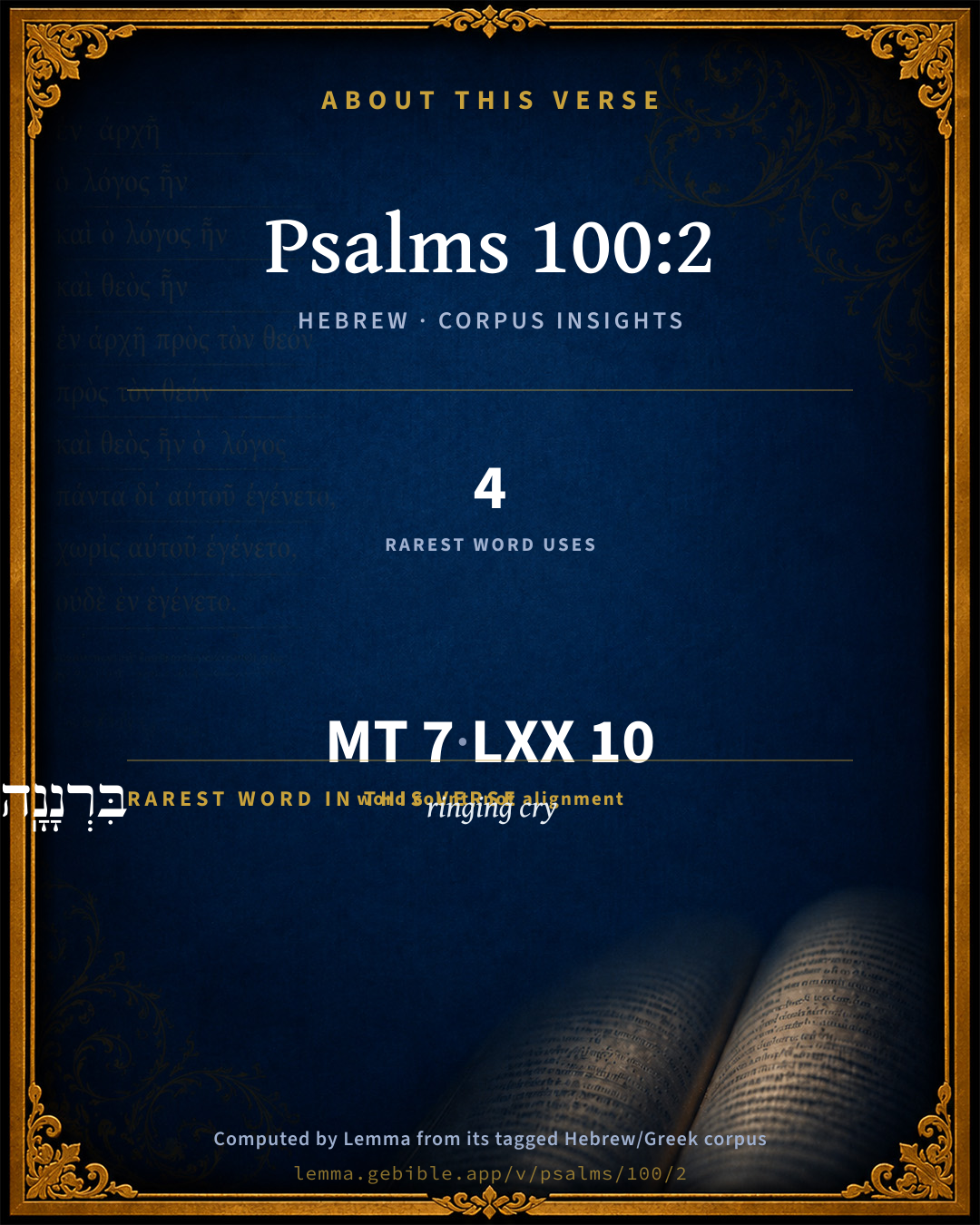
The rarest word here is בִּרְנָנָֽה ringing cry H7445 — appearing just 4 times in the whole Hebrew Bible.

Shared distinctive vocabulary

בִּרְנָנָֽה ringing cry H7445 occurs in 4 verses of the Hebrew Bible. Also found in:

Grammatical profile

  • 2 verbs
  • 4 nouns
  • 1 particle

Verb forms

  • עִבְד֣וּ Qal · Imperative
  • בֹּ֥אוּ Qal · Imperative

Hebrew & Septuagint length

In English translation the verse runs 10 words from the Hebrew and 11 from the Septuagint (LXX English) — closely comparable.

A rough comparison of the two English renderings, which tokenize alike — not a word-level alignment.

Word counts can differ between the Hebrew and the Greek without any difference in meaning — e.g. the Hebrew direct-object marker אֵת has no separate Greek word, and Greek often adds the article ὁ.

In the original languages it is 7 Hebrew tokens and 10 Greek tokens — but the two are counted differently (Hebrew bundles its prefixes and suffixes into one token; the Greek is in lemma form), so that isn’t a like-for-like length.

Cross-references

14

Topical passages linked to Psalms 100:2 in the Treasury of Scripture Knowledge — connected by theme and wording, ordered by reader-vote popularity; previews shown in the World English Bible.

  • Philippians 4:4 Rejoice in the Lord always! Again I will say, Rejoice!
  • Psalms 95:2 Let's come before his presence with thanksgiving. Let's extol him with songs!
  • Psalms 71:23 My lips shall shout for joy! My soul, which you have redeemed, sings praises to you!
  • Deuteronomy 28:47 Because you didn't serve Yahweh your God with joyfulness, and with gladness of heart, by reason of the abundance of all things;
  • 2 Chronicles 20:27–28 Then they returned, every man of Judah and Jerusalem, and Jehoshaphat in the forefront of them, to go again to Jerusalem with joy; for Yahweh had made them to rejoice over their enemies.
  • Acts 2:46–47 Day by day, continuing steadfastly with one accord in the temple, and breaking bread at home, they took their food with gladness and singleness of heart,
  • Psalms 42:4 These things I remember, and pour out my soul within me, How I used to go with the crowd, and led them to the house of God, With the voice of joy and praise, a multitude keeping a holy day.
  • Psalms 107:21–22 Let them praise Yahweh for his loving kindness, For his wonderful works to the children of men!
  • Deuteronomy 12:12 You shall rejoice before Yahweh your God, you, and your sons, and your daughters, and your men-servants, and your maid-servants, and the Levite who is within your gates, because he has no portion nor inheritance with you.
  • Deuteronomy 16:11 and you shall rejoice before Yahweh your God, you, and your son, and your daughter, and your man-servant, and your maid-servant, and the Levite who is within your gates, and the foreigner, and the fatherless, and the widow, who are in the midst of you, in the place which Yahweh your God shall choose, to cause his name to dwell there.
  • Deuteronomy 16:14 and you shall rejoice in your feast, you, and your son, and your daughter, and your man-servant, and your maid-servant, and the Levite, and the foreigner, and the fatherless, and the widow, who are within your gates.
  • 1 Kings 8:66 On the eighth day he sent the people away; and they blessed the king, and went to their tents joyful and glad of heart for all the goodness that Yahweh had shown to David his servant, and to Israel his people.
  • 2 Chronicles 31:2 Hezekiah appointed the divisions of the priests and the Levites after their divisions, every man according to his service, both the priests and the Levites, for burnt offerings and for peace-offerings, to minister, and to give thanks, and to praise in the gates of the camp of Yahweh.
  • Psalms 63:4–5 So I will bless you while I live. I will lift up my hands in your name.

Cross-references courtesy of OpenBible.info (CC BY 4.0).

Hebrew and Greek witnesses Masoretic Hebrew ↔ Greek Septuagint

The same verse in the two great witnesses to the Old Testament, shown verse-for-verse.

You’re reading Greek Psalm 99 (Hebrew Psalm 100). The Septuagint counts the superscription, so verse numbers can differ from the Hebrew — chapter-level alignment, not verse-by-verse. Numbering follows Rahlfs.

These are two independent witnesses, not word-aligned to each other, and the Septuagint is shown in lemma (dictionary) form.

Hebrew Psalms 100:2 Masoretic · Westminster Leningrad Codex

עִבְד֣וּ אֶת יְהוָ֣ה בְּשִׂמְחָ֑ה בֹּ֥אוּ לְ֝פָנָ֗יו בִּרְנָנָֽה

Serve Yahweh with gladness. Come before his presence with singing.

World English Bible · Public Domain

Greek LXX Greek Psalm 99:2 Septuagint · lemma form

δουλεύω ὁ κύριος ἐν εὐφροσύνη εἰςἔρχομαι ἐνώπιον αὐτός ἐν ἀγαλλίασις

Serve the Lord with gladness; come before his presence with exultation.

LXX2012 (modern English Septuagint) · Public Domain

Hebrew: Westminster Leningrad Codex (CC BY 4.0). Greek: Septuagint (public domain); English from LXX2012 (modern English Septuagint) (Public Domain). How the Septuagint differs from the Hebrew →

Commentary

Notes on Psalms 100:2 from classic Christian and Jewish commentators (each source and its license shown beneath its notes). The classic Christian expositions comment on the surrounding passage and are grouped to its opening verse, so a note may address several verses; the Jewish commentaries on the Tanakh (Rashi and others) are per-verse, so they appear only where the commentator wrote on this verse.

Lemma curates 59 commentaries, every one of them public domain or Creative Commons licensed, each selected and text-cleaned for this edition rather than reprinted as found. About our sources →

Trapp's Complete Commentary

John Trapp

Psa 100:2 Serve the LORD with gladness: come before his presence with singing.

Ver. 2. Serve the Lord with gladness] The Cabbalists have a proverb, The Holy Ghost singeth not but out of a glad heart. Cheerfulness is much called for in both Testaments, God loveth a cheerful server.

John Trapp, A Commentary or Exposition upon All the Books of the Old and New Testament (1647–1656) — public domain. Text from a community e-Sword module.

The Biblical Illustrator

Joseph S. Exell

Psa_100:2

Serve the Lord with gladness.

Glad service

I. There are essentials which God and our own nature require in order to render spiritual service with gladness.

1. There must be reconciliation with God through faith in Christ.

2. There must be love to God as the motive (Gal_5:6).

3. We must take Gods will as our rule in the service.

4. We must serve Him in hope of success and reward.

II. The reasons there are why we should serve the Lord with gladness.

1. Because of our indebtedness to Him (Psa_103:1-5; Eph_1:3).

2. Because the service itself is holy, ennobling, and in its very nature joy-inspiring. To be in harmony with God, to be engaged in His service, seeking to raise men out of the ignorance, guilt, and misery of sin--how blessed is such service.

3. Because such service only can be acceptable to God. God loveth a cheerful giver. We cannot endure to serve grudgingly. How welcome is love-inspired glad service! (G. W. Humphreys, B.A.)

The joyfulness of the service of God

I. The obligation, duty and privilege of thanksgiving. There is not only the showing forth the praises of God with our lips, but in our hearts and lives; this latter the real practical offering and sacrifice, of which the former should be the inspired utterance and expression. Our outward worship must be verified and substantiated by inward truth; and this can only be done as we serve God in spirit, principle, life, action, and thus with the whole man show forth His praise.

II. The reasons.

1. Because He is our Maker, Supporter, God.

2. Because He is the Author of reconciliation and redemption, and His rule is the rule of righteousness and love.

3. Because of the largeness, freeness, universality and unchangeableness of His love.

4. Because the very spirit and principles of His service are a wellspring of life and gladness.

5. Because His will, His commandments, are right and good, His service a reasonable service.

6. Because we thus most truly represent and heartily commend His Gospel and service unto men. (W. Smith.)

Serving the Lord with gladness

Serve! saith the man, why should I be a servant? I hate the yoke, and I will not bow my neck. The lawless spirit, fond of what it calls free thought and free action, hates the sound of the word serve. I will be my own master, says the wayward soul of the man who knows not what is meant by obedience, and has never drunk into the deep joy of submission to the Lord. Serve! saith he, let those do so who are calves enough to bow their necks, but as for me, I know no government but my own ungovernable will. But to the soul that is humble, teachable, weaned from the world, and changed into a little child, the thought of service has heaven in it; for such a heart remembers that in the New Jerusalem they serve God day and night, and it looks forward to perfect service as being its perfect rest. Renewed minds accept Ich dien--I serve--as their motto, and feel ennobled thereby.

I. The gladsome service of God has its secret springs.

1. One main cause why the believer serves God with gladness is, that he is free from the bondage of the law. When the believer serves the Lord, it is with no idea whatever of obtaining eternal life thereby. The child of God works not for life, but from life: he does not work to be saved, he works because he is saved.

2. Another reason why the Christian serves God with gladness, is because he has a lively sense of the contrast between his present service and his former slavery. What a hard, cruel, Egyptian bondage, was that out of which Jesus brought us! Jesus is the Master and Lord, whom to obey is perfect peace; but Satan, the foul tyrant, is one from whom we rejoice to have been delivered.

3. Moreover, the believers joy in the Lords service springs from the fact that he serves God from the instincts of his new nature. The genuine Christian, full of the love of God, cannot be an idler.

4. Another reason why the Christian is conscious of great gladness in serving God is, that he has a sense of honour with it. Did you ever reflect how wondrous a condescension it is in God to allow a creature to serve Him? He sits on His own throne, and establisheth it by His own power. He has no dependence upon His creatures. The greatest of spirits He has ever made are as nothing before Him, and yet, see! He condescends to be served by us!

5. Furthermore, the believer, when he serves God, knows that his service is not the highest place which he occupies. I am a servant, saith he, I am not ashamed of it--to serve God is royal dignity, but then I am not altogether and alone a servant. Here is the Christians joy--he hears his Master say (Joh_15:15).

6. Again, there comes over the Christians mind a gentle thought which in his darkest moments yields him joy; namely, that grace has promised a reward. We are not to be rewarded for the merit of our works, but still the free grace of God has promised that we shall not toil for nought. Well done, good and faithful servant, etc.

II. Trace some of the manifest streams of Christian service in their gladness. In the first place, we should always serve the Lord with gladness in the public assemblies of His people. The more hypocritical a people are, the more solemnly miserable their outward aspect when at worship. O ye chosen seed, be glad; and of all the days in the week, look at the first as the prime glory of all the feast-days of the soul. Do not pull the blinds down, let the sun shine into the room more cheerily than on week days. Be cheerful and happy at family worship. In your private devotions you should also Serve the Lord with gladness. Serve the Lord with gladness. But then the Christians service for God lasts all the day long! The genuine Christian knows that he can serve God as much in the shop as he can in the meeting-house; that the service of God can be carried on in the farmyard and market, while he is buying and selling, quite as well as in singing and praying. Should not we do our business much better if we looked upon it in that light? Would not it be a happy thing, if, regarding all our work as serving God, we went about it with gladness?

III. It is not always easy to serve God with gladness; if it were, we should not need to be told to do it, but on account of the difficulty of it, we are therefore the oftener bidden to be happy. Rejoice in the Lord alway: and again, says the apostle, I say, Rejoice. If he had felt it would be easy, it was sufficient to tell us once, but the repetition shows the difficulty. Our inbred sin--is not that enough, when we serve God, to make us do it with the bitter cry, O wretched man that I am l who shall deliver me? Yes, but we shall be delivered, I thank God, through Christ our Lord, we shall be delivered from the bondage of our corruption. Let us serve God in infirmities with the glad thought that we shall not always be imperfect, but by and by shall be in the glory of our Master, without spot or wrinkle or any such thing. Outward trials, again--how hard it is to serve God with gladness when one is losing an estate, or when the cupboard is bare, and there is scarcely money to provide the children with clothes! Yet the Christian does not live upon what he sees alone; he knows there is a secret strength, a secret helper, and he knows how to go to God in times of outward trouble, and cast his care upon Him who careth for him.

IV. There is much excellence in cheerful service. Is it possible that when we serve God with gladness, we thereby escape many fatherly chastisements which otherwise might come upon us? (Deu_28:47). Do you not think, too, that when Christians serve God with gladness, they derive many benefits themselves? Does not the Lord water those who water others? Besides, does not our God deserve to be served with gladness? Oh, when we get to heaven, if we could have regrets, would not this be one, that we had not served Him better? Our Master deserves to have the best love, the warmest confidence, the sternest perseverance, the utmost self-denial--let us seek to give Him these, and to give them with a cheerful heart. Besides, if we would do good to our fellow-men, we must serve God with gladness. I believe thousands of young people are kept from considering the Gospel by the gloom of some professors. (C. H. Spurgeon.)

The religion of being happy

Are you happy? I look upon the faces of the men and women I see as I pass along the crowded street as I meet them on the railway, or in the tram, in their business, or at their leisure, and how few faces comparatively look really happy! The most people one looks on seem to exist rather than to live. Why are people not happy? Is it right to be happy? Is it consistent for a Christian to be happy? Is religion designed to make us happy or unhappy, to depress life or to stimulate and fulfil it? I may take it that there is no being who exists who does not wish to be happy. Yet many a man and woman who in the abstract wishes to be happy rather takes a delight in being or feeling unhappy, in assuming that it is rather a proper thing not to realize happiness; and many men, while sincerely wishing to be happy, never take the smallest steps scientifically to discover the way of happiness, and to realize it in their own person. Then, again, ideas rule the world, and I have no doubt that the deficiency of happiness in our age is due to a religious idea. While science has advanced, religious conceptions have advanced very little beyond those of the savage. Our own age, so far from having escaped from its meshes, has deliberately reverted to mediaeval theology. The conviction prevails that religious people in particular ought to suffer and be more or less unhappy. Pain itself is thought to be pleasing to God. Because suffering is in the world we have no right to say that it is Gods will it should remain there. We have grown out of many things, and we are to grow out of this. God is happy, and therefore we are destined to be happy. We shall grow happier as we grow nearer Christ. But how to be happy? I will tell you the secret. The Kingdom of God is within you. Once realize that happiness is not going to be given you by anybody, that you have the power in yourselves, and you have learnt the mighty secret, you are on the first step of the path. You may be happy, you ought to be happy. Were you to range through the universe, and live through eternity, happiness can come no nearer to you while you ask it of any as a favour, or expect it as a gift. Begin the work within. You are your own self-creator, by the power which the Eternal has entrusted to you. Are you unhappy, what you lack is life. Illness, disease, moral, physical, mental, is want of life. We ought to be happy in all our activity. Blessed is the man who has found his work, and can do it, says Carlyle. Our work is the manifestation and expression of our life. No work is well done which is not done joyfully, therefore joyousness is a very element of religious service. (C. E. Beeby, B.D.)

Joy in service

Wellington once took passage to Portugal in one of His Majestys frigates, the captain of which asked him if he did not admire the order, and discipline the ship was in. Certainly, answered Wellington; I could not have supposed it possible, everything goes on like clockwork; but, sir, I would not command an army on the same terms you do your ship for thee crown of England. I have not seen a smile on the face of any individual since I have been on board her.

All service of God should be set to praise

The story is told of an ancient king that he caused a temple to be built to the accompaniment of music. From the laying of the corner-stone until the last tower was finished, the workmen performed their task under the influence of the sweetest, most melodious sounds. When the temple was finished it was found that the work had been done not only more expeditiously, but more soundly and beautifully than any of its kind in the kingdom.

The Biblical Illustrator, edited by Joseph S. Exell (c. 1880s–1900s) — public domain. Text from a community e-Sword module.

J. A. Alexander on Psalms

Joseph Addison Alexander

2. (Psa 100:2) Serve Jehovah with joy, come before him with singing! Since he is the king of the nations, they are his subjects, and as such bound to serve him. What they are required to do in Psa 2:11 with fear and trembling, as repentant rebels, they are here invited to do with joy and gladness, as his willing subjects.

Joseph Addison Alexander, The Psalms Translated and Explained (1850) — public domain. Text from a community e-Sword module.

Adam Clarke's Commentary

Verse 2. Serve the Lord with gladness] It is your privilege and duty to be happy in your religious worship. The religion of the true God is intended to remove human misery, and to make mankind happy. He whom the religion of Christ has not made happy does not understand that religion, or does not make a proper use of it.

Adam Clarke's Commentary on the Bible (1810–1826) — public domain. Text from a community e-Sword/MySword module.

The Cambridge Bible for Schools and Colleges

gen. ed. J. J. S. Perowne

2. Serve] The homage of worship takes the place of the homage of submission (Psa_2:11); and now the nations can draw near with joy instead of fear.

singing] Cp. Psa_95:1; Psa_98:4.

The Cambridge Bible for Schools and Colleges (gen. ed. J. J. S. Perowne; Cambridge University Press, 1878–1918) — public domain. Text from a community e-Sword module.

John Gill's Exposition

Serve the Lord with gladness,.... Not with a slavish fear, under a spirit of bondage, as the Jews under the legal dispensation; not in the oldness of the letter, but in the newness of the Spirit: with spiritual joy and freedom of soul, as under the spirit of adoption; readily, willingly, cheerfully; without sinister and selfish ends and views; as their Lord and Master; taking delight in his person, and pleasure in his service; rejoicing in him, without having any confidence in the flesh:

come before his presence with singing; to the throne of his grace with thankfulness for mercies received, as well as to implore others; and into his house, and at his ordinances, beginning public worship with singing psalms, hymns, and spiritual songs; see Psa 95:2.

John Gill's Exposition of the Whole Bible (1746–1763) — public domain (CC PDM 1.0). Text via the HelloAO Bible API.

Albert Barnes' Notes on the Bible

Serve the Lord with gladness - That is, In your worship, and in all your acts of obedience. Let there be joy in this service. Let it not be with the fear of slaves; not as a matter of compulsion and force; not with reluctance, moroseness, or gloom. Let it be a cheerful, happy service; let it be freely rendered, let it be an occasion of joy to the soul. The service of God is a source of the highest joy that man knows.

Come before his presence with singing - As expressive of joy. So the birds sing; so nature rejoices; so should man - intelligent, redeemed, immortal man, be joyful.

Albert Barnes' Notes on the Bible (1834–1885) — public domain. Text from a community e-Sword/MySword module.

The Treasury of David

Charles H. Spurgeon

Ver. 2. Serve the LORD with gladness. "Glad homage pay with awful mirth." He is our Lord, and therefore he is to be served; he is our gracious Lord, and therefore to be served with joy. The invitation to worship here given is not a melancholy one, as though adoration were a funeral solemnity, but a cheery gladsome exhortation, as though we were bidden to a marriage feast.

Come before his presence with singing. We ought in worship to realise the presence of God, and by an effort of the mind to approach him. This is an act which must to every rightly instructed heart be one of great solemnity, but at the same time it must not be performed in the servility of fear, and therefore we come before him, not with weepings and wailings, but with Psalms and hymns. Singing, as it is a joyful, and at the same time a devout, exercise, should be a constant form of approach to God. The measured, harmonious, hearty utterance of praise by a congregation of really devout persons is not merely decorous but delightful, and is a fit anticipation of the worship of heaven, where praise has absorbed prayer, and become the sole mode of adoration. How a certain society of brethren can find it in their hearts to forbid singing in public worship is a riddle which we cannot solve. We feel inclined to say with Dr. Watts

"Let those refuse to sing

Who never knew our God;

But favourites of the heavenly king

Must speak his praise abroad."

Ver. 2. The first half of this verse is from Ps 2:11, only that instead of "with fear, "there, where the psalmist has to do with fierce rebels, there is substituted here "gladness" or joy. F.W. Hengstenberg.

Ver. 2. Serve the LORD with gladness. It is a sign the oil of grace hath been poured into the heart "when the oil of gladness" shines on the countenance. Cheerfulness credits religion. Thomas Watson.

Ver. 2. Serve the LORD. It is our privilege to serve the Lord in all things. It is ours to please the Lord in loosing the latchet of a shoe; and to enjoy the expression of his favour therein. The servant of God is not serving at the same time another master; he has not been hired for occasional service; he abides in the service of his God, and cannot be about anything but his Master's business; he eats, he drinks, he sleeps, he walks, he discourses, he findeth recreation, all by the way of serving God. Serve the Lord with gladness. Can you bear to be waited upon by a servant who goes moping and dejected to his every task? You would rather have no servant at all, than one who evidently finds your service cheerless and irksome. George Bowen.

Ver. 2. Serve the LORD with gladness.

1. For he is the best of beings.

2. For his commandments are not grievous.

3. For he is your Saviour, as well as Creator; your friend, as well as Lord.

4. The angels, so much greater than yourself, know no reason why they should not serve him with gladness.

5. In serving him you serve yoreself.

6. You make religion attractive.

7. You get fitness for heaven. George Bowen.

Ver. 2 (first clause) A true heart,

1. Is humbleserves.

2. Is pious"serve the Lord."

3. Is activeserves.

4. Is consequently joyful"with gladness."

Ver. 2. (first clause). "Serving the Lord with gladness." See "Spurgeon's Sermons, "No. 769.

Psalms 100:3*

Charles H. Spurgeon's The Treasury of David (1869–1885) — public domain. Psalms only. Text from a community e-Sword/MySword module.

Whedon's Commentary on the Bible

Daniel D. Whedon

2. Serve the Lord with gladness—Different from “serve the Lord with fear,” Psa_2:11. There the hostile nations were to be awed into submission; here the reconciled nations, as with peace offerings of thanksgiving, are called to rejoice.

Daniel D. Whedon (gen. ed.), Commentary on the Old and New Testaments (1874–1909) — public domain. Text from a community e-Sword module.

The Pulpit Commentary

Serve the Lord with gladness. "Gladness" is the emphatic word. Almost every clause of the psalm contains some such call. Come before his presence with singing; or, with a cry of joy.

Glad service.

"Serve the Lord with gladness." So sings the psalmist, and his teaching has been echoed by the wisest of human teachers. "Give me the man who sings at his work;" so writes Carlyle. "A merry heart goes all the day, Your sad tires in a mile-a.

So teaches Shakespeare. Now glad service is what God asks for here. But

I IT IS ALL TOO RARE. That it is so is evident; for:

1. Look at the countenances of those who profess to serve God. How grave, gloomy, austere, they seem! how seldom they ripple out into sunny smiles! This characteristic of the Puritans has had not a little to do with the disfavour in which they have long been and are still held by our countrymen generally. A common epithet for earnestly religious persons was that they were "serious people." Certainly they were not thought to "serve the Lord with gladness.

2. Read their writings. Their hymns, even, are either sad or stern, and as to their books and sermons, they are fall of grave, earnest, and often terrible teaching; but "gladness" is conspicuous chiefly by its absence. And their prayers are the same. As if God were a tyrannical Taskmaster, and not our loving Father.

3. Listen to their teachings. How much too dull and sombre these are!

4. Observe their worship. How bare and uninspiring! how destitute of beauty and brightness! how much too often it depresses rather than uplifts!

5. Ask our own consciences. Must they not own the general absence of gladness in our service of the Lord?

6. If it be askedWhy is this gladness so rare? the answer is that with some the sense of sin, the remembrance of their much transgression, is ever before them; with others, the mystery of life, the presence of earthly sorrow; with others, the tyranny of inward sin; with others, misunderstanding and misreading of the Gospel; and with yet others, and most, the want of real trust in God. We are so slow to take God at his word, and when he says he has forgiven us, to believe that he has really done so.

II BUT GLADNESS IN THE LORD, THOUGH SO RARE, IS YET MOST REASONABLE. Whether we think:

1. Of the Lord whom we serve. How good and gracious he is!

2. Or of the service itself. How healthful, right, blessed both for ourselves and for others!

3. Or of the wages. "The recompense of the reward." We are all little better than eleventh-hour workers, and yet for us there is the whole day"s wage.

III AND ALONE EFFECTUAL.

1. It is so in our secular work. Slave work, task work, is never like that of free men. All the heart is taken out of it if it be not glad service such as only free men can render.

2. Yet more in the service of the Lord. See the elder son in the parable of the prodigal. He had no joy in his service, and hence how harsh and unloving he became! This is why St. Paul is forever rejoicing that we are not under law, but under grace. So only will real service be rendered.

IV AND IT OUGHT TO BE. See in that same parable the father"s reply, "Son, thou art ever," etc. He was surprised at such a spirit in his son; it ought to have been so different. But if it was wrong for that elder brother, who never transgressed, how much more wrong for us who have transgressed, and yet have been freely forgiven! Pray, therefore, not only that you may serve the Lord, but that you may serve him "with gladness. S.C.

HOMILIES BY R. TUCK Ver. 2. Service with gladness.

"Make a joyful noise;" "Serve the Lord with gladness; come before his presence with singing." It does not appear that anything in the nature of a song service was connected with the Mosaic tabernacle. David systematized, if he did not actually introduce, that element. And it made a vital change. Previously the Divine worship had been a ceremony; from that time it became a service. Previously it had been an affair exclusively of priests; from that time it became an affair of priests and people. Singing is the portion of service in which the people can share. Instrumental music, in the olden time, was not the refined expression of various moods of feelings that we know. Noise was thought more of than harmony; though the stringed instruments must have been capable of delicate expression. Just as children now express their joy by noisy "hurrahs!" so the Hebrews expressed joy by great shouts, loud blasts, and noisy clangings. What we may properly learn is that the elements of joy and gladness, which find their easiest and best expression in music and song, are the proper accompaniment of all worship offered to God. It has been pointed out that "thanksgiving and praise are the higher elements of worship, and so the essence of the worship of heaven;" confession and prayer belong to the imperfection of earth.

I GLADNESS IN THE SERVICE OF GOD"S HOUSE IS BECOMING. In view of God"s gracious ways with us. They who receive gifts from friends are cheered and gladdened by the gifts; and we are receiving fresh gifts from our heavenly Friend continually. Dulness and sadness would say that God"s favours are little valued. As the thing that is fitting, becoming, God"s people should nourish a bright, cheery, hopeful, happy spirit.

II GLADNESS IN THE SERVICE OF GOD"S HOUSE IS HONOURING. Note that it has ever been this feature that has made Divine service attractive. And the supreme anxiety of each generation has been to get brightness into its service that will make it attractive. So joy in God"s house honours God by winning men to him.

III GLADNESS IN THE SERVICE OF GOD"S HOUSE IS INSPIRING. We are consciously helped by sunny cheerful services. Nothing carries away our cares, doubts, fears, like joining together in holy song. "The joy of the Lord is our strength. R.T.

The Pulpit Commentary (1880–1919), ed. H.D.M. Spence-Jones & Joseph S. Exell — public domain. Text from a community e-Sword module.

Rashi

Rabbi Shlomo Yitzchaki (Rashi)

Serve the Lord with joy Now why so much? You should know the Lord is God, Who recompenses you with reward for your work, but the heathens need not worship with joy because their deities do not give them any reward.

Rashi on the Tanakh — English translations: “The Judaica Press complete Tanach with Rashi, translated by A. J. Rosenberg” (CC BY 4.0); “Pentateuch with Rashi's commentary by M. Rosenbaum and A.M. Silbermann, 1929-1934” (public domain); “The Metsudah Tanach series, Lakewood, N.J” (CC BY 4.0); and “The Book of Joshua, Metsudah Publications, 1997” (CC BY 4.0). Text via Sefaria.

Lesson kit

Teaching starters — assembled from the data on this page, not authored interpretation. Every prompt links to the verse data it draws on. Edit before teaching.

Psalms, in the Wisdom, opens this verse with 7 words (7 distinct Hebrew lemmas). Its most distinctive word is rᵉnânâh (“ringing cry”). A historical commentator’s framing appears above. Read the whole chapter for the surrounding context.

Discussion questions

  1. What does “ringing cry” (rᵉnânâh) contribute to the verse as a whole?
  2. How does Job 3:7, which shares the word «ringing cry», read alongside this verse?
  3. These translations render this verse differently; the difference is in the English rendering, not the original. What questions does that raise?
  4. «עִבְד֣וּ» is a Qal Imperative verb. How does that grammatical form shape the action described?
  5. Compare how Trapp's Complete Commentary and The Biblical Illustrator read this verse. Where do they agree or differ?

Things to notice

Reading settings

Reading text

Shown beneath each verse's original-language words.

Old Testament
Old Testament edition

Read the OT as the Masoretic Hebrew (MT) or the Greek Septuagint (LXX).

English shown for the Greek Septuagint (in the Hebrew ↔ Greek comparison).

Comparing translations? Open the Compare panel on any verse page to stack up to four side by side.