
Jeremiah 16:9

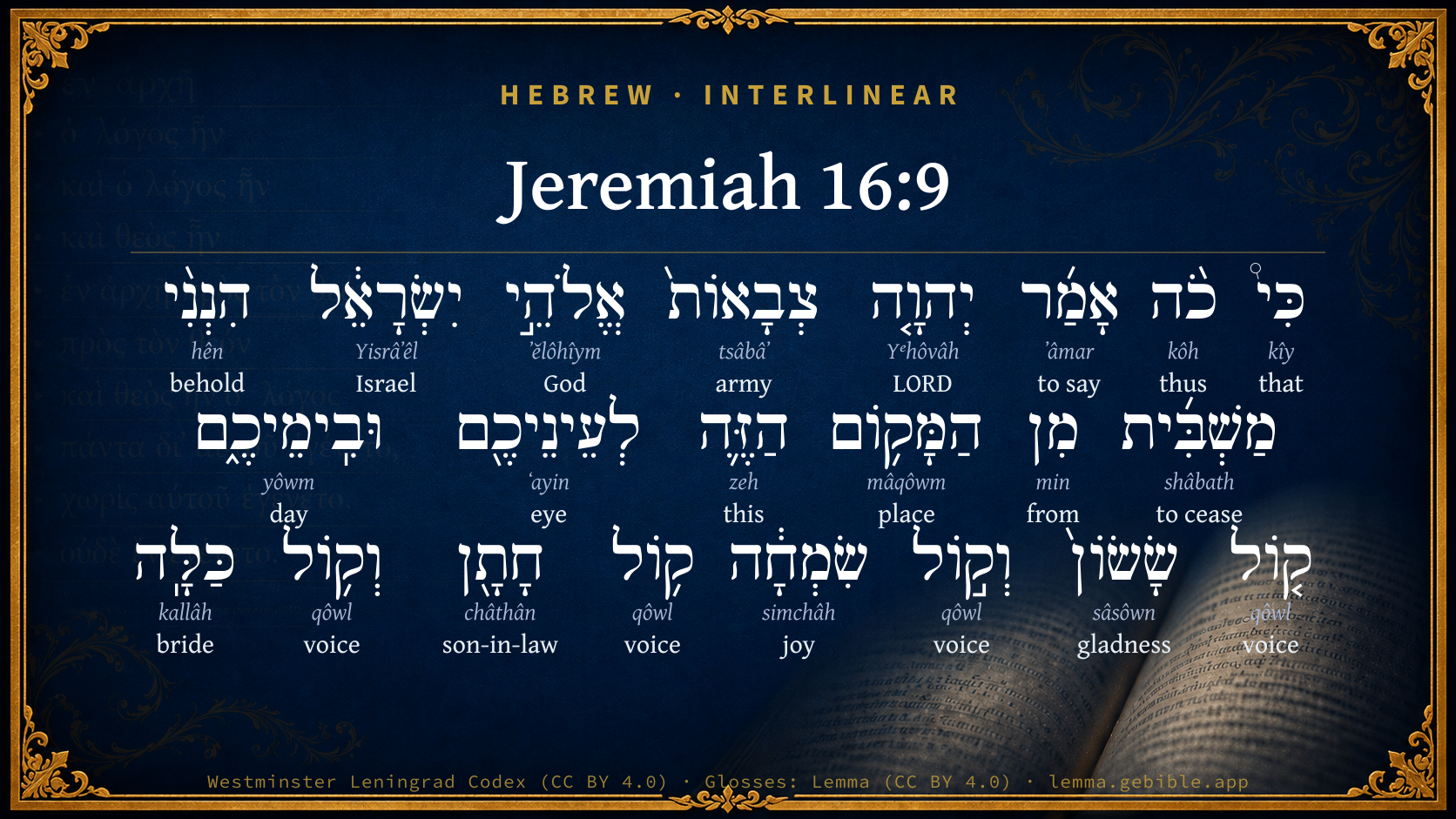
Hebrew (Westminster Leningrad Codex) Jeremiah 16:9 appears in the Hebrew Old Testament. The text above is from the Westminster Leningrad Codex. Each word links to its Strong’s number, a concise gloss, and parsing drawn from the Open Scriptures Hebrew Bible morphology. Click any word for its full Brown-Driver-Briggs (BDB) entry.
Download image
Cite this verse

Jeremiah 16:9 (World English Bible). Public Domain. Lemma interlinear Bible study tool, https://lemma.gebible.app/v/jeremiah/16/9.

Show BibTeX & RIS
BibTeX
RIS
English Translation
For thus says Yahweh of Hosts, the God of Israel: Behold, I will cause to cease out of this place, before your eyes and in your days, the voice of mirth and the voice of gladness, the voice of the bridegroom and the voice of the bride.
World English Bible · Public Domain
Download a study sheet

One document with this verse’s original text, its word-by-word gloss line, the meaning frame, cross-references with their text, attributed commentary, and full source and license credits — printable, and it pastes into notes with its structure intact.

This verse Autodidact and up

Study sheet (.html) Plain text (.txt)

A passage Seminary Student

Up to 50 verses in one chapter. A passage sheet keeps up to 6 commentary sources and 12 cross-references per verse, in the order this page ranks them, and says so on the sheet whenever that leaves anything out. Ask for a single verse and you get the Autodidact verse sheet above.

Everything on this page stays free to read, with no account — the sheet is a download of what is already on screen, not access to it.

Want to remove ads? Support Godless Engineer
Compare translations 3

The same verse in 3 English versions, stacked beneath the original-language interlinear above. Click any original word for its lexicon entry.

Each is an independent rendering of the whole verse — the interlinear is not word-aligned to these translations.

Highlighted words mark where these versions differ — a whole-verse word diff, not a word-by-word alignment.

  • World English Bible Public Domain
    For thus says Yahweh of Hosts, the God of Israel: Behold, I will cause to cease out of this place, before your eyes and in your days, the voice of mirth and the voice of gladness, the voice of the bridegroom and the voice of the bride.
  • King James Version Public Domain
    For thus saith the LORD of hosts, the God of Israel; Behold, I will cause to cease out of this place in your eyes, and in your days, the voice of mirth, and the voice of gladness, the voice of the bridegroom, and the voice of the bride.
  • unfoldingWord Literal Text CC BY-SA 4.0
    For thus says Yahweh of hosts, God of Israel, ‘Behold, I will cause to cease from this place, before your eyes and in your days, the voice of joy and the voice of gladness, the voice of the bridegroom and the voice of the bride.

unfoldingWord Literal Text — © unfoldingWord, licensed CC BY-SA 4.0. Word-aligned USFM3 via Door43 (git.door43.org/unfoldingWord/en_ult).

Versions to compare (up to 4)

3 of 4 selected

Show all 18 translations

Every available English version of this verse, each an independent rendering of the whole verse.

  • World English Bible Public Domain
    For thus says Yahweh of Hosts, the God of Israel: Behold, I will cause to cease out of this place, before your eyes and in your days, the voice of mirth and the voice of gladness, the voice of the bridegroom and the voice of the bride.
  • Berean Standard Bible Public Domain
    For this is what the LORD of Hosts, the God of Israel, says: I am going to remove from this place, before your very eyes and in your days, the sounds of joy and gladness, the voices of the bride and bridegroom.
  • Majority Standard Bible Public Domain
    For this is what the LORD of Hosts, the God of Israel, says: I am going to remove from this place, before your very eyes and in your days, the sounds of joy and gladness, the voices of the bride and bridegroom.
  • King James Version Public Domain
    For thus saith the LORD of hosts, the God of Israel; Behold, I will cause to cease out of this place in your eyes, and in your days, the voice of mirth, and the voice of gladness, the voice of the bridegroom, and the voice of the bride.
  • American Standard Version (1901) Public Domain
    For thus saith Jehovah of hosts, the God of Israel: Behold, I will cause to cease out of this place, before your eyes and in your days, the voice of mirth and the voice of gladness, the voice of the bridegroom and the voice of the bride.
  • Revised Version (1885) Public Domain
    For thus saith the LORD of hosts, the God of Israel: Behold, I will cause to cease out of this place, before your eyes and in your days, the voice of mirth and the voice of gladness, the voice of the bridegroom and the voice of the bride.
  • Geneva Bible (1599) Public Domain
    For thus sayth the Lord of hostes, the God of Israel, Beholde, I wil cause to cease out of this place in your eyes, euen in your dayes the voyce of myrth, and the voyce of gladnes, the voyce of the bridegrome and the voyce of the bride.
  • Douay-Rheims (1899) Public Domain
    For thus saith the Lord of hosts, the God of Israel: Behold I will take away out of this place in your sight, and in your days the voice of mirth, and the voice of gladness, the voice of the bridegroom, and the voice of the bride.
  • Young's Literal Translation Public Domain
    For thus said Jehovah of Hosts, God of Israel: Lo, I am causing to cease from this place, Before your eyes, and in your days, The voice of joy, and the voice of rejoicing, The voice of bridegroom and voice of bride.
  • Literal Standard Version CC BY-SA 4.0
    For thus said YHWH of Hosts, God of Israel: “Behold, I am causing to cease from this place, || Before your eyes, and in your days, || The voice of joy, and the voice of rejoicing, || The voice of bridegroom and voice of bride.
  • Unlocked Literal Bible CC BY-SA 4.0
    For Yahweh of hosts, God of Israel, says this, 'See, before your eyes, in your days and in this place, I am about to put an end to the sound of joy and the sound of gladness, the sound of the groom and the sound of the bride.'
  • unfoldingWord Literal Text CC BY-SA 4.0
    For thus says Yahweh of hosts, God of Israel, ‘Behold, I will cause to cease from this place, before your eyes and in your days, the voice of joy and the voice of gladness, the voice of the bridegroom and the voice of the bride.
  • Darby Bible Public Domain
    For thus saith Jehovah of hosts, the God of Israel: Behold, I will cause to cease out of this place, before your eyes, and in your days, the voice of mirth and the voice of joy, the voice of the bridegroom and the voice of the bride.
  • World Messianic Bible Public Domain
    For the LORD of Hosts, the God of Israel says: “Behold, I will cause to cease out of this place, before your eyes and in your days, the voice of mirth and the voice of gladness, the voice of the bridegroom and the voice of the bride.
  • Webster's Bible Public Domain
    For thus saith the LORD of hosts, the God of Israel; Behold, I will cause to cease out of this place in your eyes, and in your days, the voice of mirth, and the voice of gladness, the voice of the bridegroom, and the voice of the bride.
  • Free Bible Version CC BY-SA 4.0
    This is what the Lord Almighty, the God of Israel, says: I am going to put a stop right here, while you watch, to any sounds of celebration and joy, the happy voices of the groom and bride.
  • Bible in Basic English Public Domain
    For the Lord of armies, the God of Israel, has said, See, before your eyes and in your days I will put an end in this place to the laughing voices and the voice of joy; to the voice of the newly-married man and the voice of the bride.
  • JPS Tanakh (1917) Public Domain
    For thus saith the LORD of hosts, the God of Israel: Behold, I will cause to cease out of this place, before your eyes and in your days, the voice of mirth and the voice of gladness, the voice of the bridegroom and the voice of the bride.

Literal Standard Version (2020), Covenant Press — licensed CC BY-SA 4.0. Text via the HelloAO Bible API (eBible.org). Unlocked Literal Bible (unfoldingWord) — licensed CC BY-SA 4.0. Text via the HelloAO Bible API (eBible.org). unfoldingWord Literal Text — © unfoldingWord, licensed CC BY-SA 4.0. Word-aligned USFM3 via Door43 (git.door43.org/unfoldingWord/en_ult). Free Bible Version, Dr. Jonathan Gallagher — licensed CC BY-SA 4.0. Text via the HelloAO Bible API (eBible.org).

Word by word

More ways to search: Search by grammar → Find every occurrence → Compare this word →

Practice this passage: Drill this verse → Learn its vocabulary →

חָתָ֖ן
châthân
H2860
“son-in-law”
Noun, Common, Masculine, Singular, Absolute
Part of Speech
Noun
Type
Common
Gender
Masculine
Number
Singular
State
Absolute
Full BDB Definition

Origin: from H2859

TWOT: 781c

son-in-law, daughter's husband, bridegroom, husband
  1. כִּי֩ kîy H3588 “that” Conjunction
  2. כֹ֨ה kôh H3541 “thus” Adverb
  3. אָמַ֜ר ʼâmar H559 “to say” Verb, Qal, Perfect, 3rd Person, Masculine, Singular
  4. יְהוָ֤ה Yᵉhôvâh H3068 “LORD” Noun, Proper
  5. צְבָאוֹת֙ tsâbâʼ H6635 “armies” Noun, Common, Both, Plural, Absolute
  6. אֱלֹהֵ֣י ʼĕlôhîym H430 “God(s) of” Noun, Common, Masculine, Plural, Construct
  7. יִשְׂרָאֵ֔ל Yisrâʼêl H3478 “Israel” Noun, Proper
  8. הִנְנִ֨י hên H2005 “behold · me” Particle, Demonstrative + Suffix, Personal, 1st Person, Common, Singular
  9. מַשְׁבִּ֜ית shâbath H7673 “ceasing” Verb, Hiphil, Participle Active, Masculine, Singular, Absolute
  10. מִן min H4480 “from” Preposition
  11. הַמָּק֥וֹם mâqôwm H4725 “the · place” Particle, Definite Article + Noun, Common, Masculine, Singular, Absolute
  12. הַזֶּ֛ה zeh H2088 “the · this” Particle, Definite Article + Pronoun, Demonstrative, Masculine, Singular
  13. לְעֵינֵיכֶ֖ם ʻayin H5869 “to/for · eyes · your” Preposition + Noun, Common, Both, Dual, Construct + Suffix, Personal, 2nd Person, Masculine, Plural
  14. וּבִֽימֵיכֶ֑ם yôwm H3117 “and · in/at · days · your” Conjunction + Preposition + Noun, Common, Masculine, Plural, Construct + Suffix, Personal, 2nd Person, Masculine, Plural
  15. ק֤וֹל qôwl H6963 “voice of” Noun, Common, Masculine, Singular, Construct
  16. שָׂשׂוֹן֙ sâsôwn H8342 “gladness” Noun, Common, Masculine, Singular, Absolute
  17. וְק֣וֹל qôwl H6963 “and · voice of” Conjunction + Noun, Common, Masculine, Singular, Construct
  18. שִׂמְחָ֔ה simchâh H8057 “joy” Noun, Common, Feminine, Singular, Absolute
  19. ק֥וֹל qôwl H6963 “voice of” Noun, Common, Masculine, Singular, Construct
  20. וְק֥וֹל qôwl H6963 “and · voice of” Conjunction + Noun, Common, Masculine, Singular, Construct
  21. כַּלָּֽה kallâh H3618 “bride” Noun, Common, Feminine, Singular, Absolute

About this verse

These counts appear in no published source. They are computed here, from the morphology-tagged text and Lemma’s own curated glosses. What Lemma adds →

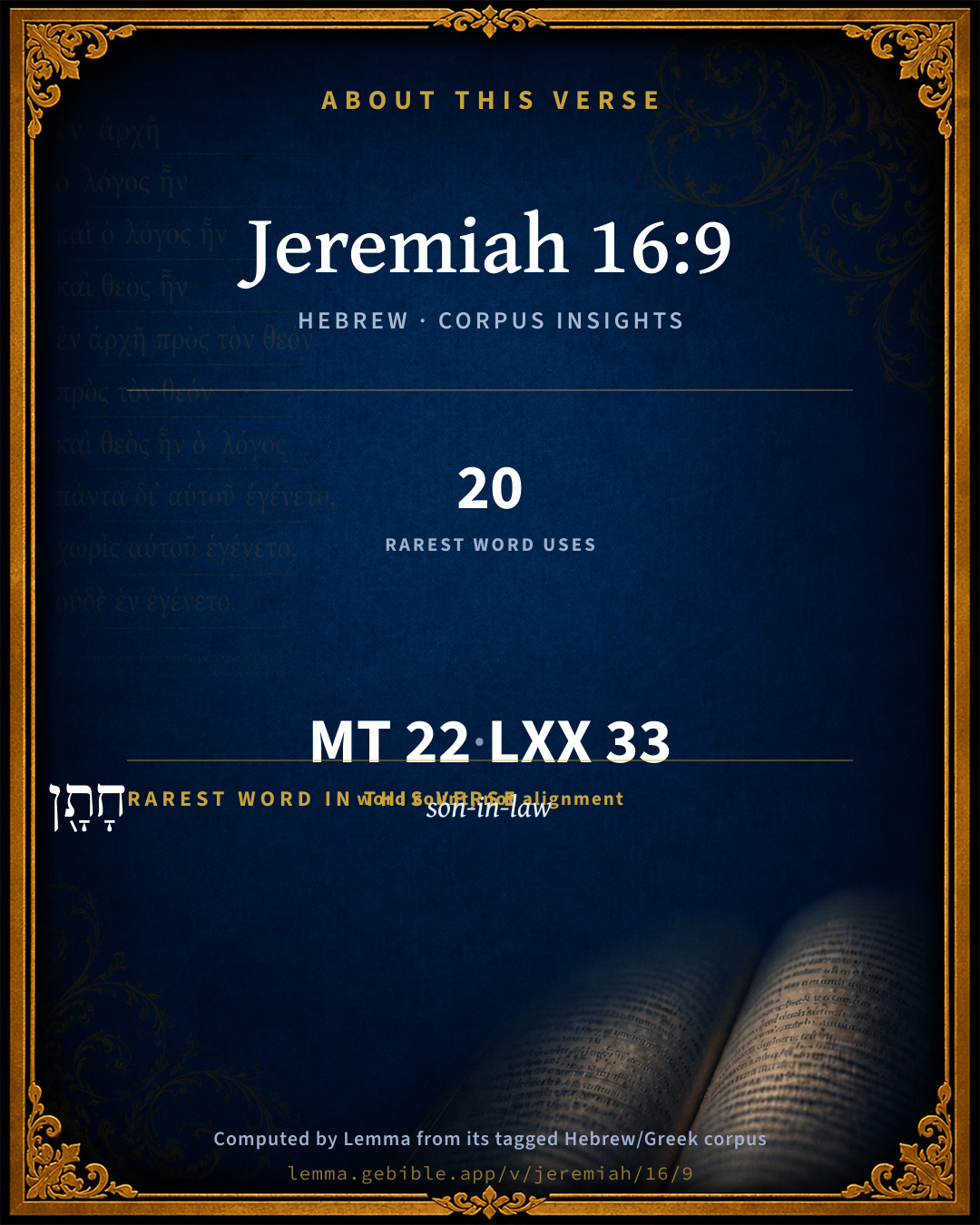
22
words
19
distinct lemmas
Prophets
section

Notable vocabulary

The rarest word here is חָתָ֖ן son-in-law H2860 — appearing just 20 times in the whole Hebrew Bible.

Shared distinctive vocabulary

חָתָ֖ן son-in-law H2860 occurs in 19 verses of the Hebrew Bible. Also found in:

Grammatical profile

  • 2 verbs
  • 15 nouns
  • 1 pronoun
  • 1 preposition
  • 1 conjunction
  • 1 adverb
  • 1 particle

Verb forms

  • אָמַ֜ר Qal · Perfect
  • מַשְׁבִּ֜ית Hiphil · Participle Active

Repetition

A word recurs within this verse — often emphatic in Hebrew:

  • ק֤וֹל voice H6963 ×4

Hebrew & Septuagint length

In the original languages it is 22 Hebrew tokens and 33 Greek tokens — but the two are counted differently (Hebrew bundles its prefixes and suffixes into one token; the Greek is in lemma form), so that isn’t a like-for-like length.

Cross-references

6

Topical passages linked to Jeremiah 16:9 in the Treasury of Scripture Knowledge — connected by theme and wording, ordered by reader-vote popularity; previews shown in the World English Bible.

  • Jeremiah 7:34 Then will I cause to cease from the cities of Judah, and from the streets of Jerusalem, the voice of mirth and the voice of gladness, the voice of the bridegroom and the voice of the bride; for the land shall become a waste.
  • Jeremiah 25:10 Moreover I will take from them the voice of mirth and the voice of gladness, the voice of the bridegroom and the voice of the bride, the sound of the millstones, and the light of the lamp.
  • Ezekiel 26:13 I will cause the noise of your songs to cease; and the sound of your harps shall be no more heard.
  • Hosea 2:11 I will also cause all her celebrations to cease: Her feasts, her new moons, her Sabbaths, and all her solemn assemblies.
  • Isaiah 24:7–12 The new wine mourns, the vine languishes, all the merry-hearted do sigh.
  • Revelation 18:22–23 The voice of harpists, minstrels, flute players, and trumpeters will be heard no more at all in you. No craftsman, of whatever craft, will be found any more at all in you. The sound of a mill will be heard no more at all in you.

Cross-references courtesy of OpenBible.info (CC BY 4.0).

Hebrew and Greek witnesses Masoretic Hebrew ↔ Greek Septuagint

The same verse in the two great witnesses to the Old Testament, shown verse-for-verse.

These are two independent witnesses, not word-aligned to each other, and the Septuagint is shown in lemma (dictionary) form.

Hebrew Jeremiah 16:9 Masoretic · Westminster Leningrad Codex

כִּי֩ כֹ֨ה אָמַ֜ר יְהוָ֤ה צְבָאוֹת֙ אֱלֹהֵ֣י יִשְׂרָאֵ֔ל הִנְנִ֨י מַשְׁבִּ֜ית מִן הַמָּק֥וֹם הַזֶּ֛ה לְעֵינֵיכֶ֖ם וּבִֽימֵיכֶ֑ם ק֤וֹל שָׂשׂוֹן֙ וְק֣וֹל שִׂמְחָ֔ה ק֥וֹל חָתָ֖ן וְק֥וֹל כַּלָּֽה

For thus says Yahweh of Hosts, the God of Israel: Behold, I will cause to cease out of this place, before your eyes and in your days, the voice of mirth and the voice of gladness, the voice of the bridegroom and the voice of the bride.

World English Bible · Public Domain

Greek LXX Structure differs

In the Septuagint, Jeremiah is about an eighth shorter than the Hebrew and arranges its material differently — the Oracles Against the Nations (Hebrew chapters 46–51) appear in the middle of the Greek book, after 25:13. Because the chapter and verse boundaries do not line up, a verse-for-verse comparison with the Hebrew is not shown.

A verse-for-verse comparison isn’t shown here because the chapters and verses don’t line up. Switch to the LXX edition with the MT / LXX toggle above to read the Greek directly.

Hebrew: Westminster Leningrad Codex (CC BY 4.0). Greek: Septuagint (public domain); English from a public-domain English Septuagint. How the Septuagint differs from the Hebrew →

Targum (Aramaic paraphrase)

1

The Targum is the ancient Jewish Aramaic paraphrase of the Hebrew Scriptures — an interpretive translation, not the Hebrew text itself. Onkelos (literal) and Pseudo-Jonathan (expansive) render the Torah, and Jonathan the Prophets. Coverage is partial: where no permissively-licensed English translation exists for a verse, only the Aramaic is shown. This is verse-level text, not a word-by-word alignment to the Hebrew.

  1. Targum Jonathan Prophets (Joshua–Malachi)
    אֲרֵי כִּדְנַן אֲמַר יְיָ צְבָאוֹת אֱלָהָא דְיִשְׂרָאֵל הָא אֲנָא מְבַטֵל מִן אַתְרָא הָדֵין לְעֵינֵיכוֹן וּבְיוֹמֵיכוֹן קָל בְיָע וְקָל חֶדְוָא קָל חַתְנִין וְקָל כַּלָן:

    (no public-domain English translation for this verse)

    Targum Jonathan — Aramaic: “Mikraot Gedolot” (public domain). English: “Sefaria Community Translation” (CC0 1.0 (public-domain dedication)); “London "Chaldee Paraphrase," 1871” (public domain). Text via Sefaria.

Commentary

Notes on Jeremiah 16:9 from classic Christian and Jewish commentators (each source and its license shown beneath its notes). The classic Christian expositions comment on the surrounding passage and are grouped to its opening verse, so a note may address several verses; the Jewish commentaries on the Tanakh (Rashi and others) are per-verse, so they appear only where the commentator wrote on this verse.

Lemma curates 59 commentaries, every one of them public domain or Creative Commons licensed, each selected and text-cleaned for this edition rather than reprinted as found. About our sources →

Trapp's Complete Commentary

John Trapp

Jer 16:9 For thus saith the LORD of hosts, the God of Israel; Behold, I will cause to cease out of this place in your eyes, and in your days, the voice of mirth, and the voice of gladness, the voice of the bridegroom, and the voice of the bride.

Ver. 9. Behold, I will cause to cease.] See Jer 7:34. {See Trapp on "Jer 7:34"}

John Trapp, A Commentary or Exposition upon All the Books of the Old and New Testament (1647–1656) — public domain. Text from a community e-Sword module.

Jamieson, Fausset & Brown

Robert Jamieson, A. R. Fausset & David Brown

(Jer 7:34; Jer 25:10; Eze 26:13).

Jamieson, Fausset & Brown — Commentary Critical and Explanatory on the Whole Bible (1871) — public domain (CC PDM 1.0). Text via the HelloAO Bible API.

John Calvin's Commentaries

This verse contains a reason for the preceding, — that every connection with that people would be accursed. Yet he states one thing more expressly, — that the time was come in which they were already deprived of all joy; for the ungodly, even when God most awfully threatens them, strengthen themselves in their security, hence God intended to give them some presage, that they might before the time know that the saddest calamities were at hand, by which every joy and gladness were to be taken away.

He then says, that the God of hosts and the God of Israel had spoken. He at the same time deprived them of all hope, though he called himself the God of Israel. Hypocrites were wont either to despise the power of God, or to abuse his goodness. Had not God checked them, they would have deemed as nothing what the prophets threatened; and how so? Because they depreciated, as far as they could, the power of God. Hence God says, that he is the God of hosts. But when they could not in their pride and haughtiness throw down, as it were the power of God, then they betook themselves to another asylum; they promised to themselves that he would deal indulgently with them; and thus they deceived themselves. Hence, on the other hand, God calls himself here the God of Israel, in order that they might know, that it was of no avail to them, that he had adopted the seed of Abraham; for they were not the children of Abraham, but aliens, as they had departed from his piety and faith. This served as a preface.

Now when he says, הנני, enni, Behold me, he shews that the Jews had no reason to put off the time, and to indulge avain confidence; for vengeance was already come. Behold me, he says, he thus comes forth and testifies that he is already prepared to execute his judgment. Behold me,, he says, taking away from this place, before your eyes, and in your days, etc.; their destruction would happen in a short time and before their eyes. I am taking away, he says, the voice of joy and the voice of gladness, the voice of the bridegroom and the voice of the bride Here by stating a part for the whole, he intimates that they would become like the dead rather than the living; for the continuance of the human race is preserved by marriage, as in the offspring mankind are as it were born again, who would otherwise perish daily. Since then there was no more time left for marriages, it was a token of final destruction. This is what the Prophet intimates, when he says, that God would cause the voice of the bridegroom and of the bride to cease, so that there would be no more any congratulations. It follows, —

John Calvin's Commentaries (1540-1563) — public domain. Text from the Calvin Translation Society English edition (1840s-50s) via the Christian Classics Ethereal Library (ccel.org). Calvin's coverage is partial (roughly two-thirds of the Bible); uncommented books and verses are honest gaps, never fabricated. The 19th-century editor's footnotes and remarks are omitted so the notes are faithfully Calvin's own voice.

Ellicott's Commentary for English Readers

(9) The voice of mirth . . .—The words had been used once before (Jer_7:34), and will meet us yet again (Jer_25:10; Jer_33:11), but they gain rather than lose in their solemnity by this verbal iteration.

A Bible Commentary for English Readers, edited by Charles John Ellicott (1878–1897) — public domain. Text from a community e-Sword module.

The Cambridge Bible for Schools and Colleges

gen. ed. J. J. S. Perowne

9. Cp. Jer_7:34.

9–21. Du. rejects all these vv. Co. omits 9–13, suspects the genuineness of 14, 15 both here and in Jer_23:7 f., and rejects 16, as well as portions of 17–21. Gi. retains of the whole series only Jer_16:19, while admitting (Metrik) that 20, 21 may be genuine. Schmidt denies the genuineness of 14–21. There is thus a considerable consensus of authorities against the passage, but their arguments do not appear conclusive except as to 14, 15. See further in individual notes. According to Gi. (Metrik) metre is doubtful or non-existent, except in 7, 8, 19–21.

The Cambridge Bible for Schools and Colleges (gen. ed. J. J. S. Perowne; Cambridge University Press, 1878–1918) — public domain. Text from a community e-Sword module.

John Gill's Exposition

And it shall come to pass, when thou shalt show this people all these words,.... Or, "all these things" (a); which he was forbid to do; as marrying and having children, going into the house of mourning or feasting, with the reasons of all, because of the calamities coming upon them:

and they shall say unto thee, wherefore hath the Lord pronounced all this great evil against us? as if they were quite innocent, and were not conscious of anything they had done deserving such punishment, especially so great as this was threatened to be inflicted on them; as their dying grievous deaths, parents and children, great and small, and be unlamented, and unburied: or "what is our iniquity?" or "what is our sin that we have committed against the Lord our God?" supposing we have been guilty of some weaknesses and frailties; or of some few faults; which though they cannot be justified, yet surely are not to be reckoned of such a nature as to deserve and require so great a punishment: thus would they either deny or lessen the sins they had been guilty of, and suggest that the Lord was very hard and severe upon them.

(a) "omnes res hasce", Gataker, Piscator.

John Gill's Exposition of the Whole Bible (1746–1763) — public domain (CC PDM 1.0). Text via the HelloAO Bible API.

Matthew Poole's English Annotations

And he declares that he laid this injunction upon him as a type that his countrymen, by such his forbearance, might understand that God in his providence was about to put an end to all their civil mirth in their days.

Matthew Poole's English Annotations on the Holy Bible (1683–1685) — public domain. Text from a community e-Sword/MySword module.

Whedon's Commentary on the Bible

Daniel D. Whedon

9. Cause to cease — All glad and joyous notes shall have died out of the psalm of human life. Only the voices of misery and despair, wailing and lamentation, remain.

Daniel D. Whedon (gen. ed.), Commentary on the Old and New Testaments (1874–1909) — public domain. Text from a community e-Sword module.

The Pulpit Commentary

The voice of mirth, etc.; a striking deaf, on, repeated from Jer_7:34.

The Pulpit Commentary (1880–1919), ed. H.D.M. Spence-Jones & Joseph S. Exell — public domain. Text from a community e-Sword module.

Lesson kit

Teaching starters — assembled from the data on this page, not authored interpretation. Every prompt links to the verse data it draws on. Edit before teaching.

Jeremiah, in the Prophets, opens this verse with 22 words (19 distinct Hebrew lemmas). Its most distinctive word is châthân (“son-in-law”). A historical commentator’s framing appears above. Read the whole chapter for the surrounding context.

Discussion questions

  1. What does “son-in-law” (châthân) contribute to the verse as a whole?
  2. How does Genesis 19:12, which shares the word «son-in-law», read alongside this verse?
  3. What does the repetition of “voice” (4× in this one verse) do in this verse?
  4. These translations render this verse differently. What is at stake in choosing one wording over another?
  5. «אָמַ֜ר» is a Qal Perfect verb. How does that grammatical form shape the action described?
  6. Compare how Trapp's Complete Commentary and Jamieson, Fausset & Brown read this verse. Where do they agree or differ?

Things to notice

Reading settings

Reading text

Shown beneath each verse's original-language words.

Old Testament
Old Testament edition

Read the OT as the Masoretic Hebrew (MT) or the Greek Septuagint (LXX).

English shown for the Greek Septuagint (in the Hebrew ↔ Greek comparison).

Comparing translations? Open the Compare panel on any verse page to stack up to four side by side.