
Isaiah 30:29

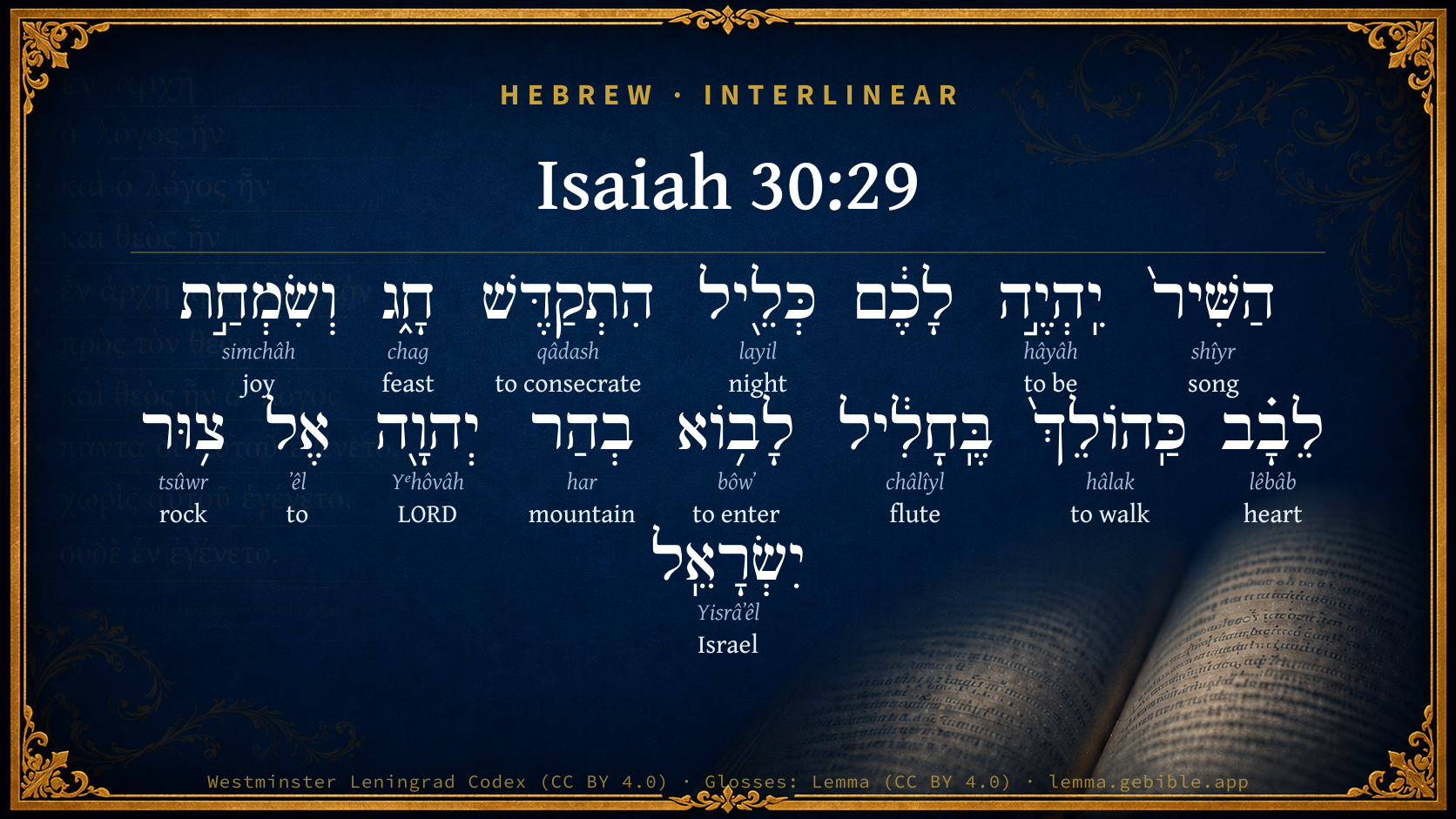
Hebrew (Westminster Leningrad Codex) Isaiah 30:29 appears in the Hebrew Old Testament. The text above is from the Westminster Leningrad Codex. Each word links to its Strong’s number, a concise gloss, and parsing drawn from the Open Scriptures Hebrew Bible morphology. Click any word for its full Brown-Driver-Briggs (BDB) entry.
Download image
Cite this verse

Isaiah 30:29 (World English Bible). Public Domain. Lemma interlinear Bible study tool, https://lemma.gebible.app/v/isaiah/30/29.

Show BibTeX & RIS
BibTeX
RIS
English Translation
You shall have a song as in the night when a holy feast is kept; and gladness of heart, as when one goes with a pipe to come to the mountain of Yahweh, to the Rock of Israel.
World English Bible · Public Domain
Download a study sheet

One document with this verse’s original text, its word-by-word gloss line, the meaning frame, cross-references with their text, attributed commentary, and full source and license credits — printable, and it pastes into notes with its structure intact.

This verse Autodidact and up

Study sheet (.html) Plain text (.txt)

A passage Seminary Student

Up to 50 verses in one chapter. A passage sheet keeps up to 6 commentary sources and 12 cross-references per verse, in the order this page ranks them, and says so on the sheet whenever that leaves anything out. Ask for a single verse and you get the Autodidact verse sheet above.

Everything on this page stays free to read, with no account — the sheet is a download of what is already on screen, not access to it.

Want to remove ads? Support Godless Engineer
Compare translations 3

The same verse in 3 English versions, stacked beneath the original-language interlinear above. Click any original word for its lexicon entry.

Each is an independent rendering of the whole verse — the interlinear is not word-aligned to these translations.

Highlighted words mark where these versions differ — a whole-verse word diff, not a word-by-word alignment.

  • World English Bible Public Domain
    You shall have a song as in the night when a holy feast is kept; and gladness of heart, as when one goes with a pipe to come to the mountain of Yahweh, to the Rock of Israel.
  • King James Version Public Domain
    Ye shall have a song, as in the night when a holy solemnity is kept; and gladness of heart, as when one goeth with a pipe to come into the mountain of the LORD, to the mighty One of Israel.
  • unfoldingWord Literal Text CC BY-SA 4.0
    A song will be to you as in the night of consecrating a feast, and gladness of heart, as one walking with a flute to come onto the mountain of Yahweh, to the Rock of Israel.

unfoldingWord Literal Text — © unfoldingWord, licensed CC BY-SA 4.0. Word-aligned USFM3 via Door43 (git.door43.org/unfoldingWord/en_ult).

Versions to compare (up to 4)

3 of 4 selected

Show all 18 translations

Every available English version of this verse, each an independent rendering of the whole verse.

  • World English Bible Public Domain
    You shall have a song as in the night when a holy feast is kept; and gladness of heart, as when one goes with a pipe to come to the mountain of Yahweh, to the Rock of Israel.
  • Berean Standard Bible Public Domain
    You will sing as on the night of a holy festival, and your heart will rejoice like one who walks to the music of a flute, going up to the mountain of the LORD, to the Rock of Israel.
  • Majority Standard Bible Public Domain
    You will sing as on the night of a holy festival, and your heart will rejoice like one who walks to the music of a flute, going up to the mountain of the LORD, to the Rock of Israel.
  • King James Version Public Domain
    Ye shall have a song, as in the night when a holy solemnity is kept; and gladness of heart, as when one goeth with a pipe to come into the mountain of the LORD, to the mighty One of Israel.
  • American Standard Version (1901) Public Domain
    Ye shall have a song as in the night when a holy feast is kept; and gladness of heart, as when one goeth with a pipe to come unto the mountain of Jehovah, to the Rock of Israel.
  • Revised Version (1885) Public Domain
    Ye shall have a song as in the night when a holy feast is kept; and gladness of heart, as when one goeth with a pipe to come into the mountain of the LORD, to the Rock of Israel.
  • Geneva Bible (1599) Public Domain
    But there shall be a song vnto you as in the night, when solemne feast is kept: and gladnes of heart, as he that commeth with a pipe to goe vnto the mount of the Lord, to the mightie one of Israel.
  • Douay-Rheims (1899) Public Domain
    You shall have a song as in the night of the sanctified solemnity, and joy of heart, as when one goeth with a pipe, to come into the mountain of the Lord, to the Mighty One of Israel.
  • Young's Literal Translation Public Domain
    Singing is to you as in a night sanctified for a festival, And joy of heart as he who is going with a pipe, To go in to the mountain of Jehovah, Unto the rock of Israel.
  • Literal Standard Version CC BY-SA 4.0
    Singing is to you as in a night sanctified for a festival, || And joy of heart as he who is going with a pipe, || To go to the mountain of YHWH, || To the rock of Israel.
  • Unlocked Literal Bible CC BY-SA 4.0
    You will have a song as in the night when a holy feast is observed, and gladness of heart, as when one goes with a flute to the mountain of Yahweh, to the Rock of Israel.
  • unfoldingWord Literal Text CC BY-SA 4.0
    A song will be to you as in the night of consecrating a feast, and gladness of heart, as one walking with a flute to come onto the mountain of Yahweh, to the Rock of Israel.
  • Darby Bible Public Domain
    Ye shall have a song, as in the night when a feast is sanctified; and joy of heart, as of one who goeth with a pipe to come unto the mountain of Jehovah, to the Rock of Israel.
  • World Messianic Bible Public Domain
    You will have a song, as in the night when a holy feast is kept, and gladness of heart, as when one goes with a flute to come to the LORD’s mountain, to Israel’s Rock.
  • Webster's Bible Public Domain
    Ye shall have a song, as in the night, when a holy solemnity is kept; and gladness of heart, as when one goeth with a pipe to come upon the mountain of the LORD, to the mighty One of Israel.
  • Free Bible Version CC BY-SA 4.0
    But you will have a song to sing like you do on the night of a holy festival. You will celebrate in happiness like those who play pipes as they go up to the mountain of the Lord, to the Rock of Israel.
  • Bible in Basic English Public Domain
    You will have a song, as in the night when a holy feast is kept; and you will be glad in heart, as when they go with music of the pipe to the mountain of the Lord, the Rock of Israel.
  • JPS Tanakh (1917) Public Domain
    Ye shall have a song as in the night when a feast is hallowed; and gladness of heart, as when one goeth with the pipe to come into the mountain of the LORD, to the Rock of Israel.

Literal Standard Version (2020), Covenant Press — licensed CC BY-SA 4.0. Text via the HelloAO Bible API (eBible.org). Unlocked Literal Bible (unfoldingWord) — licensed CC BY-SA 4.0. Text via the HelloAO Bible API (eBible.org). unfoldingWord Literal Text — © unfoldingWord, licensed CC BY-SA 4.0. Word-aligned USFM3 via Door43 (git.door43.org/unfoldingWord/en_ult). Free Bible Version, Dr. Jonathan Gallagher — licensed CC BY-SA 4.0. Text via the HelloAO Bible API (eBible.org).

Word by word

More ways to search: Search by grammar → Find every occurrence → Compare this word →

Practice this passage: Drill this verse → Learn its vocabulary →

בֶּֽחָלִ֔יל
châlîyl
H2485
“in/at the · flute”
Preposition, Determined + Noun, Common, Masculine, Singular, Absolute
Part of Speech
Preposition + Noun
Type
Common
Gender
Masculine
Number
Singular
State
Absolute
Full BDB Definition

Origin: from H2490

TWOT: 660d

pipe, flute
  1. הַשִּׁיר֙ shîyr H7892 “the · song” Particle, Definite Article + Noun, Common, Both, Singular, Absolute
  2. יִֽהְיֶ֣ה hâyâh H1961 “to be” Verb, Qal, Imperfect, 3rd Person, Masculine, Singular
  3. כְּלֵ֖יל layil H3915 “like/as · night of” Preposition + Noun, Common, Masculine, Singular, Construct
  4. הִתְקַדֶּשׁ qâdash H6942 “to consecrate” Verb, Hithpael, Infinitive Construct
  5. חָ֑ג chag H2282 “feast” Noun, Common, Masculine, Singular, Absolute
  6. וְשִׂמְחַ֣ת simchâh H8057 “and · joy of” Conjunction + Noun, Common, Feminine, Singular, Construct
  7. לֵבָ֗ב lêbâb H3824 “heart” Noun, Common, Masculine, Singular, Absolute
  8. כַּֽהוֹלֵךְ֙ hâlak H1980 “like/as the · walking” Preposition, Determined + Verb, Qal, Participle Active, Masculine, Singular, Absolute
  9. לָב֥וֹא bôwʼ H935 “to enter” Preposition + Verb, Qal, Infinitive Construct
  10. בְהַר har H2022 “in/at · mountain of” Preposition + Noun, Common, Masculine, Singular, Construct
  11. יְהוָ֖ה Yᵉhôvâh H3068 “LORD” Noun, Proper
  12. אֶל ʼêl H413 “to” Preposition
  13. צ֥וּר tsûwr H6697 “rock of” Noun, Common, Masculine, Singular, Construct
  14. יִשְׂרָאֵֽל Yisrâʼêl H3478 “Israel” Noun, Proper

About this verse

These counts appear in no published source. They are computed here, from the morphology-tagged text and Lemma’s own curated glosses. What Lemma adds →

16
words
15
distinct lemmas
Prophets
section

Notable vocabulary

The rarest word here is בֶּֽחָלִ֔יל flute H2485 — appearing just 6 times in the whole Hebrew Bible.

Shared distinctive vocabulary

בֶּֽחָלִ֔יל flute H2485 occurs in 5 verses of the Hebrew Bible. Also found in:

Grammatical profile

  • 4 verbs
  • 10 nouns
  • 2 prepositions

Verb forms

  • יִֽהְיֶ֣ה Qal · Imperfect
  • הִתְקַדֶּשׁ Hithpael · Infinitive Construct
  • כַּֽהוֹלֵךְ֙ Qal · Participle Active
  • לָב֥וֹא Qal · Infinitive Construct

Hebrew & Septuagint length

In English translation the verse runs 38 words from the Hebrew and 39 from the Septuagint (LXX English) — closely comparable.

A rough comparison of the two English renderings, which tokenize alike — not a word-level alignment.

Word counts can differ between the Hebrew and the Greek without any difference in meaning — e.g. the Hebrew direct-object marker אֵת has no separate Greek word, and Greek often adds the article ὁ.

Cross-references

22

Topical passages linked to Isaiah 30:29 in the Treasury of Scripture Knowledge — connected by theme and wording, ordered by reader-vote popularity; previews shown in the World English Bible.

  • Psalms 42:4 These things I remember, and pour out my soul within me, How I used to go with the crowd, and led them to the house of God, With the voice of joy and praise, a multitude keeping a holy day.
  • Exodus 15:1–21 Then Moses and the children of Israel sang this song to Yahweh, and said, "I will sing to Yahweh, for he has triumphed gloriously: The horse and his rider he has thrown into the sea.
  • Psalms 95:1–2 Oh come, let's sing to Yahweh. Let's shout aloud to the rock of our salvation!
  • Deuteronomy 16:6 but at the place which Yahweh your God shall choose, to cause his name to dwell in, there you shall sacrifice the Passover at even, at the going down of the sun, at the season that you came forth out of Egypt.
  • Deuteronomy 32:4 The Rock, his work is perfect; For all his ways are justice: A God of faithfulness and without iniquity, Just and right is he.
  • Psalms 81:1–4 Sing aloud to God, our strength! Make a joyful shout to the God of Jacob!
  • Isaiah 2:3 Many peoples shall go and say, "Come, let's go up to the mountain of Yahweh, To the house of the God of Jacob; And he will teach us of his ways, And we will walk in his paths. For out of Zion the law shall go forth, And the word of Yahweh from Jerusalem.
  • Isaiah 26:4 Trust in Yahweh forever; for in Yah, Yahweh, is an everlasting Rock.
  • Matthew 26:30 When they had sung a hymn, they went out to the Mount of Olives.
  • Revelation 15:3 They sang the song of Moses, the servant of God, and the song of the Lamb, saying, "Great and marvelous are your works, Lord God, the Almighty; Righteous and true are your ways, you King of the nations.
  • Leviticus 23:32 It shall be a Sabbath of solemn rest for you, and you shall deny yourselves. In the ninth day of the month at evening, from evening to evening, you shall keep your Sabbath."
  • Deuteronomy 16:14 and you shall rejoice in your feast, you, and your son, and your daughter, and your man-servant, and your maid-servant, and the Levite, and the foreigner, and the fatherless, and the widow, who are within your gates.
  • Deuteronomy 32:31 For their rock is not as our Rock, Even our enemies themselves being judges.
  • 1 Chronicles 13:7–8 They carried the ark of God on a new cart, [and brought it] out of the house of Abinadab: and Uzza and Ahio drove the cart.
  • 2 Chronicles 20:27–28 Then they returned, every man of Judah and Jerusalem, and Jehoshaphat in the forefront of them, to go again to Jerusalem with joy; for Yahweh had made them to rejoice over their enemies.
  • Psalms 18:31 For who is God, except Yahweh? Who is a rock, besides our God,
  • Psalms 32:7 You are my hiding place. You will preserve me from trouble. You will surround me with songs of deliverance. Selah.
  • Isaiah 12:1 In that day you will say, "I will give thanks to you, Yahweh; for though you were angry with me, your anger has turned away and you comfort me.
  • Jeremiah 19:1–7 Thus said Yahweh, Go, and buy a potter's earthen bottle, and [take] of the elders of the people, and of the elders of the priests;
  • Isaiah 26:1 In that day shall this song be sung in the land of Judah: we have a strong city; salvation will he appoint for walls and bulwarks.
  • Jeremiah 33:11 the voice of joy and the voice of gladness, the voice of the bridegroom and the voice of the bride, the voice of those who say, Give thanks to Yahweh of Hosts, for Yahweh is good, for his loving kindness endures forever; [and of them] who bring [sacrifices of] thanksgiving into the house of Yahweh. For I will cause the captivity of the land to return as at the first, says Yahweh.
  • Psalms 150:3–5 Praise him with the sounding of the trumpet! Praise him with harp and lyre!

Cross-references courtesy of OpenBible.info (CC BY 4.0).

Hebrew and Greek witnesses Masoretic Hebrew ↔ Greek Septuagint

The same verse in the two great witnesses to the Old Testament, shown verse-for-verse.

These are two independent witnesses, not word-aligned to each other, and the Septuagint is shown in lemma (dictionary) form.

Hebrew Isaiah 30:29 Masoretic · Westminster Leningrad Codex

הַשִּׁיר֙ יִֽהְיֶ֣ה לָכֶ֔ם כְּלֵ֖יל הִתְקַדֶּשׁ חָ֑ג וְשִׂמְחַ֣ת לֵבָ֗ב כַּֽהוֹלֵךְ֙ בֶּֽחָלִ֔יל לָב֥וֹא בְהַר יְהוָ֖ה אֶל צ֥וּר יִשְׂרָאֵֽל

You shall have a song as in the night when a holy feast is kept; and gladness of heart, as when one goes with a pipe to come to the mountain of Yahweh, to the Rock of Israel.

World English Bible · Public Domain

Greek LXX Isaiah 30:29 Septuagint · lemma form

μή διά πᾶς δέω σύ εὐφραίνω καί εἰςπορεύομαι εἰς ὁ ἅγιος ἐγώ διά πᾶς ὡσεί ἑορτάζω καί ὡσεί εὐφραίνω εἰςἔρχομαι μετά αὐλός εἰς ὁ ὄρος ὁ κύριος πρός ὁ θεός ὁ ἰσραήλ

Must you⌃ always rejoice, and go into my holy places continually, as they that keep a feast? and must you⌃ go with a pipe, as those that rejoice, into the mountain of the Lord, to the God of Israel?

LXX2012 (modern English Septuagint) · Public Domain

Hebrew: Westminster Leningrad Codex (CC BY 4.0). Greek: Septuagint (public domain); English from LXX2012 (modern English Septuagint) (Public Domain). How the Septuagint differs from the Hebrew →

Targum (Aramaic paraphrase)

1

The Targum is the ancient Jewish Aramaic paraphrase of the Hebrew Scriptures — an interpretive translation, not the Hebrew text itself. Onkelos (literal) and Pseudo-Jonathan (expansive) render the Torah, and Jonathan the Prophets. Coverage is partial: where no permissively-licensed English translation exists for a verse, only the Aramaic is shown. This is verse-level text, not a word-by-word alignment to the Hebrew.

  1. Targum Jonathan Prophets (Joshua–Malachi)
    תּוּשְׁבְּחָא תְּהֵי לְכוֹן כְּלִילְיָא דְאִתְקַדֵשׁ בֵּיהּ חַגָא וְחֶדְוַת לִבָּא כְּמָא דְנָגִין בְּתוֹדָתָא בְּאַבּוּבָא לְמֵיעַל בְּטוּר קוּדְשָׁא דַייָ לְאִתְחֲזָאָה קֳדָם תַּקִיפָא דְיִשְׂרָאֵל:

    Ye shall have a song as in the night, as in the night when the festival is sanctified with joy of heart, as when they march with thanksgivings and the pipe, to enter the holy mountain of the Lord, to appear before the mighty One of Israel.

    Targum Jonathan — Aramaic: “Mikraot Gedolot” (public domain). English: “Sefaria Community Translation” (CC0 1.0 (public-domain dedication)); “London "Chaldee Paraphrase," 1871” (public domain). Text via Sefaria.

Commentary

Notes on Isaiah 30:29 from classic Christian and Jewish commentators (each source and its license shown beneath its notes). The classic Christian expositions comment on the surrounding passage and are grouped to its opening verse, so a note may address several verses; the Jewish commentaries on the Tanakh (Rashi and others) are per-verse, so they appear only where the commentator wrote on this verse.

Lemma curates 59 commentaries, every one of them public domain or Creative Commons licensed, each selected and text-cleaned for this edition rather than reprinted as found. About our sources →

Trapp's Complete Commentary

John Trapp

Isa 30:29 Ye shall have a song, as in the night [when] a holy solemnity is kept; and gladness of heart, as when one goeth with a pipe to come into the mountain of the LORD, to the mighty One of Israel.

Ver. 29. He shall have a song.] As, after the passover eaten, they sang a hynm; so, after the Assyrian destroyed, there shall be a different sound heard in their several camps. Apud utrosque audietur sonus, et strepitus, sed diversa admodum ratione: so was fulfilled that of our prophet. {Isa 65:13-14}

As in the night when a holy solemnity is kept.] Pintus saith, that the night before some solemn sacrifice, the Jews usually spent in jollity and singing. They still conclude their Sabbath with singing, or caterwauling {a} rather, which they continue as long as they can, for ease of the defunct souls.

{a} Any hideous, discordant howling noise.

John Trapp, A Commentary or Exposition upon All the Books of the Old and New Testament (1647–1656) — public domain. Text from a community e-Sword module.

The Biblical Illustrator

Joseph S. Exell

Isa_30:29

Ye shall have a song

Communion memories

These Jewish wayfarers returned to their several homes to resume their usual occupations.

So it is with us. After the most sacred festal and sacramental seasons, the worlds business and cares necessarily reassert their claims. But, would these old Jewish worshippers in casting off their holiday attire, cast off also their holiday and festive spirit? In the midst of the coarse contacts of daily existence, would the recollections of the Jerusalem festival no longer linger in their memories? Nay, rather, would not these songs of Sion still haunt their ears and hang upon their lips?--would not the shepherd be heard chanting them in the midst of his fleecy charge by green pastures and still waters?--would not the fisherman warble them in his night watch on the lake? and the sailor as he bounded over the great sea, and the dim mountains of his fatherland were receding from view?--would not the cottager, as he reached his home among the hills of Kedesh or on the spurs of Hermon, evening after evening, in returning from his toil, gather his little ones by his knee, and rehearse to them the joyful remembrances of the holy season? Be it ours, while we leave the New Testament feast, and engage in our daily avocations, to carry the hallowed memories of it along with us. (J. R.Macduff, D. D.)

The song of Gods redeemed

I. A GLORIOUS ANTICIPATION. This is represented under two figures.

1. A holy service. The night when a holy solemnity is kept.

(1) Observe the time, the night. It is not until the day of life is past and the turmoil of earth is done, that the great and solemn assembly shall be convened.

(2) Observe the character, holy. Impurity is done away. There shall nothing enter which can pollute or mar or injure.

(3) Observe the proceedings, a solemnity. Our meetings with God lack proper solemnity. But how great and solemn will be the eternal service! A joyous meeting. As when one goeth forth with a pipe to come to the mountain of the Lord. Here are subjects going forth to meet their King, who is good and great. Here are friends going forth to meet their Brother, whom they have long desired to embrace. Here are guests going forth to the banquet of their Beloved.

II. A SUITABLE STATE OF MIND. Ye shall have a song and gladness of heart.

1. Ye shall have a song. There are two things, revolved in this.

(1) There is a subject to sing of. He hath put a new song in my mouth.

(2) There shall be a disposition to sing. The redeemed soul will be filled with praise.

2. Ye shall have gladness of heart. It will be caused by--

(1) The presence of God.

(2) Happy surroundings.

(3) Blessed reunions.

III. A PRESENT ENCOURAGEMENT. This future promise may be now realised by faith. And what a different aspect will this give to the present life! We may not sing the full chorus of the songs of Heaven, but we can hear the echo. We cannot see our Lord, but we can feel His arms and hear His voice.

IV. A DESIRABLE CONDITION. The text affords a most urgent stimulus to our present life. It speaks of a song which the people of God will be enabled to sing with confidence when their Lords judgments are abroad. Let us endeavour to realise the confidence, the peace, the happiness of that future time. (Homilist.)

The Biblical Illustrator, edited by Joseph S. Exell (c. 1880s–1900s) — public domain. Text from a community e-Sword module.

Joseph Benson's Commentary

Isa 30:29-31. Ye shall have a song, &c. — You shall have occasion of great joy, and of singing songs of praise for your stupendous deliverance from that formidable enemy; as in the night, &c. — He mentions the night, either because the Jewish feasts began in the evening, and were celebrated with great joy during a part of the night, as well as on the following day; or because he has a particular respect to the solemnity of the passover, in which they spent some considerable part of the night in rejoicing, and singing sacred songs before the Lord. As when one goeth, &c. — Like the joy of one that is going up to the solemn feasts with music. The Lord shall cause his glorious voice to be heard — His thunder, metaphorically taken for a terrible judgment. “This destruction shall be from the immediate hand of God, in which he shall as evidently appear as if he had discomfited the army by a tempest of thunder, and lightning, and hail-stones, as he formerly destroyed the Canaanites and Philistines.” — Lowth. And show the lighting down of his arm — Upon the Assyrian, whom he will smite with a deadly blow in the face of the world; with the indignation of his anger — With great wrath; which is signified by heaping so many words of the same signification together. The Assyrian, who smote with a rod — Who was the rod wherewith God smote his people and other nations: he who used to smite others shall now be smitten himself.

Joseph Benson's Commentary on the Old and New Testaments (1811–1818) — public domain. Text from a community e-Sword module.

The Preacher's Complete Homiletical Commentary

Joseph S. Exell (gen. ed.)

THE EARTHLY SONG AND THE HEAVENLY VOICE

Isa_30:29-33. Ye shall have a song … and the Lord shall cause His glorious voice to be heard, &c.

The fulfilment of this prophecy is recorded in Isa_37:36. The Assyrian power, hitherto unopposed in its march of conquest, sustained a severe check when it assailed Jerusalem. The great deliverance is here foretold. Inside the walls there would be song and gladness; outside, swift destruction. “The holy solemnity” was probably the Passover which Hezekiah and his people observed; and the “song” in that case would be the Paschal Hymn, comprising Psalms 113-118. There is a tradition that Sennacherib’s army was destroyed on the night of the passover; and thus while the people were recalling their great national deliverance, a further and somewhat similar divine interposition was about to be made in their behalf. Mark how grandly, as if in response to the songs and gladness of the passover night, the voice of Jehovah comes in. It is impossible not to see the connection between the two voices. Songs of praise and gladness have still an echo in heaven, and call forth a divine response to quell the church’s foes. Look, then, at the two voices, the human and the divine, in relation to each other.

1. A voice of confidence on man’s part responded to by a voice of power on God’s part. It showed no small faith in Hezekiah and his people to observe the passover in the circumstances. How could the little kingdom of Judah oppose the mighty conqueror? How could Jerusalem stand out against the assailants encamped in such numbers around its walls? God was their defence. To Him in this emergency they raised their songs of confidence. Nothing could more appropriately express their faith than the passover hymn. That night reminded them of the rescue from Egypt, and would inspire them with confidence in God. They were on the eve of another great deliverance, and their song was well fitted to prepare them for it, containing such passages as these, Psa_115:1-11; Psa_118:6-13. Nor was their confidence disappointed. Without any human help, God overthrew their besiegers, but it was the song of faith that called forth the powerful voice of God. When faith appeals to God, the appeal is heard on high (Exo_14:13; Psa_46:10). Two prisoners once prayed and sang praises to God at midnight. Their testimony for Christ had been silenced, but from the dark dungeon the song of confidence rose to heaven. “And the Lord caused His glorious voice to be heard,” an earthquake shook the foundations of the prison, and God gave His two witnesses an opportunity of bringing the Gospel to bear upon hardened hearts. Do you wish to see the arm of the Lord revealed? then sing your song of faith. Does the Church in these days sit powerless, sad, and despairing through the gloomy night of unbelief and prevailing ungodliness? Let her know that man’s extremity is God’s opportunity. In the darkest night of seeming failure she has her God-given song, and if only she can sing it in spite of all that is black and threatening in her prospects, “the Lord shall cause His glorious voice to be heard, and shall show the lighting down of His arm” in rebuking scepticism and indifference, in softening hard hearts, and in making friends of foes.

2. A song of gladness and joy in God responded to by a voice of complacent affection. All the Jewish feasts were occasions of gladness, and the passover must have been so, when we consider the event it commemorated, the communion with God to which it invited, and the future salvation it foreshadowed. The paschal hymn resounds with notes of gladness, e.g., Psa_118:14-15; Psa_118:24. If our song of joy in God is hearty and sincere, we may expect a corresponding response. If we rejoice in God, He will rejoice over us (Zep_3:17; Isa_31:4-5.)

3. A song of self-dedication answered by a voice of recognition. The song breathes the spirit of consecration to God’s service (Psa_116:12-19). Do we thus consciously and spontaneously lay ourselves on the altar as living sacrifices? If we own God, God will own us. The destruction of Sennacherib’s hosts was a proof to all the world that God owned Israel as His peculiar people. You, too, will have the token of divine ownership. For your sake God will rebuke the devourer. In response to your song of dedication, “the Lord shall cause His glorious voice to be heard,” giving success to your efforts and enterprises, blessing you and making you a blessing.

4. A song of security calling forth a voice of preservation. Within the walls the people marched in procession “to the mountain of the Lord, to the rock of Israel.” That rock of ages was their defence. They felt secure in God’s faithful keeping (Psa_115:17-18; Psa_118:16-18). Have you entered into this element of the paschal song? You shall hear God’s protecting voice, and see the acts of His preserving care. However strong the foes that muster against you, they shall not prevail, for all the divine resources are engaged for your support (Col_3:3).

5. A song of thanksgiving for past mercies answered by a voice that commanded new mercies. This element was very prominent in the Passover observances, and it enters largely into the Lord’s Supper, called on this account the Eucharist. How can we remember Christ without thankfulness and praise? When He took the bread and the cup He “gave thanks,” and He and His disciples sang the paschal hymn. What strains of high thanksgiving it contains! It begins with praise (Psa_113:1-2). It recalls the Exodus (Psalms 114) It rises to a grateful recognition of God’s goodness (Psa_116:7-8; Psa_116:17). When such a song rises from human lips, God will give fresh occasions for thankfulness.

Let the subject teach us the importance of sacred song. Prayer and preaching are divinely appointed means of grace and instruction, but we cannot dispense with song. God fights for His people, but it is with the accompaniment of tabrets and harps (Isa_30:32).—William Guthrie, M.A.

The Preacher's Complete Homiletical Commentary (gen. ed. Joseph S. Exell; Funk & Wagnalls, c. 1892) — public domain (pre-1929). A full-Bible homiletical/sermon-outline anthology covering 65 of 66 books (2 John is absent from the source module). Text from a community e-Sword module.

Geneva Bible (1599)

Geneva Bible translators

Ye shall rejoice at the destruction of your enemies, as they that sung for joy of the solemn feast, which began in the evening.

Geneva Bible (1599) marginal notes — public domain. Text via Bolls.life.

Jamieson, Fausset & Brown

Robert Jamieson, A. R. Fausset & David Brown

the night . . . solemnity--As in the passover night ye celebrate your deliverance from Egypt, so shall ye celebrate your rescue from Assyrian bondage. Translate, "the solemnity" (Exo 12:42).

goeth with a pipe--or flute. They used to go up to Jerusalem ("the mountain of the Lord," Zion) at the three feasts with music and gladness (Deu 16:16; Ezr 2:65; Psa 122:1-4).

Jamieson, Fausset & Brown — Commentary Critical and Explanatory on the Whole Bible (1871) — public domain (CC PDM 1.0). Text via the HelloAO Bible API.

Ellicott's Commentary for English Readers

(29) Ye shall have a song . . .—The “holy solemnity,” or feast, was probably the Feast of Tabernacles, the feast of in-gathering, of all the festivals of the Jewish year the most abounding in its joy. In later times, and probably, therefore, in earlier, it had a night-ritual of special solemnity, the court of the Temple being illuminated with a great candelabrum. It was known as being pre-eminently “the feast” (1Ki_8:2; 1Ki_8:65; 1Ki_12:32; Eze_45:25; 2Ch_7:8-9). The second clause of the verse completes the picture, by introducing the day-ritual of the procession of pilgrims from the country, bringing their firstfruits and playing on their flutes. (Comp. 1Sa_10:5.)

The mighty One of Israel.—Literally, the Rock of Israel, as a name of Jehovah (Isa_17:10; Deu_32:4, et al.).

A Bible Commentary for English Readers, edited by Charles John Ellicott (1878–1897) — public domain. Text from a community e-Sword module.

The Cambridge Bible for Schools and Colleges

gen. ed. J. J. S. Perowne

29. Ye shall have a song] lit. “the song shall be to you.” Undoubtedly, the song is sung by the Israelites, not by an angelic choir, as is strangely suggested by Duhm. The song will be like that in the night when a feast is hallowed (R.V. marg.). The feast is probably the Passover, the only festival which, so far as we know, included a nocturnal ceremony, in the O.T. times. That singing then formed a part of the ritual (as in the time of Christ: Mat_26:30), cannot be proved, but it is not unlikely that this was the case. The reason why this particular festival is selected for comparison may be that it commemorated the deliverance of Israel from Egypt. It is thought by many that the “Song of Moses,” Exodus 15, was used as a Paschal hymn.

as when one goeth with a pipe] Or: like his who marches with a flute, &c. (cf. 1Ki_1:40); in other words, “who takes part in a festal procession to the Temple.”

the mighty One of Israel] the Rock of Israel (R.V.), 2Sa_23:3.

29–32. Songs of rejoicing arise within the city, while the Assyrians are slaughtered under its walls.

The Cambridge Bible for Schools and Colleges (gen. ed. J. J. S. Perowne; Cambridge University Press, 1878–1918) — public domain. Text from a community e-Sword module.

John Gill's Exposition

Ye shall have a song,.... That is, the Jews should have a song, and sing it upon the ruin of the Assyrian army; as the Israelites had, when Pharaoh and his host were drowned in the Red Sea; and so will the Christian church have one, at the fall of Babylon, Rev 15:1,

as in the night, when a holy solemnity is kept; and gladness of heart, the Jewish feasts always began, the even preceding, and were ushered in with singing songs, and psalms; especially the feast of the passover, which it is thought is alluded to here. It is a common notion of the Jews (k), that the slaughter of the Assyrian army was on the night of the passover; that it was in the night is certain, Kg2 19:35 but that it was on the night of the passover is not certain; however, the songs sung on that night were not on this occasion, nor could this be sung so soon; and it will be at evening time that the latter day glory shall break out, and songs of joy be heard from the uttermost parts of the earth, Zac 14:7,

as when one goeth with a pipe to come into the mountain of the Lord; the temple; it being usual for persons, that came from distant parts of the land to the temple to worship, to bring pipes along with them in their hands, and play upon them as they were travelling, to divert them, and the company that were with them; see Psa 42:4. Jarchi thinks the allusion is to the bringing up of the first fruits to the temple at Jerusalem, which was preceded with a pipe, as appears from the Misnah (l):

to the mighty One of Israel; or, "Rock of Israel" (m); one of the names of the Messiah, Sa2 23:3 to whom the song of praise and triumph shall be sung, in the latter day, by those that stand upon Mount Zion, with harps in their hands, having gotten the victory over the beast and his image, Rev 14:1.

(k) Vid. Aben Ezra, Ben Melech, & Abendana. (l) Biccurim, c. 3. sect. 3, 4. (m) "rupem Israelis", Junius & Tremellius, Piscator, Cocceius; "petram Israel", Montanus.

John Gill's Exposition of the Whole Bible (1746–1763) — public domain (CC PDM 1.0). Text via the HelloAO Bible API.

Albert Barnes' Notes on the Bible

Ye shall have a song - That is, ye inhabitants of Jerusalem shall rejoice when the army of the Assyrian is destroyed.

As in the night, when a solemnity is kept - The word ‘solemnity’ here (חג châg) denotes a festival, or feast; and refers, by way of eminence, to the Passover, which is usually designated as “the feast;” that is, the principal festival of the Jews (see Mat 27:15; Joh 5:1, Joh 5:11, Joh 5:13, Joh 5:23). This festival was kept at first at night, and was required to be so celebrated ever afterward Exo 12:42; Deu 16:1-6.

As when one goeth with a pipe - Music was used in the daily service of the temple, and their processions and celebrations were all with instrumental music. The simple idea is, that the sudden and complete destruction of the army of Sennacherib would be the occasion of the highest joy.

Albert Barnes' Notes on the Bible (1834–1885) — public domain. Text from a community e-Sword/MySword module.

Haydock's Catholic Bible Commentary

Night. When the festivals commenced. (Calmet) --- He may particularly mean that night, when the destroying angel slew the Egyptians. (Vatable) --- Pipe. Music. (Haydock) --- This was not prescribed.

George Leo Haydock (1774–1849), Haydock's Catholic Family Bible and Commentary, 1859 edition — public domain. Excludes Psalms (Douay-Rheims chapter numbering differs from Protestant) and Deuterocanonical books (Catholic canon only).

Matthew Poole's English Annotations

Ye shall have a song; you shall have occasion of great joy and songs of praise for your stupendous deliverance from that formidable enemy. Are in the night when a holy solemnity is kept: he mentions the night, either because the Jewish feasts begun at the evening, and were celebrated with great joy in part of the night season, as well as on the following day; or because he hath a particular respect to the solemnity of the passover, in which they spent some considerable part of the night in feasting, and rejoicing, and singing of psalms and songs before the Lord.

As when one goeth with a pipe; like the joy of one that is going up to the solemn feasts with music, and the voice of joy and praise, as they used to do, Psa 42:4, to cheer up themselves in the way, which to many of them was long, and would otherwise have been tedious.

Matthew Poole's English Annotations on the Holy Bible (1683–1685) — public domain. Text from a community e-Sword/MySword module.

Whedon's Commentary on the Bible

Daniel D. Whedon

29. Ye shall have a song — The “song,” as indicated by the emphatic article in Hebrew. It shall commemorate divine deliverances as does the song at the holy passover solemnities. If it be the destruction of Sennacherib’s army in one night (2Ki_19:35-37,) which here flits across the prophet’s mind, how appropriate is this song occasion! How would all Jerusalem have resounded with hallelujahs the whole night long had the people known the work of destruction then going on in the plains toward Egypt! But it is the same always. Isaiah here pictures what is ever true of God’s people in extremities. They “shall have a song,” celebrating Jehovah’s grand deliverances.

Daniel D. Whedon (gen. ed.), Commentary on the Old and New Testaments (1874–1909) — public domain. Text from a community e-Sword module.

The Pulpit Commentary

Ye shall have a song; literally, to you will then be a song. While the nations weep and lament, and are burnt up by God"s anger, and swept away by his "overflowing flood," and guided to their destruction by his bridle in their jaws, Israel shall rejoice with singing. As in the night when a holy solemnity is kept. Perhaps a special reference is intended to the Pass-over-feast, which commenced with an even-tag or night celebration. (Exo_12:6, Exo_12:8, 42 Mat_26:30) Or perhaps "Isaiah is not referring to one feast more than another" (Cheyne), night-rituals belonging to all toasts, since the day commenced with the sunset. The Passover-song consisted of Psalm 113-118. And as when one goeth with a pipe to come into the mountain of the Lord. Joyful processions from the country districts to Jerusalem are alluded to. These were commonly headed by a piper or a band of pipers (Vitringa). They took place several times in the year at each of the three great feasts, and irregularly when any district sent up its firstfruits to the temple treasury. (Neh_10:35-37) To the Mighty One of Israel; literally, to the Rock of Israel; i.e. to Jehovah. (comp. Isa_17:10; and see also Deu_32:4, Deu_32:15, Deu_32:18, Deu_32:30, 31 Psa_18:2, Psa_18:31, Psa_18:46, etc.) The idea embodied in the metaphor is rather that of an unfailing refuge than of mere might and power.

Vers. 29, 32. The punishments of nations for deliverance, rather than for vengeance.

God "hath no pleasure in the death of him that dieth". (Eze_18:32) His justice compels him to punish the wicked, and sometimes requires the destruction even of a nation; but the main object of the Almighty in all such destructions is not to take vengeance on the oppressor, but to deliver the oppressed. Assyria, and the nations leagued with her, had now by their wickedness, their pride, their blasphemy, their cruelty, their idolatry, their impurity, provoked him, as scarcely ever had he been provoked before. He was about to inflict a signal punishment, the fame of which would spread far and wide. But it was not on the punishment itself, or on the sufferings of those affected by it, that his own eye was fixed. It was on the consequences which would follow to his own people. They would "have a song, as in the night when a holy solemnity is kept;" they would have "gladness of heart, as when one goeth with a pipe to come into the mountain of the Lord." The result to them would be the removal of a constant and terrible fear; a feeling of satisfaction and safety; a sense of relief which would for a time be jubilant, and show itself in music and song, perhaps in shouting and dancing. The punishment of the Assyrians would be to them deliverance a deliverance which, it might be hoped, would convert the heart of the nation to God.

The joy-song of the delivered,

Reference is to the deliverance of Hezekiah and Judah from the yoke of the Assyrians and the fear of their overwhelming attack. Illustrating the pleasure Eastern people feel in "night-songs," Roberts says, "Music is considered far more enchanting at night than at any other period; it gives cheerfulness in darkness, and pleasure to the heart." Nothing is more common than for adults to sing themselves to sleep; thus, as they recline, they beat a tabret and chant the praises of their gods till, through heaviness, they can scarcely articulate a word. In passing through a village or town at midnight may be heard people at their nightly song, to grace the festive scene, to beguile away their time, to charm their fears, or to procure refreshing sleep,

I GOD GIVES SONGS IN THE NIGHT OF OUR FEARS, A striking illustration is found in the times of Jehoshaphat. (2Ch 20) A time of exceeding peril and fear came through an invasion of Moabites and Ammonites; the matter was committed to God in prayer; deliverance was assured, and we read that the singers went out before the army, to praise the beauty of holiness, and say, "Praise the Lord, for his mercy endureth forever." They were to sing their songs of trust while yet the deliverance tarried. Singing songs when we are well out of fears is easy work; singing songs even while struggling with our fears is the beautiful triumph of faith.

II GOD GIVES SONGS IN THE NIGHT OF WEEPING. Weeping represents troubles being borne, not troubles only feared. Smiles can break through tears. God gives heart-rest that can give forth a song, even to the sons and daughters of pain and grief.

III GOD GIVES SONGS IN THE NIGHT OF WEARY PILGRIMAGE. For oftentimes "waiting work," and the work of keeping steadily on, is very trying and hard. Many a man knows the painful depression of "patient continuance in well-doing." This is typified in the long, dreary journey of Israelites from distant parts of the country to the feasts at Jerusalem. Weary work, indeed, in those slow-travelling days. It is said that each band of pilgrims on its way to Jerusalem was headed by a person who played the flute. Nothing cheers a journey like a song. See the power of music on a soldier"s march. Then"Sing on your heavenward way, Ye ransomed sinners, sing.

IV GOD GIVES SONGS IN THE NIGHT OF DEATH. Songs in the soul, when lips are sealed in weakness. How often those who watch beside dying saints see the lips moving, and catch faint sounds of the old trustful hymns learned in childhood! Familiar texts and well-loved hymns are the wings that bear many a soul through the long dark valley into the holy realms of light and love and song. R.T.

The Pulpit Commentary (1880–1919), ed. H.D.M. Spence-Jones & Joseph S. Exell — public domain. Text from a community e-Sword module.

John Wesley's Explanatory Notes

A song - You shall have songs of praise. The night - He seems to have a particular respect to the solemnity of the passover, in which they spent some considerable part of the night in rejoicing, and singing psalms before the Lord. As when - Like the joy of one that is going up to the solemn feasts with musick.

John Wesley, Explanatory Notes Upon the Whole Bible (1754–1765) — public domain. Text via the GEBible commentary corpus.

Keil & Delitzsch

C. F. Keil & F. Delitzsch

This is the issue of the judgment which begins at the house of God, then turns against the instrument employed, namely the heathen, and becomes to the Israel that survives a counterpart of the deliverance from Egypt. "Your song will then sound as in the night, when the feast is celebrated; and ye will have joy of heart like those who march with the playing of flutes, to go up to the mountain of Jehovah, to the Rock of Israel." In the word châg (feast), which is generally used with special reference to the feast of tabernacles, there is here an unmistakeable allusion to the passover, as we may see from the introduction of "the night," which evidently means the night before the passover (lēl shimmurı̄m, Exo 12:42), which was so far a festal night, that it preceded and introduced the feast of unleavened bread. The prophet has taken his figure from the first passover-night in Egypt, when Israel was rejoicing in the deliverance which it was just about to receive, whilst the destroying angel was passing through the land. Such would be the song which they would be able to sing, when Jehovah poured out His judgment upon His people's enemies outside. The church is shut up in its chamber (Isa 26:20), and its joy resembles the heartfelt joy of those who go on pilgrimage on one of the three great feasts, or in the procession that carries up the first-fruits to Jerusalem (Biccurim, iii. 3), going up with the sound of flutes to the mountain of Jehovah, to appear before Him, the Rock of Israel.

Keil & Delitzsch — Biblical Commentary on the Old Testament (1861–1891) — public domain (CC PDM 1.0). Text via the HelloAO Bible API. (Old Testament only.)

J. A. Alexander on Isaiah

Joseph Addison Alexander

“The song (or singing) shall be to you (i.e., your song shall be) like the night of the consecration of a feast, and joy of heart (i.e., your joy shall be) like (that of) one marching with the pipe (or flute) to go into the mountain of Jehovah, to the Rock of Israel.” The night may be particularly mentioned in the first clause, either because all the Mosaic festivals began in the evening, or with special allusion to the Passover, which is described in the law (Exo 12:42)as a night to be much observed unto the Lord, as that night of the Lord to be observed of all the children of Israel in their generations. This verse gives an interesting glimpse of ancient usage as to the visitation of the temple at the greater yearly festivals. The Rock of Israel is not Mount Zion or Moriah, but Jehovah Himself, to whose presence they resorted, as appears from 2Sa 23:3.

Joseph Addison Alexander, The Prophecies of Isaiah (1846–1847; New York: Scribner, 1870–1878) — public domain. Text from a community e-Sword module.

unfoldingWord translationNotes

Door43 World Missions Community

General Information:

Isaiah continues speaking to the people of Judah.

You will have a song

This can be reworded so the noun "song" is stated as a verb. AT: "You will sing"

as in the night when a holy feast is observed

This simile emphasizes how happy the people will be. (See: Simile)

when a holy feast is observed

This can be stated in active form. AT: "when you observe a holy feast" (See: Active or Passive)

gladness of heart

Here "heart" represents a person's inner being. AT: "you will be glad" (See: Metonymy)

as when one goes ... Rock of Israel

This simile emphasizes how happy the people will be. (See: Simile)

to the Rock of Israel

Yahweh having the power to protect his people is spoken of as if he were a rock on which the people could climb and escape from enemies. AT: "to Israel's protective rock" or "which is like a protective rock for Israel" (See: Metaphor)

translationWords

holy

feast

heart

flute

Yahweh

Israel

unfoldingWord translationNotes — © Distant Shores Media and the Door43 World Missions Community, licensed CC BY-SA 4.0. Source: git.door43.org/Door43/en_tn.

Rashi

Rabbi Shlomo Yitzchaki (Rashi)

This song shall be to you On the night of Passover shall this joy come to you.

as the night of the sanctification of the festival Just as you recited a song over the Paschal sacrifices in Egypt [It appears from this verse as though he wishes to teach us about Sennacherib, but he teaches us about Pharaoh, that they recited Hallel on the night of the eating of the Paschal sacrifices. In Midrash Tehillim (1:20)].

like one who goes with a flute And you shall rejoice with the downfall of Sennacherib like the joy of those who bring the First Fruits, before whom the flute would play, to come upon the mountain of God, as we learned in Tractate Bikkurim (3:4).

Rashi on the Tanakh — English translations: “The Judaica Press complete Tanach with Rashi, translated by A. J. Rosenberg” (CC BY 4.0); “Pentateuch with Rashi's commentary by M. Rosenbaum and A.M. Silbermann, 1929-1934” (public domain); “The Metsudah Tanach series, Lakewood, N.J” (CC BY 4.0); and “The Book of Joshua, Metsudah Publications, 1997” (CC BY 4.0). Text via Sefaria.

Ibn Ezra

Rabbi Abraham ibn Ezra

To you, to Judah.

As in the night when a holy solemnity is kept, In the night of the passover. Our sages said therefore, that the Assyrian army was destroyed on the Passover night.

לבוא To come. To be joined with כהולך as when one goeth.

Ibn Ezra on the Tanakh — English translations: “Sefaria Community Translation” (CC0 1.0 (public-domain dedication)); “Yalkut, Sifsei Chachomim Chumash, Metsudah Publications, 2009” (CC BY 4.0); and “Commentary of Ibn Ezra on Isaiah - trans. by M. Friedlander, 1873” (public domain). Text via Sefaria.

Lesson kit

Teaching starters — assembled from the data on this page, not authored interpretation. Every prompt links to the verse data it draws on. Edit before teaching.

Isaiah, in the Prophets, opens this verse with 16 words (15 distinct Hebrew lemmas). Its most distinctive word is châlîyl (“flute”). A historical commentator’s framing appears above. Read the whole chapter for the surrounding context.

Discussion questions

  1. The word châlîyl carries the sense “flute.” How does it shape the verse?
  2. How does 1 Samuel 10:5, which shares the word «flute», read alongside this verse?
  3. The translations on this page render this verse differently — a whole-verse word diff, not a word-by-word alignment. What might account for the different wordings?
  4. «יִֽהְיֶ֣ה» is a Qal Imperfect verb. How does that grammatical form shape the action described?
  5. Compare how Trapp's Complete Commentary and The Biblical Illustrator read this verse. Where do they agree or differ?

Things to notice

Reading settings

Reading text

Shown beneath each verse's original-language words.

Old Testament
Old Testament edition

Read the OT as the Masoretic Hebrew (MT) or the Greek Septuagint (LXX).

English shown for the Greek Septuagint (in the Hebrew ↔ Greek comparison).

Comparing translations? Open the Compare panel on any verse page to stack up to four side by side.