
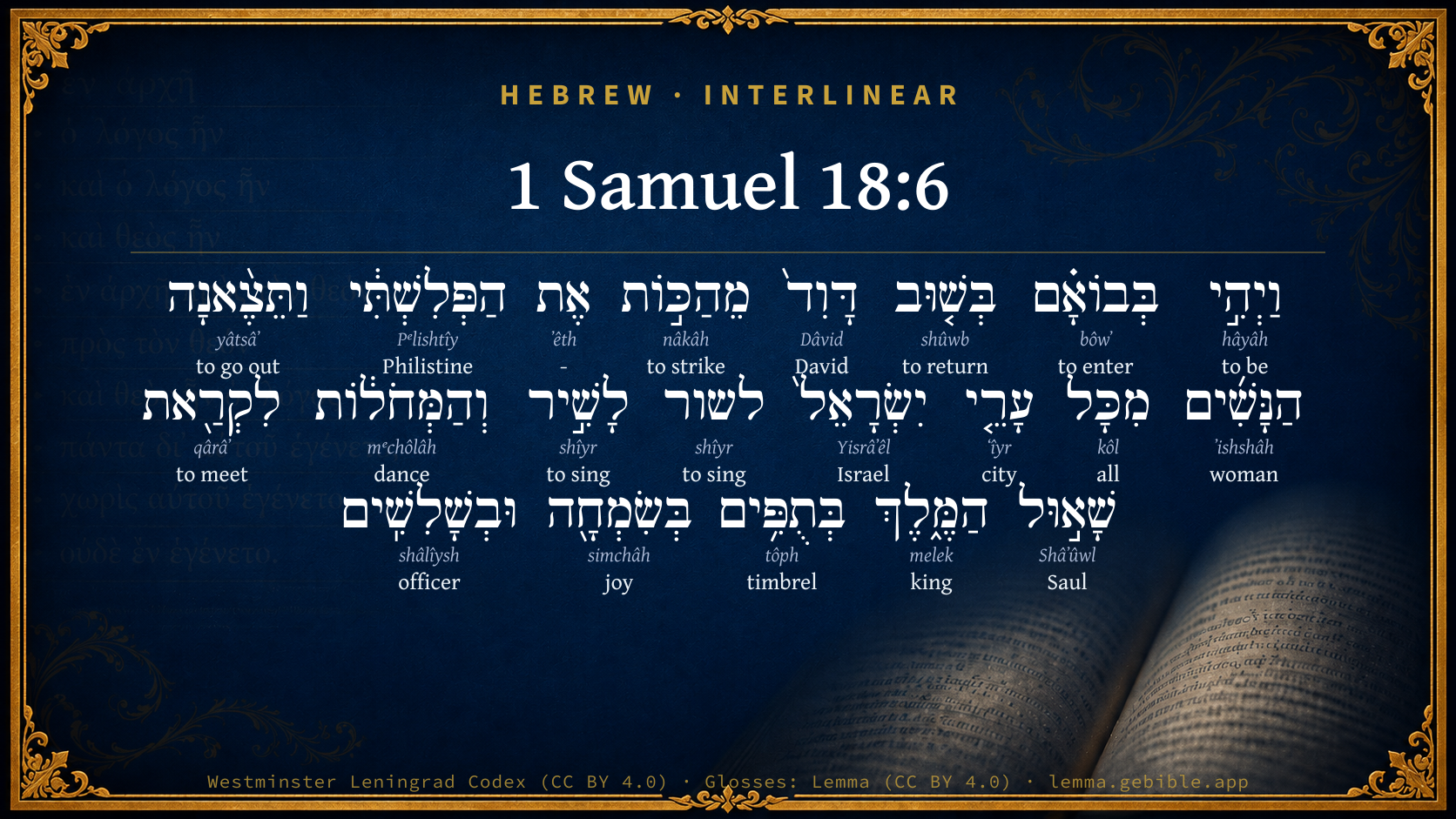
1 Samuel 18:6

Hebrew (Westminster Leningrad Codex) 1 Samuel 18:6 appears in the Hebrew Old Testament. The text above is from the Westminster Leningrad Codex. Each word links to its Strong’s number, a concise gloss, and parsing drawn from the Open Scriptures Hebrew Bible morphology. Click any word for its full Brown-Driver-Briggs (BDB) entry.
Download image
Cite this verse

1 Samuel 18:6 (World English Bible). Public Domain. Lemma interlinear Bible study tool, https://lemma.gebible.app/v/1-samuel/18/6.

Show BibTeX & RIS
BibTeX
RIS
English Translation
It happened as they came, when David returned from the slaughter of the Philistine, that the women came out of all the cities of Israel, singing and dancing, to meet king Saul, with tambourines, with joy, and with instruments of music.
World English Bible · Public Domain
Download a study sheet

One document with this verse’s original text, its word-by-word gloss line, the meaning frame, cross-references with their text, attributed commentary, and full source and license credits — printable, and it pastes into notes with its structure intact.

This verse Autodidact and up

Study sheet (.html) Plain text (.txt)

A passage Seminary Student

Up to 50 verses in one chapter. A passage sheet keeps up to 6 commentary sources and 12 cross-references per verse, in the order this page ranks them, and says so on the sheet whenever that leaves anything out. Ask for a single verse and you get the Autodidact verse sheet above.

Everything on this page stays free to read, with no account — the sheet is a download of what is already on screen, not access to it.

Want to remove ads? Support Godless Engineer
Compare translations 3

The same verse in 3 English versions, stacked beneath the original-language interlinear above. Click any original word for its lexicon entry.

Each is an independent rendering of the whole verse — the interlinear is not word-aligned to these translations.

Highlighted words mark where these versions differ — a whole-verse word diff, not a word-by-word alignment.

  • World English Bible Public Domain
    It happened as they came, when David returned from the slaughter of the Philistine, that the women came out of all the cities of Israel, singing and dancing, to meet king Saul, with tambourines, with joy, and with instruments of music.
  • King James Version Public Domain
    And it came to pass as they came, when David was returned from the slaughter of the Philistine, that the women came out of all cities of Israel, singing and dancing, to meet king Saul, with tabrets, with joy, and with instruments of music.
  • unfoldingWord Literal Text CC BY-SA 4.0
    And it happened, when they came, when David returned from striking the Philistine, that the women came out from all of the cities of Israel to sing and the dances to meet Saul the king with tambourines, with joy, and with triples.

unfoldingWord Literal Text — © unfoldingWord, licensed CC BY-SA 4.0. Word-aligned USFM3 via Door43 (git.door43.org/unfoldingWord/en_ult).

Versions to compare (up to 4)

3 of 4 selected

Show all 18 translations

Every available English version of this verse, each an independent rendering of the whole verse.

  • World English Bible Public Domain
    It happened as they came, when David returned from the slaughter of the Philistine, that the women came out of all the cities of Israel, singing and dancing, to meet king Saul, with tambourines, with joy, and with instruments of music.
  • Berean Standard Bible Public Domain
    As the troops were returning home after David had killed the Philistine, the women came out of all the cities of Israel to meet King Saul with singing and dancing, with joyful songs, and with tambourines and other instruments.
  • Majority Standard Bible Public Domain
    As the troops were returning home after David had killed the Philistine, the women came out of all the cities of Israel to meet King Saul with singing and dancing, with joyful songs, and with tambourines and other instruments.
  • King James Version Public Domain
    And it came to pass as they came, when David was returned from the slaughter of the Philistine, that the women came out of all cities of Israel, singing and dancing, to meet king Saul, with tabrets, with joy, and with instruments of music.
  • American Standard Version (1901) Public Domain
    And it came to pass as they came, when David returned from the slaughter of the Philistine, that the women came out of all the cities of Israel, singing and dancing, to meet king Saul, with timbrels, with joy, and with instruments of music.
  • Revised Version (1885) Public Domain
    And it came to pass as they came, when David returned from the slaughter of the Philistine, that the women came out of all the cities of Israel, singing and dancing, to meet king Saul, with timbrels, with joy, and with instruments of music.
  • Geneva Bible (1599) Public Domain
    When they came againe, and Dauid returned from the slaughter of the Philistim, the women came out of all cities of Israel singing and dauncing to meete king Saul, with timbrels, with instruments of ioy, and with rebeckes.
  • Douay-Rheims (1899) Public Domain
    Now when David returned, after be slew the Philistine, the women came out of all the cities of Israel, singing and dancing, to meet king Saul, with timbrels of joy, and cornets.
  • Young's Literal Translation Public Domain
    And it cometh to pass, in their coming in, in David's returning from smiting the Philistine, that the women come out from all the cities of Israel to sing -- also the dancers -- to meet Saul the king, with tabrets, with joy, and with three-stringed instruments;
  • Literal Standard Version CC BY-SA 4.0
    And it comes to pass, in their coming in, in David’s returning from striking the Philistine, that the women come out from all the cities of Israel to sing—also the dancers—to meet Saul the king, with tambourines, with joy, and with three-stringed instruments;
  • Unlocked Literal Bible CC BY-SA 4.0
    As they came home from defeating the Philistines, the women came from all the cities of Israel, singing and dancing, to meet King Saul, with tambourines, with joy, and with musical instruments.
  • unfoldingWord Literal Text CC BY-SA 4.0
    And it happened, when they came, when David returned from striking the Philistine, that the women came out from all of the cities of Israel to sing and the dances to meet Saul the king with tambourines, with joy, and with triples.
  • Darby Bible Public Domain
    And it came to pass as they came, when David returned from the slaughter of the Philistine, that the women came out of all the cities of Israel, singing and dancing, to meet king Saul, with tambours, with joy, and with triangles.
  • World Messianic Bible Public Domain
    As they came, when David returned from the slaughter of the Philistine, the women came out of all the cities of Israel, singing and dancing, to meet King Saul with tambourines, with joy, and with instruments of music.
  • Webster's Bible Public Domain
    And it came to pass as they came, when David had returned from the slaughter of the Philistine, that the women came out of all the cities of Israel, singing and dancing, to meet king Saul, with tabrets, with joy, and with instruments of music.
  • Free Bible Version CC BY-SA 4.0
    When the soldiers returned home after David had killed the Philistine, the women of all the towns of Israel came out singing and dancing to meet King Saul, happily celebrating with tambourines and musical instruments.
  • Bible in Basic English Public Domain
    Now on their way, when David came back after the destruction of the Philistine, the women came out of all the towns of Israel, with songs and dances, meeting David with melody and joy and instruments of music.
  • JPS Tanakh (1917) Public Domain
    And it came to pass as they came, when David returned from the slaughter of the Philistine, that the women came out of all the cities of Israel, singing and dancing, to meet king Saul, with timbrels, with joy, and with three-stringed instruments.

Literal Standard Version (2020), Covenant Press — licensed CC BY-SA 4.0. Text via the HelloAO Bible API (eBible.org). Unlocked Literal Bible (unfoldingWord) — licensed CC BY-SA 4.0. Text via the HelloAO Bible API (eBible.org). unfoldingWord Literal Text — © unfoldingWord, licensed CC BY-SA 4.0. Word-aligned USFM3 via Door43 (git.door43.org/unfoldingWord/en_ult). Free Bible Version, Dr. Jonathan Gallagher — licensed CC BY-SA 4.0. Text via the HelloAO Bible API (eBible.org).

Word by word

More ways to search: Search by grammar → Find every occurrence → Compare this word →

Practice this passage: Drill this verse → Learn its vocabulary →

וְהַמְּחֹל֔וֹת
mᵉchôlâh
H4246
“and · the · dances”
Conjunction + Particle, Definite Article + Noun, Common, Feminine, Plural, Absolute
Part of Speech
Conjunction + Particle + Noun
Type
Common
Gender
Feminine
Number
Plural
State
Absolute
Full BDB Definition

Origin: from H4284

TWOT: 623h

dancing, dance
  1. וַיְהִ֣י hâyâh H1961 “and · to be” Conjunction + Verb, Qal, Sequential Imperfect, 3rd Person, Masculine, Singular
  2. בְּבוֹאָ֗ם bôwʼ H935 “in/at · to enter · them” Preposition + Verb, Qal, Infinitive Construct + Suffix, Personal, 3rd Person, Masculine, Plural
  3. בְּשׁ֤וּב shûwb H7725 “in/at · to return” Preposition + Verb, Qal, Infinitive Construct
  4. דָּוִד֙ Dâvid H1732 “David” Noun, Proper
  5. מֵהַכּ֣וֹת nâkâh H5221 “from · to strike” Preposition + Verb, Hiphil, Infinitive Construct
  6. אֶת ʼêth H853 “-” Particle, Direct Object
  7. הַפְּלִשְׁתִּ֔י Pᵉlishtîy H6430 “the · Philistine” Particle, Definite Article + Noun, Gentilic, Masculine, Singular, Absolute
  8. וַתֵּצֶ֨אנָה yâtsâʼ H3318 “and · to go out” Conjunction + Verb, Qal, Sequential Imperfect, 3rd Person, Feminine, Plural
  9. הַנָּשִׁ֜ים ʼishshâh H802 “the · women” Particle, Definite Article + Noun, Common, Feminine, Plural, Absolute
  10. מִכָּל kôl H3605 “from · all of” Preposition + Noun, Common, Masculine, Singular, Construct
  11. עָרֵ֤י ʻîyr H5892 “cities of” Noun, Common, Feminine, Plural, Construct
  12. יִשְׂרָאֵל֙ Yisrâʼêl H3478 “Israel” Noun, Proper
  13. לשור shîyr H7891 “to sing” Preposition + Verb, Qal, Infinitive Construct
  14. לָשִׁ֣יר shîyr H7891 “to sing” Preposition + Verb, Qal, Infinitive Construct
  15. לִקְרַ֖את qârâʼ H7122 “to meet” Preposition + Verb, Qal, Infinitive Construct
  16. שָׁא֣וּל Shâʼûwl H7586 “Saul” Noun, Proper
  17. הַמֶּ֑לֶךְ melek H4428 “the · king” Particle, Definite Article + Noun, Common, Masculine, Singular, Absolute
  18. בְּתֻפִּ֥ים tôph H8596 “in/at · timbrels” Preposition + Noun, Common, Masculine, Plural, Absolute
  19. בְּשִׂמְחָ֖ה simchâh H8057 “in/at · joy” Preposition + Noun, Common, Feminine, Singular, Absolute
  20. וּבְשָׁלִשִֽׁים shâlîysh H7991 “and · in/at · officers” Conjunction + Preposition + Noun, Common, Masculine, Plural, Absolute

About this verse

These counts appear in no published source. They are computed here, from the morphology-tagged text and Lemma’s own curated glosses. What Lemma adds →

21
words
20
distinct lemmas
Historical
section

Notable vocabulary

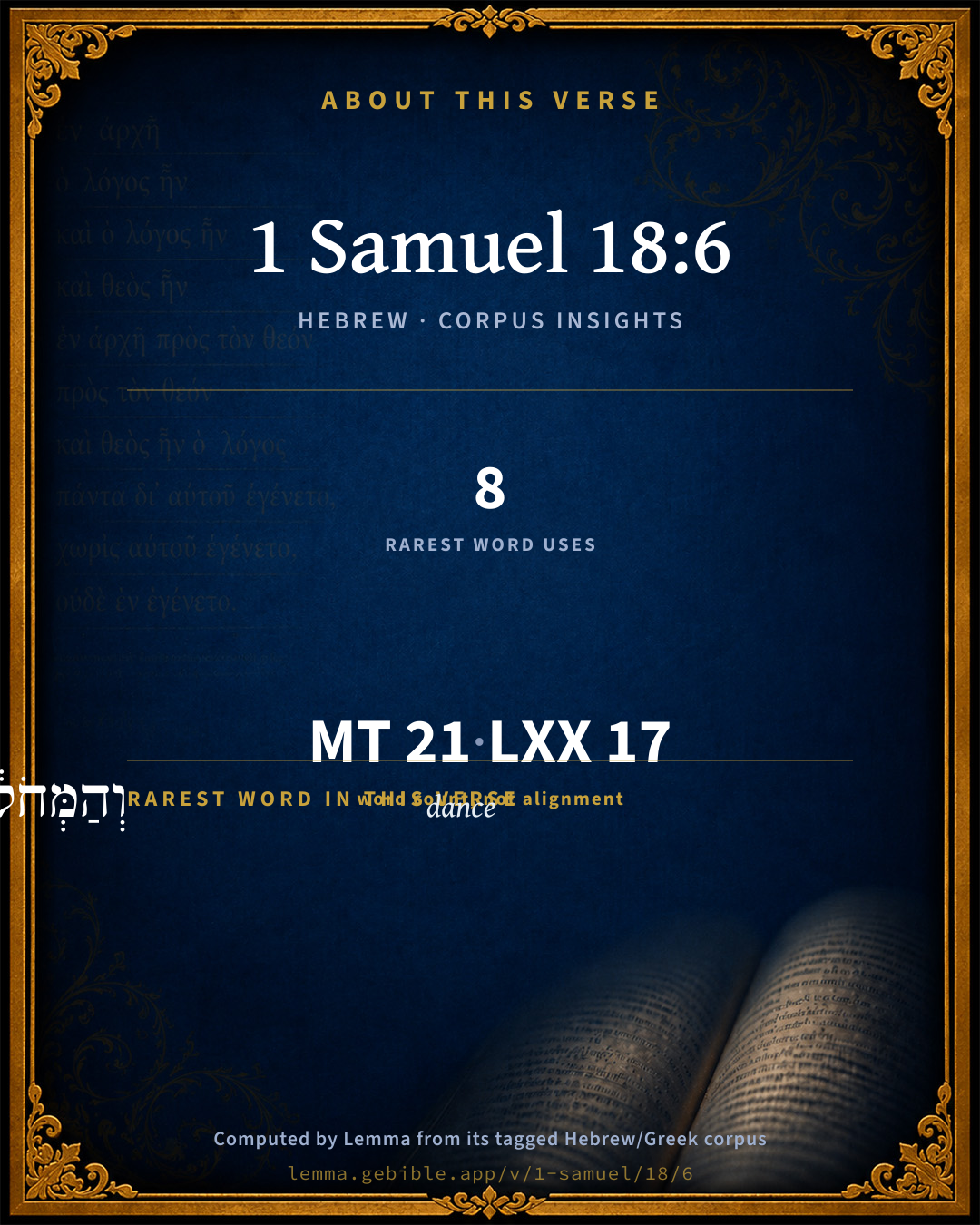
The rarest word here is וְהַמְּחֹל֔וֹת dance H4246 — appearing just 8 times in the whole Hebrew Bible.

Shared distinctive vocabulary

וְהַמְּחֹל֔וֹת dance H4246 occurs in 8 verses of the Hebrew Bible. Also found in:

Grammatical profile

  • 8 verbs
  • 12 nouns
  • 1 particle

Verb forms

  • וַיְהִ֣י Qal · Sequential Imperfect
  • בְּבוֹאָ֗ם Qal · Infinitive Construct
  • בְּשׁ֤וּב Qal · Infinitive Construct
  • מֵהַכּ֣וֹת Hiphil · Infinitive Construct
  • וַתֵּצֶ֨אנָה Qal · Sequential Imperfect
  • לשור Qal · Infinitive Construct
  • לָשִׁ֣יר Qal · Infinitive Construct
  • לִקְרַ֖את Qal · Infinitive Construct

Repetition

A word recurs within this verse — often emphatic in Hebrew:

  • לשור to sing H7891 ×2

Hebrew & Septuagint length

In English translation the verse runs 41 words from the Hebrew and 25 from the Septuagint (LXX English) — the Septuagint runs noticeably shorter here. See the side-by-side →

A rough comparison of the two English renderings, which tokenize alike — not a word-level alignment.

Word counts can differ between the Hebrew and the Greek without any difference in meaning — e.g. the Hebrew direct-object marker אֵת has no separate Greek word, and Greek often adds the article ὁ.

In the original languages it is 21 Hebrew tokens and 17 Greek tokens — but the two are counted differently (Hebrew bundles its prefixes and suffixes into one token; the Greek is in lemma form), so that isn’t a like-for-like length.

Cross-references

4

Topical passages linked to 1 Samuel 18:6 in the Treasury of Scripture Knowledge — connected by theme and wording, ordered by reader-vote popularity; previews shown in the World English Bible.

  • Exodus 15:20 Miriam the prophetess, the sister of Aaron, took a tambourine in her hand; and all the women went out after her with tambourines and with dances.
  • Judges 11:34 Jephthah came to Mizpah to his house; and, behold, his daughter came out to meet him with tambourines and with dances: and she was his only child; besides her he had neither son nor daughter.
  • Psalms 68:25 The singers went before, the minstrels followed after, In the midst of the ladies playing with tambourines,
  • Jeremiah 31:11–13 For Yahweh has ransomed Jacob, and redeemed him from the hand of him who was stronger than he.

Cross-references courtesy of OpenBible.info (CC BY 4.0).

Hebrew and Greek witnesses Masoretic Hebrew ↔ Greek Septuagint

The same verse in the two great witnesses to the Old Testament, shown verse-for-verse.

Here the Septuagint runs noticeably shorter than the Hebrew — LXX2012 (modern English Septuagint) 25 words vs World English Bible 41. A rough length comparison of the two English translations, not a word-level alignment — read both below.

These are two independent witnesses, not word-aligned to each other, and the Septuagint is shown in lemma (dictionary) form.

Hebrew 1 Samuel 18:6 Masoretic · Westminster Leningrad Codex

וַיְהִ֣י בְּבוֹאָ֗ם בְּשׁ֤וּב דָּוִד֙ מֵהַכּ֣וֹת אֶת הַפְּלִשְׁתִּ֔י וַתֵּצֶ֨אנָה הַנָּשִׁ֜ים מִכָּל עָרֵ֤י יִשְׂרָאֵל֙ לשור לָשִׁ֣יר וְהַמְּחֹל֔וֹת לִקְרַ֖את שָׁא֣וּל הַמֶּ֑לֶךְ בְּתֻפִּ֥ים בְּשִׂמְחָ֖ה וּבְשָׁלִשִֽׁים

It happened as they came, when David returned from the slaughter of the Philistine, that the women came out of all the cities of Israel, singing and dancing, to meet king Saul, with tambourines, with joy, and with instruments of music.

World English Bible · Public Domain

Greek LXX 1 Samuel 18:6 Septuagint · lemma form

καί ἀποἵστημι αὐτός ἀπό αὐτός καί καταἵστημι αὐτός ἑαυτοῦ χιλίαρχος καί ἐκπορεύομαι καί εἰςπορεύομαι ἔμπροσθεν ὁ λαός

And there came out women in dances to meet David out of all the cities of Israel, with timbrels, and with rejoicing, and with cymbals.

LXX2012 (modern English Septuagint) · Public Domain

On this verse, Keil & Delitzsch discusses the Septuagint’s reading. Read the note in Commentary ↓

Hebrew: Westminster Leningrad Codex (CC BY 4.0). Greek: Septuagint (public domain); English from LXX2012 (modern English Septuagint) (Public Domain). How the Septuagint differs from the Hebrew →

Targum (Aramaic paraphrase)

1

The Targum is the ancient Jewish Aramaic paraphrase of the Hebrew Scriptures — an interpretive translation, not the Hebrew text itself. Onkelos (literal) and Pseudo-Jonathan (expansive) render the Torah, and Jonathan the Prophets. Coverage is partial: where no permissively-licensed English translation exists for a verse, only the Aramaic is shown. This is verse-level text, not a word-by-word alignment to the Hebrew.

  1. Targum Jonathan Prophets (Joshua–Malachi)
    וַהֲוָה בְּמֵיעַלְהוֹן כַּד תַּב דָוִד מִלְמִקְטַל יַת פְּלִשְׁתָּאָה וּנְפַקָא נְשַׁיָא מִכָּל קִירְוֵי יִשְׂרָאֵל לְשַׁבָּחָא בְּחִנְגַיָא לָקֳדָמוּת שָׁאוּל מַלְכָּא בְּתֻפִּין בְּחֶדְוָא וּבְצֶלְצְלִין:

    (no public-domain English translation for this verse)

    Targum Jonathan — Aramaic: “Mikraot Gedolot” (public domain). English: “Sefaria Community Translation” (CC0 1.0 (public-domain dedication)); “London "Chaldee Paraphrase," 1871” (public domain). Text via Sefaria.

Commentary

Notes on 1 Samuel 18:6 from classic Christian and Jewish commentators (each source and its license shown beneath its notes). The classic Christian expositions comment on the surrounding passage and are grouped to its opening verse, so a note may address several verses; the Jewish commentaries on the Tanakh (Rashi and others) are per-verse, so they appear only where the commentator wrote on this verse.

Lemma curates 59 commentaries, every one of them public domain or Creative Commons licensed, each selected and text-cleaned for this edition rather than reprinted as found. About our sources →

Matthew Henry's Commentary

Now begin David's troubles, and they not only tread on the heels of his triumphs, but take rise from them, such is the vanity of that in this world which seems greatest.

I. He was too much magnified by the common people. Some time after the victory Saul went a triumphant progress through the cities of Israel that lay next him, to receive the congratulations of the country. And, when he made his public entry into any place, the women were most forward to show him respect, as was usual then in public triumphs (Sa1 18:6), and they had got a song, it seems, which they sang in their dances (made by some poet or other, that was a great admirer of David's bravery, and was more just than wise, in giving his achievements in the late action the preference before Saul's), the burden of which was, Saul had slain his thousands, and David his ten thousands. Such a difference as this Moses made between the numbers of Ephraim and Manasseh, Deu 33:17.

II. This mightily displeased Saul, and made him envy David, Sa1 18:8, Sa1 18:9. He ought to have considered that they referred only to this late action, and intended not to diminish any of Saul's former exploits; and that in the action now celebrated it was undeniably true that David, in killing Goliath, did in effect slay all the Philistines that were slain that day and defeated the whole army; so that they did but give David his due. It may be, he that composed the song only used a poetic liberty, and intended not any invidious comparison between Saul and David; or, if he did, it was below the great mind of a prince to take notice of such a reflection upon his personal honour, when it appeared that the glory of the public was sincerely intended. But Saul was very wroth, and presently suspected some treasonable design at the bottom of it: What can he have more but the kingdom? This made him eye David as one he was jealous of and sought advantages against (Sa1 18:9): his countenance was not towards him as it had been. Proud men cannot endure to hear any praised but themselves, and think all their honour lost that goes by themselves. It is a sign that the Spirit of God has departed from men if they be peevish in their resentment of affronts, envious and suspicious of all about them, and ill-natured in their conduct; for the wisdom from above makes us quite otherwise.

III. In his fury he aimed to kill David, Sa1 18:10, Sa1 18:11. Jealousy is the rage of a man; it made Saul outrageous against David and impatient to get him out of the way. 1. His fits of frenzy returned upon him. The very next day after he conceived malice against David the evil spirit from God, that had formerly haunted him, seized him again. Those that indulge themselves in envy and uncharitableness give place to the devil, and prepare for the re-entry of the unclean spirit, with seven others more wicked. Where envy is there is confusion. Saul pretended a religious ecstasy: He prophesied in the midst of the house, that is, he had the gestures and motions of a prophet, and humoured the thing well enough to decoy David into a snare, and that he might be fearless of any danger and off his guard; and perhaps designing, if he could but kill him, to impute it to a divine impulse and to charge it upon the spirit of prophecy with which he seemed to be animated: but really it was a hellish fury that actuated him. 2. David, though advanced to a much higher post of honour, disdained not, for his master's service, to return to his harp: He played with his hand as at other times. Let not the highest think any thing below them whereby they may do good and be serviceable to those they are obliged to. 3. He took this opportunity to aim at the death of David. A sword in a madman's hand is a dangerous thing, especially such a madman as Saul was, that was mad with malice. Yet he had a javelin or dart in his hand, which he projected, endeavouring thereby to slay David, not in a sudden passion, but deliberately: I will smite David to the wall with it, with such a desperate force did he throw it. Justly does David complain of his enemies that they hated him with a cruel hatred, Psa 25:19. No life is thought too precious to be sacrificed to malice. If a grateful sense of the great service David had done to the public could not assuage Saul's fury, yet one would think he should have allowed himself to consider the kindness David was now doing him, in relieving him, as no one else could, against the worst of troubles. Those are possessed with a devilish spirit indeed that render evil for good. Compare David, with his harp in his hand, aiming to serve Saul, and Saul, with his javelin in his hand, aiming to slay David; and observe the meekness and usefulness of God's persecuted people and the brutishness and barbarity of their persecutors. The bloodthirsty hate the upright, but the just seek his soul, Pro 29:10. 4. David happily avoided the blow twice (namely, now, and afterwards, Pro 19:10); he did not throw the javelin at Saul again, but withdrew, not fighting but flying for his own preservation; though he had both strength and courage enough, and colour of right, to make resistance and revenge the injury, yet he did no more than secure himself, by getting out of the way of it. David, no doubt, had a watchful eye upon Saul's hand, and the javelin in it, and did as bravely in running from it as he did lately in running upon Goliath. Yet his safety must be ascribed to the watchful eye of God's providence upon him, saving his servant from the hurtful sword; and by this narrow escape it seemed he was designed for something extraordinary.

Matthew Henry's Commentary on the Whole Bible (1708–1710) — public domain (CC PDM 1.0). Text via the HelloAO Bible API.

The Cambridge Bible for Schools and Colleges

gen. ed. J. J. S. Perowne

6–9. The celebration of David’s victory

6. And it came to pass, &c.] The narrative has made a digression to relate the circumstances of David’s permanent reception into Saul’s service, the commencement of the friendship between him and Jonathan, and his ultimate promotion and success. It now goes back to relate the welcome which David received when the army returned in triumph from the successful completion of the Philistine war. Ch. 1Sa_18:6 is to be read (as it actually stands in the Sept.) in connexion with 1Sa_17:54, though some time may have elapsed, during which the army was occupied in following up its first success. The Sept. reads 1Sa_18:6 thus; “And the dancing women came out of all the cities of Israel to meet David, with tabrets and rejoicing and cymbals.”

the women came out, &c.] To escort the victors home with singing and dancing. Dancing was the usual expression of rejoicing upon occasions of national triumph like the present; cp. Exo_15:20-21; Jdg_11:34; and at religions festivals (Psa_68:25; Psa_149:3). These dances were as a rule confined to women—David’s dancing in 2Sa_6:14 was exceptional—and probably resembled the modern Oriental dance, in which the evolutions are extemporaneous, and not confined to any fixed rule, but varied at the pleasure of the leading dancer, who is imitated by the rest of the company.

with tabrets, &c.] The dance was accompanied (1) by the “tabret” or “timbrel” (Exo_15:20; Jdg_11:34): i.e. the hand-drum, an instrument still used by the Arabs, and described as “a hoop (sometimes with pieces of brass fixed in it to make a jingling) over which a piece of parchment is distended. It is beaten with the fingers:”—(2) “with joy:” i.e. jubilant shouts and songs: (3) “with instruments of music;” either “triangles,” or “three-stringed instruments.”

The Cambridge Bible for Schools and Colleges (gen. ed. J. J. S. Perowne; Cambridge University Press, 1878–1918) — public domain. Text from a community e-Sword module.

Trapp's Complete Commentary

John Trapp

1Sa 18:6 And it came to pass as they came, when David was returned from the slaughter of the Philistine, that the women came out of all cities of Israel, singing and dancing, to meet king Saul, with tabrets, with joy, and with instruments of musick.

Ver. 6. Women came ont.] Women share deeply in a common calamity by war; they usually are ravished, abused, slaved; they therefore greatly rejoiced, as there was reason, when the enemy was vanquished. See Exo 15:20 Jdg 11:34

John Trapp, A Commentary or Exposition upon All the Books of the Old and New Testament (1647–1656) — public domain. Text from a community e-Sword module.

Joseph Benson's Commentary

1Sa 18:6-9. The women came out of all the cities — All the neighbouring cities. And the women answered one another as they played — They sang, as well as played on musical instruments. And they sang alternately, as they did Exo 15:21. And the burden of the song seems to have been that which follows. And said, Saul hath slain his thousands, &c. — To understand this it is necessary to observe, that the usual way of singing at that time was in parts. So that some of these women having taken up or begun the song with, Saul hath slain his thousands, another party answered them in their turn in the same strain, And David his ten thousands. And Saul was very wroth — He began to be jealous they would advance David to the throne in a little time, having so highly magnified him above their king. And Saul eyed David — Narrowly observed him, or looked upon him with an envious eye.

Joseph Benson's Commentary on the Old and New Testaments (1811–1818) — public domain. Text from a community e-Sword module.

Keil & Delitzsch

C. F. Keil & F. Delitzsch

Saul's jealousy towards David.

(Note: The section Sa1 18:6-14 is supposed by Thenius and others to have been taken by the compiler from a different source from the previous one, and not to have been written by the same author: (1) because the same thing is mentioned in Sa1 18:13, Sa1 18:14, as in Sa1 18:5, though in a somewhat altered form, and Sa1 18:10, Sa1 18:11 occur again in Sa1 19:9-10, with a few different words, and in a more appropriate connection; (2) because the contents of Sa1 19:9, and the word ממּחרת in Sa1 19:10, are most directly opposed to Sa1 18:2 and Sa1 18:5. On these grounds, no doubt, the lxx have not only omitted the beginning of Sa1 18:6 from their version, but also Sa1 18:9-11. But the supposed discrepancy between Sa1 18:9 and Sa1 18:10 and Sa1 18:2 and Sa1 18:5, - viz., that Saul could not have kept David by his side from attachment to him, or have placed him over his men of war after several prosperous expeditions, as is stated in Sa1 18:2 and Sa1 18:5, if he had looked upon him with jealous eyes from the very first day, or if his jealousy had broken out on the second day in the way described in Sa1 18:10, Sa1 18:11, - is founded upon two erroneous assumptions; viz., (1) that the facts contained in Sa1 18:1-5 were contemporaneous with those in Sa1 18:6-14; and (2) that everything contained in these two sections is to be regarded as strictly chronological. But the fact recorded in Sa1 18:2, namely, that Saul took David to himself, and did not allow him to go back to his father's house any more, occurred unquestionably some time earlier than those mentioned in Sa1 18:6. with their consequences. Saul took David to himself immediately after the defeat of Goliath, and before the war had been brought to an end. But the celebration of the victory, in which the paean of the women excited jealousy in Saul's mind, did not take place till the return of the people and of the king at the close of the war. How long the war lasted we do not know; but from the fact that the Israelites pursued the flying Philistines to Gath and Ekron, and then plundered the camp of the Philistines after that (Sa1 17:52-53), it certainly follows that some days, if not weeks, must have elapsed between David's victory over Goliath and the celebration of the triumph, after the expulsion of the Philistines from the land. Thus far the events described in the two sections are arranged in their chronological order; but for all the rest the facts are arranged antithetically, according to their peculiar character, whilst the consequences, which reached further than the facts that gave rise to them, and were to some extent contemporaneous, are appended immediately to the facts themselves. Thus David's going out whithersoever Saul sent him (Sa1 18:5) may indeed have commenced during the pursuit of the flying Philistines; but it reached far beyond this war, and continued even while Saul was looking upon him with jealous eyes. Sa1 18:5 contains a general remark, with which the historian brings to a close one side of the relation between David and Saul, which grew out of David's victory. He then proceeds in Sa1 18:6 to give the other side, and rounds off this paragraph also (Sa1 18:14-16) with a general remark, the substance of which resembles, in the main, the substance of Sa1 18:5. At the same time it implies some progress, inasmuch as the delight of the people at the acts performed by David (Sa1 18:5) grew into love to David itself. This same progress is also apparent in Sa1 18:13 ("Saul made him captain over a thousand"), as compared with Sa1 18:5 ("Saul set him over the men of war"). Whether the elevation of David into a captain over a thousand was a higher promotion than his appointment over the men of war, or the latter expression is to be taken as simply a more general or indefinite term, denoting his promotion to the rank of commander-in-chief, is a point which can hardly be determined with certainty.)

- Saul had no sooner attached the conqueror of Goliath to his court, than he began to be jealous of him. The occasion for his jealousy was the celebration of victory at the close of the war with the Philistines.

Sa1 18:6-7

"When they came," i.e., when the warriors returned with Saul from the war, "when (as is added to explain what follows) David returned from the slaughter," i.e., from the war in which he had slain Goliath, the women came out of all the towns of Israel, "to singing and dancing," i.e., to celebrate the victory with singing and choral dancing (see the remarks on Exo 15:20), "to meet king Saul with tambourines, with joy, and with triangles." שׂמהה is used here to signify expressions of joy, a fte, as in Jdg 16:23, etc. The striking position in which the word stands, viz., between two musical instruments, shows that, the word is to be understood here as referring specially to songs of rejoicing, since according to Sa1 18:7 their playing was accompanied with singing. The women who "sported" (משׂחקות), i.e., performed mimic dances, sang in alternate choruses ("answered," as in Exo 15:21), "Saul hath slain his thousands, and David his ten thousands."

Sa1 18:8

Saul was enraged at this. The words displeased him, so that he said, "They have given David ten thousands, and to me thousands, and there is only the kingdom more for him" (i.e., left for him to obtain). "In this foreboding utterance of Saul there was involved not only a conjecture which the result confirmed, but a deep inward truth: if the king of Israel stood powerless before the subjugators of his kingdom at so decisive a period as this, and a shepherd boy came and decided the victory, this was an additional mark of his rejection" (O. v. Gerlach).

Sa1 18:9

From that day forward Saul was looking askance at David. עון, a denom. verb, from עין, an eye, looking askance, is used for עוין (Keri).

Sa1 18:10-11

The next day the evil spirit fell upon Saul ("the evil spirit of God;" see at Sa1 16:14), so that he raved in his house, and threw his javelin at David, who played before him "as day by day," but did not hit him, because David turned away before him twice. התנבּא does not mean to prophesy in this instance, but "to rave." This use of the word is founded upon the ecstatic utterances, in which the supernatural influence of the Spirit of God manifested itself in the prophets (see at Sa1 10:5). ויּטל, from טוּל, he hurled the javelin, and said (to himself), "I will pierce David and the wall." With such force did he hurl his spear; but David turned away from him, i.e., eluded it, twice. His doing so a second time presupposes that Saul hurled the javelin twice; that is to say, he probably swung it twice without letting it go out of his hand, - a supposition which is raised into certainty by the fact that it is not stated here that the javelin entered the wall, as in Sa1 19:10. But even with this view יטל is not to be changed into יטּל, as Thenius proposes, since the verb נטל cannot be proved to have ever the meaning to swing. Saul seems to have held the javelin in his hand as a sceptre, according to ancient custom.

Sa1 18:12-13

"And Saul was afraid of David, because the Spirit of Jehovah was with him, and had departed from Saul;" he "removed him therefore from him," i.e., from his immediate presence, by appointing him chief captain over thousand. In this fear of David on the part of Saul, the true reason for his hostile behaviour is pointed out with deep psychological truth. The fear arose from the consciousness that the Lord had departed from him, - a consciousness which forced itself involuntarily upon him, and drove him to make the attempt, in a fit of madness, to put David to death. The fact that David did not leave Saul immediately after this attempt upon his life, may be explained not merely on the supposition that he looked upon this attack as being simply an outburst of momentary madness, which would pass away, but still more from his firm believing confidence, which kept him from forsaking the post in which the Lord had placed him without any act of his own, until he saw that Saul was plotting to take his life, not merely in these fits of insanity, but also at other times, in calm deliberation (vid., Sa1 19:1.).

Sa1 18:14-16

As chief commander over thousand, he went out and in before the people, i.e., he carried out military enterprises, and that so wisely and prosperously, that the blessing of the Lord rested upon all he did. But these successes on David's part increased Saul's fear of him, whereas all Israel and Judah came to love him as their leader. David's success in all that he took in hand compelled Saul to promote him; and his standing with the people increased with his promotion. But as the Spirit of God had departed from Saul, this only filled him more and more with dread of David as his rival. As the hand of the Lord was visibly displayed in David's success, so, on the other hand, Saul's rejection by God was manifested in his increasing fear of David.

Keil & Delitzsch — Biblical Commentary on the Old Testament (1861–1891) — public domain (CC PDM 1.0). Text via the HelloAO Bible API. (Old Testament only.)

Geneva Bible (1599)

Geneva Bible translators

To wit, Goliath.

Geneva Bible (1599) marginal notes — public domain. Text via Bolls.life.

Jamieson, Fausset & Brown

Robert Jamieson, A. R. Fausset & David Brown

SAUL ENVIES HIS PRAISE. (Sa1 18:5-9)

the women came out of all cities of Israel--in the homeward march from the pursuit of the Philistines. This is a characteristic trait of Oriental manners. On the return of friends long absent, and particularly on the return of a victorious army, bands of women and children issue from the towns and villages, to form a triumphal procession, to celebrate the victory, and, as they go along, to gratify the soldiers with dancing, instrumental music, and extempore songs, in honor of the generals who have earned the highest distinction by feats of gallantry. The Hebrew women, therefore, were merely paying the customary gratulations to David as the deliverer of their country, but they committed a great indiscretion by praising a subject at the expense of their sovereign.

Jamieson, Fausset & Brown — Commentary Critical and Explanatory on the Whole Bible (1871) — public domain (CC PDM 1.0). Text via the HelloAO Bible API.

Adam Clarke's Commentary

Verse 6. When David was returned] This verse connects well with the 54th verse of the preceding chapter; 1Sa 17:54 and carries on the narration without any break or interruption. See the notes there.

The women came out] It was the principal business of certain women to celebrate victories, sing at funerals, c.

With instruments of music.] The original word (שלשים shalishim) signifies instruments with three strings and is, I think, properly translated by the Vulgate, cum sistris, "with sistrums." This instrument is well known as being used among the ancient Egyptians: it was made of brass, and had three, sometimes more, brass rods across; which, being loose in their holes, made a jingling noise when the instrument was shaken.

Adam Clarke's Commentary on the Bible (1810–1826) — public domain. Text from a community e-Sword/MySword module.

Ellicott's Commentary for English Readers

(6) When David was returned.—The triumphant return of the young soldier does not refer to the homecoming after the death of the giant, but to the close of the campaign which followed that event. Evidently a series of victories after the fall of the dreaded champion—perhaps spread over a very considerable period—had for a time restored the supremacy of Israel in Canaan. In this war, David, on whom after his great feat of arms the eyes of all the soldiery were fixed, established his character for bravery and skill.

Singing and dancing.—This was on some grand occasion—probably the final triumph at the end of the war. The Speaker’s Commentary, on the English rendering “singing and dancing,” remarks that “the Hebrew text is probably here corrupt, and suggests that for vau, ‘and,’ we ought to read beth, ‘with’ and that then the sense would be to sing ‘in the dance,’ or ‘with dancing.’ The action was for the women to dance to the sound of the timbrel, and to sing the Epinicium with strophe and antistrophe as they danced and played.” (Comp. Exo_15:20-21; Jdg_11:34.)

We know that music and song were originally closely connected with dancing. David, for instance, when a mighty king, on one great occasion in Jerusalem actually himself performed dances before all the people (2Sa_6:14; 2Sa_6:16). (See Note on Exo_15:20.)

A Bible Commentary for English Readers, edited by Charles John Ellicott (1878–1897) — public domain. Text from a community e-Sword module.

John Gill's Exposition

And it came to pass, as they came,.... The armies of Israel, with their commanders at the head of them:

when David was returned from the slaughter of the Philistine; either from the slaughter of Goliath, with his head in his hand, going to Jerusalem, and Saul accompanying him; or rather from the slaughter of the Philistines at some other time, the singular being put for the plural; since, according to the order of the history, this seems to be done after David was brought to court, and had been made a captain, and had been sent out on military expeditions, and had been successful therein, and from one of which he now returned:

that the women came out of all the cities of Israel; through which they passed:

singing and dancing; as were usual after great victories obtained, and deliverances wrought, the female sex being generally greatly affected with such things; since when things go otherwise they suffer much, and their fears rise high in time of battle; and when victory goes on their side, it gives them great joy, and which they used to express in this way:

to meet King Saul; the commander-in-chief, with his other officers, and David among the rest:

with tabrets, with joy, and with instruments of music; with pipes or flutes, which they both blew with their mouths, and played on with their hands, and other musical instruments exciting joy; the last word is, by the Targum, rendered,"with cymbals;''and so the Septuagint version; it signifies a musical instrument of three cords, according to Kimchi; and others, as Ben Gersom, understand it of principal songs, in which things wonderful, excellent, and honourable, were spoken of: see Exo 15:20. Such sort of women were among the Romans called Cymballatriae and Tympanistriae (t), who shook the cymbals, and beat upon tabrets and drums at times of rejoicing.

(t) Vid. Pignorium de Servis, p. 166, 174.

John Gill's Exposition of the Whole Bible (1746–1763) — public domain (CC PDM 1.0). Text via the HelloAO Bible API.

Albert Barnes' Notes on the Bible

The Philistine - Rather as in the margin. The allusion is not to Goliath, but to one of the expeditions referred to in 1Sa 18:5.

Singing and dancing - Women used to dance to the sound of the timbrel, and to sing as they danced and played.

(instruments of music The word means, an instrument like the triangle, or with three cords.

Albert Barnes' Notes on the Bible (1834–1885) — public domain. Text from a community e-Sword/MySword module.

Haydock's Catholic Bible Commentary

Philistine. Some explain this of some fresh achievement against that nation, (Malvenda; Worthington) but without reason. --- Dancing. Hebrew also playing on the flute, or on some such instrument of music. (Calmet) --- So Mary [Miriam] sung after the Israelites had crossed the Red Sea, Exodus xv. 20., 2 Kings i. 20., and Judges xi. 34.

George Leo Haydock (1774–1849), Haydock's Catholic Family Bible and Commentary, 1859 edition — public domain. Excludes Psalms (Douay-Rheims chapter numbering differs from Protestant) and Deuterocanonical books (Catholic canon only).

Matthew Poole's English Annotations

When David was returned from the slaughter of the Philistine; either, first, From some eminent victory obtained by him against the Philistines, though not particularly related, wherein also Saul might be present and concerned. Or rather, secondly, From the slaughter of Goliath, and the other Philistines with him. Against this it is objected, that this song was sung either after David was advanced and employed, as is related 1Sa 18:5, and therefore not immediately after that great victory; or, before he was so advanced; and then it would have raised Saul’s jealousy and envy, and consequently hindered David’s advancement. But it may be replied, that this song, though placed afterwards, was sung before David’s advancement, related 1Sa 18:5. And that this did not hinder David’s preferment, must be ascribed partly to Saul’s policy, who, though he had an eye upon David, and designed to crush him upon a fit occasion; yet saw it necessary for his own reputation, and the encouragement of other men’s valour, and for the satisfaction of Jonathan’s passionate desire, and the just and general expectation of the whole army and people, to give him some considerable preferment for the present; and principally to God’s providence overruling Saul, against his own inclination, and his mistaken interest.

Out of all cities of Israel, i.e. out of all the neighbouring cities, by or through which the victorious army marched.

Singing and dancing, according to the custom of those times and places; of which See Poole "Exo 15:20", See Poole "Jdg 11:34".

Matthew Poole's English Annotations on the Holy Bible (1683–1685) — public domain. Text from a community e-Sword/MySword module.

Whedon's Commentary on the Bible

Daniel D. Whedon

6. All cities of Israel — All those near which the returning army passed.

Singing and dancing — According to the custom of the Hebrew women after great victories. Compare Exo_15:20; Jdg_11:34.

Instruments of music — Margin, three-stringed instruments. שׁלשׁים, as the name of a musical instrument, occurs here only, and signifies, literally, threes. The triangle is probably intended, of which we subjoin an engraving.

Daniel D. Whedon (gen. ed.), Commentary on the Old and New Testaments (1874–1909) — public domain. Text from a community e-Sword module.

The Pulpit Commentary

SAUL"S HATRED OF DAVID (vers. 6-16).

When David was returned from the slaughter of the Philistine. Or more probably, as in the margin, "of the Philistines." The allusion is not to the combat with Goliath, but to one of the expeditions referred to in ver. 5, in which David had gained some decisive victory. The women would not have described the slaughter of one champion as the slaying of ten thousand, nor would there have been any contrast between this act and the military enterprises of Saul. Probably he too would have looked with indifference upon this Oriental exaggeration of the daring bravery of a boy; but what galled him was David"s continual success in repeated campaigns. The Philistine means the whole people of that name; and as the war between them and Saul lasted all the days of Saul"s life, and was his main kingly work, he saw with envy the rapid growth of David"s reputation; and when, after some noble achievement, the women gave David an ovation, and declared in their songs that he had achieved a success ten times as great as Saul, an outburst of ill feeling was the result. Saul suddenly became aware that the young captain on whose shoulders he had devolved the chief labours of the war had supplanted him in the popular estimation, and hatred took the place of the good feeling which he had previously entertained towards him. The women came out of all cities of Israel to meet king Saul. It is evident that this refers to some grand occasion, and probably to the conclusion of a peace between the two nations. The battle in the valley of Elah was probably followed by several years of warfare, during which David developed those great military qualities which made him subsequently the founder of the wide empire over which Solomon reigned. It was unendurable for Saul, himself a great soldier, to find, when the war at last was over, that the people recognised in his lieutenant higher military qualities than they had discovered in himself. With tabrets. See on 1Sa_10:5. With joy. As this is placed between the names of two instruments of music, it must mean some kind of joyous shouting or singing to the sound of their tabrets. With instruments of music. Hebrew, with triangles, a very ancient but effective instrument for an outdoor procession accompanied with dancing.

Vers. 6-16. (GIBEAH)

Envy.

Saul eyed David from that day forward" (ver. 9). How extraordinary are the moral contrasts which are often presented in human life! The friendship of Jonathan here stands in opposition to the envy of Saul. Hardly had David experienced the one before he was exposed to the other. "His victory had a double issue, Jonathan"s love and Saul"s envy, which God so mixed that the one was a remedy of the other" (Hall). On the day of public rejoicing the seeds of jealousy, envy, and hatred were sown in his heart. He eyed David not with favour, as before, but with dislike on account of the honour given to him beyond himself. The general suspicion which he entertained in consequence of the intimations of Samuel concerning his successor also seems to have fastened on him as the man; and henceforth he looked upon him as a dangerous rival. "Mingling with his constitutional malady, it poisoned his whole future relations with David." Of envy notice that

I IT TAKES ROOT IN AN EVIL HEART. In the case of Saul the soil was congenial and ready prepared by

1. Alienation from God and conviction of his disfavour.

2. Selfishness and morbid concentration of thought upon himself.

3. Self-will, pride, and worldly ambition, still continuing and increasing.

4. Wrathful passion. He was very wroth, and the saying displeased him (ver. 8). "He who is apt to feel indignation, feels pain at those who are undeservedly successful; but the envious man, going beyond him, feels pain at every one"s success" (Aristotle, "Ethics").

II IT GROWS IS THE SHADE OF ANOTHER"S PRE-EMINENCE in

1. Popular estima tion. "They have ascribed unto David ten thousands," etc. (ver. 8). "What properly occasions envy is the fruit of the accomplishments of others; the pre-eminence which the opinion of the world bestows, or which we dread it will bestow, on their talents above ours" (Blair).

2. Successful achievements, from which such preference proceeds. "The bright day brings out the adder." Prosperity is generally attended by envy.

3. Personal excellences. David "behaved himself wisely" (ver. 5); "very wisely" (ver. 15); "more wisely than all" (ver. 30). He acted prudently, cautiously, skilfully, and therefore prosperously.

Base envy withers at another"s joy, And hates the excellence it cannot reach (Thomson).

4. Divine approbation, which appears in prosperous enterprises. "And Saul was afraid of David, because the Lord was with him," etc. (ver. 12). "And Cain was very wroth," etc. (Gen_4:5; 1Jn_3:2) The envy felt at the favour shown to another by God is peculiarly criminal, because of its opposition to God himself.

III IT IS MARKED BY MANY ODIOUS FEATURES.

1. Unreasonableness.

2. In most cases ingratitude. David had conferred a great benefit on Saul and Israel by his victory over Goliath; he "went out whithersoever Saul sent him," and fought his battles; and often soothed his melancholy with the music of his harp (ver. 10).

3. Injustice. He did him "shame" (1Sa_20:34) by entertaining suspicions of his loyalty and treating him as a traitor.

4. Ungodliness and all uncharitableness. "Charity envieth not." "Envy is the worst of all passions, and feedeth upon the spirits, and they again upon the body; and so much the more because it is perpetual, and, as it is said, keepeth no holidays" (Bacon, "Essays").

IV IT IS PRODUCTIVE OF MUCH DEADLY FRUIT, in relation both to others (Pro_27:4) and to the envious man himself; (Pro_14:30) partly of hatred and partly of grief. "As it shows itself in hatred it strikes at the person envied; but as it affects a man in the nature of grief it recoils and does execution upon the envier. It lies at the heart like a worm, always gnawing and corroding and piercing it with a secret, invisible sting and poison" (South, "Sermons," 58.). In Saul it produced unrest of soul, increased subjection to the power of evil came to pass on the morrow, etc. (ver. 10); ungovernable rage poised the javelin" twice; craft and hypocrisy; fear (vers. 11, 15); continual enmity (ver. 21); deliberate avowal of murderous intentions; (1Sa_19:1) open and unceasing persecution; despair and self-destruction. "When in the last judgment envy is placed at the bar of God, what an indictment will he laid against the evil spirit! The insulting anger of Eliab, the cruelty of Joseph"s brethren, the murderous wrath of Cain, and the greatest share in the greatest crime in the world the crucifying of the Lord of glory will be charged upon him. To cast this demon out of our bosoms before that final condemnation is one purpose of Jesus, and with all our hearts we should pray for his complete and. speedy victory" (C Vince).

Conclusion: In order to the cure or prevention of this evil passion, seek a renewed heart; dwell much on the Divine love "that spurns all envying in its bounty;" estimate aright temporal advantages; entertain lowly thoughts of self; learn to admire excellence in others, and regard it as if it were your own; check the first impulse of jealous or envious feeling; and "commit thy way unto the Lord.

O man! why place thy heart where there doth need Exclusion of participants in good? Heaven calls, And, round about you wheeling, courts your gaze With everlasting beauties. Yet your eye Turns with fond doting still upon the earth. Therefore he smites you who discerneth all (Dante, "Purg." 14. ). D.

The Pulpit Commentary (1880–1919), ed. H.D.M. Spence-Jones & Joseph S. Exell — public domain. Text from a community e-Sword module.

unfoldingWord translationNotes

Door43 World Missions Community

from all the cities of Israel

This is generalization that emphasizes the great number of women who came from many cities. AT: "from many of the cities throughout Israel" (See: Hyperbole and Generalization)

with tambourines, with joy, and with musical instruments

"joyfully playing tambourines and other musical instruments"

with tambourines

A "tambourine" is a small handheld drum.

David his ten thousands

The verb may be supplied from the previous line. AT: "David has killed his ten thousands" (See: Ellipsis)

translationWords

Philistines

Israel

king

Saul (OT)

joy

David

unfoldingWord translationNotes — © Distant Shores Media and the Door43 World Missions Community, licensed CC BY-SA 4.0. Source: git.door43.org/Door43/en_tn.

Rashi

Rabbi Shlomo Yitzchaki (Rashi)

And cymbals. Targum Yonoson renders, 'and with cymbals,' a type of musical instrument.

Rashi on the Tanakh — English translations: “The Judaica Press complete Tanach with Rashi, translated by A. J. Rosenberg” (CC BY 4.0); “Pentateuch with Rashi's commentary by M. Rosenbaum and A.M. Silbermann, 1929-1934” (public domain); “The Metsudah Tanach series, Lakewood, N.J” (CC BY 4.0); and “The Book of Joshua, Metsudah Publications, 1997” (CC BY 4.0). Text via Sefaria.

Lesson kit

Teaching starters — assembled from the data on this page, not authored interpretation. Every prompt links to the verse data it draws on. Edit before teaching.

1 Samuel, in the Historical, opens this verse with 21 words (20 distinct Hebrew lemmas). Its most distinctive word is mᵉchôlâh (“dance”). The Greek Septuagint runs shorter here. A historical commentator’s framing appears above. Read the whole chapter for the surrounding context.

Discussion questions

  1. How does “dance” (mᵉchôlâh) shape what this verse is saying?
  2. How does Exodus 15:20, which shares the word «dance», read alongside this verse?
  3. What does the repetition of “to sing” (2× in this one verse) do in this verse?
  4. The Septuagint runs shorter here than the Hebrew. What might account for the difference?
  5. These translations render this verse differently; the difference is in the English rendering, not the original. What questions does that raise?
  6. «וַיְהִ֣י» is a Qal Sequential Imperfect verb. How does that grammatical form shape the action described?
  7. Compare how Matthew Henry's Commentary and The Cambridge Bible for Schools and Colleges read this verse. Where do they agree or differ?

Things to notice

Reading settings

Reading text

Shown beneath each verse's original-language words.

Old Testament
Old Testament edition

Read the OT as the Masoretic Hebrew (MT) or the Greek Septuagint (LXX).

English shown for the Greek Septuagint (in the Hebrew ↔ Greek comparison).

Comparing translations? Open the Compare panel on any verse page to stack up to four side by side.