
Isaiah 61:7

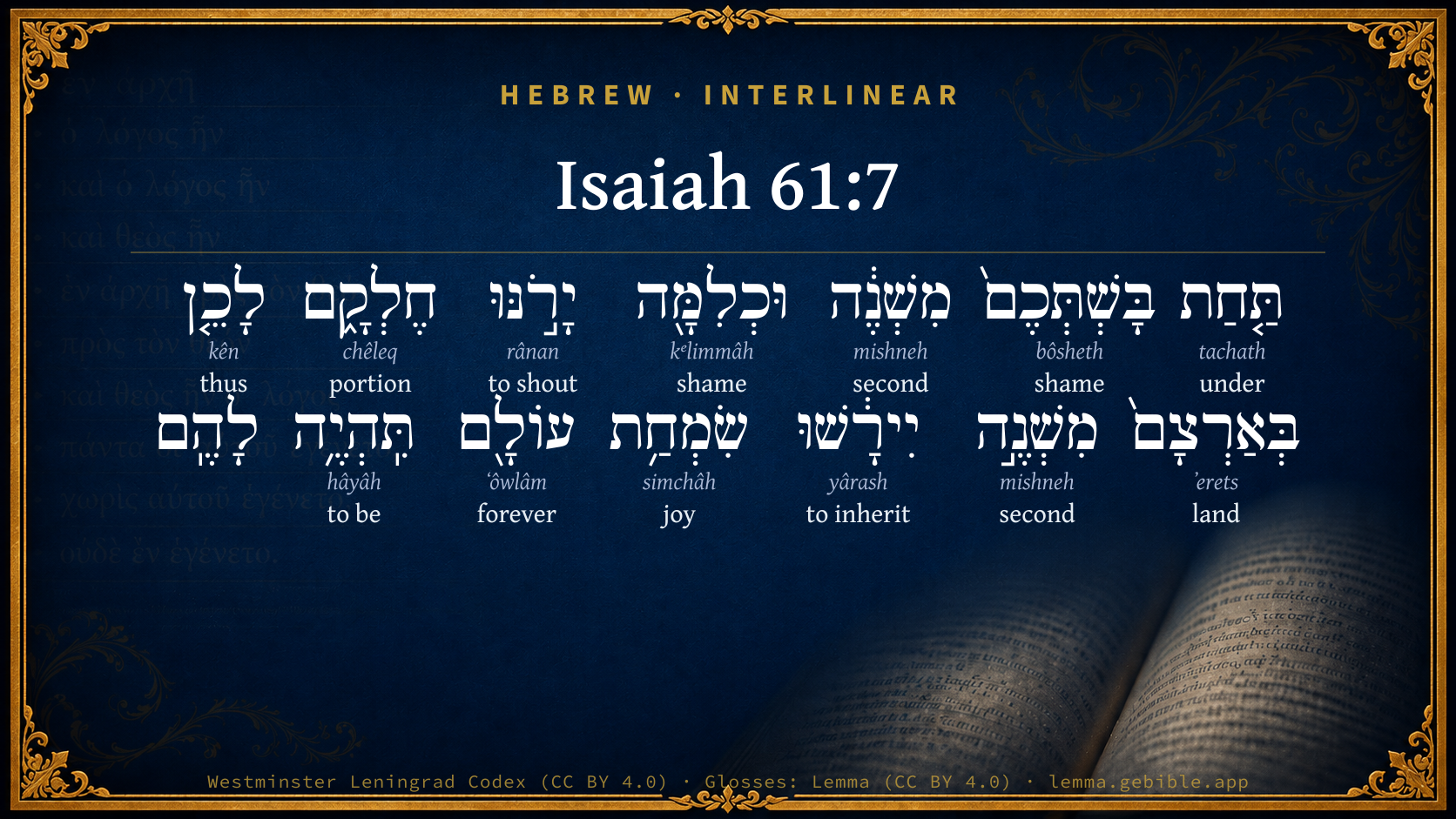
Hebrew (Westminster Leningrad Codex) Isaiah 61:7 appears in the Hebrew Old Testament. The text above is from the Westminster Leningrad Codex. Each word links to its Strong’s number, a concise gloss, and parsing drawn from the Open Scriptures Hebrew Bible morphology. Click any word for its full Brown-Driver-Briggs (BDB) entry.
Download image
Cite this verse

Isaiah 61:7 (World English Bible). Public Domain. Lemma interlinear Bible study tool, https://lemma.gebible.app/v/isaiah/61/7.

Show BibTeX & RIS
BibTeX
RIS
English Translation
Instead of your shame [you shall have] double; and instead of dishonor they shall rejoice in their portion: therefore in their land they shall possess double; everlasting joy shall be to them.
World English Bible · Public Domain
Download a study sheet

One document with this verse’s original text, its word-by-word gloss line, the meaning frame, cross-references with their text, attributed commentary, and full source and license credits — printable, and it pastes into notes with its structure intact.

This verse Autodidact and up

Study sheet (.html) Plain text (.txt)

A passage Seminary Student

Up to 50 verses in one chapter. A passage sheet keeps up to 6 commentary sources and 12 cross-references per verse, in the order this page ranks them, and says so on the sheet whenever that leaves anything out. Ask for a single verse and you get the Autodidact verse sheet above.

Everything on this page stays free to read, with no account — the sheet is a download of what is already on screen, not access to it.

Want to remove ads? Support Godless Engineer
Compare translations 3

The same verse in 3 English versions, stacked beneath the original-language interlinear above. Click any original word for its lexicon entry.

Each is an independent rendering of the whole verse — the interlinear is not word-aligned to these translations.

Highlighted words mark where these versions differ — a whole-verse word diff, not a word-by-word alignment.

  • World English Bible Public Domain
    Instead of your shame [you shall have] double; and instead of dishonor they shall rejoice in their portion: therefore in their land they shall possess double; everlasting joy shall be to them.
  • King James Version Public Domain
    For your shame ye shall have double; and for confusion they shall rejoice in their portion: therefore in their land they shall possess the double: everlasting joy shall be unto them.
  • unfoldingWord Literal Text CC BY-SA 4.0
    Instead of your shame, double, and dishonor, they will shout their portion. Therefore in their land they will possess double; joy of eternity will be to them. q1

unfoldingWord Literal Text — © unfoldingWord, licensed CC BY-SA 4.0. Word-aligned USFM3 via Door43 (git.door43.org/unfoldingWord/en_ult).

Versions to compare (up to 4)

3 of 4 selected

Show all 18 translations

Every available English version of this verse, each an independent rendering of the whole verse.

  • World English Bible Public Domain
    Instead of your shame [you shall have] double; and instead of dishonor they shall rejoice in their portion: therefore in their land they shall possess double; everlasting joy shall be to them.
  • Berean Standard Bible Public Domain
    Instead of shame, My people will have a double portion, and instead of humiliation, they will rejoice in their share; and so they will inherit a double portion in their land, and everlasting joy will be theirs.
  • Majority Standard Bible Public Domain
    Instead of shame, My people will have a double portion, and instead of humiliation, they will rejoice in their share; and so they will inherit a double portion in their land, and everlasting joy will be theirs.
  • King James Version Public Domain
    For your shame ye shall have double; and for confusion they shall rejoice in their portion: therefore in their land they shall possess the double: everlasting joy shall be unto them.
  • American Standard Version (1901) Public Domain
    Instead of your shame `ye shall have' double; and instead of dishonor they shall rejoice in their portion: therefore in their land they shall possess double; everlasting joy shall be unto them.
  • Revised Version (1885) Public Domain
    For your shame ye shall have double; and for confusion they shall rejoice in their portion: therefore in their land they shall possess double: everlasting joy shall be unto them.
  • Geneva Bible (1599) Public Domain
    For your shame you shall receiue double, and for confusion they shall reioyce in their portion: for in their lande they shall possesse the double: euerlasting ioy shall be vnto them.
  • Douay-Rheims (1899) Public Domain
    For your double confusion and shame, they shall praise their part: therefore shall they receive double in their land, everlasting joy shall be unto them.
  • Young's Literal Translation Public Domain
    Instead of your shame and confusion, A second time they sing of their portion, Therefore in their land A second time do they take possession, Joy age-during `is' for them.
  • Literal Standard Version CC BY-SA 4.0
    Instead of your shame—double [honor], || And [instead of] confusion, || They rejoice in their portion, || Therefore they take possession in their land a second time, || Continuous joy [is] for them.
  • Unlocked Literal Bible CC BY-SA 4.0
    Instead of your shame you will have double; and instead of dishonor they will rejoice over their share. So they will have a double share of their land; everlasting joy will be theirs.
  • unfoldingWord Literal Text CC BY-SA 4.0
    Instead of your shame, double, and dishonor, they will shout their portion. Therefore in their land they will possess double; joy of eternity will be to them. q1
  • Darby Bible Public Domain
    Instead of your shame [ye shall have] double; instead of confusion they shall celebrate with joy their portion: therefore in their land they shall possess the double; everlasting joy shall be unto them.
  • World Messianic Bible Public Domain
    Instead of your shame you will have double. Instead of dishonor, they will rejoice in their portion. Therefore in their land they will possess double. Everlasting joy will be to them.
  • Webster's Bible Public Domain
    For your shame ye shall have double; and for confusion they shall rejoice in their portion: therefore in their land they shall possess the double: everlasting joy shall be to them.
  • Free Bible Version CC BY-SA 4.0
    Instead of shame you will receive a double blessing; instead of insults, you will be happy to have a double amount of land given to you, and your joy will last forever.
  • Bible in Basic English Public Domain
    As they had twice as much grief, and marks of shame were their heritage, so in their land they will be rewarded twice over, and will have eternal joy.
  • JPS Tanakh (1917) Public Domain
    For your shame which was double, and for that they rejoiced: 'Confusion is their portion'; therefore in their land they shall possess double, everlasting joy shall be unto them.

Literal Standard Version (2020), Covenant Press — licensed CC BY-SA 4.0. Text via the HelloAO Bible API (eBible.org). Unlocked Literal Bible (unfoldingWord) — licensed CC BY-SA 4.0. Text via the HelloAO Bible API (eBible.org). unfoldingWord Literal Text — © unfoldingWord, licensed CC BY-SA 4.0. Word-aligned USFM3 via Door43 (git.door43.org/unfoldingWord/en_ult). Free Bible Version, Dr. Jonathan Gallagher — licensed CC BY-SA 4.0. Text via the HelloAO Bible API (eBible.org).

Word by word

More ways to search: Search by grammar → Find every occurrence → Compare this word →

Practice this passage: Drill this verse → Learn its vocabulary →

וּכְלִמָּ֖ה
kᵉlimmâh
H3639
“and · shame”
Conjunction + Noun, Common, Feminine, Singular, Absolute
Part of Speech
Conjunction + Noun
Type
Common
Gender
Feminine
Number
Singular
State
Absolute
Full BDB Definition

Origin: from H3637

TWOT: 987a

disgrace, reproach, shame, confusion, dishonour, insult, ignominy - insult, reproach - reproach, ignominy
  1. תַּ֤חַת tachath H8478 “under” Preposition
  2. בָּשְׁתְּכֶם֙ bôsheth H1322 “shame · your” Noun, Common, Feminine, Singular, Construct + Suffix, Personal, 2nd Person, Masculine, Plural
  3. מִשְׁנֶ֔ה mishneh H4932 “second” Noun, Common, Masculine, Singular, Absolute
  4. יָרֹ֣נּוּ rânan H7442 “to shout” Verb, Qal, Imperfect, 3rd Person, Masculine, Plural
  5. חֶלְקָ֑ם chêleq H2506 “portion · their” Noun, Common, Masculine, Singular, Construct + Suffix, Personal, 3rd Person, Masculine, Plural
  6. לָכֵ֤ן kên H3651 “to/for · thus” Preposition + Adverb
  7. בְּאַרְצָם֙ ʼerets H776 “in/at · land · their” Preposition + Noun, Common, Both, Singular, Construct + Suffix, Personal, 3rd Person, Masculine, Plural
  8. מִשְׁנֶ֣ה mishneh H4932 “second” Noun, Common, Masculine, Singular, Absolute
  9. יִירָ֔שׁוּ yârash H3423 “to inherit” Verb, Qal, Imperfect, 3rd Person, Masculine, Plural
  10. שִׂמְחַ֥ת simchâh H8057 “joy of” Noun, Common, Feminine, Singular, Construct
  11. עוֹלָ֖ם ʻôwlâm H5769 “forever” Noun, Common, Masculine, Singular, Absolute
  12. תִּֽהְיֶ֥ה hâyâh H1961 “to be” Verb, Qal, Imperfect, 3rd Person, Feminine, Singular

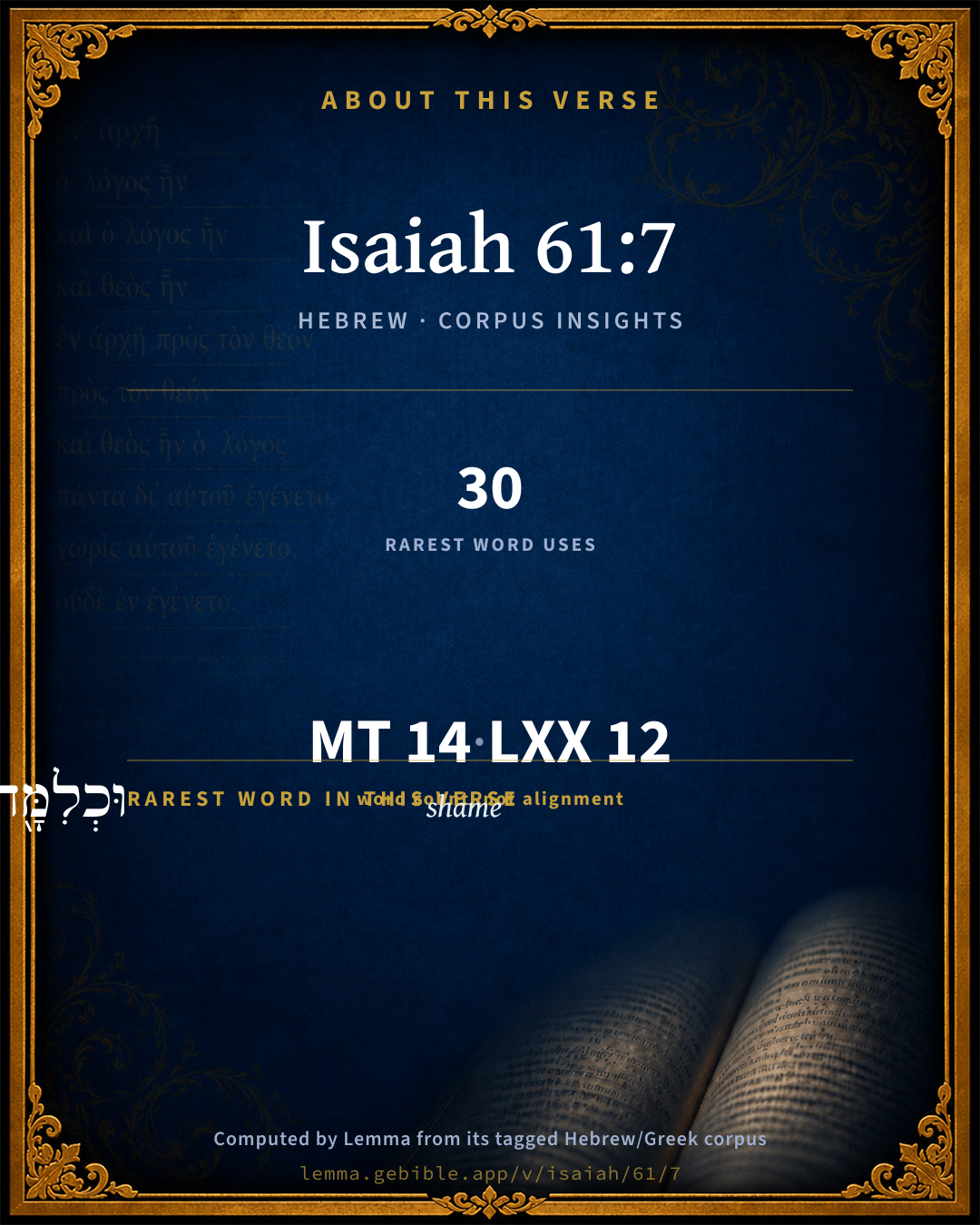
About this verse

These counts appear in no published source. They are computed here, from the morphology-tagged text and Lemma’s own curated glosses. What Lemma adds →

14
words
12
distinct lemmas
Prophets
section

Shared distinctive vocabulary

וּכְלִמָּ֖ה shame H3639 occurs in 29 verses of the Hebrew Bible. Also found in:

Grammatical profile

  • 3 verbs
  • 8 nouns
  • 2 prepositions
  • 1 adverb

Verb forms

  • יָרֹ֣נּוּ Qal · Imperfect
  • יִירָ֔שׁוּ Qal · Imperfect
  • תִּֽהְיֶ֥ה Qal · Imperfect

Repetition

A word recurs within this verse — often emphatic in Hebrew:

  • מִשְׁנֶ֔ה second H4932 ×2

Hebrew & Septuagint length

In English translation the verse runs 32 words from the Hebrew and 17 from the Septuagint (LXX English) — the Septuagint runs noticeably shorter here. See the side-by-side →

A rough comparison of the two English renderings, which tokenize alike — not a word-level alignment.

Word counts can differ between the Hebrew and the Greek without any difference in meaning — e.g. the Hebrew direct-object marker אֵת has no separate Greek word, and Greek often adds the article ὁ.

In the original languages it is 14 Hebrew tokens and 12 Greek tokens — but the two are counted differently (Hebrew bundles its prefixes and suffixes into one token; the Greek is in lemma form), so that isn’t a like-for-like length.

Cross-references

12

Topical passages linked to Isaiah 61:7 in the Treasury of Scripture Knowledge — connected by theme and wording, ordered by reader-vote popularity; previews shown in the World English Bible.

  • Job 42:10 Yahweh turned the captivity of Job, when he prayed for his friends. Yahweh gave Job twice as much as he had before.
  • Zechariah 9:12 Turn to the stronghold, you prisoners of hope! Even today I declare that I will restore double to you.
  • Isaiah 40:2 Speak comfortably to Jerusalem; and cry to her, that her warfare is accomplished, that her iniquity is pardoned, that she has received of Yahweh's hand double for all her sins.
  • Isaiah 60:19–20 The sun shall be no more your light by day; neither for brightness shall the moon give light to you: but Yahweh will be to you an everlasting light, and your God your glory.
  • Psalms 16:11 You will show me the path of life. In your presence is fullness of joy. In your right hand there are pleasures forevermore.
  • 2 Kings 2:9 It happened, when they had gone over, that Elijah said to Elisha, Ask what I shall do for you, before I am taken from you. Elisha said, please let a double portion of your spirit be on me.
  • Isaiah 51:11 The ransomed of Yahweh shall return, and come with singing to Zion; and everlasting joy shall be on their heads: they shall obtain gladness and joy; [and] sorrow and sighing shall flee away.
  • 2 Corinthians 4:17 For our light affliction, which is for the moment, works for us more and more exceedingly an eternal weight of glory;
  • Isaiah 35:10 and the ransomed of Yahweh shall return, and come with singing to Zion; and everlasting joy shall be on their heads: they shall obtain gladness and joy, and sorrow and sighing shall flee away.
  • Matthew 25:46 These will go away into eternal punishment, but the righteous into eternal life."
  • 2 Thessalonians 2:16 Now our Lord Jesus Christ himself, and God our Father, who loved us and gave us eternal comfort and good hope through grace,
  • Deuteronomy 21:17 but he shall acknowledge the firstborn, the son of the hated, by giving him a double portion of all that he has; for he is the beginning of his strength; the right of the firstborn is his.

Cross-references courtesy of OpenBible.info (CC BY 4.0).

Hebrew and Greek witnesses Masoretic Hebrew ↔ Greek Septuagint

The same verse in the two great witnesses to the Old Testament, shown verse-for-verse.

Here the Septuagint runs noticeably shorter than the Hebrew — LXX2012 (modern English Septuagint) 17 words vs World English Bible 32. A rough length comparison of the two English translations, not a word-level alignment — read both below.

These are two independent witnesses, not word-aligned to each other, and the Septuagint is shown in lemma (dictionary) form.

Hebrew Isaiah 61:7 Masoretic · Westminster Leningrad Codex

תַּ֤חַת בָּשְׁתְּכֶם֙ מִשְׁנֶ֔ה וּכְלִמָּ֖ה יָרֹ֣נּוּ חֶלְקָ֑ם לָכֵ֤ן בְּאַרְצָם֙ מִשְׁנֶ֣ה יִירָ֔שׁוּ שִׂמְחַ֥ת עוֹלָ֖ם תִּֽהְיֶ֥ה לָהֶֽם

Instead of your shame [you shall have] double; and instead of dishonor they shall rejoice in their portion: therefore in their land they shall possess double; everlasting joy shall be to them.

World English Bible · Public Domain

Greek LXX Isaiah 61:7 Septuagint · lemma form

οὕτως ἐκ δεύτερος κληρονομέω ὁ γῆ καί εὐφροσύνη αἰώνιος ὑπέρ κεφαλή αὐτός

Thus shall they inherit the land a second time, and everlasting joy shall be upon their head.

LXX2012 (modern English Septuagint) · Public Domain

On this verse, Keil & Delitzsch discusses the Septuagint’s reading. Read the note in Commentary ↓

Hebrew: Westminster Leningrad Codex (CC BY 4.0). Greek: Septuagint (public domain); English from LXX2012 (modern English Septuagint) (Public Domain). How the Septuagint differs from the Hebrew →

Targum (Aramaic paraphrase)

1

The Targum is the ancient Jewish Aramaic paraphrase of the Hebrew Scriptures — an interpretive translation, not the Hebrew text itself. Onkelos (literal) and Pseudo-Jonathan (expansive) render the Torah, and Jonathan the Prophets. Coverage is partial: where no permissively-licensed English translation exists for a verse, only the Aramaic is shown. This is verse-level text, not a word-by-word alignment to the Hebrew.

  1. Targum Jonathan Prophets (Joshua–Malachi)
    חֲלַף דִבְהַתְהוּן וְאִתְכְּנַעְתּוּן עַל חַד תְרֵין בְּטַבְוָן דַאֲמָרֵית לְכוֹן אַיְתֵי לְכוֹן וְיִתְבָּהֲתוּן עַמְמַיָא דַהֲווֹ מִשְׁתַּבְּחִין בְּחוּלַקְהוֹן בְּכֵן בְּאַרְעֲהוֹן עַל חַד תְּרֵין יַחְסְנוּן חֶדְוַת עֲלָם תְּהִי לְהוֹן:

    Instead of your having suffered shame, and confusion, I will bring unto you double mercies, from which I have promised you; and the Gentiles who glory in their portion shall be confounded: therefore in their own land they shall possess double: everlasting joy shall be unto them.

    Targum Jonathan — Aramaic: “Mikraot Gedolot” (public domain). English: “Sefaria Community Translation” (CC0 1.0 (public-domain dedication)); “London "Chaldee Paraphrase," 1871” (public domain). Text via Sefaria.

Commentary

Notes on Isaiah 61:7 from classic Christian and Jewish commentators (each source and its license shown beneath its notes). The classic Christian expositions comment on the surrounding passage and are grouped to its opening verse, so a note may address several verses; the Jewish commentaries on the Tanakh (Rashi and others) are per-verse, so they appear only where the commentator wrote on this verse.

Lemma curates 59 commentaries, every one of them public domain or Creative Commons licensed, each selected and text-cleaned for this edition rather than reprinted as found. About our sources →

Trapp's Complete Commentary

John Trapp

Isa 61:7 For your shame [ye shall have] double; and [for] confusion they shall rejoice in their portion: therefore in their land they shall possess the double: everlasting joy shall be unto them.

Ver. 7. For your shame ye shall have double,] i.e., Plentiful reparation, double damages, as Job had. {Isa 42:10; Isa 42:12}

And for confusion they shall rejoice.] Your grief shall be turned into joy, as our Saviour somewhere saith. See Mat 5:12.

Everlasting joy shall be unto them.] They shall be everlastingly merry; not so much for the double honour done to themselves, as for the enlargement of God’s kingdom, and the increase of his people, with whom they shall spiritually rejoice and reign for ever.

John Trapp, A Commentary or Exposition upon All the Books of the Old and New Testament (1647–1656) — public domain. Text from a community e-Sword module.

The Biblical Illustrator

Joseph S. Exell

Isa_61:7

Everlasting joy shall be unto them

The everlasting joy

We pore with intense earnestness over the words which picture the joys of the future.

Everlasting joy. What are its springs?

I. THE INWARD HARMONY, THE PERFECT ORDER OF THE BEING, THE CONCERT OF EVERY FACULTY AND FORCE IN THE FULFILMENT OF THE WILL OF GOD. That is the peace of God--the perfect peace. The redeemed man is the governed man; the man who has re-found the King who can evoke his loyal passions, and control and direct his manifold powers. This rule, the rule of his true King, has been lost to him through sin. This supreme, complete control of his being heaven will restore. An unsphered planet could be won back to the harmony of its sister planets only by the attraction of their common sun. The King has appeared and claimed His own. We know little of heavens occupations, the aspect of its homes, the modes of its speech, the forms of its life. We know only that the God-man is there, and reigns. He whom we can love with intensest passion, and serve with exulting joy, will meet us on its threshold, will sweep the flood of His attractions round every limb and organ of our being, and thrill us in one intense moment with the sense that we are one, that we are blessed.

II. THE FULL VISION OF THE GLORY OF GOD IN THE CREATION, the beholding of all that God has meant, and sin has marred, in the constitution of the worlds.

III. THE COMMUNION OF THE BLESSED--the joy of fellowship when the struggle and toil are ended for ever--the companionship of the elect and beloved--intercourse with the elder spirits who are before the throne. (J. R. Brown, B. A.)

The Biblical Illustrator, edited by Joseph S. Exell (c. 1880s–1900s) — public domain. Text from a community e-Sword module.

Keil & Delitzsch

C. F. Keil & F. Delitzsch

The shame of banishment will then be changed into an excess of joy, and honourable distinction. "Instead of shame ye will have double, and (instead) of insult they rejoice at their portion: thus in their land they will possess double; everlasting joy will they have. For I Jehovah love right, hate robbery in wickedness; and give them their reward in faithfulness, and conclude an everlasting covenant with them. And their family will be known among the nations, and their offspring in the midst of the nations: all who see them will recognise them, for they are a family that Jehovah hath blessed." The enigmatical first half of Isa 61:7 is explained in Isa 61:2, where mishneh is shown to consist of double possession in the land of their inheritance, which has not only been restored to them, but extended far beyond the borders of their former possession; and yârōnnū chelqâm (cf., Isa 65:14) denotes excessive rejoicing in the ground and soil belonging to them (according to the appointment of Jehovah): chelqâm as in Mic 2:4; and mishneh as equivalent not to כבוד משׁנה, but to ירשּׁה משׁנה. Taking this to be the relation between Isa 61:7 and Isa 61:7, the meaning of lâkhēn is not, "therefore, because they have hitherto suffered shame and reproach;" but what is promised in Isa 61:7 is unfolded according to its practical results, the effects consequent upon its fulfilment being placed in the foreground; so that there is less to astonish us in the elliptically brief form of Isa 61:7 which needed explanation. The transition from the form of address to that of declaration is the same as in Isa 1:29; Isa 31:6; Isa 52:14-15. וּכלמּה is a concise expression for כלמה ותחת, just as וּתהלּתי in Isa 48:9 is for תהלתי וּלמען. Chelqâm is either the accusative of the object, according to the construction of רנּן, which occurs in Psa 51:16; or what I prefer, looking at חמה in Isa 42:25, and וּזבחיך in Isa 43:23, an adverbial accusative = בחלקם. The lxx, Jerome, and Saad. render the clause, in opposition to the accents, "instead of your double shame and reproach;" but in that case the principal words of the clause would read הלקכם תּרנּוּ. The explanation adopted by the Targum, Saad., and Jerome, "shame on the part of those who rejoice in their portion," is absolutely impossible. The great majority of the modern commentators adopt essentially the same explanation of Isa 61:7 as we have done, and even A. E. Kimchi does the same. Hahn's modification, "instead of your shame is the double their portion, and (instead) of the insult this, that they will rejoice," forces a meaning upon the syntax which is absolutely impossible. The reason for the gracious recompense for the wrong endured is given in Isa 61:8, "Jehovah loves the right," which the enemies of Israel have so shamefully abused. "He hates בּעולה גזל, i.e., not rapinam in holocausto (as Jerome, Talmud b. Succa 30a, Luther, and others render it; Eng. ver. "robbery for burnt-offering") - for what object would there be in mentioning sacrifices here, seeing that only heathen sacrifices could be intended, and there would be something worse than gâzēl to condemn in them? - but robbery, or, strictly speaking, "something robbed in or with knavery" (lxx, Targ., Syr., Saad.), which calls to mind at once the cruel robbery or spoiling that Israel had sustained from the Chaldeans, its bōzezı̄m (Isa 42:24) - a robbery which passed all bounds. עולה is softened from עולה (from עול, עול), like עלתה in Job 5:16, and עולת in Psa 58:3 and Psa 64:7; though it is doubtful whether the punctuation assumes the latter, as the Targum does, and not rather the meaning holocaustum supported by the Talmud. For the very reason, therefore, that Israel had been so grievously ill-treated by the instruments of punishment employed by Jehovah, He would give those who had been ill-treated their due reward, after He had made the evil, which He had not approved, subservient to His own salutary purposes. פּעלּה is the reward of work in Lev 19:13, of hardship in Eze 29:20; here it is the reward of suffering. This reward He would give בּאמת, exactly as He had promised, without the slightest deduction. The posterity of those who have been ill-treated and insulted will be honourably known (נודע as in Pro 31:23) in the world of nations, and men will need only to catch sight of them to recognise them (by prominent marks of blessing), for they are a family blessed of God. כּי, not quod (because), although it might have this meaning, but nam (for), as in Gen 27:23, since hikkı̄r includes the meaning agnoscere (to recognise).

Keil & Delitzsch — Biblical Commentary on the Old Testament (1861–1891) — public domain (CC PDM 1.0). Text via the HelloAO Bible API. (Old Testament only.)

Tyndale Open Study Notes

Tyndale Open Resources

61:7 The people had suffered God’s wrath for their sins (40:2); now they would receive a double share of God’s blessing.

Tyndale Open Study Notes — © Tyndale Open Resources, licensed CC BY-SA 4.0. Text via the HelloAO Bible API.

Geneva Bible (1599)

Geneva Bible translators

Abundant recompense, as this word is used, Isa. 40:2.

That is, the Jews.

To wit, of the Gentiles.

Whereas the Gentiles had dominion over the Jews in times past, now they shall have double authority over them and possess twice so much.

Geneva Bible (1599) marginal notes — public domain. Text via Bolls.life.

Jamieson, Fausset & Brown

Robert Jamieson, A. R. Fausset & David Brown

double--Instead of your past share, ye shall have not merely as much, but "double" as much reward (Isa 40:2; Zac 9:12; compare the third clause in this verse).

confusion--rather, "humiliation," or "contumely."

rejoice--They shall celebrate with jubilation their portion [MAURER]. Transition from the second to the third person.

in their land--marking the reference to literal Israel, not to the Church at large.

everlasting joy-- (Isa 35:10).

Jamieson, Fausset & Brown — Commentary Critical and Explanatory on the Whole Bible (1871) — public domain (CC PDM 1.0). Text via the HelloAO Bible API.

Adam Clarke's Commentary

Verse 7. For your shame - "Instead of your shame"] The translation of this verse, which is very confused, and probably corrupted in the Hebrew, is taken from the Syriac Version; except that the latter has not expressed the word משנה mishneh, double, in the first place. Five MSS. add the conjunction ו vau to שמחת simchath. The Syriac reads תרנו taronnu, and תירשו tirashu, in the second person, "ye shall rejoice, ye shall inherit." And for להם lahem, to them, two MSS., (one of them ancient,) three of De Rossi's, and the Syriac, read לכם lachem, to you, in the second person likewise.

The Version of the Septuagint is imperfect in this place; the first half of the verse is entirely omitted in all the printed copies. It is supplied by MSS. Pachom. and I. D. II. in the following manner: -

Αντι της αισχυνης ὑμων της διπλης,

Και αντι της εντροπης αγαλλιασεται ἡ μερις αυτων·

Δια τουτο την γην αυτων εκ δευτερου -

"Instead of your shame ye shall have double,

And instead of your confusion their portion shall rejoice;

Therefore, they shall possess their land a second time."

In which the two MSS. agree, except that I. D. II. has by mistake ἡμερας, day, for ἡ μερις, the part. And Cod. Marchal., in the margin, has pretty nearly the same supplement as from Theodotion. - L.

Adam Clarke's Commentary on the Bible (1810–1826) — public domain. Text from a community e-Sword/MySword module.

Ellicott's Commentary for English Readers

(7) For your shame ye shall have double . . .—i.e., double compensation for the suffering of years (comp. Zec_9:12), the general idea passing in the next clause into a double inheritance of territory. See Note on Isa_40:2.

A Bible Commentary for English Readers, edited by Charles John Ellicott (1878–1897) — public domain. Text from a community e-Sword module.

The Cambridge Bible for Schools and Colleges

gen. ed. J. J. S. Perowne

7. The first half of the verse is harsh in construction; and the text as it stands is corrupt. The general sense, however, is sufficiently established by the second half: the prosperity of the future shall be a twofold recompense for the miseries of the past and the present.

the double] in the same sense (mutatis mutandis) as ch. Isa_40:2.

everlasting joy] ch. Isa_35:10 (= Isa_51:11).

The Cambridge Bible for Schools and Colleges (gen. ed. J. J. S. Perowne; Cambridge University Press, 1878–1918) — public domain. Text from a community e-Sword module.

John Gill's Exposition

For your shame you shall have double,.... Or, "for your double shame" (b); instead of being a reproach, a proverb, a taunt, and a curse, as the Jews now are everywhere; being converted, they will have double honour, both in things civil and religious, be in great esteem with Christ, and all his people:

and for confusion they shall rejoice in their portion; instead of the confusion and reproach they have long lain under; or of that they shall be thrown into, when first awakened and convinced of their sin, of unbelief and rejection of the Messiah; they shall rejoice in Christ their portion, and in all those spiritual blessings they will see themselves blessed with in him; they will now have the double portion of the firstborn, they once were, and to which there may be an allusion, as some think; or, as others, to the double portion of the spirit of Elijah on Elisha; they shall now have the spirit of grace and supplication poured upon them, and all the gifts and graces of the Spirit bestowed on them, all which will be cause of joy and rejoicing to them:

therefore in their land they shall possess the double; not only in the land of the Gentiles, where they have suffered reproach, shall they have double honour; but in their own land, the land of Israel, to which they shall be restored; they shall enjoy great plenty of all kind of blessings, temporal and spiritual:

everlasting joy shall be unto them; for after this they shall no more be carried captive, or be dispossessed either of their civil or religious privileges; see Isa 35:10.

(b) "pro pudore vestro duplici", Gataker, Vitringa; "loco pudoris vestri duplicis", Piscator.

John Gill's Exposition of the Whole Bible (1746–1763) — public domain (CC PDM 1.0). Text via the HelloAO Bible API.

Albert Barnes' Notes on the Bible

For your shame - That is, instead of the reproach and humiliation which you have been called to experience.

You shall have double - A double inheritance or reward (see the notes at Isa 40:2).

And for confusion - The word ‘confusion’ here means the same as a blush of shame, and refers to the scenes of humiliation and sorrow which the nation had passed through on account of its sins.

They shall rejoice - There is here a change from the second to the third person - a change which is not unfrequent in Isaiah. The same persons, however, are intended.

In their portion - That is, you shall be permitted to rejoice in the augmented privileges which you shall enjoy. They will be more than a compensation for all the calamities which you have been called to endure.

Therefore in their land - This is to be regarded as addressed to the exiles in Babylon, and the promise is, that the people of God would be restored again to their own land, and to more than their former privileges and blessings there.

The double - Double of what they formerly possessed; that is, their blessings would be greatly increased and multiplied. Applied to the times of the Messiah, to which the prophet undoubtedly refers, it means that the privileges of the friends of God would be far greater than had been enjoyed even in the most favored times under the former dispensation.

Everlasting joy - (See the notes at Isa 35:10).

Albert Barnes' Notes on the Bible (1834–1885) — public domain. Text from a community e-Sword/MySword module.

Haydock's Catholic Bible Commentary

Part: God, or the land. Converts shall bless God for having withdrawn them from the crowd of infidels, and they will rejoice in suffering for his sake, (Calmet) preferring their lot before that of unbelievers. Before this change the apostles grieved. (Worthington)

George Leo Haydock (1774–1849), Haydock's Catholic Family Bible and Commentary, 1859 edition — public domain. Excludes Psalms (Douay-Rheims chapter numbering differs from Protestant) and Deuterocanonical books (Catholic canon only).

Matthew Poole's English Annotations

For your shame ye shall have double: See Poole "Isa 40:2". Supply honour. Though you have been little accounted of among your enemies, yet now you shall be greatly in their esteem, Zec 9:12; you shall have double damages.

In their portion, viz. of honour that God will give them; the same thing with the former: or, in their inheritance which God shall restore to them; and that either,

1. For worth and value through God’s blessing upon it. Or,

2. For room and space, and that possibly by reason of the few that will return to inhabit there, viz. only a tenth part, Isa 6:13; or that which he shall give them out of their enemy’s land.

Therefore; or rather, because; being rendered as a reason of their rejoicing, because of the doubling of their portion, in which sense it is taken Isa 16:14.

Everlasting joy; of long continuance here, and everlasting hereafter; or to be perpetually remembered on their anniversary festivals: though this had its accomplishment in their return from Babylon, yet was it most signally made good in that great change for the better which they should find in the gospel state, in the enlargement of Christ’s kingdom and increase of his people, with whom they should ever rejoice together.

Matthew Poole's English Annotations on the Holy Bible (1683–1685) — public domain. Text from a community e-Sword/MySword module.

Whedon's Commentary on the Bible

Daniel D. Whedon

7. For your shame… double — The Hebrew is perplexing. Clearly another promise is here given, possibly pursuant to Isa_40:2. Instead of shame for past sin and punishment, ye shall have abundant recompense. The promise in its largeness of meaning is: Instead of the former meagerness of the dispensation out of which you have emerged, you shall have the ever-expanding glory of Messiah’s new and final order of things in this world.

Their portion… they shall possess — An enallage common to Isaiah, or a change from “your” to “their” occurs here. The same persons are intended. “Their portion” is the same as your “portion;” “they shall possess,” the same as you shall possess. The “double” means the far larger measure.

Confusion — This refers to the disorders in general of the old state — all the judgments of God on Israel’s sin.

Daniel D. Whedon (gen. ed.), Commentary on the Old and New Testaments (1874–1909) — public domain. Text from a community e-Sword module.

The Pulpit Commentary

For your shame ye shall have double. Instead of the shame and confusion of face which were the portion of Israel during the Captivity, (Isa_51:7, 23 54:4 Dan_9:7, Dan_9:8, etc.) they should after their restoration to Palestine "have double" their former glory and double their former territory. An increase of territory had been already prophesied (Isa_49:18-21) an increase which, however, was not so much an extension of the bounds of Palestine as a spread of the Church over the whole earth. (comp. Zec_9:12) For confusion; rather, as for disgrace. So far from feeling disgraced, they will rejoice, or exult, in their portion; i.e. in the territory assigned them. It will be ample; and their life in it will be one of everlasting joy. The speaker passes on in his thought to the time of the "new heavens and the new earth," which he regards as continuous with that of Israel"s return.

The Pulpit Commentary (1880–1919), ed. H.D.M. Spence-Jones & Joseph S. Exell — public domain. Text from a community e-Sword module.

John Wesley's Explanatory Notes

Double - honour. Portion - Of honour, that God will give them.

John Wesley, Explanatory Notes Upon the Whole Bible (1754–1765) — public domain. Text via the GEBible commentary corpus.

J. A. Alexander on Isaiah

Joseph Addison Alexander

“Instead of your shame (ye shall have) double, and (instead of their) confusion they shall celebrate their portion; therefore in their land shall they inherit double, everlasting joy shall be to them.” It is not impossible that the Prophet has in view the same two classes who are distinctly mentioned in the preceding verses. ‘Double’ is used indefinitely to denote a large proportion. Compare Isa 40:2.

Joseph Addison Alexander, The Prophecies of Isaiah (1846–1847; New York: Scribner, 1870–1878) — public domain. Text from a community e-Sword module.

Rashi

Rabbi Shlomo Yitzchaki (Rashi)

Instead of your shame which was twofold, even they would constantly bemoan their disgrace as their lot. That is to say that instead of until now My people were constantly bemoaning disgrace, their lot... There are instances of רִנָּה that is an expression of mourning. Comp. (Lam. 2:19) “Rise, cry (רֹנִּי) at night,” and comp. (I Kings 22:36) “A cry (הָרִנָּה) passed through the camp,” concerning Ahab’s death.

Rashi on the Tanakh — English translations: “The Judaica Press complete Tanach with Rashi, translated by A. J. Rosenberg” (CC BY 4.0); “Pentateuch with Rashi's commentary by M. Rosenbaum and A.M. Silbermann, 1929-1934” (public domain); “The Metsudah Tanach series, Lakewood, N.J” (CC BY 4.0); and “The Book of Joshua, Metsudah Publications, 1997” (CC BY 4.0). Text via Sefaria.

Ibn Ezra

Rabbi Abraham ibn Ezra

משנה Double. The verb you shall inherit is to be supplied.

ותחת כלמה═ובלמה And for confusion.

Therefore in their land, etc.

This is the explanation of the word double in the first part of the verse.

Ibn Ezra on the Tanakh — English translations: “Sefaria Community Translation” (CC0 1.0 (public-domain dedication)); “Yalkut, Sifsei Chachomim Chumash, Metsudah Publications, 2009” (CC BY 4.0); and “Commentary of Ibn Ezra on Isaiah - trans. by M. Friedlander, 1873” (public domain). Text via Sefaria.

Lesson kit

Teaching starters — assembled from the data on this page, not authored interpretation. Every prompt links to the verse data it draws on. Edit before teaching.

Isaiah, in the Prophets, opens this verse with 14 words (12 distinct Hebrew lemmas). Its most distinctive word is kᵉlimmâh (“shame”). The Greek Septuagint runs shorter here. A historical commentator’s framing appears above. Read the whole chapter for the surrounding context.

Discussion questions

  1. How does “shame” (kᵉlimmâh) shape what this verse is saying?
  2. How does Job 20:3, which shares the word «shame», read alongside this verse?
  3. What does the repetition of “second” (2× in this one verse) do in this verse?
  4. The Septuagint runs shorter here than the Hebrew. What might account for the difference?
  5. The translations on this page render this verse differently — a whole-verse word diff, not a word-by-word alignment. What might account for the different wordings?
  6. «יָרֹ֣נּוּ» is a Qal Imperfect verb. How does that grammatical form shape the action described?
  7. Compare how Trapp's Complete Commentary and The Biblical Illustrator read this verse. Where do they agree or differ?

Things to notice

Reading settings

Reading text

Shown beneath each verse's original-language words.

Old Testament
Old Testament edition

Read the OT as the Masoretic Hebrew (MT) or the Greek Septuagint (LXX).

English shown for the Greek Septuagint (in the Hebrew ↔ Greek comparison).

Comparing translations? Open the Compare panel on any verse page to stack up to four side by side.