Psalms 30:11

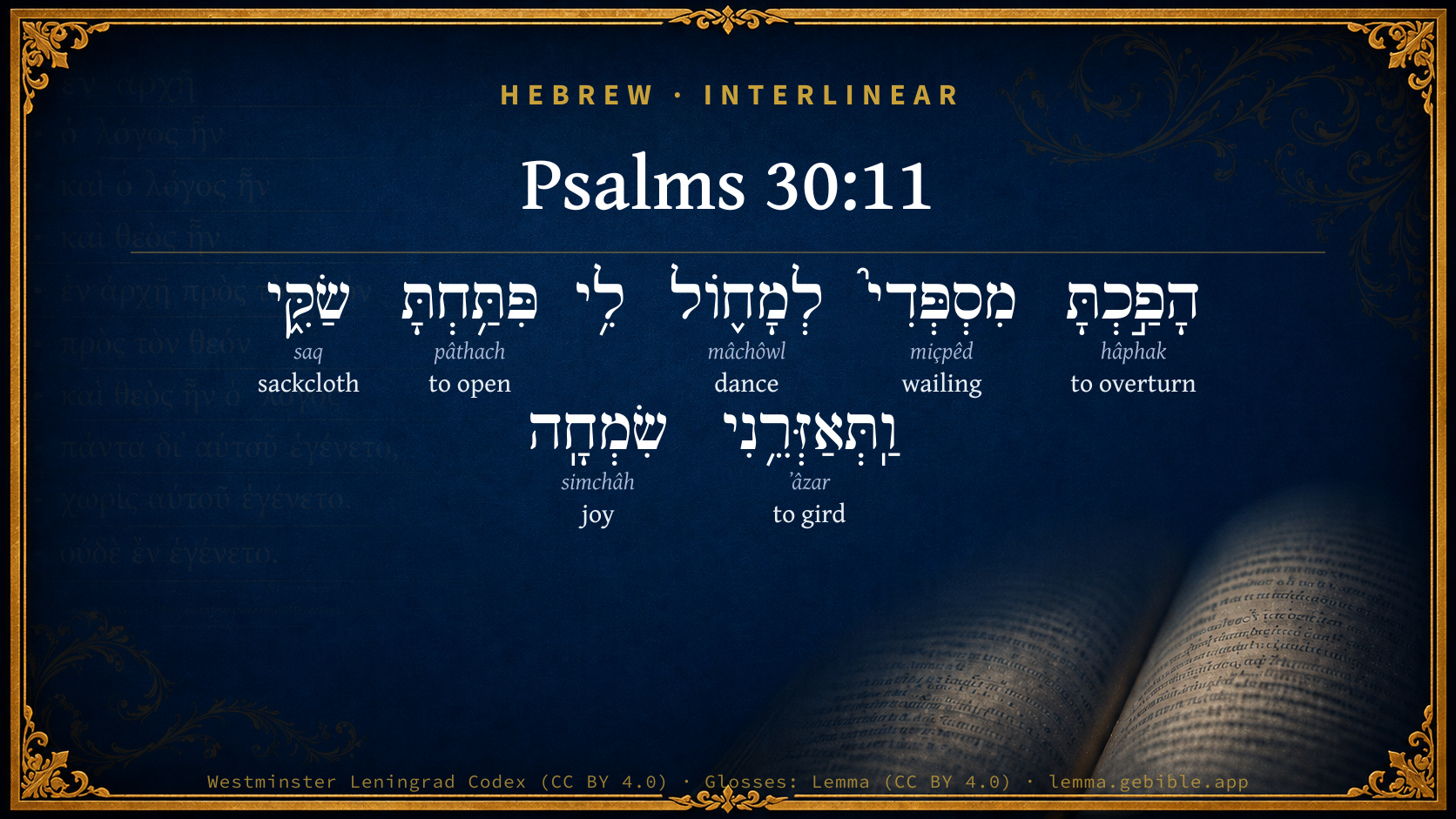
Hebrew (Westminster Leningrad Codex) Psalms 30:11 appears in the Hebrew Old Testament. The text above is from the Westminster Leningrad Codex. Each word links to its Strong’s number, a concise gloss, and parsing drawn from the Open Scriptures Hebrew Bible morphology. Click any word for its full Brown-Driver-Briggs (BDB) entry.
Download image
Cite this verse

Psalms 30:11 (World English Bible). Public Domain. Lemma interlinear Bible study tool, https://lemma.gebible.app/v/psalms/30/11.

Show BibTeX & RIS
BibTeX
RIS
English Translation
You have turned my mourning into dancing for me. You have removed my sackcloth, and clothed me with gladness,
World English Bible · Public Domain
Highlights
  • 1 first appearance in the Hebrew Bible
Full analysis ↓
Download a study sheet

One document with this verse’s original text, its word-by-word gloss line, the meaning frame, cross-references with their text, attributed commentary, and full source and license credits — printable, and it pastes into notes with its structure intact.

This verse Autodidact and up

Study sheet (.html) Plain text (.txt)

A passage Seminary Student

Up to 50 verses in one chapter. A passage sheet keeps up to 6 commentary sources and 12 cross-references per verse, in the order this page ranks them, and says so on the sheet whenever that leaves anything out. Ask for a single verse and you get the Autodidact verse sheet above.

Everything on this page stays free to read, with no account — the sheet is a download of what is already on screen, not access to it.

Want to remove ads? Support Godless Engineer
Compare translations 3

The same verse in 3 English versions, stacked beneath the original-language interlinear above. Click any original word for its lexicon entry.

Each is an independent rendering of the whole verse — the interlinear is not word-aligned to these translations.

Highlighted words mark where these versions differ — a whole-verse word diff, not a word-by-word alignment.

  • World English Bible Public Domain
    You have turned my mourning into dancing for me. You have removed my sackcloth, and clothed me with gladness,
  • King James Version Public Domain
    Thou hast turned for me my mourning into dancing: thou hast put off my sackcloth, and girded me with gladness;
  • unfoldingWord Literal Text CC BY-SA 4.0
    You have turned for me my mourning to dancing; you have loosed my sackcloth and have clothed me with gladness

unfoldingWord Literal Text — © unfoldingWord, licensed CC BY-SA 4.0. Word-aligned USFM3 via Door43 (git.door43.org/unfoldingWord/en_ult).

Versions to compare (up to 4)

3 of 4 selected

Show all 18 translations

Every available English version of this verse, each an independent rendering of the whole verse.

  • World English Bible Public Domain
    You have turned my mourning into dancing for me. You have removed my sackcloth, and clothed me with gladness,
  • Berean Standard Bible Public Domain
    You turned my mourning into dancing; You peeled off my sackcloth and clothed me with joy,
  • Majority Standard Bible Public Domain
    You turned my mourning into dancing; You peeled off my sackcloth and clothed me with joy,
  • King James Version Public Domain
    Thou hast turned for me my mourning into dancing: thou hast put off my sackcloth, and girded me with gladness;
  • American Standard Version (1901) Public Domain
    Thou hast turned for me my mourning into dancing; Thou hast loosed my sackcloth, and girded me with gladness;
  • Revised Version (1885) Public Domain
    Thou hast turned for me my mourning into dancing; thou hast loosed my sackcloth, and girded me with gladness:
  • Geneva Bible (1599) Public Domain
    Thou hast turned my mourning into ioy: thou hast loosed my sacke and girded mee with gladnesse.
  • Douay-Rheims (1899) Public Domain
    The Lord hath heard, and hath had mercy on me: the Lord became my helper.
  • Young's Literal Translation Public Domain
    Thou hast turned my mourning to dancing for me, Thou hast loosed my sackcloth, And girdest me `with' joy.
  • Literal Standard Version CC BY-SA 4.0
    You have turned my mourning to dancing for me, || You have loosed my sackcloth, || And gird me [with] joy.
  • Unlocked Literal Bible CC BY-SA 4.0
    You have turned my mourning into dancing; you have removed my sackcloth and clothed me with gladness.
  • unfoldingWord Literal Text CC BY-SA 4.0
    You have turned for me my mourning to dancing; you have loosed my sackcloth and have clothed me with gladness
  • Darby Bible Public Domain
    Thou hast turned for me my mourning into dancing; thou hast loosed my sackcloth, and girded me with gladness;
  • World Messianic Bible Public Domain
    You have turned my mourning into dancing for me. You have removed my sackcloth, and clothed me with gladness,
  • Webster's Bible Public Domain
    \\30:10\\Hear, O LORD, and have mercy upon me: LORD, be thou my helper.
  • Free Bible Version CC BY-SA 4.0
    You have turned my weeping into dancing. You have taken off my clothes of sackcloth and dressed me in happiness,
  • Bible in Basic English Public Domain
    By you my sorrow is turned into dancing; you have taken away my clothing of grief, and given me robes of joy;
  • JPS Tanakh (1917) Public Domain
    (30-12) Thou didst turn for me my mourning into dancing; Thou didst loose my sackcloth, and gird me with gladness;

Literal Standard Version (2020), Covenant Press — licensed CC BY-SA 4.0. Text via the HelloAO Bible API (eBible.org). Unlocked Literal Bible (unfoldingWord) — licensed CC BY-SA 4.0. Text via the HelloAO Bible API (eBible.org). unfoldingWord Literal Text — © unfoldingWord, licensed CC BY-SA 4.0. Word-aligned USFM3 via Door43 (git.door43.org/unfoldingWord/en_ult). Free Bible Version, Dr. Jonathan Gallagher — licensed CC BY-SA 4.0. Text via the HelloAO Bible API (eBible.org).

Word by word

More ways to search: Search by grammar → Find every occurrence → Compare this word →

Practice this passage: Drill this verse → Learn its vocabulary →

לְמָח֪וֹל
mâchôwl
H4234
“to/for · dance”
Preposition + Noun, Common, Masculine, Singular, Absolute
Part of Speech
Preposition + Noun
Type
Common
Gender
Masculine
Number
Singular
State
Absolute
Full BDB Definition

Origin: from H2342

TWOT: 623g

dance, dancing
  1. הָפַ֣כְתָּ hâphak H2015 “to overturn” Verb, Qal, Perfect, 2nd Person, Masculine, Singular
  2. מִסְפְּדִי֮ miçpêd H4553 “wailing · my” Noun, Common, Masculine, Singular, Construct + Suffix, Personal, 1st Person, Common, Singular
  3. פִּתַּ֥חְתָּ pâthach H6605 “to open” Verb, Piel, Perfect, 2nd Person, Masculine, Singular
  4. שַׂקִּ֑י saq H8242 “sackcloth · my” Noun, Common, Masculine, Singular, Construct + Suffix, Personal, 1st Person, Common, Singular
  5. וַֽתְּאַזְּרֵ֥נִי ʼâzar H247 “and · to gird · me” Conjunction + Verb, Piel, Sequential Imperfect, 2nd Person, Masculine, Singular + Suffix, Personal, 1st Person, Common, Singular
  6. שִׂמְחָֽה simchâh H8057 “joy” Noun, Common, Feminine, Singular, Absolute

About this verse

These counts appear in no published source. They are computed here, from the morphology-tagged text and Lemma’s own curated glosses. What Lemma adds →

8
words
7
distinct lemmas
Wisdom
section

Notable vocabulary

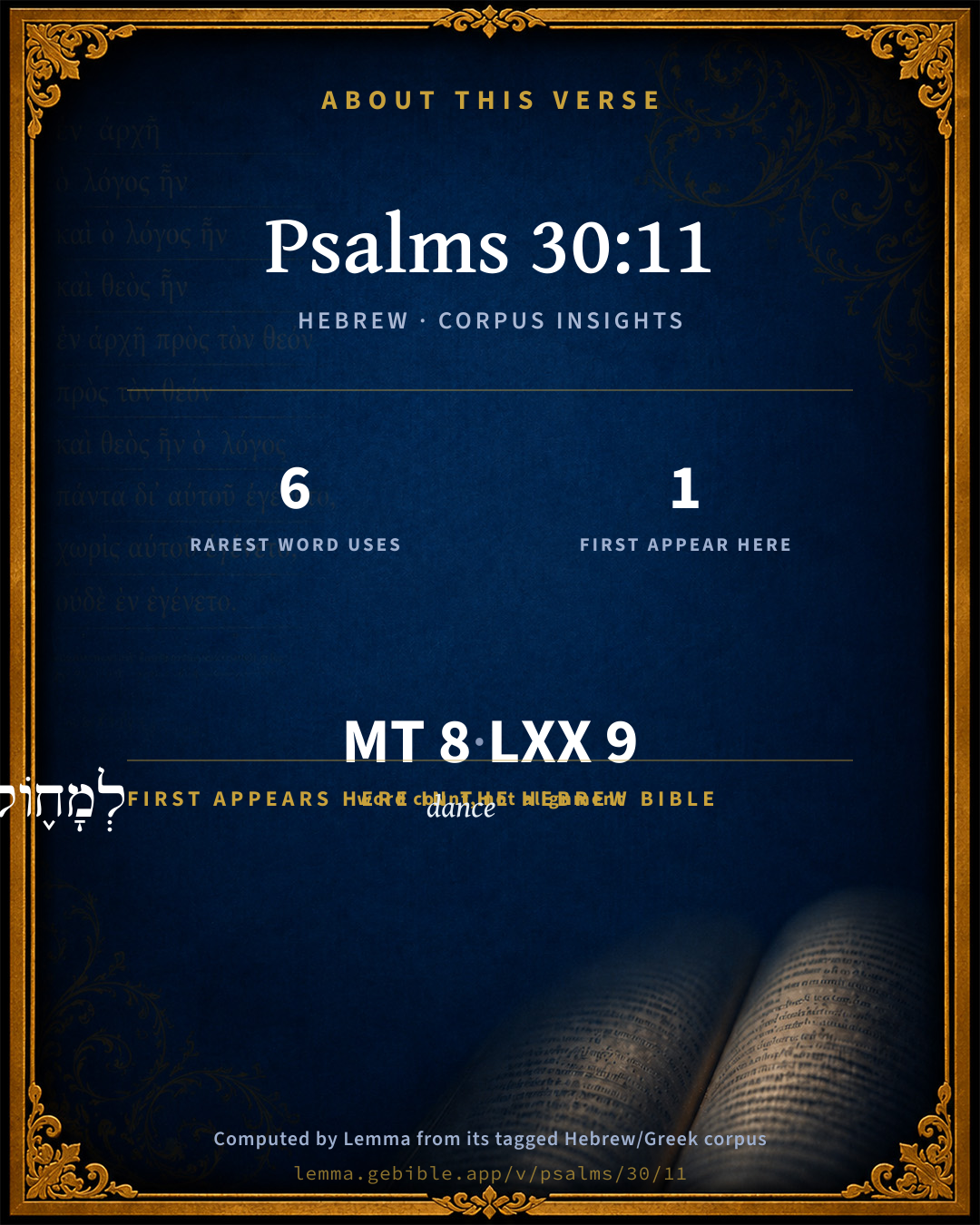
The rarest word here is לְמָח֪וֹל dance H4234 — appearing just 6 times in the whole Hebrew Bible.

First appearance in Scripture

This word makes its first canonical appearance in the Hebrew Bible here:

  • לְמָח֪וֹל dance H4234

Shared distinctive vocabulary

לְמָח֪וֹל dance H4234 occurs in 6 verses of the Hebrew Bible. Also found in:

Grammatical profile

  • 3 verbs
  • 4 nouns
  • 1 preposition

Verb forms

  • הָפַ֣כְתָּ Qal · Perfect
  • פִּתַּ֥חְתָּ Piel · Perfect
  • וַֽתְּאַזְּרֵ֥נִי Piel · Sequential Imperfect

Hebrew & Septuagint length

In English translation the verse runs 19 words from the Hebrew and 20 from the Septuagint (LXX English) — closely comparable.

A rough comparison of the two English renderings, which tokenize alike — not a word-level alignment.

Word counts can differ between the Hebrew and the Greek without any difference in meaning — e.g. the Hebrew direct-object marker אֵת has no separate Greek word, and Greek often adds the article ὁ.

In the original languages it is 8 Hebrew tokens and 9 Greek tokens — but the two are counted differently (Hebrew bundles its prefixes and suffixes into one token; the Greek is in lemma form), so that isn’t a like-for-like length.

Cross-references

26

Topical passages linked to Psalms 30:11 in the Treasury of Scripture Knowledge — connected by theme and wording, ordered by reader-vote popularity; previews shown in the World English Bible.

  • Jeremiah 31:4 Again will I build you, and you shall be built, O virgin of Israel: again shall you be adorned with your tambourines, and shall go forth in the dances of those who make merry.
  • Ecclesiastes 3:4 A time to weep, And a time to laugh; A time to mourn, And a time to dance;
  • Jeremiah 31:13–14 Then shall the virgin rejoice in the dance, and the young men and the old together; for I will turn their mourning into joy, and will comfort them, and make them rejoice from their sorrow.
  • 2 Chronicles 20:12 Our God, will you not judge them? for we have no might against this great company that comes against us; neither know we what to do: but out eyes are on you.
  • Isaiah 25:8 He has swallowed up death forever; and the Lord Yahweh will wipe away tears from off all faces; and the reproach of his people will he take away from off all the earth: for Yahweh has spoken it.
  • Psalms 149:3 Let them praise his name in the dance! Let them sing praises to him with tambourine and harp!
  • Psalms 30:5 For his anger is but for a moment; His favor is for a lifetime. Weeping may stay for the night, But joy comes in the morning.
  • Psalms 150:4 Praise him with tambourine and dancing! Praise him with stringed instruments and flute!
  • Psalms 126:1–2 When Yahweh brought back those who returned to Zion, We were like those who dream.
  • Isaiah 61:3 to appoint to those who mourn in Zion, to give to them a garland for ashes, the oil of joy for mourning, the garment of praise for the spirit of heaviness; that they may be called trees of righteousness, the planting of Yahweh, that he may be glorified.
  • Luke 15:22 "But the father said to his servants, 'Bring out the best robe, and put it on him. Put a ring on his hand, and shoes on his feet.
  • 2 Samuel 6:14 David danced before Yahweh with all his might; and David was girded with a linen ephod.
  • Isaiah 61:10 I will greatly rejoice in Yahweh, my soul shall be joyful in my God; for he has clothed me with the garments of salvation, he has covered me with the robe of righteousness, as a bridegroom decks himself with a garland, and as a bride adorns herself with her jewels.
  • Psalms 4:7 You have put gladness in my heart, More than when their grain and their new wine are increased.
  • John 16:20 Most assuredly I tell you, that you will weep and lament, but the world will rejoice. You will be sorrowful, but your sorrow will be turned into joy.
  • Revelation 21:4 He will wipe away from them every tear from their eyes. Death will be no more; neither will there be mourning, nor crying, nor pain, any more. The first things have passed away."
  • 2 Chronicles 20:9 If evil come on us, the sword, judgment, or pestilence, or famine, we will stand before this house, and before you, (for your name is in this house), and cry to you in our affliction, and you will hear and save.
  • Revelation 7:14–17 I told him, "My lord, you know." He said to me, "These are those who came out of the great tribulation. They washed their robes, and made them white in the Lamb's blood.
  • 2 Chronicles 20:27–28 Then they returned, every man of Judah and Jerusalem, and Jehoshaphat in the forefront of them, to go again to Jerusalem with joy; for Yahweh had made them to rejoice over their enemies.
  • Isaiah 66:10–11 Rejoice you with Jerusalem, and be glad for her, all you who love her: rejoice for joy with her, all you who mourn over her;
  • Genesis 45:28 Israel said, "It is enough. Joseph my son is still alive. I will go and see him before I die."
  • Nehemiah 8:10 Then he said to them, Go your way, eat the fat, and drink the sweet, and send portions to him for whom nothing is prepared; for this day is holy to our Lord: neither be you grieved; for the joy of Yahweh is your strength.
  • Esther 9:22 as the days in which the Jews had rest from their enemies, and the month which was turned to them from sorrow to gladness, and from mourning into a good day; that they should make them days of feasting and gladness, and of sending portions one to another, and gifts to the needy.
  • Isaiah 25:3 Therefore shall a strong people glorify you; a city of awesome nations shall fear you.
  • Genesis 37:35 All his sons and all his daughters rose up to comfort him; but he refused to be comforted. He said, "For I will go down to Sheol to my son mourning." His father wept for him.
  • 2 Chronicles 20:3 Jehoshaphat feared, and set himself to seek to Yahweh; and he proclaimed a fast throughout all Judah.

Cross-references courtesy of OpenBible.info (CC BY 4.0).

Hebrew and Greek witnesses Masoretic Hebrew ↔ Greek Septuagint

The same verse in the two great witnesses to the Old Testament, shown verse-for-verse.

You’re reading Greek Psalm 29 (Hebrew Psalm 30). The Septuagint counts the superscription, so verse numbers can differ from the Hebrew — chapter-level alignment, not verse-by-verse. Numbering follows Rahlfs.

These are two independent witnesses, not word-aligned to each other, and the Septuagint is shown in lemma (dictionary) form.

Hebrew Psalms 30:11 Masoretic · Westminster Leningrad Codex

הָפַ֣כְתָּ מִסְפְּדִי֮ לְמָח֪וֹל לִ֥י פִּתַּ֥חְתָּ שַׂקִּ֑י וַֽתְּאַזְּרֵ֥נִי שִׂמְחָֽה

You have turned my mourning into dancing for me. You have removed my sackcloth, and clothed me with gladness,

World English Bible · Public Domain

Greek LXX Greek Psalm 29:11 Septuagint · lemma form

ἀκούω κύριος καί ἐλεέω ἐγώ κύριος γίγνομαι βοηθός ἐγώ

You have turned my mourning into joy for me: you have torn off my sackcloth, and girded me with gladness;

LXX2012 (modern English Septuagint) · Public Domain

Hebrew: Westminster Leningrad Codex (CC BY 4.0). Greek: Septuagint (public domain); English from LXX2012 (modern English Septuagint) (Public Domain). How the Septuagint differs from the Hebrew →

Commentary

Notes on Psalms 30:11 from classic Christian and Jewish commentators (each source and its license shown beneath its notes). The classic Christian expositions comment on the surrounding passage and are grouped to its opening verse, so a note may address several verses; the Jewish commentaries on the Tanakh (Rashi and others) are per-verse, so they appear only where the commentator wrote on this verse.

Lemma curates 59 commentaries, every one of them public domain or Creative Commons licensed, each selected and text-cleaned for this edition rather than reprinted as found. About our sources →

Trapp's Complete Commentary

John Trapp

Psa 30:11 Thou hast turned for me my mourning into dancing: thou hast put off my sackcloth, and girded me with gladness;

Ver. 11. Thou hast turned for me my mourning, &c.] Sustulisti luctum, et laetitiam attulisti. {See Trapp on "Psa 30:5"}

John Trapp, A Commentary or Exposition upon All the Books of the Old and New Testament (1647–1656) — public domain. Text from a community e-Sword module.

The Biblical Illustrator

Joseph S. Exell

Psa_30:11-12

Thou hast turned for me my mourning into dancing.

Easter joy

Here is described a change, complete, and more or less sudden, from sadness to joy. David has escaped a danger which had brought him very near to death; and now he is thankful and exultant. His words are in keeping with what Christians feel, as they pass from the last days of Holy Week into the first hours of Easter. If Easter is associated predominantly with any one emotion, it is with that of joy. And thus, ever since, the Church of Christ has laboured to make the Easter festival, beyond all others, the feast of Christian joy. All that nature and art could furnish has been summoned to express, so far as outward things may, this overmastering emotion of Christian souls worshipping at the tomb of their Risen Lord. All the deliverances of Gods ancient people, from Egypt, from Assyria, from Babylon, are but rehearsals of the great deliverance of all on the Resurrection morning; and each prophet and psalmist that heralds any of them, sounds in Christian ears some separate note of the Resurrection hymn. And this, the joy which fills the soul of the believing Church on Easter Day, has some sort of echo in the world outside; so that those who sit loosely to our faith and hope, and who worship rarely, if ever, before our altars, yet feel that good spirits are somehow in order on Easter morning. For their sakes, as for our own, let us try to take the emotion to pieces, as we find it in a Christian soul; let us ask why it is so natural for Christians to say, this day, with David, Thou hast turned my heaviness into joy: Thou hast put off my sackcloth, and girded me with gladness.

I. The first reason, then, for this Easter joy is the triumph and satisfaction enjoyed by our Lord himself. We follow Him in the stages of His sufferings and death. We sympathize reverently with the awful sorrows of our Adorable Lord and Friend; and thus we enter, in some far-off way, into the sense of triumph, unspeakable and sublime, which follows beyond it. It is His triumph; that is the first consideration; His triumph, who was but now so cruelly insulted and tortured. It is all over now; by a single motion of His Majestic Will, He is risen. And we, as we kneel before Him, think, first of all, of Him. It is His joy which inspires ours; it turns our heaviness into joy, and puts off our sorrow and girds us with gladness. Do I say this is the case? Perhaps it were more prudent to say that it ought to be. For in truth the habit of getting out of and forgetting our miserable selves in the absorbing sense of the beauty and magnificence of God, belongs rather to ancient than to modern Christianity. To those old Christians God was all, man nothing, or well-nigh nothing. Theirs was a disinterested interest in God. With us, we are too prone to value God, not so much for His own sake as for ours. Be it yours to show that my misgiving is unwarranted. You know that pure sympathy with an earthly friends happiness loaves altogether out of consideration the question whether it contributes anything to your own; and in like manner endeavour to say to-day to your Heavenly Friend: It is because Thou, Lord Jesus, hast vanquished Thine enemies, hast overcome death, and hast entered into Thy glory, that Thou hast turned my Lenten heaviness into joy, and put off my sackcloth and girded me with gladness.

II. because of the sense of confidence with which Christs resurrection from the dead invigorates our grasp of Christian truth. The mind loves to rest truth on a secure basis. This is what the old Roman poet meant by saying that the man was really happy who had attained to know the causes of things. The chemist who has at last explained the known effect of a particular drug, by laying bare, upon analysis, an hitherto undiscovered property in it; the historian who has been enabled to show that the conjecture of years rests on the evidence of a trustworthy document; the mathematician on whom has flashed the formula which solves some problem that has long haunted and eluded him; the anatomist who has been able to refer what he had hitherto regarded as an abnormal occurrence to the operation of a recognized law;--these men know what joy is. Now, akin to the joy of students and workers is the satisfaction of a Christian when he steadily dwells on the Resurrection of our Lord Jesus Christ. The Christian Creed is like a tower which rears towards heaven its windows and pinnacles in successive stages of increasing gracefulness. We lavish our admiration first on this detail of it, and then on that; and, while we thus study and admire, we dwell continuously in its upper stories, till at last perhaps a grave question occurs or is suggested to us. What does it all rest upon? What is the foundation-fact on which this structure has been reared in all its august and fascinating beauty? What fact, if removed, would be fatal to it? And the answer is--our Lords Resurrection is one such fact. He was declared to be the Son of God with power by the Resurrection from the dead. Yes; it is here, beside the empty tomb of the Risen Jesus, that Christian faith feels itself on the hard rock of fact; here we break through the tyranny of matter and sense, and rise with Christ into the immaterial world; here we put a term to the enervating alternation of guesses and doubts which prevails elsewhere, and we reach the frontier of the absolutely certain. And we can but answer, Truly, Lord Jesus, by Thy Resurrection Thou hast turned my heaviness into joy: Thou hast put off my sackcloth, and gilded me with gladness.

III. And because of the assurance it gives of our own resurrection. Paganism could only guess and speculate as to the immortality of the soul. It is the Gospel which gives certainty; it has unveiled the immortality of man in his completeness, in body and in soul. Thus shall we recognize our friends in heaven, for they shall wear there the features and the expression which they wore on earth. All men shall rise with their bodies. Joyfully, therefore, do we think of the blessed dead. (Canon Liddon.)

Girded me with gladness.--

Elevation of feeling

For the expression and manifestation of the state in which we are, God has made a rich provision of power. The forehead, the eye, the mouth, the whole face, the hands, the arms, the gait, and especially the voice, are so many instruments and agents of expression; and we are not true to ourselves, we are false to our condition, we are disloyal to God, when we clothe ourselves with a uniform reticence and unexpressiveness of demeanour. The clouds drop their blackness and appear brilliantly coloured and gorgeously gilded when the sun shines on them. The sea casts off its leaden hue and is covered with crisped smiles when the storm is over. The battle-field absorbs the blood which, in the day of war, is spilt on its bosom, and exhibits lovely flowers, or verdant pasture, or golden corn. The earth casts off her winterly attire and puts on her summerly vestments when the time of the singing of birds has come. In like manner there is in human life and experience the turning of mourning into dancing; the putting off of sackcloth and the girding with gladness. (S. Martin.)

Praise continuous

One summer day I watched a lark rise from a field, and I listened with almost rapture to its unequalled song. The bird rose in successive stages, singing while rising and singing while resting, and the last ascent it made caused it to appear like a speck on the blue sky, an almost imperceptible spring of sweet music in the heavens. Nothing appeared wanting to complete the scene but the opening of the heavenly gates to receive this minister of song, that its sacrifice of sweetest sounds might be laid on the altar of God. But while thinking of this consummation the bird began to descend, falling rapidly in successive stages until near the earth, and then flying horizontally until it was lost in its nest. Does not the ascent and descent of this favourite songster represent our praise to God? Our glory is not always silent. We do sometimes sing praise to our God, and we rise into glorious elevations of feeling and of thought. But if we rise high in the morning, we fall low before noon; if we ascend on the Lords day, we sink low on other days. A day will come in which there shall be a final putting off of sackcloth, and a final girding with gladness; and in that day silence shall be broken for ever, and our eternal life shall be one eternal psalm and service of praise. (S. Martin.)

.

Psa_31:1-24

The Biblical Illustrator, edited by Joseph S. Exell (c. 1880s–1900s) — public domain. Text from a community e-Sword module.

Joseph Benson's Commentary

Psa 30:11. Thou hast turned for me, &c. — Having related his prayer, he now declares the gracious answer which God gave him. Thou hast put off my sackcloth — Hast given me occasion to put it off, alluding to the sackcloth which they used to wear in times of mourning, and with which possibly, in an humble compliance with the divine providence, David had clothed himself, in his distress; or, perhaps, he speaks figuratively, and only means that God had taken away his sorrow with the causes of it. And girded me with gladness — Either with garments of gladness, or rejoicing: or with joy, as with a garment, surrounding me on every side; as Psa 18:32, for a similar reason he is said to be girded with strength.

Joseph Benson's Commentary on the Old and New Testaments (1811–1818) — public domain. Text from a community e-Sword module.

J. A. Alexander on Psalms

Joseph Addison Alexander

12. (Psa 30:11). Thou hast turned my lament into a dance for me; thou hast opened my sackcloth and hast girded me (with) joy. To his prayer he now adds the account of its fulfilment. The relief of his distress is described as an exchange of his lament or funeral song for a joyful dance, Compare Jer 31:13, Lam 5:15. In further allusion to the mourning customs of the east, he represents his mourning dress, made of the coarsest hair-cloth, as now opened, i.e. loosened, unfastened, for the purpose of removal, to be replaced not merely by a gay or festive dress, but by joy itself, poetically represented as a garment. See above, on Psa 18:33; Psa 18:40 (32, 39), and compare Isa 61:3.

Joseph Addison Alexander, The Psalms Translated and Explained (1850) — public domain. Text from a community e-Sword module.

Jamieson, Fausset & Brown

Robert Jamieson, A. R. Fausset & David Brown

sackcloth--was used, even by kings, in distress (Ch1 21:16; Isa 37:1) but "gladness," used for a garment, shows the language to be figurative.

Jamieson, Fausset & Brown — Commentary Critical and Explanatory on the Whole Bible (1871) — public domain (CC PDM 1.0). Text via the HelloAO Bible API.

Adam Clarke's Commentary

Verse 11. Thou hast turned - my mourning into dancing] Rather into piping. I have not prayed in vain. Though I deserved to be cut off from the land of the living, yet thou hast spared me, and the remnant of my people. Thou hast taken away my sackcloth, the emblem of my distress and misery, and girded me with gladness, when thou didst say to the destroying angel, when he stood over Jerusalem ready to destroy it: "It is enough, stay now thy hand;" 2Sa 24:16.

Adam Clarke's Commentary on the Bible (1810–1826) — public domain. Text from a community e-Sword/MySword module.

John Calvin's Commentaries

11. Thou hast turned my mourning into dancing. David concludes the psalm as he had begun it, with thanksgiving. He affirms that it was by the help and blessing of God that he had escaped safe; and he then adds, that the final object of his escape was, that he might employ the rest of his life in celebrating the praises of God. Moreover, he shows us that he was not insensible or obdurate under his afflictions, but mourned in heaviness and sorrow; and he also shows that his very mourning had been the means of leading him to pray to God to deprecate his wrath. Both these points are most worthy of our observation, in order, first, that we may not suppose that the saints are guilty of stoical insensibility, depriving them of all feeling of grief; and, secondly, that we may perceive that in their mourning they were exercised to repentance. This latter he denotes by the term sackcloth. It was a common practice among the ancients to clothe themselves with sackcloth when mourning, This custom was not confined to the Israelites. It was practiced also among the heathen nations. An instance of this is recorded in Jonah 3:5-8. It appears from Plutarch, that this was also sometimes practiced among the Greeks. The Hebrew word for sackcloth is שק, sak; and it is remarkable that the word sak exists in various languages, denoting the same thing. It shows the unaffected character of real sorrow, leading men to neglect the adorning of their persons, when we find several nations manifesting it by wearing the same dismal garb, and employing a word of the same sound to express it.

“Ne monstrant qu’abjection et desplaisanee d’eux-mesmes. — Fr.

John Calvin's Commentaries (1540-1563) — public domain. Text from the Calvin Translation Society English edition (1840s-50s) via the Christian Classics Ethereal Library (ccel.org). Calvin's coverage is partial (roughly two-thirds of the Bible); uncommented books and verses are honest gaps, never fabricated. The 19th-century editor's footnotes and remarks are omitted so the notes are faithfully Calvin's own voice.

Ellicott's Commentary for English Readers

(11) Thou hast turned for me.—This verse gives the answer to the prayer. Mourning is literally beating the breast, and therefore dancing forms a proper parallelism; or else, according to one derivation of the word, machôl would suggest piping. (See margin, Psa_149:3; Psa_150:4; see Smith’s Bible Dictionary, under “Dance;” and Bible Educator, vol. ii., p. 70; and comp. Note to Son_6:13.)

A Bible Commentary for English Readers, edited by Charles John Ellicott (1878–1897) — public domain. Text from a community e-Sword module.

The Cambridge Bible for Schools and Colleges

gen. ed. J. J. S. Perowne

11. Better, Thou didst turn … didst loose … and gird. He looks back to the moment when his prayer was answered.

mourning … dancing] The gestures of sorrow and joy are contrasted, for mourning means literally the beating of the breast (planctus). Cp. Lam_5:15. In place of the sackcloth which was the mourner’s garb, gladness clothes him like a festal garment. Cp. Isa_61:3.

11, 12. Prayer answered: life prolonged, and its purpose.

The Cambridge Bible for Schools and Colleges (gen. ed. J. J. S. Perowne; Cambridge University Press, 1878–1918) — public domain. Text from a community e-Sword module.

John Gill's Exposition

Those hast turned for me my mourning into dancing,.... This, with what follows, expresses the success he had in seeking the Lord by prayer and supplication; there was a sudden change of things, as it often is with the people of God; sometimes they are mourning by reason of sin, their own and others; or on account of afflictions; or because of spiritual decays; or through the temptations of Satan; or, as it was the case of the psalmist now, because of the hidings of God's face; but this mourning is exchanged for joy and gladness when the Lord discovers his pardoning love, revives his work in their souls, takes off his afflicting hand from them, rebukes the tempter, and delivers out of his temptations, and shows himself, his grace and favour;

thou hast put off my sackcloth; which was used in mourning for relations, and in times of calamity and distress, and as a token of humiliation and repentance, Gen 37:34;

and girded me with gladness; by these phrases the same thing is signified as before; see Isa 61:3.

John Gill's Exposition of the Whole Bible (1746–1763) — public domain (CC PDM 1.0). Text via the HelloAO Bible API.

Albert Barnes' Notes on the Bible

Thou hast turned for me - In my behalf. That is, God had heard his prayer; he had brought his troubles to an end; he had caused his sorrows to be succeeded by correspondent joy.

My mourning into dancing - Joy, exultation, every expression of rejoicing, had been made to succeed his deep sorrows. Compare Psa 30:5. It was this which he commemorated at the dedication of his house; this joy succeeding scenes of sorrow that he now called to remembrance as he entered the place which he had reared for a permanent abode. The contrast of his circumstances now - in a palace, with every comfort of plenty and peace around him - with his former circumstances which had been so sad, made it proper for him thus to celebrate the goodness of God.

Thou hast put off my sackcloth - That which I wore, or had girded around me, as an emblem of sorrow, or in the time of my mourning. See Isa 3:24, note; Job 16:15, note; and Mat 11:21, note.

And girded me with gladness - Instead of a girdle of sackcloth he had been clothed in a festive dress, or with such a dress - girded with an elegant girdle - as was worn on joyous and festive occasions. See the notes at Mat 5:38-41.

Albert Barnes' Notes on the Bible (1834–1885) — public domain. Text from a community e-Sword/MySword module.

Matthew Poole's English Annotations

Having related his prayer, he now declares the gracious answer which God gave him.

Put off my sackcloth, i.e. given me occasion to put off that sackcloth, which they used to wear in times of mourning. See Est 4:1; Psa 35:13; Isa 32:11; Joe 1:13.

With gladness; either with garments of gladness or rejoicing; or with joy, as with a garment surrounding me on every side; as he is for the like reason said to be girded with strength, Psa 18:32.

Matthew Poole's English Annotations on the Holy Bible (1683–1685) — public domain. Text from a community e-Sword/MySword module.

The Treasury of David

Charles H. Spurgeon

Ver. 11. Observe the contrast, God takes away the mourning of his people; and what does he give them instead of it? Quiet and peace? Aye, and a great deal more than that. Thou hast turned for me my mourning into dancing. He makes their hearts to dance at the sound of his name. He takes off their sackcloth. That is good. What a delight to be rid of the habiliments of woe! But what then? He clothes us. And how? With some common dress? Nay, but with that royal vestment which is the array of glorified spirits in heaven. Thou hast girded me with gladness. This is better than to wear garments of silk or cloth of gold, bedight with embroidery and bespangled with gems. Many a poor man wears this heavenly apparel wrapped around his heart, though fustian and corduroy are his only outward garb; and such a man needs not envy the emperor in all his pomp. Glory be to thee, O God, if, by a sense of full forgiveness and present justification, thou hast enriched my spiritual nature, and filled me with all the fulness of God.

Ver. 11. Thou hast turned for me my mourning into dancing: thou hast put off my sackcloth, and girded me with gladness. This might be true of David, delivered from his calamity; it was true of Christ, arising from the tomb, to die no more; it is true of the penitent, exchanging his sackcloth for the garments of salvation; and it will be verified in all us, at the last day, when we shall put off the dishonours of the grave, to shine in glory everlasting. George Horne.

Ver. 11. Thou hast turned. I do so like the ups and downs in the Psalms. Adelaide Newton.

Ver. 11. Thou hast put off my sackcloth, and girded me with gladness. I say with the apostle, "Overcome evil with good, " sorrow with joy. Joy is the true remedy for sorrow. It never had, never could have any other. We must always give the soul that weeps reason to rejoice; all other consolation is utterly useless. Alexander Rodolph Vinet, D.D., 1797-1847.

Ver. 11. Thou hast girded me with gladness. My "sackcloth" was but a loose garment about me, which might easily be put off at pleasure, but my "gladness" is girt about me, to be fast and sure, and cannot leave me though it would; at least none shall be able to take it from me. Sir Richard Baker.

Ver. 11. Transformations. Sudden; complete; divine, thou; personal, "for me; "gracious.

Ver. 11. Holy dancing: open up the metaphor.

Ver. 11. The believer's change of raiment: illustrate by life of Mordecai or Joseph; mention all the garbs the believer is made to wear, as a mourner, a beggar, a criminal, &c.

Psalms 30:12*

Charles H. Spurgeon's The Treasury of David (1869–1885) — public domain. Psalms only. Text from a community e-Sword/MySword module.

Whedon's Commentary on the Bible

Daniel D. Whedon

11. Dancing—This is not to be taken literally. “Dancing, here, is poetical of joy, or shouts of joy—thanksgiving and songs.”—Hupfeld. See this usage in Jer_31:4; Jer_31:13; Lam_4:15. This sense is confirmed by the parallel word “gladness,” in next hemistich. The Hebrews, especially the women, sang responsively and danced upon great festive occasions, as in Exodus 15; Judges 5; 1Sa_18:6-7; 2Sa_6:14; 2Sa_6:16; but dancing was never permanently attached to their religious worship. See notes on Psa_42:4; Psa_149:3

Daniel D. Whedon (gen. ed.), Commentary on the Old and New Testaments (1874–1909) — public domain. Text from a community e-Sword module.

The Pulpit Commentary

Thou hast turned (rather, thou turnedst) for me my mourning into dancing. Suddenly, in a moment, all was changed. The angel ceased to slay. God bade him hold his hand. The Prophet Gad was sent with the joyful news to David, and commanded him at once to build an altar at Jehovah. Then the mourning ceased, and a joyful ceremonial was instituted, of which dancing, as so often, formed a part. (see Exo_15:20 1Sa_18:6 2Sa_6:14-16 Psa_149:3 Jer_31:4) Thou hast put off (rather, didst put off) my sackcloth. That the king had clothed himself in sackcloth on the occasion, is mentioned by the author of Chronicles. (1Ch_21:16) And girded (girdedst) me with gladness. (comp. 1Ch_21:26)

The Pulpit Commentary (1880–1919), ed. H.D.M. Spence-Jones & Joseph S. Exell — public domain. Text from a community e-Sword module.

John Wesley's Explanatory Notes

Sackcloth - Given me occasion to put off that sackcloth, which they used to wear in times of mourning, Esth iv, 1 chap. xxxv, 13 Isaiah xxxii, 11 Joel i, 13. Girded - With joy, as with a garment, surrounding me on every side.

John Wesley, Explanatory Notes Upon the Whole Bible (1754–1765) — public domain. Text via the GEBible commentary corpus.

Keil & Delitzsch

C. F. Keil & F. Delitzsch

(Heb.: 30:12-13) In order to express the immediate sequence of the fulfilling of the prayer upon the prayer itself, the otherwise (e.g., Psa 32:5) usual ו of conjunction is omitted; on הפכתּ וגו cf. the echoes in Jer 31:13; Lam 5:15. According to our interpretation of the relation of the Psalm to the events of the time, there is as little reason for thinking of Sa2 6:14 in connection with מחול, as of Ch1 21:16 in connection with שׂקּי. In place of the garment of penitence and mourning (cf. מחגרת שׂק, Isa 3:24) slung round the body (perhaps fastened only with a cord) came a girding up (אזּר, synon. חגר Psa 65:13, whence אזור, חגרה) with joy. The designed result of such a speedy and radical change in his affliction, after it had had the salutary effect of humbling him, was the praise of Jahve: in order that my glory (כּבוד for כּבודי = נפשׁי, as in Psa 7:6; Psa 16:9; Psa 108:2) may sing Thy praises without ceasing (ידּם fut. Kal). And the praise of Jahve for ever is moreover his resolve, just as he vows, and at the same time carries it out, in this Psalm.

Keil & Delitzsch — Biblical Commentary on the Old Testament (1861–1891) — public domain (CC PDM 1.0). Text via the HelloAO Bible API. (Old Testament only.)

unfoldingWord translationNotes

Door43 World Missions Community

You have turned my mourning into dancing

It was customary for the Jews to dance when they were very happy. The abstract nouns "mourning" and "dancing" can be stated as verbs. AT: "You have caused me to stop mourning and to dance with joy instead" (See: Abstract Nouns)

you have removed my sackcloth

Sackcloth was associated with mourning and sorrow. AT: "You have caused me to no longer be sad" (See: Metonymy)

clothed me with gladness

The writer speaks of gladness as if it were a garment that he could put on. AT: "caused me to be glad" (See: Metaphor)

my glory will sing praise to you

Here "my glory" refers to the writer's soul or heart or inner being. This represents the entire person of the writer, who worships God because God has made him glad. AT: "I will sing praise to you" (See: Synecdoche)

translationWords

mourn

sackcloth

clothe

glory

praise

eternity

unfoldingWord translationNotes — © Distant Shores Media and the Door43 World Missions Community, licensed CC BY-SA 4.0. Source: git.door43.org/Door43/en_tn.

Lesson kit

Teaching starters — assembled from the data on this page, not authored interpretation. Every prompt links to the verse data it draws on. Edit before teaching.

Psalms, in the Wisdom, opens this verse with 8 words (7 distinct Hebrew lemmas). Its most distinctive word is mâchôwl (“dance”). A historical commentator’s framing appears above. Read the whole chapter for the surrounding context.

Discussion questions

  1. The word mâchôwl carries the sense “dance.” How does it shape the verse?
  2. This is the first place “dance” appears in Scripture (first appears here). What does its debut here establish?
  3. How does Psalms 149:3, which shares the word «dance», read alongside this verse?
  4. The translations on this page render this verse differently — a whole-verse word diff, not a word-by-word alignment. What might account for the different wordings?
  5. «הָפַ֣כְתָּ» is a Qal Perfect verb. How does that grammatical form shape the action described?
  6. Compare how Trapp's Complete Commentary and The Biblical Illustrator read this verse. Where do they agree or differ?

Things to notice

Reading settings

Reading text

Shown beneath each verse's original-language words.

Old Testament
Old Testament edition

Read the OT as the Masoretic Hebrew (MT) or the Greek Septuagint (LXX).

English shown for the Greek Septuagint (in the Hebrew ↔ Greek comparison).

Comparing translations? Open the Compare panel on any verse page to stack up to four side by side.