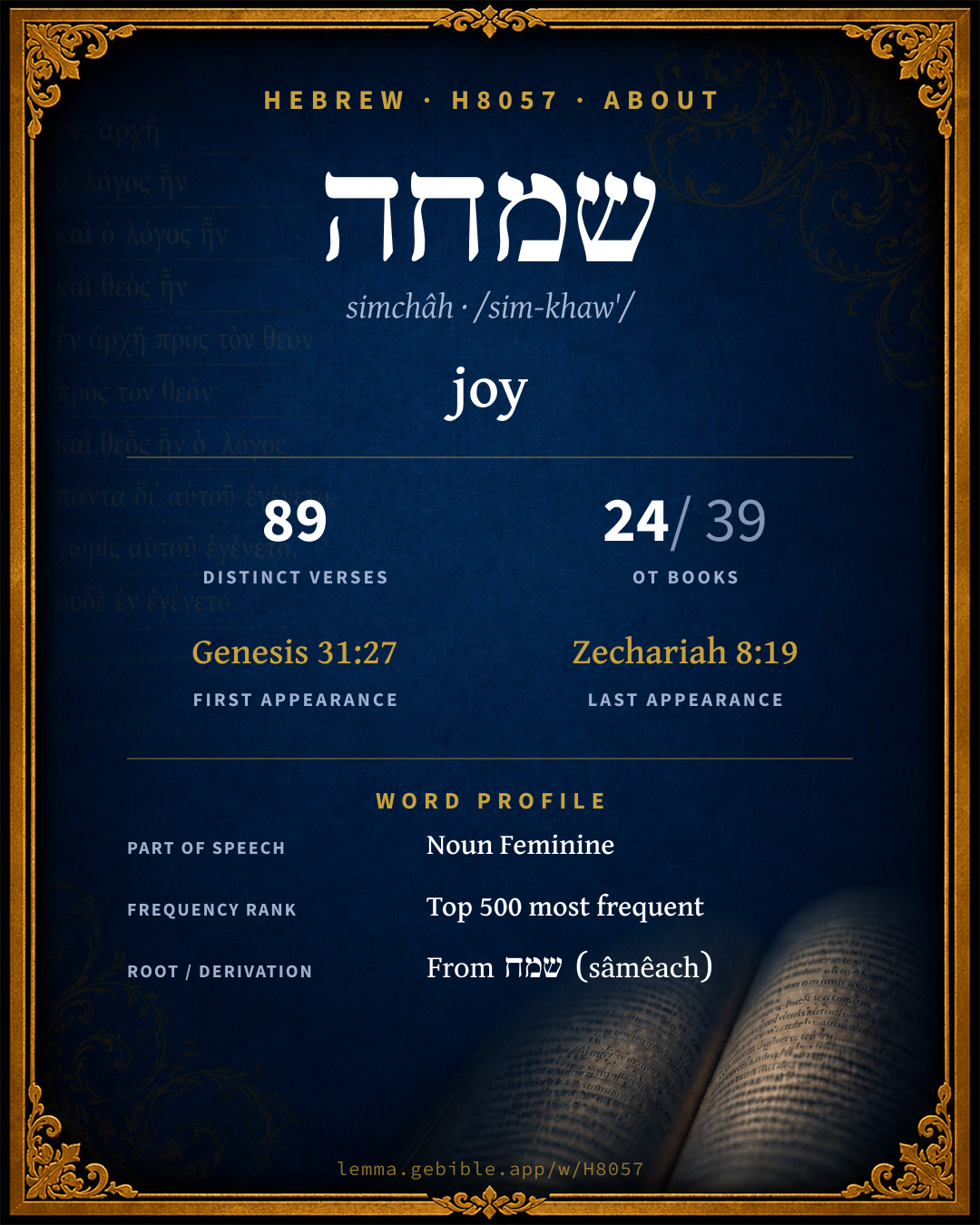
שִׂמְחָה
joy
also: mirth, gladness fuller range ↓
Full lexicon entry — Brown-Driver-Briggs (BDB)
From Brown-Driver-Briggs (BDB)
Where this word appears
Grammar key — what these labels mean
Part of speech
- Noun
- A naming word — a person, place, thing, or idea.
Noun type
- Common
- A common noun — a general class of person, place, or thing (“king,” “city,” “water”), not a specific name.
State
- Absolute
- The independent form of a noun, not bound to a following word.
- Construct
- A noun bound to a following noun in a possessive / “of” relationship (the construct chain).
Gender
- Feminine
- Grammatically feminine.
Number
- Singular
- One.
- Plural
- More than one (in Hebrew, generally three or more).
Every verse where H8057 appears in the Book of 1 Chronicles — 6 distinct verses. Click any verse to open its interlinear word-by-word view. Verse text shown in the World English Bible for context — . Each verse’s Hebrew form is shown with its reference; the English is not keyword-highlighted, since the data carries no word-level English alignment. Use “Compare translations” on any verse to read it across multiple English versions. This concordance covers the Hebrew Bible; Septuagint (Greek Old Testament) occurrences are not indexed here.
1 Chronicles
- 1 Chronicles 12:40 שִׂמְחָ֖ה n c fs Moreover those who were near to them, [even] as far as Issachar and Zebulun and Naphtali, brought bread on donkeys, and on camels, and on mules, and on oxen, food of meal, cakes of figs, and clusters of raisins, and wine, and oil, and oxen, and sheep in abundance: for there was joy in Israel.
- 1 Chronicles 15:16 לְ/שִׂמְחָֽה prep + n c fs David spoke to the chief of the Levites to appoint their brothers the singers, with instruments of music, psalteries and harps and cymbals, sounding aloud and lifting up the voice with joy.
- 1 Chronicles 15:25 בְּ/שִׂמְחָֽה prep + n c fs So David, and the elders of Israel, and the captains over thousands, went to bring up the ark of the covenant of Yahweh out of the house of Obed-edom with joy.
- 1 Chronicles 29:9 שִׂמְחָ֥ה n c fs Then the people rejoiced, because they offered willingly, because with a perfect heart they offered willingly to Yahweh: and David the king also rejoiced with great joy.
- 1 Chronicles 29:17 בְ/שִׂמְחָ֖ה prep + n c fs I know also, my God, that you try the heart, and have pleasure in uprightness. As for me, in the uprightness of my heart I have willingly offered all these things: and now have I seen with joy your people, that are present here, offer willingly to you.
- 1 Chronicles 29:22 בְּ/שִׂמְחָ֣ה prep + n c fs and ate and drink before Yahweh on that day with great gladness. They made Solomon the son of David king the second time, and anointed him to Yahweh to be prince, and Zadok to be priest.
About this entry
At a glance — auto-summarized from this page’s data, not written by a person. Every figure links to its source below. This summary describes the numbers; it doesn’t interpret them.
“joy” is the headline sense of the Hebrew noun שמחה (simchâh). Beyond “joy” it also covers “mirth” and “gladness” — see its full sense range. It appears 89 verses across 24 books of the Hebrew Bible, among its moderately common vocabulary. First canonically at Genesis 31:27, it enters the text early. The sections below give every sense, occurrence, and version rendering.
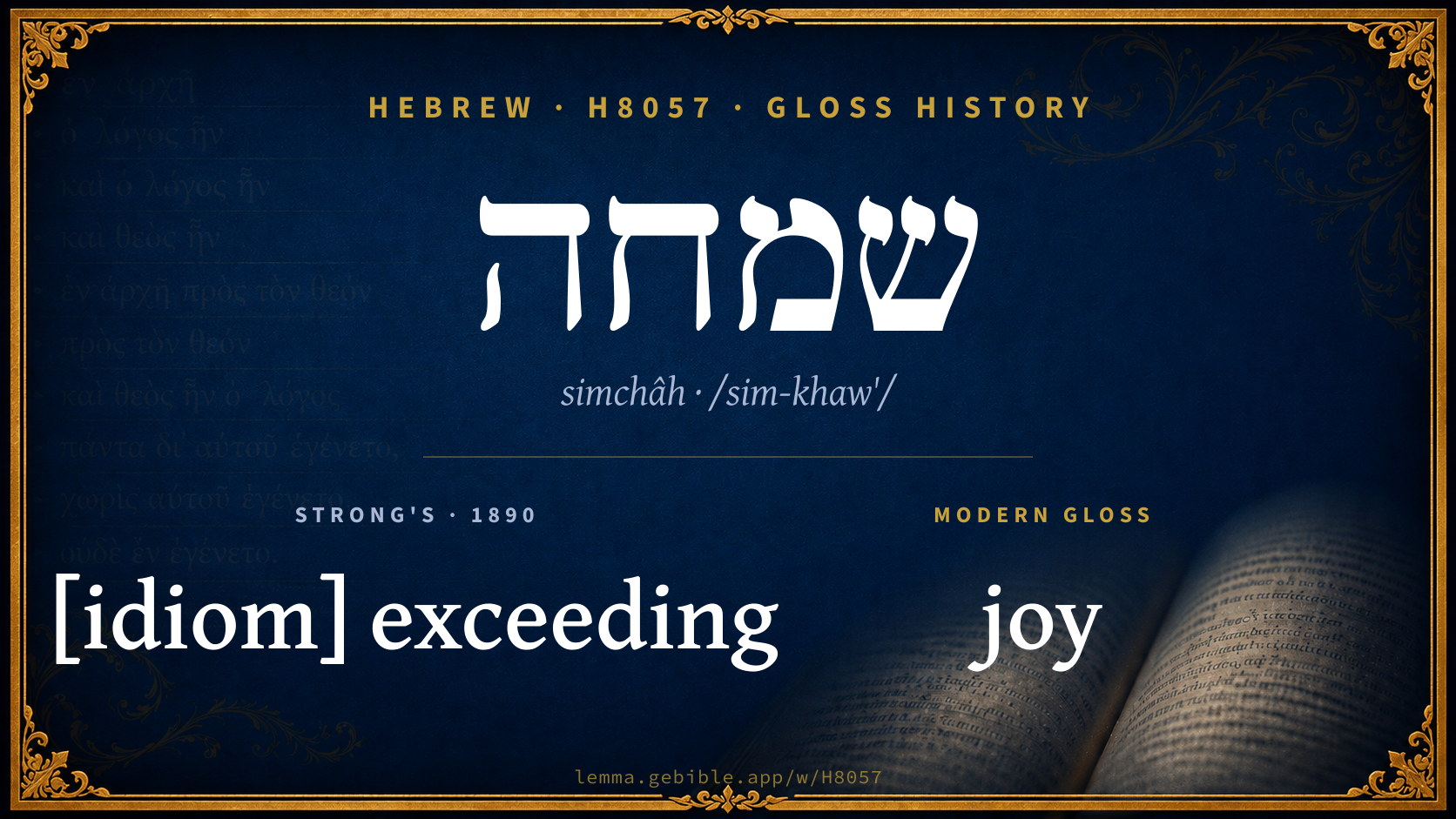
Gloss history
Strong's 1890 vs modern scholarship
About this word
Strong's H8057 catalogs a Hebrew word from the Hebrew Old Testament.
These counts are not copied from any lexicon or concordance. They are computed here, from the morphology-tagged Hebrew Old Testament. What Lemma adds →
- 89
- distinct verses
- The word appears in 89 distinct verses.
- 24 / 39
- OT books
- The word appears in 24 of 39 Old Testament books.
- #440
- by frequency
- Top 500 most frequent Hebrew words (rank 440 of 8,640 Hebrew words by occurrence).
View all 89 occurrences in the concordance →
By section of the Old Testament
By traditional corpus
Conventional, traditional groupings — biblical authorship is debated, so this is a traditional corpus grouping, not an authorship claim. Each share is this word’s portion of its verses in that division of the Hebrew canon. Each figure is a share of the word’s 89 distinct verses.
- Writings (Ketuvim) 57 verses · 64%
- Prophets (Nevi'im) 29 verses · 33%
- Torah (Pentateuch) 3 verses · 3%
How translations render this word
Counts come from each version’s own published word-to-Strong’s tagging or interlinear alignment — an approximate guide to how each version renders this word, not a word-level alignment the data otherwise carries. Because each total is that version’s own tagged count, the per-version totals vary from one another and need not match the appearance or distinct-verse counts above. These counts may also differ from a printed concordance because Lemma counts each distinctly tagged rendering and does not collapse phrase taggings into a single head-word total. This is a fixed set of word-tagged versions (KJV, ASV, BSB, ULT) and does not change with the reading translation you choose elsewhere. Each version’s license is shown beside its name below (and on Sources).
- King James Version: Joy 33×, Gladness 29×, Mirth 6×
- American Standard Version: Joy 31×, Gladness 29×, Mirth 5×
- Berean Standard Bible: Joy 42×, Gladness 14×, Rejoicing 6×
- unfoldingWord Literal Text: Joy 39×, Rejoicing 17×, Gladness 11×
King James Version Public Domain
Renders H8057 across 93 tagged occurrences — most commonly:
Plus 20 renderings that appear only once — usually multi-word phrases or single function words the recovered tagging swept in, not distinct renderings. Not rendered by a distinct English word in 1 further occurrence.
American Standard Version Public Domain
Renders H8057 across 93 tagged occurrences — most commonly:
Plus 23 renderings that appear only once — usually multi-word phrases or single function words the recovered tagging swept in, not distinct renderings.
Berean Standard Bible Public Domain
Renders H8057 across 91 tagged occurrences — most commonly:
Plus 19 renderings that appear only once — usually multi-word phrases or single function words the recovered tagging swept in, not distinct renderings. Not rendered by a distinct English word in 3 further occurrences.
unfoldingWord Literal Text CC BY-SA 4.0
Renders H8057 across 97 tagged occurrences — most commonly:
Plus 14 renderings that appear only once — usually multi-word phrases or single function words the recovered tagging swept in, not distinct renderings.
Senses in the full BDB
What do BDB’s symbols mean?
BDB uses these scholarly abbreviations:
| Symbol | Meaning |
|---|---|
| 𝔊 | the Septuagint (the ancient Greek translation, LXX) |
| 𝔙 | the Vulgate (the Latin translation) |
| 𝔖 | the Syriac version (the Peshitta) |
| 𝔗 | the Targum (the Aramaic translation) |
| ψ | the Psalms |
| √ | root (the underlying root or stem) |
| ‖ | parallel passage (a synonymous or contrasted parallel) |
| † | the dagger: every passage where the word occurs is cited |
The 4 senses and sub-senses the full Brown-Driver-Briggs lexicon distinguishes for this word, in lexicon order (not ranked by frequency), with BDB’s own verbatim wording and sub-sense lettering. Shown in Hebrew script with BDB’s own scholarly abbreviations. The condensed entry is in the Lexicon Entry tab. See also the Forms in the corpus table below.
- 1. mirth, gladness, e.g. in festivity, Gn 31:27 (E), ψ 137:3, 6, 1 K 1:40; 1 S 18:6; Is 9:2(×2); 16:10 ψ 45:16; יוֹם מִשְׁתֶּה וְשׂ׳ Est 9:17, 18, 22 cf. (יוֹם om.) v 19 (+ יוֹם טוֹב), v 22 (‖ יוֹם טוֹב), + 5 times, + קוֹל שׂ׳ Je 7:34 = 16:9 = 25:10 = 33:11; joy of heart Pr 14:10, 13; Ec 5:19; Ct 3:11, cf. (of inward joy) Jon 4:6; Pr 15:23; 21:15; = gaiety, pleasure Is 22:13; Ec 2:1, 2, 10; 8:15; 9:7, בֵּית שׂ׳ 7:4; שׂ׳ חָנֵף Jb 20:5, of foolish Pr 15:21; 21:17; malicious joy Ez 35:15 (ל rei), so שׂ׳ כָּל־לֵבָב 36:5. e.g. Genesis 31:27
- 2. 46 (especially ψψ Chr) religious: 2 S 6:12 ‖ 1 Ch 15:16, 25; Jo 1:16 +; יוֹם שׂ׳ Nu 10:10 (P); עָשָׂה שׂ׳ i.e. make a (sacred) festivity 2 Ch 30:23; Ne 8:12; 12:27; שִׂמְחַת עוֹלָם Is 35:10 = 51:11; 61:7; שׂ׳ c. עַל pers. Ne 12:44; joy of heart Is 30:29; Je 15:16; as gift of י׳ ψ 4:8; 21:7 + 7 times + (in mockery) Is 66:5. e.g. 2 Samuel 6:12
- 3. joy of י׳ Zp 3:17. e.g. Zephaniah 3:17
- 4. glad result, happy issue ψ 106:5 (‖ טוֹבָה), Pr 10:28; 12:20 (Gr. אֱמֻנָה, Toy מִשְׁפָּט; opp. מִרְמָה). e.g. Psalms 106:5
Senses from the full Brown-Driver-Briggs lexicon (Brown, Driver, Briggs; Oxford 1906 — public domain), digitized via Sefaria, supplemented by the OpenScriptures HebrewLexicon (CC BY 4.0). Full attribution on Sources.
Word origin
n.f. joy, gladness, mirth;—abs. שׂ׳ Gn 31:37 +, cstr. שִׂמְחַת Is 9:2 +; sf. שִׂמְחָתִי ψ 137:6, etc.; pl. שְׂמָחוֹת ψ 16:11, -ת֗ 45:16;—
— Brown-Driver-Briggs (Oxford 1906, public domain), digitized via Sefaria, supplemented by the OpenScriptures HebrewLexicon (CC BY 4.0). See Sources.
Derived from שמח (sâmêach) (H8056) — joyful.
Jastrow Dictionary
A second Hebrew/Aramaic lexicon for comparison, covering Aramaic and post-biblical (Talmudic, Targumic, Midrashic) usage that the biblical-Hebrew BDB does not. Matched by lemma rather than by Strong’s number, so a lemma may carry more than one Jastrow headword (shown separately below), and the entries cover usage well beyond the Bible.
שִׂמְחָה
- preced.) joy, rejoicing, festive occasion. Keth. 8ᵃ (in Chald. dict.) אפושי ש׳ בעלמא הוא it is merely an extension of the wedding joy (not a new festive occasion). Ib. מברך שהש׳ במעונו he says the benediction containing the words, ‘in whose dwelling there is joy.’ Y. B. Bath. IX, 16ᵈ bot. שִׂמְחַת זכר the joy over the birth of a male child. Gen. R. s. 70; M. Kat. 8ᵇ ש׳ בש׳, v. עָרב I; a. fr.—Esp. שמחת יום טוב, or ש׳ the rejoicing on the festival (Deut. XVI, 11; 14). R. Hash. 6ᵇ איתה בש׳ she (woman) is included in the commandment to observe the festival with joy. Ḥag. 6ᵃ חנה … מיחייבא בש׳ was not Hannah herself bound to visit the Temple in order to rejoice? Pes. 109ᵃ בזמן … אין ש׳ אלא בבשר … אין ש׳ אלא ביין as long as the Temple stood, the festive rejoicing consisted in eating meat (of the peace-offering), … but now … the festive celebration consists in partaking of wine; a. fr.—Pl. שְׂמָחוֹת. Zeb. 102ᵃ חמש ש׳ היתה וכ׳ Elisheba had five joys (distinctions) more than ordinary daughters of Israel: her brother-in-law (Moses) was king &c.; a. e.—ש׳ (מסכת) S’maḥoth, one of the small treatises of Talmud Babli, euphem. for אבל רבתי, v. אֵבֶל. e.g. Deuteronomy 16:11
A Dictionary of the Targumim, the Talmud Babli and Yerushalmi, and the Midrashic Literature (Marcus Jastrow; London, Luzac, 1903) — Public Domain. Digitized via Sefaria. Digitized via Sefaria. Full attribution on Sources.
Forms in the corpus
The 49 distinct written forms H8057 takes in the Hebrew Bible, most frequent first — each parse links to that state’s occurrences in the concordance. Hebrew forms include their vowel points and cantillation, so a single lemma takes many written forms.
Septuagint verse parallels
This word appears in 80 verses that also exist in the Greek Old Testament (Septuagint), out of the 89 Hebrew verses it occurs in. You can read those verses in Greek by switching the Old Testament edition to the Septuagint.
Read these verses in the Septuagint
- Genesis 31:27
- Numbers 10:10
- Deuteronomy 28:47
- Judges 16:23
- 1 Samuel 18:6
- 2 Samuel 6:12
- 1 Kings 1:40
- 1 Chronicles 12:40
- 2 Chronicles 20:27
- Ezra 3:12
- Esther 8:16
- Job 20:5
This is a verse-level parallel only — the same verses exist in both the Hebrew and Greek Old Testaments. No word-level Hebrew↔Greek correspondence is claimed: the data carries no such alignment, so no Greek word is shown as this Hebrew word’s translation. Coverage is not total — the Septuagint omits the deuterocanon and renumbers the Psalms, so some Hebrew verses have no direct Greek parallel.