
1 Chronicles 29:17

Hebrew (Westminster Leningrad Codex) 1 Chronicles 29:17 appears in the Hebrew Old Testament. The text above is from the Westminster Leningrad Codex. Each word links to its Strong’s number, a concise gloss, and parsing drawn from the Open Scriptures Hebrew Bible morphology. Click any word for its full Brown-Driver-Briggs (BDB) entry.
Download image
Cite this verse

1 Chronicles 29:17 (World English Bible). Public Domain. Lemma interlinear Bible study tool, https://lemma.gebible.app/v/1-chronicles/29/17.

Show BibTeX & RIS
BibTeX
RIS
English Translation
I know also, my God, that you try the heart, and have pleasure in uprightness. As for me, in the uprightness of my heart I have willingly offered all these things: and now have I seen with joy your people, that are present here, offer willingly to you.
World English Bible · Public Domain
Highlights
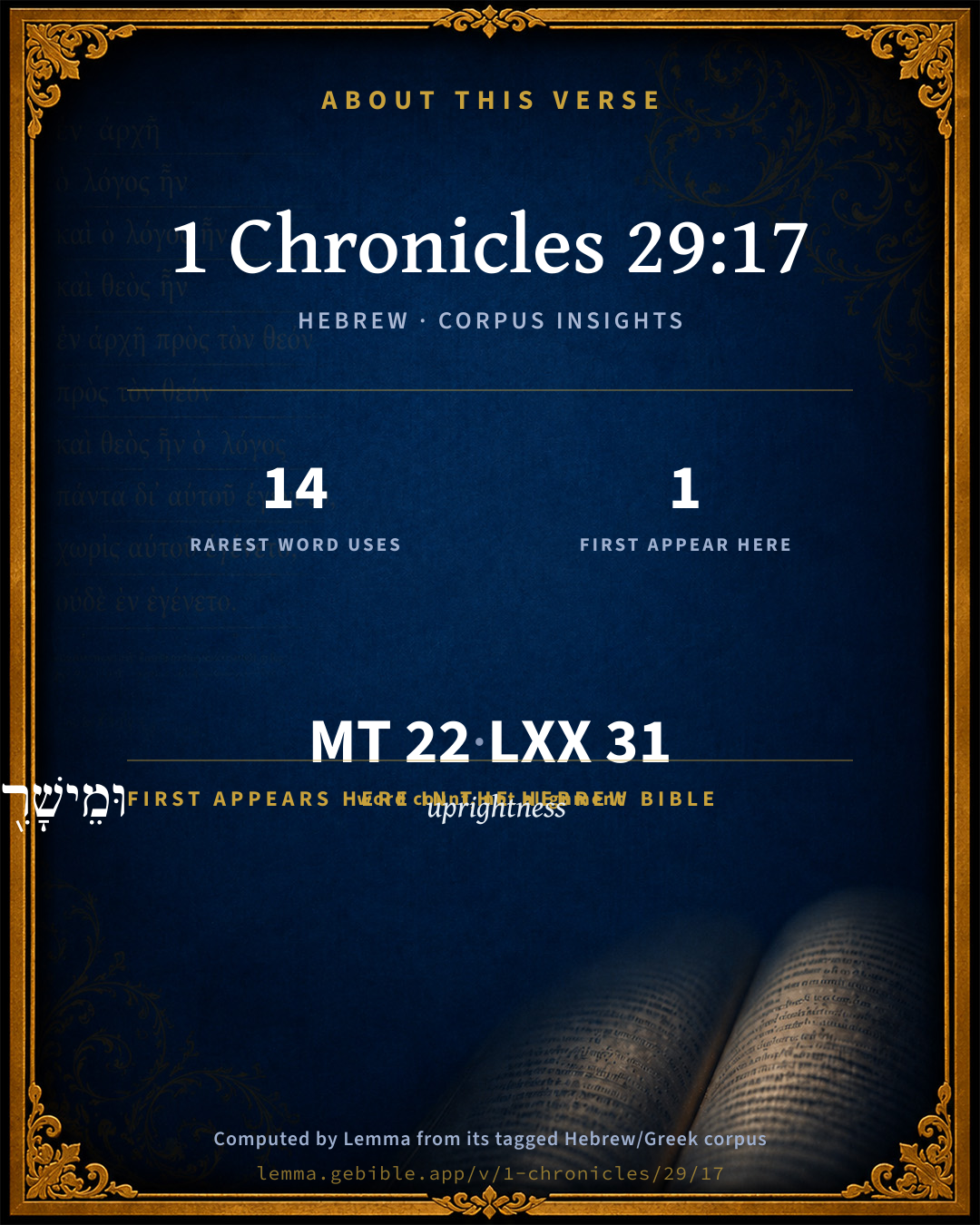
  • 1 first appearance in the Hebrew Bible
Full analysis ↓
Download a study sheet

One document with this verse’s original text, its word-by-word gloss line, the meaning frame, cross-references with their text, attributed commentary, and full source and license credits — printable, and it pastes into notes with its structure intact.

This verse Autodidact and up

Study sheet (.html) Plain text (.txt)

A passage Seminary Student

Up to 50 verses in one chapter. A passage sheet keeps up to 6 commentary sources and 12 cross-references per verse, in the order this page ranks them, and says so on the sheet whenever that leaves anything out. Ask for a single verse and you get the Autodidact verse sheet above.

Everything on this page stays free to read, with no account — the sheet is a download of what is already on screen, not access to it.

Want to remove ads? Support Godless Engineer
Compare translations 3

The same verse in 3 English versions, stacked beneath the original-language interlinear above. Click any original word for its lexicon entry.

Each is an independent rendering of the whole verse — the interlinear is not word-aligned to these translations.

Highlighted words mark where these versions differ — a whole-verse word diff, not a word-by-word alignment.

  • World English Bible Public Domain
    I know also, my God, that you try the heart, and have pleasure in uprightness. As for me, in the uprightness of my heart I have willingly offered all these things: and now have I seen with joy your people, that are present here, offer willingly to you.
  • King James Version Public Domain
    I know also, my God, that thou triest the heart, and hast pleasure in uprightness. As for me, in the uprightness of mine heart I have willingly offered all these things: and now have I seen with joy thy people, which are present here, to offer willingly unto thee.
  • unfoldingWord Literal Text CC BY-SA 4.0
    And I know, my God, that you are examining the heart and are pleased with uprightnesses. In the uprightness of my heart, I, I have offered freely all of these. And now your people have been found here, I see with rejoicing, to offer freely to you.

unfoldingWord Literal Text — © unfoldingWord, licensed CC BY-SA 4.0. Word-aligned USFM3 via Door43 (git.door43.org/unfoldingWord/en_ult).

Versions to compare (up to 4)

3 of 4 selected

Show all 18 translations

Every available English version of this verse, each an independent rendering of the whole verse.

  • World English Bible Public Domain
    I know also, my God, that you try the heart, and have pleasure in uprightness. As for me, in the uprightness of my heart I have willingly offered all these things: and now have I seen with joy your people, that are present here, offer willingly to you.
  • Berean Standard Bible Public Domain
    I know, my God, that You test the heart and delight in uprightness. All these things I have given willingly and with an upright heart, and now I have seen Your people who are present here giving joyfully and willingly to You.
  • Majority Standard Bible Public Domain
    I know, my God, that You test the heart and delight in uprightness. All these things I have given willingly and with an upright heart, and now I have seen Your people who are present here giving joyfully and willingly to You.
  • King James Version Public Domain
    I know also, my God, that thou triest the heart, and hast pleasure in uprightness. As for me, in the uprightness of mine heart I have willingly offered all these things: and now have I seen with joy thy people, which are present here, to offer willingly unto thee.
  • American Standard Version (1901) Public Domain
    I know also, my God, that thou triest the heart, and hast pleasure in uprightness. As for me, in the uprightness of my heart I have willingly offered all these things: and now have I seen with joy thy people, that are present here, offer willingly unto thee.
  • Revised Version (1885) Public Domain
    I know also, my God, that thou triest the heart, and hast pleasure in uprightness, As for me, in the uprightness of mine heart I have willingly offered all these things: and now have I seen with joy thy people, which are present here, to offer willingly unto thee.
  • Geneva Bible (1599) Public Domain
    I knowe also, my God, that thou tryest the heart, and hast pleasure in righteousnesse: I haue offred willingly in the vprightnesse of mine heart all these things: now also haue I seene thy people which are found here, to offer vnto thee willingly with ioy.
  • Douay-Rheims (1899) Public Domain
    I know my God that thou provest hearts, and lovest simplicity, wherefore I also in the simplicity of my heart, have joyfully offered all these things: and I have seen with great joy thy people, which are here present, offer thee their offerings.
  • Young's Literal Translation Public Domain
    `And I have known, my God, that Thou art trying the heart, and uprightness dost desire; I, in the uprightness of my heart, have willingly offered all these: and now, Thy people who are found here I have seen with joy to offer willingly to Thee.
  • Literal Standard Version CC BY-SA 4.0
    And I have known, my God, that You are trying the heart, and desire uprightness; I, in the uprightness of my heart, have willingly offered all these; and now, I have seen Your people who are found here with joy to offer willingly to You.
  • Unlocked Literal Bible CC BY-SA 4.0
    I know also, my God, that you examine the heart and have pleasure in uprightness. As for me, in the uprightness of my heart I have willingly offered all these things, and now I look with joy as your people who are present here willingly offer gifts to you.
  • unfoldingWord Literal Text CC BY-SA 4.0
    And I know, my God, that you are examining the heart and are pleased with uprightnesses. In the uprightness of my heart, I, I have offered freely all of these. And now your people have been found here, I see with rejoicing, to offer freely to you.
  • Darby Bible Public Domain
    And I know, my God, that thou triest the heart, and hast pleasure in uprightness. In the uprightness of my heart have I willingly offered all these things; and now have I seen with joy thy people, which are present here, offer willingly to thee.
  • World Messianic Bible Public Domain
    I know also, my God, that you try the heart and have pleasure in uprightness. As for me, in the uprightness of my heart I have willingly offered all these things. Now I have seen with joy your people, who are present here, offer willingly to you.
  • Webster's Bible Public Domain
    I know also, my God, that thou triest the heart, and hast pleasure in uprightness. As for me, in the uprightness of my heart I have willingly offered all these things: and now have I seen with joy thy people, who are present here, to offer willingly to thee.
  • Free Bible Version CC BY-SA 4.0
    I know, my God, that you look on the inside and are happy when we live right. Everything I have given willingly and with an honest heart, and now I have seen your people here giving happily and willingly to you.
  • Bible in Basic English Public Domain
    And I am conscious, my God, that you are the searcher of hearts, taking pleasure in righteousness. As for me, with an upright heart I have freely given all these things; and I have seen with joy your people who are here to make their offerings freely to you.
  • JPS Tanakh (1917) Public Domain
    I know also, my God, that Thou triest the heart, and hast pleasure in uprightness. As for me, in the uprightness of my heart I have willingly offered all these things; and now have I seen with joy Thy people, that are present here, offer willingly unto Thee.

Literal Standard Version (2020), Covenant Press — licensed CC BY-SA 4.0. Text via the HelloAO Bible API (eBible.org). Unlocked Literal Bible (unfoldingWord) — licensed CC BY-SA 4.0. Text via the HelloAO Bible API (eBible.org). unfoldingWord Literal Text — © unfoldingWord, licensed CC BY-SA 4.0. Word-aligned USFM3 via Door43 (git.door43.org/unfoldingWord/en_ult). Free Bible Version, Dr. Jonathan Gallagher — licensed CC BY-SA 4.0. Text via the HelloAO Bible API (eBible.org).

Word by word

More ways to search: Search by grammar → Find every occurrence → Compare this word →

Practice this passage: Drill this verse → Learn its vocabulary →

בְּיֹ֤שֶׁר
yôsher
H3476
“in/at · uprightness of”
Preposition + Noun, Common, Masculine, Singular, Construct
Part of Speech
Preposition + Noun
Type
Common
Gender
Masculine
Number
Singular
State
Construct
Full BDB Definition

Origin: from H3474

TWOT: 930b

straightness, uprightness - straightness, evenness (moral implications) - rightness, uprightness - what is right, what is due
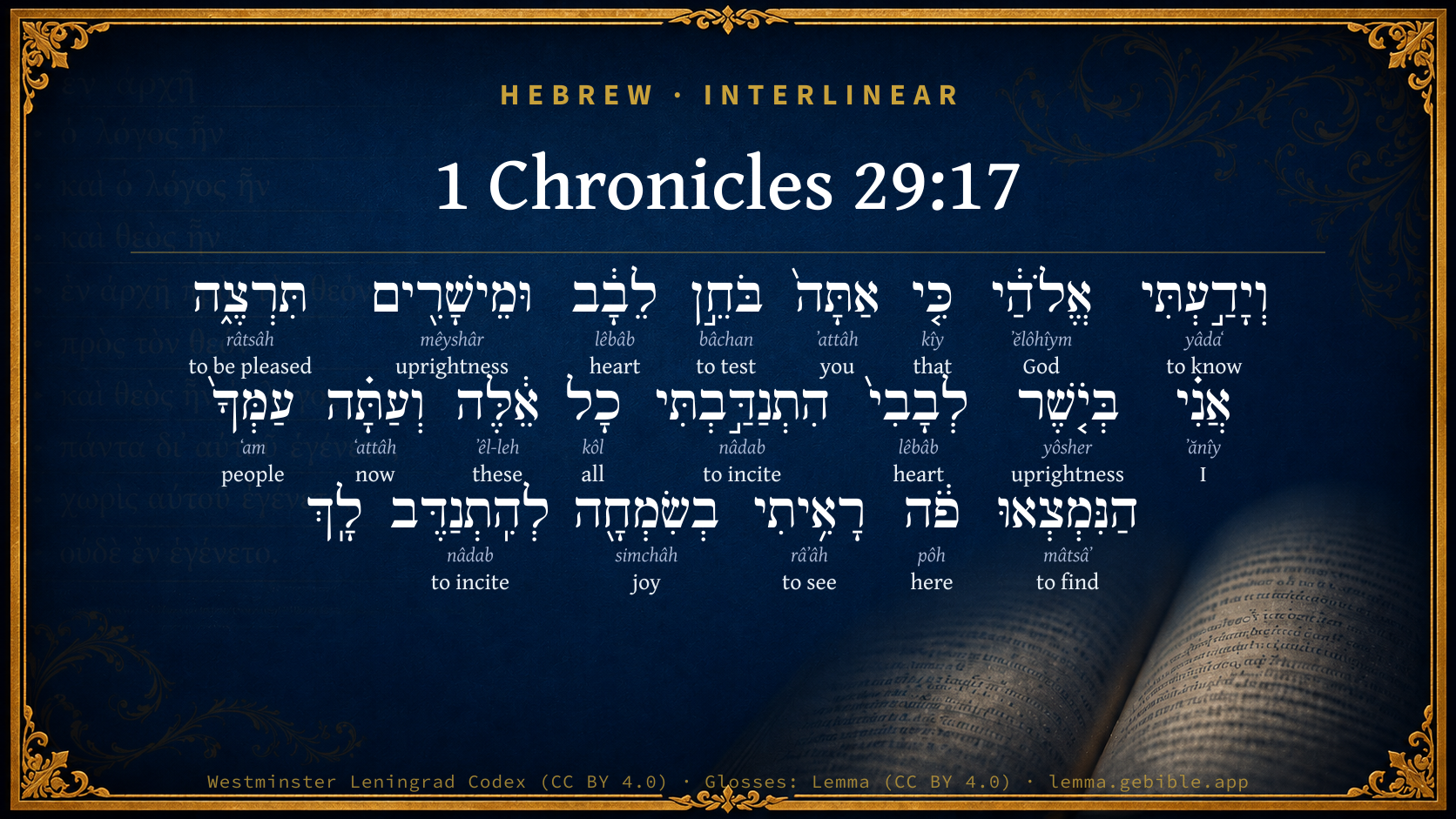
  1. וְיָדַ֣עְתִּי yâdaʻ H3045 “and · to know” Conjunction + Verb, Qal, Sequential Perfect, 1st Person, Common, Singular
  2. אֱלֹהַ֔י ʼĕlôhîym H430 “God(s) · my” Noun, Common, Masculine, Plural, Construct + Suffix, Personal, 1st Person, Common, Singular
  3. כִּ֤י kîy H3588 “that” Conjunction
  4. אַתָּה֙ ʼattâh H859 “you” Pronoun, Personal, 2nd Person, Masculine, Singular
  5. בֹּחֵ֣ן bâchan H974 “testing” Verb, Qal, Participle Active, Masculine, Singular, Absolute
  6. לֵבָ֔ב lêbâb H3824 “heart” Noun, Common, Masculine, Singular, Absolute
  7. וּמֵישָׁרִ֖ים mêyshâr H4339 “and · uprightness” Conjunction + Noun, Common, Masculine, Plural, Absolute
  8. תִּרְצֶ֑ה râtsâh H7521 “to be pleased” Verb, Qal, Imperfect, 2nd Person, Masculine, Singular
  9. אֲנִ֗י ʼănîy H589 “I” Pronoun, Personal, 1st Person, Common, Singular
  10. לְבָבִי֙ lêbâb H3824 “heart · my” Noun, Common, Masculine, Singular, Construct + Suffix, Personal, 1st Person, Common, Singular
  11. הִתְנַדַּ֣בְתִּי nâdab H5068 “to incite” Verb, Hithpael, Perfect, 1st Person, Common, Singular
  12. כָל kôl H3605 “all of” Noun, Common, Masculine, Singular, Construct
  13. אֵ֔לֶּה ʼêl-leh H428 “these” Pronoun, Demonstrative, Common, Plural
  14. וְעַתָּ֗ה ʻattâh H6258 “and · now” Conjunction + Adverb
  15. עַמְּךָ֙ ʻam H5971 “people · your” Noun, Common, Masculine, Singular, Construct + Suffix, Personal, 2nd Person, Masculine, Singular
  16. הַנִּמְצְאוּ mâtsâʼ H4672 “the · to find” Particle, Definite Article + Verb, Niphal, Perfect, 3rd Person, Common, Plural
  17. פֹ֔ה pôh H6311 “here” Adverb
  18. רָאִ֥יתִי râʼâh H7200 “to see” Verb, Qal, Perfect, 1st Person, Common, Singular
  19. בְשִׂמְחָ֖ה simchâh H8057 “in/at · joy” Preposition + Noun, Common, Feminine, Singular, Absolute
  20. לְהִֽתְנַדֶּב nâdab H5068 “to incite” Preposition + Verb, Hithpael, Infinitive Construct

About this verse

These counts appear in no published source. They are computed here, from the morphology-tagged text and Lemma’s own curated glosses. What Lemma adds →

22
words
19
distinct lemmas
Historical
section

Notable vocabulary

The rarest word here is בְּיֹ֤שֶׁר uprightness H3476 — appearing just 14 times in the whole Hebrew Bible.

First appearance in Scripture

This word makes its first canonical appearance in the Hebrew Bible here:

  • וּמֵישָׁרִ֖ים uprightness H4339

Shared distinctive vocabulary

בְּיֹ֤שֶׁר uprightness H3476 occurs in 14 verses of the Hebrew Bible. Also found in:

Grammatical profile

  • 7 verbs
  • 8 nouns
  • 3 pronouns
  • 1 preposition
  • 1 conjunction
  • 2 adverbs

Verb forms

  • וְיָדַ֣עְתִּי Qal · Sequential Perfect
  • בֹּחֵ֣ן Qal · Participle Active
  • תִּרְצֶ֑ה Qal · Imperfect
  • הִתְנַדַּ֣בְתִּי Hithpael · Perfect
  • הַנִּמְצְאוּ Niphal · Perfect
  • רָאִ֥יתִי Qal · Perfect
  • לְהִֽתְנַדֶּב Hithpael · Infinitive Construct

Repetition

Words recur within this verse — often emphatic in Hebrew:

  • לֵבָ֔ב heart H3824 ×2
  • הִתְנַדַּ֣בְתִּי to incite H5068 ×2

Hebrew & Septuagint length

In English translation the verse runs 48 words from the Hebrew and 42 from the Septuagint (LXX English) — closely comparable.

A rough comparison of the two English renderings, which tokenize alike — not a word-level alignment.

Word counts can differ between the Hebrew and the Greek without any difference in meaning — e.g. the Hebrew direct-object marker אֵת has no separate Greek word, and Greek often adds the article ὁ.

In the original languages it is 22 Hebrew tokens and 31 Greek tokens — but the two are counted differently (Hebrew bundles its prefixes and suffixes into one token; the Greek is in lemma form), so that isn’t a like-for-like length.

Cross-references

21

Topical passages linked to 1 Chronicles 29:17 in the Treasury of Scripture Knowledge — connected by theme and wording, ordered by reader-vote popularity; previews shown in the World English Bible.

  • Jeremiah 17:10 I, Yahweh, search the mind, I try the heart, even to give every man according to his ways, according to the fruit of his doings.
  • Proverbs 11:20 Those who are perverse in heart are an abomination to Yahweh, But those whose ways are blameless are his delight.
  • 1 Chronicles 28:9 You, Solomon my son, know the God of your father, and serve him with a perfect heart and with a willing mind; for Yahweh searches all hearts, and understands all the imaginations of the thoughts: if you seek him, he will be found of you; but if you forsake him, he will cast you off forever.
  • 1 Samuel 16:7 But Yahweh said to Samuel, "Don't look on his face, or on the height of his stature; because I have rejected him: for [Yahweh sees] not as man sees; for man looks at the outward appearance, but Yahweh looks at the heart."
  • Psalms 51:6 Behold, you desire truth in the inward parts. You teach me wisdom in the inmost place.
  • John 1:47 Jesus saw Nathanael coming to him, and said about him, "Behold, an Israelite indeed, in whom is no deceit!"
  • 2 Corinthians 1:12 For our boasting is this: the testimony of our conscience, that in holiness and sincerity of God, not in fleshly wisdom but in the grace of God we behaved ourselves in the world, and more abundantly toward you.
  • 1 Thessalonians 2:10 You are witnesses with God, how holy, righteously, and blamelessly we behaved ourselves toward you who believe.
  • Philemon 1:7 For we have much joy and comfort in your love, because the hearts of the saints have been refreshed through you, brother.
  • Hebrews 4:12 For the word of God is living, and active, and sharper than any two-edged sword, and piercing even to the dividing of soul and spirit, of both joints and marrow, and is able to discern the thoughts and intentions of the heart.
  • Deuteronomy 8:2 You shall remember all the way which Yahweh your God has led you these forty years in the wilderness, that he might humble you, to prove you, to know what was in your heart, whether you would keep his commandments, or not.
  • 1 Chronicles 29:9 Then the people rejoiced, because they offered willingly, because with a perfect heart they offered willingly to Yahweh: and David the king also rejoiced with great joy.
  • Psalms 7:9 Oh let the wickedness of the wicked come to an end, But establish the righteous; Their minds and hearts are searched by the righteous God.
  • Psalms 15:2 He who walks blamelessly does what is right, And speaks truth in his heart;
  • Proverbs 15:8–9 The sacrifice made by the wicked is an abomination to Yahweh, But the prayer of the upright is his delight.
  • Proverbs 16:2 All the ways of a man are clean in his own eyes; But Yahweh weighs the motives.
  • Acts 24:16 Herein I also practice always having a conscience void of offense toward God and men.
  • Philemon 1:20 Yes, brother, let me have joy from you in the Lord. Refresh my heart in the Lord.
  • Proverbs 17:3 The refining pot is for silver, and the furnace for gold, But Yahweh tests the hearts.
  • Proverbs 21:2 Every way of a man is right in his own eyes, But Yahweh weighs the hearts.
  • Revelation 2:23 I will kill her children with Death, and all the assemblies will know that I am he who searches the minds and hearts. I will give to each one of you according to your deeds.

Cross-references courtesy of OpenBible.info (CC BY 4.0).

Hebrew and Greek witnesses Masoretic Hebrew ↔ Greek Septuagint

The same verse in the two great witnesses to the Old Testament, shown verse-for-verse.

These are two independent witnesses, not word-aligned to each other, and the Septuagint is shown in lemma (dictionary) form.

Hebrew 1 Chronicles 29:17 Masoretic · Westminster Leningrad Codex

וְיָדַ֣עְתִּי אֱלֹהַ֔י כִּ֤י אַתָּה֙ בֹּחֵ֣ן לֵבָ֔ב וּמֵישָׁרִ֖ים תִּרְצֶ֑ה אֲנִ֗י בְּיֹ֤שֶׁר לְבָבִי֙ הִתְנַדַּ֣בְתִּי כָל אֵ֔לֶּה וְעַתָּ֗ה עַמְּךָ֙ הַנִּמְצְאוּ פֹ֔ה רָאִ֥יתִי בְשִׂמְחָ֖ה לְהִֽתְנַדֶּב לָֽךְ

I know also, my God, that you try the heart, and have pleasure in uprightness. As for me, in the uprightness of my heart I have willingly offered all these things: and now have I seen with joy your people, that are present here, offer willingly to you.

World English Bible · Public Domain

Greek LXX 1 Chronicles 29:17 Septuagint · lemma form

καί γιγνώσκω κύριος ὅτι σύ εἰμί ὁ ἐτάζω καρδία καί δικαιοσύνη ἀγαπάω ἐν ἁπλότης καρδία προθυμέομαι πᾶς οὗτος καί νῦν ὁ λαός σύ ὁ εὑρίσκω ὧδε ὁράω ἐν εὐφροσύνη προθυμέομαι σύ

And I know, Lord, that you are he that searches the hearts, and you love righteousness. I have willingly offered all these things in simplicity of heart; and now I have seen with joy your people here present, willingly offering to you.

LXX2012 (modern English Septuagint) · Public Domain

On this verse, Haydock's Catholic Bible Commentary discusses the Septuagint’s reading. Read the note in Commentary ↓

Hebrew: Westminster Leningrad Codex (CC BY 4.0). Greek: Septuagint (public domain); English from LXX2012 (modern English Septuagint) (Public Domain). How the Septuagint differs from the Hebrew →

Commentary

Notes on 1 Chronicles 29:17 from classic Christian and Jewish commentators (each source and its license shown beneath its notes). The classic Christian expositions comment on the surrounding passage and are grouped to its opening verse, so a note may address several verses; the Jewish commentaries on the Tanakh (Rashi and others) are per-verse, so they appear only where the commentator wrote on this verse.

Lemma curates 59 commentaries, every one of them public domain or Creative Commons licensed, each selected and text-cleaned for this edition rather than reprinted as found. About our sources →

Trapp's Complete Commentary

John Trapp

1Ch 29:17 I know also, my God, that thou triest the heart, and hast pleasure in uprightness. As for me, in the uprightness of mine heart I have willingly offered all these things: and now have I seen with joy thy people, which are present here, to offer willingly unto thee.

Ver. 17. I know … that thou triest the heart.] see Pro 17:3, {See Trapp on "Pro 17:3"} It was David’s comfort that he had to do with a heart searching God: for though the "sinners in Zion are afraid fearfulness surprise the hypocrites," neither are they able to "dwell with devouring fire," that is, to stand before the holy God, yet "he that walketh uprightly and speaketh righteously shall dwell on high," {Isa 33:14-16} shall look God in the face with everlasting comfort, and dare appeal unto him, as here, for the uprightness of his heart - as touching the main - in performance of his service.

And hast pleasure in uprightness.] See on Psa 51:6.

In the uprightness of my heart.] Sincero, recto et candido corde, I can boldly and safely say it.

John Trapp, A Commentary or Exposition upon All the Books of the Old and New Testament (1647–1656) — public domain. Text from a community e-Sword module.

Joseph Benson's Commentary

1Ch 29:17. I know also, my God, that thou triest the heart, &c. — That thou observest with what intention and disposition of mind any offering is made and work performed; and hast pleasure in uprightness — Without which the most costly gift, and most laborious services, would be as nothing before thee. And hence it is that I hope thou wilt be pleased to accept what I now present to thee, being conscious that I offer it with a heart devoted to thy love and service, and with an intention to glorify thee. It is a great satisfaction to a good man to know that God tries the heart, and has pleasure in uprightness; and that whoever may misinterpret or contemn it, he is acquainted with, and approves, the way of the righteous. It was a comfort to David that God knew with what pleasure he both offered his own, and saw the people’s offering. I have seen with joy thy people offer willingly unto thee — By the largeness of their offering I discern the sincerity, willingness, and generosity of their hearts toward thee: for David judged, as in reason and charity he ought, of the tree by its fruit, and of their hearts by their actions.

Joseph Benson's Commentary on the Old and New Testaments (1811–1818) — public domain. Text from a community e-Sword module.

Ellicott's Commentary for English Readers

(17) Thou triest the heart.—Psa_11:4; Psa_7:9; Psa_26:2.

Hast pleasure in.—1Ch_28:4, 1Ch_29:3. (Comp. also 1Ch_28:9.)

Uprightness.—Or, sincerity (mêshârîm, Son_1:4).

In the uprightness (yôsher), integrity (Deu_9:5),, a synonym of mêshârîm. Both literally mean straightness: e.g., of a road (Pro_2:13; Pro_23:31). The connexion of ideas is this: Thou that lookest upon the heart knowest that my offering has been made without grudging and without hypocrisy; my motive was not my own interest, but Thy glory. Hence my joyful thanksgiving, because of the free generosity of Thy people.

Which are present here.—Literally, Who have found themselves here (reflexive verb). (So 2Ch_5:11, and other places.)

A Bible Commentary for English Readers, edited by Charles John Ellicott (1878–1897) — public domain. Text from a community e-Sword module.

John Gill's Exposition

O Lord God of Abraham, Isaac, and of Israel, our fathers, The ancestors of the Jewish nation, whose covenant God the Lord was, and who had ever been mindful of his promise to them, with respect to them their seed:

keep this for ever in the imagination of the thoughts of the heart of thy people; let the same disposition of mind always continue in them to serve the Lord their God:

and prepare their heart unto thee; incline and dispose their minds always to fear the Lord, and obey his will.

John Gill's Exposition of the Whole Bible (1746–1763) — public domain (CC PDM 1.0). Text via the HelloAO Bible API.

Haydock's Catholic Bible Commentary

Simplicity. Hebrew, "uprightness." Septuagint, "justice;" (Haydock) a pure intention, which our Saviour styled a single eye, Matthew vi. 22. (Tirinus)

George Leo Haydock (1774–1849), Haydock's Catholic Family Bible and Commentary, 1859 edition — public domain. Excludes Psalms (Douay-Rheims chapter numbering differs from Protestant) and Deuterocanonical books (Catholic canon only).

Matthew Poole's English Annotations

By the largeness of their offering I discern the sincerity, willingness, and generosity of their hearts towards thee; for David judged, as in reason and clarity he ought, of the tree by its fruit, and of their hearts by their actions.

Matthew Poole's English Annotations on the Holy Bible (1683–1685) — public domain. Text from a community e-Sword/MySword module.

The Pulpit Commentary

It may very possibly be that the stress with which David here says, I know, had its special cause. The thought of God as one who "tried" the heart is one often brought out in David"s psalms, but a strong conviction of it may have been wrought in David"s mind by Samuel"s rehearsal of the language God used to him at the very time of the election of David from amid all the other of Jesse"s sons. (1Sa_16:7)

The assured acceptance of the sincere.

pleasure in uprightness." It is a characteristic of David that he makes constant appeal to his conscious integrity and expects to gain Divine acceptance for his sincerity and uprightness. But this, conflicts with the Christian notion that a man cannot be accepted for anything in himself, and so it needs consideration and explanation. We have often to notice how certain words get a stiff, rigid, and limited meaning fixed upon them, through their use in the expression of theological opinions and creeds. Illustration may be taken from the terms grace, law, faith, justify, eternal. Joubert says, "The trick of personifying words is a fatal source of mischief in theology." The words "integrity," "righteousness," have suffered at the hands of theologians, and their larger and more comprehensive meanings are almost lost sight of. David can stand before God, and appeal to his personal righteousness, and ask to be judged by his integrity. Our Lord implies that a man may have a righteousness, when he says, "Except your righteousness shall exceed the righteousness of the scribes and Pharisees," etc. The words will not stiffen into one rigid meaning. Sometimes they mean right-heartedness, sincerity, and show us a man at heart centred on God and virtue. At other times they refer to that renewed state into which we are brought by the regenerations of the Holy Ghost. Illustrate the first of these two meanings from David"s career. This great impression had been left on him from his own experiences, and to it he gives utterance as life closes: "I know that thou hast pleasure in uprightness. " Throughout his career save in halting moments David was right at heart. We have a way of speaking of men as being "good at bottom." If we say that as any excuse for men"s sins, we are miserably and shamefully wrong. If we say it with due recognition of human frailty, with fitting discernment of life as the conflict of the human will over the disabilities that surround the man, then it may be a true and worthy expression. Many men around us yes, even we ourselves are, like David, "good at bottom." The "desire of our soul is to the Divine Name." We are pilgrims, indeed, who have come in at the gate, and right by the cross, even if men or angels do find us wandering out of the way into By-path meadows, and sleeping in arbours, and losing our rolls. David"s example permits us to realize and rejoice in our conscious integrity; not proudly, in any way of self-confidence or self-conceit, but humbly, in a thankful recognition of "grace abounding" to usward. David"s sincerity and integrity come out when we compare him with King Saul. Saul failed altogether, and fell away from God, because his sins were sins of will; neither his heart nor his life were right with God. David stumbled, but he did not utterly fall; because, in his case, the will was only forced to consent to sin, and it sprang back to God as soon as the force of bodily passion that held it down was removed. David only failed in the body-sphere ; Saul failed in both the body and the soul spheres. It would have been better indeed if, like Samuel, heart and life had both shown, throughout his career, the harmony of goodness; but God and man recognize the acceptableness of sincerity of heart, even if qualified by some failings of life. But, from the Christian standpoint, it should be earnestly pressed that sincerity, which is acceptable to God, is properly one of the after-signs of Divine renewal; and that we all need to be made right converted, regenerated ere we can be set right and kept right, and dare ask God to search and see whether we are sincerely and wholly his. R.T.

The Pulpit Commentary (1880–1919), ed. H.D.M. Spence-Jones & Joseph S. Exell — public domain. Text from a community e-Sword module.

Keil & Delitzsch

C. F. Keil & F. Delitzsch

O Lord God of Abraham, Isaac, and of Israel, our fathers, The ancestors of the Jewish nation, whose covenant God the Lord was, and who had ever been mindful of his promise to them, with respect to them their seed:

keep this for ever in the imagination of the thoughts of the heart of thy people; let the same disposition of mind always continue in them to serve the Lord their God:

and prepare their heart unto thee; incline and dispose their minds always to fear the Lord, and obey his will.

Keil & Delitzsch — Biblical Commentary on the Old Testament (1861–1891) — public domain (CC PDM 1.0). Text via the HelloAO Bible API. (Old Testament only.)

Rashi

Rabbi Shlomo Yitzchaki (Rashi)

And I know, my God, that You test the heart You test who has two hearts, one for good and one for evil.

and You desire equity And You desire a good and straight heart, and so I know that with the straightness of my heart, for I have straightened my heart to one heart when I willingly gave all these, and from Your people, who gave willingly. The meaning is: With mine I am familiar and I know it well, but that of others I do not know, but I saw that they donated joyously, I say...

and now, Your people, who are present here, offer willingly to You That is to say, I saw that they rejoiced in their donation, but I do not know whether it was from the willingness of their heart, as it is written: (above verse 9): “... and the people rejoiced over their donation.”

who are present The ones found here are those mentioned above (28:1): “And David assembled all the leaders of Israel, etc.,” but all the wealthy of Israel who were in all the cities were not found here. Therefore, Lord of the universe, the donation was diminished, for had all the remaining Israelites been there, then the donation would have increased.

Rashi on the Tanakh — English translations: “The Judaica Press complete Tanach with Rashi, translated by A. J. Rosenberg” (CC BY 4.0); “Pentateuch with Rashi's commentary by M. Rosenbaum and A.M. Silbermann, 1929-1934” (public domain); “The Metsudah Tanach series, Lakewood, N.J” (CC BY 4.0); and “The Book of Joshua, Metsudah Publications, 1997” (CC BY 4.0). Text via Sefaria.

Lesson kit

Teaching starters — assembled from the data on this page, not authored interpretation. Every prompt links to the verse data it draws on. Edit before teaching.

1 Chronicles, in the Historical, opens this verse with 22 words (19 distinct Hebrew lemmas). Its most distinctive word is yôsher (“uprightness”). A historical commentator’s framing appears above. Read the whole chapter for the surrounding context.

Discussion questions

  1. The word yôsher carries the sense “uprightness.” How does it shape the verse?
  2. The word “uprightness” first appears here in Scripture. What is being introduced at this debut?
  3. Deuteronomy 9:5 shares the word «uprightness» with this verse. How do the two illuminate each other?
  4. “heart” occurs 2× in this one verse. What is the effect of the repetition?
  5. These translations render this verse differently; the difference is in the English rendering, not the original. What questions does that raise?
  6. The verb «וְיָדַ֣עְתִּי» is Qal Sequential Perfect. How does its form color the action?
  7. Reading how Trapp's Complete Commentary and Joseph Benson's Commentary read this verse, where do the two commentators agree and where do they part?

Things to notice

Reading settings

Reading text

Shown beneath each verse's original-language words.

Old Testament
Old Testament edition

Read the OT as the Masoretic Hebrew (MT) or the Greek Septuagint (LXX).

English shown for the Greek Septuagint (in the Hebrew ↔ Greek comparison).

Comparing translations? Open the Compare panel on any verse page to stack up to four side by side.