
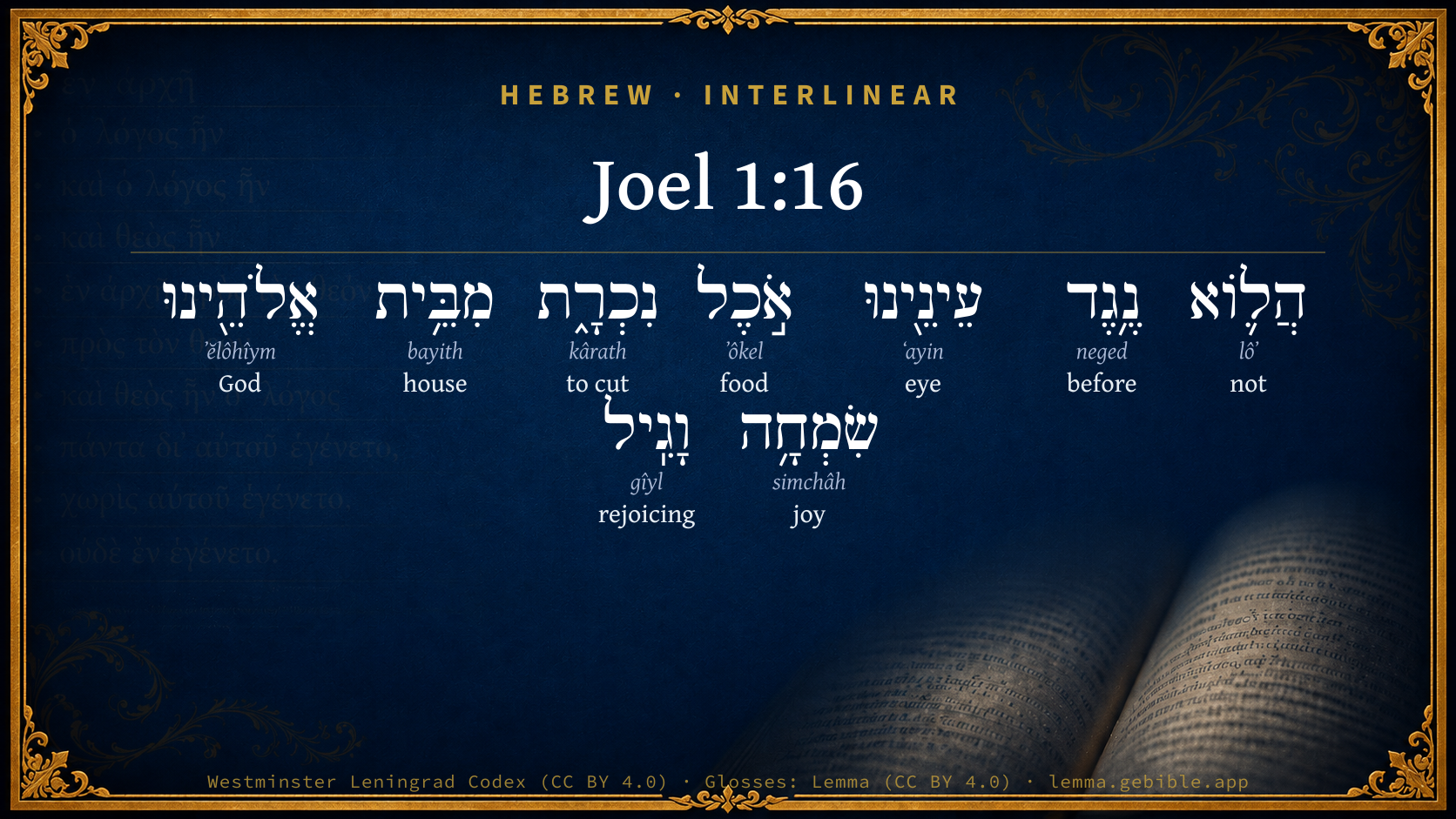
Joel 1:16

Hebrew (Westminster Leningrad Codex) Joel 1:16 appears in the Hebrew Old Testament. The text above is from the Westminster Leningrad Codex. Each word links to its Strong’s number, a concise gloss, and parsing drawn from the Open Scriptures Hebrew Bible morphology. Click any word for its full Brown-Driver-Briggs (BDB) entry.
Download image
Cite this verse

Joel 1:16 (World English Bible). Public Domain. Lemma interlinear Bible study tool, https://lemma.gebible.app/v/joel/1/16.

Show BibTeX & RIS
BibTeX
RIS
English Translation
Isn't the food cut off before our eyes; Joy and gladness from the house of our God?
World English Bible · Public Domain
Download a study sheet

One document with this verse’s original text, its word-by-word gloss line, the meaning frame, cross-references with their text, attributed commentary, and full source and license credits — printable, and it pastes into notes with its structure intact.

This verse Autodidact and up

Study sheet (.html) Plain text (.txt)

A passage Seminary Student

Up to 50 verses in one chapter. A passage sheet keeps up to 6 commentary sources and 12 cross-references per verse, in the order this page ranks them, and says so on the sheet whenever that leaves anything out. Ask for a single verse and you get the Autodidact verse sheet above.

Everything on this page stays free to read, with no account — the sheet is a download of what is already on screen, not access to it.

Want to remove ads? Support Godless Engineer
Compare translations 3

The same verse in 3 English versions, stacked beneath the original-language interlinear above. Click any original word for its lexicon entry.

Each is an independent rendering of the whole verse — the interlinear is not word-aligned to these translations.

Highlighted words mark where these versions differ — a whole-verse word diff, not a word-by-word alignment.

  • World English Bible Public Domain
    Isn't the food cut off before our eyes; Joy and gladness from the house of our God?
  • King James Version Public Domain
    Is not the meat cut off before our eyes, yea, joy and gladness from the house of our God?
  • unfoldingWord Literal Text CC BY-SA 4.0
    Has not food been cut off before our eyes, joy and gladness from the house of our God?

unfoldingWord Literal Text — © unfoldingWord, licensed CC BY-SA 4.0. Word-aligned USFM3 via Door43 (git.door43.org/unfoldingWord/en_ult).

Versions to compare (up to 4)

3 of 4 selected

Show all 18 translations

Every available English version of this verse, each an independent rendering of the whole verse.

  • World English Bible Public Domain
    Isn't the food cut off before our eyes; Joy and gladness from the house of our God?
  • Berean Standard Bible Public Domain
    Has not the food been cut off before our very eyes—joy and gladness from the house of our God?
  • Majority Standard Bible Public Domain
    Has not the food been cut off before our very eyes—joy and gladness from the house of our God?
  • King James Version Public Domain
    Is not the meat cut off before our eyes, yea, joy and gladness from the house of our God?
  • American Standard Version (1901) Public Domain
    Is not the food cut off before our eyes, `yea', joy and gladness from the house of our God?
  • Revised Version (1885) Public Domain
    Is not the meat cut off before our eyes, yea, joy and gladness from the house of our God?
  • Geneva Bible (1599) Public Domain
    Is not the meate cut off before our eyes? and ioy, and gladnesse from the house of our God?
  • Douay-Rheims (1899) Public Domain
    Is not your food cut off before your eyes, joy and gladness from the house of our God?
  • Young's Literal Translation Public Domain
    Is not before our eyes food cut off? From the house of our God joy and rejoicing?
  • Literal Standard Version CC BY-SA 4.0
    Is food not cut off before our eyes? Joy and rejoicing from the house of our God?
  • Unlocked Literal Bible CC BY-SA 4.0
    Has not food been cut off from before our eyes, and joy and gladness from the house of our God?
  • unfoldingWord Literal Text CC BY-SA 4.0
    Has not food been cut off before our eyes, joy and gladness from the house of our God?
  • Darby Bible Public Domain
    Is not the food cut off before our eyes, joy and gladness from the house of our God?
  • World Messianic Bible Public Domain
    Isn’t the food cut off before our eyes, joy and gladness from the house of our God?
  • Webster's Bible Public Domain
    Is not the food cut off before our eyes, and joy and gladness from the house of our God?
  • Free Bible Version CC BY-SA 4.0
    Haven't we seen our food taken away from us, right before our eyes? There is no joy and happiness in God's Temple.
  • Bible in Basic English Public Domain
    Is not food cut off before our eyes? joy and delight from the house of our God?
  • JPS Tanakh (1917) Public Domain
    Is not the food cut off before our eyes, yea, joy and gladness from the house of our God?

Literal Standard Version (2020), Covenant Press — licensed CC BY-SA 4.0. Text via the HelloAO Bible API (eBible.org). Unlocked Literal Bible (unfoldingWord) — licensed CC BY-SA 4.0. Text via the HelloAO Bible API (eBible.org). unfoldingWord Literal Text — © unfoldingWord, licensed CC BY-SA 4.0. Word-aligned USFM3 via Door43 (git.door43.org/unfoldingWord/en_ult). Free Bible Version, Dr. Jonathan Gallagher — licensed CC BY-SA 4.0. Text via the HelloAO Bible API (eBible.org).

Word by word

More ways to search: Search by grammar → Find every occurrence → Compare this word →

Practice this passage: Drill this verse → Learn its vocabulary →

About this verse

These counts appear in no published source. They are computed here, from the morphology-tagged text and Lemma’s own curated glosses. What Lemma adds →

9
words
9
distinct lemmas
Prophets
section

Notable vocabulary

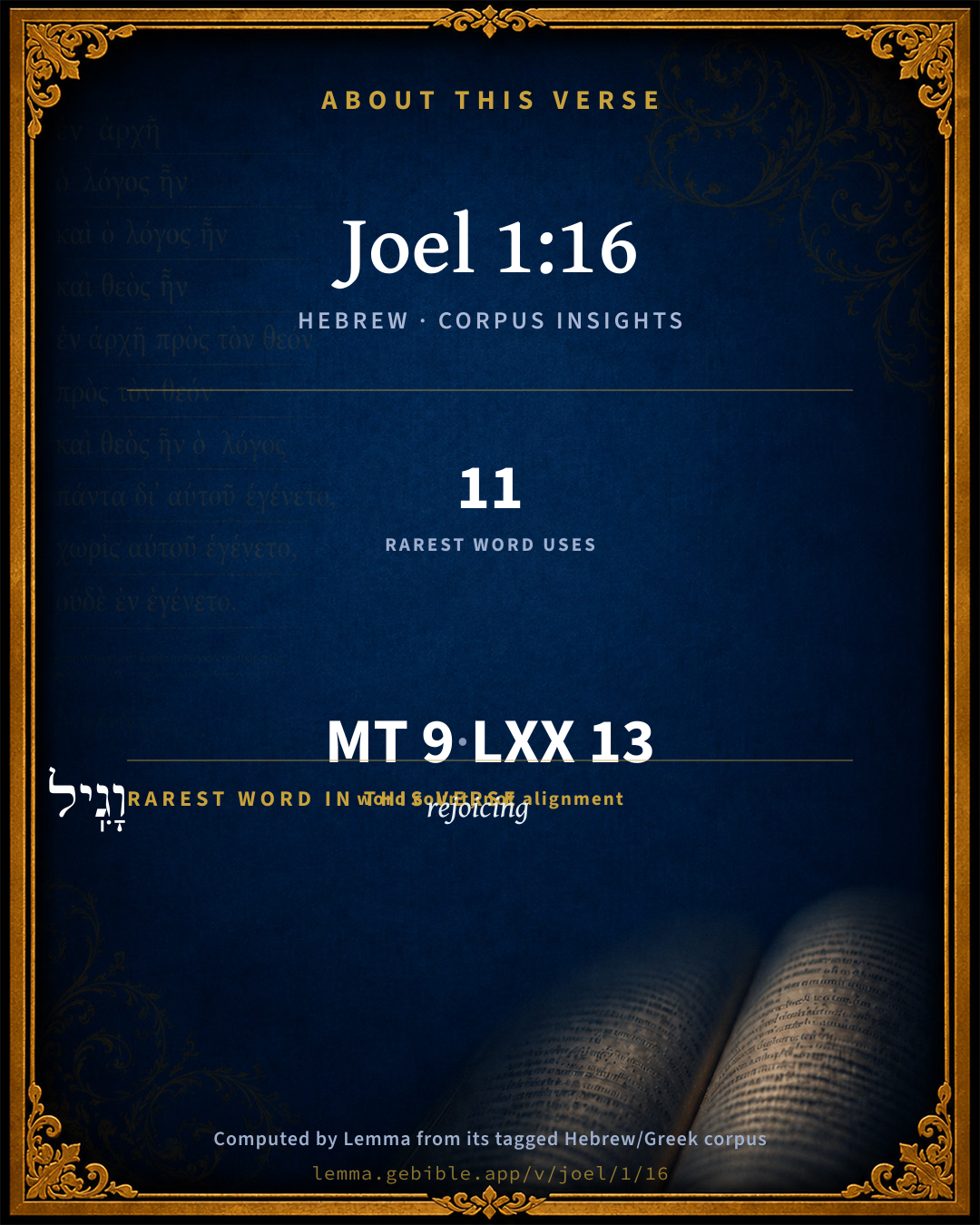
The rarest word here is וָגִֽיל rejoicing H1524 — appearing just 11 times in the whole Hebrew Bible.

Shared distinctive vocabulary

וָגִֽיל rejoicing H1524 occurs in 10 verses of the Hebrew Bible. Also found in:

Grammatical profile

  • 1 verb
  • 6 nouns
  • 1 preposition
  • 1 particle

Verb forms

  • נִכְרָ֑ת Niphal · Perfect

Hebrew & Septuagint length

In English translation the verse runs 17 words from the Hebrew and 19 from the Septuagint (LXX English) — closely comparable.

A rough comparison of the two English renderings, which tokenize alike — not a word-level alignment.

Word counts can differ between the Hebrew and the Greek without any difference in meaning — e.g. the Hebrew direct-object marker אֵת has no separate Greek word, and Greek often adds the article ὁ.

In the original languages it is 9 Hebrew tokens and 13 Greek tokens — but the two are counted differently (Hebrew bundles its prefixes and suffixes into one token; the Greek is in lemma form), so that isn’t a like-for-like length.

Cross-references

10

Topical passages linked to Joel 1:16 in the Treasury of Scripture Knowledge — connected by theme and wording, ordered by reader-vote popularity; previews shown in the World English Bible.

  • Deuteronomy 12:6–7 and there you shall bring your burnt offerings, and your sacrifices, and your tithes, and the heave-offering of your hand, and your vows, and your freewill-offerings, and the firstborn of your herd and of your flock:
  • Psalms 43:4 Then I will go to the altar of God, To God, my exceeding joy. I will praise you on the harp, God, my God.
  • Psalms 105:3 Glory in his holy name. Let the heart of those who seek Yahweh rejoice.
  • Deuteronomy 12:11–12 then it shall happen that to the place which Yahweh your God shall choose, to cause his name to dwell there, there shall you bring all that I command you: your burnt offerings, and your sacrifices, your tithes, and the heave-offering of your hand, and all your choice vows which you vow to Yahweh.
  • Deuteronomy 16:10–15 You shall keep the feast of weeks to Yahweh your God with a tribute of a freewill-offering of your hand, which you shall give, according as Yahweh your God blesses you:
  • Isaiah 3:7 In that day he will cry out, saying, I will not be a healer; For in my house is neither bread nor clothing. You shall not make me ruler of the people.
  • Isaiah 62:8–9 Yahweh has sworn by his right hand, and by the arm of his strength, Surely I will no more give your grain to be food for your enemies; and foreigners shall not drink your new wine, for which you have labored:
  • Joel 1:5–9 Wake up, you drunkards, and weep! Wail, all you drinkers of wine, because of the sweet wine; For it is cut off from your mouth.
  • Joel 1:13 Put on sackcloth and mourn, you priests! Wail, you ministers of the altar. Come, lie all night in sackcloth, you ministers of my God, For the meal offering and the drink offering are withheld from your God's house.
  • Amos 4:6–7 "I also have given you cleanness of teeth in all your cities, And lack of bread in every town; Yet you haven't returned to me," says Yahweh.

Cross-references courtesy of OpenBible.info (CC BY 4.0).

Hebrew and Greek witnesses Masoretic Hebrew ↔ Greek Septuagint

The same verse in the two great witnesses to the Old Testament, shown verse-for-verse.

These are two independent witnesses, not word-aligned to each other, and the Septuagint is shown in lemma (dictionary) form.

Hebrew Joel 1:16 Masoretic · Westminster Leningrad Codex

הֲל֛וֹא נֶ֥גֶד עֵינֵ֖ינוּ אֹ֣כֶל נִכְרָ֑ת מִבֵּ֥ית אֱלֹהֵ֖ינוּ שִׂמְחָ֥ה וָגִֽיל

Isn't the food cut off before our eyes; Joy and gladness from the house of our God?

World English Bible · Public Domain

Greek LXX Joel 1:16 Septuagint · lemma form

κατέναντι ὁ ὀφθαλμός σύ βρῶμα ἐκὀλεθρεύω ἐκ οἶκος θεός σύ εὐφροσύνη καί χαρά

Your meat has been destroyed before your eyes, joy and gladness from out of the house of your God.

LXX2012 (modern English Septuagint) · Public Domain

On this verse, Keil & Delitzsch discusses the Septuagint’s reading. Read the note in Commentary ↓

Hebrew: Westminster Leningrad Codex (CC BY 4.0). Greek: Septuagint (public domain); English from LXX2012 (modern English Septuagint) (Public Domain). How the Septuagint differs from the Hebrew →

Targum (Aramaic paraphrase)

1

The Targum is the ancient Jewish Aramaic paraphrase of the Hebrew Scriptures — an interpretive translation, not the Hebrew text itself. Onkelos (literal) and Pseudo-Jonathan (expansive) render the Torah, and Jonathan the Prophets. Coverage is partial: where no permissively-licensed English translation exists for a verse, only the Aramaic is shown. This is verse-level text, not a word-by-word alignment to the Hebrew.

  1. Targum Jonathan Prophets (Joshua–Malachi)
    הֲלָא עוֹד דַאֲנַחֲנָא חָזָן עִבּוּרָא סַף פְּסַק מִבֵּית מַקְדְשָׁא דֵאלָהָנָא חֶדְוָא וּבִיע:

    (no public-domain English translation for this verse)

    Targum Jonathan — Aramaic: “Mikraot Gedolot” (public domain). English: “Sefaria Community Translation” (CC0 1.0 (public-domain dedication)); “London "Chaldee Paraphrase," 1871” (public domain). Text via Sefaria.

Commentary

Notes on Joel 1:16 from classic Christian and Jewish commentators (each source and its license shown beneath its notes). The classic Christian expositions comment on the surrounding passage and are grouped to its opening verse, so a note may address several verses; the Jewish commentaries on the Tanakh (Rashi and others) are per-verse, so they appear only where the commentator wrote on this verse.

Lemma curates 59 commentaries, every one of them public domain or Creative Commons licensed, each selected and text-cleaned for this edition rather than reprinted as found. About our sources →

Trapp's Complete Commentary

John Trapp

Joe 1:16 Is not the meat cut off before our eyes, [yea], joy and gladness from the house of our God?

Ver. 16. Is not the meat cut off before your eyes] Heb. before your eyes: and so it appeareth to be the prophet’s speech, and not a form prescribed by him to the people, by adding the word (saying) to the end of the fourteenth verse, "Cry to the Lord, saying, Alas, for the day," &c. And it is as if the prophet should say; Do ye not yet see what case you are in? Are ye so stupid and so stout or sturdy, as not to stoop, though starved almost? should not vexation give understanding? are not the fiercest creatures tamed with hard hunger? Will not men in such case buy or beg food of their deadly enemies? O brawny breasts! O horny heart strings!

Yea, joy and gladness from the house of our God] All God’s services were to be performed with joy; but now, for want of corn and wine (which cheereth God and man, Jdg 9:13), the daily sacrfice ceased, and all good hearts were thereby saddened. Joe 1:9. {See Trapp on "Joe 1:9"}

John Trapp, A Commentary or Exposition upon All the Books of the Old and New Testament (1647–1656) — public domain. Text from a community e-Sword module.

The Biblical Illustrator

Joseph S. Exell

Joe_1:16; Joe_1:18

Is not the meat cut off before our eyes.

Sin a great deprivation

I. That sin deprives man of his cherished hope. Is not the meat cut off before our eyes?

1. This deprivation was unexpected. The ripe crops were seen by the people of Judah, who were rejoicing in the prospect of a safe harvest, when to their astonishment all was destroyed. And sin deprives sinners of their expected pleasures just when they are within sure reach, and turns in an unexpected moment the fairest prospects into barren wastes, it is the way of God to disappoint the evil-doer of his cherished anticipations.

2. This deprivation was calamitous. The people of Judah were dependent upon the ripe crops for the supply of their temporal wants, and would not be able to provide anything as a substitute for them. And sin does not merely deprive man of those things which are for his luxury, but even those things which are essential to his bare comfort.

3. This deprivation was righteous. The people of Judah might imagine that it was very unjust thus to deprive them of the harvest for which they had laboured, and that too at the very moment they were expecting to gather it in for use. They would be unable to understand the equity and meaning of such a visitation. But it is a righteous thing that sin should be punished, and in the manner most likely to restrain it, and this is often done by the destruction of a cherished hope.

II. That sin deprives the sanctuary of its appropriate joy. Is not the meat cut off before our eyes, yea, joy and gladness from the house of our Lord?

1. That joy should ever be associated with the service of the sanctuary. Joy and gladness always belonged to the ancient temple; thither the Jews went to give thanks, and to acknowledge themselves the blessed of the Lord. But now they could not rejoice in the presence of God, because of the calamities which were upon them.

2. That sin deprives the sanctuary of the joy which should ever be associated with it. The sins of the people of Judah rendered it impossible for them to participate in their usual harvest festivals, and divested the Divine presence of its accustomed joy. And sin will extinguish the bright lights of the sanctuary; it will hush its sweet music, and stay the spring of joy which God has destined should flow from the temple into human souls.

III. That sin deprives the seed of its necessary vitality. The seed is rotten under the clods, the garners are laid desolate, the barns are broken down; for the corn is withered. Thus we see that sin perverts the natural order of Gods universe, it renders the seed which is full of life destitute of all vitality. The seed is precious; mans sin makes it useless. God can plague mans mercies in the germ or in the barn, it is impossible to escape His retribution.

IV. That sin deprives the brute of its refreshing pasture. How do the beasts groan! the herds of cattle are perplexed, because they have no pasture, yea, the flocks of sheep are made desolate. All the life and interests of the universe arc one, and one part of it cannot suffer without involving the rest; hence the sin of man affects the whole. Lessons--

1. That men who imagine that they gain anything by sin are deceived.

2. That sin divests the most sacred places of their destined gladness.

3. That sin brings famine where God intended there should be plenty. (J. S. Exell, M. A.)

The seed is rotten under their clods.

National calamities

The Supreme Ruler of the world is righteous and beneficent. What, then, is the cause of national calamities? It is sin.

I. Some of the prevailing sins which have brought us into our present situation. The vices which, on account of their enormity and uncommon spread, may be considered as, in a certain degree, peculiar to the present age.

1. Ingratitude. No nation ever experienced more of the kindness of heaven. Our climate is desirable; our minerals are varied and abundant; our situation favours our independence; our form of government is just and efficient. Internal peace is a blessing we have long enjoyed, Has our gratitude increased in proportion as our blessings have been multiplied? Consider, too, our religious privileges. What returns have we made to God for these mercies?

2. Pride. This has been called the universal passion. It is by no means peculiar to our country and times. Yet it may be called one of the peculiar sins of our age. Would to God that pride were confined to the State! Alas! its ravages have extended to the Church.

3. Infidelity has of late been greatly increasing. There is public avowed scepticism, by which revelation in general is censured and rejected.

4. Luxury and licentiousness of manners prevail to a most alarming degree. Was there ever a period, not excepting the age of the second Charles, when profanity, intemperance, seduction, and other vices were so common? Lewdness and intemperance are not confined to the more wealthy. Our prosperity, it may be said, is the cause of all these disorders. But shall we dare to palliate our vices by that which aggravates them in an inconceivable degree?

5. The prevailing influence of a worldly spirit.

6. The spirit of irreligion. As seen in the practice of profane swearing, in the omission of family duties, and in the neglect of Divinely instituted ordinances.

II. The means of deliverance. Consider those important duties without which there is neither safety nor hope.

1. We must return to God in the exercise of faith.

2. The review of our sins ought to fill us with grief.

3. Our faith and contrition must be accompanied with a universal reformation of our hearts and conduct. Exercise faith in God. Present to Him the sacrifices of a broken spirit. Be concerned to mortify the whole body of sin. These are duties beyond the strength of fallen humanity. The Spirit alone can enable us to perform them. To Unwearied diligence let us add fervent supplication to the God of our Lord Jesus Christ, that He would have mercy upon us, and cause His Spirit to descend as a spirit of faith, of contrition, and of holiness. (Alex. Black.)

Potting seeds

This is the first new stroke of pathos which the poet adds to his previous description; but mark how he multiplies stroke on stroke. As though it were not enough to lose all mirth in the passing day, the heart of the people is torn with apprehension for the future. The very grain in the earth has rotted under the clods, so that there is no prospect of a crop in the coming year to compensate for the loss of this years harvest. Smitten by the burning rays of the sun, denied the vivifying touch of dew or rain, the germ has withered in the seed. The husbandmen, hopeless of any reward for their toils, fold their hands in indolent despair; they suffer their garners to moulder away, their barns to fall. Why should they repair barn and storehouse when the corn is withered, even the seed-corn? (Samel Cox, D. D.)

Gods voice in things terrible

How does God utter His voice? In things terrible by terror, so that the feeling He inspires finds utterance in voice of man. In nature, by objects which He creates. In history, by results which He brings about. In calls to repentance, by the concurrence of calamity with our sense of sin, whether an instinct trained or rather a sentiment inbreathed by Divine communion. When such sentiments run through a people, kindled by prophets or organised by priests, the national temples echo with them; public religion embodies them; signs of joy are suspended, and prayers go up to the unsearchable Dweller of eternity in words which are the words of men, seeking to move the mind of God, yet breathing a life which Gods breath implanted. (Rowland Williams, D. D.)

The Biblical Illustrator, edited by Joseph S. Exell (c. 1880s–1900s) — public domain. Text from a community e-Sword module.

The Preacher's Complete Homiletical Commentary

Joseph S. Exell (gen. ed.)

CRITICAL NOTES.]

Joe_1:16.] Food cut off, the joy of festivals and sacrifices banished.

Joe_1:17. Seed] decayed under the clods. Garners] Storehouses went to ruin and prospects of future harvest were blighted.

Joe_1:18.] From the homestead attention is directed to the fields. Cattle] bewildered because the plains often cropped yield no pasture. Sheep] seem to mourn the guilt of man.

GREAT NATIONAL CALAMITIES.—Joe_1:16-18

As a proof that the day of the Lord is approaching the prophet sets in detail the judgments that were upon the land. Present prospects were cut off, all future hope frustrated, rotten seed, withered fruits, and desolate land, cause man and beast to mourn.

I. Human sustenance taken away. “Is not the meat cut off before your eyes?” When the fruits were ripe, the corn ready for the reaper, and the grapes longing to be pressed; when everything was set before their eyes for their enjoyment, they were taken away. God can easily disappoint our expectations. Meat is often cut off from our eyes by sin. True sustenance is in God and in his word. Man’s life, even his physical life, is not dependent for its continuance upon bread alone. God has but to will to the subject elements, material and spiritual, and any other means will suffice, as well as bread, to sustain life. “Man shall not live by bread alone, but by every word that proceedeth out of the mouth of God.”

II. Festive joy cut off. “Joy and gladness from the house of our God.” Pinched by famine, the offerings for the priest and the temple had perished. Annual feasts and national thanksgivings had departed. The joy, all the deeper because it was “the joy of the Lord,” the gladness, all the more pure and sweet because it was “gladness in the house of their God,” had ceased perforce. How sad to be deprived of necessary food and the ordinances of God’s house! When the body is not fed the mind will starve, the morals will suffer. As the brain depends upon the blood for its nourishment, so the soul depends upon God for its health. He imparts to those who love him a joy of exuberance in all the good things of life. None are poor but those who sin and despise the warnings of God’s providence. “The Lord will not suffer the soul of the righteous to famish; but he casteth away the substance of the wicked.”

III. National drought prevailed. The land greatly suffered, cattle and herds were distressed, and groaned out their life through want of pasture.

1. The cattle suffered. “How do the beasts groan! the herds of cattle are perplexed.” Touch after touch is given. Not only do men suffer, but innocent cattle groan who depend upon their care. The herds of oxen find the oft-cropped plains destitute of pasture. The sheep, which can feed where herds cannot, wander in their pitiful distress and bleat in vain. “Thou hidest thy face, they are troubled: thou takest away their breath, they die, and return to their dust.”

2. The homesteads were destroyed. “The barns are broken down.” It is not enough to lose joy and mirth. The very “seed is rotten under the clods.” The prospects of the harvest are destroyed. Vegetation and grass, smitten by the burning sun, have withered. The husbandmen despair, and suffer their “barns” to break down, and their “garners” to become heaps of ruins. Thus one mischief is heaped upon another. All nature is touched in sympathy and robed in mourning for man’s guilt. “Therefore shall the land mourn, and every one that dwelleth therein shall languish, with the beasts of the field and with the fowls of heaven” (Hos_4:3).

HOMILETIC HINTS AND OUTLINES

The husbandman was called to mourning for a threefold calamity that lay upon his tillage (Amo_5:16). First, immoderate rain in or about seeding; secondly, locusts and other vermin at spring; thirdly, extreme drought after all (Joe_1:19-20). Thus God followeth sinners with one plague in the neck of another (as he did Pharaoh, that sturdy rebel), till he has made his foes his footstools. To multiply sin is to multiply sorrow (Psa_16:4); to heap up wickedness is to heap up wrath (Rom_2:5) [Trapp].

Let us here recall the fact, that it is the Spirit of God who speaks by the mouth of his prophet; for it is to be feared that we do not make enough of the humanity of God, of his intense delight in trees and flowers, in herds and flocks; of his humane care for them, of his tender sympathy with them. The Psalms and Prophecies are full of this Divine humanity, no Prophecy fuller, perhaps, than that of Joel; and in no passage of Joel’s is that tender, intense humanity more beautifully and pathetically expressed than in the verses (18–20) we have just considered [Cox].

ILLUSTRATIONS TO CHAPTER 1

Joe_1:16-18. Nature presents two aspects towards us. If we sin and oppose her, she is stern, implacable, and destructive, charged with storms and thunder, famine and pestilence; if we yield and obey, we secure her blessings, co-operate with her laws, and command her forces. Love and serve God, and nature shall be at peace with thee.

The Preacher's Complete Homiletical Commentary (gen. ed. Joseph S. Exell; Funk & Wagnalls, c. 1892) — public domain (pre-1929). A full-Bible homiletical/sermon-outline anthology covering 65 of 66 books (2 John is absent from the source module). Text from a community e-Sword module.

Keil & Delitzsch

C. F. Keil & F. Delitzsch

"Is not the food destroyed before our eyes, joy and exulting from the house of our God? Joe 1:17. The grains have mouldered under their clods, the storehouses are desolate, the barns have fallen down; because the corn is destroyed. Joe 1:18. How the cattle groan! the herds of oxen are bewildered, for no pasture was left for them; even the flocks of sheep suffer." As a proof that the day of the Lord is coming like a devastation from the Almighty, the prophet points in Joe 1:16 to the fact that the food is taken away before their eyes, and therewith all joy and exulting from the house of God. "The food of the sinners perishes before their eyes, since the crops they looked for are snatched away from their hands, and the locust anticipates the reaper" (Jerome). אכל, food as the means of sustenance; according to Joe 1:19, corn, new wine, and oil. The joy is thereby taken from the house of Jehovah, inasmuch as, when the crops are destroyed, neither first-fruits nor thank-offerings can be brought to the sanctuary to be eaten there at joyful meals (Deu 12:6-7; Deu 16:10-11). And the calamity became all the more lamentable, from the fact that, in consequence of a terrible drought, the seed perished in the earth, and consequently the prospect of a crop the following year entirely disappeared. The prophet refers to this in Joe 1:17, which has been rendered in extremely different ways by the lxx, Chald., and Vulg., on account of the ̔απ. λεγ. עבשׁוּ, פּרדות, and מגרפות (compare Pococke, ad h. l.). עבשׁ signifies to moulder away, or, as the injury was caused by dryness and heat, to dry up; it is used here of grains of corn which lose their germinating power, from the Arabic ‛bs, to become dry or withered, and the Chaldee עפשׁ, to get mouldy. Perudōth, in Syriac, grains of corn sowed broadcast, probably from pârad, to scatter about. Megrâphōth, according to Ab. Esr., clods of earth (compare Arab. jurf, gleba terrai), from gâraph, to wash away (Jdg 5:21) a detached piece of earth. If the seed-corn loses its germinating power beneath the clod, no corn-harvest can be looked for. The storehouses ('ōtsârōth; cf. Ch2 32:27) moulder away, and the barns (mammegurâh with dag. dirim. = megūrâh in Hag 2:19) fall, tumble to pieces, because being useless they are not kept in proper condition. The drought also deprives the cattle of their pasture, so that the herds of oxen and flocks of sheep groan and suffer with the rest from the calamity. בּוּך, niphal, to be bewildered with fear. 'Ashēm, to expiate, to suffer the consequences of men's sin.

The fact, that even irrational creatures suffer along with men, impels the prophet to pray for help to the Lord, who helps both man and beast (Psa 36:7). Joe 1:19. "To Thee, O Jehovah, do I cry: for fire has devoured the pastures of the wilderness, and flame has consumed all the trees of the field. Joe 1:20. Even the beasts of the field cry unto Thee; for the water-brooks are dried up, and fire has devoured the pastures of the wilderness." Fire and flame are the terms used by the prophet to denote the burning heat of the drought, which consumes the meadows, and even scorches up the trees. This is very obvious from the drying up of the water-brooks (in Joe 1:20). For Joe 1:20, compare Jer 14:5-6. In Jer 14:20 the address is rhetorically rounded off by the repetition of ואשׁ אכלה וגו from Jer 14:19.

Keil & Delitzsch — Biblical Commentary on the Old Testament (1861–1891) — public domain (CC PDM 1.0). Text via the HelloAO Bible API. (Old Testament only.)

Jamieson, Fausset & Brown

Robert Jamieson, A. R. Fausset & David Brown

Compare Joe 1:9, and latter part of Joe 1:12.

joy--which prevailed at the annual feasts, as also in the ordinary sacrificial offerings, of which the offerers ate before the Lord with gladness and thanksgivings (Deu 12:6-7, Deu 12:12; Deu 16:11, Deu 16:14-15).

Jamieson, Fausset & Brown — Commentary Critical and Explanatory on the Whole Bible (1871) — public domain (CC PDM 1.0). Text via the HelloAO Bible API.

John Calvin's Commentaries

He repeats the same thing as before, for he reproaches the Jews for being so slow to consider that the hand of God was against them. Has not the meat, he says, been cut off before our eyes? joy and exultation from the house of our God? Here he chides the madness of the Jews, that they perceived not things set before their eyes. He therefore says that they were blind in the midst of light, and that their sight was such, that seeing they saw nothing: they surely ought to have felt distressed, when want reached the temple. For since God had commanded the first-fruits to be offered to him, the temple ought not by any means to have been without its sacrifices; and though mortals perish a hundred times through famine and want, yet God ought not to be defrauded of his right. When, therefore, there was now no offering nor libation, how great was the stupidity of the people not to feel this curse, which ought to have wounded them more than if they had been consumed a hundred times by famine? We see then the design of the Prophet’s words, that is, to condemn the Jews for their stupidity; for they considered not that a most grievous judgment was brought on them, when the temple was deprived of its usual sacrifices.

He afterwards adds, that joy and gladness were taken away: for God commanded the Jews to come to the temple to give thanks and to acknowledge themselves blessed, because he had chosen his habitation among them. Hence this expression is so often repeated by Moses, ‘Thou shalt rejoice before thy God;’ for by saying this, God intended to encourage the people the more to come cheerfully to the temple; as though he said, “I certainly want not your presence, but I wish by my presence to make you glad.” But now when the worship of God ceased, the Prophet says, that joy had been also abolished; for the Jews could not cheerfully give thanks to God when his curse was before their eyes, when they saw that he was their adversary, and also when they were deprived of the ordinances of religion. We now then perceive why the Prophet joins joy and gladness with oblations: they were the symbols of thanksgiving.

John Calvin's Commentaries (1540-1563) — public domain. Text from the Calvin Translation Society English edition (1840s-50s) via the Christian Classics Ethereal Library (ccel.org). Calvin's coverage is partial (roughly two-thirds of the Bible); uncommented books and verses are honest gaps, never fabricated. The 19th-century editor's footnotes and remarks are omitted so the notes are faithfully Calvin's own voice.

The Cambridge Bible for Schools and Colleges

gen. ed. J. J. S. Perowne

16. the meat] food, the reference being in particular to the products of the soil mentioned in Joe_1:10. Meat in the A.V., and sometimes (as here) in the R.V. as well, is not restricted, as in modern English, to the flesh of animals (comp. on Amo_5:22).

before our eyes] The position of these words shews that they are the emphatic words in the sentence. The fact which they emphasize is the helplessness of those who witness the process going on, and their inability to stay it. This is the regular force of this, or similar expressions, in Hebrew: comp. Isa_1:7 (“your land, strangers are devouring it in your presence”); Deu_28:31 (“Thine ox shall be slain before thine eyes, and thou shalt not eat thereof”); Psa_23:5 (“Thou preparest a table before me in the presence of mine enemies,”—who experience the mortification of being unable to overthrow it).

joy and gladness from the house of our God] There would be no first-fruits, for instance, to be presented in the Temple with gladness (Deu_26:1-2; Deu_26:10-11). The feasts of Weeks and of Ingathering, which marked respectively the completion of wheat-harvest, and of vintage, could no longer be observed with the rejoicings which naturally accompanied them (Deu_16:10 f., 13–15); and the number of persons offering peace-offerings, with the sacred meals which formed their distinctive concomitant (cf. Deu_12:6-7), would naturally be much fewer than usual.

16–20. In justification of the alarm just expressed, the prophet points again to the terrible condition to which the country has been reduced: anything which the locusts may have spared has been parched by the drought: the water brooks are dried up; cattle and human beings alike are perishing from thirst.

The Cambridge Bible for Schools and Colleges (gen. ed. J. J. S. Perowne; Cambridge University Press, 1878–1918) — public domain. Text from a community e-Sword module.

John Gill's Exposition

Is not the meat cut off before our eyes?.... Such an interrogation most strongly affirms; it was a matter out of all question, they could not but see it with their eyes; it was a plain case, and not to be denied, that every eatable thing, or that of which food was wont to be made, was cut off by the locusts, or the drought, or by the Assyrian or Chaldean army:

yea, joy and gladness from the house of our God; the harvest being perished, there were no firstfruits brought to the temple, which used to be attended with great joy; and the corn and vines being wasted, no meat offerings made of fine flour, nor drink offerings of wine, were offered, which used to make glad God and man; nor any other sacrifices, on which the priests and their families lived, and were matter of joy to them; and these they ate of in the temple, or in courts adjoining to it. So Philo (y) the Jew says of the ancient Jews, that

"having prayed and offered sacrifices, and appeased the Deity, they washed their bodies and souls; the one in lavers, the other in the streams of the laws, and right instruction; and being cheerful, turned themselves to their food, not going home oftentimes, but remaining in the holy places where they sacrificed; and as mindful of the sacrifices, and reverencing the place, they kept a feast truly holy, not shining either in word or deed.''

(y) De Plantatione Noe, p. 237.

John Gill's Exposition of the Whole Bible (1746–1763) — public domain (CC PDM 1.0). Text via the HelloAO Bible API.

Albert Barnes' Notes on the Bible

Is not the meat cut off before our eyes? - The prophet exhibits the immediate judgment, as if it were already fullilled in act. He sets it in detail before their eyes. “When the fruits of the earth were now ripe, the grain now calling for the reaper, and the grapes fully ripe and desiring to be pressed out, they were taken away, when set before their eyes for them to enjoy.” Yea, “joy and gladness from the house of our God.” The joy in the abundance of the harvest was expressed in one universal thanksgiving to God, by fathers of families, sons, daughters, menservants, maidservants, with the priest and Levite. All this was to be cut off together. The courts of God’s house were to be desolate and silent, or joy and gladness were to be turned into sorrow and wailing.

: “So it befell those who rejected and insulted Christ. “The Bread of life Which came down from heaven and gave life to the world Joh 6:48, Joh 6:51, the grain of wheat, which fell into the ground and died, and brought forth much fruit” Joh 12:24, that spiritual “wine” which knoweth how to “gladden the heart of man,” was already in a manner before their eyes. But when they ceased not to insult Him in unbelief, He, as it were, disappeared from their eyes, and they lost all spiritual sustenance. All share in all good is gone from them. “Joy and gladness” have also gone “from the House” which they had. For they are given up to desolation, and “abide without king or prince or sacrifice” Hos 3:4. Again, the Lord said, “Man, shall not live by bread alone, but by every word which cometh forth out of the Mouth of God” Mat 4:4. The word of God then is food. This hath been taken away from the Jews, for they understood not the writings of Moses, but “to this day the veil is upon their heart” 2Co 3:15. For they hate the oracles of Christ. All spiritual food is perished, not in itself but to “them.” To them, it is as though it were not. But the Lord Himself imparts to these who believe in Him a right to all exuberance of joy in the good tilings from above. For it is written, “The Lord will not suffer the soul of the righteous to famish; but He thrusts away the desire of the wicked” Pro 10:3.

Albert Barnes' Notes on the Bible (1834–1885) — public domain. Text from a community e-Sword/MySword module.

Haydock's Catholic Bible Commentary

God. None can bring the first-fruits. All appear in mourning.

George Leo Haydock (1774–1849), Haydock's Catholic Family Bible and Commentary, 1859 edition — public domain. Excludes Psalms (Douay-Rheims chapter numbering differs from Protestant) and Deuterocanonical books (Catholic canon only).

Matthew Poole's English Annotations

Is not the meat? the question does most vehemently affirm, our food, what we should eat, i.e. all provision we should live upon.

Cut off; devoured by locusts, or withered with drought, it is perished.

Before our eyes; we see it, it is not so far off as what is foretold, it is under our eye.

Yea, joy and gladness from the house of our God: sacrifices fail much, and priests have scarce enough to live upon, while free-will offerings, first-fruits, and tithes amount to very little, not sufficient to feast the sacrificers and offerers, who on such occasion did use to rejoice in the house of God.

Matthew Poole's English Annotations on the Holy Bible (1683–1685) — public domain. Text from a community e-Sword/MySword module.

The Pulpit Commentary

Vers. 16-18. These verses contain manifest proofs that the day of the Lord was coming, and coming as a destruction from the Almighty. Is not the meat cut off before our eyes? The food for daily sustenance, and the food for Divine service the corn and wine and oil, as mentioned in ver. 10 had vanished while they beheld the process of destruction, but could not binder it. "These locusts," says Thomson, in "The Land and the Book," "at once strip the vines of every leaf and cluster of grapes, and of every green twig. I also saw many large fig orchards "clean bare," not a leaf remaining; and, as the bark of the fig tree is of a silvery whiteness, the whole orchards, thus rifled of their green veils, spread abroad their branches "made white" in melancholy nakedness to the burning sun." He then refers to the exclamation in ver. 15, and to that in the words before us, "Is not the meat cut off before our eyes?" and then proceeds," This is most emphatically true. I saw under my own eye not only a large vineyard loaded with young grapes, but whole fields of corn, disappear as if by magic, and the hope of the husbandman vanish like smoke." Yea, joy and gladness from the house of our God. Not only had the food necessary for the support of daily life perished food of the sinners," says Jerome, "perishes before their eyes, since the crops they looked for are snatched away from their hands, and the locust anticipates the reaper, but the offerings used in Divine worship had ceased. Owing to the destruction of the crops, the firstfruits, as a matter of course, failed; the thank offerings could not be procured. Consequently, the joy that usually accompanied the presentation of these and other offerings was also cut off. When the Hebrews of old brought their burnt offerings, sacrifices, tithes, heave offerings, vows, free-will offerings, and firstlings of herds and flocks, it was a joyful season, a time of rejoicing before the Lord, as we learn from Deu_12:7, "There ye shall eat before the Lord your God, and ye shall rejoice in all that ye put your hand unto, ye and your households." All this joy and gladness, so graciously associated with the worship of Jehovah, were now things of the past. The seed (margin, grains) is rotten under their clods, the garners are laid desolate, the barns are broken down; for the corn is withered. This was a fearful aggravation of their calamity. Their present distress thus prolonged itself into the future, as there was no prospect of a crop in the following year to cheer them. The rotting of the seed that had been sown and carefully covered in the earth was occasioned by the drought. The visitation of locusts, as Stanley says, "came, like all such visitations, in the season of" unusual drought a drought which passed over the country like flames of fire." The rotting of the seed, and the withering of the corn, if the mouldering seed germinated and put forth a blade at all, rendered barns useless, and granaries, or the larger storehouses, unnecessary. The barns were left to decay and tumble down; and the granaries were desolate, and so there was no further use for them. Several difficult expressions occur in this verse, Perudoth is from parad, to scatter about, or to sow broadcast, and hence signifies "scattered things, seed or grain sown. vb is to dry up, moulder, wither; and is said of seeds that lose their germinating power Megraphoth are clods of earth, the root being garaph, to wash away; (Jud_1:5:21) the noun, therefore, denotes a clod of earth rolled together by water and swept away. Otsaroth were the storehouses, but these were allowed to moulder away, as there was no reasonable prospect of a harvest or of grain to store in them. The mam-megurah or megurah, viz. the barns, had now become a useless appendage of the farmstead. How do the beasts groan! the herds of cattle are perplexed, because they have no pasture; yea, the flocks of sheep are made desolate. The drought that preceded and accompanied the plague of locusts destroyed the pasture-grounds, and thus the herds of cattle were bewildered, being deprived of pasture and water; they were perplexed to know where to find food to satisfy the cravings of hunger, and water to quench their thirst; in their perplexity they sought both, but found neither. The flocks of sheep, too, that are more easily satisfied and accustomed to browse on grass shorter and sparser, were desolate for want of nourishment, or, as the word ashem may be translated, "expiate the sin of man," inasmuch as they suffered from its consequences. This also was true to the life, as Thomson assures us. After quoting this verse (18) he adds, "This is poetic, but true. A field over which this flood of desolation the locusts has rolled shows not a blade for even a goat to nip." What with the locusts devouring what appeared above ground, and the drought destroying the seeds sown under the surface, the havoc was complete; famine and distress afflicted both man and beast. In tile progress of this visitation the cereals corn, and wheat, and barley, and other grains were ruined; the fruit trees vine, and olive, and fig, and pomegranate. and apple, and palm were destroyed. But not only were the herbs for the service of man eaten up, but the grass for the cattle perished. Stanley refers to it in the following eloquent words: "The purple vine, the green fig tree, the grey olive, the scarlet pomegranate, the golden corn, the waving palm, the fragrant citron, vanished before them; end the trunks and branches were left bare and white by their devouring teeth. What had been but a few moments before like the garden of Eden was turned into a desolate wilderness. The herds of cattle and flocks of sheep so dear to the shepherds of Judah, the husbandmen so dear to King Uzziah, were reduced to starvation. The flour and oil for the "meat offerings" failed; even the temple lost its accustomed sacrifices." The remarks of Kimchi on some of the difficult or unusual words of this verse deserve attention. On w he observes, "It is equivalent in meaning to w for the beth and the pe belong to the same organ." In his note on perudoth he says, "They are the grains of seed that are under the earth; and he says another curse will be that the seed will be destroyed and rotten under the earth, and shall not bud; and what shall bud, the locusts shall eat it. Or the grains of seed shall rot because of the rains which do not descend upon them, for there shall also be in like manner a great drought literally, " restraint of rain in those years." On the garners (otsaroth) being laid desolate, and the barns (mammeguroth) broken down, he observes on the former, "The garners for the produce are laid desolate, for there was nothing to bring into them, and, lo! they are laid desolate. In reference to the latter he says, "He (the prophets) repeats the matter in different words; for mammeguroth is the same as otsaroth, and so "is the seed yet in the barn, megurah", (Hos_2:20) gives proof of this." And he accounts for their being broken down either

(1) because they brought nothing into them, or

(2) they were broken down because they had no caretaker to repair them after the custom from year to year, and so they fell and were destroyed." Of the perplexity of the herds he gives the following explanation: "He speaks collectively (i.e. the verb is singular, agreeing with the noun), and afterwards individually (the verb being plural); perplexed has the meaning of confusion, as a man who is confused in his knowledge, and does not know what to do, and so they (the herds) are confused in the land," in other words, they wandered up and down, and knew not where to go for drink or pasture. He (Kimchi) adds, in his further explanation. "that the flecks of sheep sometimes find pasture where the oxen do not find it, because that they (sheep) go up upon the mountains and upon the hills a thing which the oxen do not in general do."

The Pulpit Commentary (1880–1919), ed. H.D.M. Spence-Jones & Joseph S. Exell — public domain. Text from a community e-Sword module.

John Wesley's Explanatory Notes

Cut off - Devoured by locusts, or withered with drought.

John Wesley, Explanatory Notes Upon the Whole Bible (1754–1765) — public domain. Text via the GEBible commentary corpus.

Rashi

Rabbi Shlomo Yitzchaki (Rashi)

from before our eyes—I.e., we see it.

Rashi on the Tanakh — English translations: “The Judaica Press complete Tanach with Rashi, translated by A. J. Rosenberg” (CC BY 4.0); “Pentateuch with Rashi's commentary by M. Rosenbaum and A.M. Silbermann, 1929-1934” (public domain); “The Metsudah Tanach series, Lakewood, N.J” (CC BY 4.0); and “The Book of Joshua, Metsudah Publications, 1997” (CC BY 4.0). Text via Sefaria.

Lesson kit

Teaching starters — assembled from the data on this page, not authored interpretation. Every prompt links to the verse data it draws on. Edit before teaching.

Joel, in the Prophets, opens this verse with 9 words (9 distinct Hebrew lemmas). Its most distinctive word is gîyl (“rejoicing”). A historical commentator’s framing appears above. Read the whole chapter for the surrounding context.

Discussion questions

  1. How does “rejoicing” (gîyl) shape what this verse is saying?
  2. Job 3:22 shares the word «rejoicing» with this verse. How do the two illuminate each other?
  3. These translations render this verse differently. What is at stake in choosing one wording over another?
  4. The verb «נִכְרָ֑ת» is Niphal Perfect. How does its form color the action?
  5. Reading how Trapp's Complete Commentary and The Biblical Illustrator read this verse, where do the two commentators agree and where do they part?

Things to notice

Reading settings

Reading text

Shown beneath each verse's original-language words.

Old Testament
Old Testament edition

Read the OT as the Masoretic Hebrew (MT) or the Greek Septuagint (LXX).

English shown for the Greek Septuagint (in the Hebrew ↔ Greek comparison).

Comparing translations? Open the Compare panel on any verse page to stack up to four side by side.