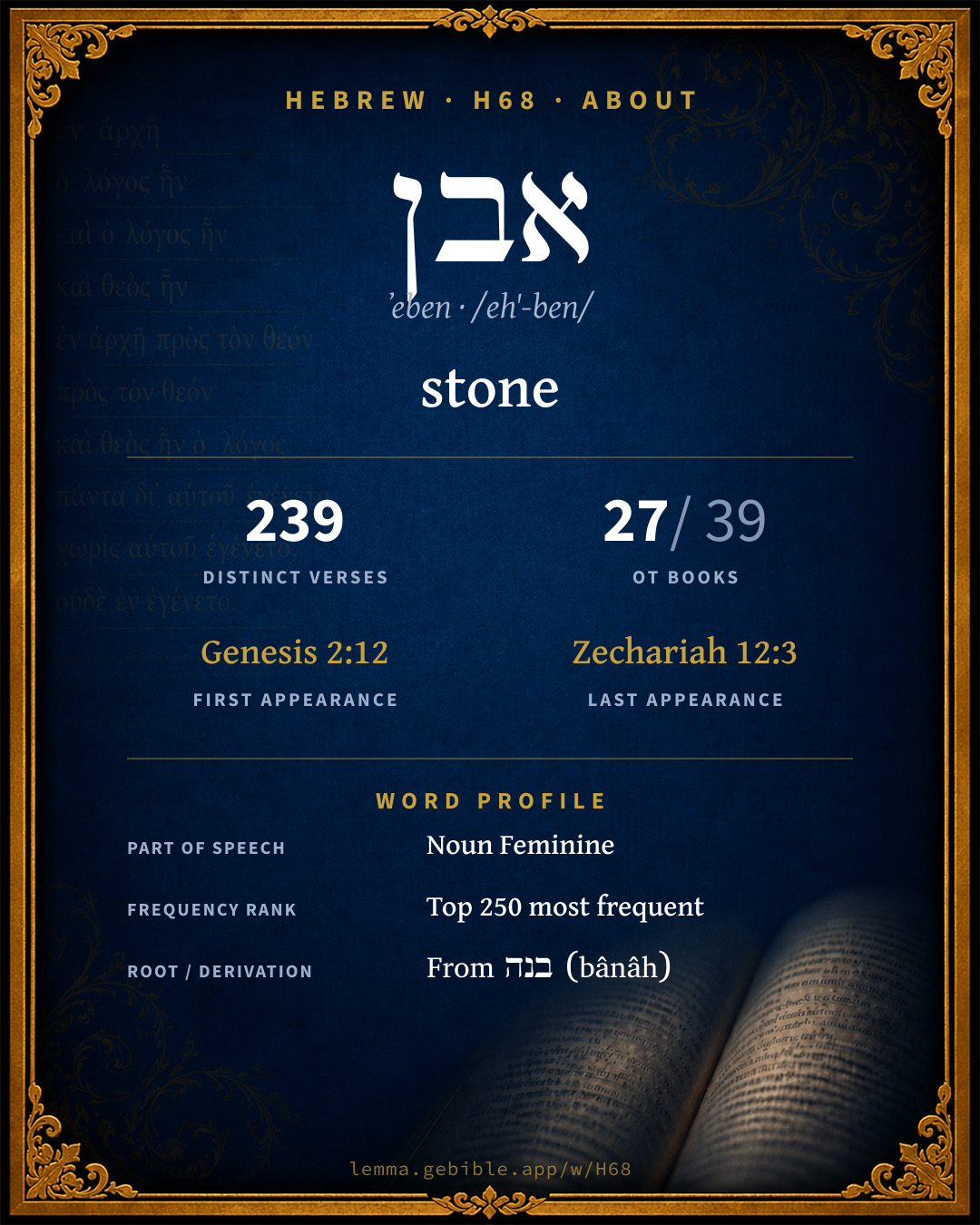
אֶ֫בֶן
stone
‘stone’ is one of 9 main senses fuller range ↓
Full lexicon entry — Brown-Driver-Briggs (BDB)
From Brown-Driver-Briggs (BDB)
Where this word appears
See every Absolute-state word in the Hebrew Bible →
Grammar key — what these labels mean
Part of speech
- Noun
- A naming word — a person, place, thing, or idea.
Noun type
- Common
- A common noun — a general class of person, place, or thing (“king,” “city,” “water”), not a specific name.
State
- Absolute
- The independent form of a noun, not bound to a following word.
- Construct
- A noun bound to a following noun in a possessive / “of” relationship (the construct chain).
Gender
- Feminine
- Grammatically feminine.
Number
- Singular
- One.
- Plural
- More than one (in Hebrew, generally three or more).
Every verse where H68 appears in the Book of Joshua — 20 distinct verses. Click any verse to open its interlinear word-by-word view. Verse text shown in the World English Bible for context — . Each verse’s Hebrew form is shown with its reference; the English is not keyword-highlighted, since the data carries no word-level English alignment. Use “Compare translations” on any verse to read it across multiple English versions. This concordance covers the Hebrew Bible; Septuagint (Greek Old Testament) occurrences are not indexed here.
Joshua
- Joshua 4:3 אֲבָנִ֑ים n c fp and command you them, saying, Take hence out of the midst of the Jordan, out of the place where the priests' feet stood firm, twelve stones, and carry them over with you, and lay them down in the lodging-place, where you shall lodge this night.
- Joshua 4:5 אֶ֤בֶן n c fs and Joshua said to them, Pass over before the ark of Yahweh your God into the midst of the Jordan, and take up every man of you a stone on his shoulder, according to the number of the tribes of the children of Israel;
- Joshua 4:6 הָ/אֲבָנִ֥ים ptcl def.art + n c fp that this may be a sign among you, that when your children ask in time to come, saying, What do you mean by these stones?
- Joshua 4:7 הָ/אֲבָנִ֨ים ptcl def.art + n c fp then you shall tell them, Because the waters of the Jordan were cut off before the ark of the covenant of Yahweh; when it passed over the Jordan, the waters of the Jordan were cut off: and these stones shall be for a memorial to the children of Israel forever.
- Joshua 4:8 אֲבָנִ֜ים n c fp The children of Israel did so as Joshua commanded, and took up twelve stones out of the midst of the Jordan, as Yahweh spoke to Joshua, according to the number of the tribes of the children of Israel; and they carried them over with them to the place where they lodged, and laid them down there.
- Joshua 4:9 אֲבָנִ֗ים n c fp Joshua set up twelve stones in the midst of the Jordan, in the place where the feet of the priests who bore the ark of the covenant stood: and they are there to this day.
- Joshua 4:20 הָֽ/אֲבָנִים֙ ptcl def.art + n c fp Those twelve stones, which they took out of the Jordan, did Joshua set up in Gilgal.
- Joshua 4:21 הָ/אֲבָנִ֥ים ptcl def.art + n c fp He spoke to the children of Israel, saying, When your children shall ask their fathers in time to come, saying, What mean these stones?
- Joshua 7:25 אֶ֔בֶן בָּ/אֲבָנִֽים n c fs prep det + n c fp Joshua said, Why have you troubled us? Yahweh shall trouble you this day. All Israel stoned him with stones; and they burned them with fire, and stoned them with stones.
- Joshua 7:26 אֲבָנִ֣ים n c fp They raised over him a great heap of stones, to this day; and Yahweh turned from the fierceness of his anger. Therefore the name of that place was called "The valley of Achor" to this day.
- Joshua 8:29 אֲבָנִ֣ים n c fp The king of Ai he hanged on a tree until the evening: and at the going down of the sun Joshua commanded, and they took his body down from the tree, and cast it at the entrance of the gate of the city, and raised thereon a great heap of stones, to this day.
- Joshua 8:31 אֲבָנִ֣ים n c fp as Moses the servant of Yahweh commanded the children of Israel, as it is written in the book of the law of Moses, an altar of uncut stones, on which no man had lifted up any iron: and they offered thereon burnt offerings to Yahweh, and sacrificed peace-offerings.
- Joshua 8:32 הָ/אֲבָנִ֑ים ptcl def.art + n c fp He wrote there on the stones a copy of the law of Moses, which he wrote, in the presence of the children of Israel.
- Joshua 10:11 אֲבָנִ֨ים בְּ/אַבְנֵ֣י n c fp prep + n c fp cs It happened, as they fled from before Israel, while they were at the descent of Beth Horon, that Yahweh cast down great stones from the sky on them to Azekah, and they died: they were more who died with the hailstones than they whom the children of Israel killed with the sword.
- Joshua 10:18 אֲבָנִ֥ים n c fp Joshua said, Roll great stones to the mouth of the cave, and set men by it to keep them:
- Joshua 10:27 אֲבָנִ֤ים n c fp It happened at the time of the going down of the sun, that Joshua commanded, and they took them down off the trees, and cast them into the cave in which they had hidden themselves, and laid great stones on the mouth of the cave, to this very day.
- Joshua 15:6 אֶ֥בֶן n c fs cs and the border went up to Beth Hoglah, and passed along by the north of Beth Arabah; and the border went up to the stone of Bohan the son of Reuben;
- Joshua 18:17 אֶ֥בֶן n c fs cs and it extended northward, and went out at En Shemesh, and went out to Geliloth, which is over against the ascent of Adummim; and it went down to the stone of Bohan the son of Reuben;
- Joshua 24:26 אֶ֣בֶן n c fs Joshua wrote these words in the book of the law of God; and he took a great stone, and set it up there under the oak that was by the sanctuary of Yahweh.
- Joshua 24:27 הָ/אֶ֤בֶן ptcl def.art + n c fs Joshua said to all the people, Behold, this stone shall be a witness against us; for it has heard all the words of Yahweh which he spoke to us: it shall be therefore a witness against you, lest you deny your God.
About this entry
At a glance — auto-summarized from this page’s data, not written by a person. Every figure links to its source below. This summary describes the numbers; it doesn’t interpret them.
אבן (ʼeben) is a Hebrew noun most often rendered “stone.” Not a single-sense word: explore its full sense range. The Hebrew Bible uses it across 239 verses — common. It first appears in Genesis 2:12. Sharing its root, it stands alongside בנה, בית and בן. The sections below give every sense, occurrence, and version rendering.
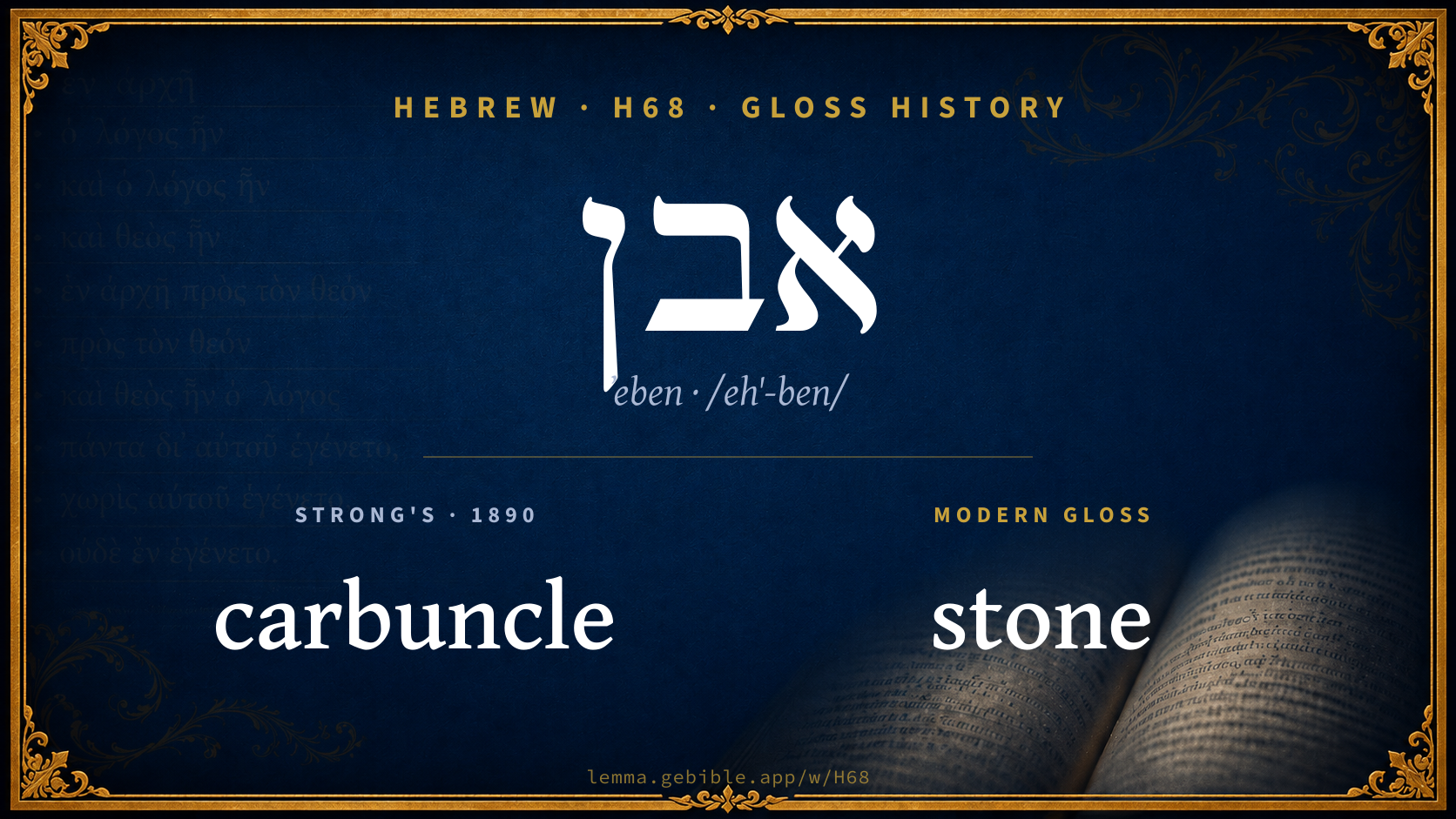
Gloss history
Strong's 1890 vs modern scholarship
About this word
Strong's H68 catalogs a Hebrew word from the Hebrew Old Testament.
These counts are not copied from any lexicon or concordance. They are computed here, from the morphology-tagged Hebrew Old Testament. What Lemma adds →
- 239
- distinct verses
- The word appears in 239 distinct verses.
- 27 / 39
- OT books
- The word appears in 27 of 39 Old Testament books.
- #181
- by frequency
- Top 250 most frequent Hebrew words (rank 181 of 8,640 Hebrew words by occurrence).
View all 239 occurrences in the concordance →
Most concentrated in
- Exodus 25 verses 10%
- Deuteronomy 24 verses 10%
- Joshua 20 verses 8%
By section of the Old Testament
By traditional corpus
Conventional, traditional groupings — biblical authorship is debated, so this is a traditional corpus grouping, not an authorship claim. Each share is this word’s portion of its verses in that division of the Hebrew canon. Each figure is a share of the word’s 239 distinct verses.
- Prophets (Nevi'im) 111 verses · 46%
- Torah (Pentateuch) 76 verses · 32%
- Writings (Ketuvim) 52 verses · 22%
How translations render this word
Counts come from each version’s own published word-to-Strong’s tagging or interlinear alignment — an approximate guide to how each version renders this word, not a word-level alignment the data otherwise carries. Because each total is that version’s own tagged count, the per-version totals vary from one another and need not match the appearance or distinct-verse counts above. These counts may also differ from a printed concordance because Lemma counts each distinctly tagged rendering and does not collapse phrase taggings into a single head-word total. This is a fixed set of word-tagged versions (KJV, ASV, BSB, ULT) and does not change with the reading translation you choose elsewhere. Each version’s license is shown beside its name below (and on Sources).
- King James Version: Stones 126×, Stone 93×, Weight 4×
- American Standard Version: Stones 117×, Stone 90×, Diverse weights 3×
- Berean Standard Bible: Stones 90×, Stone 84×, Gemstones 7×
- unfoldingWord Literal Text: Stone 108×, Stones 94×, Stones of 30×
King James Version Public Domain
Renders H68 across 264 tagged occurrences — most commonly:
Plus 31 renderings that appear only once — usually multi-word phrases or single function words the recovered tagging swept in, not distinct renderings. Not rendered by a distinct English word in 8 further occurrences.
American Standard Version Public Domain
Renders H68 across 259 tagged occurrences — most commonly:
Plus 40 renderings that appear only once — usually multi-word phrases or single function words the recovered tagging swept in, not distinct renderings.
Berean Standard Bible Public Domain
Renders H68 across 242 tagged occurrences — most commonly:
Plus 33 renderings that appear only once — usually multi-word phrases or single function words the recovered tagging swept in, not distinct renderings. Not rendered by a distinct English word in 28 further occurrences.
unfoldingWord Literal Text CC BY-SA 4.0
Renders H68 across 303 tagged occurrences — most commonly:
Plus other, less common renderings. Plus 21 renderings that appear only once — usually multi-word phrases or single function words the recovered tagging swept in, not distinct renderings.
9 senses and sub-senses in the full BDB
What do BDB’s symbols mean?
BDB uses these scholarly abbreviations:
| Symbol | Meaning |
|---|---|
| 𝔊 | the Septuagint (the ancient Greek translation, LXX) |
| 𝔙 | the Vulgate (the Latin translation) |
| 𝔖 | the Syriac version (the Peshitta) |
| 𝔗 | the Targum (the Aramaic translation) |
| ψ | the Psalms |
| √ | root (the underlying root or stem) |
| ‖ | parallel passage (a synonymous or contrasted parallel) |
| † | the dagger: every passage where the word occurs is cited |
The 9 senses and sub-senses the full Brown-Driver-Briggs lexicon distinguishes for this word, in lexicon order (not ranked by frequency), with BDB’s own verbatim wording and sub-sense lettering. Shown in Hebrew script with BDB’s own scholarly abbreviations. The condensed entry is in the Lexicon Entry tab. See also the Forms in the corpus table below.
- 1. in natural state, used as pillow Gn 28:11, 18 (E); seat Ex 17:12 (E); cover of well Gn 29:3(×2), 8, 10 (J) causing one to stumble Is 8:14; marring good ground 2 K 3:19, 25; hand-missile Ex 21:18 (JE) Nu 35:17, 23 (P) 2 S 16:6, 13, especially in judicial stoning, with vb. רָגַם Lv 20:2, 27; 24:23 Nu 14:10; 15:35, 36 Jos 7:25a (all P), so also Dt 21:21 2 Ch 24:21 Ez 16:40; 23:47; cf. 1 K 12:18 = 2 Ch 10:18; with vb. סָקַל Dt 13:11; 17:5; 22:21, 24 1 K 21:13; also Jos 7:25b (JE or D); sling-stones Ju 20:16 1 S 17:40, 49(×2), 50 2 Ch 26:14; hurled by engines 2 Ch 26:15; set up for inscribing law Dt 27:2, 4, 8 Jos 8:32 (all D); as memorial Jos 4:3, 5, 6, 7, 8, 9, 20, 21 (JED) 1 S 7:12; as sacred pillar (מַצֵּבָה) Gn 28:18; 35:14 (anointed with oil), 28:22 (= בֵּיתאֵל) cf. יִשְׂרָאֵל (רֹעֶה)א׳ Gn 49:24 (v. Di); as witness 31:45 cf. Jos 24:26, 27 (all JE); pl. gathered into heap (גַּל) over dead, Jos 7:26 (v. Di) 8:29 cf. 10:18, 27 (JE) 2 S 18:17; גַּל on which meal was eaten, in a compact Gn 31:46(×2) (JE); built into altar Ex 20:25 Dt 27:5, 6 (JED) Jos 8:31 1 K 18:31, 32, 38; cf. 2 K 23:15 𝔊 Klo (for הבמה); of figured stone (forbidden) א׳ מַשְׂכִּית Lv 26:1 (H); א׳ גדולה where ark rested 1 S 6:14, 15 also v 18 (MT אבל q.v.); (v. for other noteworthy stones 9. infr.) e.g. Genesis 28:11
- 2. stone, as material, of tablets Ex 24:12; 31:18; 34:1 (pl.) v 4(×2) (JE) Dt 4:13; 5:19; 9:9, 10, 11; 10:1, 3; of vessels, hence prob. Ex 7:19 (P; א׳ = vessels of stone ‖ עצים) v. Di; idols (‖ עץ) Dt 4:28; 28:36, 64; 29:16 2 K 19:18 = Is 37:19; also Je 3:9 Ez 20:32; pavement 2 K 16:17; edifice 1 K 6:7 cf. Gn 11:3; also 2 S 5:11 2 K 12:13 1 Ch 22:15; often pl. of (worked) stones Lv 14:40, 42(×2), 43, 45 (P; in wall of house) 2 K 22:6 +, cf. of city-wall Ne 3:35; of (ruined) city 1 K 15:22 Ne 3:34; tomb Is 14:19; אֲבָנִים יְקָרוֹת (costly building-stones) 1 K 5:31; 7:9, 10, 11 (v. also sub 3); אַבְנֵי־שַׁיִשׁ = marble (v. 𝔊) 1 Ch 29:2; אַבְנֵי גָזִית = hewn stones 1 K 5:31 1 Ch 22:2 Ez 40:42 (for altar-tables),—cf. גָּזִית; א׳ מַחְצֵב 2 K 12:13; 22:6 2 Ch 34:11; foundation-stone, corner-stone Is 28:16 Je 51:26 Jb 38:6 ψ 118:22; cap-stone, completing the building, הָא׳ הָרִאשֹׁנָה Zc 4:7 (but v. רֹאשׁ פִּנָּה ψ 118:22 as above), Zc 3:9 upon one stone seven eyes, prob. refers to this cap- or head-stone; the eyes are symbol of God’s watchfulness; perhaps explaining cup-stones found in Orient, v. GutheZPV 1890, 129; stone-cutters חָרָשֵׁי א׳ 2 S 5:11 1 Ch 22:15; חֹצְבֵי הָא׳ 2 K 12:13 cf. 1 Ch 22:2. e.g. Exodus 24:12
- 3. precious stone, gen. with modifying word א׳ יְקָרָה coll. 2 S 12:30 1 K 10:2 + often (v. 2); א׳ הַשֹׁהַם Gn 2:12 (J) cf. Ex 25:7; 28:9; 35:9, 27; 39:6 (P) 1 Ch 29:2; א׳ מִלֻּאִים Ex 25:7; 35:9, 27 cf. 1 Ch 29:2; א׳ סַפִּיר Ez 1:26; 10:1; אַבְנֵי אֶקְדָּח Is 54:12; א׳ חֵפֶץ ib.; אַבְנֵי פוּךְ וְרִקְמָה 1 Ch 29:2; א׳ חֵן Pr 17:8; on אַבְנֵי אֵשׁ (stones of fire) Ez 28:14, 16 as precious stones = Assyrian aban išâti (?) v. DlPa 118 & W 40; but Sm al. thunderbolts; also without distinctive modifier Ex 25:7; 35:9; חָרַשׁ א׳ engraver in stone Ex 28:11 cf. 31:5; 35:33 (P). e.g. 2 Samuel 12:30
- 4. stones containing metal, = ore, Dt 8:9 (v. Di) Jb 28:2 cf. v. 3. e.g. Deuteronomy 8:9
- 5. a weight, as orig. stone (v. Pr 27:3 cf. Eng. weight stone = 14 lb) אַבְנֵי־כִיס Pr 16:11 (cf. Assyrian DlW 38); א׳ הַמֶּלֶךְ 2 S 14:26 (i.e. according to royal standard; cf. COT Gn 23:16); א׳ וָא׳ Dt 25:13 Pr 20:10, 23 (i.e. different weights, for dishonest use); כִּיס אַבְנֵי מִרְמָה Mi 6:11; just weights אַבְנֵי־צֶדֶק Lv 19:36; א׳ שְׁלֵמָה Pr 11:1; hence also heavy mass of metal (lead) Zc 5:8. e.g. Proverbs 27:3
- 6. plummet Is 34:11 (stones of devastation, or emptiness, cf. on sense 2 K 21:13 Am 7:7, 8); also made of metal הא׳ הַבְּדִּיל Zc 4:10 (conversely plummet from plumbum). e.g. Isaiah 34:11
- 7. objectslike stones; partic. hail, explicitly, אַבְנֵי הַבָּרָד Jos 10:11 cf. Is 30:30; א׳ אֶלְגָּבִישׁ Ez 13:11, 13; 38:22; but also גְּדֹלוֹת אֲבָנִים Jos 10:11 (E) (cf. Assyrian DlW 38); lime-stones אַבְנֵי־גִד Is 27:9. e.g. Joshua 10:11
- 8. in sim. (mostly poet.) of sinking in water Ex 15:5 = Ne 9:11; motionlessness Ex 15:16; strength Jb 6:12; firmness 41:16; solidity (of ice) 38:30; in prose, of commonness 1 K 10:27 2 Ch 1:15; also metaph. of one in fear 1 S 25:37 (i.e. petrified with terror, cf. Ex 15:16 supr.); לֵב הָא׳ = perverse, hard heart Ez 11:19; 36:26; אַבְנֵי־נֵזֶר Zc 9:16 (of ransomed Isr.)—א׳ personif. Hb 2:11 cf. v 19; cf. Ez 13:11 (v. 7 supr.) e.g. Exodus 15:5
- 9. In topogr. terms (nearly = n.pr.); אֶבֶן בֹּהַן Jos 15:6; 18:17; א׳ הָעֶזֶר 1 S 5:1 cf. 7:12, also 4:1 (We Dr); הָא׳ הָאָ֑זֶל 1 S 20:19, read הָאַרְגָּב הַלָּאז v. 𝔊 here & v 41 (We Dr Klo); א׳ הַזֹּחֶלֶת 1 K 1:9 (where WeSkizzen III,171 comp. Ar. Zuḥal = Saturn). e.g. Joshua 15:6
Senses from the full Brown-Driver-Briggs lexicon (Brown, Driver, Briggs; Oxford 1906 — public domain), digitized via Sefaria, supplemented by the OpenScriptures HebrewLexicon (CC BY 4.0). Full attribution on Sources.
Word origin
n.f. Gn 29:2 (m. 1 S 17:40?) stone (Assyrian abnu, = the sharp, projecting? v. DlW, Pr 107; Ph. אבן; Aramaic. אֶבֶן, ܐܰܒܢܳܐ; Ethiopic እብን Sab. אבנ[ם] DHMZMG 1883, 341) = א׳ abs. Gn 28:22 +; אָ֑בֶן 11:3 +; cstr. 49:24 +; sf. אַבְנוֹ 2 K 3:25; אֲבָנִים Gn 31:46 +, etc.;—a stone (large or small).
— Brown-Driver-Briggs (Oxford 1906, public domain), digitized via Sefaria, supplemented by the OpenScriptures HebrewLexicon (CC BY 4.0). See Sources.
Derived from בנה (bânâh) (H1129) — to build.
Jastrow Dictionary
A second Hebrew/Aramaic lexicon for comparison, covering Aramaic and post-biblical (Talmudic, Targumic, Midrashic) usage that the biblical-Hebrew BDB does not. Matched by lemma rather than by Strong’s number, so a lemma may carry more than one Jastrow headword (shown separately below), and the entries cover usage well beyond the Bible.
אֶבֶן
- , v. Ges. H. Dict. s. v.) stone. Sabb. 10ᵃ; Pes. 12ᵇ כזורק א׳ וכ׳ like throwing a stone into a leather bottle (has no effect, or is indigestible). Num. R. s. 22 (prov.) into a well out of which you drank אל תזרוק בו א׳ cast no stone.—א׳ טובה jewel. B. Bath. 16ᵇ; a. fr. Pl. אֲבָנִים, const. אַבְנֵי. Gen. R. s. 68 שנים עשרה א׳. Ib. אם מתאחות הן שלשה א׳ (read שלש) if these three stones shall grow into one; a. fr.
- Stone Chamber, name of a Temple compartment. Parah III, 1.—א׳ גליון, v. אָוֶן.—א׳ הטועים (א׳ טועין, א׳ טוען, v. טָעָה) Stone of Losers (Claims), a place in Jerusalem where lost and found things were deposited and claimed. Taan. III, 8; Y. ib. 66ᵈ bot.; B. Mets. 28ᵇ—א׳ המבר or א׳ המקח auction place (for slaves). Sifré Deut. 26. Sifra B’har ch. VII, s. 6. Yalk. Lev. 667 א׳ הלקח.—א׳ מסמא a stone used for closing a pit etc. Nidd. 69ᵇ בא׳ מ׳ the corpse was put on a closing (immovable) stone; a. e.—קבועה א׳ a stone rooted in the ground, opp. תלושה. Y. Sotah IX, 23ᶜ top.—אבני השדה v. אדני.—שׁוֹאֶבֶת א׳ magnetic stone, load-stone. Snh. 107ᵇ; a. e.—א׳ הַשָּׁעוֹת stone-dial, Kel. XII, 4; a. e.—א׳ שְׁתִיָּה foundation stone, stone Sh’thiya which in the second Temple occupied the place of the Holy Arc. Yoma V, 2 (3); v. Ib. a. l.—אבנים תּוֹשָׁבוֹת immigrant stones, i.e. stones brought over from another ground. Tosef. Shebi. III, 4; cmp. Shebi. III, 7 a. Y. Ib. a. l.—א׳ תלושה v. sup. א׳ קבועה.—א׳ תקומה preserving stone, a stone believed to protect against abortion. Sabb. 66ᵇ.—[For other combinations see respective determinants.]
אֶבֶן ²
- Targ. Gen. XXVIII, 18; a. fr.—Pl. אַבְנַיָּא, אַבְנֵי, אַבְנִין. Targ. Ex. XXVIII, 11; a. fr. Lev. R. s. 16; a. e.—א׳ דאכפא weight-stones, to prevent the sheaves being blown away. B. Bath. 69ᵃ.—א׳ דכוחלא black marble stone. Kidd. 12ᵃ. [Targ. Prov. XXIII, 28, read with Ms. Luzz. וצאדא בניא שברי and captures foolish sons.] [Y. B. Bath. II, 13ᶜ … דיין אבן corrupt a. defective.]
אֹבֶן
- , only in Du. אָבְנַיִם (b. h.,
- 1. the potter’s turning implement.
- 2. the passage of the embryo, vagina. Ex. R. s. 1 (etym.) מקום שהולד נפנה בו (some ed. נקנה incorr.) where the child turns (to come to light). [Oth. etym. v. ibid. a. Sot. 11ᵇ.]
A Dictionary of the Targumim, the Talmud Babli and Yerushalmi, and the Midrashic Literature (Marcus Jastrow; London, Luzac, 1903) — Public Domain. Digitized via Sefaria. Digitized via Sefaria. Full attribution on Sources.
Forms in the corpus
The 122 distinct written forms H68 takes in the Hebrew Bible, most frequent first — each parse links to that state’s occurrences in the concordance. Hebrew forms include their vowel points and cantillation, so a single lemma takes many written forms.
The 60 most common forms are shown; 62 rarer forms follow in the full concordance.
Same root — word family
Other BDB entries built from the same root as H68, grouped by Strong’s listed origin. These share a root / origin per the lexicon — not necessarily a shared meaning. Each links to that word’s own entry.
Derives from
Shares the same root
- בית bayith H1004 house
- בן bên H1121 son
- בנא bᵉnâʼ H1124 to build
- בניה binyâh H1140 building
- בנין binyân H1146 building
- בת bath H1323 daughter
- מבנה mibneh H4011 building
- תבן teben H8401 stubble
- תבנית tabnîyth H8403 pattern
Derived from this word
Proper names from this root
People and places named from this root — a name, not an additional meaning of the word.
- בנוי Binnûwy H1131 Binnui
- בני Bânîy H1137 Bani
- בני Bunnîy H1138 Bunni
- בניה Bᵉnâyâh H1141 Benaiah
- יבנאל Yabnᵉʼêl H2995 Jabneel
- יבנה Yabneh H2996 Jabneh
- יבניה Yibnᵉyâh H2997 Ibneiah
- יבניה Yibnîyâh H2998 Ibnijah
- מבני Mᵉbunnay H4012 Mebunnai
- אבנה ʼĂbânâh H71 Abana
- אבן העזר ʼEben hâ-ʻÊzer H72 Ebenezer
Compare all same-root words → Showing 4 of 24 — not the complete family. 11 of the same-root words are proper names (people or places). They share a root, not necessarily a meaning.
Septuagint verse parallels
This word appears in 227 verses that also exist in the Greek Old Testament (Septuagint), out of the 239 Hebrew verses it occurs in. You can read those verses in Greek by switching the Old Testament edition to the Septuagint.
Read these verses in the Septuagint
- Genesis 2:12
- Exodus 7:19
- Leviticus 14:40
- Numbers 14:10
- Deuteronomy 4:13
- Joshua 4:3
- Judges 9:5
- 1 Samuel 6:14
- 2 Samuel 5:11
- 1 Kings 1:9
- 2 Kings 3:19
- 1 Chronicles 12:2
This is a verse-level parallel only — the same verses exist in both the Hebrew and Greek Old Testaments. No word-level Hebrew↔Greek correspondence is claimed: the data carries no such alignment, so no Greek word is shown as this Hebrew word’s translation. Coverage is not total — the Septuagint omits the deuterocanon and renumbers the Psalms, so some Hebrew verses have no direct Greek parallel.