
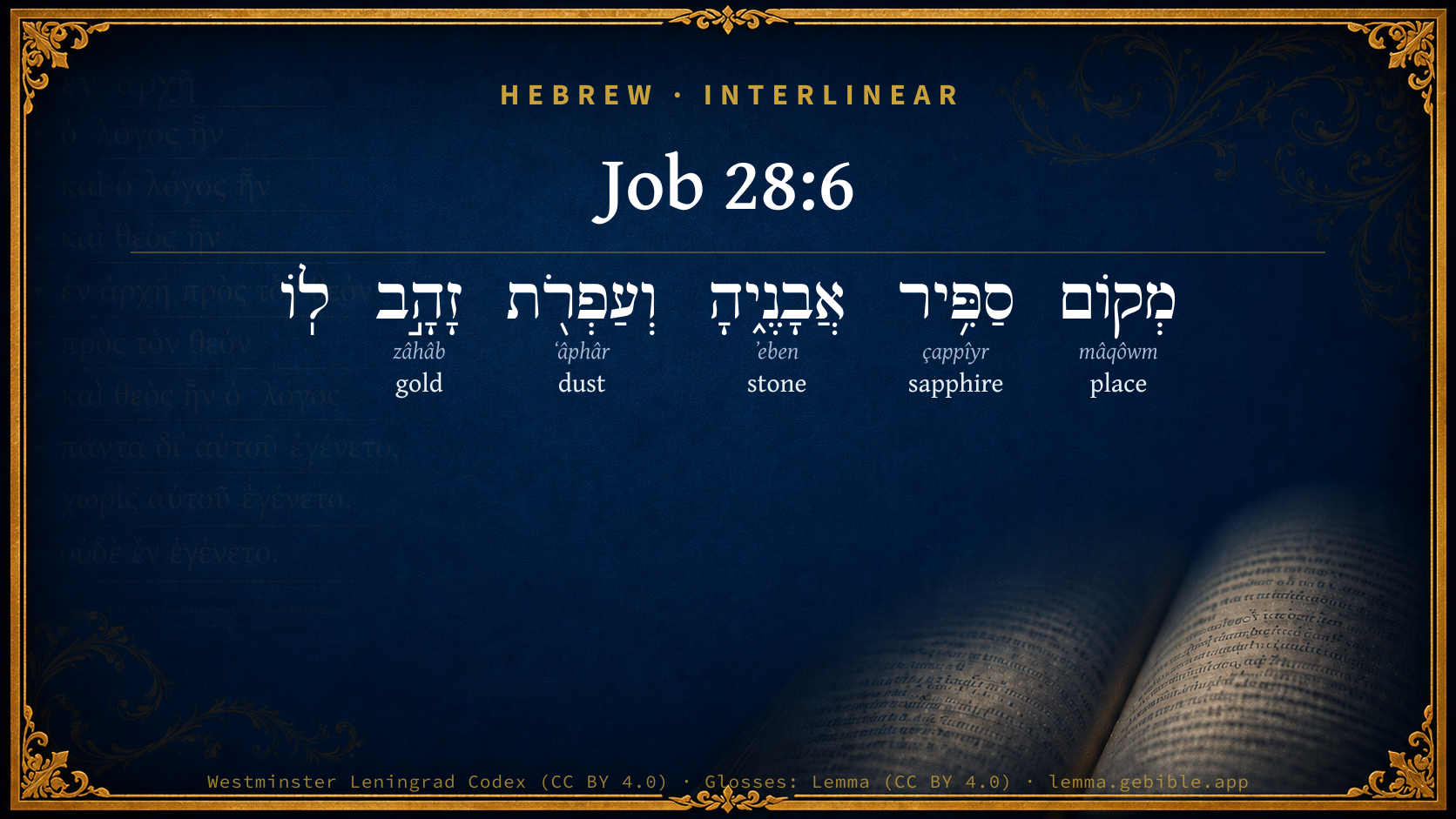
Job 28:6

Hebrew (Westminster Leningrad Codex) Job 28:6 appears in the Hebrew Old Testament. The text above is from the Westminster Leningrad Codex. Each word links to its Strong’s number, a concise gloss, and parsing drawn from the Open Scriptures Hebrew Bible morphology. Click any word for its full Brown-Driver-Briggs (BDB) entry.
Download image
Cite this verse

Job 28:6 (World English Bible). Public Domain. Lemma interlinear Bible study tool, https://lemma.gebible.app/v/job/28/6.

Show BibTeX & RIS
BibTeX
RIS
English Translation
Sapphires come from its rocks. It has dust of gold.
World English Bible · Public Domain
Download a study sheet

One document with this verse’s original text, its word-by-word gloss line, the meaning frame, cross-references with their text, attributed commentary, and full source and license credits — printable, and it pastes into notes with its structure intact.

This verse Autodidact and up

Study sheet (.html) Plain text (.txt)

A passage Seminary Student

Up to 50 verses in one chapter. A passage sheet keeps up to 6 commentary sources and 12 cross-references per verse, in the order this page ranks them, and says so on the sheet whenever that leaves anything out. Ask for a single verse and you get the Autodidact verse sheet above.

Everything on this page stays free to read, with no account — the sheet is a download of what is already on screen, not access to it.

Want to remove ads? Support Godless Engineer
Compare translations 3

The same verse in 3 English versions, stacked beneath the original-language interlinear above. Click any original word for its lexicon entry.

Each is an independent rendering of the whole verse — the interlinear is not word-aligned to these translations.

Highlighted words mark where these versions differ — a whole-verse word diff, not a word-by-word alignment.

  • World English Bible Public Domain
    Sapphires come from its rocks. It has dust of gold.
  • King James Version Public Domain
    The stones of it are the place of sapphires: and it hath dust of gold.
  • unfoldingWord Literal Text CC BY-SA 4.0
    Its stones the place of sapphire, and dusts of gold to it.

unfoldingWord Literal Text — © unfoldingWord, licensed CC BY-SA 4.0. Word-aligned USFM3 via Door43 (git.door43.org/unfoldingWord/en_ult).

Versions to compare (up to 4)

3 of 4 selected

Show all 18 translations

Every available English version of this verse, each an independent rendering of the whole verse.

  • World English Bible Public Domain
    Sapphires come from its rocks. It has dust of gold.
  • Berean Standard Bible Public Domain
    Its rocks are the source of sapphires, containing flecks of gold.
  • Majority Standard Bible Public Domain
    Its rocks are the source of sapphires, containing flecks of gold.
  • King James Version Public Domain
    The stones of it are the place of sapphires: and it hath dust of gold.
  • American Standard Version (1901) Public Domain
    The stones thereof are the place of sapphires, And it hath dust of gold.
  • Revised Version (1885) Public Domain
    The stones thereof are the place of sapphires, and it hath dust of gold.
  • Geneva Bible (1599) Public Domain
    The stones thereof are a place of saphirs, and the dust of it is golde.
  • Douay-Rheims (1899) Public Domain
    The stones of it are the place of sapphires, and the clods of it are gold.
  • Young's Literal Translation Public Domain
    A place of the sapphire `are' its stones, And it hath dust of gold.
  • Literal Standard Version CC BY-SA 4.0
    A place of the sapphire [are] its stones, || And it has dust of gold.
  • Unlocked Literal Bible CC BY-SA 4.0
    Its stones are the place where sapphires are found, and its dust contains gold.
  • unfoldingWord Literal Text CC BY-SA 4.0
    Its stones the place of sapphire, and dusts of gold to it.
  • Darby Bible Public Domain
    The stones of it are the place of sapphires, and it hath dust of gold.
  • World Messianic Bible Public Domain
    Sapphires come from its rocks. It has dust of gold.
  • Webster's Bible Public Domain
    The stones of it are the place of sapphires: and it hath dust of gold.
  • Free Bible Version CC BY-SA 4.0
    Here the rocks contain lapis lazuli and the dust contains gold.
  • Bible in Basic English Public Domain
    Its stones are the place of sapphires, and it has dust of gold.
  • JPS Tanakh (1917) Public Domain
    The stones thereof are the place of sapphires, and it hath dust of gold.

Literal Standard Version (2020), Covenant Press — licensed CC BY-SA 4.0. Text via the HelloAO Bible API (eBible.org). Unlocked Literal Bible (unfoldingWord) — licensed CC BY-SA 4.0. Text via the HelloAO Bible API (eBible.org). unfoldingWord Literal Text — © unfoldingWord, licensed CC BY-SA 4.0. Word-aligned USFM3 via Door43 (git.door43.org/unfoldingWord/en_ult). Free Bible Version, Dr. Jonathan Gallagher — licensed CC BY-SA 4.0. Text via the HelloAO Bible API (eBible.org).

Word by word

More ways to search: Search by grammar → Find every occurrence → Compare this word →

Practice this passage: Drill this verse → Learn its vocabulary →

About this verse

These counts appear in no published source. They are computed here, from the morphology-tagged text and Lemma’s own curated glosses. What Lemma adds →

6
words
5
distinct lemmas
Wisdom
section

Notable vocabulary

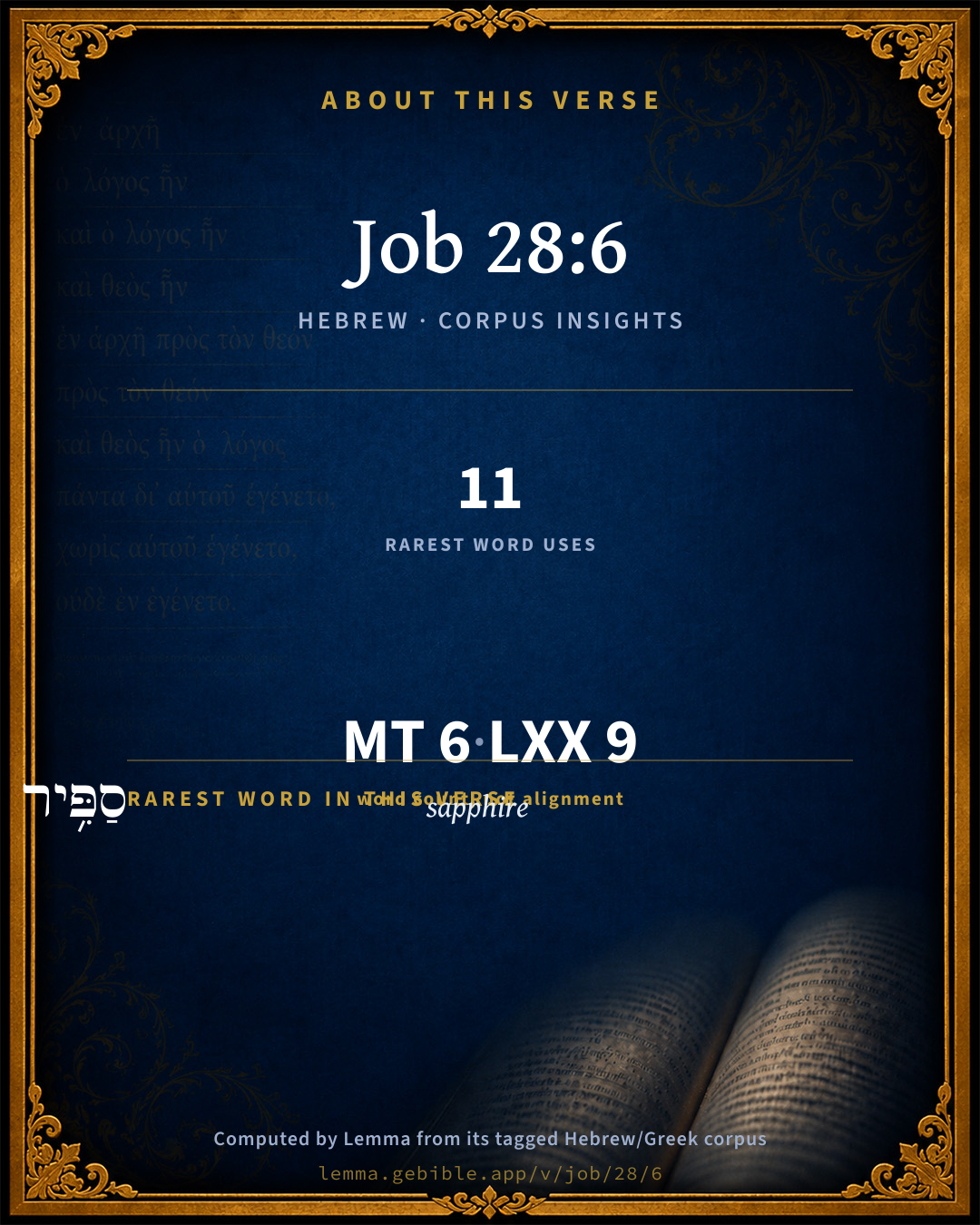
The rarest word here is סַפִּ֥יר sapphire H5601 — appearing just 11 times in the whole Hebrew Bible.

Shared distinctive vocabulary

סַפִּ֥יר sapphire H5601 occurs in 11 verses of the Hebrew Bible. Also found in:

Grammatical profile

  • 5 nouns
  • 1 preposition

Hebrew & Septuagint length

In English translation the verse runs 10 words from the Hebrew and 15 from the Septuagint (LXX English) — the Septuagint runs noticeably longer here. See the side-by-side →

A rough comparison of the two English renderings, which tokenize alike — not a word-level alignment.

Word counts can differ between the Hebrew and the Greek without any difference in meaning — e.g. the Hebrew direct-object marker אֵת has no separate Greek word, and Greek often adds the article ὁ.

In the original languages it is 6 Hebrew tokens and 9 Greek tokens — but the two are counted differently (Hebrew bundles its prefixes and suffixes into one token; the Greek is in lemma form), so that isn’t a like-for-like length.

Cross-references

5

Topical passages linked to Job 28:6 in the Treasury of Scripture Knowledge — connected by theme and wording, ordered by reader-vote popularity; previews shown in the World English Bible.

  • Exodus 24:10 They saw the God of Israel. Under his feet was like a paved work of sapphire stone, like the skies for clearness.
  • Job 28:16 It can't be valued with the gold of Ophir, With the precious onyx, or the sapphire.
  • Song of Solomon 5:14 His hands are like rings of gold set with beryl. His body is like ivory work overlaid with sapphires.
  • Isaiah 54:11 you afflicted, tossed with tempest, and not comforted, behold, I will set your stones in beautiful colors, and lay your foundations with sapphires.
  • Revelation 21:19 The foundations of the city's wall were adorned with all kinds of precious stones. The first foundation was jasper; the second, sapphire; the third, chalcedony; the fourth, emerald;

Cross-references courtesy of OpenBible.info (CC BY 4.0).

Hebrew and Greek witnesses Masoretic Hebrew ↔ Greek Septuagint

The same verse in the two great witnesses to the Old Testament, shown verse-for-verse.

Here the Septuagint runs noticeably longer than the Hebrew — LXX2012 (modern English Septuagint) 15 words vs World English Bible 10. A rough length comparison of the two English translations, not a word-level alignment — read both below.

These are two independent witnesses, not word-aligned to each other, and the Septuagint is shown in lemma (dictionary) form.

Hebrew Job 28:6 Masoretic · Westminster Leningrad Codex

מְקוֹם סַפִּ֥יר אֲבָנֶ֑יהָ וְעַפְרֹ֖ת זָהָ֣ב לֽוֹ

Sapphires come from its rocks. It has dust of gold.

World English Bible · Public Domain

Greek LXX Job 28:6 Septuagint · lemma form

τόπος σάπφειρος ὁ λίθος αὐτός καί χῶμα χρυσίον αὐτός

Her stones are the place of the sapphire: and her dust supplies man with gold.

LXX2012 (modern English Septuagint) · Public Domain

Hebrew: Westminster Leningrad Codex (CC BY 4.0). Greek: Septuagint (public domain); English from LXX2012 (modern English Septuagint) (Public Domain). How the Septuagint differs from the Hebrew →

Commentary

Notes on Job 28:6 from classic Christian and Jewish commentators (each source and its license shown beneath its notes). The classic Christian expositions comment on the surrounding passage and are grouped to its opening verse, so a note may address several verses; the Jewish commentaries on the Tanakh (Rashi and others) are per-verse, so they appear only where the commentator wrote on this verse.

Lemma curates 59 commentaries, every one of them public domain or Creative Commons licensed, each selected and text-cleaned for this edition rather than reprinted as found. About our sources →

Trapp's Complete Commentary

John Trapp

Job 28:6 The stones of it [are] the place of sapphires: and it hath dust of gold.

Ver. 6. The stones of it are the place of sapphires] Which are excellent stones, and, therefore, here joined with gold, Quod punctis aureis collucant, because they shine with golden sparklings. Exo 24:10, the Sanhedrim "saw the God of Israel, and there was under his feet as it were a paved work of a sapphire stone," &c. To show, saith one, that God had now changed their condition, their bricks made in their bondage to sapphire. So, Isa 54:11, God graciously promiseth unto his afflicted Church, that had been tossed with tempests, and not comforted, to lay her stones with fair colours and her foundation with sapphires; to make her windows of agates, and her gates of carbuncles, and all her borders of pleasant stones; to render her all glorious within, by the curious enamel and embroidery of holy graces, and to beautify also and bespangle her with outward plenty and prosperity, that she might glitter in the eyes of God and men.

And it hath dust of gold] Or, ore of gold; better than that which our Frobisher, in his voyage to discover the strait, brought back with him; from which, when there could be drawn neither gold nor silver, nor any other metal, we have seen it cast forth to repair the highways, saith Mr Cambden.

John Trapp, A Commentary or Exposition upon All the Books of the Old and New Testament (1647–1656) — public domain. Text from a community e-Sword module.

The Biblical Illustrator

Joseph S. Exell

Job_28:6

And it hath dust of gold.

How to turn everything to gold

This chapter in Job describes with all a poets force and beauty the miners life in its loneliness, its dangers, and its triumphs. In those old days men endured the toil, and faced the dangers, to win the hidden gold, or precious stones. And from then till now men have ever been eager to find gold. The passion for gold is one of the strongest in the human heart. It has done much to shape the worlds history. It has given us new arts, new sciences, and new industries. It has made solitary places populous, and filled empty lands with busy multitudes. Why is gold so coveted? For one thing, it is very rare. Gold has many properties peculiar to itself. And it is very durable. The principal reason of the high esteem for gold, is because it is the chief means of exchange between buyers and sellers. Some things, precious as it is, gold cannot buy. It cannot buy wisdom, knowledge, or goodness. Its possession means power to acquire all worldly good. Happiness cannot be bought with gold. The secret I am going to tell you is,--How to turn everything into gold. Not in a literal sense. Some people, though poor, are as happy as if all gold was theirs. Their purses may never be very full, but their hearts always are of faith and love They are always bright, and have a cheery smile and a kindly word for all in trouble. Such people have found the secret of turning everything to gold. What is the secret? Paul says, I have learned, in whatever state I am, therewith to be content He had learned so to love the Heavenly Fathers will, so to trust Him, that all care and fear and darkness had fled out of life, and left it touched with perpetual golden light. And that is the secret that all men know who can turn things to gold. Love Christ, and follow Him, and you will have discovered the secret--how to turn everything to gold. (James Legge, M. A.)

The Biblical Illustrator, edited by Joseph S. Exell (c. 1880s–1900s) — public domain. Text from a community e-Sword module.

Geneva Bible (1599)

Geneva Bible translators

He alludeth to the mines and secrets of nature, which are under the earth, whereinto neither fowls nor beasts can enter.

Geneva Bible (1599) marginal notes — public domain. Text via Bolls.life.

Jamieson, Fausset & Brown

Robert Jamieson, A. R. Fausset & David Brown

Sapphires are found in alluvial soil near rocks and embedded in gneiss. The ancients distinguished two kinds: 1. The real, of transparent blue: 2. That improperly so called, opaque, with gold spots; that is, lapis lazuli. To the latter, looking like gold dust, UMBREIT refers "dust of gold." English Version better, "The stones of the earth are, &c., and the clods of it (Vulgate) are gold"; the parallel clauses are thus neater.

Jamieson, Fausset & Brown — Commentary Critical and Explanatory on the Whole Bible (1871) — public domain (CC PDM 1.0). Text via the HelloAO Bible API.

Adam Clarke's Commentary

Verse 6. The stones - the place of sapphires] In the language of mineralogists, the gangue, matrix, or bed in which the sapphire is found. For a description of this stone, see on Job 28:16.

Dust of gold] Or rather, gold dust.

Adam Clarke's Commentary on the Bible (1810–1826) — public domain. Text from a community e-Sword/MySword module.

Ellicott's Commentary for English Readers

(6) The stones of it are the place of sapphires.—So ingenious is man that he discovereth a place of which the stones are sapphires and the very dust gold, and a path that no bird of prey knoweth, and which the falcon’s eye hath not seen.

A Bible Commentary for English Readers, edited by Charles John Ellicott (1878–1897) — public domain. Text from a community e-Sword module.

The Cambridge Bible for Schools and Colleges

gen. ed. J. J. S. Perowne

6. Through these operations which carry ruin into the bowels of the earth men, however, find the richest reward. The stones of the heart of the earth are the place of sapphires, and of auriferous dust.

it hath dust of gold] “It” refers to the “place” in the first clause, hardly to the sapphire, although a particular kind of sapphire is described as being grained or striated with gold. This, however, can hardly be what is meant by “dust of gold.” Instead of it hath dust we might render he hath—i. e. man; he finds his way to the place of sapphires and possesses himself of the auriferous earth.

The Cambridge Bible for Schools and Colleges (gen. ed. J. J. S. Perowne; Cambridge University Press, 1878–1918) — public domain. Text from a community e-Sword module.

John Gill's Exposition

The stones of it are the place of sapphires,.... In some parts of the earth its stones are a quarry of sapphires, put here for all precious stones: this is a most excellent precious stone, of a sky colour, with golden specks, and was one of the stones in the breast plate of the high priest; and by which are represented the pavement under the feet of the God of Israel, the throne of Christ, his bowels and affections for his people, the comeliness of them, and the glory of his church in the latter day, Exo 24:10;

and it hath dust of gold; some parts of the earth abound with the dust of gold; its dust is gold, or it hath gold as plenty as dust; though some think this refers to the sapphire in the preceding clause, which, as Pliny says (d), has "pulvis aureus", dust of gold, in it, and shines and sparkles with golden points, or specks; and so say other writers (e); but the word used rather signifies clods, lumps, masses of gold, which better agree with the earth; and, besides, no very good reason can be given why there should be such a particular description of the sapphire; whereas the earth is the original of that, and of all the other things before spoken of.

(d) Nat. Hist. l. 37. c. 9. (e) Ruaeus de Gemmis, l. 2. c. 2.

John Gill's Exposition of the Whole Bible (1746–1763) — public domain (CC PDM 1.0). Text via the HelloAO Bible API.

Albert Barnes' Notes on the Bible

The stones of it are the place - Among the stones of the earth sapphires are found. “The situation of the sapphire is in alluvial soil, in the vicinity of rocks, belonging to the secondary floetz trap formation, and imbedded in gneiss.” Jameson. “The sapphire occurs in considerable abundance in the granitic alluvion of Matura and Saffragam, in Ceylon.” Davy.

Sapphires - Compare the note at Isa 54:11. The sapphire is a precious stone, usually of a blue color, though it is sometimes yellow, red, violet. green, or white. In hardness it is inferior to the diamond only:

“In unroll’d tufts, flowers purpled, blue and white,

Like sapphire, pearl, in rich embroidery.”

Shakespeare

“He tinctures rubies with their rosy hue,

And on the sapphire spreads a heavenly blue.”

Blackmore

The mineral is, next to the diamond, the most valuable of the precious stones. The most highly prized varieties are the crimson and carmine red; these are the “Oriental ruby” of the traveler, and next to the diamond are the most valuable jewels hitherto discovered. The blue varieties - the sapphire of the jeweler - are next in value to the red. The yellow varieties - the “Oriental Topaz” of the jeweler - are of less value than the blue or true sapphire. Edinburgh Encyclopedia, article “Mineralogy.”

And it hath dust of gold - Margin, or “gold ore.” Literally, “The dusts of gold are in it.” Gold is often found in the form of dust. It is obtained by washing it from the sand, and passing it over a fleece of wool, to which the gold adheres.

Albert Barnes' Notes on the Bible (1834–1885) — public domain. Text from a community e-Sword/MySword module.

Haydock's Catholic Bible Commentary

Sapphires. The best are found in Media, in the country of the Taphyri, (Ptol.) or Raspires. (Herodotus iii. 94.) --- Gold. This precious metal, like all others, is found in the bowels of the earth, (Haydock) and in the bed of rivers, in Ophir, Peru, &c. (Calmet)

George Leo Haydock (1774–1849), Haydock's Catholic Family Bible and Commentary, 1859 edition — public domain. Excludes Psalms (Douay-Rheims chapter numbering differs from Protestant) and Deuterocanonical books (Catholic canon only).

Matthew Poole's English Annotations

The place of sapphires, i.e. of precious stones; the sapphire, as one of the most eminent, being put for all the rest. In some parts of the earth the sapphires are mixed with stones, and cut out of them and polished. Of this stone, see Exo 24:10; Son 5:14; Lam 4:7; Eze 1:26.

It hath, i.e. the earth containeth in or under it.

Dust of gold; which is a distinct thing from that gold which is found in the mass or lump, of which Job 28:2; both sorts of gold being found in the earth.

Matthew Poole's English Annotations on the Holy Bible (1683–1685) — public domain. Text from a community e-Sword/MySword module.

Whedon's Commentary on the Bible

Daniel D. Whedon

6. Sapphires — The precious stone we call the sapphire is generally of a sky-blue colour, transparent, and harder than ruby. The ancients seem to have called the lapis lazuli by that name. But this was too plentiful, as Winer (i, 282) well says, to admit of its being accounted one of the precious stones of Job. There was discovered (A.D. 1859) at the opening of the tomb of Amosis, in Thebes, an axe made of lapis lazuli.

Dust of gold — “Modern science, instead of confuting, only confirms the aphorism of the patriarch Job, who has shadowed forth the downward persistence of the one, (silver,) and the superficial distribution of the other, (gold.) Surely there is a vein for the silver, the earth hath dust of gold.” — Sir Roderick Murchison. Hitzig supposes the words of this verse to be the reply of the miner, justifying his ingratitude by the consideration of the sapphires and gold he expects to gain out of the earth.

Daniel D. Whedon (gen. ed.), Commentary on the Old and New Testaments (1874–1909) — public domain. Text from a community e-Sword module.

The Pulpit Commentary

The stones of it are the place of sapphires. Among the rocks and stones whereof the interior of the earth is mainly composed are found gems of inestimable value, for instance, sapphires. It is doubtful whether the Hebrew sapphire (ryps) was the gem which bears that name among ourselves, or the lapis lazuli. In either case it was highly esteemed, and appeared in kings" crowns, (Eze_28:13) and in the high priest"s breastplate; (Exo_28:18) Job notes its high value in ver. 16. And it (i.e. the earth) hath dust of gold; literally, dusts; i.e. a multitude of small specks or atoms. In the auriferous rocks gold is commonly scattered in such specks.

The Pulpit Commentary (1880–1919), ed. H.D.M. Spence-Jones & Joseph S. Exell — public domain. Text from a community e-Sword module.

John Wesley's Explanatory Notes

Sapphires - Of precious stones; the sapphire, is one of the most eminent, being put for all the rest. In some parts of the earth, the sapphires are mixed with stones, and cut out of them and polished. Hath - The earth continueth. Dust - Distinct from that gold which is found in the mass, both sorts of gold being found in the earth.

John Wesley, Explanatory Notes Upon the Whole Bible (1754–1765) — public domain. Text via the GEBible commentary corpus.

Rashi

Rabbi Shlomo Yitzchaki (Rashi)

a place of sapphire its stones were.

Rashi on the Tanakh — English translations: “The Judaica Press complete Tanach with Rashi, translated by A. J. Rosenberg” (CC BY 4.0); “Pentateuch with Rashi's commentary by M. Rosenbaum and A.M. Silbermann, 1929-1934” (public domain); “The Metsudah Tanach series, Lakewood, N.J” (CC BY 4.0); and “The Book of Joshua, Metsudah Publications, 1997” (CC BY 4.0). Text via Sefaria.

Lesson kit

Teaching starters — assembled from the data on this page, not authored interpretation. Every prompt links to the verse data it draws on. Edit before teaching.

Job, in the Wisdom, opens this verse with 6 words (5 distinct Hebrew lemmas). Its most distinctive word is çappîyr (“sapphire”). The Greek Septuagint runs longer here. A historical commentator’s framing appears above. Read the whole chapter for the surrounding context.

Discussion questions

  1. How does “sapphire” (çappîyr) shape what this verse is saying?
  2. How does Exodus 24:10, which shares the word «sapphire», read alongside this verse?
  3. The Septuagint runs longer here than the Hebrew. What might account for the difference?
  4. The translations on this page render this verse differently — a whole-verse word diff, not a word-by-word alignment. What might account for the different wordings?
  5. Compare how Trapp's Complete Commentary and The Biblical Illustrator read this verse. Where do they agree or differ?

Things to notice

Reading settings

Reading text

Shown beneath each verse's original-language words.

Old Testament
Old Testament edition

Read the OT as the Masoretic Hebrew (MT) or the Greek Septuagint (LXX).

English shown for the Greek Septuagint (in the Hebrew ↔ Greek comparison).

Comparing translations? Open the Compare panel on any verse page to stack up to four side by side.