
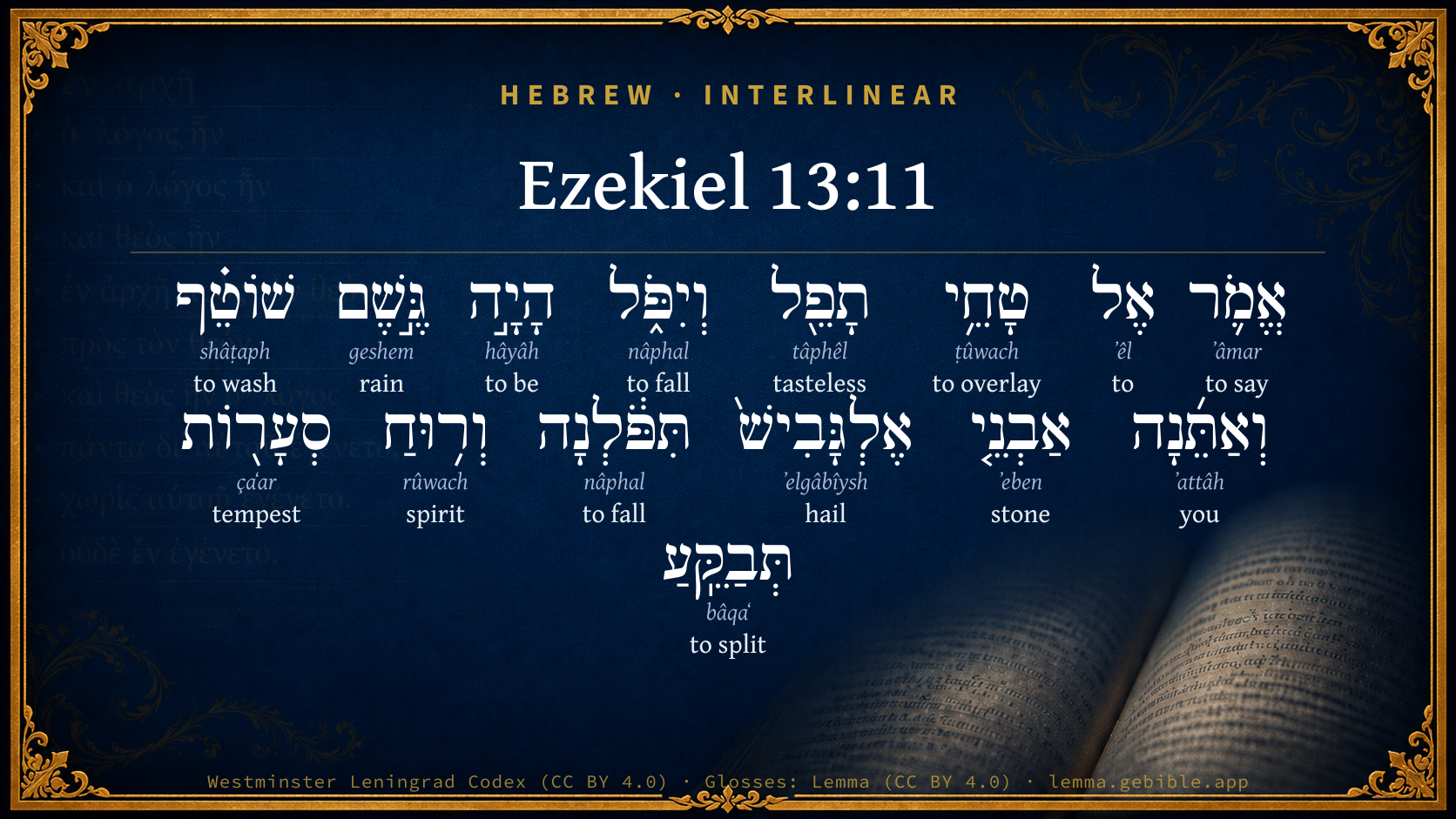
Ezekiel 13:11

Hebrew (Westminster Leningrad Codex) Ezekiel 13:11 appears in the Hebrew Old Testament. The text above is from the Westminster Leningrad Codex. Each word links to its Strong’s number, a concise gloss, and parsing drawn from the Open Scriptures Hebrew Bible morphology. Click any word for its full Brown-Driver-Briggs (BDB) entry.
Download image
Cite this verse

Ezekiel 13:11 (World English Bible). Public Domain. Lemma interlinear Bible study tool, https://lemma.gebible.app/v/ezekiel/13/11.

Show BibTeX & RIS
BibTeX
RIS
English Translation
tell those who daub it with whitewash, that it shall fall: there shall be an overflowing shower; and you, great hailstones, shall fall; and a stormy wind shall tear it.
World English Bible · Public Domain
Highlights
  • 1 first appearance in the Hebrew Bible
Full analysis ↓
Download a study sheet

One document with this verse’s original text, its word-by-word gloss line, the meaning frame, cross-references with their text, attributed commentary, and full source and license credits — printable, and it pastes into notes with its structure intact.

This verse Autodidact and up

Study sheet (.html) Plain text (.txt)

A passage Seminary Student

Up to 50 verses in one chapter. A passage sheet keeps up to 6 commentary sources and 12 cross-references per verse, in the order this page ranks them, and says so on the sheet whenever that leaves anything out. Ask for a single verse and you get the Autodidact verse sheet above.

Everything on this page stays free to read, with no account — the sheet is a download of what is already on screen, not access to it.

Want to remove ads? Support Godless Engineer
Compare translations 3

The same verse in 3 English versions, stacked beneath the original-language interlinear above. Click any original word for its lexicon entry.

Each is an independent rendering of the whole verse — the interlinear is not word-aligned to these translations.

Highlighted words mark where these versions differ — a whole-verse word diff, not a word-by-word alignment.

  • World English Bible Public Domain
    tell those who daub it with whitewash, that it shall fall: there shall be an overflowing shower; and you, great hailstones, shall fall; and a stormy wind shall tear it.
  • King James Version Public Domain
    Say unto them which daub it with untempered morter, that it shall fall: there shall be an overflowing shower; and ye, O great hailstones, shall fall; and a stormy wind shall rend it.
  • unfoldingWord Literal Text CC BY-SA 4.0
    Say to those who are whitewashing the wall, ‘It will fall down; there will be a downpour of rain, and I will send hailstones to make it fall down, and a windstorm wind to break it down.

unfoldingWord Literal Text — © unfoldingWord, licensed CC BY-SA 4.0. Word-aligned USFM3 via Door43 (git.door43.org/unfoldingWord/en_ult).

Versions to compare (up to 4)

3 of 4 selected

Show all 18 translations

Every available English version of this verse, each an independent rendering of the whole verse.

  • World English Bible Public Domain
    tell those who daub it with whitewash, that it shall fall: there shall be an overflowing shower; and you, great hailstones, shall fall; and a stormy wind shall tear it.
  • Berean Standard Bible Public Domain
    tell those whitewashing the wall that it will fall. Rain will come in torrents, I will send hailstones plunging down, and a windstorm will burst forth.
  • Majority Standard Bible Public Domain
    tell those whitewashing the wall that it will fall. Rain will come in torrents, I will send hailstones plunging down, and a windstorm will burst forth.
  • King James Version Public Domain
    Say unto them which daub it with untempered morter, that it shall fall: there shall be an overflowing shower; and ye, O great hailstones, shall fall; and a stormy wind shall rend it.
  • American Standard Version (1901) Public Domain
    say unto them that daub it with untempered `mortar', that it shall fall: there shall be an overflowing shower; and ye, O great hailstones, shall fall; and a stormy wind shall rend it.
  • Revised Version (1885) Public Domain
    say unto them which daub it with untempered mortar, that it shall fall: there shall be an overflowing shower; and ye, O great hailstones, shall fall; and a stormy wind shall rend it.
  • Geneva Bible (1599) Public Domain
    Say vnto them which daube it with vntempered morter, that it shall fall: for there shall come a great showre, and I wil sende haylestones, which shall cause it to fall, and a stormie winde shall breake it.
  • Douay-Rheims (1899) Public Domain
    Say to them that daub without tempering, that it shall fall: for there shall be an overflowing shower, and I will cause great hailstones to fall violently from above, and a stormy wind to throw it down.
  • Young's Literal Translation Public Domain
    Say to those daubing with chalk -- It falleth, There hath been an overflowing shower, And ye, O hailstones, do fall, And a tempestuous wind doth rend,
  • Literal Standard Version CC BY-SA 4.0
    Say to those coating with chalk—It falls, || There has been an overflowing shower, || And you, O hailstones, fall, || And a turbulent wind breaks out,
  • Unlocked Literal Bible CC BY-SA 4.0
    Say to those who are whitewashing the wall, 'It will fall down; there will be a downpour of rain, and I will send hailstones to make it fall down, and a windstorm wind to break it down.
  • unfoldingWord Literal Text CC BY-SA 4.0
    Say to those who are whitewashing the wall, ‘It will fall down; there will be a downpour of rain, and I will send hailstones to make it fall down, and a windstorm wind to break it down.
  • Darby Bible Public Domain
    say unto them which daub it with untempered [mortar] that it shall fall: there shall be an overflowing rain, and ye, O great hailstones, shall fall, and a stormy wind shall burst forth.
  • World Messianic Bible Public Domain
    Tell those who plaster it with whitewash that it will fall. There will be an overflowing shower; and you, great hailstones, will fall. A stormy wind will tear it.
  • Webster's Bible Public Domain
    Say to them who daub it with untempered mortar, that it shall fall: there shall be an overflowing shower; and ye, O great hailstones, shall fall; and a stormy wind shall rend it.
  • Free Bible Version CC BY-SA 4.0
    So tell those people whitewashing the wall that it's going to collapse. Rain will come pouring down. I will send hailstones crashing down on it. A windstorm will blow hard against it.
  • Bible in Basic English Public Domain
    Say to those who put whitewash on it, There will be an overflowing shower; and you, O ice-drops, will come raining down; and it will be broken in two by the storm-wind.
  • JPS Tanakh (1917) Public Domain
    say unto them that daub it with whited plaster, that it shall fall; there shall be an overflowing shower, and ye, O great hailstones, shall fall, and a stormy wind shall break forth,

Literal Standard Version (2020), Covenant Press — licensed CC BY-SA 4.0. Text via the HelloAO Bible API (eBible.org). Unlocked Literal Bible (unfoldingWord) — licensed CC BY-SA 4.0. Text via the HelloAO Bible API (eBible.org). unfoldingWord Literal Text — © unfoldingWord, licensed CC BY-SA 4.0. Word-aligned USFM3 via Door43 (git.door43.org/unfoldingWord/en_ult). Free Bible Version, Dr. Jonathan Gallagher — licensed CC BY-SA 4.0. Text via the HelloAO Bible API (eBible.org).

Word by word

More ways to search: Search by grammar → Find every occurrence → Compare this word →

Practice this passage: Drill this verse → Learn its vocabulary →

אֶלְגָּבִישׁ֙
ʼelgâbîysh
H417
“hail”
Noun, Common, Masculine, Singular, Absolute
Part of Speech
Noun
Type
Common
Gender
Masculine
Number
Singular
State
Absolute
Full BDB Definition

Origin: from H410 and H1378

TWOT: 89a

hail (literally - pearls of God)
  1. אֱמֹ֛ר ʼâmar H559 “say” Verb, Qal, Imperative, 2nd Person, Masculine, Singular
  2. אֶל ʼêl H413 “to” Preposition
  3. טָחֵ֥י ṭûwach H2902 “overlaying” Verb, Qal, Participle Active, Masculine, Plural, Construct
  4. תָפֵ֖ל tâphêl H8602 “tasteless” Noun, Common, Masculine, Singular, Absolute
  5. וְיִפֹּ֑ל nâphal H5307 “and · to fall” Conjunction + Verb, Qal, Imperfect, 3rd Person, Masculine, Singular
  6. הָיָ֣ה hâyâh H1961 “to be” Verb, Qal, Perfect, 3rd Person, Masculine, Singular
  7. גֶּ֣שֶׁם geshem H1653 “rain” Noun, Common, Masculine, Singular, Absolute
  8. שׁוֹטֵ֗ף shâṭaph H7857 “washing” Verb, Qal, Participle Active, Masculine, Singular, Absolute
  9. וְאַתֵּ֜נָה ʼattâh H859 “and · you” Conjunction + Pronoun, Personal, 2nd Person, Feminine, Plural
  10. אַבְנֵ֤י ʼeben H68 “stones of” Noun, Common, Feminine, Plural, Construct
  11. תִּפֹּ֔לְנָה nâphal H5307 “to fall” Verb, Qal, Imperfect, 2nd Person, Feminine, Plural
  12. וְר֥וּחַ rûwach H7307 “and · spirit of” Conjunction + Noun, Common, Both, Singular, Construct
  13. סְעָר֖וֹת çaʻar H5591 “tempests” Noun, Common, Feminine, Plural, Absolute
  14. תְּבַקֵּֽעַ bâqaʻ H1234 “to split” Verb, Piel, Imperfect, 3rd Person, Feminine, Singular

About this verse

These counts appear in no published source. They are computed here, from the morphology-tagged text and Lemma’s own curated glosses. What Lemma adds →

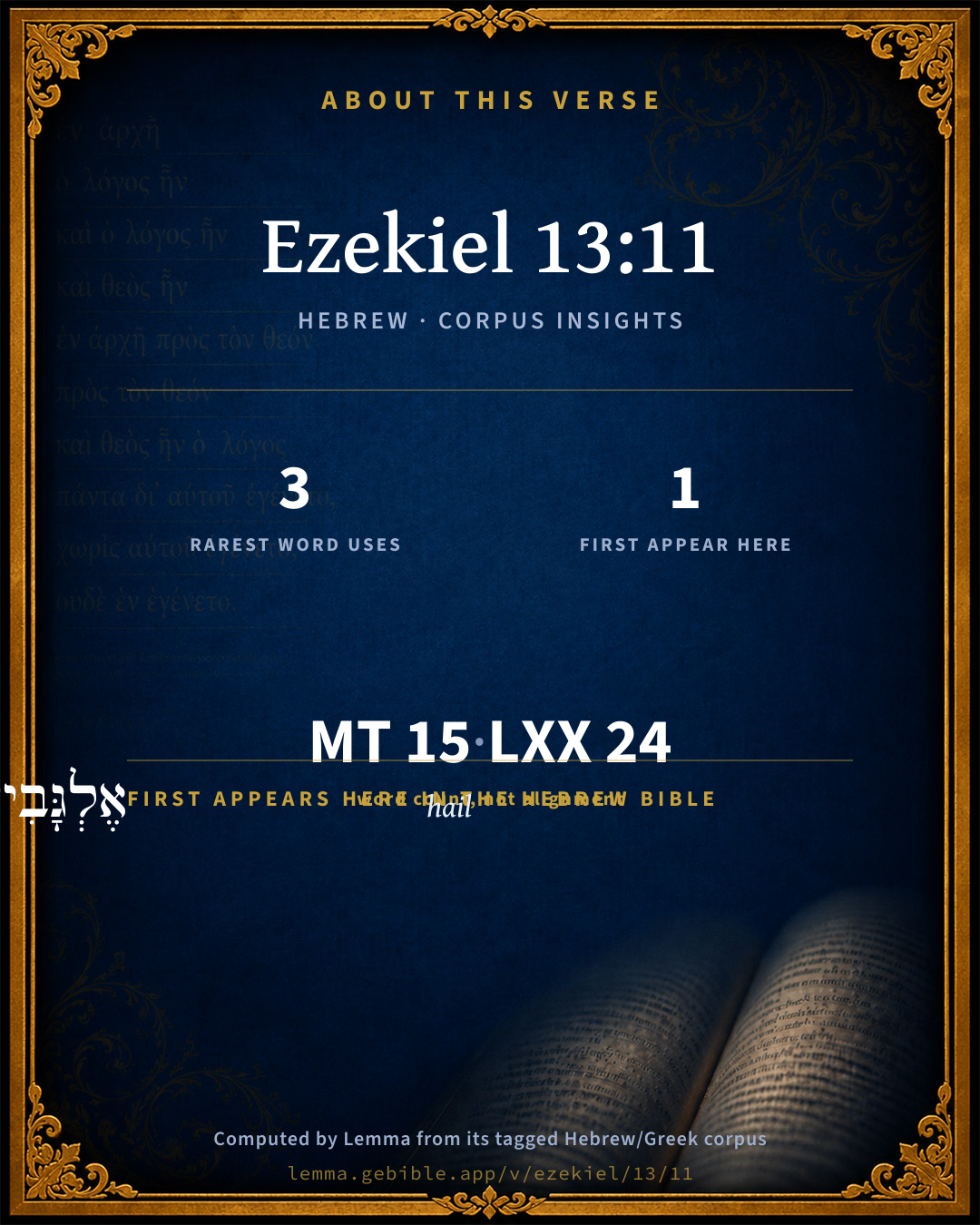
15
words
14
distinct lemmas
Prophets
section

Notable vocabulary

The rarest word here is אֶלְגָּבִישׁ֙ hail H417 — appearing just 3 times in the whole Hebrew Bible.

First appearance in Scripture

This word makes its first canonical appearance in the Hebrew Bible here:

  • אֶלְגָּבִישׁ֙ hail H417

Shared distinctive vocabulary

אֶלְגָּבִישׁ֙ hail H417 occurs in 3 verses of the Hebrew Bible. Also found in:

Grammatical profile

  • 7 verbs
  • 6 nouns
  • 1 pronoun
  • 1 preposition

Verb forms

  • אֱמֹ֛ר Qal · Imperative
  • טָחֵ֥י Qal · Participle Active
  • וְיִפֹּ֑ל Qal · Imperfect
  • הָיָ֣ה Qal · Perfect
  • שׁוֹטֵ֗ף Qal · Participle Active
  • תִּפֹּ֔לְנָה Qal · Imperfect
  • תְּבַקֵּֽעַ Piel · Imperfect

Repetition

A word recurs within this verse — often emphatic in Hebrew:

  • וְיִפֹּ֑ל to fall H5307 ×2

Hebrew & Septuagint length

In English translation the verse runs 30 words from the Hebrew and 41 from the Septuagint (LXX English) — closely comparable.

A rough comparison of the two English renderings, which tokenize alike — not a word-level alignment.

Word counts can differ between the Hebrew and the Greek without any difference in meaning — e.g. the Hebrew direct-object marker אֵת has no separate Greek word, and Greek often adds the article ὁ.

In the original languages it is 15 Hebrew tokens and 24 Greek tokens — but the two are counted differently (Hebrew bundles its prefixes and suffixes into one token; the Greek is in lemma form), so that isn’t a like-for-like length.

Cross-references

15

Topical passages linked to Ezekiel 13:11 in the Treasury of Scripture Knowledge — connected by theme and wording, ordered by reader-vote popularity; previews shown in the World English Bible.

  • Ezekiel 38:22 With pestilence and with blood will I enter into judgment with him; and I will rain on him, and on his hordes, and on the many peoples who are with him, an overflowing shower, and great hailstones, fire, and sulfur.
  • Isaiah 28:2 Behold, the Lord has a mighty and strong one; as a tempest of hail, a destroying storm, as a tempest of mighty waters overflowing, will he cast down to the earth with the hand.
  • Job 27:21 The east wind carries him away, and he departs; It sweeps him out of his place.
  • Psalms 11:6 On the wicked he will rain blazing coals; Fire, sulfur, and scorching wind shall be the portion of their cup.
  • Psalms 18:13–14 Yahweh also thundered in the sky, The Most High uttered his voice: Hailstones and coals of fire.
  • Psalms 32:6 For this, let everyone who is godly pray to you in a time when you may be found. Surely when the great waters overflow, they shall not reach to him.
  • Isaiah 25:4 For you have been a stronghold to the poor, a stronghold to the needy in his distress, a refuge from the storm, a shade from the heat, when the blast of the awesome ones is as a storm against the wall.
  • Isaiah 28:15–18 Because you have said, We have made a covenant with death, and with Sheol are we at agreement; when the overflowing scourge shall pass through, it shall not come to us; for we have made lies our refuge, and under falsehood have we hid ourselves:
  • Isaiah 29:6 She shall be visited of Yahweh of Hosts with thunder, and with earthquake, and great noise, with whirlwind and tempest, and the flame of a devouring fire.
  • Isaiah 32:19 But it shall hail in the downfall of the forest; and the city shall be utterly laid low.
  • Nahum 1:3 Yahweh is slow to anger, and great in power, and will by no means leave the guilty unpunished. Yahweh has his way in the whirlwind and in the storm, and the clouds are the dust of his feet.
  • Nahum 1:7–8 Yahweh is good, a stronghold in the day of trouble; and he knows those who take refuge in him.
  • Matthew 7:25 The rain came down, the floods came, and the winds blew, and beat on that house; and it didn't fall, for it was founded on the rock.
  • Matthew 7:27 The rain came down, the floods came, and the winds blew, and beat on that house; and it fell--and great was its fall."
  • Luke 6:48–49 He is like a man building a house, who dug and went deep, and laid a foundation on the rock. When a flood arose, the stream broke against that house, and could not shake it, because it was founded on the rock.

Cross-references courtesy of OpenBible.info (CC BY 4.0).

Hebrew and Greek witnesses Masoretic Hebrew ↔ Greek Septuagint

The same verse in the two great witnesses to the Old Testament, shown verse-for-verse.

These are two independent witnesses, not word-aligned to each other, and the Septuagint is shown in lemma (dictionary) form.

Hebrew Ezekiel 13:11 Masoretic · Westminster Leningrad Codex

אֱמֹ֛ר אֶל טָחֵ֥י תָפֵ֖ל וְיִפֹּ֑ל הָיָ֣ה גֶּ֣שֶׁם שׁוֹטֵ֗ף וְאַתֵּ֜נָה אַבְנֵ֤י אֶלְגָּבִישׁ֙ תִּפֹּ֔לְנָה וְר֥וּחַ סְעָר֖וֹת תְּבַקֵּֽעַ

tell those who daub it with whitewash, that it shall fall: there shall be an overflowing shower; and you, great hailstones, shall fall; and a stormy wind shall tear it.

World English Bible · Public Domain

Greek LXX Ezekiel 13:11 Septuagint · lemma form

εἶπον πρός ὁ ἀλείφω πίπτω καί εἰμί ὑετός κατακλύζω καί δίδωμι λίθος πετροβόλος εἰς ὁ ἔνδεσμος αὐτός καί πίπτω καί πνεῦμα ἐκαἴρω καί ῥηγνύναι

Say to them that plaster it, It shall fall; and there shall be a flooding rain; and I will send great stones upon their joinings, and they shall fall; and there shall be a sweeping wind, and it shall be broken.

LXX2012 (modern English Septuagint) · Public Domain

On this verse, The Pulpit Commentary discusses the Septuagint’s reading. Read the note in Commentary ↓

Hebrew: Westminster Leningrad Codex (CC BY 4.0). Greek: Septuagint (public domain); English from LXX2012 (modern English Septuagint) (Public Domain). How the Septuagint differs from the Hebrew →

Targum (Aramaic paraphrase)

1

The Targum is the ancient Jewish Aramaic paraphrase of the Hebrew Scriptures — an interpretive translation, not the Hebrew text itself. Onkelos (literal) and Pseudo-Jonathan (expansive) render the Torah, and Jonathan the Prophets. Coverage is partial: where no permissively-licensed English translation exists for a verse, only the Aramaic is shown. This is verse-level text, not a word-by-word alignment to the Hebrew.

  1. Targum Jonathan Prophets (Joshua–Malachi)
    אֱמַר לִדְבָנֵי מְחִיצָא וְשָׁעֵיָא לֵיהּ טִין פַּטִיר דְלָא תֶבֶן נָפִיל הוּא כְּעַן יְהֵי מְטַר מַגְבַּר וְיַת אַבְנֵי אֶלְגָבִישׁ יַחְתָן וְרוּחַ עַלְעוֹלִין תְּבַזַע:

    (no public-domain English translation for this verse)

    Targum Jonathan — Aramaic: “Mikraot Gedolot” (public domain). English: “Sefaria Community Translation” (CC0 1.0 (public-domain dedication)); “London "Chaldee Paraphrase," 1871” (public domain). Text via Sefaria.

Commentary

Notes on Ezekiel 13:11 from classic Christian and Jewish commentators (each source and its license shown beneath its notes). The classic Christian expositions comment on the surrounding passage and are grouped to its opening verse, so a note may address several verses; the Jewish commentaries on the Tanakh (Rashi and others) are per-verse, so they appear only where the commentator wrote on this verse.

Lemma curates 59 commentaries, every one of them public domain or Creative Commons licensed, each selected and text-cleaned for this edition rather than reprinted as found. About our sources →

John Gill's Exposition

Therefore thus saith the Lord God,.... Confirming what he had before bid the prophet say, Eze 13:11;

I will even rend it with a stormy wind in my fury; stormy winds sometimes rend rocks asunder, Kg1 19:11; and much more feeble tottering walls; what is before ascribed to the stormy wind is said to be done here by the Lord himself, making use of that as an instrument; stormy winds fulfil his word, Psa 148:8; the cause of which is his wrath, which made the dispensation, or the invasion of the Chaldean army, the more terrible; and this is mentioned in all the following clauses:

and there shall be an overflowing shower in mine anger, and great hailstones in my fury to consume it; which, coming from the Lord, and attended with his wrath and fury, must needs bring on utter ruin and destruction. The whole is paraphrased by the Targum thus,

"and I will bring a mighty king with the force of tempests; and a destroying people as a prevailing rain in my fury shall come; and kings, who were powerful as hailstones, in wrath to consume.''

John Gill's Exposition of the Whole Bible (1746–1763) — public domain (CC PDM 1.0). Text via the HelloAO Bible API.

Trapp's Complete Commentary

John Trapp

Eze 13:11 Say unto them which daub [it] with untempered [morter], that it shall fall: there shall be an overflowing shower; and ye, O great hailstones, shall fall; and a stormy wind shall rend [it].

Ver. 11. Say unto them.] Tell them so from me, and they may trust to it. Dei dicere est facere. For God, to say is to do.

That it shall fall.] And the fall of it shall be great, as Mat 7:27, where our Saviour seemeth to allude to this text.

There shall be an overflowing shower.] The Chaldean army. {Isa 59:19; Isa 8:7-8}

Great hailstones.] Sept., λιθους πετροβολους, catapults, battering rams, to make breaches in stone walls. The Hebrew is Elgabiah, i.e, grandis grandinis lapides, huge hailstones of God’s own hurling. {a}

{a} Alloquitur grandinem velut imperator suos milites. - Lavat.

John Trapp, A Commentary or Exposition upon All the Books of the Old and New Testament (1647–1656) — public domain. Text from a community e-Sword module.

Whedon's Commentary on the Bible

Daniel D. Whedon

11. It shall fall — They make a great show, but their whitewashed bulwarks shall be beaten down by the hail, and holes shall be blown through them by the wind (Eze_13:11; Eze_13:13; Mat_7:25; Mat_7:27).

Daniel D. Whedon (gen. ed.), Commentary on the Old and New Testaments (1874–1909) — public domain. Text from a community e-Sword module.

Jamieson, Fausset & Brown

Robert Jamieson, A. R. Fausset & David Brown

overflowing--inundating; such as will at once wash away the mere clay mortar. The three most destructive agents shall co-operate against the wall--wind, rain, and hailstones. These last in the East are more out of the regular course of nature and are therefore often particularly specified as the instruments of God's displeasure against His foes (Exo 9:18; Jos 10:11; Job 38:22; Psa 18:12-13; Isa 28:2; Isa 30:30; Rev 16:21). The Hebrew here is, literally, "stones of ice." They fall in Palestine at times an inch thick with a destructive velocity. The personification heightens the vivid effect, "O ye hail stones." The Chaldeans will be the violent agency whereby God will unmask and refute them, overthrowing their edifice of lies.

Jamieson, Fausset & Brown — Commentary Critical and Explanatory on the Whole Bible (1871) — public domain (CC PDM 1.0). Text via the HelloAO Bible API.

Adam Clarke's Commentary

Verse 11. There shall be an overflowing shower] That shall wash off this bad mortar; sweep away the ground on which the wall stands, and level it with the earth. In the eastern countries, where the walls are built with unbaked bricks, desolations of this kind are often occasioned by tempestuous rains. Of this sort of materials were the walls of ancient cities made, and hence the reason why no vestige of them remains. Witness Babylon, which was thus built. See Clarke on Eze 4:1.

Adam Clarke's Commentary on the Bible (1810–1826) — public domain. Text from a community e-Sword/MySword module.

John Calvin's Commentaries

How, then, can it happen that we can be at rest while God is opposed to us? Thou shalt say, therefore, to those who daub with untempered mortar, it shall fall. Here the Spirit signifies that the false prophets should be subject to the greatest ridicule, when they shall be convicted by the event, and their is shall be proved by clear proof. Hence, also, we may gather the utility of the doctrine which Paul teaches, that we must stand bravely when God gives the reins to impostors to disturb or disperse the Church. They shall not proceed any further, says he. (2 Timothy 3:9.) He says elsewhere in the same epistle, (2 Timothy 3:13,) They shall wax worse and worse; that is, as far as God pleases to be patient with them. But meanwhile the end is at hand, when the Lord shall shame all the impious false prophets, and detect their ignorance, rashness, and audacity, because they dared to use his name in offering peace to the reprobate. Thou shalt say, therefore, the wall shall fall. He speaks here of doctrine. There shall be an overflowing shower, says he — a desolating rain. Here the Spirit signifies that there shall be a violent concussion which shall disperse all the artifices of the false prophets, and detect their frauds, when the Lord should bring on the Chaldaeans, and deliver the city to them. Hence the same meaning is intended by the shower, by stones, by the rush of a whirlwind, but it was necessary to express the same thing in many ways, because the Israelites had grown torpid through their fallacies, and willingly seized upon what the false prophets said — that God would be propitious to them. After he had mentioned the shower, he goes on to hailstones. The more probable reading is, Ye, O great hailstones, shall fall; unless perhaps it is better to take the verb תפלנה, thephelneh, transitively, as I am inclined to do, ye shall make fall. This apostrophe is emphatic, because God addresses the stones themselves, and thereby obliquely reproves the sloth of those who thought to escape in safety through their blandishments. When God, therefore, addresses the stones, he doubtless reproaches the Israelites for hardening themselves so completely. He adds the violence of whirlwinds, or of tempests, in the same sense. The violence of the whirlwinds, then, shall break down or overthrow the wall. In conclusion, Ezekiel teaches that the doctrine of the false prophets had no need of any other refutation, that the arrival of the Chaldaeans, and their boasting, is like a storm and whirlwind to devastate the whole land: and thus he derides those praters who used their tongues so audaciously: he says that those strangers should come to refute these lies, not by words only, but by a violent attack. It follows —

John Calvin's Commentaries (1540-1563) — public domain. Text from the Calvin Translation Society English edition (1840s-50s) via the Christian Classics Ethereal Library (ccel.org). Calvin's coverage is partial (roughly two-thirds of the Bible); uncommented books and verses are honest gaps, never fabricated. The 19th-century editor's footnotes and remarks are omitted so the notes are faithfully Calvin's own voice.

Ellicott's Commentary for English Readers

(11) Great hailstones.—Hail is unusual in Palestine, but its destructive effects were well known. The figure of this prophecy may be compared with the parable of Mat_7:27.

A Bible Commentary for English Readers, edited by Charles John Ellicott (1878–1897) — public domain. Text from a community e-Sword module.

The Cambridge Bible for Schools and Colleges

gen. ed. J. J. S. Perowne

11. and ye, O great hailstones] The apostrophe to the hailstones is rather unnatural. A different pointing gives the sense, and I will cause great hailstones to fall, but the construction is altogether improbable. Jer_8:13, is not in point.

wind shall rent it] Or, a strong wind shall break forth.

The Cambridge Bible for Schools and Colleges (gen. ed. J. J. S. Perowne; Cambridge University Press, 1878–1918) — public domain. Text from a community e-Sword module.

Haydock's Catholic Bible Commentary

Hailstones. Literally, "stones," like those which fell on the enemies of Josue, (x. 11.; Haydock) or thunderbolts. (Grotius) (Calmet) --- Such will be the fate of all the buildings of the wicked, Matthew vii. 27. (Haydock) --- None can resist the judgments of God, who will employ the Chaldeans. (Menochius)

George Leo Haydock (1774–1849), Haydock's Catholic Family Bible and Commentary, 1859 edition — public domain. Excludes Psalms (Douay-Rheims chapter numbering differs from Protestant) and Deuterocanonical books (Catholic canon only).

Matthew Poole's English Annotations

Unto them; the meaner and less noted, who follow the arch false prophets, and are as under-workers in this wall.

It shall fall; most certainly its fall shall be the shame and loss of the builders, and those that hoped its duration.

An overflowing shower; abundant, violent, and continued showers shall soak into your wall and dissolve the cement; and this shower is the Babylonish invasion, which all your provision shall be no more able to withstand, than mire in a wall can keep the stones together when drenched with showers. I will summon in the storms of hail, which with mighty stones shall beat upon the ruinous wall.

A stormy wind; a whirlwind, to shake the tumbling stones, which without much shaking would ere long drop down; but, to hasten the downfall, soaking showers, storms of hail and violent winds, shall meet; so shall your crazy state, O deceived Jews, come down to ruin.

Matthew Poole's English Annotations on the Holy Bible (1683–1685) — public domain. Text from a community e-Sword/MySword module.

The Pulpit Commentary

In words which would almost seem to have been in our Lord"s thoughts in Mat_7:25, we have the picture of an Eastern storm, torrents of rain passing into hail (LXX, liqoi petroboloi), accompanied by a tornado of irresistible violence. (compare like pictures in Jos_10:11; Isa_30:30 Isa_28:2, Isa_28:17) And when the disastercomes men will turn to those who professed to be master builders and repairers of the breach, with derision, and ask, "Where is the daubing wherewith ye have daubed?" And then men shall see that through all this it is Jehovah"s hand that has been working. It is he who "rends" the wall; he who "brings it down to the ground;" he who "accomplishes his wrath" (vers. 13-15). That shall be the end of the false "visions of peace.

Vers. 11-16. Untempered mortar.

The teaching of the false prophets of peace is here compared to a wall built of untempered mortar, which is overthrown in a tern pest.

I A FALSE HOPE IS LIKE A WALL BUILT WITH UNTEMPERED MORTAR.

1. It offers protection. The wall is built, and it endures long enough to invite the threatened people to take shelter behind it. It stands between them and the enemy. So a false hope is planted between men and their danger, like a city wall, and it encourages them to despise the danger.

2. It presents a fair appearance. The wall may be well designed with towers, and bastions, and battlements, and all the latest improvements in plans of fortifications. It has a certain mortar holding the stones together, which may appear to be of the very best quality. So false hopes charm with an appearance of solidity.

3. It contains solid materials. It is not a mere mound of earth. There are good hewn stones in the structure. Hence its deceptive appearance. A lie that is half a truth is the most deadly lie. We may have certain solid truths of the Christian religion. Yet if these are not united by personal faith they hang loosely together, and will not save us.

4. It lacks an essential element. The mortar is rotten. Then all the rest goes for nothing. "One thing thou lackest". (Mar_10:21) Yet that one thing may be so vital that the absence of it may lead to utter failure. Our system of religion, like the teaching of the false prophets, may have every commendable element, beauty, symmetry, fulness, etc., except onetruth. Then, alas! there is nothing to hold it together, and the whole is no better than a heap of rubbish.

II THE TEMPEST OF TRIAL WILL SHATTER A FALSE HOPE. When we see people who are comfortably ensconced in a neat little system of religious conceptions, though we know that that system is only held together by the friable mortar of fancy, not by the Portland cement of truth, at first it might seem cruel to unsettle them. But it should be remembered that they are certain to be unsettled at length, and the only questions are as to when and how this will take place. If the rotten wall is not pulled down, some day it will be thrown down.

1. The tempest of tribal will come. God sends his hailstorm, his hurricane. It came to Jerusalem in Nebuchadnezzar"s invasion. It visits every soul at some time, for "man is born to trouble," etc. If our bark is only made for fair weather, it is doomed to shipwreck, because the storm will break at last on every life. If it dues not come during our earthly course, it will visit us at the close. Death will then come as a howling tempest.

2. The false hope will then crumble away. Hail and hurricane dash down the feeble, pretentious wall. Trouble overthrows false hopes. We may be content to live in the dreamland of illusion during the drowsy summer days of prosperity. But trouble compels us to be real. Then we are forced to ask ourselves in solemn earnestness, "What is truth?" Then the refuge of lies tumbles into a hopeless ruin.

3. The builder of the false hope will suffer in its overthrow. "Ye shall be consumed in the midst thereof." False teachers will suffer with the overthrow of their teachings. They who take refuge in falsehood will be buried in the ruin of their delusions. The greater the hope, the more fearful will be its fall, and the more dreadfully will they be bruised and crushed who take up their abode in it.

4. The false hope is overthrown that we may turn to the true Hope. "Christ our Hope."

The Pulpit Commentary (1880–1919), ed. H.D.M. Spence-Jones & Joseph S. Exell — public domain. Text from a community e-Sword module.

Rashi

Rabbi Shlomo Yitzchaki (Rashi)

then you Heb. וְאַתֵּנָה, like וְאֶתֵּן [the second person pronoun in the feminine plural].

gigantic hailstones Heb. אַבְנֵי אֶלְגָּבִישּׁ, huge hailstones, and I say that because they shine as do all [crystal] hailstones, he likens them to crystal (גָבִישּׁ), which is a precious stone, as in the way that it is stated (Job 28:18): “Coral and crystal (וְגָבִישּׁ).” Our Sages (Ber. 54b) said: [They are called] אֶלְגָבִישּׁ because they [once] stood in the air over a man עַל גַב אִישּׁ, and this is Moses, our teacher, as it is said (Exod. 9: 33): “and rain did not reach the earth” those that started to fall did not reach the earth.

will fall on the wall.

Rashi on the Tanakh — English translations: “The Judaica Press complete Tanach with Rashi, translated by A. J. Rosenberg” (CC BY 4.0); “Pentateuch with Rashi's commentary by M. Rosenbaum and A.M. Silbermann, 1929-1934” (public domain); “The Metsudah Tanach series, Lakewood, N.J” (CC BY 4.0); and “The Book of Joshua, Metsudah Publications, 1997” (CC BY 4.0). Text via Sefaria.

Lesson kit

Teaching starters — assembled from the data on this page, not authored interpretation. Every prompt links to the verse data it draws on. Edit before teaching.

Ezekiel, in the Prophets, opens this verse with 15 words (14 distinct Hebrew lemmas). Its most distinctive word is ʼelgâbîysh (“hail”). A historical commentator’s framing appears above. Read the whole chapter for the surrounding context.

Discussion questions

  1. The word ʼelgâbîysh carries the sense “hail.” How does it shape the verse?
  2. This is the first place “hail” appears in Scripture (first appears here). What does its debut here establish?
  3. How does Ezekiel 13:13, which shares the word «hail», read alongside this verse?
  4. What does the repetition of “to fall” (2× in this one verse) do in this verse?
  5. These translations render this verse differently; the difference is in the English rendering, not the original. What questions does that raise?
  6. «אֱמֹ֛ר» is a Qal Imperative verb. How does that grammatical form shape the action described?
  7. Compare how John Gill's Exposition and Trapp's Complete Commentary read this verse. Where do they agree or differ?

Things to notice

Reading settings

Reading text

Shown beneath each verse's original-language words.

Old Testament
Old Testament edition

Read the OT as the Masoretic Hebrew (MT) or the Greek Septuagint (LXX).

English shown for the Greek Septuagint (in the Hebrew ↔ Greek comparison).

Comparing translations? Open the Compare panel on any verse page to stack up to four side by side.