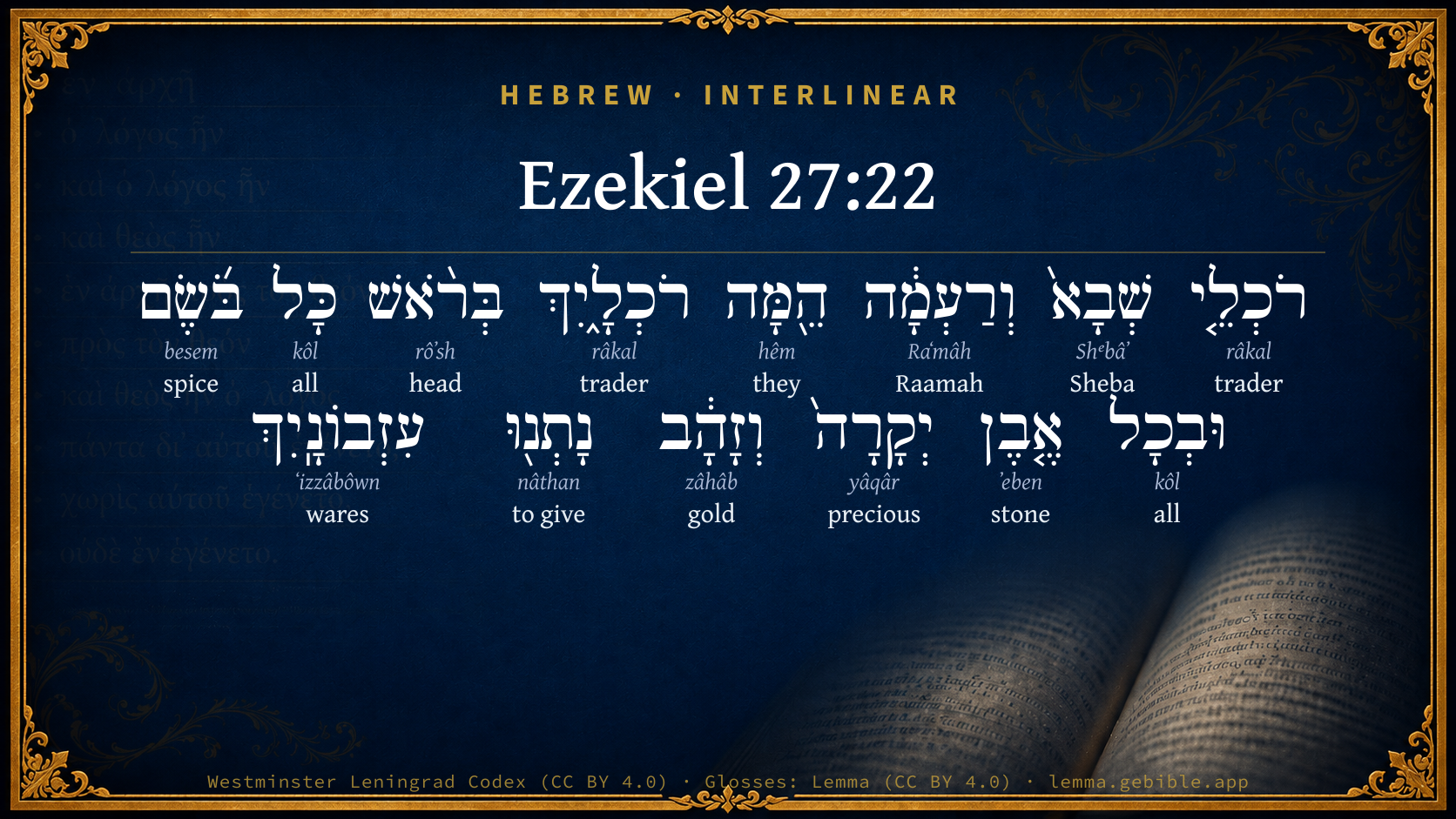
Ezekiel 27:22

Hebrew (Westminster Leningrad Codex) Ezekiel 27:22 appears in the Hebrew Old Testament. The text above is from the Westminster Leningrad Codex. Each word links to its Strong’s number, a concise gloss, and parsing drawn from the Open Scriptures Hebrew Bible morphology. Click any word for its full Brown-Driver-Briggs (BDB) entry.
Download image
Cite this verse

Ezekiel 27:22 (World English Bible). Public Domain. Lemma interlinear Bible study tool, https://lemma.gebible.app/v/ezekiel/27/22.

Show BibTeX & RIS
BibTeX
RIS
English Translation
The traffickers of Sheba and Raamah, they were your traffickers; they traded for your wares with the chief of all spices, and with all precious stones, and gold.
World English Bible · Public Domain
Download a study sheet

One document with this verse’s original text, its word-by-word gloss line, the meaning frame, cross-references with their text, attributed commentary, and full source and license credits — printable, and it pastes into notes with its structure intact.

This verse Autodidact and up

Study sheet (.html) Plain text (.txt)

A passage Seminary Student

Up to 50 verses in one chapter. A passage sheet keeps up to 6 commentary sources and 12 cross-references per verse, in the order this page ranks them, and says so on the sheet whenever that leaves anything out. Ask for a single verse and you get the Autodidact verse sheet above.

Everything on this page stays free to read, with no account — the sheet is a download of what is already on screen, not access to it.

Want to remove ads? Support Godless Engineer
Compare translations 3

The same verse in 3 English versions, stacked beneath the original-language interlinear above. Click any original word for its lexicon entry.

Each is an independent rendering of the whole verse — the interlinear is not word-aligned to these translations.

Highlighted words mark where these versions differ — a whole-verse word diff, not a word-by-word alignment.

  • World English Bible Public Domain
    The traffickers of Sheba and Raamah, they were your traffickers; they traded for your wares with the chief of all spices, and with all precious stones, and gold.
  • King James Version Public Domain
    The merchants of Sheba and Raamah, they were thy merchants: they occupied in thy fairs with chief of all spices, and with all precious stones, and gold.
  • unfoldingWord Literal Text CC BY-SA 4.0
    The traders of Sheba and Raamah came to sell you the best of every spice and in all kinds of precious gems; they traded gold for your merchandise.

unfoldingWord Literal Text — © unfoldingWord, licensed CC BY-SA 4.0. Word-aligned USFM3 via Door43 (git.door43.org/unfoldingWord/en_ult).

Versions to compare (up to 4)

3 of 4 selected

Show all 18 translations

Every available English version of this verse, each an independent rendering of the whole verse.

  • World English Bible Public Domain
    The traffickers of Sheba and Raamah, they were your traffickers; they traded for your wares with the chief of all spices, and with all precious stones, and gold.
  • Berean Standard Bible Public Domain
    The merchants of Sheba and Raamah traded with you; for your wares they exchanged gold, the finest of all spices, and precious stones.
  • Majority Standard Bible Public Domain
    The merchants of Sheba and Raamah traded with you; for your wares they exchanged gold, the finest of all spices, and precious stones.
  • King James Version Public Domain
    The merchants of Sheba and Raamah, they were thy merchants: they occupied in thy fairs with chief of all spices, and with all precious stones, and gold.
  • American Standard Version (1901) Public Domain
    The traffickers of Sheba and Raamah, they were thy traffickers; they traded for thy wares with the chief of all spices, and with all precious stones, and gold.
  • Revised Version (1885) Public Domain
    The traffickers of Sheba and Raamah, they were thy traffickers: they traded for thy wares with chief of all spices, and with all precious stones, and gold.
  • Geneva Bible (1599) Public Domain
    The marchats of Sheba, and Raamah were thy marchantes: they occupied in thy faires with the chiefe of all spices, and with al precious stones and golde.
  • Douay-Rheims (1899) Public Domain
    The sellers of Saba, and Reema, they were thy merchants: with all the best spices, and precious stones, and gold, which they set forth in thy market.
  • Young's Literal Translation Public Domain
    Merchants of Sheba and Raamah -- they `are' thy merchants, For the chief of all spices, And for every precious stone, and gold, They have given out thy remnants.
  • Literal Standard Version CC BY-SA 4.0
    Merchants of Sheba and Raamah—they [are] your merchants, || They have given the chief of all spices, || And every precious stone, and gold [for] your wares.
  • Unlocked Literal Bible CC BY-SA 4.0
    The traders of Sheba and Raamah came to sell you the best of every spice and in all kinds of precious gems; they traded gold for your merchandise.
  • unfoldingWord Literal Text CC BY-SA 4.0
    The traders of Sheba and Raamah came to sell you the best of every spice and in all kinds of precious gems; they traded gold for your merchandise.
  • Darby Bible Public Domain
    The merchants of Sheba and Raamah were thy traffickers: they furnished thy markets with all the choice spices, and with all precious stones and gold.
  • World Messianic Bible Public Domain
    “‘“The traders of Sheba and Raamah were your traders. They traded for your wares with the best of all spices, all precious stones, and gold.
  • Webster's Bible Public Domain
    The merchants of Sheba and Raamah, they were thy merchants: they occupied in thy fairs with chief of all spices, and with all precious stones, and gold.
  • Free Bible Version CC BY-SA 4.0
    The merchants of Sheba and Raamah traded with you, exchanging gold, the very best spices, and precious stones for your goods.
  • Bible in Basic English Public Domain
    The traders of Sheba and Raamah did trade with you; they gave the best of all sorts of spices and all sorts of stones of great price and gold for your goods.
  • JPS Tanakh (1917) Public Domain
    The traffickers of Sheba and Raamah, they were thy traffickers; they traded for thy wares with chief of all spices, and with all precious stones, and gold.

Literal Standard Version (2020), Covenant Press — licensed CC BY-SA 4.0. Text via the HelloAO Bible API (eBible.org). Unlocked Literal Bible (unfoldingWord) — licensed CC BY-SA 4.0. Text via the HelloAO Bible API (eBible.org). unfoldingWord Literal Text — © unfoldingWord, licensed CC BY-SA 4.0. Word-aligned USFM3 via Door43 (git.door43.org/unfoldingWord/en_ult). Free Bible Version, Dr. Jonathan Gallagher — licensed CC BY-SA 4.0. Text via the HelloAO Bible API (eBible.org).

Word by word

More ways to search: Search by grammar → Find every occurrence → Compare this word →

Practice this passage: Drill this verse → Learn its vocabulary →

וְרַעְמָ֔ה
Raʻmâh
H7484
“and · Raamah”
Conjunction + Noun, Proper
Part of Speech
Conjunction + Noun
Type
Proper
Full BDB Definition

Origin: the same as H7483

TWOT: None

Raamah = "horse's mane" - son of Cush and father of Sheba and Dedan (noun proper masculine) - a home of traders (noun proper locative)
  1. רֹכְלֵ֤י râkal H7402 “trader” Verb, Qal, Participle Active, Masculine, Plural, Construct
  2. שְׁבָא֙ Shᵉbâʼ H7614 “Sheba” Noun, Proper
  3. הֵ֖מָּה hêm H1992 “they” Pronoun, Personal, 3rd Person, Masculine, Plural
  4. רֹכְלָ֑יִךְ râkal H7402 “trader · you” Verb, Qal, Participle Active, Masculine, Plural, Construct + Suffix, Personal, 2nd Person, Feminine, Singular
  5. בְּרֹ֨אשׁ rôʼsh H7218 “in/at · head of” Preposition + Noun, Common, Masculine, Singular, Construct
  6. כָּל kôl H3605 “all of” Noun, Common, Masculine, Singular, Construct
  7. בֹּ֜שֶׂם besem H1314 “spice” Noun, Common, Masculine, Singular, Absolute
  8. וּבְכָל kôl H3605 “and · in/at · all of” Conjunction + Preposition + Noun, Common, Masculine, Singular, Construct
  9. אֶ֤בֶן ʼeben H68 “stone” Noun, Common, Feminine, Singular, Absolute
  10. יְקָרָה֙ yâqâr H3368 “precious” Adjective, Adjective, Feminine, Singular, Absolute
  11. וְזָהָ֔ב zâhâb H2091 “and · gold” Conjunction + Noun, Common, Masculine, Singular, Absolute
  12. נָתְנ֖וּ nâthan H5414 “to give” Verb, Qal, Perfect, 3rd Person, Common, Plural
  13. עִזְבוֹנָֽיִךְ ʻizzâbôwn H5801 “wares · your” Noun, Common, Masculine, Plural, Construct + Suffix, Personal, 2nd Person, Feminine, Singular

About this verse

These counts appear in no published source. They are computed here, from the morphology-tagged text and Lemma’s own curated glosses. What Lemma adds →

14
words
12
distinct lemmas
Prophets
section

Notable vocabulary

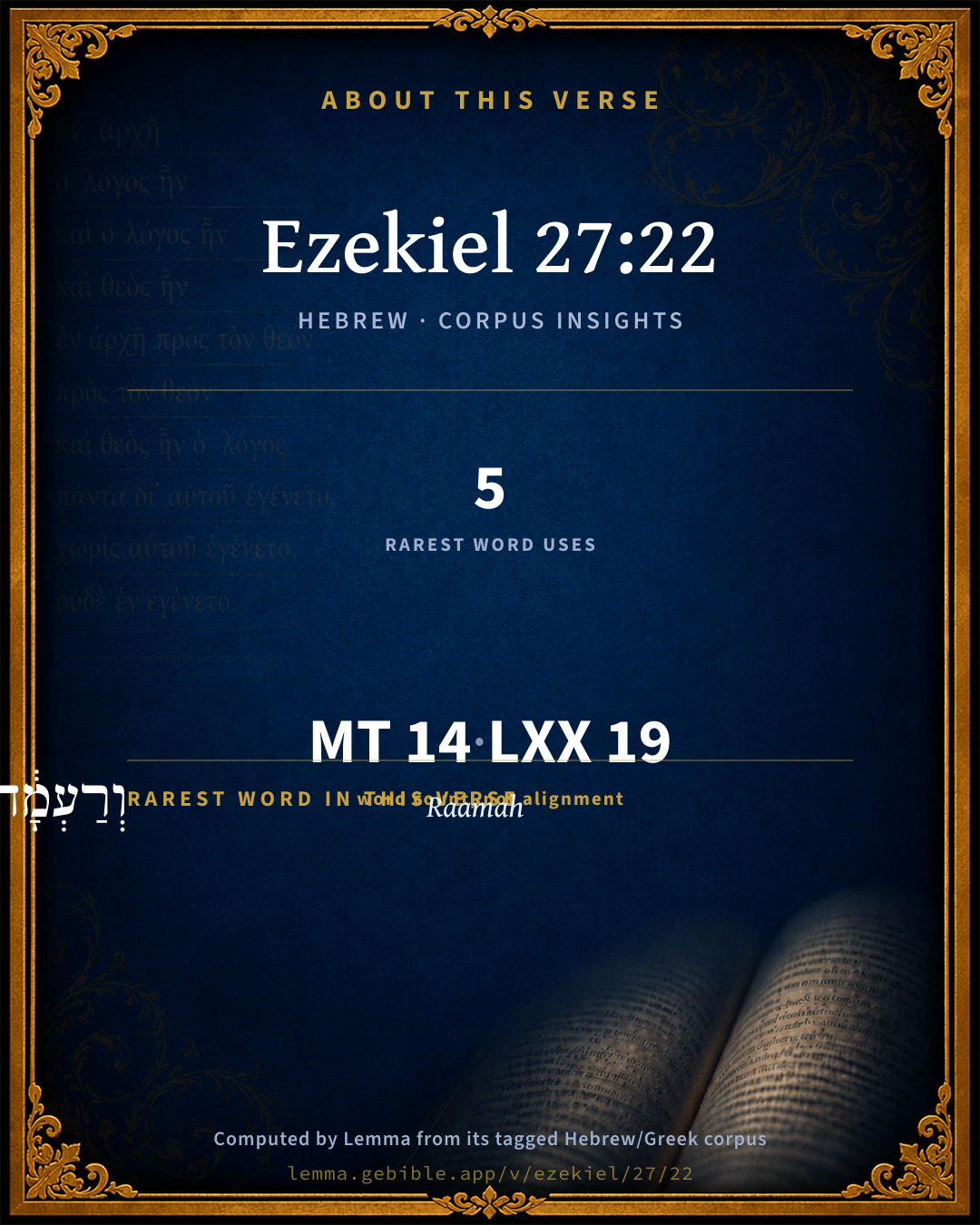
The rarest word here is וְרַעְמָ֔ה Raamah H7484 — appearing just 5 times in the whole Hebrew Bible.

Shared distinctive vocabulary

וְרַעְמָ֔ה Raamah H7484 occurs in 3 verses of the Hebrew Bible. Also found in:

Grammatical profile

  • 3 verbs
  • 9 nouns
  • 1 adjective
  • 1 pronoun

Verb forms

  • רֹכְלֵ֤י Qal · Participle Active
  • רֹכְלָ֑יִךְ Qal · Participle Active
  • נָתְנ֖וּ Qal · Perfect

Repetition

Words recur within this verse — often emphatic in Hebrew:

  • רֹכְלֵ֤י trader H7402 ×2
  • כָּל all H3605 ×2

Hebrew & Septuagint length

In English translation the verse runs 28 words from the Hebrew and 23 from the Septuagint (LXX English) — closely comparable.

A rough comparison of the two English renderings, which tokenize alike — not a word-level alignment.

Word counts can differ between the Hebrew and the Greek without any difference in meaning — e.g. the Hebrew direct-object marker אֵת has no separate Greek word, and Greek often adds the article ὁ.

In the original languages it is 14 Hebrew tokens and 19 Greek tokens — but the two are counted differently (Hebrew bundles its prefixes and suffixes into one token; the Greek is in lemma form), so that isn’t a like-for-like length.

Cross-references

9

Topical passages linked to Ezekiel 27:22 in the Treasury of Scripture Knowledge — connected by theme and wording, ordered by reader-vote popularity; previews shown in the World English Bible.

  • Genesis 10:7 The sons of Cush: Seba, Havilah, Sabtah, Raamah, and Sabteca. The sons of Raamah: Sheba and Dedan.
  • Isaiah 60:6 The multitude of camels shall cover you, the dromedaries of Midian and Ephah; all they from Sheba shall come; they shall bring gold and frankincense, and shall proclaim the praises of Yahweh.
  • Genesis 43:11 Their father, Israel, said to them, "If it be so now, do this. Take from the choice fruits of the land in your bags, and carry down a present for the man, a little balm, a little honey, spices and myrrh, nuts, and almonds;
  • 1 Kings 10:1–13 When the queen of Sheba heard of the fame of Solomon concerning the name of Yahweh, she came to prove him with hard questions.
  • 1 Chronicles 1:9 The sons of Cush: Seba, and Havilah, and Sabta, and Raama, and Sabteca. The sons of Raamah: Sheba, and Dedan.
  • 2 Chronicles 9:1–12 When the queen of Sheba heard of the fame of Solomon, she came to prove Solomon with hard questions at Jerusalem, with a very great train, and camels that bore spices, and gold in abundance, and precious stones: and when she was come to Solomon, she talked with him of all that was in her heart.
  • Psalms 72:10 The kings of Tarshish and of the isles will bring tribute. The kings of Sheba and Seba shall offer gifts.
  • Psalms 72:15 They shall live, and to him shall be given of the gold of Sheba. Men shall pray for him continually. They shall bless him all day long.
  • Ezekiel 38:13 Sheba, and Dedan, and the merchants of Tarshish, with all the young lions of it, shall tell you, Are you come to take the spoil? have you assembled your company to take the prey? to carry away silver and gold, to take away cattle and goods, to take great spoil?

Cross-references courtesy of OpenBible.info (CC BY 4.0).

Hebrew and Greek witnesses Masoretic Hebrew ↔ Greek Septuagint

The same verse in the two great witnesses to the Old Testament, shown verse-for-verse.

These are two independent witnesses, not word-aligned to each other, and the Septuagint is shown in lemma (dictionary) form.

Hebrew Ezekiel 27:22 Masoretic · Westminster Leningrad Codex

רֹכְלֵ֤י שְׁבָא֙ וְרַעְמָ֔ה הֵ֖מָּה רֹכְלָ֑יִךְ בְּרֹ֨אשׁ כָּל בֹּ֜שֶׂם וּבְכָל אֶ֤בֶן יְקָרָה֙ וְזָהָ֔ב נָתְנ֖וּ עִזְבוֹנָֽיִךְ

The traffickers of Sheba and Raamah, they were your traffickers; they traded for your wares with the chief of all spices, and with all precious stones, and gold.

World English Bible · Public Domain

Greek LXX Ezekiel 27:22 Septuagint · lemma form

ἔμπορος σαβα καί ραγμα οὗτος ἔμπορος σύ μετά πρῶτος ἥδυσμα καί λίθος χρηστός καί χρυσίον δίδωμι ὁ ἀγορά σύ

The merchants of Sabba and Ramma, these were your merchants, with choice spices, and precious stones: and they brought gold to your market.

LXX2012 (modern English Septuagint) · Public Domain

Hebrew: Westminster Leningrad Codex (CC BY 4.0). Greek: Septuagint (public domain); English from LXX2012 (modern English Septuagint) (Public Domain). How the Septuagint differs from the Hebrew →

Targum (Aramaic paraphrase)

1

The Targum is the ancient Jewish Aramaic paraphrase of the Hebrew Scriptures — an interpretive translation, not the Hebrew text itself. Onkelos (literal) and Pseudo-Jonathan (expansive) render the Torah, and Jonathan the Prophets. Coverage is partial: where no permissively-licensed English translation exists for a verse, only the Aramaic is shown. This is verse-level text, not a word-by-word alignment to the Hebrew.

  1. Targum Jonathan Prophets (Joshua–Malachi)
    תַּגָרֵי שְׁבָא וְרַעֲמָה אִינוּן תַּגָרַיִךְ בְּרֵישׁ כָּל בּוּסְמִין וּבְכָל אַבְנִין טָבָן וְדַהֲבָא יְהָבוּ בְּבֵית גִנְזָיִךְ:

    (no public-domain English translation for this verse)

    Targum Jonathan — Aramaic: “Mikraot Gedolot” (public domain). English: “Sefaria Community Translation” (CC0 1.0 (public-domain dedication)); “London "Chaldee Paraphrase," 1871” (public domain). Text via Sefaria.

Commentary

Notes on Ezekiel 27:22 from classic Christian and Jewish commentators (each source and its license shown beneath its notes). The classic Christian expositions comment on the surrounding passage and are grouped to its opening verse, so a note may address several verses; the Jewish commentaries on the Tanakh (Rashi and others) are per-verse, so they appear only where the commentator wrote on this verse.

Lemma curates 59 commentaries, every one of them public domain or Creative Commons licensed, each selected and text-cleaned for this edition rather than reprinted as found. About our sources →

John Gill's Exposition

Haran, and Canneh, and Eden,.... Haran was a city of Mesopotamia, the same with Haran, where Abraham dwelt awhile, Act 7:2, the Charrae of the Parthians, famous for the defeat of Crassus. Canneh is thought to be the same with Calneh, Gen 10:10, afterwards called Ctesiphon; and here, by the Targum, Netzibin, a place not far from Tigris; and Eden also was between Tigris and Euphrates. All three places seem to be in Mesopotamia, and not far from each other; the latter is thought by some to be the place where the garden of Eden was.

The merchants of Sheba; this was another Sheba, distinct from that in Eze 27:22, this Sheba was the son of Jokshan, a son of Abraham by Keturah, Gen 25:3, these were the Sabaeans, who were not far from the former, and dwelt near the Persian sea.

Ashur and Chilmad were thy merchants; or dealt in "thy merchandise"; took goods of them. Ashur designs the Assyrians, who had their name from Ashur, the builder of Nineveh, Gen 10:11 and Chilmad is by the Targum rendered Media; and by Grotius thought to be the Gaala of Media in Ptolemy (b); and so Hillerus (c) takes it to be a city of Media.

(b) Geograph. l. 6. c. 2. (c) Onomastic. Sacr. p. 108.

John Gill's Exposition of the Whole Bible (1746–1763) — public domain (CC PDM 1.0). Text via the HelloAO Bible API.

Trapp's Complete Commentary

John Trapp

Eze 27:22 The merchants of Sheba and Raamah, they [were] thy merchants: they occupied in thy fairs with chief of all spices, and with all precious stones, and gold.

Ver. 22. The merchants of Sheba and Raamah,] i.e., Ethiopians and Indians. Erat enim Tyrus emporium propemodum totius mundi. {a}

With chief of all spices.] All aromatic wares. Pliny reports of cinnamon that in his time a pound of it was worth a thousand denarii, that is, 150 crowns of our money. Galen writeth that it was hard to be found, except in the storehouses of great princes.

{a} Oecolamp.

John Trapp, A Commentary or Exposition upon All the Books of the Old and New Testament (1647–1656) — public domain. Text from a community e-Sword module.

Tyndale Open Study Notes

Tyndale Open Resources

27:22 Sheba was a kingdom in southwest Arabia. The location of Raamah is uncertain, but it was always associated with Sheba.

Tyndale Open Study Notes — © Tyndale Open Resources, licensed CC BY-SA 4.0. Text via the HelloAO Bible API.

Jamieson, Fausset & Brown

Robert Jamieson, A. R. Fausset & David Brown

Sheba . . . Raamah--in Arabia.

chief of . . . spices--that is, best spices (Deu 33:15). Obtained from India and conveyed in caravans to Tyre.

Jamieson, Fausset & Brown — Commentary Critical and Explanatory on the Whole Bible (1871) — public domain (CC PDM 1.0). Text via the HelloAO Bible API.

Adam Clarke's Commentary

Verse 22. Sheba and Raamah] Inhabitants of Arabia Felix, at the entrance of the Persian Gulf, who were famous for their riches and spices.

Adam Clarke's Commentary on the Bible (1810–1826) — public domain. Text from a community e-Sword/MySword module.

Ellicott's Commentary for English Readers

(22) Sheba and Raamah were both Hamites, descended from Cush (Gen_10:7). They occupied that part of Arabia in the south-east which lies on the Bay of Oman, in the Persian Gulf, and were famous in antiquity for the products mentioned in the text, and which, with the exception of gold, are still found there.

A Bible Commentary for English Readers, edited by Charles John Ellicott (1878–1897) — public domain. Text from a community e-Sword module.

The Cambridge Bible for Schools and Colleges

gen. ed. J. J. S. Perowne

22. merchants of Sheba] The abode of this people was in the S.W. of Arabia, the ruins of their capital Marib still remain, six days’ journey E. of San‘âa, the capital of Yemen. Their caravans (Job_6:19) traded to Syria and other countries with gold, precious stones and aromatics (1Ki_10:2; 1Ki_10:10; Isa_60:6; Jer_6:20; Psa_72:10; Psa_72:15).

occupied in thy fairs] they brought chief of all spices … as thy wares. Raamah was son of Cush and father of Sheba and Dedan (Gen_10:7). Raamah probably lay on the Persian Gulf.

The Cambridge Bible for Schools and Colleges (gen. ed. J. J. S. Perowne; Cambridge University Press, 1878–1918) — public domain. Text from a community e-Sword module.

Matthew Poole's English Annotations

Sheba; a country in Arabia Felix, whence the queen came that visited Solomon.

Raamah; it is read Rhegma by change of v into G, as in Gomorrah, another people of the same Arabia. This Rhegma, brother to Sheba, settled near him in that fruitful land, and built towns there, and grew to fame.

Chief of all spices: this country affords all sorts of the best aromatics, or spices, which were carried to Tyre.

All precious stones, rich jewels of all sorts,

and gold too.

Matthew Poole's English Annotations on the Holy Bible (1683–1685) — public domain. Text from a community e-Sword/MySword module.

Whedon's Commentary on the Bible

Daniel D. Whedon

22. Sheba — See note on “Arabia,” Eze_27:21; Gen_10:7; Gen_10:28; 1Ki_10:2; 1Ki_10:10; Isa_60:6; Job_6:19; Jer_6:20; Psa_72:10; Psa_72:15. In their inscriptions the Sabaeans distinguished themselves from the nomadic Arabs.

Raamah — The tribe is named in Gen_10:7. Glaser thinks it was located on the Persian Gulf (at Regma); Cornill by a slight change instead of the merchants of reads “Havilah” (Gen_2:11), which Glaser identifies with a district in central and Northeast Arabia.

Precious stones — Such as onyx, jasper, rubies, agate, and carnelians. (See also 1Ki_10:2.)

Daniel D. Whedon (gen. ed.), Commentary on the Old and New Testaments (1874–1909) — public domain. Text from a community e-Sword module.

The Pulpit Commentary

Sheba. The Sabaea of the Greeks. It is applied, in Gen_10:7 and 1Ch_1:9, to a grandson of Cush; in Gen_10:28 1Ch_1:22, to a son of Joktan; and in Gen_25:3 and 1Ch_1:32, to a grandson of Abraham. Geographically, in Ezekiel"s time it probably included the South-Arabian region, that of Yemen, or Arabia Felix, and was famous, as in the history of the Queen of Sheba, for its gold, gems, and spices (1Ki_10:1, 1Ki_10:2; Psa_72:10, Psa_72:15) Raamah. Named in Gen_10:7 as father of the Cushite Sheba, and probably, therefore, connected with it ethnologically and geographically. The chief of all spices had probably a technical name, like the "principal spices" of Exo_30:23 and Son_4:14 for the genuine balsam, the product of the Amyris opobalsamum, which is found between Mecca and Medina. The precious stones includes onyx, rubies, agates, and cornelians found in the mountains of Hadramant, and the jaspers and crystals of Yemen. In the Rhammanitae, mentioned by Strabo as a Sabaean tribe (16:782), we have, perhaps, a survival of the old name.

The Pulpit Commentary (1880–1919), ed. H.D.M. Spence-Jones & Joseph S. Exell — public domain. Text from a community e-Sword module.

John Wesley's Explanatory Notes

Sheba - A country in Arabia Felix. Raamah - Another people of the same Arabia.

John Wesley, Explanatory Notes Upon the Whole Bible (1754–1765) — public domain. Text via the GEBible commentary corpus.

unfoldingWord translationNotes

Door43 World Missions Community

Connecting Statement:

Yahweh continues giving Ezekiel his message to Tyre.

General Information:

The words "you" and "your" in these verses refer to Tyre.

Sheba ... Raamah ... Haran ... Kanneh ... Eden ... Sheba ... Ashur ... Kilmad

These are the names of places. (See: How to Translate Names)

precious gems

"valuable stones"

Haran, Kanneh, and Eden were traders with you, along with Sheba, Ashur, and Kilmad

This refers to the people from these places. AT: "The people of Haran, Kanneh, and Eden were traders with you, along with the people of Sheba, Ashur, and Kilmad" (See: Metonymy)

translationWords

Sheba

gold

Haran

unfoldingWord translationNotes — © Distant Shores Media and the Door43 World Missions Community, licensed CC BY-SA 4.0. Source: git.door43.org/Door43/en_tn.

Lesson kit

Teaching starters — assembled from the data on this page, not authored interpretation. Every prompt links to the verse data it draws on. Edit before teaching.

Ezekiel, in the Prophets, opens this verse with 14 words (12 distinct Hebrew lemmas). Its most distinctive word is Raʻmâh (“Raamah”). A historical commentator’s framing appears above. Read the whole chapter for the surrounding context.

Discussion questions

  1. What does “Raamah” (Raʻmâh) contribute to the verse as a whole?
  2. Genesis 10:7 shares the word «Raamah» with this verse. How do the two illuminate each other?
  3. “trader” occurs 2× in this one verse. What is the effect of the repetition?
  4. These translations render this verse differently; the difference is in the English rendering, not the original. What questions does that raise?
  5. The verb «רֹכְלֵ֤י» is Qal Participle Active. How does its form color the action?
  6. Reading how John Gill's Exposition and Trapp's Complete Commentary read this verse, where do the two commentators agree and where do they part?

Things to notice

Reading settings

Reading text

Shown beneath each verse's original-language words.

Old Testament
Old Testament edition

Read the OT as the Masoretic Hebrew (MT) or the Greek Septuagint (LXX).

English shown for the Greek Septuagint (in the Hebrew ↔ Greek comparison).

Comparing translations? Open the Compare panel on any verse page to stack up to four side by side.