Jeremiah 51:26

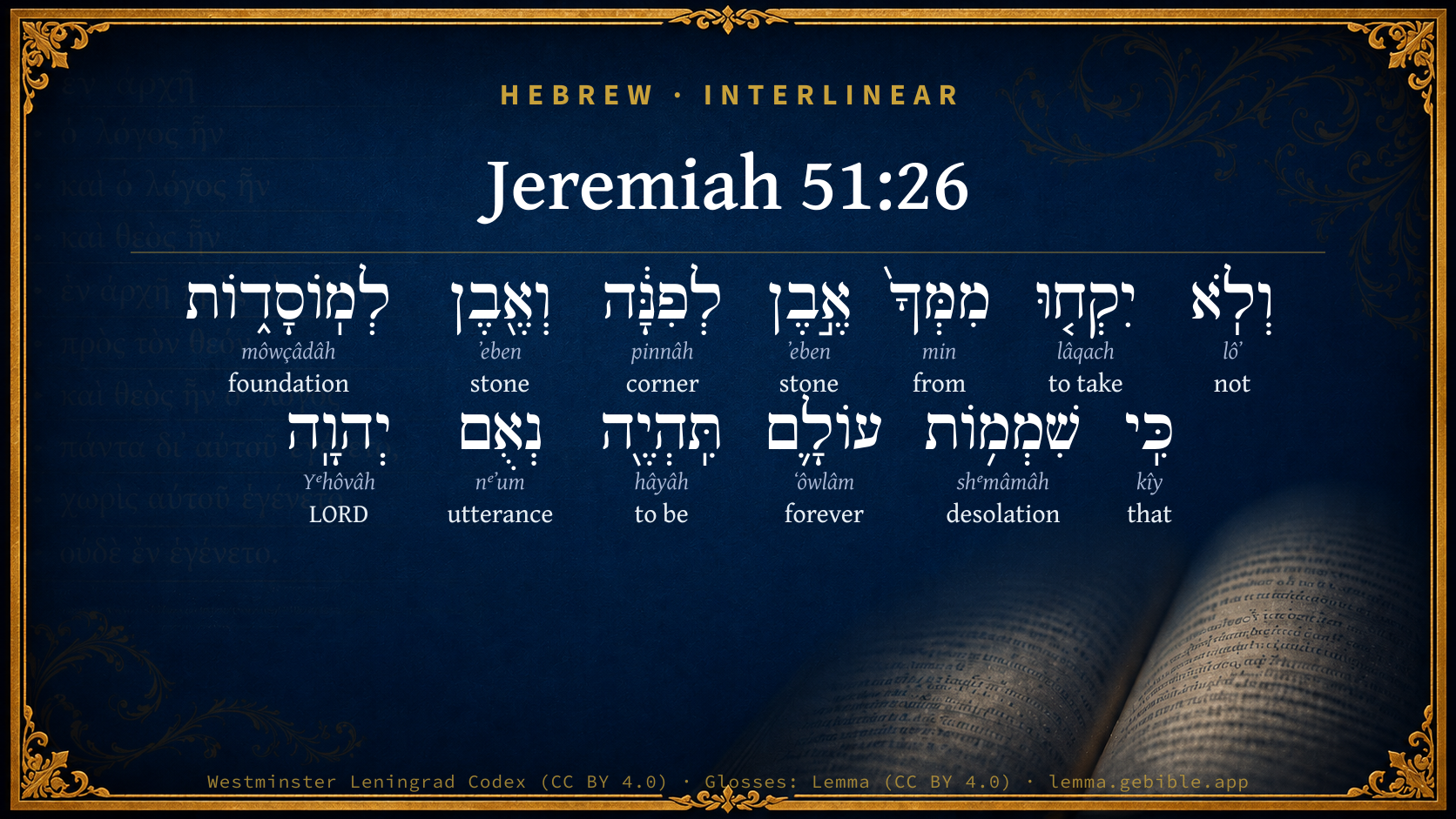
Hebrew (Westminster Leningrad Codex) Jeremiah 51:26 appears in the Hebrew Old Testament. The text above is from the Westminster Leningrad Codex. Each word links to its Strong’s number, a concise gloss, and parsing drawn from the Open Scriptures Hebrew Bible morphology. Click any word for its full Brown-Driver-Briggs (BDB) entry.
Download image
Cite this verse

Jeremiah 51:26 (World English Bible). Public Domain. Lemma interlinear Bible study tool, https://lemma.gebible.app/v/jeremiah/51/26.

Show BibTeX & RIS
BibTeX
RIS
English Translation
They shall not take of you a stone for a corner, nor a stone for foundations; but you shall be desolate for ever, says Yahweh.
World English Bible · Public Domain
Download a study sheet

One document with this verse’s original text, its word-by-word gloss line, the meaning frame, cross-references with their text, attributed commentary, and full source and license credits — printable, and it pastes into notes with its structure intact.

This verse Autodidact and up

Study sheet (.html) Plain text (.txt)

A passage Seminary Student

Up to 50 verses in one chapter. A passage sheet keeps up to 6 commentary sources and 12 cross-references per verse, in the order this page ranks them, and says so on the sheet whenever that leaves anything out. Ask for a single verse and you get the Autodidact verse sheet above.

Everything on this page stays free to read, with no account — the sheet is a download of what is already on screen, not access to it.

Want to remove ads? Support Godless Engineer
Compare translations 3

The same verse in 3 English versions, stacked beneath the original-language interlinear above. Click any original word for its lexicon entry.

Each is an independent rendering of the whole verse — the interlinear is not word-aligned to these translations.

Highlighted words mark where these versions differ — a whole-verse word diff, not a word-by-word alignment.

  • World English Bible Public Domain
    They shall not take of you a stone for a corner, nor a stone for foundations; but you shall be desolate for ever, says Yahweh.
  • King James Version Public Domain
    And they shall not take of thee a stone for a corner, nor a stone for foundations; but thou shalt be desolate for ever, saith the LORD.
  • unfoldingWord Literal Text CC BY-SA 4.0
    So they will not take from you any stone to construct a building’s corner or foundation; for you will become an everlasting devastation—this is Yahweh’s declaration.

unfoldingWord Literal Text — © unfoldingWord, licensed CC BY-SA 4.0. Word-aligned USFM3 via Door43 (git.door43.org/unfoldingWord/en_ult).

Versions to compare (up to 4)

3 of 4 selected

Show all 18 translations

Every available English version of this verse, each an independent rendering of the whole verse.

  • World English Bible Public Domain
    They shall not take of you a stone for a corner, nor a stone for foundations; but you shall be desolate for ever, says Yahweh.
  • Berean Standard Bible Public Domain
    No one shall retrieve from you a cornerstone or a foundation stone, because you will become desolate forever,” declares the LORD.
  • Majority Standard Bible Public Domain
    No one shall retrieve from you a cornerstone or a foundation stone, because you will become desolate forever,” declares the LORD.
  • King James Version Public Domain
    And they shall not take of thee a stone for a corner, nor a stone for foundations; but thou shalt be desolate for ever, saith the LORD.
  • American Standard Version (1901) Public Domain
    And they shall not take of thee a stone for a corner, nor a stone for foundations; but thou shalt be desolate for ever, saith Jehovah.
  • Revised Version (1885) Public Domain
    And they shall not take of thee a stone for a corner, nor a stone for foundations; but thou shalt be desolate for ever, saith the LORD.
  • Geneva Bible (1599) Public Domain
    They shall not take of thee a stone for a corner, nor a stone for foundations, but thou shalt be destroyed for euer, sayth the Lord.
  • Douay-Rheims (1899) Public Domain
    And they shall not take of thee a stone for the corner, nor a stone for foundations, but thou shalt be destroyed for ever, saith the Lord.
  • Young's Literal Translation Public Domain
    And they take not out of thee a stone for a corner, And a stone for foundations, For desolations age-during art thou, An affirmation of Jehovah.
  • Literal Standard Version CC BY-SA 4.0
    And they do not take out of you a stone for a corner, || And a stone for foundations, || For you are continuous desolations,” || A declaration of YHWH.
  • Unlocked Literal Bible CC BY-SA 4.0
    So they will not take from you any stone to construct a building's corner or foundation; for you will become an everlasting devastation—this is Yahweh's declaration.
  • unfoldingWord Literal Text CC BY-SA 4.0
    So they will not take from you any stone to construct a building’s corner or foundation; for you will become an everlasting devastation—this is Yahweh’s declaration.
  • Darby Bible Public Domain
    And they shall not take of thee a stone for a corner, nor a stone for foundations; for thou shalt be desolate for ever, saith Jehovah.
  • World Messianic Bible Public Domain
    They won’t take a cornerstone from you, nor a stone for foundations; but you will be desolate forever,” says the LORD.
  • Webster's Bible Public Domain
    And they shall not take of thee a stone for a corner, nor a stone for foundations; but thou shalt be desolate for ever, saith the LORD.
  • Free Bible Version CC BY-SA 4.0
    Nobody will be even able to find themselves a cornerstone or a foundation stone among your ruins, because you will be so utterly destroyed, declares the Lord.
  • Bible in Basic English Public Domain
    And they will not take from you a stone for the angle of a wall or the base of a building; but you will be a waste place for ever, says the Lord.
  • JPS Tanakh (1917) Public Domain
    And they shall not take of thee a stone for a corner, nor a stone for foundations; but thou shalt be desolate for ever, saith the LORD.

Literal Standard Version (2020), Covenant Press — licensed CC BY-SA 4.0. Text via the HelloAO Bible API (eBible.org). Unlocked Literal Bible (unfoldingWord) — licensed CC BY-SA 4.0. Text via the HelloAO Bible API (eBible.org). unfoldingWord Literal Text — © unfoldingWord, licensed CC BY-SA 4.0. Word-aligned USFM3 via Door43 (git.door43.org/unfoldingWord/en_ult). Free Bible Version, Dr. Jonathan Gallagher — licensed CC BY-SA 4.0. Text via the HelloAO Bible API (eBible.org).

Word by word

More ways to search: Search by grammar → Find every occurrence → Compare this word →

Practice this passage: Drill this verse → Learn its vocabulary →

לְמֽוֹסָד֑וֹת
môwçâdâh
H4146
“to/for · foundations”
Preposition + Noun, Common, Both, Plural, Absolute
Part of Speech
Preposition + Noun
Type
Common
Gender
Both
Number
Plural
State
Absolute
Full BDB Definition

Origin: from H4144

TWOT: 875f

foundation
  1. וְלֹֽא lôʼ H3808 “and · not” Conjunction + Particle, Negative
  2. יִקְח֤וּ lâqach H3947 “to take” Verb, Qal, Imperfect, 3rd Person, Masculine, Plural
  3. מִמְּךָ֙ min H4480 “from · you” Preposition + Suffix, Personal, 2nd Person, Masculine, Singular
  4. אֶ֣בֶן ʼeben H68 “stone” Noun, Common, Feminine, Singular, Absolute
  5. לְפִנָּ֔ה pinnâh H6438 “to/for · corner” Preposition + Noun, Common, Feminine, Singular, Absolute
  6. וְאֶ֖בֶן ʼeben H68 “and · stone” Conjunction + Noun, Common, Feminine, Singular, Absolute
  7. כִּֽי kîy H3588 “that” Conjunction
  8. שִׁמְמ֥וֹת shᵉmâmâh H8077 “desolations of” Noun, Common, Feminine, Plural, Construct
  9. עוֹלָ֛ם ʻôwlâm H5769 “forever” Noun, Common, Masculine, Singular, Absolute
  10. תִּֽהְיֶ֖ה hâyâh H1961 “to be” Verb, Qal, Imperfect, 2nd Person, Masculine, Singular
  11. נְאֻם nᵉʼum H5002 “utterance of” Noun, Common, Masculine, Singular, Construct
  12. יְהוָֽה Yᵉhôvâh H3068 “LORD” Noun, Proper

About this verse

These counts appear in no published source. They are computed here, from the morphology-tagged text and Lemma’s own curated glosses. What Lemma adds →

13
words
12
distinct lemmas
Prophets
section

Notable vocabulary

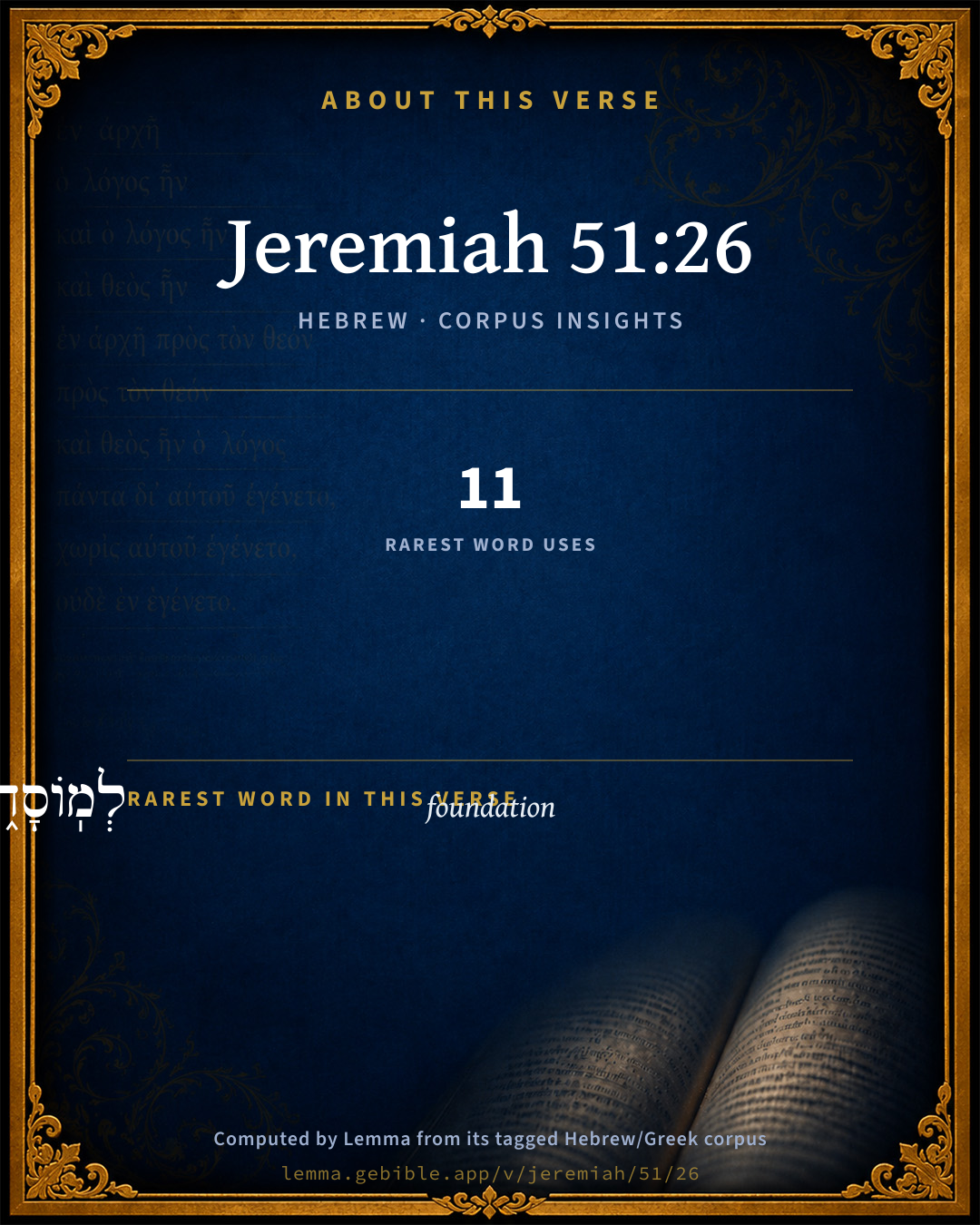
The rarest word here is לְמֽוֹסָד֑וֹת foundation H4146 — appearing just 11 times in the whole Hebrew Bible.

Shared distinctive vocabulary

לְמֽוֹסָד֑וֹת foundation H4146 occurs in 11 verses of the Hebrew Bible. Also found in:

Grammatical profile

  • 2 verbs
  • 8 nouns
  • 1 preposition
  • 1 conjunction
  • 1 particle

Verb forms

  • יִקְח֤וּ Qal · Imperfect
  • תִּֽהְיֶ֖ה Qal · Imperfect

Repetition

A word recurs within this verse — often emphatic in Hebrew:

  • אֶ֣בֶן stone H68 ×2

Cross-references

9

Topical passages linked to Jeremiah 51:26 in the Treasury of Scripture Knowledge — connected by theme and wording, ordered by reader-vote popularity; previews shown in the World English Bible.

  • Isaiah 13:19–22 Babylon, the glory of kingdoms, the beauty of the Chaldeans' pride, shall be as when God overthrew Sodom and Gomorrah.
  • Jeremiah 50:12–13 your mother shall be utterly disappointed; she who bore you shall be confounded: behold, she shall be the least of the nations, a wilderness, a dry land, and a desert.
  • Jeremiah 51:43 Her cities are become a desolation, a dry land, and a desert, a land in which no man dwells, neither does any son of man pass thereby.
  • Revelation 18:20–24 Rejoice over her, O heaven, you saints, apostles, and prophets; for God has judged your judgment on her."
  • Isaiah 14:23 I will also make it a possession for the porcupine, and pools of water: and I will sweep it with the broom of destruction, says Yahweh of Hosts.
  • Isaiah 34:8–17 For Yahweh has a day of vengeance, a year of recompense for the cause of Zion.
  • Jeremiah 50:40–41 As when God overthrew Sodom and Gomorrah and the neighbor cities of it, says Yahweh, so shall no man dwell there, neither shall any son of man sojourn therein.
  • Jeremiah 51:29 The land trembles and is in pain; for the purposes of Yahweh against Babylon do stand, to make the land of Babylon a desolation, without inhabitant.
  • Jeremiah 51:37 Babylon shall become heaps, a dwelling-place for jackals, an astonishment, and a hissing, without inhabitant.

Cross-references courtesy of OpenBible.info (CC BY 4.0).

Hebrew and Greek witnesses Masoretic Hebrew ↔ Greek Septuagint

The same verse in the two great witnesses to the Old Testament, shown verse-for-verse.

These are two independent witnesses, not word-aligned to each other, and the Septuagint is shown in lemma (dictionary) form.

Hebrew Jeremiah 51:26 Masoretic · Westminster Leningrad Codex

וְלֹֽא יִקְח֤וּ מִמְּךָ֙ אֶ֣בֶן לְפִנָּ֔ה וְאֶ֖בֶן לְמֽוֹסָד֑וֹת כִּֽי שִׁמְמ֥וֹת עוֹלָ֛ם תִּֽהְיֶ֖ה נְאֻם יְהוָֽה

They shall not take of you a stone for a corner, nor a stone for foundations; but you shall be desolate for ever, says Yahweh.

World English Bible · Public Domain

Greek LXX Structure differs

In the Septuagint, Jeremiah is about an eighth shorter than the Hebrew and arranges its material differently — the Oracles Against the Nations (Hebrew chapters 46–51) appear in the middle of the Greek book, after 25:13. Because the chapter and verse boundaries do not line up, a verse-for-verse comparison with the Hebrew is not shown.

A verse-for-verse comparison isn’t shown here because the chapters and verses don’t line up. Switch to the LXX edition with the MT / LXX toggle above to read the Greek directly.

Hebrew: Westminster Leningrad Codex (CC BY 4.0). Greek: Septuagint (public domain); English from a public-domain English Septuagint. How the Septuagint differs from the Hebrew →

Targum (Aramaic paraphrase)

1

The Targum is the ancient Jewish Aramaic paraphrase of the Hebrew Scriptures — an interpretive translation, not the Hebrew text itself. Onkelos (literal) and Pseudo-Jonathan (expansive) render the Torah, and Jonathan the Prophets. Coverage is partial: where no permissively-licensed English translation exists for a verse, only the Aramaic is shown. This is verse-level text, not a word-by-word alignment to the Hebrew.

  1. Targum Jonathan Prophets (Joshua–Malachi)
    וְלָא יִסְבוּן מִנָךְ מְלַךְ לְמָלְכוּ וְשִׁלְטוֹן לְשׁוּלְטָנוּ אֲרֵי צָדוּת עֲלַם תְּהֵי אֲמַר יְיָ:

    (no public-domain English translation for this verse)

    Targum Jonathan — Aramaic: “Mikraot Gedolot” (public domain). English: “Sefaria Community Translation” (CC0 1.0 (public-domain dedication)); “London "Chaldee Paraphrase," 1871” (public domain). Text via Sefaria.

Commentary

Notes on Jeremiah 51:26 from classic Christian and Jewish commentators (each source and its license shown beneath its notes). The classic Christian expositions comment on the surrounding passage and are grouped to its opening verse, so a note may address several verses; the Jewish commentaries on the Tanakh (Rashi and others) are per-verse, so they appear only where the commentator wrote on this verse.

Lemma curates 59 commentaries, every one of them public domain or Creative Commons licensed, each selected and text-cleaned for this edition rather than reprinted as found. About our sources →

Trapp's Complete Commentary

John Trapp

Jer 51:26 And they shall not take of thee a stone for a corner, nor a stone for foundations; but thou shalt be desolate for ever, saith the LORD.

Ver. 26. And they shall not take of thee a stone.] Thou shalt never be re-edified. So it is foretold of Rome,

“ Tota eris in cineres quasi nunquam Roma fuisses. ”

John Trapp, A Commentary or Exposition upon All the Books of the Old and New Testament (1647–1656) — public domain. Text from a community e-Sword module.

Jamieson, Fausset & Brown

Robert Jamieson, A. R. Fausset & David Brown

corner . . . stone . . . foundations--The corner-stone was the most important one in the building, the foundation-stones came next in importance (Eph 2:20). So the sense is, even as there shall be no stones useful for building left of thee, so no leading prince, or governors, shall come forth from thy inhabitants.

Jamieson, Fausset & Brown — Commentary Critical and Explanatory on the Whole Bible (1871) — public domain (CC PDM 1.0). Text via the HelloAO Bible API.

John Calvin's Commentaries

He confirms the former verse, that when Babylon was destroyed, there would be no hope of restoration. It often happens, that those cities which have been wholly destroyed are afterwards built up again; but God says that this would not be the case with Babylon, for it was given over to perpetual destruction. By corner and foundations he understands the strength of the buildings, he then says, that there was no hope that the stones would be again fitted together, for the building of the city, for Babylon would become a perpetual waste or desolation.

We have, indeed, said, that the walls of Babylon were not made of stones but of bricks: but the Prophet simply speaks according to the common manner, in order to show that its ruin would be for ever. We have also said elsewhere that a difference is commonly made by the prophets between the people of God and the reprobate, that God promises to his Church a new state as a resurrection from death, but that he denounces on the unbelieving perpetual desolation. This course is now followed by our Prophet when he says, that the desolations there would be for ever, because there is no hope of pardon or of mercy to the unbelieving. It afterwards follows, —

John Calvin's Commentaries (1540-1563) — public domain. Text from the Calvin Translation Society English edition (1840s-50s) via the Christian Classics Ethereal Library (ccel.org). Calvin's coverage is partial (roughly two-thirds of the Bible); uncommented books and verses are honest gaps, never fabricated. The 19th-century editor's footnotes and remarks are omitted so the notes are faithfully Calvin's own voice.

Ellicott's Commentary for English Readers

(26) They shall not take of thee a stone for a corner.—The prophet uses general language applicable to any city destroyed by fire, without noting the special fact that Babylon was built of bricks.

A Bible Commentary for English Readers, edited by Charles John Ellicott (1878–1897) — public domain. Text from a community e-Sword module.

The Cambridge Bible for Schools and Colleges

gen. ed. J. J. S. Perowne

26. The figure of stones, which by the action of fire have been rendered unfit for use in building, is continued in this verse. No Empire shall again have Babylon for its centre. Its position as a capital city is for ever shattered, and its glory burnt out.

The Cambridge Bible for Schools and Colleges (gen. ed. J. J. S. Perowne; Cambridge University Press, 1878–1918) — public domain. Text from a community e-Sword module.

John Gill's Exposition

Prepare against her the nations, with the kings of the Medes,.... At the head of them, Darius and Cyrus. The Syriac version has it in the singular number, the king of the Modes:

the captains thereof, and all the rulers thereof, and all the land of his dominions; that is, the inhabitants of it, the common people, with their princes, nobles, governors, as captains of them, under Cyrus, their generalissimo.

John Gill's Exposition of the Whole Bible (1746–1763) — public domain (CC PDM 1.0). Text via the HelloAO Bible API.

Albert Barnes' Notes on the Bible

The prophet means that:

(1) Babylon would never again be the seat of empire. Nor

(2) would any new development of events take its rise thence.

Albert Barnes' Notes on the Bible (1834–1885) — public domain. Text from a community e-Sword/MySword module.

Haydock's Catholic Bible Commentary

Corner. No king or conqueror shall spring thence. Alexander [the Great] thought of making it the seat of his empire, but was prevented by death. (Strabo xv.)

George Leo Haydock (1774–1849), Haydock's Catholic Family Bible and Commentary, 1859 edition — public domain. Excludes Psalms (Douay-Rheims chapter numbering differs from Protestant) and Deuterocanonical books (Catholic canon only).

Matthew Poole's English Annotations

God threateneth to Babylon an utter ruin and desolation, so as they should not have a stone left fit to lay a foundation, or to make a corner-stone; or, as some others interpret it, that city should never be built again, there should never from the rubbish of it be taken a stone to lay the foundation, nor to lay upon the corners of new houses, new walls, new towers in that place. Foundation-stones, and corner-stones, are principal stones in buildings. Nothing shall be left in Babylon of any worth, value, or considerableness.

Matthew Poole's English Annotations on the Holy Bible (1683–1685) — public domain. Text from a community e-Sword/MySword module.

The Pulpit Commentary

And they shall not take of thee, etc. "Of thee," i.e. "of the Babylonian power" personified not "of Babylon," which was built of brick, not of stone. The figure of the mountain is still preserved.

The Pulpit Commentary (1880–1919), ed. H.D.M. Spence-Jones & Joseph S. Exell — public domain. Text from a community e-Sword module.

Lesson kit

Teaching starters — assembled from the data on this page, not authored interpretation. Every prompt links to the verse data it draws on. Edit before teaching.

Jeremiah, in the Prophets, opens this verse with 13 words (12 distinct Hebrew lemmas). Its most distinctive word is môwçâdâh (“foundation”). A historical commentator’s framing appears above. Read the whole chapter for the surrounding context.

Discussion questions

  1. How does “foundation” (môwçâdâh) shape what this verse is saying?
  2. How does Deuteronomy 32:22, which shares the word «foundation», read alongside this verse?
  3. What does the repetition of “stone” (2× in this one verse) do in this verse?
  4. These translations render this verse differently; the difference is in the English rendering, not the original. What questions does that raise?
  5. «יִקְח֤וּ» is a Qal Imperfect verb. How does that grammatical form shape the action described?
  6. Compare how Trapp's Complete Commentary and Jamieson, Fausset & Brown read this verse. Where do they agree or differ?

Things to notice

Reading settings

Reading text

Shown beneath each verse's original-language words.

Old Testament
Old Testament edition

Read the OT as the Masoretic Hebrew (MT) or the Greek Septuagint (LXX).

English shown for the Greek Septuagint (in the Hebrew ↔ Greek comparison).

Comparing translations? Open the Compare panel on any verse page to stack up to four side by side.