
Ezekiel 10:9

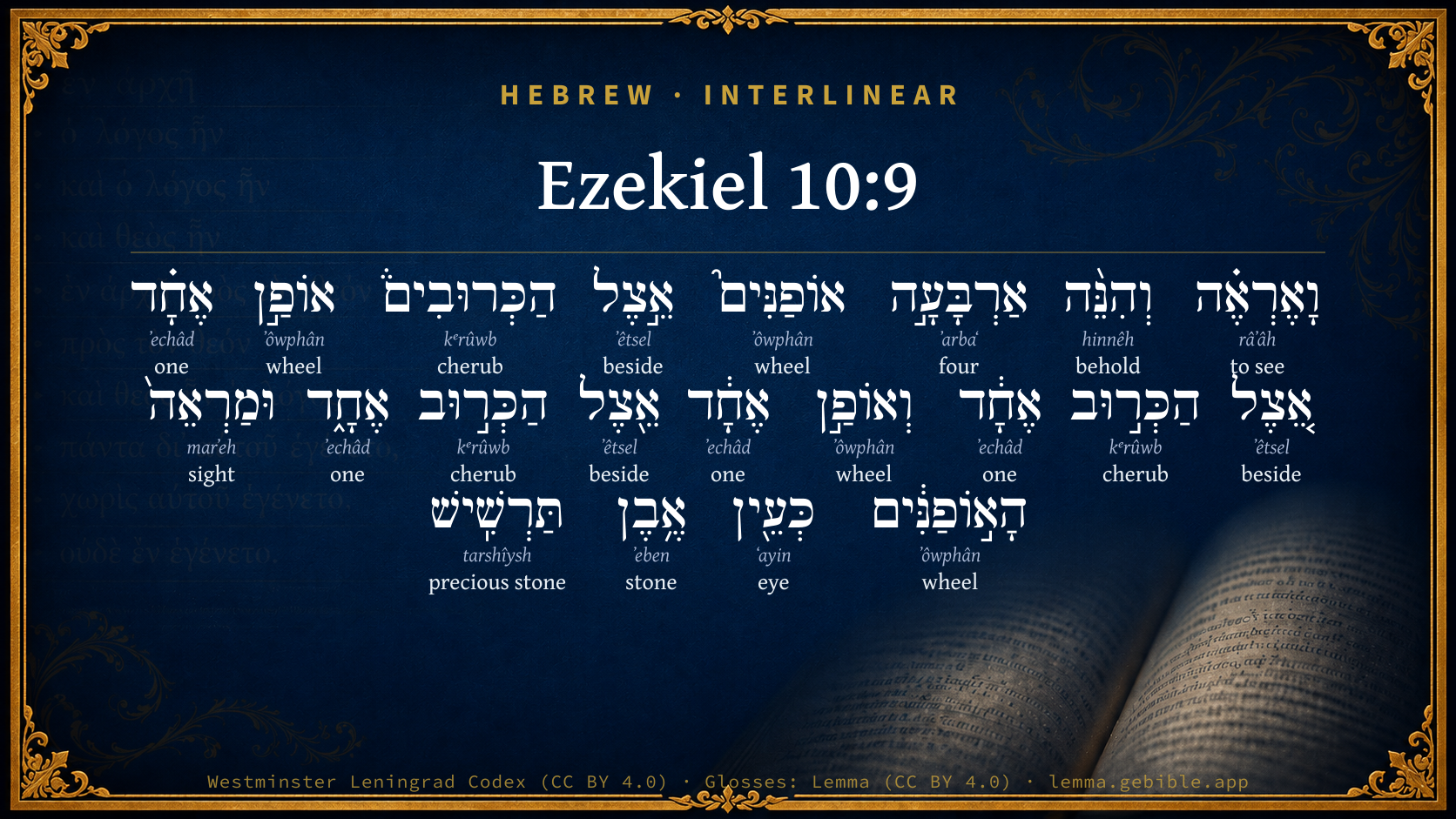
Hebrew (Westminster Leningrad Codex) Ezekiel 10:9 appears in the Hebrew Old Testament. The text above is from the Westminster Leningrad Codex. Each word links to its Strong’s number, a concise gloss, and parsing drawn from the Open Scriptures Hebrew Bible morphology. Click any word for its full Brown-Driver-Briggs (BDB) entry.
Download image
Cite this verse

Ezekiel 10:9 (World English Bible). Public Domain. Lemma interlinear Bible study tool, https://lemma.gebible.app/v/ezekiel/10/9.

Show BibTeX & RIS
BibTeX
RIS
English Translation
I looked, and behold, four wheels beside the cherubim, one wheel beside one cherub, and another wheel beside another cherub; and the appearance of the wheels was like a beryl stone.
World English Bible · Public Domain
Download a study sheet

One document with this verse’s original text, its word-by-word gloss line, the meaning frame, cross-references with their text, attributed commentary, and full source and license credits — printable, and it pastes into notes with its structure intact.

This verse Autodidact and up

Study sheet (.html) Plain text (.txt)

A passage Seminary Student

Up to 50 verses in one chapter. A passage sheet keeps up to 6 commentary sources and 12 cross-references per verse, in the order this page ranks them, and says so on the sheet whenever that leaves anything out. Ask for a single verse and you get the Autodidact verse sheet above.

Everything on this page stays free to read, with no account — the sheet is a download of what is already on screen, not access to it.

Want to remove ads? Support Godless Engineer
Compare translations 3

The same verse in 3 English versions, stacked beneath the original-language interlinear above. Click any original word for its lexicon entry.

Each is an independent rendering of the whole verse — the interlinear is not word-aligned to these translations.

Highlighted words mark where these versions differ — a whole-verse word diff, not a word-by-word alignment.

  • World English Bible Public Domain
    I looked, and behold, four wheels beside the cherubim, one wheel beside one cherub, and another wheel beside another cherub; and the appearance of the wheels was like a beryl stone.
  • King James Version Public Domain
    And when I looked, behold the four wheels by the cherubims, one wheel by one cherub, and another wheel by another cherub: and the appearance of the wheels was as the colour of a beryl stone.
  • unfoldingWord Literal Text CC BY-SA 4.0
    So I looked, and behold! Four wheels were beside the cherubim—one wheel beside each cherub—and the appearance of the wheels was like a beryl stone.

unfoldingWord Literal Text — © unfoldingWord, licensed CC BY-SA 4.0. Word-aligned USFM3 via Door43 (git.door43.org/unfoldingWord/en_ult).

Versions to compare (up to 4)

3 of 4 selected

Show all 18 translations

Every available English version of this verse, each an independent rendering of the whole verse.

  • World English Bible Public Domain
    I looked, and behold, four wheels beside the cherubim, one wheel beside one cherub, and another wheel beside another cherub; and the appearance of the wheels was like a beryl stone.
  • Berean Standard Bible Public Domain
    Then I looked and saw four wheels beside the cherubim, one wheel beside each cherub. And the wheels gleamed like a beryl stone.
  • Majority Standard Bible Public Domain
    Then I looked and saw four wheels beside the cherubim, one wheel beside each cherub. And the wheels gleamed like a beryl stone.
  • King James Version Public Domain
    And when I looked, behold the four wheels by the cherubims, one wheel by one cherub, and another wheel by another cherub: and the appearance of the wheels was as the colour of a beryl stone.
  • American Standard Version (1901) Public Domain
    And I looked, and behold, four wheels beside the cherubim, one wheel beside one cherub, and another wheel beside another cherub; and the appearance of the wheels was like unto a beryl stone.
  • Revised Version (1885) Public Domain
    And I looked, and behold, four wheels beside the cherubim, one wheel beside one cherub, and another wheel beside another cherub: and the appearance of the wheels was as the colour of a beryl stone.
  • Geneva Bible (1599) Public Domain
    And when I looked vp, beholde, foure wheeles were beside the Cherubims, one wheele by one Cherub, and another wheele by another Cherub, and the appearance of the wheeles was as the colour of a Chrysolite stone.
  • Douay-Rheims (1899) Public Domain
    And I saw, and behold there were four wheels by the cherubims: one wheel by one cherub, and another wheel by an- other cherub: and the appearance of the wheels was to the sight like the chrysolite stone:
  • Young's Literal Translation Public Domain
    and I look, and lo, four wheels near the cherubs, one wheel near the one cherub, and another wheel near the other cherub, and the appearance of the wheels `is' as the colour of a beryl stone.
  • Literal Standard Version CC BY-SA 4.0
    and I look, and behold, four wheels near the cherubim, one wheel near one cherub, and another wheel near the other cherub, and the appearance of the wheels [is] as the color of a beryl stone.
  • Unlocked Literal Bible CC BY-SA 4.0
    So I looked, and behold! Four wheels were beside the cherubim—one wheel beside each cherub—and the appearance of the wheels was like a beryl stone.
  • unfoldingWord Literal Text CC BY-SA 4.0
    So I looked, and behold! Four wheels were beside the cherubim—one wheel beside each cherub—and the appearance of the wheels was like a beryl stone.
  • Darby Bible Public Domain
    And I looked, and behold, four wheels beside the cherubim, one wheel beside one cherub, and another wheel beside another cherub; and the appearance of the wheels was as the look of a chrysolite stone.
  • World Messianic Bible Public Domain
    I looked, and behold, there were four wheels beside the cherubim, one wheel beside one cherub, and another wheel beside another cherub. The appearance of the wheels was like a beryl stone.
  • Webster's Bible Public Domain
    And when I looked, behold the four wheels by the cherubim, one wheel by one cherub, and another wheel by another cherub: and the appearance of the wheels was as the color of a beryl stone.
  • Free Bible Version CC BY-SA 4.0
    I saw four wheels next to the cherubim, one wheel beside each cherub. The wheels shone like topaz.
  • Bible in Basic English Public Domain
    And looking, I saw four wheels by the side of the winged ones, one wheel by the side of a winged one and another wheel by the side of another: and the wheels were like the colour of a beryl stone to the eye.
  • JPS Tanakh (1917) Public Domain
    And I looked, and behold four wheels beside the cherubim, one wheel beside one cherub, and another wheel beside another cherub; and the appearance of the wheels was as the colour of a beryl stone.

Literal Standard Version (2020), Covenant Press — licensed CC BY-SA 4.0. Text via the HelloAO Bible API (eBible.org). Unlocked Literal Bible (unfoldingWord) — licensed CC BY-SA 4.0. Text via the HelloAO Bible API (eBible.org). unfoldingWord Literal Text — © unfoldingWord, licensed CC BY-SA 4.0. Word-aligned USFM3 via Door43 (git.door43.org/unfoldingWord/en_ult). Free Bible Version, Dr. Jonathan Gallagher — licensed CC BY-SA 4.0. Text via the HelloAO Bible API (eBible.org).

Word by word

More ways to search: Search by grammar → Find every occurrence → Compare this word →

Practice this passage: Drill this verse → Learn its vocabulary →

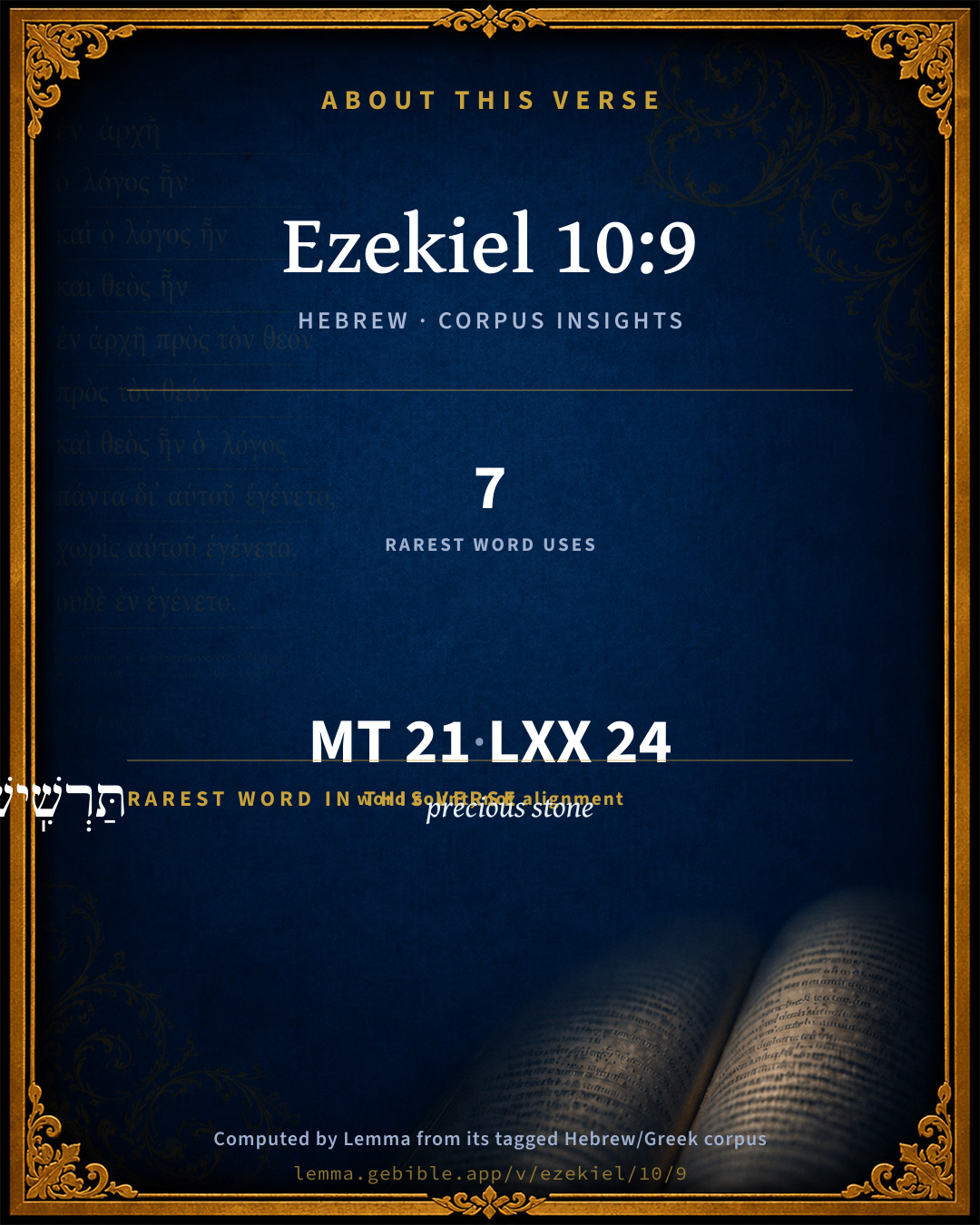
תַּרְשִֽׁישׁ
tarshîysh
H8658
“precious stone”
Noun, Common, Masculine, Singular, Absolute
Part of Speech
Noun
Type
Common
Gender
Masculine
Number
Singular
State
Absolute
Full BDB Definition

Origin: probably of foreign derivation [compare H8659 ]

TWOT: 2546

a precious stone or semi-precious gem - perhaps a chrysolite, yellow jasper, or other yellow coloured stone
  1. וָאֶרְאֶ֗ה râʼâh H7200 “and · to see” Conjunction + Verb, Qal, Sequential Imperfect, 1st Person, Common, Singular
  2. וְהִנֵּ֨ה hinnêh H2009 “and · behold” Conjunction + Particle, Demonstrative
  3. אַרְבָּעָ֣ה ʼarbaʻ H702 “four” Adjective, Cardinal number, Masculine, Singular, Absolute
  4. אוֹפַנִּים֮ ʼôwphân H212 “wheels” Noun, Common, Masculine, Plural, Absolute
  5. אֵ֣צֶל ʼêtsel H681 “beside” Preposition
  6. הַכְּרוּבִים֒ kᵉrûwb H3742 “the · cherubim” Particle, Definite Article + Noun, Common, Masculine, Plural, Absolute
  7. אוֹפַ֣ן ʼôwphân H212 “wheel” Noun, Common, Masculine, Singular, Absolute
  8. אֶחָ֗ד ʼechâd H259 “one” Adjective, Cardinal number, Masculine, Singular, Absolute
  9. אֵ֚צֶל ʼêtsel H681 “beside” Preposition
  10. הַכְּר֣וּב kᵉrûwb H3742 “the · cherub” Particle, Definite Article + Noun, Common, Masculine, Singular, Absolute
  11. אֶחָ֔ד ʼechâd H259 “one” Adjective, Cardinal number, Masculine, Singular, Absolute
  12. וְאוֹפַ֣ן ʼôwphân H212 “and · wheel” Conjunction + Noun, Common, Masculine, Singular, Absolute
  13. אֶחָ֔ד ʼechâd H259 “one” Adjective, Cardinal number, Masculine, Singular, Absolute
  14. אֵ֖צֶל ʼêtsel H681 “beside” Preposition
  15. הַכְּר֣וּב kᵉrûwb H3742 “the · cherub” Particle, Definite Article + Noun, Common, Masculine, Singular, Absolute
  16. אֶחָ֑ד ʼechâd H259 “one” Adjective, Cardinal number, Masculine, Singular, Absolute
  17. וּמַרְאֵה֙ marʼeh H4758 “and · sight of” Conjunction + Noun, Common, Masculine, Singular, Construct
  18. הָא֣וֹפַנִּ֔ים ʼôwphân H212 “the · wheels” Particle, Definite Article + Noun, Common, Masculine, Plural, Absolute
  19. כְּעֵ֖ין ʻayin H5869 “like/as · eye of” Preposition + Noun, Common, Both, Singular, Construct
  20. אֶ֥בֶן ʼeben H68 “stone of” Noun, Common, Feminine, Singular, Construct

About this verse

These counts appear in no published source. They are computed here, from the morphology-tagged text and Lemma’s own curated glosses. What Lemma adds →

21
words
11
distinct lemmas
Prophets
section

Notable vocabulary

The rarest word here is תַּרְשִֽׁישׁ precious stone H8658 — appearing just 7 times in the whole Hebrew Bible.

Shared distinctive vocabulary

תַּרְשִֽׁישׁ precious stone H8658 occurs in 7 verses of the Hebrew Bible. Also found in:

Grammatical profile

  • 1 verb
  • 11 nouns
  • 5 adjectives
  • 3 prepositions
  • 1 particle

Verb forms

  • וָאֶרְאֶ֗ה Qal · Sequential Imperfect

Repetition

Words recur within this verse — often emphatic in Hebrew:

  • אוֹפַנִּים֮ wheel H212 ×4
  • אֶחָ֗ד one H259 ×4
  • אֵ֣צֶל beside H681 ×3
  • הַכְּרוּבִים֒ cherub H3742 ×3

Hebrew & Septuagint length

In English translation the verse runs 31 words from the Hebrew and 30 from the Septuagint (LXX English) — closely comparable.

A rough comparison of the two English renderings, which tokenize alike — not a word-level alignment.

Word counts can differ between the Hebrew and the Greek without any difference in meaning — e.g. the Hebrew direct-object marker אֵת has no separate Greek word, and Greek often adds the article ὁ.

In the original languages it is 21 Hebrew tokens and 24 Greek tokens — but the two are counted differently (Hebrew bundles its prefixes and suffixes into one token; the Greek is in lemma form), so that isn’t a like-for-like length.

Cross-references

3

Topical passages linked to Ezekiel 10:9 in the Treasury of Scripture Knowledge — connected by theme and wording, ordered by reader-vote popularity; previews shown in the World English Bible.

  • Ezekiel 1:15–17 Now as I saw the living creatures, behold, one wheel on the earth beside the living creatures, for each of the four faces of it.
  • Daniel 10:6 his body also was like the beryl, and his face as the appearance of lightning, and his eyes as flaming torches, and his arms and his feet like burnished brass, and the voice of his words like the voice of a multitude.
  • Revelation 21:20 the fifth, sardonyx; the sixth, sardius; the seventh, chrysolite; the eighth, beryl; the ninth, topaz; the tenth, chrysoprasus; the eleventh, jacinth; and the twelfth, amethyst.

Cross-references courtesy of OpenBible.info (CC BY 4.0).

Hebrew and Greek witnesses Masoretic Hebrew ↔ Greek Septuagint

The same verse in the two great witnesses to the Old Testament, shown verse-for-verse.

These are two independent witnesses, not word-aligned to each other, and the Septuagint is shown in lemma (dictionary) form.

Hebrew Ezekiel 10:9 Masoretic · Westminster Leningrad Codex

וָאֶרְאֶ֗ה וְהִנֵּ֨ה אַרְבָּעָ֣ה אוֹפַנִּים֮ אֵ֣צֶל הַכְּרוּבִים֒ אוֹפַ֣ן אֶחָ֗ד אֵ֚צֶל הַכְּר֣וּב אֶחָ֔ד וְאוֹפַ֣ן אֶחָ֔ד אֵ֖צֶל הַכְּר֣וּב אֶחָ֑ד וּמַרְאֵה֙ הָא֣וֹפַנִּ֔ים כְּעֵ֖ין אֶ֥בֶן תַּרְשִֽׁישׁ

I looked, and behold, four wheels beside the cherubim, one wheel beside one cherub, and another wheel beside another cherub; and the appearance of the wheels was like a beryl stone.

World English Bible · Public Domain

Greek LXX Ezekiel 10:9 Septuagint · lemma form

καί ὁράω καί ἰδού τροχός τέσσαρες ἵστημι ἔχω ὁ χερουβείμ τροχός εἷς ἔχω χερουβ εἷς καί ὁ ὄψις ὁ τροχός ὡς ὄψις λίθος ἄνθραξ

And I saw, and behold, four wheels stood by the cherubs, one wheel by each cherub: and the appearance of the wheels was as the appearance of a carbuncle stone.

LXX2012 (modern English Septuagint) · Public Domain

On this verse, Adam Clarke's Commentary discusses the Septuagint’s reading. Read the note in Commentary ↓

Hebrew: Westminster Leningrad Codex (CC BY 4.0). Greek: Septuagint (public domain); English from LXX2012 (modern English Septuagint) (Public Domain). How the Septuagint differs from the Hebrew →

Targum (Aramaic paraphrase)

1

The Targum is the ancient Jewish Aramaic paraphrase of the Hebrew Scriptures — an interpretive translation, not the Hebrew text itself. Onkelos (literal) and Pseudo-Jonathan (expansive) render the Torah, and Jonathan the Prophets. Coverage is partial: where no permissively-licensed English translation exists for a verse, only the Aramaic is shown. This is verse-level text, not a word-by-word alignment to the Hebrew.

  1. Targum Jonathan Prophets (Joshua–Malachi)
    וַחֲזֵית וְהָא אַרְבְּעָא גַלְגְלַיָא בִּסְטַר כְּרוּבַיָא גַלְגַל חַד בִּסְטַר כְּרוּבָא חָד וְגַלְגַל חַד בִּסְטַר כְּרוּבָא חָד וְחֵיזוּ גַלְגְלַיָא כְּעֵין אֲבַן טָבָא:

    (no public-domain English translation for this verse)

    Targum Jonathan — Aramaic: “Mikraot Gedolot” (public domain). English: “Sefaria Community Translation” (CC0 1.0 (public-domain dedication)); “London "Chaldee Paraphrase," 1871” (public domain). Text via Sefaria.

Commentary

Notes on Ezekiel 10:9 from classic Christian and Jewish commentators (each source and its license shown beneath its notes). The classic Christian expositions comment on the surrounding passage and are grouped to its opening verse, so a note may address several verses; the Jewish commentaries on the Tanakh (Rashi and others) are per-verse, so they appear only where the commentator wrote on this verse.

Lemma curates 59 commentaries, every one of them public domain or Creative Commons licensed, each selected and text-cleaned for this edition rather than reprinted as found. About our sources →

Trapp's Complete Commentary

John Trapp

Eze 10:9 And when I looked, behold the four wheels by the cherubims, one wheel by one cherub, and another wheel by another cherub: and the appearance of the wheels [was] as the colour of a beryl stone.

Ver. 9. And when I looked, behold the four wheels.] This chapter compared with the first, do, like glasses set one against another, cast a mutual light.

As the colour of a beryl stone.] Lapidis berylli thalassis. See Eze 1:16. Wheels are voluble, and the sea tumultuous; so are all things and places in this present life: lay hold on life eternal.

John Trapp, A Commentary or Exposition upon All the Books of the Old and New Testament (1647–1656) — public domain. Text from a community e-Sword module.

The Biblical Illustrator

Joseph S. Exell

Eze_10:9

The four wheels by the cherubims.

The Divine government

I. This vision represents the absolute and universal government of God.

1. That God does possess and wield such a government is indicated by the reference to the throne--an object which is in itself the symbol of supreme power. It is indicated also by a reference to the influences emanating from the throne, and regulating the movement of the cherubim and of the wheels--the cherubim signifying angelic beings, and the wheels signifying the procedure and course of mundane affairs, all subordinated to Him and regulated by Him, the possessor of infinite majesty. While we acknowledge its immensity, let us endeavour habitually and most profoundly to feel that we ourselves are subject to the government of God.

2. The peculiar connection in which this government is exhibited. The prophetic descriptions speak of a human form as being associated with the manifestation of the Divine glory. Now, from the analogous statements of inspiration we cannot do otherwise than consider this part of the vision as introducing to us the Son of God--Him who became incarnate in the fulness of time, as Mediator uniting in Himself the human and the Divine nature, and in that complex state effecting the great work of human redemption. What is pourtrayed can suit none but Him; and to Him, as Emmanuel, God with us, God manifest in the flesh, it does emphatically and beautifully answer.

II. This vision represents the characteristics which the procedure of the Divine government includes and exemplifies.

1. There is a representation of its intricacy. This is conveyed in the structure of the cherubim; it is conveyed in the relation between the cherubim and the wheels; and it is conveyed in what is stated as to the wheels themselves. We live truly in the midst of mysteries; and as those mysteries pass, in their dark and shadowy forms, there ever resounds to us the challenge, Lo, these are parts of His ways, etc.

2. There is the characteristic of intelligence. It is stated, with regard to the agencies which are now introduced for our attention, that their whole body and their backs and their hands and their wings and the wheels were full of eyes round about, even the wheels that they four had; the eyes, according to the interpretation of Scripture symbols, being known as the signs and emblems of intelligence. Here, we conceive, we have the fact brought before us, that the system according to which the course of our world proceeds is not that of blind mechanism or fate--a dogma which modern infidelity, imitating its predecessors, has revived and promulgated, but that it proceeds under the direction of mind, the highest operation by which events can by possibility be regulated. The infinite mind of Jehovah is constantly occupied in directorial functions. That infinite mind formed the plan of government, and that infinite mind, as the course of His government proceeds, is ever active, diffusing itself to the furthest range, and penetrating to the most minute recesses, lighting up all as with the radiance of its own emissions, and by knowing all, prompting and ordering all.

3. There is the characteristic of immense and ever active energy. We read, for example, of the cherubim and of their movements, that as for the likeness of the living creatures, their appearance was like burning coals of fire, and like the appearance of lamps: it went up and down, etc. And the living creatures ran and returned as the appearance of a flash of lightning. And as to the wheels it is said, when they went, they went upon their four sides; they turned not as they went, but to the place whither the head looked they followed it; they turned not as they went. The agencies which are set in motion by God never cease and never tire, but pass steadily and uniformly onward, in order to accomplish the purpose of Him who worketh all things according to the counsel of His own will--their energy being constantly supplied and fed by the resources of His energy, which is inexhaustible, as the God who is almighty, the Lord God Omnipotent.

4. There is the characteristic of harmony. We read that the wheels have one likeness; and we read also that the wheels and the cherubim act and proceed in entire and in perfect concert. I looked, says the prophet, and behold the four wheels--the spirit of the living creature was in them. We learn from this that the agencies employed under the Divine administration are never disjointed from each other, never contravene or oppose each other, but blend all their movements and operations as though they were actually, notwithstanding their multifariousness and variety, one. We may observe that the procedure of these agencies is also in perfect harmony with the original plan of the Divine mind, never for a moment deviating from it, but always answering to that which is designed to be accomplished. We may also observe that the procedure of these agencies thus harmonising will finally appear so before the whole intelligent creation, that they may admire, and that God may receive His highest glory.

III. This vision represents the tribute which the government of God, so characterised, demands.

1. The government of God, thus characterised, demands our adoration. It is truly the development of what is great and ineffably majestic; and the proper tribute for the development of its greatness and majesty is that of humble and awful reverence.

2. The government of God, so characterised, demands our study. Intelligent beings were formed with the view that they should become the students of the government of God. It is made known to them that they might meditate upon it, so as to apprehend it; and only thus can they offer the other departments of the tribute which are required from them. The Divine procedure and government is the noblest theme which can possibly engage our immortal mind. There is nothing but what is comprehended here. It includes all history, all the inventions of art, all the discoveries of science--science, whether confined to matter or mind, whether referring to our own world or to the most distant tribes that are discoverable in the vast universal of space: all things that can engage our imagination or reason are comprehended in the government of God.

3. The government of God, as thus characterised, demands our submission. Nay, but, O man, who art thou that repliest against God? Be still and know that I am God.

4. The government of God, thus characterised, demands our confidence. If for our eternal welfare we are reposing upon the testimony which He has given us concerning His Son, let us exercise the same confidence with regard to the interests of nations, and with regard to the wellbeing of the Church; and let us not doubt that all things now transpiring around us, in the passions of communities, in the convulsions of nations, and in the events disastrous or Otherwise, which affect the interests of the Church, are under the management of the same perfect principle, and are gradually intended to evolve the same grand and delightful results. And then let us trust also in our anticipations of the future. (J. Parsons.)

The Biblical Illustrator, edited by Joseph S. Exell (c. 1880s–1900s) — public domain. Text from a community e-Sword module.

The Preacher's Complete Homiletical Commentary

Joseph S. Exell (gen. ed.)

EXEGETICAL NOTES.—Eze_10:9-22. The description of the cherubim and of their movements is similar to, but independent of, that given in chap. 1. Ezekiel is not prostrated as at first, and seems to see the subordinate details of the vision more distinctly. On this occasion the appearances were to be closely observed, being of great significance to the whole house of Israel. He has to connect that which he saw in the land of exile with this in the temple. He has thus a proof that he is no self-constituted messenger of the Lord to His people, that the divine glory shed its lights and shadows over the captives as well as in Jerusalem, that a change in the procedure of God was taking effect, and He would never again associate Himself with the temple-worship as in days of old. All the energies of creation fitted to carry out the determinate counsel and foreknowledge of God were ready to be put in operation.

Eze_10:9-12. These four wheels were so arranged as that one should be beside each cherub, “and the appearance of the wheels was as the colour of Tarshish stone.” Eze_10:11. ‘When they went they went toward their four sides”—to that one of the four quarters towards which each wheel was severally placed—“for to the place to which the head turned, after it they went,” this was noticeable that, though they might go in any direction, yet they always moved forward. They did so in accordance with the movement, not of a special wheel which was chief over the other three, but of that one of the wheels which happened to face the direction in which all were to roll, and ever in harmony with the cherubim. Eze_10:12. “And all their flesh, and their backs, and their hands, and their wings, and their wheels were full of eyes round about;” obviously the cherubim are included in this feature as well as the wheels, and correspond to the aspect of the living creatures as seen by John (Rev_4:6). This interruption of the description of the wheels, by a reference to the cherubim, may have been made to show how all forces were gifted with certain similar capabilities, and because the cherubim—the vital forces—were the more important: “to the four of them their wheels” is the literal rendering. If the Hebrew text is not corrupt, the phrase can only mean that to cherubim and wheels eyes were furnished all over.

Eze_10:13. Any perplexity found in this verse may be dissipated by regarding it as an address to the wheels to get into motion. “To the wheels—to them was cried in my ears, Whirl,” or the whirling. There are two Hebrew words used which are both rendered in A. V. by wheel. The distinction between them can only be maintained by some such translation as is given here. It is something like the distinction between “wheels” and “the entire machinery of wheel-work, wheel within wheel, as visible to Ezekiel and capable of quick, whirlwind-like movements.” The cry which the prophet heard, which was to impress on him the truth that the Lord was controlling all actions affecting Israel, signified that the wheels were to verify their nature by revolving. The result of this call to them is noted in Eze_10:15.

Eze_10:14. The aspect of the cherubim is defined preparatory to their rising up. “And four faces were to every one.” Ezekiel goes on to mention, not each of the four faces, but that face of each which confronted him: “the face of the first was the face of the cherub.” This defines nothing, though the succeeding clauses do define the face of a man, of a lion, of an eagle. Some commentators hold that the Hebrew word should be altered into that for “ox.” This is not to be thought of. It would be understood to be that by reference to the former vision (chap. Eze_1:10). The definite article prefixed does not mean that the face of this cherub was the only cherubic face, but rather, as Fairbairn suggests, that Ezekiel saw the whole features of the cherub which happened to be nearest to him and had given the fire to the watcher, while in the cases of the other three he saw one face only.

Eze_10:15-17. The command to whiri is obeyed by the cherubim aseending and by the revolution of the wheels in harmony with their movements. “And when the cherubim went, the wheels went beside them … when these stood they stood, and when these rose up they rose up with them.” They move together if they move at all, and in perfect unison. All created energies, whether apparently quiescent or active, are imbued with the spirit of life.

Eze_10:18-19. Another movement of deepest significance was observed. “And the glory of the Lord went forth from above the threshold,” to which it had gone a short time previously (Eze_10:4), “and stood above the cherubim;” this return is a stage towards the entire departure of the Lord from His temple, and indicates that the people might observe it, if they would not close their eyes. Having received the glory, “the cherubim lifted up their wings, and rose up from the earth before my eyes in their going forth, and the wheels beside them, and it,” the whole appearance—the glory, the cherubim, and the wheels—“stood at the opening of the gate of the Lord’s house, the eastern;” by this entrance the covenanted God would, in symbol, leave the temple, and by it, at a future period, He would come again (chap. Eze_43:2-4).

Eze_10:20-22. Now that the impending departure is on the verge of becoming an accomplished fact, that becomes definite to the prophet which he had stated already (Eze_10:15) in a parenthetical way. He has a fuller revelation than before, and realises the import of the former vision which had been granted to him at the Chebar. “This was the living creature which I saw under the God of Israel, and I knew that they were cherubim.” We may be hardly justified to say that be had doubted whether they were the cherubim which he had seen, but, at any rate, he is certain now of the identity of appearances in both visions. The Glory which has enthroned itself over the living four and hovers at the gate of the temple, if not in all points the same in form as the cherubim over the mercy-seat, are the cherubim between whom the Lord dwelleth, and they expressly appeared to him in the land of exile. Thus is Ezekiel assured by the God of Israel that, if He abandons His chosen seat, He does not abandon His people—that He is with them in their captivity to show His ways and teach His paths. This assurance of likeness is reiterated: “they are the same faces which I saw by the river Chebar—their appearances and themselves.” Not merely their external aspect, but their substance had one common resemblance.

HOMILETICS

GOD IN HUMAN ACTIVITY (Eze_10:10)

In this vision, the wings and hands, the wheels and eyes, are parts of a mystery dark with excess of light. Just as to one who knows not the plan of a battle, the noise, the clouds of smoke, and the movements of armies confuse and confound. Yet the clause which tells of a wheel within a wheel, the activity of a hidden power, may bring a lesson to our bosom and business. The thought suggested here is this, the Lord God Omnipotent thrusts forth silently and successfully His hand into the being and working of every man. Reason and the kingdom of God will prevail, and not the devil and those who do devilish work. The wrath of man shall praise God. He, like the engineer with hand on lever, holds the forces of the world.

By a wheel within a wheel God governs and makes all things work together for good to those who love Him: all pleasant and all painful things; all that is mean, contemptible, slanderous, all that vexes and annoys. So we may put on gladness, knowing that He overrules each event of life, and while we work He worketh in us according to His good pleasure.

I. The Scriptures affirm this truth. They are as full of the evidences of it as the daily press is full of the records of man’s working in individual and national life. Take the wings of the morning and dwell in the uttermost parts of the earth, God is there; or descend into hell, and He is there. The devil is wheeled about by Him there.

The broad wheel of an evil destiny seemed once to crush Joseph, but he devoutly and magnanimously said to his brothers, “Ye thought evil, God meant it for good.” There was also a wheel at work in the life of Jacob, to whom in a dark hour celestial comfort came—angels on the ladder; in the peril of Daniel in the den, whose heroic fidelity led a pagan king to say, “There is no God like the God of Daniel;” in the case of David who, in his loss of Absalom, found it good to be afflicted; in the alarm of the servant at Dothan, and in the weeping of Peter. Eyes see clearer washed with tears. Paul could glory in his infirmities, for he saw even in them that the power of Christ was made glorious. In all the pains and penalties, the joys and griefs, the thoughts and imaginations of life, God is busy, out of evil still educing good.

II. History proves this. Never did men meet behind closed doors as in Masonic secrecy without God seeing them. Every plot and conspiracy is known to Him. The Gunpowder Plot, the Spanish Armada, the American Rebellion, were carefully planned, but God overthrew them all. There was a wheel within a wheel. The Jews were persecuted and peeled, they were ever an easy prey to the spoiler, now they are the bankers and the traders of the world, and hold seats of power among the nations. The Puritans were persecuted, and you know the result. The thing you intend to accomplish carries with it a score of things you did not intend to do. Luther and Columbus accomplished more than ever they dreamed of doing, because God was in their movements. A poor man said to me, “I’ve failed, I never was in such a strange, unique position.” Ah! what is failure? Was ever there such a failure, apparently, as that which Christ made? All men forsook Him and fled. What is failure? I think of God’s slaughtered saints “on Alpine summits cold;” of the thousands who have perished in the Inquisition; of Jonah hurled into the sea to save the ship; of many who fall in battle, while victory crowns the survivors, and I ask what is failure? God’s word says that, “though hand join in hand, the wicked shall not go unpunished.” Even “the stars in their courses fought against Sisera.” Yes—

III. The laws of nature illustrate this. Say to the righteous it shall be well with them, and to the wicked that the wheel of God is working against them. The thunderstorm is His scavenger, driving off malaria and noxious vapour. The biting frost, that bent low my flowers, drove the plague from one of our cities. The earthquake is a safety-valve by which imprisoned gases are set free. Weeds, thistles, insects are made to work out some good. As Shakespeare says—

“There is some sort of goodness in things evil,

Would men observingly distil it out.”

Remark:

1. We cannot get along without God. If we choose to rebel against His working, He will curse and overthrow us. If we lead selfish, prayerless, cruel lives, He will thwart and destroy. God has punished nations who forgot Him. Go to their graves to-day. O Judea, whose poets, prophets, and priests were the admiration of thy nation, why art thou peeled and conquered? “We rejected the Holy One and would not obey Him.” O fair Greece, the home of orators and philosophers! and thou, O stately Rome on thy seven hills! why is Ichabod written on thy temples, and thy palaces in dust, with men digging among thy ruins? “We forgot justice, oppressed the poor, and listened not to the truth.” It may be said to this land in time to come, O great country, why hast thou fallen? “We hasted to be rich and turned away from God, our lips being filled with lying and our lives with injustice.” Men and nations in prosperity often forget God, and, proud of their might, go forth as Samson did to shake himself when “he wist not that the Lord had departed from him.” We live and move in God, and it is true that He lives and moves in us. Our prayer should be, “Guide me, O Thou great Jehovah!”

2. Nothing happens which does not help him who loves God. Losses, crosses, abuse, injury, lead to the growth of patience, watchfulness, and the silent bearing of sorrow. Burn your own smoke and go on. It is often darkest before dawn. Our trials help to build up character.

3. The love of God is emphasised by the truth before us. All the verses of the Bible end here—in the love of God. He reigns—not sin, not sorrow, not death. He wipes away every tear. He destroys the last enemy. His Hand guides the course of nations. Not Victoria, not Kaiser William, not the president of a republic is at the helm. God is Governor among the people. Trust in Him. Rejoice in Him. He will lead us, and will lead the world even to the end.—Gallaher.

THE PERFECT ORDER (Eze_10:13)

We see a subordination of causes, one to another, and all under one Supreme.

I. The supreme cause. He has the appearance as of a man. He speaks as with man’s voice. There is a prefiguration of the incarnation, of the Mediator ruling His providential kingdom. Infinite power and wisdom are His. If He will pull down, who can hold up? If He will suspend His action, who can impel the curbed forces to move? His ways are high above, out of our sight. We may see the hand outside, we cannot see the living Spirit within. We are in a world of changes, in which nothing happens by chance, but each change is subordinated to the will of Christ

II. The subordinate causes. Wheels are all things that are moved. They are absolutely acted on by the word of the Lord. He alone can make them execute the objects for which they are created, and at the seasons which He knows to be most fitted for the good and the true amongst men. They rise up to the highest, they descend to the inferior influences which operate in human societies. They go straight on to the points to which they are directed, and turn not from the execution of their commission.

He reigns over all things and persons. His voice fixes the destinies of earth. He will guide us by His counsel. So all impatience with the dealings of God is groundless; all murmuring is sinful, and we should learn to listen to His voice, to be diligent and persevering in doing His work, to long that one duty or trial should fit us for the next duty or trial.—M.

FEET AND WINGS

“When they stood, these stood; and when they were lifted up, these lifted up themselves also” (Eze_10:17) [Refer to chap. Eze_1:24.]

Flying creatures have wings for the air and feet for the ground. This touch of nature is put on God’s cherubim. The prophet intends no special religious lesson here, but the fact he cites may be used to convey such.

I. The subject of Christian experience, what it is and how to be maintained. We have faculties of locomotion, feeding, sense, perception, &c., by which we act our parts on foot as it were. We have attributes of faith-perception, love-appropriation, spiritual imagination, in which we become aërial creatures, resting suspensively in things above the world. This uplifting produces the transcendent mystery of experience in Christian conversion. We rise by trust in God—admitting the full revelation of His truth and friendship. When we rest ourselves, our life and life-character on God, we prove Him, and have the sense of Him revealed to our immediate knowledge. This faith is not in something about God. It is the man’s new, self-committing act, by which he puts himself out on trust and begins to live on God. It is a sublime act of migration upward into the range of spirit, and all things are new.

Can the soul thus lifted stay in that serene element? It has gravitations which pull it all the while downward, and settle it on its feet, as the flying creatures fold their wings when they settle. Let us trace some of the instances and ways in which it ceases to live by faith.

When a man of enterprise thinks of independence, how easily, how insensibly he ceases to hang on Providence as he did. His prayers lose their fervour. God is far less dear and less consciously present; and how long will he have the consciousness of His presence at all?

When there is overdoing the search after evidences of faith. What is the evidence of faith but faith itself, as we get evidence of warmth by heat which we cannot find through any inspection? And if evidence to a man is made up, he has made good his proofs. He is down on his feet.

When the disciple who is on the ground thinks to recover himself by his will instead of going back to faith. God is forgotten, and the harder throes he makes the deeper he sinks.

When disciples subside into a mere routine practice, or observance of times. It is no longer a service of impulse and liberty. They hope there may be some good in it, only of a duller sort than it should be. How much better if their faith had but a one-wing power; it would lift them a few feet upward now and then.

When a disciple shortens the distance between himself and the world that he may shorten the distance between the world and himself. There is the possibility of an over-austere practice; but the study of conformities is one in which none but a man of inflexible tenacity should ever dare to indulge, and only he when he is high enough lifted by his faith in God to suffer no bent downward. Cultivating the conformities is a plausible way of being mixed in them. Whoever undertakes to grade and gauge a ground-surface road will not be ascending into faith at all.

When a disciple thinks to fortify faith by practised investigation and deeper studies in matters of opinion. Benefits may thus be gained; but he is likely to seek his light in questions of the understanding and not by faith; then he is down upon the levels of mere nature. We think we touch bottom. We are going to be floated no more. But our solidity turns out to be a living on deductions, not on the uplifting grace of God’s inspirations. We thus settle out of grace into formulations of grace, when, of course, our wings are down.

Our conclusion is, that the moment any disciple touches ground with but the tip of his foot, and begins to rest on earthly props, a mortal weakness takes him, and he goes down. Only a calm and loving return to his trust will recover him, and God is faithful enough to be trusted at all times. Let there be this rest by faith, and he will carry himself more steadily in studies, toils, or engagements. Sometimes obscurations may occur, but he has only to believe the more strongly and wait till they be cleared.

II. Many persons miss ever going above a service on foot, by not conceiving at all the more ethereal range of experience, into which true faith would lift them. Sometimes they become reformers or philanthropists. They mean business in their religion, caring little for the fervours that are not fervours of work. The combining and rolling up of great masses of opinion are the means by which they expect to carry their projects. Censure and storm and fiery denunciation are close at hand. They, many times, do not conceive that they are disciples because of their repentances, or their prayers, or sensing of God by their faith, or any other grace that separates them from the world. They have much to say of love, but they visibly hate more strongly than they love. They never go above to descend upon the reform by inspirations there kindled; they keep on their feet, and war with the evils on the same level with them.

Sometimes they attempt self-culture in the name of religion. They could mend defects, chasten faults, put themselves in the charities they have learned from Christ, perhaps, to admire; but the work is a far more hopeless one than they imagine, if there is no uplifting help from gracious inspirations. Besides, the work keeps to a continual self-contemplation which is selfish. Old faults will come back, and they will have to fight all over again. Vexed, soured, discouraged, the whole undertaking may be given up. Oh, if they would go up to Christ, or to God in a true faith-culture, faults would fall off, as blasted flowers from a tree, by the life-principle therein. No man finishes a character who does not go above himself, and take the culture of God’s own Spirit.

Sometimes they settle down to ritualism. We all begin, almost unwittingly, to have a religion that is manipulated by our senses and sensuous tastes. We are caught by the forms. All the better that they are so nearly level with our natural faculties, and just as easy to be used without faith as with! How convenient to have a religion that lets the faiths and the fervours take care of themselves! Saying prayers, too—how much easier than to pray and find how to be heard. Thus a sufficient religion is got below; but the sad thing is, that instead of giving the disciple free wing, it keeps him down; so that if he becomes more earnest in it, it is turned into a superstition.

Sometimes they suppose they are religious because of a certain patronage they give to the Church and the word. Not being in the gift of spiritual discernment, their tastes will be the better; and as there are always a great many reasons why a thing should not be done to any single reason why it should, they assume to be specially qualified critics. They contribute these critical powers, while others, less gifted, may contribute their prayers! Such negatives do not belong to the range of the Spirit, but to the nether world of fashion, or opinion, or custom. The critics have feet but no wings. If they could give themselves over in trust to the Saviour, instead of giving their opinions and tastes, their contributions would be of worthier significance.

Sometimes they distrust experiences in religion, divine monitions, answers to prayer, calls to particular duties and works. They like the level of nature. All supernatural upliftings and fervours are fantasies that had best be avoided. Inspirations are nothing; judgments everything. What shall we say of that story which the Apostle Paul tells the Corinthians? It was his way to be going up into high regions, so that he was not sure, at times, whether he had a thing by revelation or not. People called him “mad,” because he did not stay on foot, in their level of sanity. But was there ever a soul more massive and sublimely steady in its equilibrium than his?

What is the conclusion of the whole matter? That the Christian idea of religion is not any mere playing out of nature as its own level; but is the lifting up of the man above himself in a transformation that makes him new. In so far as he is a Christian, he becomes the citizen of another kingdom. Whatever disrespect he may encounter, he will have evidences in himself that ask no certification. He will have learned that the only safe way of living is the highest. Here his internal jars and discords are laid and a glorious serenity is established. The earth is not his mother; if he descends to the ground his strength vanishes.

If we are to make an ascent into this higher plane of experience, the ties which hold our feet must be effectually cut by habitual self-renunciations. Selfishness and self-indulgence are no more for us. We must lift up everything we do in the world and hope from it, into that pure life of sacrifice and trust in which we abide with the Master. We must be as Noah when the Lord shut him in the ark, and be severed from every natural trust. Our expectation must be rested on God, not on pillars of any kind below—pillars are not wanted under wings.—Bushnell, abridged.

The Preacher's Complete Homiletical Commentary (gen. ed. Joseph S. Exell; Funk & Wagnalls, c. 1892) — public domain (pre-1929). A full-Bible homiletical/sermon-outline anthology covering 65 of 66 books (2 John is absent from the source module). Text from a community e-Sword module.

Keil & Delitzsch

C. F. Keil & F. Delitzsch

The Glory of the Lord Forsakes the Temple

Eze 10:9. And I saw, and behold four wheels by the side of the cherubim, one wheel by the side of every cherub, and the appearance of the wheels was like the look of a chrysolith stone. Eze 10:10. And as for their appearance, they had all four one form, as if one wheel were in the midst of the other. Eze 10:11. When they went, they went to their four sides; they did not turn in going; for to the place to which the head was directed, to that they went; they did not turn in their going. Eze 10:12. And their whole body, and their back, and their hands, and their wings, and wheels, were full of eyes round about: by all four their wheels. Eze 10:13. To the wheels, to them was called, "whirl!" in my hearing. Eze 10:14. And every one had four faces; the face of the first was the face of the cherub, the face of the second a man's face, and the third a lion's face, and the fourth an eagle's face. Eze 10:15. And the cherubim ascended. This was the being which I saw by the river Chebar. Eze 10:16. And when the cherubim went, the wheels went by them; and when the cherubim raised their wings to ascend from the earth, the wheels also did not turn from their side. Eze 10:17. When those stood, they stood; and when those ascended, they ascended with them; for the spirit of the being was in them. Eze 10:18.; And the glory of Jehovah went out from the threshold of the house, and stood above the cherubim. Eze 10:19. And the cherubim raised their wings, and ascended from the earth before my eyes on their going out, and the wheels beside them; and they stopped at the entrance of the eastern gate of the house of Jehovah; and the glory of the God of Israel was above them. Eze 10:20. This was the being which I saw under the God of Israel by the river Chebar, and I perceived that they were cherubim. Eze 10:21. Every one had four faces, each and every one four wings, and something like a man's hands under their wings. Eze 10:22. And as for the likeness of their faces, they were the faces which I had seen by the river Chebar, their appearance and they themselves. They went every one according to its face. - With the words "I saw, and behold," a new feature in the vision is introduced. The description of the appearance of the cherubim in these verses coincides for the most part verbatim with the account of the theophany in Ezekiel 1. It differs from this, however, not only in the altered arrangement of the several features, and in the introduction of certain points which serve to complete the former account; but still more in the insertion of a number of narrative sentence, which show that we have not merely a repetition of the first chapter here. On the contrary, Ezekiel is now describing the moving of the appearance of the glory of Jehovah from the inner court or porch of the temple to the outer entrance of the eastern gate of the outer court; in other words, the departure of the gracious presence of the Lord from the temple: and in order to point out more distinctly the importance and meaning of this event, he depicts once more the leading features of the theophany itself. The narrative sentences are found in Eze 10:13, Eze 10:15, Eze 10:18, and Eze 10:19. In Eze 10:13 we have the exclamation addressed to the wheels by the side of the cherubim to set themselves in motion; in Eze 10:15, the statement that the cherubim ascended; and in Eze 10:18 and Eze 10:19, the account of the departure of the glory of the Lord from the inner portion of the temple. To this we may add the repeated remark, that the appearance was the same as that which the prophet had seen by the river Chebar (Eze 10:15, Eze 10:20, Eze 10:22). To bring clearly out to view both the independence of these divine manifestations and their significance to Israel, Ezekiel repeats the leading features of the former description; but while doing this, he either makes them subordinate to the thoughts expressed in the narrative sentences, or places them first as introductory to these, or lets them follow as explanatory. Thus, for example, the description of the wheels, and of the manner in which they moved (Eze 10:9-12), serves both to introduce and explain the call to the wheels to set themselves in motion. The description of the wheels in Eze 10:9-11 harmonizes with Eze 1:16 and Eze 1:17, with this exception, however, that certain points are given with greater exactness here; such, for example, as the statement that the movements of the wheels were so regulated, that in whichever direction the front one turned, the other did the same. הראשׁ, the head, is not the head-wheel, or the wheel which was always the first to move, but the front one, which originated the motion, drawing the others after it and determining their direction. For Eze 10:12 and the fact that the wheels were covered with eyes, see Eze 1:18. In Eze 10:12 we have the important addition, that the whole of the body and back, as well as the hands and wings, of the cherubim were full of eyes. There is all the less reason to question this addition, or remove it (as Hitzig does) by an arbitrary erasure, inasmuch as the statement itself is apparently in perfect harmony with the whole procedure; and the significance possessed by the eyes in relation to the wheels was not only appropriate in the case of the cherubim, but necessarily to be assumed in such a connection. The fact that the suffixes in בּשׂרם, גּבּהם, etc., refer to the cherubim, is obvious enough, if we consider that the wheels to which immediate reference is made were by the side of the cherubim (Eze 10:9), and that the cherubim formed the principal feature in the whole of the vision.

Eze 10:13 does not point back to Eze 10:2, and bring the description of the wheel-work to a close, as Hitzig supposes. This assumption, by which the meaning of the whole description has been obscured, is based upon the untenable rendering, "and the wheels they named before my ears whirl" (J. D. Mich., Ros., etc.). Hvernick has already pointed out the objection to this, namely, that with such a rendering בּאזני forms an unmeaning addition; whereas it is precisely this addition which shows that קרא is used here in the sense of addressing, calling, and not of naming. One called to the wheels הגּלגּל, whirl; i.e., they were to verify their name galgal, viz., to revolve or whirl, to set themselves in motion by revolving. This is the explanation given by Theodoret: ἀνακυκλεῖσθαι καὶ ἀνακινεῖσθαι προσετάχθησαν. These words therefore gave the signal for their departure, and accordingly the rising up of the cherubim is related in Eze 10:15. Eze 10:14 prepares the way for their ascent by mentioning the four faces of each cherub; and this is still further expanded in Eze 10:16 and Eze 10:17, by the statement that the wheels moved according to the movements of the cherubim. לאחד without an article is used distributively (every one), as in Eze 1:6 and Eze 1:10. The fact that in the description which follows only one face of each of the four cherubs is given, is not at variance with Eze 1:10, according to which every one of the cherubs had the four faces named. It was not Ezekiel's intention to mention all the faces of each cherub here, as he had done before; but he regarded it as sufficient in the case of each cherub to mention simply the one face, which was turned toward him. The only striking feature which still remains is the statement that the face of the one, i.e., of the first, was the face of the cherub instead of the face of an ox (cf. Eze 1:10), since the faces of the man, the lion, and the eagle were also cherubs' faces. We may, no doubt, get rid of the difficulty by altering the text, but this will not solve it; for it would still remain inexplicable how הכּרוּב could have grown out of שׁור by a copyist's error; and still more, how such an error, which might have been so easily seen and corrected, could have been not only perpetuated, but generally adopted. Moreover, we have the article in הכּרוּב, which would also be inexplicable if the word had originated in an oversight, and which gives us precisely the index required to the correct solution of the difficulty, showing as it does that it was not merely a cherub's face, but the face of the cherub, so that the allusion is to one particular cherub, who was either well known from what had gone before, or occupied a more prominent position than the rest. Such a cherub is the one mentioned in Eze 10:7, who had taken the coals from the fire between the wheels, and stood nearest to Ezekiel. There did not appear to be any necessity to describe his face more exactly, as it could be easily seen from a comparison with Eze 1:10. - In Eze 10:15, the fact that the cherubim arose to depart from their place is followed by the remark that the cherubic figure was the being (החיּה, singular, as in Eze 1:22) which Ezekiel saw by the Chaboras, because it was a matter of importance that the identity of the two theophanies should be established as a help to the correct understanding of their real signification. But before the departure of the theophany from the temple is related, there follows in Eze 10:16 and Eze 10:17 a repetition of the circumstantial description of the harmonious movements of the wheels and the cherubim (cf. Eze 1:19-21); and then, in Eze 10:18, the statement which had such practical significance, that the glory of the Lord departed from the threshold of the temple, and resumed the throne above the cherubim; and lastly, the account in Eze 10:19, that the glory of the God of Israel, seated upon this throne, took up its position at the entrance of the eastern gate of the temple. The entrance of this gate is not the gate of the temple, but the outer side of the eastern gate of the outer court, which formed the principal entrance to the whole of the temple-space. The expression "God of Israel" instead of "Jehovah" is significant, and is used to intimate that God, as the covenant God, withdrew His gracious presence from the people of Israel by this departure from the temple; not, indeed, from the whole of the covenant nation, but from the rebellious Israel which dwelt in Jerusalem and Judah; for the same glory of God which left the temple in the vision before the eyes of Ezekiel had appeared to the prophet by the river Chebar, and by calling him to be the prophet for Israel, had shown Himself to be the God who kept His covenant, and proved that, by the judgment upon the corrupt generation, He simply desired to exterminate its ungodly nature, and create for Himself a new and holy people. This is the meaning of the remark which is repeated in Eze 10:20-22, that the apparition which left the temple was the same being as Ezekiel had seen by the Chaboras, and that he recognised the beings under the throne as cherubim.

Keil & Delitzsch — Biblical Commentary on the Old Testament (1861–1891) — public domain (CC PDM 1.0). Text via the HelloAO Bible API. (Old Testament only.)

Geneva Bible (1599)

Geneva Bible translators

Read Ezek. 1:16.

Geneva Bible (1599) marginal notes — public domain. Text via Bolls.life.

Jamieson, Fausset & Brown

Robert Jamieson, A. R. Fausset & David Brown

wheels--(See on Eze 1:15-16). The things which, from Eze 10:8 to the end of the chapter, are repeated from the first chapter are expressed more decidedly, now that he gets a nearer view: the words "as it were," and "as if," so often occurring in the first chapter, are therefore mostly omitted. The "wheels" express the manifold changes and revolutions in the world; also that in the chariot of His providence God transports the Church from one place to another and everywhere can preserve it; a truth calculated to alarm the people in Jerusalem and to console the exiles [POLANUS].

Jamieson, Fausset & Brown — Commentary Critical and Explanatory on the Whole Bible (1871) — public domain (CC PDM 1.0). Text via the HelloAO Bible API.

Adam Clarke's Commentary

Verse 9. The colour of a beryl stone.] אבן תרשיש eben Tarshish, "the stone of Tarshish." The Vulgate translates it chrysolith; Symmachus, the jacinct; the Septuagint, the carbuncle. In the parallel place, Eze 1:16, it is כעין תרשיש keeyn Tarshish, "like the eye of Tarshish;" i.e., the colour of tarshish, or the stone so called, which the Vulgate translates visio maris, "like the sea," i.e., azure. The beryl is a gem of a green colour, passing from one side into blue, on the other side into yellow. The chrysolith is also green, what is called pistachio green; but the chrysolith of the ancients was our topaz, which is of a fine wine yellow. The beryl, or chrysolith, is most likely what is here meant by tarshish. One name among the ancients served for several kinds of gems that were nearly of the same colour. The moderns go more by chemical characters than by colour.

Adam Clarke's Commentary on the Bible (1810–1826) — public domain. Text from a community e-Sword/MySword module.

John Calvin's Commentaries

Here the Prophet, as in the first chapter, says that wheels were added to each living creature. I have previously explained what the wheels mean. I will now only allude to them; concerning the living creatures I shall by and bye treat more fully. But the wheels are images of all the changes which are discerned in the world. No more suitable figure can be chosen; for nothing is stationary in the world, but revolutions, as we commonly call them, are continually happening. Since, therefore, they are so changeable, nay even tumultuous at times, profane men cannot understand how the world is governed by the fixed counsel of God; but they fabricate for themselves a blind fortune: hence God in concession to our weakness has represented to us, under the form of wheels, all changes of things, all accidents, as they are called, and all events; as if he were to say, that all things in the world are revolving and changing, not only that all elements are agitated upwards and downwards, but human events especially. Meanwhile he has corrected the error, while he has conceded something to the rudeness of men. For we see manifold conversions which appear to us under the form of a wheel: but meanwhile we indulge in too much license, when we imagine a blind fortune. Hence the Prophet saw wheels near the cherubim; that is, he saw those changes by which men’s minds are disturbed, as if all things happened rashly in the world. But he saw that the wheels did not revolve by their own force, but are annexed to the angels, since all events depend on a first cause, namely, on that secret ordinance and inspiration of God, by which the angels are moved, and whence also they have their vigor. In this explanation nothing is forced, because it is not doubtful that the living creatures, as we shall soon see, signify angela Let us go on then to the context —

John Calvin's Commentaries (1540-1563) — public domain. Text from the Calvin Translation Society English edition (1840s-50s) via the Christian Classics Ethereal Library (ccel.org). Calvin's coverage is partial (roughly two-thirds of the Bible); uncommented books and verses are honest gaps, never fabricated. The 19th-century editor's footnotes and remarks are omitted so the notes are faithfully Calvin's own voice.

The Cambridge Bible for Schools and Colleges

gen. ed. J. J. S. Perowne

9. the four wheels] Omit: the. The description is somewhat more exact than that given ch. Eze_1:15. A “beryl stone,” i.e. Tarshishstone, ch. Eze_1:16.

The Cambridge Bible for Schools and Colleges (gen. ed. J. J. S. Perowne; Cambridge University Press, 1878–1918) — public domain. Text from a community e-Sword module.

John Gill's Exposition

And when I looked, behold, the four wheels by the cherubim,.... The churches by the ministers: of these "wheels", and why the churches are so called, and of their number "four", and their situation "by" the cherubim; see Gill on Eze 1:15;

one wheel by one cherub, and another wheel by another cherub: a minister to a church; every church has its own pastor, elder, or overseer, by it, and over it:

and the appearance of the wheels was as the colour of a beryl stone; a precious stone of a sea green; See Gill on Eze 1:16. The Targum renders it in general, "a precious stone"; the Septuagint version, "a carbuncle"; and the Vulgate Latin version, "a chrysolite".

John Gill's Exposition of the Whole Bible (1746–1763) — public domain (CC PDM 1.0). Text via the HelloAO Bible API.

Haydock's Catholic Bible Commentary

CHAPTER X.

Stone. Hebrew Tharsis. Symmachus, "Hyacinth." (Chap. i. 16.) (Calmet)

George Leo Haydock (1774–1849), Haydock's Catholic Family Bible and Commentary, 1859 edition — public domain. Excludes Psalms (Douay-Rheims chapter numbering differs from Protestant) and Deuterocanonical books (Catholic canon only).

Matthew Poole's English Annotations

Looked; attentively viewed.

The four wheels; mentioned Eze 1:15,16, and there explained.

By the cherubims; one wheel by one cherub, so four cherubims and four wheels.

The appearance of the wheels; the revolutions and effects among worldly and sublunary affairs; as wheels unstable, yet governed by a sure wisdom.

As the colour of a beryl stone; of sea-green, to note the instability in a more pregnant simile.

Matthew Poole's English Annotations on the Holy Bible (1683–1685) — public domain. Text from a community e-Sword/MySword module.

Whedon's Commentary on the Bible

Daniel D. Whedon

9-11. See notes on chap. 1.

Daniel D. Whedon (gen. ed.), Commentary on the Old and New Testaments (1874–1909) — public domain. Text from a community e-Sword module.

John Wesley's Explanatory Notes

Looked - Attentively viewed. Beryl stone - Of sea-green.

John Wesley, Explanatory Notes Upon the Whole Bible (1754–1765) — public domain. Text via the GEBible commentary corpus.

Kretzmann's Popular Commentary

Paul E. Kretzmann

The Removal of Jehovah from his Temple

v. 9. And when I looked, behold the four wheels by the cherubim, one wheel by one cherub and another wheel by another cherub; and the appearance of the wheels was as the color of a beryl stone, as in the first vision, chapter 1.

v. 10. And as for their appearances, they four had one likeness, as if a wheel had been in the midst of a wheel, at right angles, as in the case of a gyroscope.

v. 11. When they went, they went upon their four sides; they turned not as they went, for their structure made it unnecessary for them to change their direction, but to the place whither the head looked they followed it; they turned not as they went. Cf.Ezekiel 1:17-19.

v. 12. And their whole body, literally, "all their flesh," and their backs, and their hands, and their wings, and the wheels, serving as a sort of conveyance to the cherubim, were full of eyes, round about, even the wheels that they four had.

v. 13. As for the wheels, it was cried unto them in my hearing, in a mighty command by the mouth of the Lord, O wheel! this call preparing for the further commands which were given.

v. 14. And every one had four faces, as in 1:10, the prophet here naming the face of each which was turned in his direction; the first face was the face of a cherub, and the second face was the face of a man and the third the face of a lion and the fourth the face of an eagle. Cf Rev 4:7.

v. 15. And the cherubim were lifted up, to be removed from the place which they then occupied. This is the living creature that I saw by the river of Chebar.

v. 16. And when the cherubim went, the wheels went by them; and when the cherubim lifted up their wing to mount up from the earth, the same wheels also turned not from beside them, so that the movement of the two was absolutely harmonious.

v. 17. When they stood, these stood; and when they were lifted up, these lifted up themselves also; for the spirit of the living creature was in them, the expression here used collectively, as in many instances.

v. 18. Then the glory of the Lord departed from off the threshold of the house, from the entrance to the holy Place, and stood over the cherubim, on the throne which it had occupied at the beginning of the vision.

v. 19. And the cherubim lifted up their wings and mounted up from the earth in my sight, the Lord thus removing His gracious presence from his People; when they went out, the wheels also were beside them, and every one, that is, the vision with the throne, stood at the door of the East Gate of the Lord’s house, that is, the eastern entrance of the outer court; and the glory of the God of Israel was over them above.

v. 20. This is the living creature that I saw under the God of Israel by the river of Chebar; and I knew that they were the cherubim, and their leaving completed the abandonment of tile Temple as a whole.

v. 21. Every one had four faces apiece and every one four wings; and the likeness of the hands of a man was under their wings. Cf.Ezekiel 1:6.

v. 22. And the likeness of their faces was the same faces which I saw by the river of Chebar, their appearances and themselves; they went every one straight forward, always under the direction of the Spirit of the Lord, whose power moved them.

Paul E. Kretzmann, Popular Commentary of the Bible (1921–1924) — public domain. Text from a community e-Sword module.

unfoldingWord translationNotes

Door43 World Missions Community

behold

Ezekiel was surprised by what he saw

wheels

See how you translated this in Ezekiel 1:15.

cherubim

See how you translated this in Ezekiel 9:3.

cherub

This is the singular form of "cherubim."

the appearance of the wheels was like a beryl stone

The abstract noun "appearance" can be translated as a verb. AT: "the wheels appeared to be like a beryl stone" or "what appeared to be wheels were like a beryl stone" (See: Abstract Nouns)

beryl stone

"Beryl" here is a very hard, valuable stone. This beryl was probably green or blue. (See: Translate Unknowns)

Their appearance was the same likeness for all four of them

The abstract noun "appearance" can be translated as a verb. The abstract noun "likeness" can be translated as an adjective. AT: "All four of them appeared to be similar" (See: Abstract Nouns)

a wheel intersecting another wheel

The word "intersecting" means "crossing" or "passing through."

they went in any of their four directions

Possible meanings are 1) "their" refers to the creatures. AT: "they would go straight in any one of the four directions that the creatures looked towards" or 2) "their" refers to the wheels.

whatever direction the head faced, they followed

Possible meanings for "the head" are 1) this refers to the winged creatures. AT: "they went in whatever direction the winged creatures were looking" or 2) this refers to the front wheel. AT: "they followed in whatever direction the front wheel went"

translationWords

face

unfoldingWord translationNotes — © Distant Shores Media and the Door43 World Missions Community, licensed CC BY-SA 4.0. Source: git.door43.org/Door43/en_tn.

Rashi

Rabbi Shlomo Yitzchaki (Rashi)

and behold four wheels Since one of the faces was changed, it was necessary to repeat here the entire account of the living beings as at first, so that you should not say that it is another Chariot.

Rashi on the Tanakh — English translations: “The Judaica Press complete Tanach with Rashi, translated by A. J. Rosenberg” (CC BY 4.0); “Pentateuch with Rashi's commentary by M. Rosenbaum and A.M. Silbermann, 1929-1934” (public domain); “The Metsudah Tanach series, Lakewood, N.J” (CC BY 4.0); and “The Book of Joshua, Metsudah Publications, 1997” (CC BY 4.0). Text via Sefaria.

Lesson kit

Teaching starters — assembled from the data on this page, not authored interpretation. Every prompt links to the verse data it draws on. Edit before teaching.

Ezekiel, in the Prophets, opens this verse with 21 words (11 distinct Hebrew lemmas). Its most distinctive word is tarshîysh (“precious stone”). A historical commentator’s framing appears above. Read the whole chapter for the surrounding context.

Discussion questions

  1. The word tarshîysh carries the sense “precious stone.” How does it shape the verse?
  2. How does Exodus 28:20, which shares the word «precious stone», read alongside this verse?
  3. What does the repetition of “wheel” (4× in this one verse) do in this verse?
  4. These translations render this verse differently. What is at stake in choosing one wording over another?
  5. «וָאֶרְאֶ֗ה» is a Qal Sequential Imperfect verb. How does that grammatical form shape the action described?
  6. Compare how Trapp's Complete Commentary and The Biblical Illustrator read this verse. Where do they agree or differ?

Things to notice

Reading settings

Reading text

Shown beneath each verse's original-language words.

Old Testament
Old Testament edition

Read the OT as the Masoretic Hebrew (MT) or the Greek Septuagint (LXX).

English shown for the Greek Septuagint (in the Hebrew ↔ Greek comparison).

Comparing translations? Open the Compare panel on any verse page to stack up to four side by side.