
Joshua 7:26

Hebrew (Westminster Leningrad Codex) Joshua 7:26 appears in the Hebrew Old Testament. The text above is from the Westminster Leningrad Codex. Each word links to its Strong’s number, a concise gloss, and parsing drawn from the Open Scriptures Hebrew Bible morphology. Click any word for its full Brown-Driver-Briggs (BDB) entry.
Download image
Cite this verse

Joshua 7:26 (World English Bible). Public Domain. Lemma interlinear Bible study tool, https://lemma.gebible.app/v/joshua/7/26.

Show BibTeX & RIS
BibTeX
RIS
English Translation
They raised over him a great heap of stones, to this day; and Yahweh turned from the fierceness of his anger. Therefore the name of that place was called "The valley of Achor" to this day.
World English Bible · Public Domain
Download a study sheet

One document with this verse’s original text, its word-by-word gloss line, the meaning frame, cross-references with their text, attributed commentary, and full source and license credits — printable, and it pastes into notes with its structure intact.

This verse Autodidact and up

Study sheet (.html) Plain text (.txt)

A passage Seminary Student

Up to 50 verses in one chapter. A passage sheet keeps up to 6 commentary sources and 12 cross-references per verse, in the order this page ranks them, and says so on the sheet whenever that leaves anything out. Ask for a single verse and you get the Autodidact verse sheet above.

Everything on this page stays free to read, with no account — the sheet is a download of what is already on screen, not access to it.

Want to remove ads? Support Godless Engineer
Compare translations 3

The same verse in 3 English versions, stacked beneath the original-language interlinear above. Click any original word for its lexicon entry.

Each is an independent rendering of the whole verse — the interlinear is not word-aligned to these translations.

Highlighted words mark where these versions differ — a whole-verse word diff, not a word-by-word alignment.

  • World English Bible Public Domain
    They raised over him a great heap of stones, to this day; and Yahweh turned from the fierceness of his anger. Therefore the name of that place was called "The valley of Achor" to this day.
  • King James Version Public Domain
    And they raised over him a great heap of stones unto this day. So the LORD turned from the fierceness of his anger. Wherefore the name of that place was called, The valley of Achor, unto this day.
  • unfoldingWord Literal Text CC BY-SA 4.0
    And they raised up over him a great pile of stones, to this day. And Yahweh turned from the burning of his nose. Therefore the name of that place is called the Valley of Achor to this day.

unfoldingWord Literal Text — © unfoldingWord, licensed CC BY-SA 4.0. Word-aligned USFM3 via Door43 (git.door43.org/unfoldingWord/en_ult).

Versions to compare (up to 4)

3 of 4 selected

Show all 18 translations

Every available English version of this verse, each an independent rendering of the whole verse.

  • World English Bible Public Domain
    They raised over him a great heap of stones, to this day; and Yahweh turned from the fierceness of his anger. Therefore the name of that place was called "The valley of Achor" to this day.
  • Berean Standard Bible Public Domain
    And they heaped over Achan a large pile of rocks that remains to this day. So the LORD turned from His burning anger. Therefore that place is called the Valley of Achor to this day.
  • Majority Standard Bible Public Domain
    And they heaped over Achan a large pile of rocks that remains to this day. So the LORD turned from His burning anger. Therefore that place is called the Valley of Achor to this day.
  • King James Version Public Domain
    And they raised over him a great heap of stones unto this day. So the LORD turned from the fierceness of his anger. Wherefore the name of that place was called, The valley of Achor, unto this day.
  • American Standard Version (1901) Public Domain
    And they raised over him a great heap of stones, unto this day; and Jehovah turned from the fierceness of his anger. Wherefore the name of that place was called, The valley of Achor, unto this day.
  • Revised Version (1885) Public Domain
    And they raised over him a great heap of stones, unto this day; and the LORD turned from the fierceness of his anger. Wherefore the name of that place was called, The valley of Achor, unto this day.
  • Geneva Bible (1599) Public Domain
    And they cast vpon him a great heape of stones vnto this day: and so the Lord turned from his fierce wrath: therefore hee called the name of that place, The valley of Achor, vnto this day.
  • Douay-Rheims (1899) Public Domain
    And they gathered together upon him a great heap of stones, which remaineth until this present day. And the wrath of the Lord was turned away from them. And the name of that place was called the Valley of Achor, until this day.
  • Young's Literal Translation Public Domain
    and they raise up over him a great heap of stones unto this day, and Jehovah turneth back from the heat of His anger, therefore hath `one' called the name of that place `Valley of Achor' till this day.
  • Literal Standard Version CC BY-SA 4.0
    and they raise up a great heap of stones over him to this day, and YHWH turns back from the heat of His anger, therefore [one] has called the name of that place “Valley of Achor” until this day.
  • Unlocked Literal Bible CC BY-SA 4.0
    They set up over him a great heap of stones that is here until this day. Yahweh turned away his burning anger. Therefore the name of the place is the Valley of Achor until this present day.
  • unfoldingWord Literal Text CC BY-SA 4.0
    And they raised up over him a great pile of stones, to this day. And Yahweh turned from the burning of his nose. Therefore the name of that place is called the Valley of Achor to this day.
  • Darby Bible Public Domain
    And they raised over him a great heap of stones, [which is there] to this day. And Jehovah turned from the fierceness of his anger. Therefore the name of that place was called, The Valley of Achor, to this day.
  • World Messianic Bible Public Domain
    They raised over him a great heap of stones that remains to this day. The LORD turned from the fierceness of his anger. Therefore the name of that place was called “The valley of Achor” to this day.
  • Webster's Bible Public Domain
    And they raised over him a great heap of stones to this day. So the LORD turned from the fierceness of his anger: wherefore the name of that place was called the valley of Achor to this day.
  • Free Bible Version CC BY-SA 4.0
    They set up a great pile of stones over him which remains to this day. The Lord was no longer angry. This is why the place was called the Valley of Achor ever since.
  • Bible in Basic English Public Domain
    And over him they put a great mass of stones, which is there to this day; then the heat of the Lord's wrath was turned away. So that place was named, The Valley of Achor, to this day.
  • JPS Tanakh (1917) Public Domain
    And they raised over him a great heap of stones, unto this day; and the LORD turned from the fierceness of His anger. Wherefore the name of that place was called The valley of Achor, unto this day.

Literal Standard Version (2020), Covenant Press — licensed CC BY-SA 4.0. Text via the HelloAO Bible API (eBible.org). Unlocked Literal Bible (unfoldingWord) — licensed CC BY-SA 4.0. Text via the HelloAO Bible API (eBible.org). unfoldingWord Literal Text — © unfoldingWord, licensed CC BY-SA 4.0. Word-aligned USFM3 via Door43 (git.door43.org/unfoldingWord/en_ult). Free Bible Version, Dr. Jonathan Gallagher — licensed CC BY-SA 4.0. Text via the HelloAO Bible API (eBible.org).

Word by word

More ways to search: Search by grammar → Find every occurrence → Compare this word →

Practice this passage: Drill this verse → Learn its vocabulary →

עָכ֔וֹר
ʻÂkôwr
H5911
“Achor”
Noun, Proper
Part of Speech
Noun
Type
Proper
Full BDB Definition

Origin: from H5916

TWOT: 1621a

trouble, disturbance - Achor - as the valley of trouble where Achan and his family were stoned
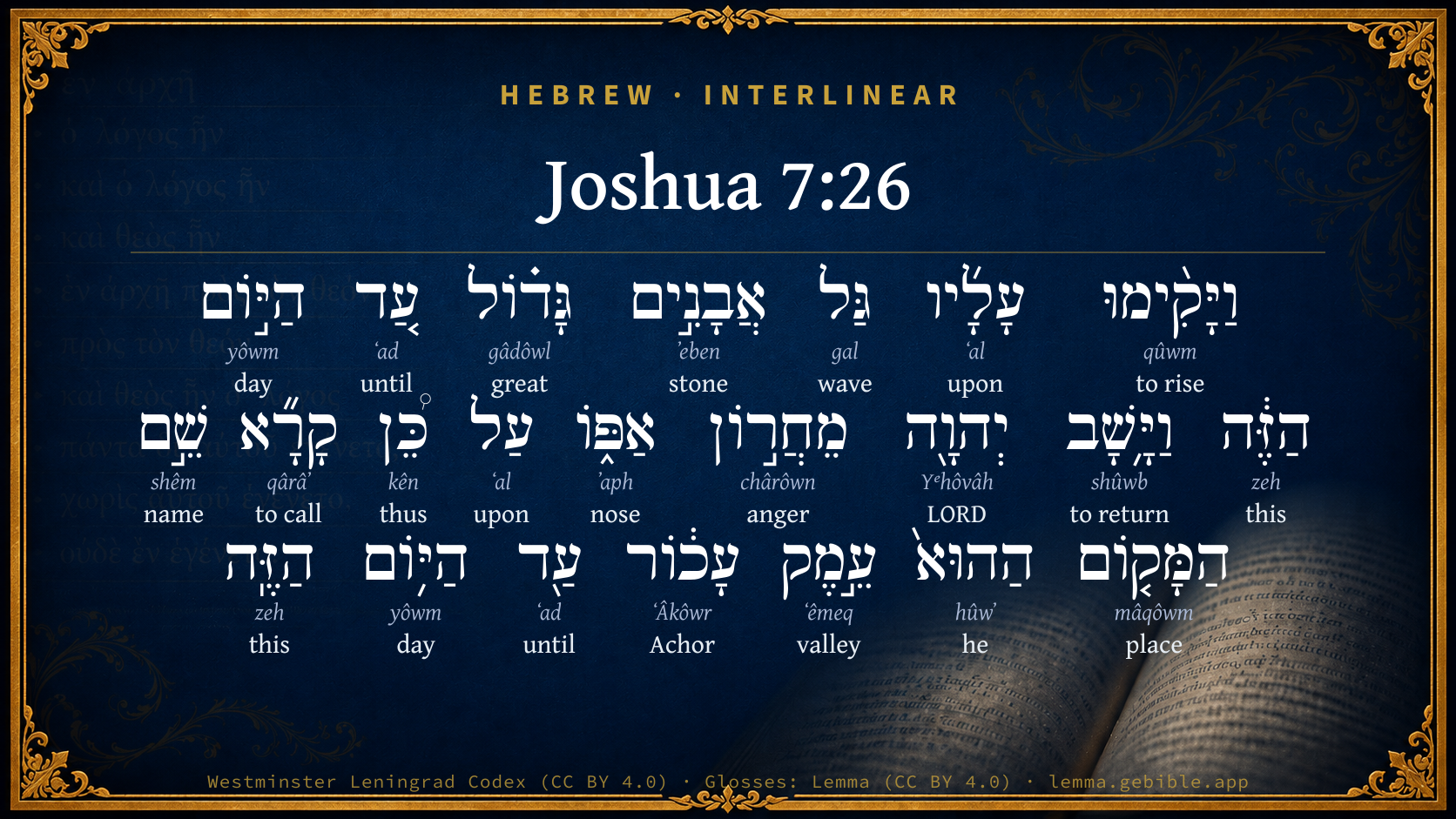
  1. וַיָּקִ֨ימוּ qûwm H6965 “and · to rise” Conjunction + Verb, Hiphil, Sequential Imperfect, 3rd Person, Masculine, Plural
  2. עָלָ֜יו ʻal H5921 “upon · him” Preposition + Suffix, Personal, 3rd Person, Masculine, Singular
  3. גַּל gal H1530 “wave of” Noun, Common, Masculine, Singular, Construct
  4. אֲבָנִ֣ים ʼeben H68 “stones” Noun, Common, Feminine, Plural, Absolute
  5. גָּד֗וֹל gâdôwl H1419 “great” Adjective, Adjective, Masculine, Singular, Absolute
  6. עַ֚ד ʻad H5704 “until” Preposition
  7. הַיּ֣וֹם yôwm H3117 “the · day” Particle, Definite Article + Noun, Common, Masculine, Singular, Absolute
  8. הַזֶּ֔ה zeh H2088 “the · this” Particle, Definite Article + Pronoun, Demonstrative, Masculine, Singular
  9. וַיָּ֥שָׁב shûwb H7725 “and · to return” Conjunction + Verb, Qal, Sequential Imperfect, 3rd Person, Masculine, Singular
  10. יְהוָ֖ה Yᵉhôvâh H3068 “LORD” Noun, Proper
  11. מֵחֲר֣וֹן chârôwn H2740 “from · anger of” Preposition + Noun, Common, Masculine, Singular, Construct
  12. אַפּ֑וֹ ʼaph H639 “nose · his” Noun, Common, Masculine, Singular, Construct + Suffix, Personal, 3rd Person, Masculine, Singular
  13. עַל ʻal H5921 “upon” Preposition
  14. כֵּ֠ן kên H3651 “thus” Particle, Demonstrative
  15. קָרָ֞א qârâʼ H7121 “to call” Verb, Qal, Perfect, 3rd Person, Masculine, Singular
  16. שֵׁ֣ם shêm H8034 “name of” Noun, Common, Masculine, Singular, Construct
  17. הַמָּק֤וֹם mâqôwm H4725 “the · place” Particle, Definite Article + Noun, Common, Masculine, Singular, Absolute
  18. הַהוּא֙ hûwʼ H1931 “the · he” Particle, Definite Article + Pronoun, Personal, 3rd Person, Masculine, Singular
  19. עֵ֣מֶק ʻêmeq H6010 “valley of” Noun, Common, Masculine, Singular, Construct
  20. עַ֖ד ʻad H5704 “until” Preposition
  21. הַיּ֥וֹם yôwm H3117 “the · day” Particle, Definite Article + Noun, Common, Masculine, Singular, Absolute
  22. הַזֶּֽה zeh H2088 “the · this” Particle, Definite Article + Pronoun, Demonstrative, Masculine, Singular

About this verse

These counts appear in no published source. They are computed here, from the morphology-tagged text and Lemma’s own curated glosses. What Lemma adds →

23
words
19
distinct lemmas
Historical
section

Notable vocabulary

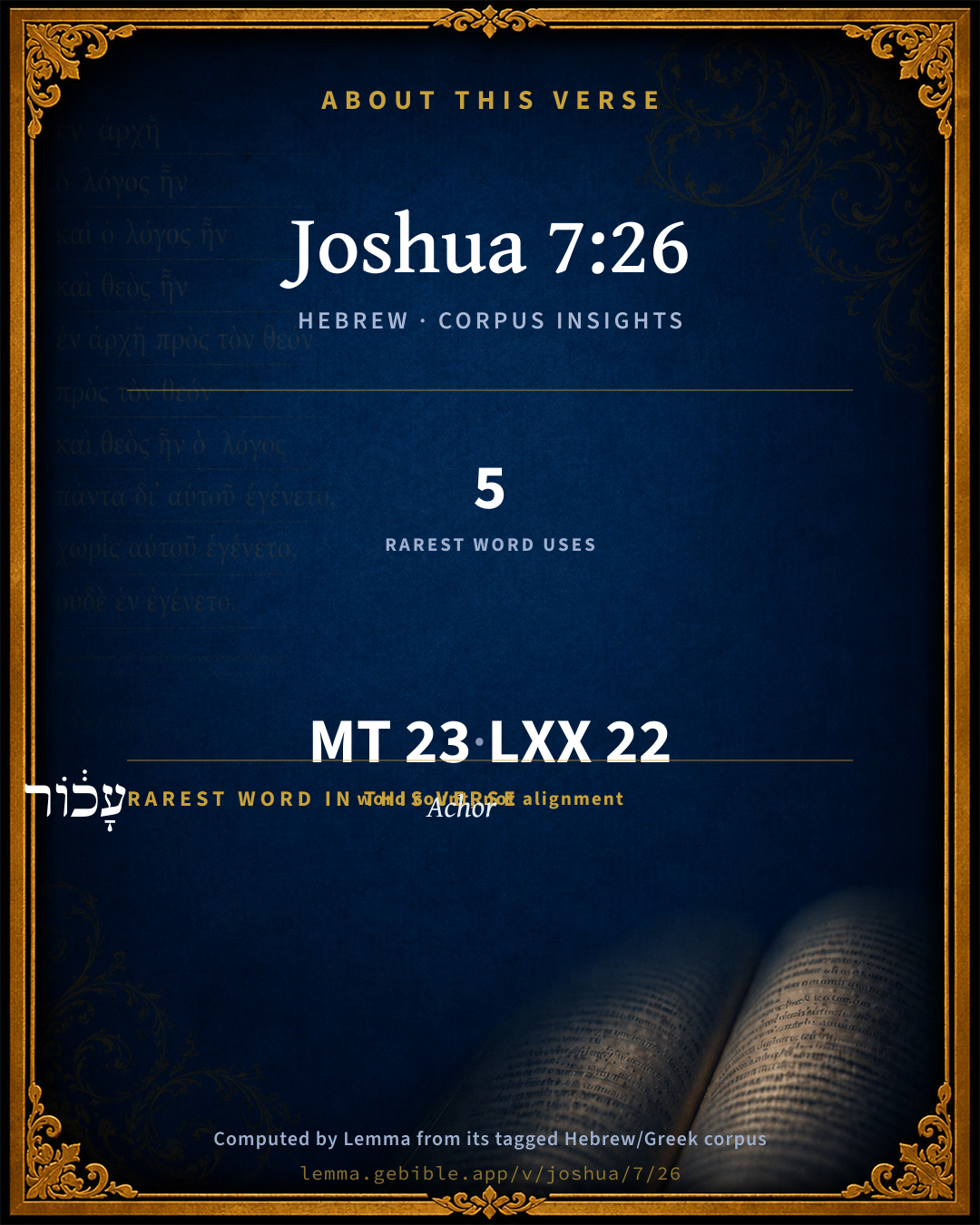
The rarest word here is עָכ֔וֹר Achor H5911 — appearing just 5 times in the whole Hebrew Bible.

Shared distinctive vocabulary

עָכ֔וֹר Achor H5911 occurs in 5 verses of the Hebrew Bible. Also found in:

Grammatical profile

  • 3 verbs
  • 11 nouns
  • 1 adjective
  • 3 pronouns
  • 4 prepositions
  • 1 particle

Verb forms

  • וַיָּקִ֨ימוּ Hiphil · Sequential Imperfect
  • וַיָּ֥שָׁב Qal · Sequential Imperfect
  • קָרָ֞א Qal · Perfect

Repetition

Words recur within this verse — often emphatic in Hebrew:

  • עָלָ֜יו upon H5921 ×2
  • עַ֚ד until H5704 ×2
  • הַיּ֣וֹם day H3117 ×2
  • הַזֶּ֔ה this H2088 ×2

Hebrew & Septuagint length

In English translation the verse runs 36 words from the Hebrew and 28 from the Septuagint (LXX English) — closely comparable.

A rough comparison of the two English renderings, which tokenize alike — not a word-level alignment.

Word counts can differ between the Hebrew and the Greek without any difference in meaning — e.g. the Hebrew direct-object marker אֵת has no separate Greek word, and Greek often adds the article ὁ.

In the original languages it is 23 Hebrew tokens and 22 Greek tokens — but the two are counted differently (Hebrew bundles its prefixes and suffixes into one token; the Greek is in lemma form), so that isn’t a like-for-like length.

Cross-references

14

Topical passages linked to Joshua 7:26 in the Treasury of Scripture Knowledge — connected by theme and wording, ordered by reader-vote popularity; previews shown in the World English Bible.

  • Isaiah 65:10 Sharon shall be a fold of flocks, and the valley of Achor a place for herds to lie down in, for my people who have sought me.
  • Hosea 2:15 I will give her vineyards from there, And the valley of Achor for a door of hope; And she will respond there, As in the days of her youth, And as in the day when she came up out of the land of Egypt.
  • Deuteronomy 13:17 There shall cleave nothing of the devoted thing to your hand; that Yahweh may turn from the fierceness of his anger, and show you mercy, and have compassion on you, and multiply you, as he has sworn to your fathers;
  • Joshua 7:24 Joshua, and all Israel with him, took Achan the son of Zerah, and the silver, and the mantle, and the wedge of gold, and his sons, and his daughters, and his oxen, and his donkeys, and his sheep, and his tent, and all that he had: and they brought them up to the valley of Achor.
  • Joshua 8:29 The king of Ai he hanged on a tree until the evening: and at the going down of the sun Joshua commanded, and they took his body down from the tree, and cast it at the entrance of the gate of the city, and raised thereon a great heap of stones, to this day.
  • 2 Samuel 18:17 They took Absalom, and cast him into the great pit in the forest, and raised over him a very great heap of stones: and all Israel fled everyone to his tent.
  • Lamentations 3:53 They have cut off my life in the dungeon, and have cast a stone on me.
  • Joshua 10:27 It happened at the time of the going down of the sun, that Joshua commanded, and they took them down off the trees, and cast them into the cave in which they had hidden themselves, and laid great stones on the mouth of the cave, to this very day.
  • 2 Samuel 21:14 They buried the bones of Saul and Jonathan his son in the country of Benjamin in Zela, in the tomb of Kish his father: and they performed all that the king commanded. After that God was entreated for the land.
  • Isaiah 40:2 Speak comfortably to Jerusalem; and cry to her, that her warfare is accomplished, that her iniquity is pardoned, that she has received of Yahweh's hand double for all her sins.
  • Joel 2:13 Tear your heart, and not your garments, And turn to Yahweh, your God; For he is gracious and merciful, Slow to anger, and abundant in loving kindness, And relents from sending calamity.
  • Joel 2:18 Then Yahweh was jealous for his land, And had pity on his people.
  • Zechariah 6:8 Then he called to me, and spoke to me, saying, "Behold, those who go toward the north country have quieted my spirit in the north country."
  • John 3:9–10 Nicodemus answered him, "How can these things be?"

Cross-references courtesy of OpenBible.info (CC BY 4.0).

Hebrew and Greek witnesses Masoretic Hebrew ↔ Greek Septuagint

The same verse in the two great witnesses to the Old Testament, shown verse-for-verse.

These are two independent witnesses, not word-aligned to each other, and the Septuagint is shown in lemma (dictionary) form.

Hebrew Joshua 7:26 Masoretic · Westminster Leningrad Codex

וַיָּקִ֨ימוּ עָלָ֜יו גַּל אֲבָנִ֣ים גָּד֗וֹל עַ֚ד הַיּ֣וֹם הַזֶּ֔ה וַיָּ֥שָׁב יְהוָ֖ה מֵחֲר֣וֹן אַפּ֑וֹ עַל כֵּ֠ן קָרָ֞א שֵׁ֣ם הַמָּק֤וֹם הַהוּא֙ עֵ֣מֶק עָכ֔וֹר עַ֖ד הַיּ֥וֹם הַזֶּֽה

They raised over him a great heap of stones, to this day; and Yahweh turned from the fierceness of his anger. Therefore the name of that place was called "The valley of Achor" to this day.

World English Bible · Public Domain

Greek LXX Joshua 7:26 Septuagint · lemma form

καί ἐπιἵστημι αὐτός σωρός λίθος μέγας καί παύω κύριος ὁ θυμός ὁ ὀργή διά οὗτος ἐπιὀνομάζω αὐτός εμεκαχωρ ἕως ὁ ἡμέρα οὗτος

And they set up over him a great heap of stones; and the Lord ceased from his fierce anger. Therefore he called the place Emecachor until this day.

LXX2012 (modern English Septuagint) · Public Domain

On this verse, Haydock's Catholic Bible Commentary discusses the Septuagint’s reading. Read the note in Commentary ↓

Hebrew: Westminster Leningrad Codex (CC BY 4.0). Greek: Septuagint (public domain); English from LXX2012 (modern English Septuagint) (Public Domain). How the Septuagint differs from the Hebrew →

Targum (Aramaic paraphrase)

1

The Targum is the ancient Jewish Aramaic paraphrase of the Hebrew Scriptures — an interpretive translation, not the Hebrew text itself. Onkelos (literal) and Pseudo-Jonathan (expansive) render the Torah, and Jonathan the Prophets. Coverage is partial: where no permissively-licensed English translation exists for a verse, only the Aramaic is shown. This is verse-level text, not a word-by-word alignment to the Hebrew.

  1. Targum Jonathan Prophets (Joshua–Malachi)
    וְאַקִימוּ עֲלוֹהִי דְגוֹר אַבְנִין רַב עַד יוֹמָא הָדֵין וְתַב יְיָ מִתְקוֹף רוּגְזֵיהּ עַל כֵּן קְרָא שְׁמָא דְאַתְרָא הַהוּא מֵישַׁר עָכוֹר עַד יוֹמָא הָדֵין:

    (no public-domain English translation for this verse)

    Targum Jonathan — Aramaic: “Mikraot Gedolot” (public domain). English: “Sefaria Community Translation” (CC0 1.0 (public-domain dedication)); “London "Chaldee Paraphrase," 1871” (public domain). Text via Sefaria.

Commentary

Notes on Joshua 7:26 from classic Christian and Jewish commentators (each source and its license shown beneath its notes). The classic Christian expositions comment on the surrounding passage and are grouped to its opening verse, so a note may address several verses; the Jewish commentaries on the Tanakh (Rashi and others) are per-verse, so they appear only where the commentator wrote on this verse.

Lemma curates 59 commentaries, every one of them public domain or Creative Commons licensed, each selected and text-cleaned for this edition rather than reprinted as found. About our sources →

Trapp's Complete Commentary

John Trapp

Jos 7:26 And they raised over him a great heap of stones unto this day. So the LORD turned from the fierceness of his anger. Wherefore the name of that place was called, The valley of Achor, unto this day.

Ver. 26. And they raised over him.] For a warning to others. Aliorum perditio tua sit cautio. It is a just presage and desert of ruin, not to be warned.

The valley of Achor.] See Hos 2:15. {See Trapp on "Hos 2:15"}

John Trapp, A Commentary or Exposition upon All the Books of the Old and New Testament (1647–1656) — public domain. Text from a community e-Sword module.

Tyndale Open Study Notes

Tyndale Open Resources

7:26 God had not been angry without basis. God’s people must be holy. To trifle with things belonging to God signifies rebellion against God, and such sin always brings trouble (‘akor) upon God’s people. Achan’s sin brought disaster on Israel, so the severe punishment he received was just.

Tyndale Open Study Notes — © Tyndale Open Resources, licensed CC BY-SA 4.0. Text via the HelloAO Bible API.

Jamieson, Fausset & Brown

Robert Jamieson, A. R. Fausset & David Brown

they raised over him a great heap of stones--It is customary to raise cairns over the graves of criminals or infamous persons in the East still.

the name of that place was called, The valley of Achor--("trouble"),

unto this day--So painful an episode would give notoriety to the spot, and it is more than once noted by the sacred writers of a later age (Isa 65:10; Hos 2:15).

Next: Joshua Chapter 8

Jamieson, Fausset & Brown — Commentary Critical and Explanatory on the Whole Bible (1871) — public domain (CC PDM 1.0). Text via the HelloAO Bible API.

Adam Clarke's Commentary

Verse 26. They raised over him a great heap of stones] The burial-places, both of heroes and eminent culprits, were anciently thus distinguished; and transactions of this kind gave rise to those great piles of stones called cairns, that are so frequently to be met with, especially in northern countries.

FROM the whole of this account we may see the exceeding sinfulness of sin, and the great danger of not withstanding its first approaches. By covetousness many lives and many souls have been destroyed, and yet the living lay it not to heart! Who fears the love of money, provided he can get riches? Through the intensity of this desire, every part of the surface of the earth, and as far as possible its bowels, are ransacked in order to get wealth; and God alone can tell, who sees all things, to how many private crimes, frauds, and dissimulations, this gives birth; by which the wrath of God is brought down upon the community at large! Who is an enemy to his country? The sinner against his God. An open foe may be resisted and repelled, because he is known; but the covetous man, who, as far as his personal safety will admit, is outraging all the requisitions of justice, is an unseen pestilence, sowing the seeds of desolation and ruin in society. Achan's covetousness, which led him to break the law of God, had nearly proved the destruction of the Israelitish camp, nor would the Lord turn away from his displeasure till the evil was detected, and the criminal punished.

Reader, is the face of God turned against thee, because of some private transgression? Are not thy circumstances and family suffering in consequence of something in thy private life? O search and try thy ways, return to God, and humble thyself before him lest thy iniquity instantly find thee out.

Adam Clarke's Commentary on the Bible (1810–1826) — public domain. Text from a community e-Sword/MySword module.

The Cambridge Bible for Schools and Colleges

gen. ed. J. J. S. Perowne

26. a great heap of stones] As a memorial and a warning of his sin and its punishment. The custom of casting stones on certain graves was not unknown among other nations also, as the Arabs and the Romans. Compare Propertius 4:5. 74.

So the Lord turned] “Even to Achan himself,” remarks Bp Wordsworth, “the valley of Achor may have been made a door of hope (Hos_2:15), because he confessed his sin, and there is reason to hope and believe that he listened to the words of Joshua, ‘My son, give glory to the Lord God of Israel,’ and submitted to the punishment due to his sin.”

The Cambridge Bible for Schools and Colleges (gen. ed. J. J. S. Perowne; Cambridge University Press, 1878–1918) — public domain. Text from a community e-Sword module.

John Gill's Exposition

And they raised over him a great heap of stones unto this day,.... That is, at the place where he suffered, or where they laid his ashes, they heaped up a pile of stones over him, as a monument whereby it might be known hereafter where he was executed and was buried; and which pile continued to the writing of this history: such sort of funeral monuments were usual with the Heathens (s) also as well as with the Jews, see Jos 8:29; so the Lord turned from the fierceness of his anger; or the effects of it ceased; the outward face of things was altered, the dealings of God in his providence with Israel were changed; though, properly speaking, there is no change in God, nor such affections and passions in him as in man:

wherefore the name of the place was called the valley of Achor unto this day; from the trouble Achan met with, and the people of Israel on his account, see Jos 7:24; and so it was called in the days of Isaiah and Hosea, Isa 65:10; and where it is prophesied of as what should be in time to come: according to Bunting (t), it was twelve miles from Jerusalem; Jerom (u) says it was at the north of Jericho, but Lamy (w), following Bonfrerius, places it to the south; see Jos 15:7.

(s) Vid. Pausan. Arcadica, sive, l. 8. p. 477. & Phocica, sive, l. 10. p. 616, 617. (t) Travels of the Patriarchs, &c. p. 98. (u) De loc. Heb. fol. 88. B. (w) Apparat. Geograph. p. 61.

Next: Joshua Chapter 8

John Gill's Exposition of the Whole Bible (1746–1763) — public domain (CC PDM 1.0). Text via the HelloAO Bible API.

Albert Barnes' Notes on the Bible

A great heap of stones - As a memorial of Achan’s sin and its punishment. (Compare Jos 8:29; 2Sa 18:17.)

The valley of Achor - Compare the marginal references. This valley formed part of the northern border of Judah Jos 15:7; and must therefore have lain among the ridges which cross the plain to the south of Jericho. But its exact site is uncertain. (Conder identifies it with Wady Kelt.)

Albert Barnes' Notes on the Bible (1834–1885) — public domain. Text from a community e-Sword/MySword module.

Haydock's Catholic Bible Commentary

CHAPTER VII.

Achor. That is, trouble; (Challoner) in allusion to the name of Achar, as he is called in the Septuagint invariably, and in the Hebrew and Vulgate in the Book of Chronicles. (Haydock) --- This heap of stones was thrown upon the ashes of the deceased, or perhaps at his person, while he was burning at the stake, as it is the custom still among the Turks. (Roger. ii. 7.) The king of Hai was treated in this manner, chap. viii. 29. See 2 Kings xviii. 17. The vale of Achor was on the road between Jerusalem and Jericho, where a small castle, at Adommim, was built to protect travellers from the insults of robbers, who infested that part, Luke x. 30., and chap. xv. 7.

George Leo Haydock (1774–1849), Haydock's Catholic Family Bible and Commentary, 1859 edition — public domain. Excludes Psalms (Douay-Rheims chapter numbering differs from Protestant) and Deuterocanonical books (Catholic canon only).

Matthew Poole's English Annotations

A great heap of stones; as a monument of the sin and judgment here mentioned, that others might be instructed and warned by the example; and as a brand of infamy, as Jos 8:29; 2Sa 18:17.

The valley of Achor; or, the valley of trouble, from the double trouble expressed Jos 7:25.

Matthew Poole's English Annotations on the Holy Bible (1683–1685) — public domain. Text from a community e-Sword/MySword module.

Whedon's Commentary on the Bible

Daniel D. Whedon

26. And they raised over him a great heap of stones — A monument of everlasting reproach. Michaelis says it is still a prevalent custom in the East to throw stones, as a mark of reproach and disgrace, upon the graves of criminals.

That place was called, The valley of Achor — This name signifies trouble, disturbance, and is derived from the verb which Joshua uses twice in Jos_7:25. Hence the propriety of the name.

Daniel D. Whedon (gen. ed.), Commentary on the Old and New Testaments (1874–1909) — public domain. Text from a community e-Sword module.

The Pulpit Commentary

And the Lord turned from the heat of His anger. There is no contradiction between this and such passages as 1Sa_15:29 Jam_1:17. It is not God, but we who turn. Our confession and restitution, by uniting our will with His, of necessity turn His wrath away. Yet of course it is through Jesus Christ alone that such confession and restitution is possible, and they are accepted simply because by faith they are united with His.

HOMILIES BY S.R. ALDRIDGE Ver. 26. Sin punished.

I A TERRIBLE PUNISHMENT. Achan is stoned to death, and his goods are then burnt with fire. He lost not only that which he had stolen, but even his own property, and above all his life. Such is the sinner"s rots-reckoning!

1. The laws of God have their sanctions annexed. Sin is followed by its peculiar immediate effects, which are a punishment in themselves, and there are besides the retribution awards of the Legislator. Achan must have felt a gnawing and a fire within him as soon as the evil deed was done; but this was only preliminary to the pain of detection and subsequent penalty of stoning. It is not well with the wicked even in this world, and we cannot forget the hints of the Bible respecting stripes to be inflicted in the world to come.

2. This narrative is intended to impress us with a deep sense of the evil of sin. God speaks to us solemnly respecting the deserts of sin. So swift a retribution could not but act as a warning to the Israelites, and the record of it may serve the same purpose with respect to ourselves. If Jehovah seemed stern for a season, he dealt in real kindness with the people, for surely it was expedient for one family to die, rather than that the whole nation should be disobedient and suffer extinction.

3. Seldom does the sinner suffer alone. Achan"s family lost their lives also. Perhaps they had connived at his theft. "By one man sin entered into the world, and death by sin, and so death passed upon all men." If we are reckless of our own interests, let us not cruelly blight the prospects of others.

II THE SIDE OF THE DIVINE CHARACTER HERE REVEALED. He is shown to be a jealous God, hating sin, and taking vengeance upon those who disregard His precepts. "The fierceness of God"s anger" may not be such a pleasant object of contemplation as the exceeding riches of the love of God, but it is good for us to think of it in connection with evil, and is part of our notion of a perfect character. The meek and lowly Jesus could kindle into holy indignation at the sight of the hypocrisy and oppression of the scribes and Pharisees, and a cloud of brightness that has no element of fire is not the representation given in Scripture of the appearance of God.

Daniel saw "a fiery stream, which issued and came forth from before" the Ancient of days.

III THE COMFORTING ASPECTS OF OUR THEME.

1. We are not informed of Achan"s final destiny, and this thought may alleviate the difficulty which some minds feel. Tempted as we are to disbelieve the genuineness of forced confessions and late repentance, it may be that Achan was sincere, and God chastised the flesh that the spirit might be saved. His death was necessary for example"s sake, and the burning of the bodies and the heaping them with stones all indicated the horrid nature of sin which, like a leprosy, frets inward till all be consumed. But the offender himself may have been saved "so as by fire;" and eternal life was purchased at the expense of temporal death. God grant, however, that we may live the life, and so die the death, of the righteous.

2. The gospel offers of mercy stand out in striking contrast to the severity of the ancient dispensation. "If we confess our sins, he is faithful and just to forgive us our sins, and to cleanse us from all unrighteousness. A.

The Pulpit Commentary (1880–1919), ed. H.D.M. Spence-Jones & Joseph S. Exell — public domain. Text from a community e-Sword module.

John Wesley's Explanatory Notes

A great heap of stones - As a monument of the sin and judgment here mentioned, that others might be warned by the example; and as a brand of infamy, as chap. viii, 29; 2 Sam. xviii, 17. The valley of Achor - Or, the valley of trouble, from the double trouble expressed, ver. 25.

John Wesley, Explanatory Notes Upon the Whole Bible (1754–1765) — public domain. Text via the GEBible commentary corpus.

Lesson kit

Teaching starters — assembled from the data on this page, not authored interpretation. Every prompt links to the verse data it draws on. Edit before teaching.

Joshua, in the Historical, opens this verse with 23 words (19 distinct Hebrew lemmas). Its most distinctive word is ʻÂkôwr (“Achor”). A historical commentator’s framing appears above. Read the whole chapter for the surrounding context.

Discussion questions

  1. The word ʻÂkôwr carries the sense “Achor.” How does it shape the verse?
  2. How does Joshua 7:24, which shares the word «Achor», read alongside this verse?
  3. What does the repetition of “upon” (2× in this one verse) do in this verse?
  4. The translations on this page render this verse differently — a whole-verse word diff, not a word-by-word alignment. What might account for the different wordings?
  5. «וַיָּקִ֨ימוּ» is a Hiphil Sequential Imperfect verb. How does that grammatical form shape the action described?
  6. Compare how Trapp's Complete Commentary and Tyndale Open Study Notes read this verse. Where do they agree or differ?

Things to notice

Reading settings

Reading text

Shown beneath each verse's original-language words.

Old Testament
Old Testament edition

Read the OT as the Masoretic Hebrew (MT) or the Greek Septuagint (LXX).

English shown for the Greek Septuagint (in the Hebrew ↔ Greek comparison).

Comparing translations? Open the Compare panel on any verse page to stack up to four side by side.