
Deuteronomy 25:13

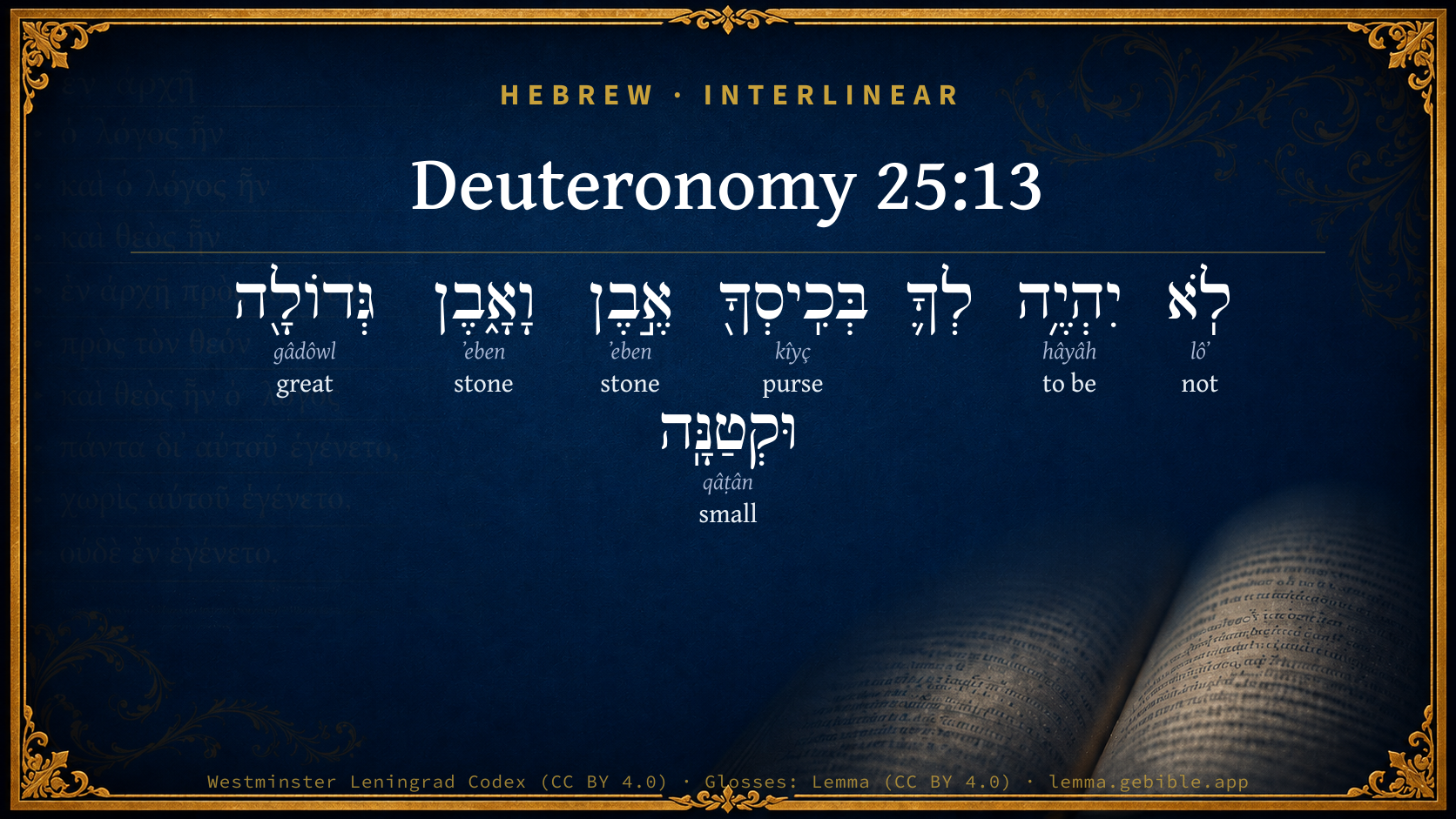
Hebrew (Westminster Leningrad Codex) Deuteronomy 25:13 appears in the Hebrew Old Testament. The text above is from the Westminster Leningrad Codex. Each word links to its Strong’s number, a concise gloss, and parsing drawn from the Open Scriptures Hebrew Bible morphology. Click any word for its full Brown-Driver-Briggs (BDB) entry.
Download image
Cite this verse

Deuteronomy 25:13 (World English Bible). Public Domain. Lemma interlinear Bible study tool, https://lemma.gebible.app/v/deuteronomy/25/13.

Show BibTeX & RIS
BibTeX
RIS
English Translation
You shall not have in your bag diverse weights, a great and a small.
World English Bible · Public Domain
Highlights
  • 1 first appearance in the Hebrew Bible
Full analysis ↓
Download a study sheet

One document with this verse’s original text, its word-by-word gloss line, the meaning frame, cross-references with their text, attributed commentary, and full source and license credits — printable, and it pastes into notes with its structure intact.

This verse Autodidact and up

Study sheet (.html) Plain text (.txt)

A passage Seminary Student

Up to 50 verses in one chapter. A passage sheet keeps up to 6 commentary sources and 12 cross-references per verse, in the order this page ranks them, and says so on the sheet whenever that leaves anything out. Ask for a single verse and you get the Autodidact verse sheet above.

Everything on this page stays free to read, with no account — the sheet is a download of what is already on screen, not access to it.

Want to remove ads? Support Godless Engineer
Compare translations 3

The same verse in 3 English versions, stacked beneath the original-language interlinear above. Click any original word for its lexicon entry.

Each is an independent rendering of the whole verse — the interlinear is not word-aligned to these translations.

Highlighted words mark where these versions differ — a whole-verse word diff, not a word-by-word alignment.

  • World English Bible Public Domain
    You shall not have in your bag diverse weights, a great and a small.
  • King James Version Public Domain
    Thou shalt not have in thy bag divers weights, a great and a small.
  • unfoldingWord Literal Text CC BY-SA 4.0
    You shall not have in your bag a stone and a stone, a large and a small.

unfoldingWord Literal Text — © unfoldingWord, licensed CC BY-SA 4.0. Word-aligned USFM3 via Door43 (git.door43.org/unfoldingWord/en_ult).

Versions to compare (up to 4)

3 of 4 selected

Show all 18 translations

Every available English version of this verse, each an independent rendering of the whole verse.

  • World English Bible Public Domain
    You shall not have in your bag diverse weights, a great and a small.
  • Berean Standard Bible Public Domain
    You shall not have two differing weights in your bag, one heavy and one light.
  • Majority Standard Bible Public Domain
    You shall not have two differing weights in your bag, one heavy and one light.
  • King James Version Public Domain
    Thou shalt not have in thy bag divers weights, a great and a small.
  • American Standard Version (1901) Public Domain
    Thou shalt not have in thy bag diverse weights, a great and a small.
  • Revised Version (1885) Public Domain
    Thou shalt not have in thy bag divers weights, a great and a small.
  • Geneva Bible (1599) Public Domain
    Thou shalt not haue in thy bagge two maner of weightes, a great and a small,
  • Douay-Rheims (1899) Public Domain
    Thou shalt not have divers weights in thy bag, a greater and a less:
  • Young's Literal Translation Public Domain
    `Thou hast not in thy bag a stone and a stone, a great and a small.
  • Literal Standard Version CC BY-SA 4.0
    You do not have [both] a great stone and a small stone in your bag.
  • Unlocked Literal Bible CC BY-SA 4.0
    You must not have in your bag different weights, a large and a small.
  • unfoldingWord Literal Text CC BY-SA 4.0
    You shall not have in your bag a stone and a stone, a large and a small.
  • Darby Bible Public Domain
    Thou shalt not have in thy bag divers weights, a great and a small.
  • World Messianic Bible Public Domain
    You shall not have in your bag diverse weights, one heavy and one light.
  • Webster's Bible Public Domain
    Thou shalt not have in thy bag divers weights, a great and a small:
  • Free Bible Version CC BY-SA 4.0
    Don't have two different measuring weights in your bag, one that's heavy and one that's light.
  • Bible in Basic English Public Domain
    Do not have in your bag different weights, a great and a small;
  • JPS Tanakh (1917) Public Domain
    Thou shalt not have in thy bag diverse weights, a great and a small.

Literal Standard Version (2020), Covenant Press — licensed CC BY-SA 4.0. Text via the HelloAO Bible API (eBible.org). Unlocked Literal Bible (unfoldingWord) — licensed CC BY-SA 4.0. Text via the HelloAO Bible API (eBible.org). unfoldingWord Literal Text — © unfoldingWord, licensed CC BY-SA 4.0. Word-aligned USFM3 via Door43 (git.door43.org/unfoldingWord/en_ult). Free Bible Version, Dr. Jonathan Gallagher — licensed CC BY-SA 4.0. Text via the HelloAO Bible API (eBible.org).

Word by word

More ways to search: Search by grammar → Find every occurrence → Compare this word →

Practice this passage: Drill this verse → Learn its vocabulary →

About this verse

These counts appear in no published source. They are computed here, from the morphology-tagged text and Lemma’s own curated glosses. What Lemma adds →

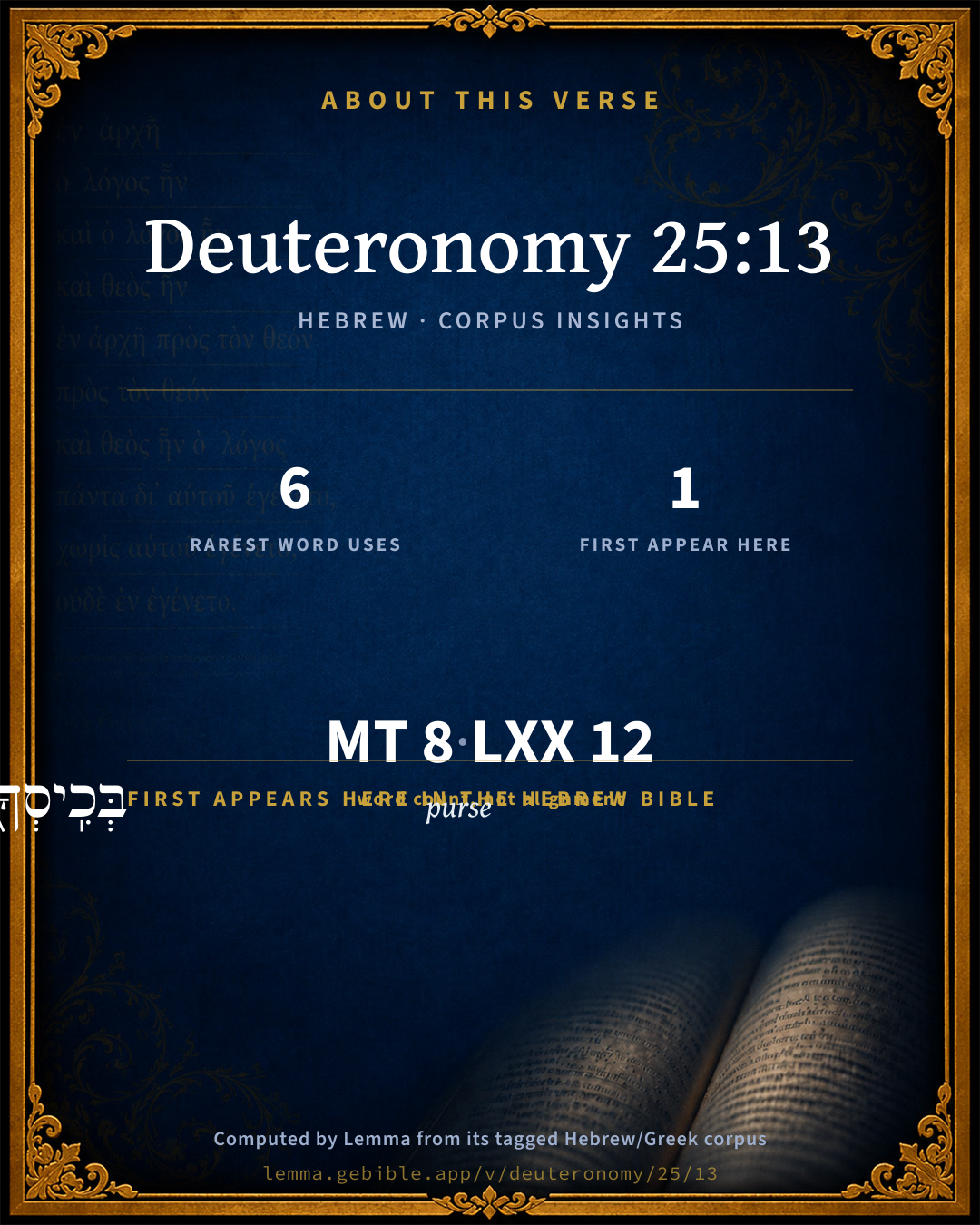
8
words
6
distinct lemmas
Pentateuch
section

Notable vocabulary

The rarest word here is בְּכִֽיסְךָ֖ purse H3599 — appearing just 6 times in the whole Hebrew Bible.

First appearance in Scripture

This word makes its first canonical appearance in the Hebrew Bible here:

  • בְּכִֽיסְךָ֖ purse H3599

Shared distinctive vocabulary

בְּכִֽיסְךָ֖ purse H3599 occurs in 6 verses of the Hebrew Bible. Also found in:

Grammatical profile

  • 1 verb
  • 3 nouns
  • 2 adjectives
  • 1 preposition
  • 1 particle

Verb forms

  • יִהְיֶ֥ה Qal · Imperfect

Repetition

A word recurs within this verse — often emphatic in Hebrew:

  • אֶ֣בֶן stone H68 ×2

Hebrew & Septuagint length

In English translation the verse runs 14 words from the Hebrew and 14 from the Septuagint (LXX English) — the same length.

A rough comparison of the two English renderings, which tokenize alike — not a word-level alignment.

Word counts can differ between the Hebrew and the Greek without any difference in meaning — e.g. the Hebrew direct-object marker אֵת has no separate Greek word, and Greek often adds the article ὁ.

In the original languages it is 8 Hebrew tokens and 12 Greek tokens — but the two are counted differently (Hebrew bundles its prefixes and suffixes into one token; the Greek is in lemma form), so that isn’t a like-for-like length.

Cross-references

7

Topical passages linked to Deuteronomy 25:13 in the Treasury of Scripture Knowledge — connected by theme and wording, ordered by reader-vote popularity; previews shown in the World English Bible.

  • Proverbs 11:1 A false balance is an abomination to Yahweh, But accurate weights are his delight.
  • Leviticus 19:35–37 "'You shall do no unrighteousness in judgment, in measures of length, of weight, or of quantity.
  • Proverbs 16:11 Honest balances and scales are Yahweh's; All the weights in the bag are his work.
  • Amos 8:5 Saying, 'When will the new moon be gone, that we may sell grain? And the Sabbath, that we may market wheat, Making the ephah small, and the shekel large, And dealing falsely with balances of deceit;
  • Proverbs 20:10 Differing weights and differing measures, Both of them alike are an abomination to Yahweh.
  • Ezekiel 45:10–11 You shall have just balances, and a just ephah, and a just bath.
  • Micah 6:11–12 Shall I be pure with dishonest scales, And with a bag of deceitful weights?

Cross-references courtesy of OpenBible.info (CC BY 4.0).

Hebrew and Greek witnesses Masoretic Hebrew ↔ Greek Septuagint

The same verse in the two great witnesses to the Old Testament, shown verse-for-verse.

These are two independent witnesses, not word-aligned to each other, and the Septuagint is shown in lemma (dictionary) form.

Hebrew Deuteronomy 25:13 Masoretic · Westminster Leningrad Codex

לֹֽא יִהְיֶ֥ה לְךָ֛ בְּכִֽיסְךָ֖ אֶ֣בֶן וָאָ֑בֶן גְּדוֹלָ֖ה וּקְטַנָּֽה

You shall not have in your bag diverse weights, a great and a small.

World English Bible · Public Domain

Greek LXX Deuteronomy 25:13 Septuagint · lemma form

οὐ εἰμί ἐν ὁ μάρσιππος σύ στάθμιον καί στάθμιον μέγας ἤ μικρός

You shall not have in your bag various weights, a great and a small.

LXX2012 (modern English Septuagint) · Public Domain

Hebrew: Westminster Leningrad Codex (CC BY 4.0). Greek: Septuagint (public domain); English from LXX2012 (modern English Septuagint) (Public Domain). How the Septuagint differs from the Hebrew →

Targum (Aramaic paraphrase)

2

The Targum is the ancient Jewish Aramaic paraphrase of the Hebrew Scriptures — an interpretive translation, not the Hebrew text itself. Onkelos (literal) and Pseudo-Jonathan (expansive) render the Torah, and Jonathan the Prophets. Coverage is partial: where no permissively-licensed English translation exists for a verse, only the Aramaic is shown. This is verse-level text, not a word-by-word alignment to the Hebrew.

  1. Targum Onkelos Torah (Genesis–Deuteronomy)
    לָא יְהֵי לָךְ בְּכִיסָךְ מַתְקַל וּמַתְקָל רַבְּתָא וּזְעֶרְתָּא

    (no public-domain English translation for this verse)

    Targum Onkelos — Aramaic: “Onkelos Genesis” (public domain); “Onkelos Exodus” (public domain); “Onkelos Leviticus” (public domain); “Onkelos Numbers” (public domain); “Onkelos Deuteronomy” (public domain). English: “Sefaria Community Translation” (CC0 1.0 (public-domain dedication)); “J.W. Etheridge. The Targums of Onkelos and Jonathan Ben Uzziel on the Pentateuch. London: Longmans, Green, 1862” (public domain). Text via Sefaria.

  2. Targum Pseudo-Jonathan Torah (Genesis–Deuteronomy)
    לָא יֶהֱוֵי לְכוֹן בְּנַרְתֵּיקֵיכוֹן מַתְקְלִין דִּנְכִיל מַתְקְלִין רַבְרְבִין לְמֶהֱוֵי זַבִּין בְּהוֹן וּמַתְקְלִין זְעִירִין לְמֶהֱוֵי מְזַבִּין בְּהוֹן

    You shall not have in your bag weights that are deceitful; great weights to buy with, and less weights to sell with.

    Targum Pseudo-Jonathan — Aramaic: “Targum Jonathan on Genesis” (public domain); “Targum Jonathan on Exodus” (public domain); “Targum Jonathan on Leviticus” (public domain); “Targum Jonathan on Numbers” (public domain); “Targum Jonathan on Deuteronomy” (public domain). English: “The Targum of Jonathan ben Uzziel, trans. J. W. Etheridge, London, 1862” (public domain). Text via Sefaria.

Commentary

Notes on Deuteronomy 25:13 from classic Christian and Jewish commentators (each source and its license shown beneath its notes). The classic Christian expositions comment on the surrounding passage and are grouped to its opening verse, so a note may address several verses; the Jewish commentaries on the Tanakh (Rashi and others) are per-verse, so they appear only where the commentator wrote on this verse.

Lemma curates 59 commentaries, every one of them public domain or Creative Commons licensed, each selected and text-cleaned for this edition rather than reprinted as found. About our sources →

Matthew Henry's Commentary

Here is, I. A law against deceitful weights and measures: they must not only not use them, but they must not have them, not have them in the bag, not have them in the house (Deu 25:13, Deu 25:14); for, if they had them, they would be strongly tempted to use them. They must not have a great weight and measure to buy by and a small one to sell by, for that was to cheat both ways, when either was bad enough; as we read of those that made the ephah small, in which they measured the corn they sold, and the shekel great, by which they weighed the money they received for it, Amo 8:5. But thou shalt have a perfect and just weight, v. 15. That which is the rule of justice must itself be just; if that be otherwise, it is a constant cheat. This had been taken care of before, Lev 19:35, Lev 19:36. This law is enforced with two very good reasons: - 1. That justice and equity will bring down upon us the blessing of God. The way to have our days lengthened, and to prosper, is to be just and fair in all our dealings Honesty is the best policy. 2. That fraud and injustice will expose us to the curse of God, Deu 25:16. Not only unrighteousness itself, but all that do unrighteously, are an abomination to the Lord. And miserable is that man who is abhorred by his Maker. How hateful, particularly, all the arts of deceit are to God, Solomon several times observes, Pro 11:1; Pro 20:10, Pro 20:23; and the apostle tells us that the Lord is the avenger of all such as overreach and defraud in any matter, Th1 4:6.

II. A law for the rooting out of Amalek. Here is a just weight and a just measure, that, as Amalek had measured to Israel, so it should be measure to Amalek again.

1. The mischief Amalek did to Israel must be here remembered, Deu 25:17, Deu 25:18. When it was first done it was ordered to be recorded (Exo 17:14-16), and here the remembrance of it is ordered to be preserved, not in personal revenge (for that generation which suffered by the Amalekites was gone, so that those who now lived, and their posterity, could not have any personal resentment of the injury), but in a zeal for the glory of God (which was insulted by the Amalekites), that throne of the Lord against which the hand of Amalek was stretched out. The carriage of the Amalekites towards Israel is here represented, (1.) As very base and disingenuous. They had no occasion at all to quarrel with Israel, nor did they give them any notice, by a manifesto or declaration of war; but took them at an advantage, when they had just come out of the house of bondage, and, for aught that appeared to them, were only going to sacrifice to God in the wilderness. (2.) As very barbarous and cruel; for they smote those that were more feeble, whom they should have succoured. The greatest cowards are commonly the most cruel; while those that have the courage of a man will have the compassion of a man. (3.) As very impious and profane: they feared not God. If they had had any reverence for the majesty of the God of Israel, which they saw a token of in the cloud, or any dread of his wrath, which they lately heard of the power of over Pharaoh, they durst not have made this assault upon Israel. Well, here was the ground of the quarrel: and it shows how God takes what is done against his people as done against himself, and that he will particularly reckon with those that discourage and hinder young beginners in religion, that (as Satan's agents) set upon the weak and feeble, either to divert them or to disquiet them, and offend his little ones.

2. This mischief must in due time be revenged, Deu 25:19. When their wars were finished, by which they were to settle their kingdom and enlarge their coast, then they must make war upon Amalek (Deu 25:19), not merely to chase them, but to consume them, to blot out the remembrance of Amalek. It was an instance of God's patience that he deferred the vengeance so long, which should have led the Amalekites to repentance; yet an instance of fearful retribution that the posterity of Amalek, so long after, were destroyed for the mischief done by their ancestors to the Israel of God, that all the world might see, and say, that he who toucheth them toucheth the apple of his eye. It was nearly 400 years after this that Saul was ordered to put this sentence in execution (1 Sa. 15), and was rejected of God because he did not do it effectually, but spared some of that devoted nation, in contempt, not only of the particular orders he received from Samuel, but of this general command here given by Moses, which he could not be ignorant of. David afterwards made some destruction of them; and the Simeonites, in Hezekiah's time, smote the rest that remained (Ch1 4:43); for when God judges he will overcome.

Matthew Henry's Commentary on the Whole Bible (1708–1710) — public domain (CC PDM 1.0). Text via the HelloAO Bible API.

Ellicott's Commentary for English Readers

Deu_25:13-16. JUST WEIGHTS AND MEASURES.

So Lev_19:35-36. Among the laws of moral holiness comes the law of just weights and measures.

(16) An abomination unto the Lord.—So in Pro_11:1, “a false balance is abomination to the Lord.” (See also Amo_8:4-8.) The protection of the poor is the chief practical end in this; rich men can take care of themselves. Poor men are doubly robbed by short weight and measure, because they cannot protect themselves against it. The injustice tends to perpetuate their poverty.

A Bible Commentary for English Readers, edited by Charles John Ellicott (1878–1897) — public domain. Text from a community e-Sword module.

The Cambridge Bible for Schools and Colleges

gen. ed. J. J. S. Perowne

13. divers weights] Lit. stone and stone. Most ancient weights discovered in Palestine are of stone; for specimens see PEFQ, 1892, 114; 1894, 215 ff.

Royal standards were fixed for them as early as David’s time (2Sa_14:26). With this and the next v. cp. H, Lev_19:35 : Thou shalt do no wrong (‘awel) in judgement or with rule, stone, or measure.

13–16. Against Divers Weights and Measures

Israel shall not use these—greater (for purchases) and smaller (for sales)—for he who does so is an abomination to Jehovah (Deu_25:13 f., Deu_25:16). Interpolated (for it breaks the connection between Deu_25:13 f. and Deu_25:16) is a positive command to have a single normal set of weights and measures; that thy days may be long, etc.—Sg. address throughout. Parallel in H, Lev_19:35 f., also a negative command with a positive added; but a different expression of the religious motive. The laws may be quite independent; for the provocations for them were many in Israel.

Amo_8:5 describes among other commercial sins making the ephah small (for selling) and the shekel great (for weighing the purchasers’ money, etc.) and dealing falsely with false balances; Mi. Deu_6:10 declares the scant measure loathsome. To the popular piety weights and measures, like the husbandman’s methods (see on Deu_22:9-11), were of divine institution, they were Jehovah’s and his work (Pro_16:11).

The Cambridge Bible for Schools and Colleges (gen. ed. J. J. S. Perowne; Cambridge University Press, 1878–1918) — public domain. Text from a community e-Sword module.

Trapp's Complete Commentary

John Trapp

Deu 25:13 Thou shalt not have in thy bag divers weights, a great and a small.

Ver. 13. Divers weights, a great and a small.] As they have that weigh not out a whole seventh day to God, who hath given men six whole days to labour in; these sell by one measure and buy by another. It was an error, doubtless, for want of due light and better information, in that pious prince, Edward VI, to give order to his council, that upon Sundays they should attend public affairs of the realm, despatch answers to letters, and make full despatches of all things concluded in the week before; provided that they be present at common prayer. {a}

{a} Life of Edw. VI, by Sir J. Heywood, p. 147.

John Trapp, A Commentary or Exposition upon All the Books of the Old and New Testament (1647–1656) — public domain. Text from a community e-Sword module.

Albert Barnes' Notes on the Bible

Honesty in trade, as a duty to our neighbor, is emphatically enforced once more (compare Lev 19:35-36). It is noteworthy that John the Baptist puts the like duties in the forefront of his preaching (compare Luk 3:12 ff); and that “the prophets” (compare Eze 45:10-12; Amo 8:5; Mic 6:10-11) and “the Psalms” Pro 16:11; Pro 20:10, Pro 20:23, not less than “the Law,” especially insist on them.

Deu 25:13

Divers weights - i. e. stones of unequal weights, the lighter to sell with, the heavier to buy with. Stones were used by the Jews instead of brass or lead for their weights, as less liable to lose anything through rust or wear.

Deu 25:17-19

It was not after the spirit or mission of the Law to aim at overcoming inveterate opposition by love and by attempts at conversion (contrast Luk 9:55-56). The law taught God’s hatred of sin and of rebellion against Him by enjoining the extinction of the obstinate sinner. The Amalekites were a kindred people Gen 36:15-16; and living as they did in the peninsula of Sinai, they could not but have well known the mighty acts God had done for His people in Egypt and the Red Sea; yet they manifested from the first a persistent hostility to Israel (compare Exo 17:8, and note; Num 14:45). They provoked therefore the sentence here pronounced, which was executed at last by Saul (1Sa 15:3 ff).

Albert Barnes' Notes on the Bible (1834–1885) — public domain. Text from a community e-Sword/MySword module.

Joseph Benson's Commentary

Deu 25:13. Divers weights, great and small — The great to buy with, the small for selling. This law taught them to be so far from practising deceit, that they were not even to have the instruments of it by them. Would to God that there was no need to enforce the same law in our days!

Joseph Benson's Commentary on the Old and New Testaments (1811–1818) — public domain. Text from a community e-Sword module.

Whedon's Commentary on the Bible

Daniel D. Whedon

THE DUTY OF UPRIGHT DEALING ENJOINED, Deu_25:13-19.

13. Divers weights — The Hebrew reads, a stone and a stone. The use of stones for weights was common. On the subject of honesty in weights and measures see Lev_19:35-36.

Daniel D. Whedon (gen. ed.), Commentary on the Old and New Testaments (1874–1909) — public domain. Text from a community e-Sword module.

Keil & Delitzsch

C. F. Keil & F. Delitzsch

The duty of integrity in trade is once more enforced in Deu 25:13-16 (as in Lev 19:35-36). "Stone and stone," i.e., two kinds of stones for weighing (cf. Psa 12:3), viz., large ones for buying and small ones for selling. On the promise in Deu 25:15, see Deu 4:26; Deu 5:16; Deu 25:16, as in Deu 22:5; Deu 18:12, etc. In the concluding words, Deu 25:16, "all that do unrighteously," Moses sums up all breaches of the law.

Keil & Delitzsch — Biblical Commentary on the Old Testament (1861–1891) — public domain (CC PDM 1.0). Text via the HelloAO Bible API. (Old Testament only.)

Tyndale Open Study Notes

Tyndale Open Resources

25:13-14 You must use accurate scales . . . full and honest measures (Hebrew you must not have stone and stone, large and small, . . . ephah and ephah, large and small): Merchants were not to use two sets of weights and measures for cheating customers—a heavier weight or measure when purchasing goods (thus reducing their own cost) and a lighter one when selling them (thus increasing their own profit).

Tyndale Open Study Notes — © Tyndale Open Resources, licensed CC BY-SA 4.0. Text via the HelloAO Bible API.

Geneva Bible (1599)

Geneva Bible translators

Hebrew, stone and stone.

Geneva Bible (1599) marginal notes — public domain. Text via Bolls.life.

Jamieson, Fausset & Brown

Robert Jamieson, A. R. Fausset & David Brown

Thou shalt not have . . . divers weights--Weights were anciently made of stone and are frequently used still by Eastern shopkeepers and traders, who take them out of the bag and put them in the balance. The man who is not cheated by the trader and his bag of divers weights must be blessed with more acuteness than most of his fellows [ROBERTS]. (Compare Pro 16:11; Pro 20:10).

Jamieson, Fausset & Brown — Commentary Critical and Explanatory on the Whole Bible (1871) — public domain (CC PDM 1.0). Text via the HelloAO Bible API.

Adam Clarke's Commentary

Verse 13. Divers weights] אבן ואבן eben vaaben, a stone and a stone, because the weights were anciently made of stone, and some had two sets of stones, a light and a heavy. With the latter they bought their wares, by the former they sold them. In our own country this was once a common case; smooth, round, or oval stones were generally chosen by the simple country people for selling their wares, especially such as were sold in pounds and half pounds. And hence the term a stone weight, which is still in use, though lead or iron be the matter that is used as a counterpoise: but the name itself shows us that a stone of a certain weight was the material formerly used as a weight. See the notes on Le 19:35-36.

Adam Clarke's Commentary on the Bible (1810–1826) — public domain. Text from a community e-Sword/MySword module.

John Gill's Exposition

Thou shalt not have in thy bag divers weights,.... Or, "a stone and a stone" (y); it being usual, in those times and countries, to have their weights of stone, as it was formerly with us here; we still say, that such a commodity is worth so much per stone, a stone being of such a weight; now these were not to be different:

a great and a small; great weights, to buy with them, and small weights, to sell with them, as the Targum of Jonathan paraphrases it.

(y) "lapis et lapis", Montanus, Vatablus, Piscator.

John Gill's Exposition of the Whole Bible (1746–1763) — public domain (CC PDM 1.0). Text via the HelloAO Bible API.

Matthew Poole's English Annotations

The

great, either to buy with, or openly to make show of; the

small, for their private use in selling.

Matthew Poole's English Annotations on the Holy Bible (1683–1685) — public domain. Text from a community e-Sword/MySword module.

The Pulpit Commentary

Vers. 13-16. Rectitude and integrity in trade are here anew inculcated. (Lev_19:35, etc.)

Diverse weights; literally, a stone and a stone a large one for buying, and a small one for selling. (cf. Amo_8:5) Both weights and measures were to be "perfect," i.e. exactly correct, and so just. (On the promise in ver. 15, see Deu_4:26 Deu_5:16)

Vers. 13-16. Righteousness in trade imperative.

This paragraph requires no preparatory elucidation. The topic for a Homily which it gives is one of the most important in the range of human ethics. It furnishes six lines of thought.

1. In the providence of God men are thrown together for the purposes of trade.

2. Opportunity is thus furnished for the exercise of right principles of mutual justice and equity.

3. There is often given an opportunity also of taking advantage of others by unequal weights and measures.

4. God requires of us absolute justice to others, always and everywhere.

5. No false maxims of men, such as "business is business," can ever exonerate us from obligations to justice.

6. Our duty to man in this respect is enforced by a double argument.

(1) The neglect of it is an abomination to God (ver. 16).

(2) The observance of it will tend to long life, prosperity, and peace (ver. 15).

Vers. 13-16. Morality in trade.

The Hebrew lawgiver lays just stress on honesty in weights and measures. The general principle is that of honesty in trade. Weights and measures connect themselves intimately with the ideas of justice, rectitude, impartiality. Justice is represented by a figure with scales and weights. Falsification of weights and measures is thus a representative sin, one which corrupts integrity in man with peculiar and fatal rapidity.

I AN INJUNCTION MUCH NEEDED. Trade morality is at present at a low ebb. Mixed up with the thousands of honest transactions which no doubt take place every day, there must be admitted to be an enormous number which are more or less fraudulent. "On the average," says Mr. Spencer, "men who deal in bales and tons differ but little in morality from men who deal in yards and pounds. Illicit practices of every form and shade, from venial deception up to all but direct theft, may be brought home to the higher grades of the commercial world. Tricks innumerable, lies acted or uttered, elaborately devised frauds, are prevalent many of them established as "customs of the trade;" nay, not only established, but defended" ("Essays," vol. 2., "Morals of Trade;" cf. Smiles on "Duty," De 3). The saddest feature in the outlook is the apparent prevalence of the feeling that trickery of this kind is absolutely essential to success that a man can"t get on without it.

II AN INJUNCTION WHICH OUGHT TO BE ENFORCED. But how? By a fearless exposure of dishonesties, and by a loud and firm demand on the part of every upright member of society for honest and truthful dealing. Only if the dishonest are a majority in society a majority of overwhelming numbers can they ultimately prevail against the honest. A determined combination on the part of persons of integrity would suffice to put them down. The man known to be honest should be supported, even at some pecuniary sacrifice. Custom should be unflinchingly withdrawn from men detected in tricks, and the stamp of public reprobation placed on such men and their doings. Means should be taken to diffuse information as to the arts and frauds by which dishonesty sustains itself. The causes of these dishonesties need also to be looked into chiefly, according to Spencer, the indiscriminate respect paid to wealth. Love of the honor and position which wealth gives the certainty of being looked up to, courted in society, applauded for success, with few questions asked, this is the taproot of the evil, and it is to be cured by distinguishing between wealth and character, and by honoring the former only when in alliance with the latter.

III AN INJUNCTION WHICH IT IS EVERY ONE"S INTEREST TO ENFORCE. Trade dishonesty should, if possible, be checked:

1. In view of its inherent immorality. Nothing can be more despicable, more mean and disgraceful, than the lies, frauds, briberies, malpractices, adulterations, which, if the witnesses are to be trusted, abound in all branches of trade. These things are a blot on our country, the shame of which touches all.

2. In view of its corrupting effect on morals generally. Its influence spreads beyond itself. It saps principle, eats out faith in virtue, unfits the individual for every moral task.

3. In view of its effects on national prosperity. These are ruinous. God"s displeasure rests on the nation, and he is certain to chastise it. But the sorest whip he uses to chastise it is the scourge of its own follies. Our dishonesties lose us (are actually losing us) our markets; lower us in the eyes of foreign nations; destroy credit; engender a spirit of general distrust; still worse, by undermining principle, they destroy the power of steady application to work, and increasingly substitute the motives of the gambler for those of the merchant content with lawful gains. The inevitable end is impoverishment and disgrace.

4. As a measure of self-protection. Each individual suffers as part of the whole. He is frequently cheated, sometimes incurs serious losses. Hard-earned money finds its way into the pockets of clever but unscrupulous scoundrels, who as rapidly squander it in reckless living. J.O.

Vers. 13-16. Religion inspires commercial life.

It is certain that God displays the liveliest interest in every department of human life. He is not only the God of the hills; he is God of the valleys also. He takes cognizance, not only of great things, but also of small. Can any man tell us what are small things? Not only on the portal of every church, but on the forefront of every shop ay, on the beam of every balance, we ought to see the inscription, "To the glory of God alone!

I RELIGION CLAIMS A THRONE IN EVERY SHOP. True religion is the sunny smile from God"s eye, and, as the common light of day penetrates into every nook and cranny of nature, so the light of God"s love pierces into every interest of human life. It is not a romantic something which has merely to do with the region of existence beyond the grave; it is the life of cur present life the secret spring of every duty. Ordinary trade is a splendid field for the practical exercise of religious virtues, because the commercial activities of the age afford large facilities either for fidelity or for fraud. In every office and warehouse religion claims to set up her throne. In the smallest act of buying and selling she insists on having a voice.

II RELIGION GOES TO THE ROOT OF THINGS DETERMINES THE STANDARDS OF HUMAN ACTION. If the weight or measure be false, then every transaction will be false. Ingenious wickedness had invented two sets of standards an over-large one for the man as buyer, an under-size for the same man as seller. This course of vile procedure carried the villainy into every item of the man"s mercantile life. It is of the first importance that we set up fight standards. The Pharisee in the temple was a perfect man, according to his standard. The rich young man who came to Jesus Christ for counsel was blameless, according to his standard. Men are prone to set up conventional standards, and measure themselves and every one else according to their rule. Take heed that your standard is God"s standard, "a perfect and just measure.

III RELIGION IS BOTH DESTRUCTIVE AND CONSTRUCTIVE. "Thou shalt not have this; thou shalt have that." It first pulls down, then builds up. It first uproots, then plants. "Mortify your members, then add to your virtues." The old must be destroyed; the new must be sown and nursed. In our self-culture and in our training of others, it is not enough that we are repressive and prohibitive; the new growths will often cast off effete and injurious matter. Prune away barren boughs; encourage the development of the fruitful wood.

IV RELIGION BRINGS COLLATERAL GAINS IN THIS LIFE. Her main reward is in the future, viz. possession of the Divine image; nevertheless, she confers many solid favors here and now. Real pleasure is her daily gift, and length of days" is her special prize. "The wicked shall not live out half their days they die prematurely. Nor is long life on earth to be despised. There are, doubtless, moral advantages and gains obtainable in this life, which are not obtainable in the life to come. Many of the means of discipline and pruning and reformation will end with this life. We are placed here for probation; and (if well-used) long school-life is an advantage unspeakable. To be esteemed by God as "the apple of his eye" is better than an earthly coronet. To be regarded by him as "abomination" is concentrated curse. D.

The Pulpit Commentary (1880–1919), ed. H.D.M. Spence-Jones & Joseph S. Exell — public domain. Text from a community e-Sword module.

John Wesley's Explanatory Notes

A great and a small - The great to buy with, the small for selling.

John Wesley, Explanatory Notes Upon the Whole Bible (1754–1765) — public domain. Text via the GEBible commentary corpus.

unfoldingWord translationNotes

Door43 World Missions Community

General Information:

Moses speaks to the Israelites as if they were one man, so the words "you" and "your" here are singular. (See: Forms of You)

You must not have in your bag different weights, a large and a small

The full meaning of this statement can be made explicit. You can also make clear the understood information. AT: "You must not cheat people by using a weight that is larger than you say it is when you buy things and by using a weight that is smaller than you say it is when you sell things" (See: Assumed Knowledge and Implicit Information and Ellipsis)

weights

Weights were stones used on a balance to determine how much something weighs

You must not have in your house different measures, a large and a small

The full meaning of this statement can be made explicit. You can also make clear the understood information. AT: "You must not cheat people by using a measure that is larger than you say it is when you buy things and by using a measure that is smaller than you say it is when you sell things" (See: Assumed Knowledge and Implicit Information and Ellipsis)

measures

A measure was a basket or other container for measuring how much there is of something.

unfoldingWord translationNotes — © Distant Shores Media and the Door43 World Missions Community, licensed CC BY-SA 4.0. Source: git.door43.org/Door43/en_tn.

Rashi

Rabbi Shlomo Yitzchaki (Rashi)

אבן ואבן [THOU SHALT NOT HAVE IN THY BAG] DIVERSE STONES — i.e., weights.

גדולה וקטנה A GREAT AND A SMALL — i.e. thou shalt not have a large one that contradicts the small one, — that one must not buy (lit., take) goods by the larger and sell (lit., give it back) by the smaller (Sifrei Devarim 294:1).

Rashi on the Tanakh — English translations: “The Judaica Press complete Tanach with Rashi, translated by A. J. Rosenberg” (CC BY 4.0); “Pentateuch with Rashi's commentary by M. Rosenbaum and A.M. Silbermann, 1929-1934” (public domain); “The Metsudah Tanach series, Lakewood, N.J” (CC BY 4.0); and “The Book of Joshua, Metsudah Publications, 1997” (CC BY 4.0). Text via Sefaria.

Lesson kit

Teaching starters — assembled from the data on this page, not authored interpretation. Every prompt links to the verse data it draws on. Edit before teaching.

Deuteronomy, in the Pentateuch, opens this verse with 8 words (6 distinct Hebrew lemmas). Its most distinctive word is kîyç (“purse”). A historical commentator’s framing appears above. Read the whole chapter for the surrounding context.

Discussion questions

  1. What does “purse” (kîyç) contribute to the verse as a whole?
  2. The word “purse” first appears here in Scripture. What is being introduced at this debut?
  3. Proverbs 1:14 shares the word «purse» with this verse. How do the two illuminate each other?
  4. “stone” occurs 2× in this one verse. What is the effect of the repetition?
  5. These translations render this verse differently. What is at stake in choosing one wording over another?
  6. The verb «יִהְיֶ֥ה» is Qal Imperfect. How does its form color the action?
  7. Reading how Matthew Henry's Commentary and Ellicott's Commentary for English Readers read this verse, where do the two commentators agree and where do they part?

Things to notice

Reading settings

Reading text

Shown beneath each verse's original-language words.

Old Testament
Old Testament edition

Read the OT as the Masoretic Hebrew (MT) or the Greek Septuagint (LXX).

English shown for the Greek Septuagint (in the Hebrew ↔ Greek comparison).

Comparing translations? Open the Compare panel on any verse page to stack up to four side by side.