
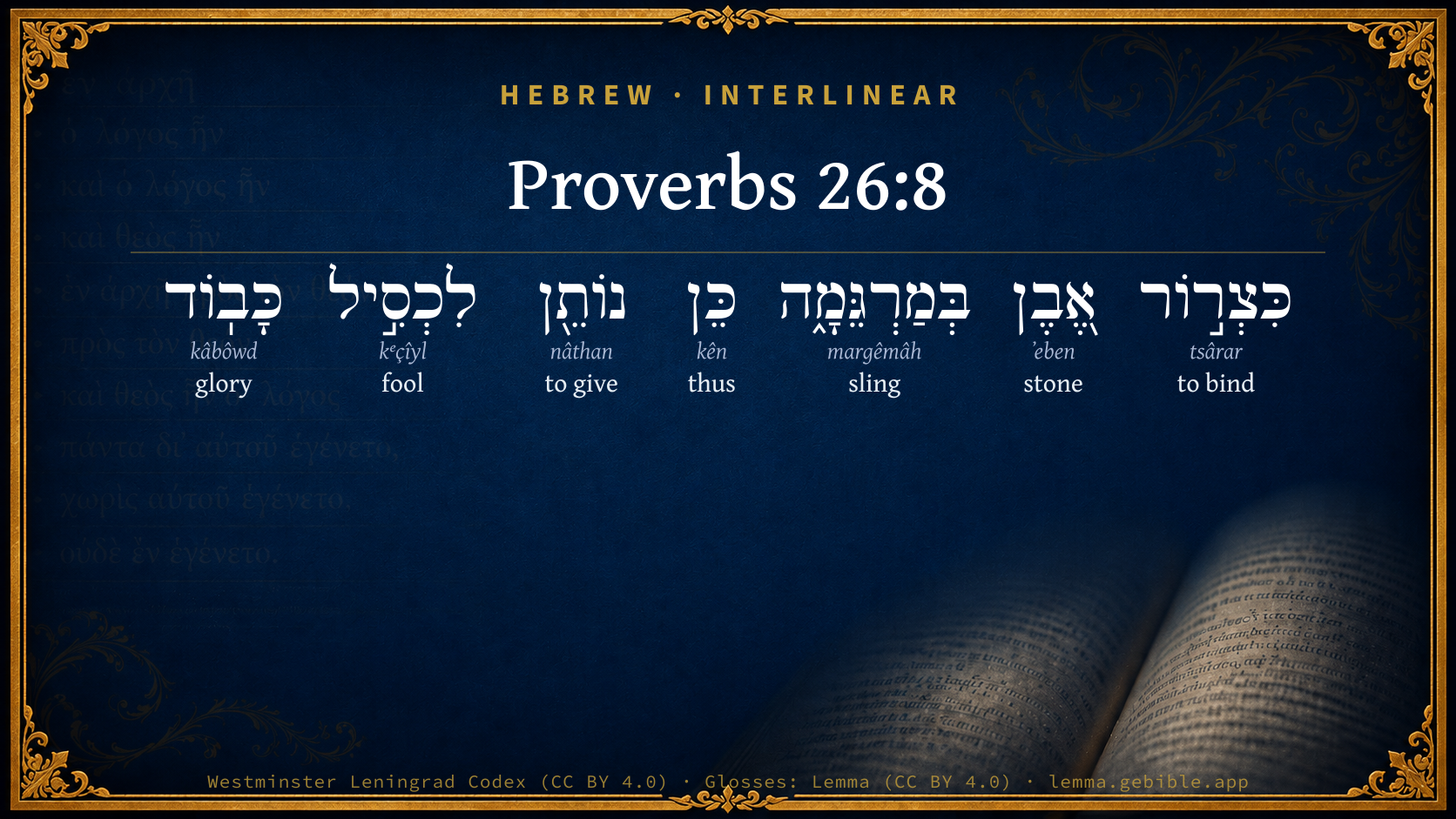
Proverbs 26:8

Hebrew (Westminster Leningrad Codex) Proverbs 26:8 appears in the Hebrew Old Testament. The text above is from the Westminster Leningrad Codex. Each word links to its Strong’s number, a concise gloss, and parsing drawn from the Open Scriptures Hebrew Bible morphology. Click any word for its full Brown-Driver-Briggs (BDB) entry.
Download image
Cite this verse

Proverbs 26:8 (World English Bible). Public Domain. Lemma interlinear Bible study tool, https://lemma.gebible.app/v/proverbs/26/8.

Show BibTeX & RIS
BibTeX
RIS
English Translation
As one who binds a stone in a sling, So is he who gives honor to a fool.
World English Bible · Public Domain
Highlights
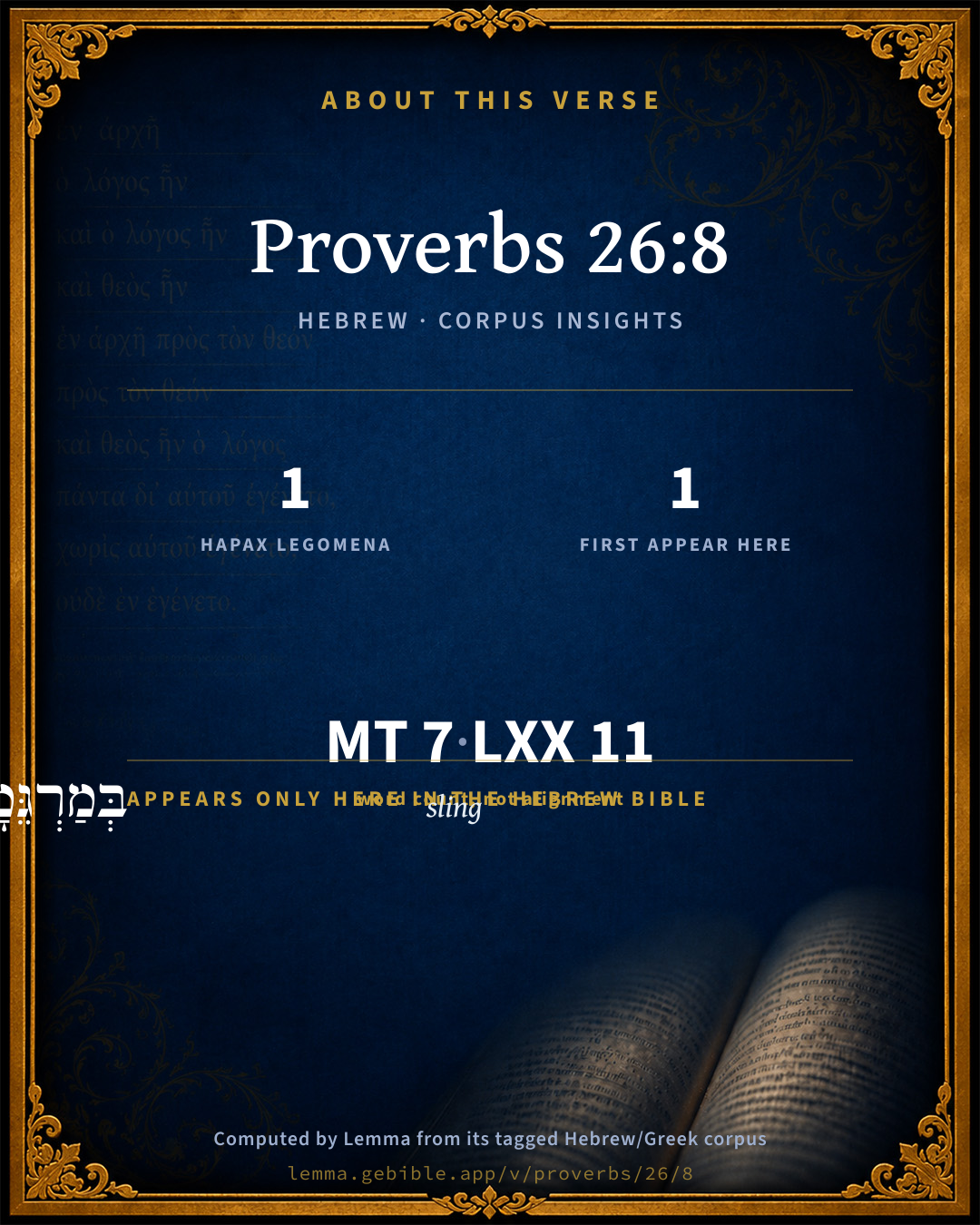
  • 1 hapax legomenon — only here in the Hebrew Bible
  • 1 first appearance in the Hebrew Bible
Full analysis ↓
Download a study sheet

One document with this verse’s original text, its word-by-word gloss line, the meaning frame, cross-references with their text, attributed commentary, and full source and license credits — printable, and it pastes into notes with its structure intact.

This verse Autodidact and up

Study sheet (.html) Plain text (.txt)

A passage Seminary Student

Up to 50 verses in one chapter. A passage sheet keeps up to 6 commentary sources and 12 cross-references per verse, in the order this page ranks them, and says so on the sheet whenever that leaves anything out. Ask for a single verse and you get the Autodidact verse sheet above.

Everything on this page stays free to read, with no account — the sheet is a download of what is already on screen, not access to it.

Want to remove ads? Support Godless Engineer
Compare translations 3

The same verse in 3 English versions, stacked beneath the original-language interlinear above. Click any original word for its lexicon entry.

Each is an independent rendering of the whole verse — the interlinear is not word-aligned to these translations.

Highlighted words mark where these versions differ — a whole-verse word diff, not a word-by-word alignment.

  • World English Bible Public Domain
    As one who binds a stone in a sling, So is he who gives honor to a fool.
  • King James Version Public Domain
    As he that bindeth a stone in a sling, so is he that giveth honour to a fool.
  • unfoldingWord Literal Text CC BY-SA 4.0
    Like tying a stone in a sling, so one who gives honor to a stupid one.

unfoldingWord Literal Text — © unfoldingWord, licensed CC BY-SA 4.0. Word-aligned USFM3 via Door43 (git.door43.org/unfoldingWord/en_ult).

Versions to compare (up to 4)

3 of 4 selected

Show all 18 translations

Every available English version of this verse, each an independent rendering of the whole verse.

  • World English Bible Public Domain
    As one who binds a stone in a sling, So is he who gives honor to a fool.
  • Berean Standard Bible Public Domain
    Like binding a stone into a sling is the giving of honor to a fool.
  • Majority Standard Bible Public Domain
    Like binding a stone into a sling is the giving of honor to a fool.
  • King James Version Public Domain
    As he that bindeth a stone in a sling, so is he that giveth honour to a fool.
  • American Standard Version (1901) Public Domain
    As one that bindeth a stone in a sling, So is he that giveth honor to a fool.
  • Revised Version (1885) Public Domain
    As a bag of gems in a heap of stones, so is he that giveth honour to a fool.
  • Geneva Bible (1599) Public Domain
    As the closing vp of a precious stone in an heape of stones, so is he that giueth glory to a foole.
  • Douay-Rheims (1899) Public Domain
    As he that casteth a stone into the heap of Mercury: so is he that giveth honour to a fool.
  • Young's Literal Translation Public Domain
    As one who is binding a stone in a sling, So `is' he who is giving honour to a fool.
  • Literal Standard Version CC BY-SA 4.0
    As one who is binding a stone in a sling, || So [is] he who is giving honor to a fool.
  • Unlocked Literal Bible CC BY-SA 4.0
    Like tying a stone in a sling is giving honor to a fool.
  • unfoldingWord Literal Text CC BY-SA 4.0
    Like tying a stone in a sling, so one who gives honor to a stupid one.
  • Darby Bible Public Domain
    As a bag of gems in a stoneheap, so is he that giveth honour to a fool.
  • World Messianic Bible Public Domain
    As one who binds a stone in a sling, so is he who gives honor to a fool.
  • Webster's Bible Public Domain
    As he that bindeth a stone in a sling, so is he that giveth honor to a fool.
  • Free Bible Version CC BY-SA 4.0
    Honoring someone stupid is as pointless as tying a stone into a sling.
  • Bible in Basic English Public Domain
    Giving honour to a foolish man is like attempting to keep a stone fixed in a cord.
  • JPS Tanakh (1917) Public Domain
    As a small stone in a heap of stones, so is he that giveth honour to a fool.

Literal Standard Version (2020), Covenant Press — licensed CC BY-SA 4.0. Text via the HelloAO Bible API (eBible.org). Unlocked Literal Bible (unfoldingWord) — licensed CC BY-SA 4.0. Text via the HelloAO Bible API (eBible.org). unfoldingWord Literal Text — © unfoldingWord, licensed CC BY-SA 4.0. Word-aligned USFM3 via Door43 (git.door43.org/unfoldingWord/en_ult). Free Bible Version, Dr. Jonathan Gallagher — licensed CC BY-SA 4.0. Text via the HelloAO Bible API (eBible.org).

Word by word

More ways to search: Search by grammar → Find every occurrence → Compare this word →

Practice this passage: Drill this verse → Learn its vocabulary →

About this verse

These counts appear in no published source. They are computed here, from the morphology-tagged text and Lemma’s own curated glosses. What Lemma adds →

7
words
7
distinct lemmas
Wisdom
section

Notable vocabulary

1 hapax legomenon — a word that appears only here in the entire Hebrew Bible:

  • בְּמַרְגֵּמָ֑ה sling H4773

First appearance in Scripture

This word makes its first canonical appearance in the Hebrew Bible here:

  • בְּמַרְגֵּמָ֑ה sling H4773

Shared distinctive vocabulary

כִּצְר֣וֹר to bind H6887 occurs in 52 verses of the Hebrew Bible. Also found in:

Grammatical profile

  • 2 verbs
  • 3 nouns
  • 1 adjective
  • 1 particle

Verb forms

  • כִּצְר֣וֹר Qal · Infinitive Construct
  • נוֹתֵ֖ן Qal · Participle Active

Hebrew & Septuagint length

In English translation the verse runs 18 words from the Hebrew and 18 from the Septuagint (LXX English) — the same length.

A rough comparison of the two English renderings, which tokenize alike — not a word-level alignment.

Word counts can differ between the Hebrew and the Greek without any difference in meaning — e.g. the Hebrew direct-object marker אֵת has no separate Greek word, and Greek often adds the article ὁ.

In the original languages it is 7 Hebrew tokens and 11 Greek tokens — but the two are counted differently (Hebrew bundles its prefixes and suffixes into one token; the Greek is in lemma form), so that isn’t a like-for-like length.

Cross-references

3

Topical passages linked to Proverbs 26:8 in the Treasury of Scripture Knowledge — connected by theme and wording, ordered by reader-vote popularity; previews shown in the World English Bible.

  • Proverbs 26:1 Like snow in summer, and as rain in harvest, So honor is not fitting for a fool.
  • Proverbs 30:22 For a servant when he is king; A fool when he is filled with food;
  • Proverbs 19:10 Delicate living is not appropriate for a fool, Much less for a servant to have rule over princes.

Cross-references courtesy of OpenBible.info (CC BY 4.0).

Hebrew and Greek witnesses Masoretic Hebrew ↔ Greek Septuagint

The same verse in the two great witnesses to the Old Testament, shown verse-for-verse.

These are two independent witnesses, not word-aligned to each other, and the Septuagint is shown in lemma (dictionary) form.

Hebrew Proverbs 26:8 Masoretic · Westminster Leningrad Codex

כִּצְר֣וֹר אֶ֭בֶן בְּמַרְגֵּמָ֑ה כֵּן נוֹתֵ֖ן לִכְסִ֣יל כָּבֽוֹד

As one who binds a stone in a sling, So is he who gives honor to a fool.

World English Bible · Public Domain

Greek LXX Proverbs 26:8 Septuagint · lemma form

ὅς ἀποδεσμεύω λίθος ἐν σφενδόνη ὅμοιος εἰμί ὁ δίδωμι ἄφρων δόξα

He that binds up a stone in a sling, is like one that gives glory to a fool.

LXX2012 (modern English Septuagint) · Public Domain

On this verse, Keil & Delitzsch discusses the Septuagint’s reading. Read the note in Commentary ↓

Hebrew: Westminster Leningrad Codex (CC BY 4.0). Greek: Septuagint (public domain); English from LXX2012 (modern English Septuagint) (Public Domain). How the Septuagint differs from the Hebrew →

Commentary

Notes on Proverbs 26:8 from classic Christian and Jewish commentators (each source and its license shown beneath its notes). The classic Christian expositions comment on the surrounding passage and are grouped to its opening verse, so a note may address several verses; the Jewish commentaries on the Tanakh (Rashi and others) are per-verse, so they appear only where the commentator wrote on this verse.

Lemma curates 59 commentaries, every one of them public domain or Creative Commons licensed, each selected and text-cleaned for this edition rather than reprinted as found. About our sources →

Trapp's Complete Commentary

John Trapp

Pro 26:8 As he that bindeth a stone in a sling, so [is] he that giveth honour to a fool.

Ver. 8. As he that bindeth a stone in a sling.] A precious stone is not fit for a sling - where it will soon be cast away and lost; no more is honour for a fool. See Pro 26:1. Ebenezra saith that Margemah, here rendered a sling, signifies purple, and senseth it thus: As it is an absurd thing to wrap a pebble in purple, so is it to prefer a fool, as Saul did Doeg, as Ahasuerus Haman.

John Trapp, A Commentary or Exposition upon All the Books of the Old and New Testament (1647–1656) — public domain. Text from a community e-Sword module.

The Biblical Illustrator

Joseph S. Exell

Pro_26:8

As he that bindeth a stone in a sling, so is he that giveth honour to a fool.

Throwing a stone at an idol

The words should be translated, as Colonel Condor was the first to point out: As he that throweth a stone at an idol, so is he that giveth honour to a fool. The comparison refers to the universal custom, in ancient times, among Pagan nations of throwing a stone at an idolatrous shrine, not in execration of it, like the stones thrown to this day by the Jews at Absaloms pillar at Jerusalem, but in honour of it. At the foot of some sacred tree, or some pillar consecrated to idolatrous worship, a cairn or heap of stones is generally found; each stone testifying of a visit paid to the spot by some votary; and the larger the heap the greater the veneration shown. In Greece, the worship of Hermes or Mercury consisted in throwing a stone at his image, set up as a mark by the wayside to protect travellers on a journey. In Palestine, amongst the primitive Canaanite inhabitants that still survived, idolatry was widely practised; and in early times it was a common sight, on rising spots among the hills of Judea and Galilee, to come upon a menhir, or dolmen, in which the object of worship was a rude stone image, forming the nucleus of a cairn or heap of stones which had gradually grown around it, in remembrance of the visits paid by worshippers. In Scotland many cairns are made of the stones thrown at a rude stone monument, or cromlech, as an act of worship; and, perhaps, many of the cairns of remembrance raised to the dead may have originated from this act of worship. The old saying, I will add a stone to your cairn, was the highest expression of reverence and regard that could be offered to a friend. With this explanation the comparison used in the Scripture proverb becomes plain and forcible. The proverb could only have been used by an iconoclast; and very probably came into existence in the days of Hezekiah, after the wholesale destruction, by this pious and zealous monareh, of the altars and stone monuments of the Canaanite idolaters which had corrupted Israel. Hezekiah was bent on the work of national reformation, and the purification and consecration of the temple by a perfect ceremonial was accompanied by the overthrow of all the high places and the idolatrous images and rites connected with them, as antagonistic to the holiness of the land as Gods heritage. And, therefore, the proverb of the text would have a deep force and meaning in his day. Like one who continued the old practice of throwing a stone at an idolatrous monument, in token of worship, a practice now forbidden and proved to be vain and useless, so was he who gave honour to a fool. A fool was as unworthy of honour as an idol is of worship. In the one case there is no reason for the honour; and in the other case the worship is a mere empty foolish superstition. An idol is nothing, and a fool is a negation. (H. Macmillan, D. D.)

The Biblical Illustrator, edited by Joseph S. Exell (c. 1880s–1900s) — public domain. Text from a community e-Sword module.

Joseph Benson's Commentary

Pro 26:8. As he that bindeth a stone in a sling — Whereby he hinders his own design of throwing the stone out of it; so is he, &c. — No less absurd is he that giveth to a fool that honour which he is not capable of using aright. Bishop Patrick and Houbigant give a different interpretation of the verse, thus: “As a stone put into a sling stays not long there, so is that honour thrown away which is bestowed upon a fool.” Parkhurst, however, according to the translation in the margin, supposes the meaning to be, “As a spark, or small piece of precious stone, in a heap of stones, so is he that giveth honour to a fool.”

Joseph Benson's Commentary on the Old and New Testaments (1811–1818) — public domain. Text from a community e-Sword module.

Keil & Delitzsch

C. F. Keil & F. Delitzsch

This proverb presents to us a new difficulty.

As one binds a stone in a sling,

So is he who giveth honour to a fool.

This translation is warranted by tradition, and is in accordance with the actual facts. A sling is elsewhere called קלע; but that מרגּמה also in the passage before us signifies a sling (from רגם, to throw with stones = to stone or to throw stones = to sling, cf. Targ. Est 5:14 רגּם, of David's slinging stones against Goliath), is supported by the lxx, Syr., and Targ. on the one side, and the Jewish Glossists on the other (Rashi: fronde, Ital. frombola). Rightly the lxx renders כּצרור as a verb: ὡς ἀποδεσμεύει; on the contrary, the Syr. and Targ. regard it as a substantive: as a piece of stone; but צרור as a substantive does not mean a piece, as one would put into a sling to use as a weapon, but a grain, and thus a little piece, Sa2 17:13; cf. Amo 9:9. Erroneously Ewald: "if one binds to the sling the stone which he yet seeks to throw, then all this throwing and aiming are in vain; so it is in vain to give to a fool honour which does not reach him." If one seeks to sling a stone, he must lay the lapis missilis so in the sling that it remains firm there, and goes forth only by the strong force of the slinging; this fitting in (of the stone), so that it does not of itself fall out, is expressed by צרר בּ (cf. Pro 30:4; Job 26:8). The giving is compared to the binding, the stones to the honour, and the sling to the fool: the fool is related to the honour which one confers on him, as the stone to the sling in which one lays it - the giving of honour is a slinging of honour. Otherwise (after Kimchi) the Venet. ὡς συνδεσμὸς λίθου ἐν λιθάδι, i.e., as Fleischer translates: ut qui crumenam gemmarum plenam in acervum lapidum conjicit. Thus also Ralbag, Ahron b. Josef, and others, and lastly Zckler. The figure is in the form of an address, and מרגּמה (from רגם, accumulare, congerere, vid., under Psa 67:1-7 :28) might certainly mean the heaping of stones. But אבן is not used in the sense of אבן יקרה (precious stone); also one does not see why one precious stone is not enough as the figure of honour, and a whole heap is named; but in the third place, כּן נותן requires for כצרור a verbal signification. Therefore Jerome translates: sicut qui mittit lapidem in acervum Mercurii; in this the echo of his Jewish teacher, for the Midrash thus explains literally: every one who gives honour to a fool is like one who throws a stone on a heap of stones consecrated to Mercury. Around the Hermes (ἑρμαὶ), i.e., pillars with the head of Mercury (statuae mercuriales or viales), were heaps of stones (ἕρμακες), to which the passer-by was wont to throw a stone; it was a mark of honour, and served at the same time to improve the way, whose patron was Mercurious (מרקולים). It is self-evident that this Graeco-Roman custom to which the Talm. makes frequent reference, cannot be supposed to have existed in the times of Solomon. Luther translates independently, and apparently rendering into German that in acervum Mercurii: that is as if one threw a precious stone on the "Rabenstein," i.e., the heap of stones raised at the foot of the gallows. This heap of stones is more natural and suitable to the times of Solomon than the heap of stones dedicated to Mercury, if, like Gussetius, one understands מרגמה of a heap of stones, supra corpus lapidatum. But against this and similar interpretations it is enough to remark that כצרור cannot signify sicut qui mittit. Had such a meaning been intended, the word would have been כּהשׁליך or כּמשׁליך. Still different is the rendering of Joseph Kimchi, Aben Ezra, and finally Lwenstein: as when one wraps up a stone in a piece of purple stuff. But ארגּמן, purple, has nothing to do with the verb רגם; it is, as the Aramaic ארגּון shows, a compound word; the supposition of a denom. מרגּמה thus proceeds from a false etymological supposition. And Hitzig's combination of מרגמה with (Arab.) munjam, handle and beam of a balance (he translates: as a stone on the beam of a balance, i.e., lies on it), is nothing but refined ingenuity, since we have no need at all of such an Arab. word for a satisfactory clearing up of מרגמה. We abide by the rendering of the sling. Bttcher translates: a sling that scatters; perhaps מרגמה in reality denotes such a sling as throws many stones at once. Let that, however, be as it may: that he who confers a title of honour, a place of honour, and the like, on a fool, is like one who lays a stone in a sling, is a true and intelligibly formed thought: the fool makes the honour no honour; he is not capable of maintaining it; that which is conferred on him is uselessly wasted.

Keil & Delitzsch — Biblical Commentary on the Old Testament (1861–1891) — public domain (CC PDM 1.0). Text via the HelloAO Bible API. (Old Testament only.)

Jamieson, Fausset & Brown

Robert Jamieson, A. R. Fausset & David Brown

A stone, bound in a sling, is useless; so honor, conferred on a fool, is thrown away.

Jamieson, Fausset & Brown — Commentary Critical and Explanatory on the Whole Bible (1871) — public domain (CC PDM 1.0). Text via the HelloAO Bible API.

Adam Clarke's Commentary

Verse 8. As he that bindeth a stone in a sling, so is he that giveth honour to a fool.] It is entirely thrown away. This, however, is a difficult proverb; and the versions give but little light on the subject. The Hebrew may be translated, "As a piece of precious stone among a heap of stones, so is he that giveth honour to a fool." See the margin, and Parkhurst: but on this interpretation the meaning would rather be, "It is as useless to throw a jewel among a heap of stones to increase its bulk, as to give honour to a fool."

As he that sendith a stoon into a hepe of monee; so he that geveth to an unwiisman wirschip. - Old MS. Bible.

"He that setteth a foole in hye dignite, that is even as yf a man dyd caste a precious stone upon the galous." - Coverdale. This translator refers to the custom of throwing a stone to the heap under which a criminal lay buried. The Vulgate gives some countenance to this translation: "He who gives honour to a fool is like one who throws a stone to Mercury's heap." Mercury was considered the deity who presided over the highways; and stones were erected in different places to guide the traveller. Hence those lines of Dr. Young: -

"Death stands like Mercuries in every way;

And kindly points us to our journey's end."

Adam Clarke's Commentary on the Bible (1810–1826) — public domain. Text from a community e-Sword/MySword module.

Ellicott's Commentary for English Readers

(8) As he that bindeth a stone in a sling . . .—i.e., the stone is soon gone from the sling and seen no more, so honour and a fool soon part company. This seems on the whole the most probable rendering of this verse.

A Bible Commentary for English Readers, edited by Charles John Ellicott (1878–1897) — public domain. Text from a community e-Sword module.

The Cambridge Bible for Schools and Colleges

gen. ed. J. J. S. Perowne

8. bindeth a stone in a sling] This, which is the rendering of the LXX. (ὅς ἀποδεσμεύει λίθον ἐν σφενδόνῃ), must be taken to mean, he who “bindeth fast” (R.V. marg.) a stone so that it cannot come out, thus frustrating by his action the very purpose for which a stone is put into a sling. Such a proceeding is a fit emblem of the incongruity of “giving honour to a fool.” But the Heb. word thus rendered “sling,” that which casts away stones, occurs nowhere else, and it may have the meaning of a heap or collection of stones. And it is so understood both in A.V. marg., As he that putteth a precious stone in an heap of stones, and in R.V. text, As a bag of gems in an heap of stones. This rendering gives point to the comparison: To put honour on one who is so utterly undeserving of it as a fool, is like hiding precious stones among worthless pebbles. It necessitates however our understanding the word “stone,” used absolutely and without anything in the context (as in Exo_28:9; Exo_35:27) to limit its meaning, of a precious stone or gem.

Some commentators both ancient and modern have supposed that the “heap of stones” referred to is that under which the criminal who had been stoned to death lay buried. A similar idea appears in Coverdale’s rendering: “He that setteth a fool in hye dignite, that is even as yf a man dyd caste a precious stone upon the galous.”

For the “bag,” “that which” (instead of “he that”) “bindeth fast,” or holdeth securely precious stones, or other valuables, comp. Pro_7:20; Gen_42:35 (“bundle”), where the Heb. word is the same as here.

The Cambridge Bible for Schools and Colleges (gen. ed. J. J. S. Perowne; Cambridge University Press, 1878–1918) — public domain. Text from a community e-Sword module.

John Gill's Exposition

As he that bindeth a stone in a sling,.... That so fastens it to it that it cannot be slung out of it, it becomes useless and does not answer the end for which it is put there; or that places it there that it may be cast out, and is cast out, and so is thrown away, and of no more use; or that puts a precious stone, so some interpret it, in a heap of common stones, even in such a heap as is used at the stoning of malefactors; or increases the heap of stones on such, which the more exposes them, and the greater reproach they are loaded with; so the more a fool is praised, it does but bring to mind his folly, and issues in his greater disgrace, so Gussetius (o): or rather it has respect to a precious stone put in such a heap of stones, as Luther; or else, according to Schultens, to such an one put into a heap of sepulchral stones; or, as Aben Ezra, that binds up a stone, a common stone, in purple, which to do is ridiculous, so R. Joseph Kimchi; the Vulgate Latin version renders it,

"as he that casts a stone to Mercury's heap;''

a Heathen deity, called by the eastern people Mertholin and Margenah (p), which last is near the same with the Hebrew word here used; whose statue was set up where two or more ways met, to direct travellers; and who therefore out of respect to the deity, and to show gratitude to him, used to cast a stone to the heap for the support of it; and which stones, set up in such doubtful places, were dedicated to him, and were called after his name (q); and not only travellers did this in honour of the deity, and to make his statue more manifest (r), but also for profit, to clear the way from stones; and this custom obtained with the Indians, Arabs, Saracens, and now does with the Mahometans (s): and such heaps of stones were also placed in cities, and at the doors of houses, in honour of Mercury, and were called from him Hermae (t); these stones were also erected for borders of countries (u). But it is not probable that this custom obtained in Solomon's time; and yet some Jewish writers interpret it to this sense, as if he that gives honour to a fool is like him that casts a stone to Mercury; and Jarchi in the text observes it as the sense of some of their Rabbins,

"that he that teacheth the law to a disciple that is not fit, is as he that casts a stone to Mercury;''

and to cast a stone to Mercury is with them the same as to commit idolatry (w); but either of the former senses is best;

so is he that giveth honour to a fool; it is all thrown away and lost, as a stone out of a sling; or as unseemly as to put a precious stone among a heap of stones, or a common stone in purple; See Gill on Pro 26:1.

(o) Ebr. Comment. p. 777. (p) D. Herbert de Chefbury d. Relig Gent. c. 7. p. 58. (q) Suidas in voce (r) Phurnutus de Natura Deorum, p. 33. (s) Vid. D. Herbert de Cherbury, ut supra, p. 59. (t) Cornel. Nepot. Vit. Alcibiad. l. 7. c. 3. (u) Pausan. Corinth. sive, l. 2. p. 157. (w) Misn. Sanhedrin, c. 7. s. 6. & Maimon. in ib.

John Gill's Exposition of the Whole Bible (1746–1763) — public domain (CC PDM 1.0). Text via the HelloAO Bible API.

Albert Barnes' Notes on the Bible

i. e., “To give honor to the fool is like binding a stone in a sling; you cannot throw it.” In each case you misapply and so waste. Others render in the sense of the margin: To use a precious stone where a pebble would be sufficient, is not less foolish than to give honor to a fool.

Albert Barnes' Notes on the Bible (1834–1885) — public domain. Text from a community e-Sword/MySword module.

Haydock's Catholic Bible Commentary

Mercury. The god of travellers, who were wont to throw a stone at the foot of his statue, as the Indians (Vincent. Bellor. xxiv.) and Arabs did. Mahomet would not disturb this superstitious custom. The Rabbins style these statues Mercolis. But Septuagint, &c., give another sense, "as he that bindeth a stone (Calmet) in the boss of a ring, Greek: sphendone, (Menochius) or in a sling," can do no good, but only endanger himself or others, "so," &c. Yet margema is never used elsewhere for a sling, and it means undoubtedly "a heap of stones," (Calmet) as Montanus substitutes instead of "the sling," in Pagnin. "As a small piece of precious stone in a heap of stones is lost, so," &c. (Pole. Syn. Parkhurst in rogom.) (Haydock) --- Honour, or an office, in which he may do harm. (Calmet)

George Leo Haydock (1774–1849), Haydock's Catholic Family Bible and Commentary, 1859 edition — public domain. Excludes Psalms (Douay-Rheims chapter numbering differs from Protestant) and Deuterocanonical books (Catholic canon only).

Matthew Poole's English Annotations

As he that bindeth a stone in a sling; whereby he hinders his own design of throwing the stone out of it; or, who fastens it there only for a season, that he may speedily and violently throw it away. Or, as it is rendered in our margin, and by many others, As he that putteth a precious stone (Heb. a stone, which is oft emphatically used for a precious stone, both in Scripture, as Exo 39:10; 1Ch 29:8, and elsewhere, and also in other authors) in an heap of stones, where it is obscured and lost.

So is he that giveth honour to a fool; no less absurd is he that giveth to a fool that honour and praise which he is not capable either of receiving, or retaining, or using aright, but it is quite wasted upon him, and doth him more hurt than good.

Matthew Poole's English Annotations on the Holy Bible (1683–1685) — public domain. Text from a community e-Sword/MySword module.

Whedon's Commentary on the Bible

Daniel D. Whedon

8. As he that bindeth a stone — The margin reads: “As he that putteth a precious stone into a heap of stones.” The reading of the text is supported by the Septuagint and Syriac, and is preferred by some very reputable modern critics. The moral is the same in both forms, namely: the folly or uselessness of giving honour — preferment, responsibility — to a fool — that is, an incapable and wicked man. These are some of the translations of the first clause: “As a bag of gems in a heap of stones” — a proverbial expression like that in Mat_7:6, casting pearls before swine. So Gesenius: “As a grain of precious stone in a heap of stones, so is he,” etc.

The precious stone in one case, and the honour in the other, is thrown away and lost. The Douay, following the Vulgate, reads: “As he that casteth a stone into a heap of mercury, so is he that giveth honour to a fool.” Did the translator take margemah for Mercury, the heathen god of the highways? But Schultens takes מרגמה, (margemah,) which occurs only here, and is rendered sling in the Authorized Version, to denote a heap of stones cast over a person stoned to death. This explanation would make the proverb more poignant. “The honour given to a fool is compared to a stone flung at a heap already thrown at a criminal stoned to death. It but adds to his shame. As the confining a precious stone in the sepulchral heap of an executed malefactor, where it must be disgraced, if not lost, so is he that giveth honour to a fool.” Zockler, Conant, and Miller prefer the old rendering, “a stone in a sling.” The Septuagint, Syriac, and Arabic support our Authorized Version. Miller maintains that the binding the stone in the sling means simply putting it there to be thrown, and, hence, to damage those it reaches.

Daniel D. Whedon (gen. ed.), Commentary on the Old and New Testaments (1874–1909) — public domain. Text from a community e-Sword module.

The Pulpit Commentary

As he that bindeth a stone in a sling. So Septuagint, OO apodesmeuei liyon en sfendonh . This gives a very good sense the point being either that the stone, after being firmly fitted in its place, quickly passes away from the sling, or, if more stress is laid on the word "bindeth," that the stone is so firmly fixed that it cannot be slung, and therefore never reaches the mark. The alternative rendering adopted by the Revised Version is this, "As a bag of gems in a heap of stones;" where the incongruity would consist either in exposing jewels on a cairn, or sepulchral monument, whence they could easily be filched, or in attracting undesirable attention. But there are grammatical and etymological reasons against this interpretation; and the Authorized Version is to be considered correct. The Vulgate is curious: Sieur qui mittit lapidem in acervum Mercurii. This rendering points to the custom, with which Jerome must have been familiar, of erecting statues of Mercury on the highways, which were thus placed under his protection. Round these statues were ranged heaps of stones, to which every wayfarer contributed by throwing a pebble as he passed. The absence of the critical faculty which discerned no absurdity in this anachronism is sufficiently remarkable. The Latin saying seems intended to denote useless labour, as we speak of "carrying coals to Newcastle." So is he that giveth honour to a fool. You pay respect to a fool, or place him in an honourable position, but your labour is wasted; he cannot act up to his dignity, he cannot maintain the honour; it passes away like the stone from the sling, or, if it remains, it is useless to him.

The Pulpit Commentary (1880–1919), ed. H.D.M. Spence-Jones & Joseph S. Exell — public domain. Text from a community e-Sword module.

John Wesley's Explanatory Notes

Bindeth - Whereby he hinders his own design of throwing the stone out of it. So - No less absurd is he that giveth to a fool that honour which he is not capable of using aright.

John Wesley, Explanatory Notes Upon the Whole Bible (1754–1765) — public domain. Text via the GEBible commentary corpus.

Rashi

Rabbi Shlomo Yitzchaki (Rashi)

in a slingshot Heb. במרגמה fronde in French, Schleuder in German, in which the stone tied will not remain, for it is destined to be thrown, so is it with one who gives honor to a fool—it is not permanent. And our Sages (Hullin 133a) explained it homiletically as referring to one who teaches Torah to an unfitting student, that he is tantamount to casting a stone into a merculis.

Rashi on the Tanakh — English translations: “The Judaica Press complete Tanach with Rashi, translated by A. J. Rosenberg” (CC BY 4.0); “Pentateuch with Rashi's commentary by M. Rosenbaum and A.M. Silbermann, 1929-1934” (public domain); “The Metsudah Tanach series, Lakewood, N.J” (CC BY 4.0); and “The Book of Joshua, Metsudah Publications, 1997” (CC BY 4.0). Text via Sefaria.

Lesson kit

Teaching starters — assembled from the data on this page, not authored interpretation. Every prompt links to the verse data it draws on. Edit before teaching.

Proverbs, in the Wisdom, opens this verse with 7 words (7 distinct Hebrew lemmas). Its most distinctive word is margêmâh (“sling”). A historical commentator’s framing appears above. Read the whole chapter for the surrounding context.

Discussion questions

  1. What does “sling” (margêmâh) contribute to the verse as a whole?
  2. 1 word here appears nowhere else in the Hebrew Bible. Why might the author reach for such rare wording?
  3. This is the first place “sling” appears in Scripture (first appears here). What does its debut here establish?
  4. How does Exodus 12:34, which shares the word «to bind», read alongside this verse?
  5. The translations on this page render this verse differently — a whole-verse word diff, not a word-by-word alignment. What might account for the different wordings?
  6. «כִּצְר֣וֹר» is a Qal Infinitive Construct verb. How does that grammatical form shape the action described?
  7. Compare how Trapp's Complete Commentary and The Biblical Illustrator read this verse. Where do they agree or differ?

Things to notice

Reading settings

Reading text

Shown beneath each verse's original-language words.

Old Testament
Old Testament edition

Read the OT as the Masoretic Hebrew (MT) or the Greek Septuagint (LXX).

English shown for the Greek Septuagint (in the Hebrew ↔ Greek comparison).

Comparing translations? Open the Compare panel on any verse page to stack up to four side by side.