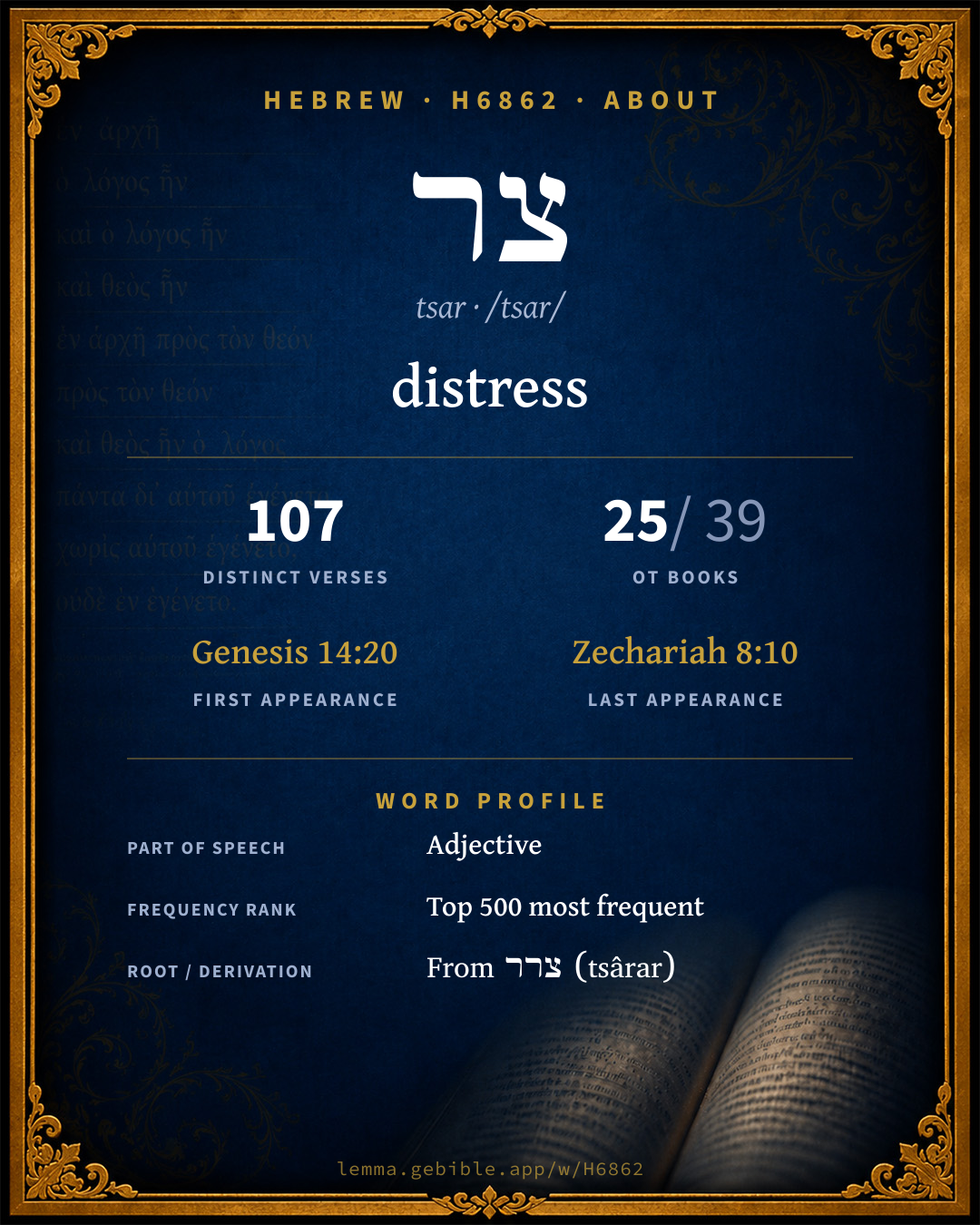
צַר
distress
‘distress’ is one of 4 main senses fuller range ↓
Full lexicon entry — Brown-Driver-Briggs (BDB)
From Brown-Driver-Briggs (BDB)
Where this word appears
See every Construct-state word in the Hebrew Bible →
Grammar key — what these labels mean
Part of speech
- Adjective
- A word that describes or qualifies a noun.
- Noun
- A naming word — a person, place, thing, or idea.
- Verb
- An action or state-of-being word.
Noun type
- Common
- A common noun — a general class of person, place, or thing (“king,” “city,” “water”), not a specific name.
Stem
- Qal
- The basic, simple active stem — the plain form of the verb (“he wrote”).
Form
- Perfect
- A completed action or state — Hebrew marks aspect (completeness) more than strict tense (“he wrote”).
- Participle Active
- A verbal adjective expressing ongoing or characteristic action (“writing / one who writes”).
State
- Absolute
- The independent form of a noun, not bound to a following word.
- Construct
- A noun bound to a following noun in a possessive / “of” relationship (the construct chain).
Person
- 3rd Person
- The one spoken about (“he / she / it / they”).
Gender
- Masculine
- Grammatically masculine.
- Feminine
- Grammatically feminine.
Number
- Singular
- One.
- Plural
- More than one (in Hebrew, generally three or more).
Every verse where H6862 appears in the Book of Psalms — 38 distinct verses. Click any verse to open its interlinear word-by-word view. Verse text shown in the World English Bible for context — . Each verse’s Hebrew form is shown with its reference; the English is not keyword-highlighted, since the data carries no word-level English alignment. Use “Compare translations” on any verse to read it across multiple English versions. This concordance covers the Hebrew Bible; Septuagint (Greek Old Testament) occurrences are not indexed here.
Psalms
- Psalms 3:1 צָרָ֑/י n c mp cs + sfx pers 1cs Yahweh, how my adversaries have increased! Many are those who rise up against me.
- Psalms 4:1 בַּ֭/צָּר prep det + Adjective Adjective ms Answer me when I call, God of my righteousness. Give me relief from my distress. Have mercy on me, and hear my prayer.
- Psalms 13:4 צָרַ֥/י n c mp cs + sfx pers 1cs Lest my enemy say, "I have prevailed against him;" Lest my adversaries rejoice when I fall.
- Psalms 18:6 בַּ/צַּר prep det + Adjective Adjective ms In my distress I called on Yahweh, And cried to my God. He heard my voice out of his temple, My cry before him came into his ears.
- Psalms 27:2 צָרַ֣/י n c mp cs + sfx pers 1cs When evil-doers came at me to eat up my flesh, Even my adversaries and my foes, they stumbled and fell.
- Psalms 27:12 צָרָ֑/י n c mp cs + sfx pers 1cs Don't deliver me over to the desire of my adversaries, For false witnesses have risen up against me, Such as breathe out cruelty.
- Psalms 32:7 מִ/צַּ֪ר prep + Adjective Adjective ms You are my hiding place. You will preserve me from trouble. You will surround me with songs of deliverance. Selah.
- Psalms 44:5 צָרֵ֣י/נוּ n c mp cs + sfx pers 1cp Through you, will we push down our adversaries. Through your name, will we tread them under who rise up against us.
- Psalms 44:7 מִ/צָּרֵ֑י/נוּ prep + n c mp cs + sfx pers 1cp But you have saved us from our adversaries, And have shamed those who hate us.
- Psalms 44:10 צָ֑ר n c ms You make us turn back from the adversary. Those who hate us take spoil for themselves.
- Psalms 59:16 צַר Qal pf 3ms But I will sing of your strength. Yes, I will sing aloud of your loving kindness in the morning. For you have been my high tower, A refuge in the day of my distress.
- Psalms 60:11 מִ/צָּ֑ר prep + n c ms Give us help against the adversary, For the help of man is vain.
- Psalms 60:12 צָרֵֽי/נוּ n c mp cs + sfx pers 1cp Through God we shall do valiantly, For it is he who will tread down our adversaries.
- Psalms 66:14 בַּ/צַּר prep det + Adjective Adjective ms which my lips promised, And my mouth spoke, when I was in distress.
- Psalms 74:10 צָ֑ר n c ms How long, God, shall the adversary reproach? Shall the enemy blaspheme your name forever?
- Psalms 78:42 צָֽר n c ms They didn't remember his hand, Nor the day when he redeemed them from the adversary;
- Psalms 78:61 צָֽר n c ms And delivered his strength into captivity, His glory into the adversary's hand.
- Psalms 78:66 צָרָ֥י/ו n c mp cs + sfx pers 3ms He struck his adversaries backward. He put them to a perpetual reproach.
- Psalms 81:14 צָ֝רֵי/הֶ֗ם n c mp cs + sfx pers 3mp I would soon subdue their enemies, And turn my hand against their adversaries.
- Psalms 89:23 צָרָ֑י/ו n c mp cs + sfx pers 3ms I will beat down his adversaries before him, And strike those who hate him.
- Psalms 89:42 צָרָ֑י/ו n c mp cs + sfx pers 3ms You have exalted the right hand of his adversaries. You have made all of his enemies rejoice.
- Psalms 97:3 צָרָֽי/ו n c mp cs + sfx pers 3ms A fire goes before him, And burns up his adversaries on every side.
- Psalms 102:2 צַ֫ר Qal pf 3ms Don't hide your face from me in the day of my distress. Turn your ear to me. Answer me quickly in the day when I call.
- Psalms 105:24 מִ/צָּרָֽי/ו prep + n c mp cs + sfx pers 3ms He increased his people greatly, And made them stronger than their adversaries.
- Psalms 106:11 צָרֵי/הֶ֑ם n c mp cs + sfx pers 3mp The waters covered their adversaries. There was not one of them left.
- Psalms 106:44 בַּ/צַּ֣ר prep det + Adjective Adjective ms Nevertheless he regarded their distress, When he heard their cry.
- Psalms 107:2 צָֽר n c ms Let the redeemed by Yahweh say so, Whom he has redeemed from the hand of the adversary,
- Psalms 107:6 בַּ/צַּ֣ר prep det + Adjective Adjective ms Then they cried to Yahweh in their trouble, And he delivered them out of their distresses,
- Psalms 107:13 בַּ/צַּ֣ר prep det + Adjective Adjective ms Then they cried to Yahweh in their trouble, And he saved them out of their distresses.
- Psalms 107:19 בַּ/צַּ֣ר prep det + Adjective Adjective ms Then they cry to Yahweh in their trouble, He saves them out of their distresses.
- Psalms 107:28 בַּ/צַּ֣ר prep det + Adjective Adjective ms Then they cry to Yahweh in their trouble, And he brings them out of their distress.
- Psalms 108:12 מִ/צָּ֑ר prep + n c ms Give us help against the enemy, For the help of man is vain.
- Psalms 108:13 צָרֵֽי/נוּ n c mp cs + sfx pers 1cp Through God, we will do valiantly. For it is he who will tread down our enemies.
- Psalms 112:8 בְ/צָרָֽי/ו prep + n c mp cs + sfx pers 3ms His heart is established. He will not be afraid in the end when he sees his adversaries.
- Psalms 119:139 צָרָֽ/י n c mp cs + sfx pers 1cs My zeal wears me out, Because my enemies ignore your words.
- Psalms 119:143 צַר adj Adjective ms Trouble and anguish have taken hold of me. Your commandments are my delight.
- Psalms 119:157 וְ/צָרָ֑/י conj + n c mp cs + sfx pers 1cs Many are my persecutors and my adversaries. I haven't swerved from your testimonies.
- Psalms 136:24 מִ/צָּרֵ֑י/נוּ prep + n c mp cs + sfx pers 1cp And has delivered us from our adversaries; For his loving kindness endures forever:
About this entry
At a glance — auto-summarized from this page’s data, not written by a person. Every figure links to its source below. This summary describes the numbers; it doesn’t interpret them.
The Hebrew adjective צר centers on the idea of “distress.” Lexicons map it across 4 senses. It turns up in 107 verses across 25 books, a common footprint. The word gravitates to Psalms (36%), then Isaiah and Job. First canonically at Genesis 14:20, it enters the text early. Dig into 107-verse concordance and the renderings breakdown below.
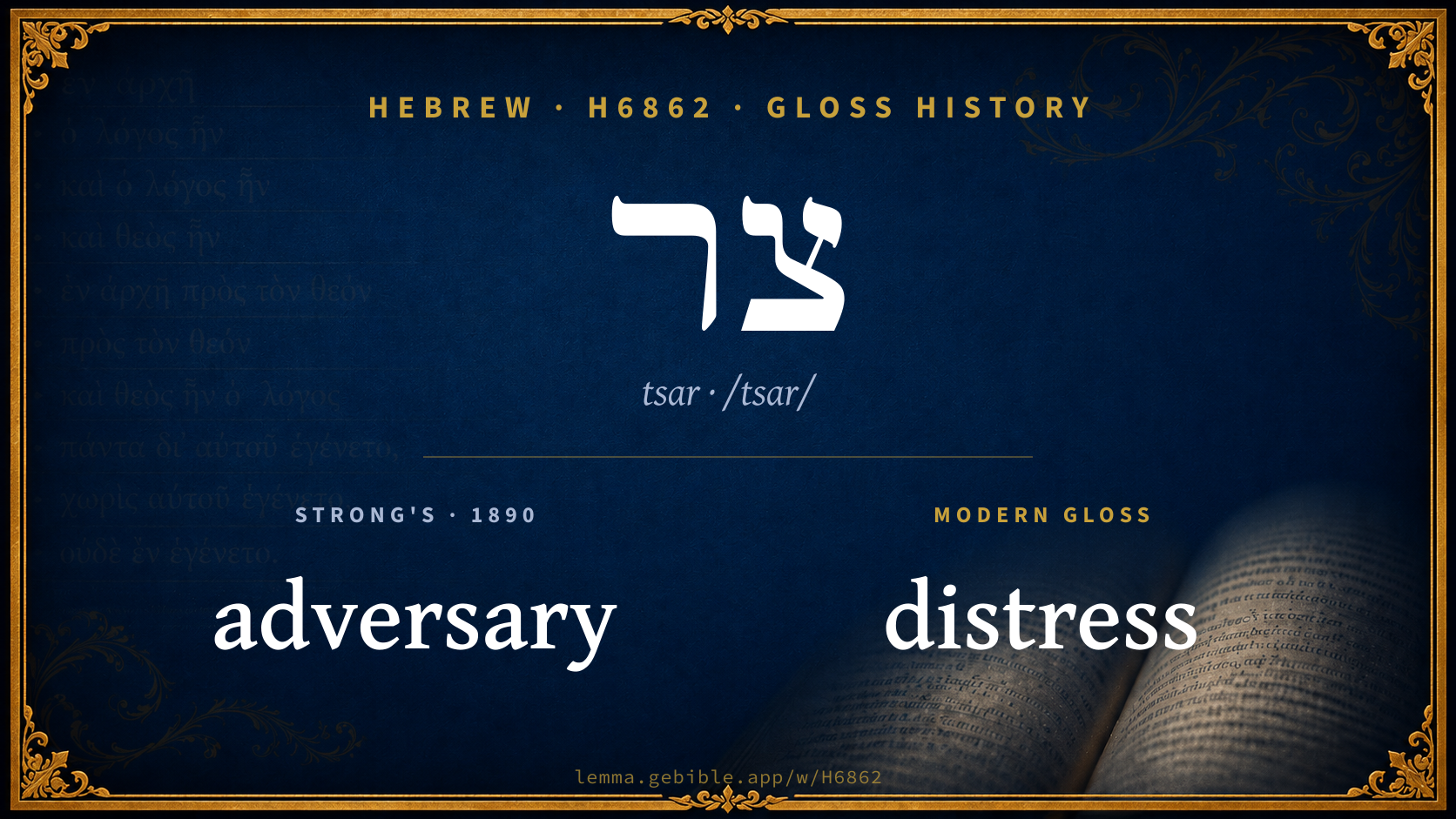
Gloss history
Strong's 1890 vs modern scholarship
About this word
Strong's H6862 catalogs a Hebrew word from the Hebrew Old Testament.
These counts are not copied from any lexicon or concordance. They are computed here, from the morphology-tagged Hebrew Old Testament. What Lemma adds →
- 107
- distinct verses
- The word appears in 107 distinct verses.
- 25 / 39
- OT books
- The word appears in 25 of 39 Old Testament books.
- #396
- by frequency
- Top 500 most frequent Hebrew words (rank 396 of 8,640 Hebrew words by occurrence).
View all 107 occurrences in the concordance →
By section of the Old Testament
By traditional corpus
Conventional, traditional groupings — biblical authorship is debated, so this is a traditional corpus grouping, not an authorship claim. Each share is this word’s portion of its verses in that division of the Hebrew canon. Each figure is a share of the word’s 107 distinct verses.
- Writings (Ketuvim) 64 verses · 60%
- Prophets (Nevi'im) 34 verses · 32%
- Torah (Pentateuch) 9 verses · 8%
How translations render this word
Counts come from each version’s own published word-to-Strong’s tagging or interlinear alignment — an approximate guide to how each version renders this word, not a word-level alignment the data otherwise carries. Because each total is that version’s own tagged count, the per-version totals vary from one another and need not match the appearance or distinct-verse counts above. These counts may also differ from a printed concordance because Lemma counts each distinctly tagged rendering and does not collapse phrase taggings into a single head-word total. This is a fixed set of word-tagged versions (KJV, ASV, BSB, ULT) and does not change with the reading translation you choose elsewhere. Each version’s license is shown beside its name below (and on Sources).
BDB lists this Strong’s number as 5 distinct words (homographs). Each count above pools all of them and is not split by sense — see the Senses section below. A low-frequency rendering may belong to a different one of those words, not the primary meaning.
- King James Version†: Enemies 23×, Adversaries 16×, Trouble 13×
- American Standard Version†: Adversaries 28×, Adversary 12×, Distress 8×
- Berean Standard Bible†: Enemies 21×, Foes 20×, Distress 16×
- unfoldingWord Literal Text†: Adversaries 30×, Distress 12×, Enemies 9×
King James Version Public Domain
Renders H6862 across 103† tagged occurrences — most commonly:
Plus 29 renderings that appear only once — usually multi-word phrases or single function words the recovered tagging swept in, not distinct renderings. Not rendered by a distinct English word in 2 further occurrences.
American Standard Version Public Domain
Renders H6862 across 102† tagged occurrences — most commonly:
Plus 38 renderings that appear only once — usually multi-word phrases or single function words the recovered tagging swept in, not distinct renderings.
Berean Standard Bible Public Domain
Renders H6862 across 109† tagged occurrences — most commonly:
Plus 21 renderings that appear only once — usually multi-word phrases or single function words the recovered tagging swept in, not distinct renderings. Not rendered by a distinct English word in 1 further occurrence.
unfoldingWord Literal Text CC BY-SA 4.0
Renders H6862 across 115† tagged occurrences — most commonly:
Plus 25 renderings that appear only once — usually multi-word phrases or single function words the recovered tagging swept in, not distinct renderings.
Senses in the full BDB
What do BDB’s symbols mean?
BDB uses these scholarly abbreviations:
| Symbol | Meaning |
|---|---|
| 𝔊 | the Septuagint (the ancient Greek translation, LXX) |
| 𝔙 | the Vulgate (the Latin translation) |
| 𝔖 | the Syriac version (the Peshitta) |
| 𝔗 | the Targum (the Aramaic translation) |
| ψ | the Psalms |
| √ | root (the underlying root or stem) |
| ‖ | parallel passage (a synonymous or contrasted parallel) |
| † | the dagger: every passage where the word occurs is cited |
The 0 senses and sub-senses the full Brown-Driver-Briggs lexicon distinguishes for this word, in lexicon order (not ranked by frequency), with BDB’s own verbatim wording and sub-sense lettering. Shown in Hebrew script with BDB’s own scholarly abbreviations. The condensed entry is in the Lexicon Entry tab. See also the Forms in the corpus table below.
צר I ii. צֹר v. I, II, III. צרר.
צר II arrow, tight
צר III [m.] straits, distress
צר IV [m.] hard pebble, flint
Senses from the full Brown-Driver-Briggs lexicon (Brown, Driver, Briggs; Oxford 1906 — public domain), digitized via Sefaria, supplemented by the OpenScriptures HebrewLexicon (CC BY 4.0). Full attribution on Sources.
Word origin
I. ii. צֹר v. I, II, III. צרר.
II. adj. narrow, tight;—abs. צ׳ 2 K 6:1 +; צָ֑ר Nu 22:26 +; f. צָרָה Pr 23:27;—narrow, מָקוֹם צָ֑ר Nu 22:26, צַר מִמֶּנּוּ 2 K 6:1 too narrow for us, cf. צַר־לִי הַמָּקוֹם Is 49:20 (of land of Judah after exile); בְּאֵר צָרָה Pr 23:27 (fig. of harlot; i.e. rescue difficult; ‖ שׁוּחָה עֲמֻקָּה); כַּנָּהָר צָר Is 59:19 like a contracted (and hence swift, powerful) river (sim. of י׳; Klo נְהַר מָצוֹר, CheHpt. נ׳ מִצֹּר, both ‘of Egypt’); סָגוּר חוֹתָם צָ֑ר Jb 41:7 (of scaly back of crocodile), usually closely joined (as) with tight seal (𝔊 Me Bi Hoffm Bu Du חוֹתַם צֹד with seal of flint, but why specify material?); בְּיוֹם צָרָה צַר כֹּחֶ֑כָה Pr 24:10 thy strength will be narrow, limited (si vera l., cf. Toy).
III. n.[m.] straits, distress;—abs. צ׳ Jb 15:24 +, also c. art. בַּצַּר Ho 5:15 +, צָ֑ר ψ 4:2 +;—straits, distress Is 5:30; Jb 15:24 ψ 32:7; 60:13 108:13 צַר־וּמָצוֹק 119:143; עֵת־צ׳ Jb 38:23, cf. בַּצַּר Is 26:16, בַּצָּ֑ר ψ 4:2; צ׳־רוּהִי Jb 7:11 distress of my spirit; לֶחֶם צַר Is 30:20; לֹא צָ֗ר Is 63:9 usually he (י׳) had distress (reading לִוֹ Qr), but 𝔊 οὐ πρέσβυς, Du CheHpt. al. לֹא צִר, no messenger (but) his own face, etc.; cf. Jb 36:16, 19. Instead of sf. directly appended, ל sf. is used (only after ב): בַּצַּר־לִי in my distress ψ 18:7 = 2 S 22:7, ψ 66:14, so בְּיוֹם צַר(־)לִי 59:17; 102:3; בַּצַּר לְךָ Dt 4:30 (prob. orig. meant as בְּצַר, or בְּצֹר [inf.], Dr; so) בַּצַּר־לוֹ Is 25:4; 2 Ch 15:4, בַּצַּר לָהֶם Ho 5:15 ψ 107:6, 13, 19, 28, also (after רָאָה) 106:44—צַר 1 S 2:32 is corrupt. III. צַר v. II. צָרַר.
IV. n.m. Nu 10:9 adversary, foe;—abs. צַר Am 3:11 +, even c. art. הַצַּר Nu 10:9, but also הַצָּר Est 7:4; צָ֑ר Zc 8:10 +; pl. צָרִים La 1:7; cstr. צָרֵי Ezr 4:1 + Is 9:10 (but read prob. צָרוֹ or צָרָיו, cf. Di-Kit CheHpt.; al. שָׂרֵי), Je 48:5 (del. 𝔊 Hi Gie), Ez 30:16 (but 𝔊 Sm וְנָפֹצוּ, so Berthol; Co וְנִפְרְצוּ, so Toy; Krae יָעוּף); sf. צָרַי ψ 3:2, צָרֵיהֶם Ez 39:23, צָרֵימוֹ Dt 32:27, etc.;—adversary, foe, Am 3:11; Gn 14:20; Nu 10:9; (P), 24:8 (JE); Dt 32:27; 33:7; Jos 5:13 (JE); 2 S 24:13; Is 9:10 (v. supr.), Zc 8:10; Ezr 4:1; Ne 4:5; Est 7:6 (אִישׁ צַר וְאוֹיֵב), + 21 times, + ψ 3:2; 13:5; 27:2; 78:42, + 13 times ψψ, + (of י׳’s foes) 78:66; 97:3; + (of י׳’s foes) also Is 1:24; 26:11; 59:18; 64:1; Je 46:10; Na 1:2; Dt 32:41, 43; Jb 19:11.—Je 48:5; Ez 30:16 v. supr.
V. n.[m.] hard pebble, flint;—כַּצַּר Is 5:28 (sim. of horses’ hoofs; read perhaps צֹר).
— Brown-Driver-Briggs (Oxford 1906, public domain), digitized via Sefaria, supplemented by the OpenScriptures HebrewLexicon (CC BY 4.0). See Sources.
Derived from צרר (tsârar) (H6887) — to bind.
Jastrow Dictionary
A second Hebrew/Aramaic lexicon for comparison, covering Aramaic and post-biblical (Talmudic, Targumic, Midrashic) usage that the biblical-Hebrew BDB does not. Matched by lemma rather than by Strong’s number, so a lemma may carry more than one Jastrow headword (shown separately below), and the entries cover usage well beyond the Bible.
צֹר
- , v. צוֹר
צַר I
- to be narrow, v. צָרַר.
צַר II
- preced.)
- 1. (adj.) narrow. Par. XII, 2 צלוחית שפיה צר a flask with a narrow neck; a. e.—צַר עַיִן, pl. צָרֵי עין narrow-minded, selfish, envious. Y. Taan. III, 66ᵈ (ref. to Job XXXVI, 19) אם סדרתה תפלה לא יהו לך צ׳ ע׳ מלמעלה if thou orderest thy prayer well, thou shalt have no envious adversaries in heaven above; a. e.; v. עַיִן.—Fem. צָרָה. Esth. R. to I, 5, a. e., v. עַיִן; a. fr.—Pl. צָרוֹת. Y. Sot. IX, 24ᵃ bot. רחבות מלמעלן וצ׳ וכ׳ wide above, and narrow below; a. fr. e.g. Job 36:19
- 2. anguish, trouble. Erub. 65ᵃ בַּצַּר אל יורה, v. יָרָה.
- 3. oppressor, adversary. Gen. R. s. 61, end, v. צוֹר.—[Yalk. Gen. 62 שונא וצר, v. עָר.]—Pl. צָרִים. Ex. R. s. 21 (ref. to Job l. c.) ערוך שועך … צ׳ מלמעלן order thy prayer before thy Maker, that thou have no adversaries (accusers) in heaven above; Snh. 44ᵇ כל המאמץ … אין לו צ׳ וכ׳ he who strengthens himself (makes a strong effort) for prayer, has no adversaries &c. Ib. ואל יהיו צ׳ וכ׳ and that he may have no adversaries &c. Ex. R. s. 27 צָרֵיהֶם של ישראל Israel’s allied adversaries; a. fr.
A Dictionary of the Targumim, the Talmud Babli and Yerushalmi, and the Midrashic Literature (Marcus Jastrow; London, Luzac, 1903) — Public Domain. Digitized via Sefaria. Digitized via Sefaria. Full attribution on Sources.
Forms in the corpus
The 67 distinct written forms H6862 takes in the Hebrew Bible, most frequent first — each parse links to that state’s occurrences in the concordance. Hebrew forms include their vowel points and cantillation, so a single lemma takes many written forms.
The 60 most common forms are shown; 7 rarer forms follow in the full concordance.
Same root — word family
Other BDB entries built from the same root as H6862, grouped by Strong’s listed origin. These share a root / origin per the lexicon — not necessarily a shared meaning. Each links to that word’s own entry.
Derives from
Shares the same root
Derived from this word
Proper names from this root
People and places named from this root — a name, not an additional meaning of the word.
Compare all same-root words → Showing 4 of 5 — not the complete family. 1 of the same-root words is a proper name (a person or place). They share a root, not necessarily a meaning.
Septuagint verse parallels
This word appears in 86 verses that also exist in the Greek Old Testament (Septuagint), out of the 107 Hebrew verses it occurs in. You can read those verses in Greek by switching the Old Testament edition to the Septuagint.
Read these verses in the Septuagint
- Genesis 14:20
- Numbers 10:9
- Deuteronomy 4:30
- Joshua 5:13
- Judges 11:7
- 1 Samuel 2:32
- 2 Samuel 22:7
- 2 Kings 6:1
- 1 Chronicles 12:17
- 2 Chronicles 15:4
- Ezra 4:1
- Esther 7:4
This is a verse-level parallel only — the same verses exist in both the Hebrew and Greek Old Testaments. No word-level Hebrew↔Greek correspondence is claimed: the data carries no such alignment, so no Greek word is shown as this Hebrew word’s translation. Coverage is not total — the Septuagint omits the deuterocanon and renumbers the Psalms, so some Hebrew verses have no direct Greek parallel.