
Psalms 108:12

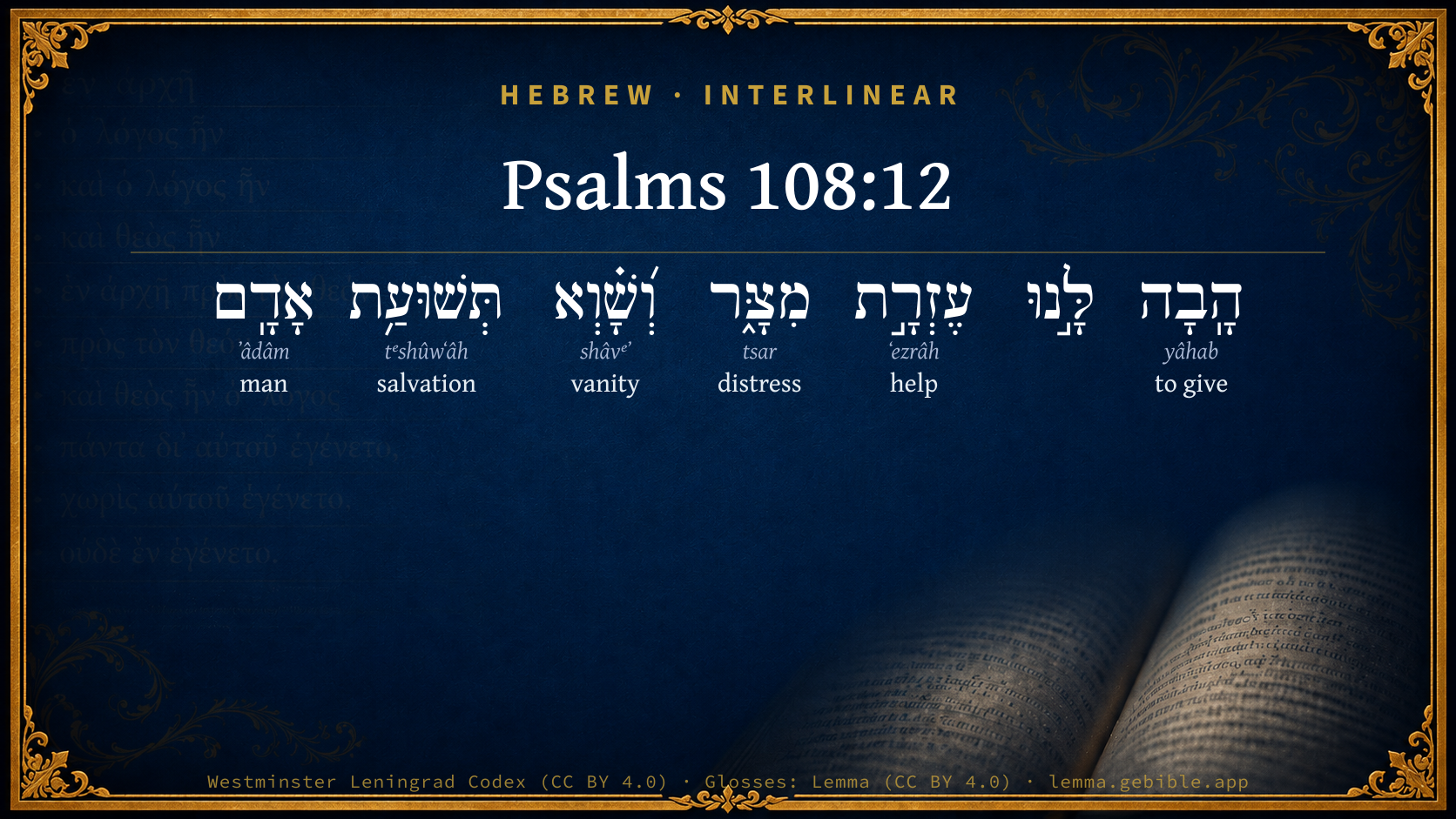
Hebrew (Westminster Leningrad Codex) Psalms 108:12 appears in the Hebrew Old Testament. The text above is from the Westminster Leningrad Codex. Each word links to its Strong’s number, a concise gloss, and parsing drawn from the Open Scriptures Hebrew Bible morphology. Click any word for its full Brown-Driver-Briggs (BDB) entry.
Download image
Cite this verse

Psalms 108:12 (World English Bible). Public Domain. Lemma interlinear Bible study tool, https://lemma.gebible.app/v/psalms/108/12.

Show BibTeX & RIS
BibTeX
RIS
English Translation
Give us help against the enemy, For the help of man is vain.
World English Bible · Public Domain
Download a study sheet

One document with this verse’s original text, its word-by-word gloss line, the meaning frame, cross-references with their text, attributed commentary, and full source and license credits — printable, and it pastes into notes with its structure intact.

This verse Autodidact and up

Study sheet (.html) Plain text (.txt)

A passage Seminary Student

Up to 50 verses in one chapter. A passage sheet keeps up to 6 commentary sources and 12 cross-references per verse, in the order this page ranks them, and says so on the sheet whenever that leaves anything out. Ask for a single verse and you get the Autodidact verse sheet above.

Everything on this page stays free to read, with no account — the sheet is a download of what is already on screen, not access to it.

Want to remove ads? Support Godless Engineer
Compare translations 3

The same verse in 3 English versions, stacked beneath the original-language interlinear above. Click any original word for its lexicon entry.

Each is an independent rendering of the whole verse — the interlinear is not word-aligned to these translations.

Highlighted words mark where these versions differ — a whole-verse word diff, not a word-by-word alignment.

  • World English Bible Public Domain
    Give us help against the enemy, For the help of man is vain.
  • King James Version Public Domain
    Give us help from trouble: for vain is the help of man.
  • unfoldingWord Literal Text CC BY-SA 4.0
    Give to us help against the enemy, and futility the deliverance of man.

unfoldingWord Literal Text — © unfoldingWord, licensed CC BY-SA 4.0. Word-aligned USFM3 via Door43 (git.door43.org/unfoldingWord/en_ult).

Versions to compare (up to 4)

3 of 4 selected

Show all 18 translations

Every available English version of this verse, each an independent rendering of the whole verse.

  • World English Bible Public Domain
    Give us help against the enemy, For the help of man is vain.
  • Berean Standard Bible Public Domain
    Give us aid against the enemy, for the help of man is worthless.
  • Majority Standard Bible Public Domain
    Give us aid against the enemy, for the help of man is worthless.
  • King James Version Public Domain
    Give us help from trouble: for vain is the help of man.
  • American Standard Version (1901) Public Domain
    Give us help against the adversary; For vain is the help of man.
  • Revised Version (1885) Public Domain
    Give us help against the adversary: for vain is the help of man.
  • Geneva Bible (1599) Public Domain
    Giue vs helpe against trouble: for vaine is the helpe of man.
  • Douay-Rheims (1899) Public Domain
    Wilt not thou, O God, who hast cast us off? and wilt not thou, O God, go forth with our armies?
  • Young's Literal Translation Public Domain
    Give to us help from adversity, And vain is the salvation of man.
  • Literal Standard Version CC BY-SA 4.0
    Give to us help from adversity, || And the salvation of man is vain.
  • Unlocked Literal Bible CC BY-SA 4.0
    Give us help against the enemy, for man's help is futile.
  • unfoldingWord Literal Text CC BY-SA 4.0
    Give to us help against the enemy, and futility the deliverance of man.
  • Darby Bible Public Domain
    Give us help from trouble; for vain is man's deliverance.
  • World Messianic Bible Public Domain
    Give us help against the enemy, for the help of man is vain.
  • Webster's Bible Public Domain
    \\108:11\\Wilt not thou, O God, who hast cast us off? and wilt not thou, O God, go forth with our armies?
  • Free Bible Version CC BY-SA 4.0
    Please give us help against our enemies, for human help is worthless.
  • Bible in Basic English Public Domain
    Give us help in our trouble; for there is no help in man.
  • JPS Tanakh (1917) Public Domain
    (108-13) Give us help against the adversary; for vain is the help of man.

Literal Standard Version (2020), Covenant Press — licensed CC BY-SA 4.0. Text via the HelloAO Bible API (eBible.org). Unlocked Literal Bible (unfoldingWord) — licensed CC BY-SA 4.0. Text via the HelloAO Bible API (eBible.org). unfoldingWord Literal Text — © unfoldingWord, licensed CC BY-SA 4.0. Word-aligned USFM3 via Door43 (git.door43.org/unfoldingWord/en_ult). Free Bible Version, Dr. Jonathan Gallagher — licensed CC BY-SA 4.0. Text via the HelloAO Bible API (eBible.org).

Word by word

More ways to search: Search by grammar → Find every occurrence → Compare this word →

Practice this passage: Drill this verse → Learn its vocabulary →

About this verse

These counts appear in no published source. They are computed here, from the morphology-tagged text and Lemma’s own curated glosses. What Lemma adds →

7
words
6
distinct lemmas
Wisdom
section

Shared distinctive vocabulary

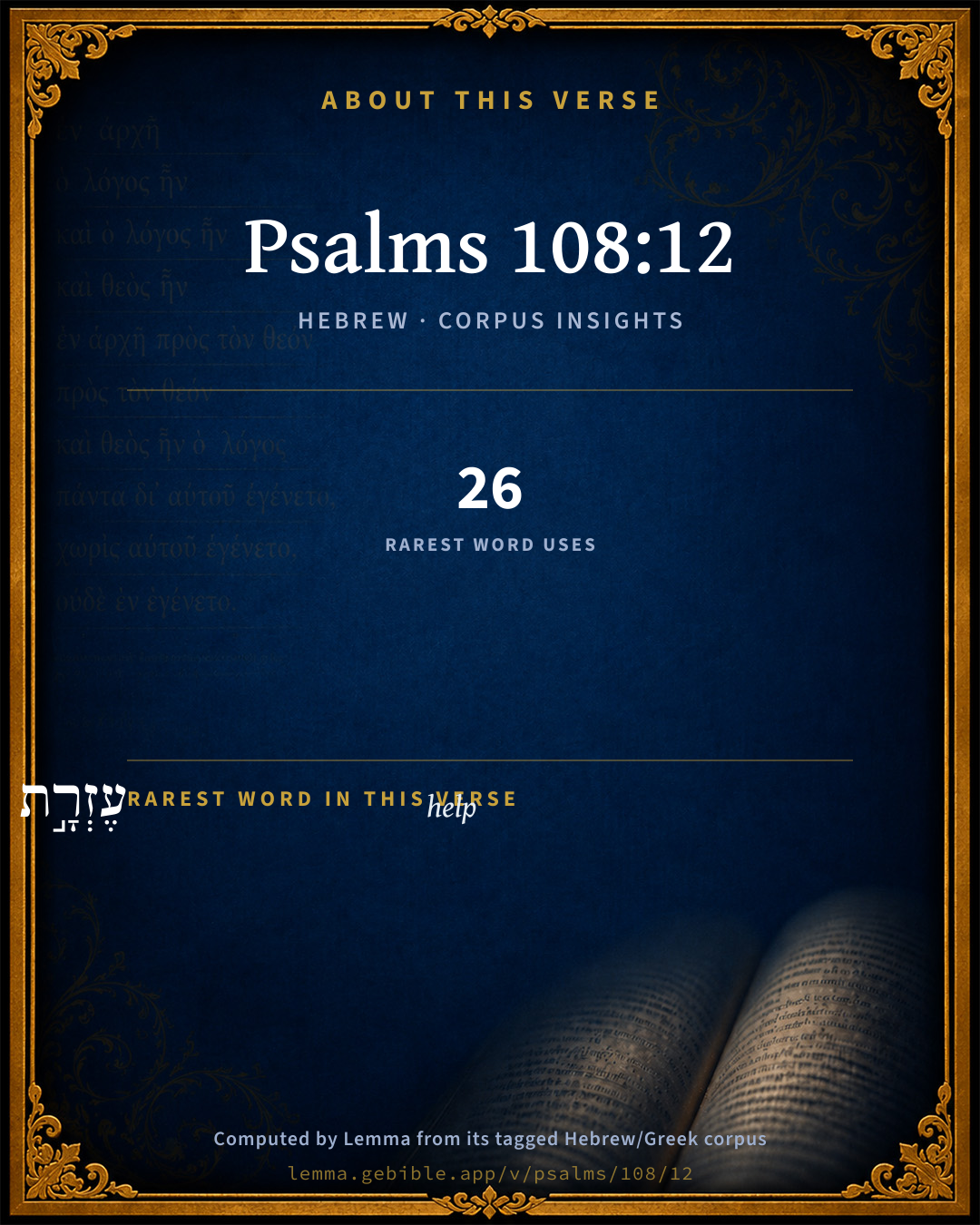
עֶזְרָ֣ת help H5833 occurs in 25 verses of the Hebrew Bible. Also found in:

Grammatical profile

  • 1 verb
  • 5 nouns
  • 1 preposition

Verb forms

  • הָֽבָה Qal · Imperative

Hebrew & Septuagint length

In English translation the verse runs 13 words from the Hebrew and 12 from the Septuagint (LXX English) — closely comparable.

A rough comparison of the two English renderings, which tokenize alike — not a word-level alignment.

Word counts can differ between the Hebrew and the Greek without any difference in meaning — e.g. the Hebrew direct-object marker אֵת has no separate Greek word, and Greek often adds the article ὁ.

Cross-references

9

Topical passages linked to Psalms 108:12 in the Treasury of Scripture Knowledge — connected by theme and wording, ordered by reader-vote popularity; previews shown in the World English Bible.

  • Jeremiah 17:5–8 Thus says Yahweh: Cursed is the man who trusts in man, and makes flesh his arm, and whose heart departs from Yahweh.
  • Psalms 146:3–5 Don't put your trust in princes, Each a son of man in whom there is no help.
  • Isaiah 31:3 Now the Egyptians are men, and not God; and their horses flesh, and not spirit: and when Yahweh shall stretch out his hand, both he who helps shall stumble, and he who is helped shall fall, and they all shall be consumed together.
  • Lamentations 4:17 Our eyes do yet fail [in looking] for our vain help: In our watching we have watched for a nation that could not save.
  • Psalms 20:1–9 May Yahweh answer you in the day of trouble. May the name of the God of Jacob set you up on high,
  • Isaiah 2:22 Stop trusting in man, whose breath is in his nostrils; For of what account is he?
  • Isaiah 30:3–5 Therefore shall the strength of Pharaoh be your shame, and the refuge in the shadow of Egypt your confusion.
  • Job 16:2 "I have heard many such things. Miserable comforters are you all!
  • Job 9:13 "God will not withdraw his anger; The helpers of Rahab stoop under him.

Cross-references courtesy of OpenBible.info (CC BY 4.0).

Hebrew and Greek witnesses Masoretic Hebrew ↔ Greek Septuagint

The same verse in the two great witnesses to the Old Testament, shown verse-for-verse.

You’re reading Greek Psalm 107 (Hebrew Psalm 108). The Septuagint counts the superscription, so verse numbers can differ from the Hebrew — chapter-level alignment, not verse-by-verse. Numbering follows Rahlfs.

These are two independent witnesses, not word-aligned to each other, and the Septuagint is shown in lemma (dictionary) form.

Hebrew Psalms 108:12 Masoretic · Westminster Leningrad Codex

הָֽבָה לָּ֣נוּ עֶזְרָ֣ת מִצָּ֑ר וְ֝שָׁ֗וְא תְּשׁוּעַ֥ת אָדָֽם

Give us help against the enemy, For the help of man is vain.

World English Bible · Public Domain

Greek LXX Greek Psalm 107:12 Septuagint · lemma form

οὐ σύ ὁ θεός ὁ ἀποὠθέω ἐγώ καί οὐ ἐκἔρχομαι ὁ θεός ἐν ὁ δύναμις ἐγώ

Give us help from tribulation: for vain is the help of man.

LXX2012 (modern English Septuagint) · Public Domain

Hebrew: Westminster Leningrad Codex (CC BY 4.0). Greek: Septuagint (public domain); English from LXX2012 (modern English Septuagint) (Public Domain). How the Septuagint differs from the Hebrew →

Commentary

Notes on Psalms 108:12 from classic Christian and Jewish commentators (each source and its license shown beneath its notes). The classic Christian expositions comment on the surrounding passage and are grouped to its opening verse, so a note may address several verses; the Jewish commentaries on the Tanakh (Rashi and others) are per-verse, so they appear only where the commentator wrote on this verse.

Lemma curates 59 commentaries, every one of them public domain or Creative Commons licensed, each selected and text-cleaned for this edition rather than reprinted as found. About our sources →

The Biblical Illustrator

Joseph S. Exell

Psa_108:12

Give us help from trouble: for vain is the help of man.

Help in trouble

I. A very common experience. Trouble.

1. Bodily.

2. Family.

3. Church.

4. Heath.

II. A very certain resource. Betaking ourselves to God in prayer.

1. The resource itself. God. He knows all our troubles. He is ever graciously disposed to help and comfort His people.

2. How the resource is available. By prayer. It may be very short--a mere fragment. But it must be the prayer of conscious need, and of believing supplication.

III. A very evident truth. For vain is the help of man. Good men may give us wise counsel, and they may sympathize sincerely and tenderly, and they may pray for us, and thus be instrumental of good to our souls; but they can neither sustain us in trouble, nor sanctify our sorrows, nor deliver us out of our afflictions.

1. They cannot control our circumstances. But God can; He alone disposes of the conditions of men--raiseth up, or casteth down--enriches, or impoverishes--sends prosperity, or adversity--joy, or grief.

2. They cannot drive back our enemies. Either those in the world, or our spiritual ones; but God can; He can enable us effectually to resist both, and to triumph over them.

3. They cannot turn our afflictions into a blessing. But God can; He is able out of the eater to bring forth meat, and out of the strong to bring forth sweetness.

4. They cannot deliver us from our troubles. Look at Abraham on the mount with Isaac! Jacob meeting Esau! Israelites on way to Red Seal Daniel in den of lions! Hebrews in the fiery furnace! Peter in prison--Paul in the stocks! In all these cases vain would have been the skill and power of man; but God did deliver each and all of them; and He will deliver those who pub their trust in Him. (J. Burns, D. D.)

Human help is of no avail

About twenty years ago a fisherman on the way to his boat met his little boy, who pleaded with him to be taken on the little voyage across to the neighbouring island. The fisherman looked at the waves; they had begun to pub on their white caps of wrath, and the swell of the sea had commenced, and he hesitated; but at last he allowed his boy to go. All seemed well in the smack, till half way across a sudden squall caught the canvas and flung the father and his assistant into the deep. They caught hold of the rope that attached the little boat behind the smack, and climbed in and were saved. Looking back, they saw the smack on her beam end, filling rapidly, and a pale, white little face, the face of the little boy at the cabin window. He had been sent down below when the squall had come. The father, in desperation, flung himself on the sinking smack. One blow of his strong fist shattered the window, and the little face there still looked out, but he cannot escape: what could the father do? The window is too small. The man was nearly demented; he tried to tear the beams from the sinking vessel, but they were too strong; and the little boy, in his homely Scotch, said, Daddy, save me, help me. Deeper and deeper, the smack turned on her side; and the tears streamed down the little white face, and down the face of the despairing father. At last he cried, God help thee, my laddie, I canna. Down went the smack, with a gurgle and a foaming bubble, and that was all. That father never went to sea again. Twenty years passed, and on his death-bed it was the same cry, God help thee, my laddie, I canna. Dear soul, you are in greater danger than that little fisher-lad. Youre sinking! God help you, you immortal soul, youre sinking; and I cannot help you, your father cant, your mother cant. God help thee (J. Robertson.)

.

The Biblical Illustrator, edited by Joseph S. Exell (c. 1880s–1900s) — public domain. Text from a community e-Sword module.

J. A. Alexander on Psalms

Joseph Addison Alexander

13. (Psa 108:12) Give us help from the enemy (or from distress); and (the rather because) vain is the salvation of man, meaning that which he affords. See above, on Psa 60:11, which agrees with this exactly.

Joseph Addison Alexander, The Psalms Translated and Explained (1850) — public domain. Text from a community e-Sword module.

The Cambridge Bible for Schools and Colleges

gen. ed. J. J. S. Perowne

12. from trouble] Or, as R.V., against the adversary. Cp. Psa_108:13.

for vain is the help of man] Lit. salvation. Cp. Psa_108:6. It is a delusion (cp. Psa_33:17) to look to human strength for victory. See Psa_44:6-7; 1Sa_17:47; Jer_17:5; and cp. Jdg_7:4; Jdg_7:7; 1Sa_14:6; 2Ch_14:11; 1Ma_3:16 ff.

The Cambridge Bible for Schools and Colleges (gen. ed. J. J. S. Perowne; Cambridge University Press, 1878–1918) — public domain. Text from a community e-Sword module.

Albert Barnes' Notes on the Bible

Give us help from trouble ... - This is copied from Psa 60:11.

Albert Barnes' Notes on the Bible (1834–1885) — public domain. Text from a community e-Sword/MySword module.

The Treasury of David

Charles H. Spurgeon

Ver. 12. Give us help from trouble: for vain is the help of man. This prayer has often fallen from the lips of men who have been bitterly disappointed by their fellows, and it has also been poured out unto the Lord in the presence of some gigantic labour in which mortal power is evidently of no avail. Edom cannot be entered by any human power, yet from its fastnesses the robber bands come rushing down; therefore, O Lord, do thou interpose and give thy people deliverance. Help divine is expected because help human is of no avail. We ought to pray with all the more confidence in God when our confidence in man is altogether gone. When the help of man is vain, we shall not find it vain to seek the help of God.

Ver. 12. Give us help from trouble, etc. He who would have God's help in any business, must quit confidence in man's help; and the seeing of the vanity of man's help must make the believer to trust the more unto, and expect the more confidently God's help, as here is done. "Give us help from trouble: for vain is the help of man." David Dickson.

Ver. 12. The failure of human help is often

1. The direct cause of our prayer.

2. The source of urgency in pleading.

3. A powerful argument for the pleader.

4. A distinct reason for hope to light upon.

Psalms 108:13*

Charles H. Spurgeon's The Treasury of David (1869–1885) — public domain. Psalms only. Text from a community e-Sword/MySword module.

The Pulpit Commentary

Give us help from trouble: for vain is the help of man. Completely identical with Psa_60:11.

The Pulpit Commentary (1880–1919), ed. H.D.M. Spence-Jones & Joseph S. Exell — public domain. Text from a community e-Sword module.

Lesson kit

Teaching starters — assembled from the data on this page, not authored interpretation. Every prompt links to the verse data it draws on. Edit before teaching.

Psalms, in the Wisdom, opens this verse with 7 words (6 distinct Hebrew lemmas). Its most distinctive word is ʻezrâh (“help”). A historical commentator’s framing appears above. Read the whole chapter for the surrounding context.

Discussion questions

  1. What does “help” (ʻezrâh) contribute to the verse as a whole?
  2. Judges 5:23 shares the word «help» with this verse. How do the two illuminate each other?
  3. These translations render this verse differently. What is at stake in choosing one wording over another?
  4. The verb «הָֽבָה» is Qal Imperative. How does its form color the action?
  5. Reading how The Biblical Illustrator and J. A. Alexander on Psalms read this verse, where do the two commentators agree and where do they part?

Things to notice

Reading settings

Reading text

Shown beneath each verse's original-language words.

Old Testament
Old Testament edition

Read the OT as the Masoretic Hebrew (MT) or the Greek Septuagint (LXX).

English shown for the Greek Septuagint (in the Hebrew ↔ Greek comparison).

Comparing translations? Open the Compare panel on any verse page to stack up to four side by side.