
Psalms 107:28

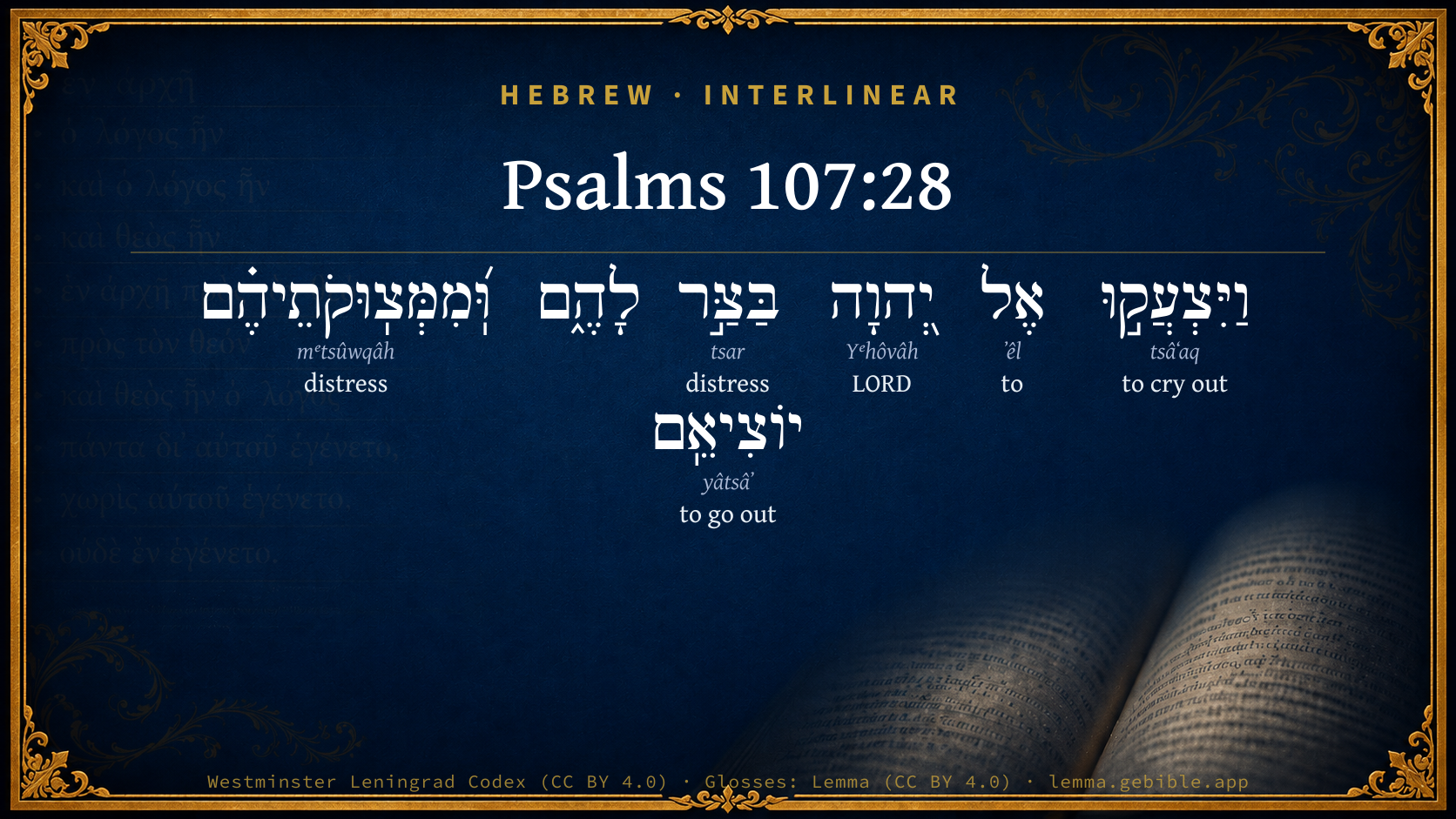
Hebrew (Westminster Leningrad Codex) Psalms 107:28 appears in the Hebrew Old Testament. The text above is from the Westminster Leningrad Codex. Each word links to its Strong’s number, a concise gloss, and parsing drawn from the Open Scriptures Hebrew Bible morphology. Click any word for its full Brown-Driver-Briggs (BDB) entry.
Download image
Cite this verse

Psalms 107:28 (World English Bible). Public Domain. Lemma interlinear Bible study tool, https://lemma.gebible.app/v/psalms/107/28.

Show BibTeX & RIS
BibTeX
RIS
English Translation
Then they cry to Yahweh in their trouble, And he brings them out of their distress.
World English Bible · Public Domain
Download a study sheet

One document with this verse’s original text, its word-by-word gloss line, the meaning frame, cross-references with their text, attributed commentary, and full source and license credits — printable, and it pastes into notes with its structure intact.

This verse Autodidact and up

Study sheet (.html) Plain text (.txt)

A passage Seminary Student

Up to 50 verses in one chapter. A passage sheet keeps up to 6 commentary sources and 12 cross-references per verse, in the order this page ranks them, and says so on the sheet whenever that leaves anything out. Ask for a single verse and you get the Autodidact verse sheet above.

Everything on this page stays free to read, with no account — the sheet is a download of what is already on screen, not access to it.

Want to remove ads? Support Godless Engineer
Compare translations 3

The same verse in 3 English versions, stacked beneath the original-language interlinear above. Click any original word for its lexicon entry.

Each is an independent rendering of the whole verse — the interlinear is not word-aligned to these translations.

Highlighted words mark where these versions differ — a whole-verse word diff, not a word-by-word alignment.

  • World English Bible Public Domain
    Then they cry to Yahweh in their trouble, And he brings them out of their distress.
  • King James Version Public Domain
    Then they cry unto the LORD in their trouble, and he bringeth them out of their distresses.
  • unfoldingWord Literal Text CC BY-SA 4.0
    Then they cried out to Yahweh in the distressing to them and he rescued them from their distresses.

unfoldingWord Literal Text — © unfoldingWord, licensed CC BY-SA 4.0. Word-aligned USFM3 via Door43 (git.door43.org/unfoldingWord/en_ult).

Versions to compare (up to 4)

3 of 4 selected

Show all 18 translations

Every available English version of this verse, each an independent rendering of the whole verse.

  • World English Bible Public Domain
    Then they cry to Yahweh in their trouble, And he brings them out of their distress.
  • Berean Standard Bible Public Domain
    Then they cried out to the LORD in their trouble, and He brought them out of their distress.
  • Majority Standard Bible Public Domain
    Then they cried out to the LORD in their trouble, and He brought them out of their distress.
  • King James Version Public Domain
    Then they cry unto the LORD in their trouble, and he bringeth them out of their distresses.
  • American Standard Version (1901) Public Domain
    Then they cry unto Jehovah in their trouble, And he bringeth them out of their distresses.
  • Revised Version (1885) Public Domain
    Then they cry unto the LORD in their trouble, and he bringeth them out of their distresses.
  • Geneva Bible (1599) Public Domain
    Then they crie vnto the Lord in their trouble, and he bringeth them out of their distresse.
  • Douay-Rheims (1899) Public Domain
    And they cried to the Lord in their affliction: and he brought them out of their distresses.
  • Young's Literal Translation Public Domain
    And they cry to Jehovah in their adversity, And from their distresses He bringeth them out.
  • Literal Standard Version CC BY-SA 4.0
    And they cry to YHWH in their adversity, || And He brings them out from their distresses.
  • Unlocked Literal Bible CC BY-SA 4.0
    Then they called out to Yahweh in their trouble, and he brought them out of their distress.
  • unfoldingWord Literal Text CC BY-SA 4.0
    Then they cried out to Yahweh in the distressing to them and he rescued them from their distresses.
  • Darby Bible Public Domain
    Then they cry unto Jehovah in their trouble, and he bringeth them out of their distresses;
  • World Messianic Bible Public Domain
    Then they cry to the LORD in their trouble, and he brings them out of their distress.
  • Webster's Bible Public Domain
    Then they cry to the LORD in their trouble, and he bringeth them out of their distresses.
  • Free Bible Version CC BY-SA 4.0
    Then they cried out to the Lord to help them in their troubles, and he saved them from their suffering.
  • Bible in Basic English Public Domain
    Then they send up their cry to the Lord in their sorrow, and he gives them salvation out of all their troubles.
  • JPS Tanakh (1917) Public Domain
    They cried unto the LORD in their trouble, and He brought them out of their distresses.

Literal Standard Version (2020), Covenant Press — licensed CC BY-SA 4.0. Text via the HelloAO Bible API (eBible.org). Unlocked Literal Bible (unfoldingWord) — licensed CC BY-SA 4.0. Text via the HelloAO Bible API (eBible.org). unfoldingWord Literal Text — © unfoldingWord, licensed CC BY-SA 4.0. Word-aligned USFM3 via Door43 (git.door43.org/unfoldingWord/en_ult). Free Bible Version, Dr. Jonathan Gallagher — licensed CC BY-SA 4.0. Text via the HelloAO Bible API (eBible.org).

Word by word

More ways to search: Search by grammar → Find every occurrence → Compare this word →

Practice this passage: Drill this verse → Learn its vocabulary →

וּֽ֝מִמְּצֽוּקֹתֵיהֶ֗ם
mᵉtsûwqâh
H4691
“and · from · distresses · their”
Conjunction + Preposition + Noun, Common, Feminine, Plural, Construct + Suffix, Personal, 3rd Person, Masculine, Plural
Part of Speech
Conjunction + Preposition + Noun
Type
Common
Gender
Feminine
Number
Plural
State
Construct
Full BDB Definition

Origin: from H4690

TWOT: 1895e

straitness, distress, straits, stress
  1. וַיִּצְעֲק֣וּ tsâʻaq H6817 “and · to cry out” Conjunction + Verb, Qal, Sequential Imperfect, 3rd Person, Masculine, Plural
  2. אֶל ʼêl H413 “to” Preposition
  3. יְ֭הוָה Yᵉhôvâh H3068 “LORD” Noun, Proper
  4. בַּצַּ֣ר tsar H6862 “in/at the · distress” Preposition, Determined + Adjective, Adjective, Masculine, Singular, Absolute
  5. יוֹצִיאֵֽם yâtsâʼ H3318 “to go out · them” Verb, Hiphil, Imperfect, 3rd Person, Masculine, Singular + Suffix, Personal, 3rd Person, Masculine, Plural

About this verse

These counts appear in no published source. They are computed here, from the morphology-tagged text and Lemma’s own curated glosses. What Lemma adds →

7
words
6
distinct lemmas
Wisdom
section

Notable vocabulary

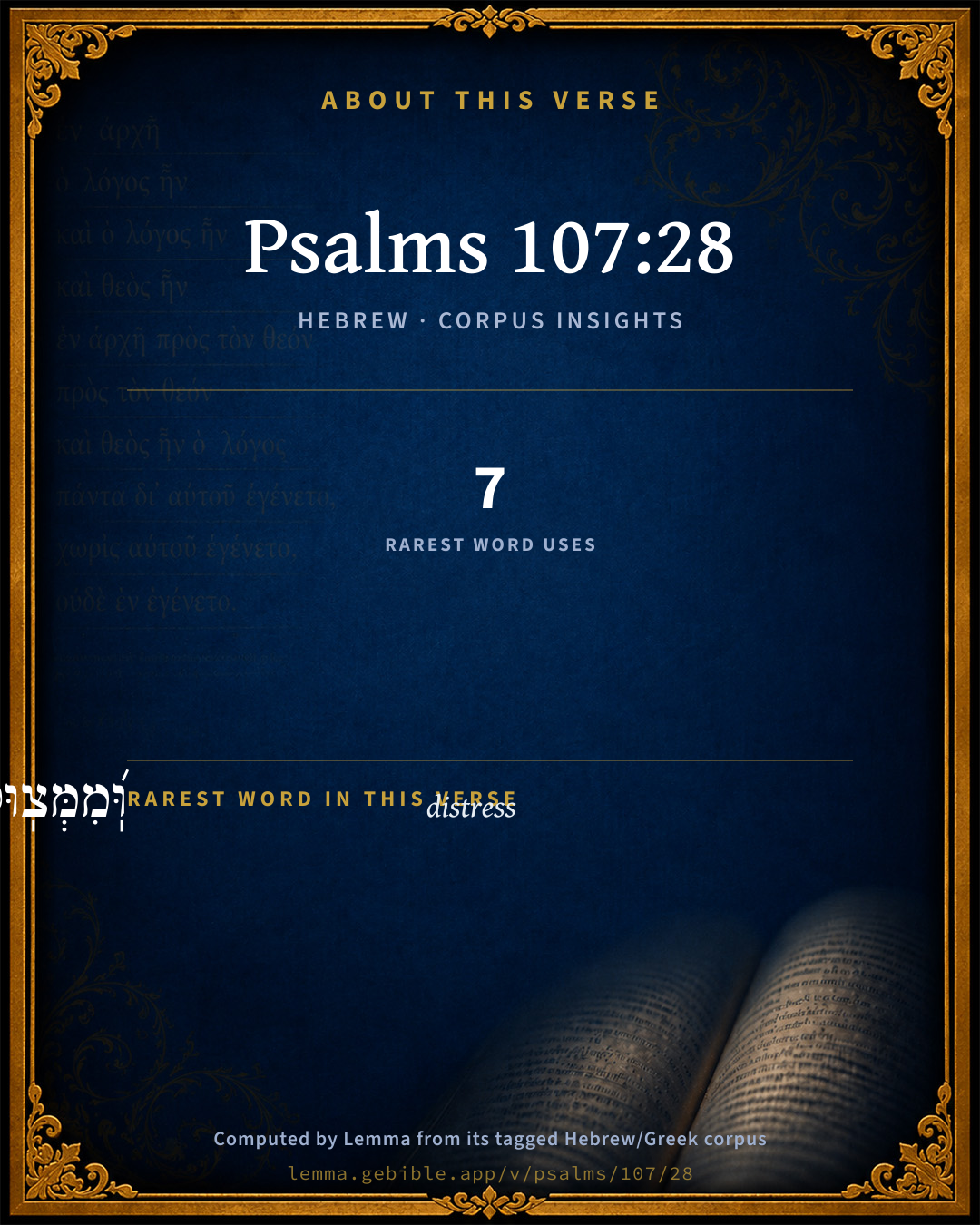
The rarest word here is וּֽ֝מִמְּצֽוּקֹתֵיהֶ֗ם distress H4691 — appearing just 7 times in the whole Hebrew Bible.

Shared distinctive vocabulary

וּֽ֝מִמְּצֽוּקֹתֵיהֶ֗ם distress H4691 occurs in 7 verses of the Hebrew Bible. Also found in:

Grammatical profile

  • 2 verbs
  • 2 nouns
  • 1 adjective
  • 2 prepositions

Verb forms

  • וַיִּצְעֲק֣וּ Qal · Sequential Imperfect
  • יוֹצִיאֵֽם Hiphil · Imperfect

Hebrew & Septuagint length

In English translation the verse runs 16 words from the Hebrew and 17 from the Septuagint (LXX English) — closely comparable.

A rough comparison of the two English renderings, which tokenize alike — not a word-level alignment.

Word counts can differ between the Hebrew and the Greek without any difference in meaning — e.g. the Hebrew direct-object marker אֵת has no separate Greek word, and Greek often adds the article ὁ.

Cross-references

7

Topical passages linked to Psalms 107:28 in the Treasury of Scripture Knowledge — connected by theme and wording, ordered by reader-vote popularity; previews shown in the World English Bible.

  • Psalms 107:13 Then they cried to Yahweh in their trouble, And he saved them out of their distresses.
  • Psalms 107:19 Then they cry to Yahweh in their trouble, He saves them out of their distresses.
  • Matthew 8:25 They came to him, and woke him up, saying, "Save us, Lord! We are dying!"
  • Psalms 107:6 Then they cried to Yahweh in their trouble, And he delivered them out of their distresses,
  • Acts 27:23–25 For there stood by me this night an angel, belonging to the God whose I am and whom I serve,
  • Jonah 1:5–6 Then the mariners were afraid, and cried every man to his god. They threw the cargo that was in the ship into the sea, to lighten it. But Jonah had gone down into the innermost parts of the ship, and he was laying down, and was fast asleep.
  • Jonah 1:14 Therefore they cried to Yahweh, and said, "We beg you, Yahweh, we beg you, let us not perish for this man's life, and don't lay on us innocent blood; for you, Yahweh, have done as it pleased you."

Cross-references courtesy of OpenBible.info (CC BY 4.0).

Hebrew and Greek witnesses Masoretic Hebrew ↔ Greek Septuagint

The same verse in the two great witnesses to the Old Testament, shown verse-for-verse.

You’re reading Greek Psalm 106 (Hebrew Psalm 107). The Septuagint counts the superscription, so verse numbers can differ from the Hebrew — chapter-level alignment, not verse-by-verse. Numbering follows Rahlfs.

These are two independent witnesses, not word-aligned to each other, and the Septuagint is shown in lemma (dictionary) form.

Hebrew Psalms 107:28 Masoretic · Westminster Leningrad Codex

וַיִּצְעֲק֣וּ אֶל יְ֭הוָה בַּצַּ֣ר לָהֶ֑ם וּֽ֝מִמְּצֽוּקֹתֵיהֶ֗ם יוֹצִיאֵֽם

Then they cry to Yahweh in their trouble, And he brings them out of their distress.

World English Bible · Public Domain

Greek LXX Greek Psalm 106:28 Septuagint · lemma form

καί κράζω πρός κύριος ἐν ὁ θλίβω αὐτός καί ἐκ ὁ ἀνάγκη αὐτός ἐκἄγω αὐτός

Then they cry to the Lord in their affliction, and he brings them out of their distresses.

LXX2012 (modern English Septuagint) · Public Domain

Hebrew: Westminster Leningrad Codex (CC BY 4.0). Greek: Septuagint (public domain); English from LXX2012 (modern English Septuagint) (Public Domain). How the Septuagint differs from the Hebrew →

Commentary

Notes on Psalms 107:28 from classic Christian and Jewish commentators (each source and its license shown beneath its notes). The classic Christian expositions comment on the surrounding passage and are grouped to its opening verse, so a note may address several verses; the Jewish commentaries on the Tanakh (Rashi and others) are per-verse, so they appear only where the commentator wrote on this verse.

Lemma curates 59 commentaries, every one of them public domain or Creative Commons licensed, each selected and text-cleaned for this edition rather than reprinted as found. About our sources →

Trapp's Complete Commentary

John Trapp

Psa 107:28 Then they cry unto the LORD in their trouble, and he bringeth them out of their distresses.

Ver. 28. Then they cry unto the Lord] "Then," if ever: hence that speech of one, Qui nescit orare, discat navigare, He who cannot pray, let him go to sea, and there he will learn. See Psa 107:6.

John Trapp, A Commentary or Exposition upon All the Books of the Old and New Testament (1647–1656) — public domain. Text from a community e-Sword module.

J. A. Alexander on Psalms

Joseph Addison Alexander

28. (Psa 107:28) And they cried to Jehovah in their distress, and out of their straits he brings them forth. The consecution of the tenses corresponds to the relation of the acts which they denote, as viewed by a spectator. "Now they have cried to the Lord, and now he is bringing them forth." The verse differs from Psa 107:13; Psa 107:19, in the first verb, which agrees with Psa 107:6, and in the last verb, which is unlike both.

Joseph Addison Alexander, The Psalms Translated and Explained (1850) — public domain. Text from a community e-Sword module.

Ellicott's Commentary for English Readers

(28) Then they cry.—There is a saying,

“Qui nescit orare, discat navigare.”

A Bible Commentary for English Readers, edited by Charles John Ellicott (1878–1897) — public domain. Text from a community e-Sword module.

The Cambridge Bible for Schools and Colleges

gen. ed. J. J. S. Perowne

28. Kay quotes a Basque proverb, “Let him who knows not how to pray go to sea.”

he bringeth them &c.] Cp. Psa_25:17.

The Cambridge Bible for Schools and Colleges (gen. ed. J. J. S. Perowne; Cambridge University Press, 1878–1918) — public domain. Text from a community e-Sword module.

John Gill's Exposition

Oh that men would praise the Lord for his goodness,.... Seafaring men particularly, before mentioned, as Jonah's mariners did, Jon 1:16, or all the four sorts of persons instanced in, as Kimchi thinks: and even all men whatsoever should do this, high and low, rich and poor, of every age, sex, and condition; since they all receive favours from the Lord, and should return thanks to him; and especially good men, who are blessed with spiritual blessings by him: these should all

confess to the Lord his goodness; as it may be rendered; see Gill on Psa 107:15, they should own the mercy received as the Lord's doing, and acknowledge their unworthiness of it, and give him the glory of it.

And for his wonderful works to the children of men! or, "confess and declare his wonderful works to the children of men": the wonderful works of creation and providence, which those that go to sea, see in the deeps, and everything of the same kind which others observe; and especially the wonderful works of grace, or what God has done in a wonderful manner for the souls of his people; see Psa 66:16.

John Gill's Exposition of the Whole Bible (1746–1763) — public domain (CC PDM 1.0). Text via the HelloAO Bible API.

Albert Barnes' Notes on the Bible

Then they cry unto the Lord in their trouble ... - See Psa 107:6, Psa 107:13, Psa 107:19. Sailors pray. If they do not pray elsewhere, they often do in a storm, when in danger of being wrecked and lost. A storm at sea brings hundreds on their knees who never prayed before - for they feel that their only help is in God, and that it is a fearful thing to die. Then they do “right.” They do what “ought” to be done. But they do then only what people ought always to do, for it is as plain a duty to pray when we are in safety as when we are in danger; when sailing on a smooth sea as in a storm; when on the land as on the ocean. People anywhere, and at any time may die; and people everywhere and at all times “should,” therefore, call upon God. Storms, tempests, fire, disease, and danger, only impel people to do what they should do always from higher motives, and when their motives will be likely to be more disinterested and pure.

Albert Barnes' Notes on the Bible (1834–1885) — public domain. Text from a community e-Sword/MySword module.

The Treasury of David

Charles H. Spurgeon

Ver. 28. Then they cry unto the LORD in their trouble. Though at their wit's end, they had wit enough to pray; their heart was melted, and it ran out in cries for help. This was well and ended well, for it is written,

And he brought them out of their distresses. Prayer is good in a storm. We may pray staggering and reeling, and pray when we are at our wit's end. God will hear us amid the thunder and answer us out of the storm. He brought their distresses upon the mariners, and therefore they did well to turn to him for the removal of them; nor did they look in vain.

Ver. 28. They cry unto the LORD. His attributes are much honoured in calling upon him, especially in times of danger and distresses.

1. When you call upon God at sea, you honour his sovereignty. God says to these proud waves, "So far and no farther!" So, "the storm and hail", they fulfil his will, and when he pleases he commands a calm.

2. Prayer in time of danger honours God's wisdom, when we see no way open for mercies and deliverance to come in at, then to look up to him, believing, "He knows how to deliver out of temptation." O how much of the wisdom of God appears in preservation in time of danger! and is it not a good token of mercy coming in when persons pray, though all visible ways are blocked up? This honours God's wisdom, which we acknowledge is never at a loss as to ways of bringing in mercy and deliverance.

3. The faithfulness of God is much honoured in times of danger, when he is called upon. The faithfulness of a friend doth most appear in a strait: now if you can rely upon his promise, God's faithfulness is the best line men sinking at sea can lay hold on. So I might add, calling upon God honours all his other attributes. John Ryther (1632-1681) in "A Plat for Mariners; or, The Seaman's Preacher", 1675.

Ver. 28. Then they cry. Tempestuous storms and deadly dangers have brought those upon their knees, that would never had bent in a calm: "Then they cry." If any one would know at what time the sailors take up the duty of prayer, let me say it is when death stares them in the face. If ever you see the heavens veiled in sable blackness, the clouds flying, and the winds roaring under them; you may conclude that some of them (though God knows but few) are at prayer, yea, hard at it with their God. But never believe it that there is any prayer amongst them when the skies are calm, the winds down, and the seas smooth. David tells you not of their praying in good and comfortable weather, but that it is in time of storms, for I believe that neither he nor I ever saw many of them on that strain...

God hears oftener from an afflicted people, than he either does or can from a people that are at ease, quiet, and out of danger. Then they cry. The prodigal son was very high, and resolved never to return till brought low by pinching and nipping afflictions, then his father had some tidings of him. Hagar was proud in Abraham's house, but humbled in the wilderness. Jonah was asleep in the ship, but awake and at prayer in the whale's belly, Jon 2:1. Manasses lived in Jerusalem like a libertine, but when bound in chains at Babel, his heart was turned to the Lord, 2Ch 33:11-12. Corporal diseases forced many under the gospel to come to Christ, whereas others that enjoyed bodily health would not acknowledge him. One would think that the Lord would abhor to hear those prayers that are made only out of the fear of danger, and not out of the love, reality, and sincerity of the heart. If there had not been so many miseries of blindness, lameness, palsies, fevers, etc., in the days of Christ, there would not have been that flocking after him. Daniel Pell.

Ver. 28. Then they cry unto the LORD. "Then", if ever: hence that speech of one, Qui nescit orare, discat navigare, He that cannot pray, let him go to sea, and there he will learn. John Trapp.

Ver. 28. Then they cry, etc. Gods of the sea and skies (for what resource have I but prayer?) abstain from rending asunder the joints of our shattered bark. Ovid.

Psalms 107:29*

Charles H. Spurgeon's The Treasury of David (1869–1885) — public domain. Psalms only. Text from a community e-Sword/MySword module.

The Pulpit Commentary

Then they cry unto the Lord in their trouble, and he bringeth them out of their distresses. Practically identical with vers. 6, 13, and 19.

The Pulpit Commentary (1880–1919), ed. H.D.M. Spence-Jones & Joseph S. Exell — public domain. Text from a community e-Sword module.

unfoldingWord translationNotes

Door43 World Missions Community

Then they called out to Yahweh in their trouble

It is implied that they are praying to Yahweh so that he will help them. See how you translated this in Psalms 107:6. AT: "Then they prayed to Yahweh to help them in their trouble" (See: Assumed Knowledge and Implicit Information)

Then they

The word "they" refers to the sailors.

He calmed the storm

"He made the wind stop"

the waves were stilled

This can be stated in active form. AT: "he made the waves still" (See: Active or Passive)

he brought them

"he guided them"

their desired harbor

"to the harbor where they wanted to go"

translationWords

Yahweh

trouble

joy

unfoldingWord translationNotes — © Distant Shores Media and the Door43 World Missions Community, licensed CC BY-SA 4.0. Source: git.door43.org/Door43/en_tn.

Lesson kit

Teaching starters — assembled from the data on this page, not authored interpretation. Every prompt links to the verse data it draws on. Edit before teaching.

Psalms, in the Wisdom, opens this verse with 7 words (6 distinct Hebrew lemmas). Its most distinctive word is mᵉtsûwqâh (“distress”). A historical commentator’s framing appears above. Read the whole chapter for the surrounding context.

Discussion questions

  1. What does “distress” (mᵉtsûwqâh) contribute to the verse as a whole?
  2. Job 15:24 shares the word «distress» with this verse. How do the two illuminate each other?
  3. The translations on this page render this verse differently — a whole-verse word diff, not a word-by-word alignment. What might account for the different wordings?
  4. The verb «וַיִּצְעֲק֣וּ» is Qal Sequential Imperfect. How does its form color the action?
  5. Reading how Trapp's Complete Commentary and J. A. Alexander on Psalms read this verse, where do the two commentators agree and where do they part?

Things to notice

Reading settings

Reading text

Shown beneath each verse's original-language words.

Old Testament
Old Testament edition

Read the OT as the Masoretic Hebrew (MT) or the Greek Septuagint (LXX).

English shown for the Greek Septuagint (in the Hebrew ↔ Greek comparison).

Comparing translations? Open the Compare panel on any verse page to stack up to four side by side.