
Psalms 44:5

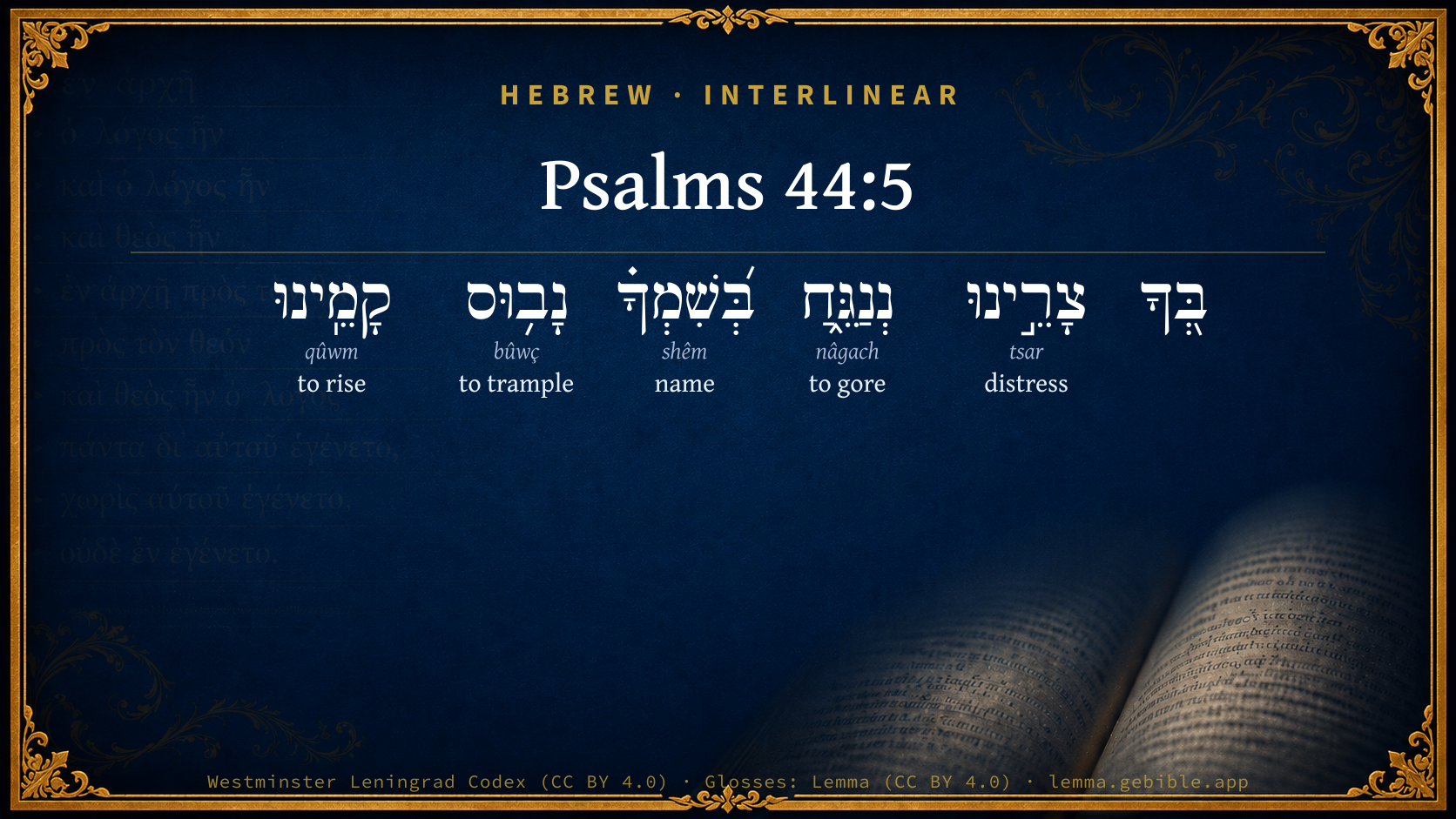
Hebrew (Westminster Leningrad Codex) Psalms 44:5 appears in the Hebrew Old Testament. The text above is from the Westminster Leningrad Codex. Each word links to its Strong’s number, a concise gloss, and parsing drawn from the Open Scriptures Hebrew Bible morphology. Click any word for its full Brown-Driver-Briggs (BDB) entry.
Download image
Cite this verse

Psalms 44:5 (World English Bible). Public Domain. Lemma interlinear Bible study tool, https://lemma.gebible.app/v/psalms/44/5.

Show BibTeX & RIS
BibTeX
RIS
English Translation
Through you, will we push down our adversaries. Through your name, will we tread them under who rise up against us.
World English Bible · Public Domain
Highlights
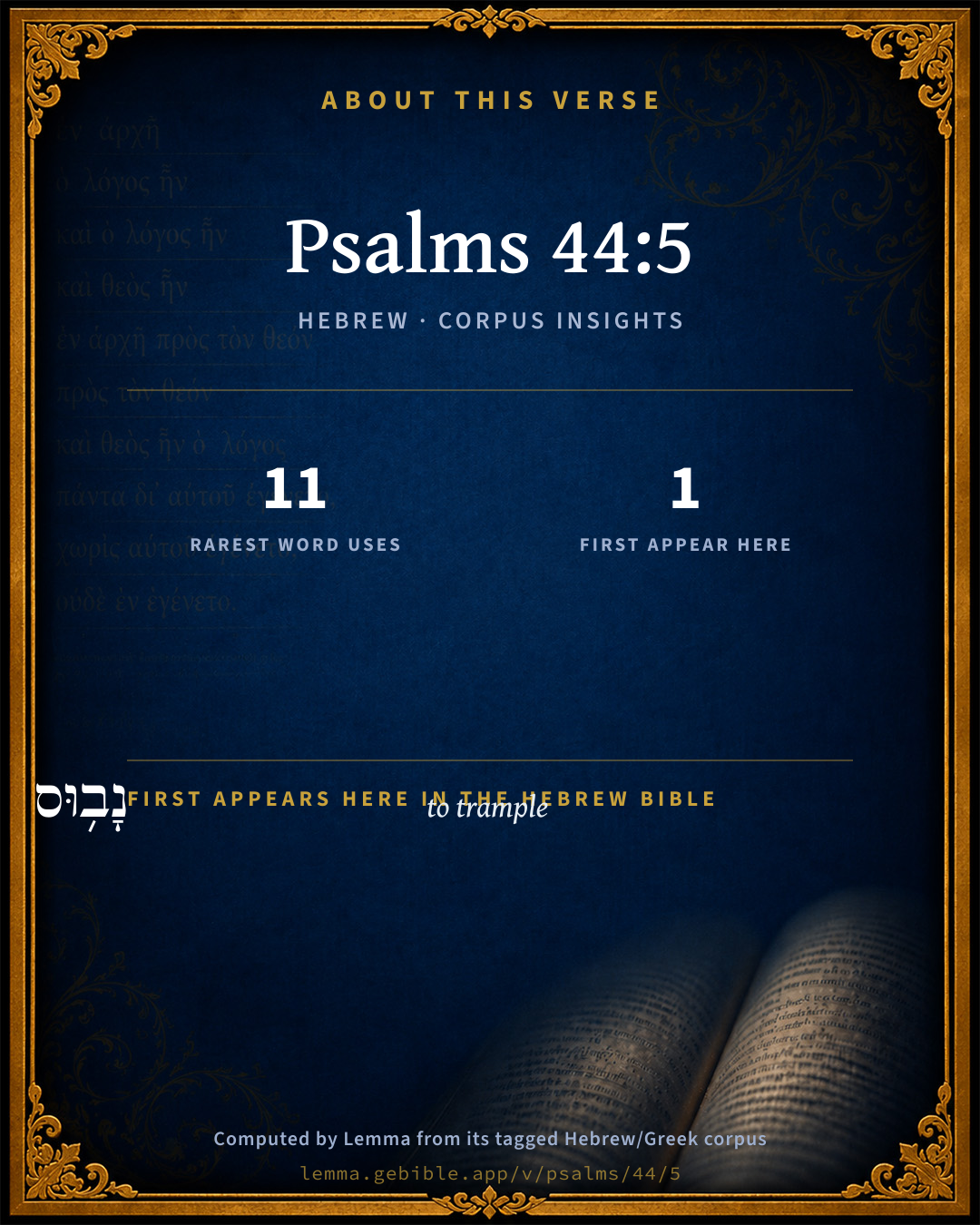
  • 1 first appearance in the Hebrew Bible
Full analysis ↓
Download a study sheet

One document with this verse’s original text, its word-by-word gloss line, the meaning frame, cross-references with their text, attributed commentary, and full source and license credits — printable, and it pastes into notes with its structure intact.

This verse Autodidact and up

Study sheet (.html) Plain text (.txt)

A passage Seminary Student

Up to 50 verses in one chapter. A passage sheet keeps up to 6 commentary sources and 12 cross-references per verse, in the order this page ranks them, and says so on the sheet whenever that leaves anything out. Ask for a single verse and you get the Autodidact verse sheet above.

Everything on this page stays free to read, with no account — the sheet is a download of what is already on screen, not access to it.

Want to remove ads? Support Godless Engineer
Compare translations 3

The same verse in 3 English versions, stacked beneath the original-language interlinear above. Click any original word for its lexicon entry.

Each is an independent rendering of the whole verse — the interlinear is not word-aligned to these translations.

Highlighted words mark where these versions differ — a whole-verse word diff, not a word-by-word alignment.

  • World English Bible Public Domain
    Through you, will we push down our adversaries. Through your name, will we tread them under who rise up against us.
  • King James Version Public Domain
    Through thee will we push down our enemies: through thy name will we tread them under that rise up against us.
  • unfoldingWord Literal Text CC BY-SA 4.0
    By you we gore our enemies; by your name we trample the ones arising us.

unfoldingWord Literal Text — © unfoldingWord, licensed CC BY-SA 4.0. Word-aligned USFM3 via Door43 (git.door43.org/unfoldingWord/en_ult).

Versions to compare (up to 4)

3 of 4 selected

Show all 18 translations

Every available English version of this verse, each an independent rendering of the whole verse.

  • World English Bible Public Domain
    Through you, will we push down our adversaries. Through your name, will we tread them under who rise up against us.
  • Berean Standard Bible Public Domain
    Through You we repel our foes; through Your name we trample our enemies.
  • Majority Standard Bible Public Domain
    Through You we repel our foes; through Your name we trample our enemies.
  • King James Version Public Domain
    Through thee will we push down our enemies: through thy name will we tread them under that rise up against us.
  • American Standard Version (1901) Public Domain
    Through thee will we push down our adversaries: Through thy name will we tread them under that rise up against us.
  • Revised Version (1885) Public Domain
    Through thee will we push down our adversaries: through thy name will we tread them under that rise up against us.
  • Geneva Bible (1599) Public Domain
    Through thee haue we thrust backe our aduersaries: by thy Name haue we troden downe them that rose vp against vs.
  • Douay-Rheims (1899) Public Domain
    Thou art thyself my king and my God, who commandest the saving of Jacob.
  • Young's Literal Translation Public Domain
    By Thee our adversaries we do push, By Thy name tread down our withstanders,
  • Literal Standard Version CC BY-SA 4.0
    By You we push our adversaries, || By Your Name we tread down our withstanders,
  • Unlocked Literal Bible CC BY-SA 4.0
    Through you we will push down our adversaries; through your name we will tread them under, those who rise up against us.
  • unfoldingWord Literal Text CC BY-SA 4.0
    By you we gore our enemies; by your name we trample the ones arising us.
  • Darby Bible Public Domain
    Through thee will we push down our adversaries; through thy name will we tread them under that rise up against us.
  • World Messianic Bible Public Domain
    Through you, we will push down our adversaries. Through your name, we will tread down those who rise up against us.
  • Webster's Bible Public Domain
    \\44:4\\Thou art my King, O God: command deliverances for Jacob.
  • Free Bible Version CC BY-SA 4.0
    Only through you can we repel our enemies; only in your name can we defeat our opponents.
  • Bible in Basic English Public Domain
    Through you will we overcome our haters; by your name will they be crushed under our feet who are violent against us.
  • JPS Tanakh (1917) Public Domain
    (44-6) Through Thee do we push down our adversaries; through Thy name do we tread them under that rise up against us.

Literal Standard Version (2020), Covenant Press — licensed CC BY-SA 4.0. Text via the HelloAO Bible API (eBible.org). Unlocked Literal Bible (unfoldingWord) — licensed CC BY-SA 4.0. Text via the HelloAO Bible API (eBible.org). unfoldingWord Literal Text — © unfoldingWord, licensed CC BY-SA 4.0. Word-aligned USFM3 via Door43 (git.door43.org/unfoldingWord/en_ult). Free Bible Version, Dr. Jonathan Gallagher — licensed CC BY-SA 4.0. Text via the HelloAO Bible API (eBible.org).

Word by word

More ways to search: Search by grammar → Find every occurrence → Compare this word →

Practice this passage: Drill this verse → Learn its vocabulary →

About this verse

These counts appear in no published source. They are computed here, from the morphology-tagged text and Lemma’s own curated glosses. What Lemma adds →

6
words
5
distinct lemmas
Wisdom
section

Notable vocabulary

The rarest word here is נְנַגֵּ֑חַ to gore H5055 — appearing just 11 times in the whole Hebrew Bible.

First appearance in Scripture

This word makes its first canonical appearance in the Hebrew Bible here:

  • נָב֥וּס to trample H947

Shared distinctive vocabulary

נְנַגֵּ֑חַ to gore H5055 occurs in 10 verses of the Hebrew Bible. Also found in:

Grammatical profile

  • 3 verbs
  • 2 nouns
  • 1 preposition

Verb forms

  • נְנַגֵּ֑חַ Piel · Imperfect
  • נָב֥וּס Qal · Imperfect
  • קָמֵֽינוּ Qal · Participle Active

Hebrew & Septuagint length

In English translation the verse runs 21 words from the Hebrew and 23 from the Septuagint (LXX English) — closely comparable.

A rough comparison of the two English renderings, which tokenize alike — not a word-level alignment.

Word counts can differ between the Hebrew and the Greek without any difference in meaning — e.g. the Hebrew direct-object marker אֵת has no separate Greek word, and Greek often adds the article ὁ.

Cross-references

12

Topical passages linked to Psalms 44:5 in the Treasury of Scripture Knowledge — connected by theme and wording, ordered by reader-vote popularity; previews shown in the World English Bible.

  • Psalms 108:13 Through God, we will do valiantly. For it is he who will tread down our enemies.
  • Psalms 60:12 Through God we shall do valiantly, For it is he who will tread down our adversaries.
  • Psalms 118:10–13 All the nations surrounded me, But in the name of Yahweh, I cut them off.
  • Philippians 4:13 I can do all things through Christ, who strengthens me.
  • Deuteronomy 33:17 The firstborn of his herd, majesty is his; His horns are the horns of the wild-ox: With them he shall push the peoples all of them, [even] the ends of the earth: They are the ten thousands of Ephraim, They are the thousands of Manasseh.
  • Daniel 8:4 I saw the ram pushing westward, and northward, and southward; and no animals could stand before him, neither was there any who could deliver out of his hand; but he did according to his will, and magnified himself.
  • Zechariah 10:5 They shall be as mighty men, Treading down muddy streets in the battle; And they shall fight, because Yahweh is with them; And the riders on horses will be confounded.
  • Psalms 91:13 You will tread on the lion and cobra. You will trample the young lion and the serpent underfoot.
  • Isaiah 41:14–16 Don't be afraid, you worm Jacob, and you men of Israel; I will help you, says Yahweh, and your Redeemer is the Holy One of Israel.
  • 1 Kings 22:11 Zedekiah the son of Chenaanah made him horns of iron, and said, Thus says Yahweh, With these shall you push the Syrians, until they be consumed.
  • Romans 16:20 And the God of peace will quickly crush Satan under your feet. The grace of our Lord Jesus Christ be with you.
  • Psalms 18:39–42 For you have girded me with strength to the battle. You have subdued under me those who rose up against me.

Cross-references courtesy of OpenBible.info (CC BY 4.0).

Hebrew and Greek witnesses Masoretic Hebrew ↔ Greek Septuagint

The same verse in the two great witnesses to the Old Testament, shown verse-for-verse.

You’re reading Greek Psalm 43 (Hebrew Psalm 44). The Septuagint counts the superscription, so verse numbers can differ from the Hebrew — chapter-level alignment, not verse-by-verse. Numbering follows Rahlfs.

These are two independent witnesses, not word-aligned to each other, and the Septuagint is shown in lemma (dictionary) form.

Hebrew Psalms 44:5 Masoretic · Westminster Leningrad Codex

בְּ֭ךָ צָרֵ֣ינוּ נְנַגֵּ֑חַ בְּ֝שִׁמְךָ֗ נָב֥וּס קָמֵֽינוּ

Through you, will we push down our adversaries. Through your name, will we tread them under who rise up against us.

World English Bible · Public Domain

Greek LXX Greek Psalm 43:5 Septuagint · lemma form

σύ εἰμί αὐτός ὁ βασιλεύς ἐγώ καί ὁ θεός ἐγώ ὁ ἐντέλλομαι ὁ σωτηρία ἰακώβ

In you will we push down our enemies, and in your name will we bring to nothing them that rise up against us.

LXX2012 (modern English Septuagint) · Public Domain

On this verse, Ellicott's Commentary for English Readers discusses the Septuagint’s reading. Read the note in Commentary ↓

Hebrew: Westminster Leningrad Codex (CC BY 4.0). Greek: Septuagint (public domain); English from LXX2012 (modern English Septuagint) (Public Domain). How the Septuagint differs from the Hebrew →

Commentary

Notes on Psalms 44:5 from classic Christian and Jewish commentators (each source and its license shown beneath its notes). The classic Christian expositions comment on the surrounding passage and are grouped to its opening verse, so a note may address several verses; the Jewish commentaries on the Tanakh (Rashi and others) are per-verse, so they appear only where the commentator wrote on this verse.

Lemma curates 59 commentaries, every one of them public domain or Creative Commons licensed, each selected and text-cleaned for this edition rather than reprinted as found. About our sources →

Trapp's Complete Commentary

John Trapp

Psa 44:5 Through thee will we push down our enemies: through thy name will we tread them under that rise up against us.

Ver. 5. Through thee will we push down our enemies] Cornu petemus, a metaphor from horned creatures, as Deu 33:17. This we shall soon do if thou do but only give the word of command; for together with thy word goeth forth a power.

Through thy name] Tuo nomine et numine, auspicio et ductu.

John Trapp, A Commentary or Exposition upon All the Books of the Old and New Testament (1647–1656) — public domain. Text from a community e-Sword module.

The Biblical Illustrator

Joseph S. Exell

Psa_44:5-8

Through Thee will we push down our enemies; through Thy name will we tread them under that rise up against us.

Gods gift of victory

1. The believer may promise to himself whatsoever God hath promised unto him; hath God promised to give His own people the victory over their enemies? then the believer may promise to himself he shall overcome his persecutors, and through Gods strength be more than a conqueror over them; Through Thee will we push down our enemies. If the enemy make head against them after a defeat, the believer may say, Through Thy name will we tread them under that rise up against us.

2. The less confidence we have in ourselves or in anything beside God, the more evidence have we of the sincerity of our faith in God: For I will not trust in my bow, etc.

3. It is a proof of sincerity of faith to give God as much credit for time to come, as He hath gained to Himself, by the evidencing of His truth in time bygone.

4. Whosoever doth hate the Lords people shall be forced to think shame of their enmity one day; Thou hast put them to shame that hated us.

5. The glory which we give to God in prosperity we should give Him the same in our adversity; change of times and dispensations should not change His glory, nor our confidence in Him. Though the Church be under foot of men, the Churchs God is above all. In God will we boast, etc. (D. Dickson.)

The better confidence

George III. was one day looking at the plate which had been recently brought from Hanover, and observing one of the articles with engraved arms upon it, he said to the domestic who attended him, This belonged to King George II.; I know it by the Latin inscription--I trust in my sword. This, said he, I always disliked; for had I nothing to trust in but my sword, I well know what would be the result; therefore, when I came to the crown, I altered it. My motto is, I trust in the truth of the Christian religion. He then, with his usual condescension, said, Which of the two inscriptions do you like best? The attendant replied, Your Majestys is infinitely preferable to the other. He said, I have ever thought so, and ever shall think so, for therein is my trust and confidence.

Psa_45:1-17

The Biblical Illustrator, edited by Joseph S. Exell (c. 1880s–1900s) — public domain. Text from a community e-Sword module.

J. A. Alexander on Psalms

Joseph Addison Alexander

5. ( Psa 44:4). Thou art He, my King, (O) God! Command deliverances for Jacob. The form of expression in the first clause is highly idiomatic and somewhat obscure. It may either mean, "Thou who hast done all this art still my king," or "Thou art he who is my king," which last may be thus resolved into the English idiom, "It is thou who art my king." Compare 2Sa 7:28, 1Ch 21:17. The church here claims the same relation to Jehovah that was sustained by the former generations of his people. The last clause may also be translated, order the salvations of Jacob, i.e. cause them to take place and regulate them by thy providence. The personal name of the patriarch is poetically substituted for his official title as the father of the chosen people. See above, on Psa 24:6.

6. (Psa 44:5). In thee our adversaries will we push; in thy name will we trample our assailants. The hopes of Israel still rely upon that power which expelled the Canaanites. The word translated adversaries properly means those who press, oppress, or persecute. See above, on Psa 3:2 (1), and compare Psa 13:5 (4), Psa 27:2; Psa 27:12. Our assailants, literally our risers up, those rising up against us. See above, on Psa 18:40 (39), and compare Deu 33:11. The verb in the first clause means specifically to push with the horns, to toss, or gore. See Exo 21:28-32, and compare Deu 33:27, 1Ki 22:11. In thy name, not merely by thy authority, or as thy representatives, but in thyself, in union and communion with thee. See above, on Psa 5:12 (11), Psa 18:30 (29). The meaning of the future verbs in this connection is, that they will triumph, if at all, in this way. They must prevail thus or be vanquished.

Joseph Addison Alexander, The Psalms Translated and Explained (1850) — public domain. Text from a community e-Sword module.

Geneva Bible (1599)

Geneva Bible translators

Because they and their forefathers made both one Church, they apply that to themselves which before they did attribute to their fathers.

Geneva Bible (1599) marginal notes — public domain. Text via Bolls.life.

Jamieson, Fausset & Brown

Robert Jamieson, A. R. Fausset & David Brown

The figure drawn from the habits of the ox.

Jamieson, Fausset & Brown — Commentary Critical and Explanatory on the Whole Bible (1871) — public domain (CC PDM 1.0). Text via the HelloAO Bible API.

Adam Clarke's Commentary

Verse 5. Through thee will we push down] Through thy WORD, במימרא bemeimra, "Thy substantial Word." - Chaldee. If thou be with us, who can be successfully against us? Literally "We will toss them in the air with our horn;" a metaphor taken from an ox or bull tossing the dogs into the air which attack him.

Through thy name] Jehovah; the infinite, the omnipotent, the eternal Being; whose power none is able to resist.

Adam Clarke's Commentary on the Bible (1810–1826) — public domain. Text from a community e-Sword/MySword module.

John Calvin's Commentaries

5. Through thee we have pushed, or smitten, with the horn our adversaries. The prophet here declares in what respect God had manifested himself to be the King of this people. He did so by investing them with such strength and power, that all their enemies stood in fear of them. The similitude, taken from bulls, which he here uses, tends to show, that they had been endued with more than human strength, by which they were enabled to assail, overturn, and trample under foot, every thing which opposed them. In God, and in the name of God, are of the same import, only the latter expression denotes, that the people had been victorious, because they fought under the authority and direction of God. It ought to be observed, that what they had spoken before concerning their fathers, they now apply to themselves, because they still formed a part of the same body of the Church.

And they do this expressly to inspire themselves with confidence and courage, for had they separated themselves from their fathers, this distinction would, in a certain sense, have interrupted the course of God’s grace, so that it would have ceased to flow down upon them. But now, since they confess that whatever God had conferred upon their fathers he had bestowed upon them, they may boldly desire him to continue his work. At the same time, it ought to be observed again in this place, that, as I have stated a little before, the reason why they ascribe their victories wholly to God is, that they were unable to arrive at such a consummation by their own sword or their own bow. When we are led to consider how great is our own weakness, and how worthless we are without God, this contrast much more clearly illustrates the grace of God. They again declare, (verse 7,) that they were saved by the power of God, and that he also had chased away and put to shame their enemies.

John Calvin's Commentaries (1540-1563) — public domain. Text from the Calvin Translation Society English edition (1840s-50s) via the Christian Classics Ethereal Library (ccel.org). Calvin's coverage is partial (roughly two-thirds of the Bible); uncommented books and verses are honest gaps, never fabricated. The 19th-century editor's footnotes and remarks are omitted so the notes are faithfully Calvin's own voice.

Ellicott's Commentary for English Readers

(5) Push down.—The image of the original is lost here, the LXX. have retained it. It is that of a buffalo or other horned animal driving back and goring its enemies. Deu_33:17 applies it as a special description of the tribe of Joseph. The figure is continued in the next clause; the infuriated animal tramples its victim under foot.

A Bible Commentary for English Readers, edited by Charles John Ellicott (1878–1897) — public domain. Text from a community e-Sword module.

The Cambridge Bible for Schools and Colleges

gen. ed. J. J. S. Perowne

5. push down) Perhaps a reminiscence of Deu_33:17; but metaphors from horned animals are common. Cp. 1Ki_22:11.

our enemies) R.V. our adversaries, and similarly in Psa_44:7; Psa_44:10, the Heb. word being different from that in Psa_44:16.

through thy name] Relying upon all that Thou hast revealed Thyself to be as the God of Israel:—an emphatic alternative for through Thee. The Name of God is the compendious expression for His revealed character and attributes. See Oehler’s O.T. Theology, § 56. Cp. Psa_5:11; Psa_20:1; Act_3:16.

The Cambridge Bible for Schools and Colleges (gen. ed. J. J. S. Perowne; Cambridge University Press, 1878–1918) — public domain. Text from a community e-Sword module.

John Gill's Exposition

Through thee will we push down our enemies,.... The Chaldee paraphrase renders it, "through the Word": the essential Word of God, the Lord Jesus Christ, who is the church's King and God, and has wrought out complete deliverance and salvation for his people; and he is the horn of salvation, by which, though weak in themselves, they push down their enemies, which are many and mighty, and they are more than conquerors over them: the metaphor is taken from creatures pushing with their horns those that oppose them, and in defence of themselves; and there seems to be an allusion to Deu 33:17;

through thy name will we tread them under that rise up against us; in the name of the Lord the saints set up their banners, and in his name they come forth and fight with their spiritual enemies, that rise up against them, as sin, Satan, and wicked men; and in the name, and through the power of the Lord, they tread them down as mire in the streets; and before long Satan will be wholly bruised under them; and the antichristian party shall be trodden down by them, and be as ashes under the soles of their feet; see Rom 16:20.

John Gill's Exposition of the Whole Bible (1746–1763) — public domain (CC PDM 1.0). Text via the HelloAO Bible API.

Albert Barnes' Notes on the Bible

Through thee - By thy help. “Will we push down our enemies.” The word here rendered “push down” means literally to strike or push with the horns, spoken of horned animals, Exo 21:28, Exo 21:31-32. Then it is applied to a conqueror prostrating nations before him: Deu 33:17; 1Ki 22:11.

Through thy name - That is, acting under thine authority and by thy help. If he gave the commandment Psa 44:4, it would be certain that they would be able to overcome their adversaries.

Will we tread them under - Will we conquer or subdue them. The language is taken from the custom of treading on a prostrate foe. See Psa 7:5, note; Psa 18:40, note; compare Job 40:12, note; Isa 10:6, note; Isa 63:3, note; Dan 7:23, note.

That rise up against us - Our enemies that have mustered their strength for war. The language would properly denote those who had rebelled against a government; but it seems here to be used in a more general sense, as referring to those who had waged war against them. See Psa 18:39,

Albert Barnes' Notes on the Bible (1834–1885) — public domain. Text from a community e-Sword/MySword module.

Matthew Poole's English Annotations

Push down, Heb. smite with the horn, i.e. subdue and destroy. The phrase is taken from Deu 33:17, and is borrowed from horned beasts. Compare 1Ki 22:11.

Through thy name, i.e. by the help of thy power.

Matthew Poole's English Annotations on the Holy Bible (1683–1685) — public domain. Text from a community e-Sword/MySword module.

The Treasury of David

Charles H. Spurgeon

Ver. 5. Through thee will we push down our enemies. The fight was very close, bows were of no avail, and swords failed to be of service, it came to daggers drawing, and hand to hand wrestling, pushing and tugging. Jacob's God was renewing in the seed of Jacob their father's wrestling. And how fared it with faith then? Could she stand foot to foot with her foe and hold her own? Yea, verily, she came forth victorious from the encounter, for she is great at a close push, and overthrows all her adversaries, the Lord being her helper.

Through thy name will we tread them under that rise up against us. The Lord's name served instead of weapons, and enabled those who used it to leap on their foes and crush them with jubilant valour. In union and communion with God, saints work wonders; if God be for us, who can be against us? Mark well that all the conquests of these believers are said to be "through thee, ""through thy name:" never let us forget this, lest going a warfare at our own charges, we fail most ignominiously. Let us not, however, fall into the equally dangerous sin of distrust, for the Lord can make the weakest of us equal to any emergency. Though today we are timid and defenceless as sheep, he can by his power make us strong as the firstling of his bullock, and cause us to push as with the horns of unicorns, until those who rose up against us shall be so crushed and battered as never to rise again. Those who of themselves can scarcely keep their feet, but like little babes totter and fall, are by divine assistance made to overthrow their foes, and set their feet upon their necks. Read Christian's fight with Apollyon, and see how

"The man so bravely played the man

He made the fiend to fly."

Ver. 5. Through thee will we push down our enemies:, literally, "We will toss them in the air with our horn; "a metaphor taken from an ox or bull tossing the dogs into the air which attack him. Adam Clarke.

Ver. 5. Our enemies, in what ways we push them down, by what strength, and in what spirit.

Ver. 5. Our enemies, their activity, the closeness of their approach, the certainty of their overthrow, the secret of our strength.

Psalms 44:6*

Charles H. Spurgeon's The Treasury of David (1869–1885) — public domain. Psalms only. Text from a community e-Sword/MySword module.

Whedon's Commentary on the Bible

Daniel D. Whedon

5. Through thee will we push down—If our theocratic King be the same now as of old, deliverance shall come to Jacob now as then.

Push down… tread them under—An allusion to the mode of attack of the buffalo, whose strength is in his horns and neck.

Daniel D. Whedon (gen. ed.), Commentary on the Old and New Testaments (1874–1909) — public domain. Text from a community e-Sword module.

The Pulpit Commentary

Through thee will we push down our enemies. Do as we ask command our deliverance and then we shall assuredly "push down," i.e. overthrow and prostrate, our enemies. Thy help will be found as effectual in the future as in the past. Through thy Name will we tread them under that rise up against us. Having pushed our foes to the ground, (comp. Deu_33:17) we shall then be able to "tread them under." The imagery is drawn from the practice of buffaloes and wild bulls.

The Pulpit Commentary (1880–1919), ed. H.D.M. Spence-Jones & Joseph S. Exell — public domain. Text from a community e-Sword module.

unfoldingWord translationNotes

Door43 World Missions Community

Through you ... through your

"By you ... by your"

push down ... tread them under ... rise up

The writer speaks of his enemies' defeat as if they are "down" and of their preparing to fight as if they are "up." (See: Metaphor)

through your name

Here the word "name" refers to God's power and authority. AT: "by your power" (See: Metonymy)

tread them under

"tread them under our feet" or "walk on top of them"

translationWords

adversary

name

raise

trust

bow and arrow

sword

unfoldingWord translationNotes — © Distant Shores Media and the Door43 World Missions Community, licensed CC BY-SA 4.0. Source: git.door43.org/Door43/en_tn.

Rashi

Rabbi Shlomo Yitzchaki (Rashi)

command the salvations of Jacob Now too.

Rashi on the Tanakh — English translations: “The Judaica Press complete Tanach with Rashi, translated by A. J. Rosenberg” (CC BY 4.0); “Pentateuch with Rashi's commentary by M. Rosenbaum and A.M. Silbermann, 1929-1934” (public domain); “The Metsudah Tanach series, Lakewood, N.J” (CC BY 4.0); and “The Book of Joshua, Metsudah Publications, 1997” (CC BY 4.0). Text via Sefaria.

Lesson kit

Teaching starters — assembled from the data on this page, not authored interpretation. Every prompt links to the verse data it draws on. Edit before teaching.

Psalms, in the Wisdom, opens this verse with 6 words (5 distinct Hebrew lemmas). Its most distinctive word is nâgach (“to gore”). A historical commentator’s framing appears above. Read the whole chapter for the surrounding context.

Discussion questions

  1. How does “to gore” (nâgach) shape what this verse is saying?
  2. This is the first place “to trample” appears in Scripture (first appears here). What does its debut here establish?
  3. How does Exodus 21:28, which shares the word «to gore», read alongside this verse?
  4. The translations on this page render this verse differently — a whole-verse word diff, not a word-by-word alignment. What might account for the different wordings?
  5. «נְנַגֵּ֑חַ» is a Piel Imperfect verb. How does that grammatical form shape the action described?
  6. Compare how Trapp's Complete Commentary and The Biblical Illustrator read this verse. Where do they agree or differ?

Things to notice

Reading settings

Reading text

Shown beneath each verse's original-language words.

Old Testament
Old Testament edition

Read the OT as the Masoretic Hebrew (MT) or the Greek Septuagint (LXX).

English shown for the Greek Septuagint (in the Hebrew ↔ Greek comparison).

Comparing translations? Open the Compare panel on any verse page to stack up to four side by side.