
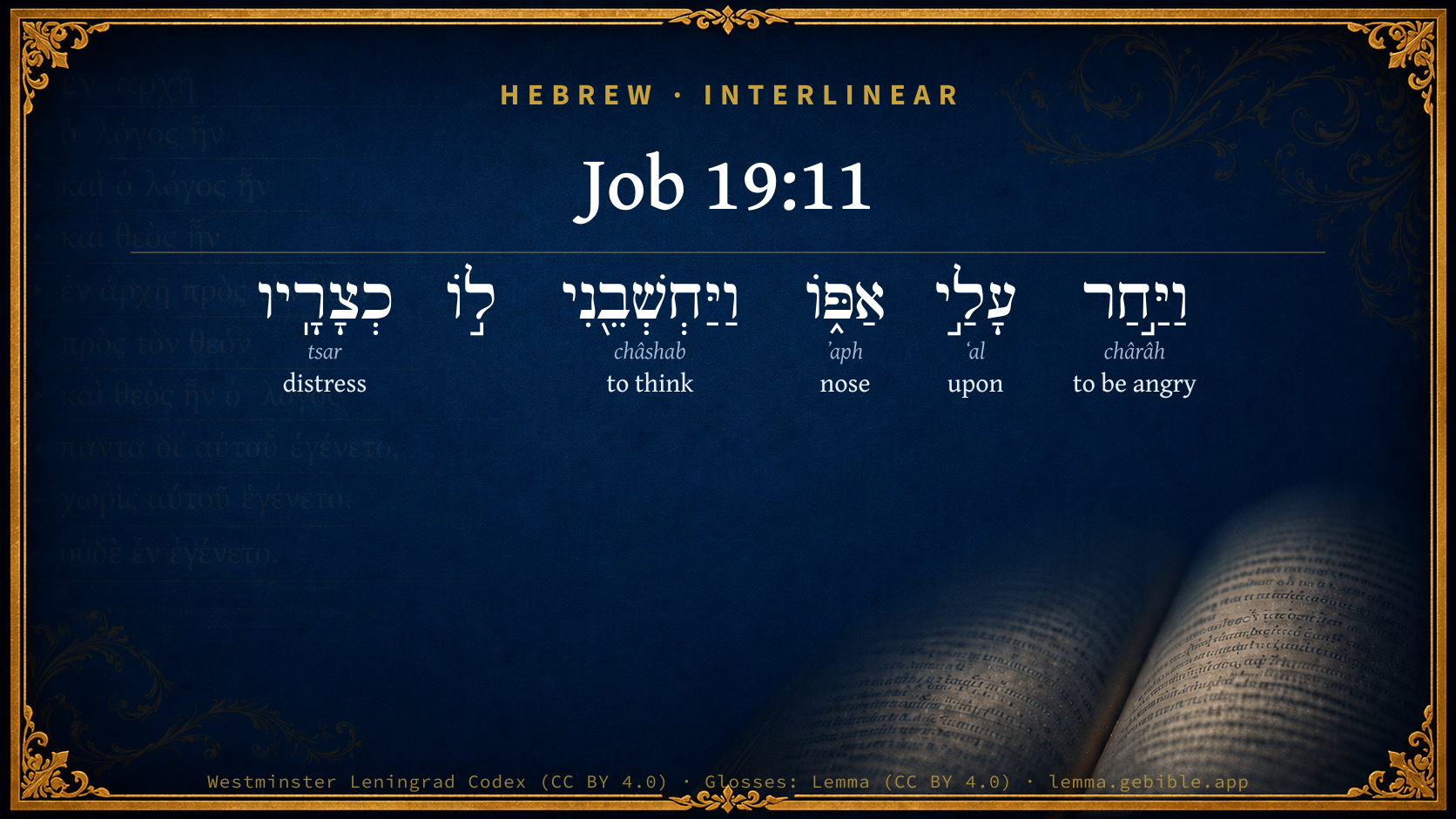
Job 19:11

Hebrew (Westminster Leningrad Codex) Job 19:11 appears in the Hebrew Old Testament. The text above is from the Westminster Leningrad Codex. Each word links to its Strong’s number, a concise gloss, and parsing drawn from the Open Scriptures Hebrew Bible morphology. Click any word for its full Brown-Driver-Briggs (BDB) entry.
Download image
Cite this verse

Job 19:11 (World English Bible). Public Domain. Lemma interlinear Bible study tool, https://lemma.gebible.app/v/job/19/11.

Show BibTeX & RIS
BibTeX
RIS
English Translation
He has also kindled his wrath against me. He counts me among his adversaries.
World English Bible · Public Domain
Download a study sheet

One document with this verse’s original text, its word-by-word gloss line, the meaning frame, cross-references with their text, attributed commentary, and full source and license credits — printable, and it pastes into notes with its structure intact.

This verse Autodidact and up

Study sheet (.html) Plain text (.txt)

A passage Seminary Student

Up to 50 verses in one chapter. A passage sheet keeps up to 6 commentary sources and 12 cross-references per verse, in the order this page ranks them, and says so on the sheet whenever that leaves anything out. Ask for a single verse and you get the Autodidact verse sheet above.

Everything on this page stays free to read, with no account — the sheet is a download of what is already on screen, not access to it.

Want to remove ads? Support Godless Engineer
Compare translations 3

The same verse in 3 English versions, stacked beneath the original-language interlinear above. Click any original word for its lexicon entry.

Each is an independent rendering of the whole verse — the interlinear is not word-aligned to these translations.

Highlighted words mark where these versions differ — a whole-verse word diff, not a word-by-word alignment.

  • World English Bible Public Domain
    He has also kindled his wrath against me. He counts me among his adversaries.
  • King James Version Public Domain
    He hath also kindled his wrath against me, and he counteth me unto him as one of his enemies.
  • unfoldingWord Literal Text CC BY-SA 4.0
    And he has kindled his nose against me, and he regards me as an enemy to him.

unfoldingWord Literal Text — © unfoldingWord, licensed CC BY-SA 4.0. Word-aligned USFM3 via Door43 (git.door43.org/unfoldingWord/en_ult).

Versions to compare (up to 4)

3 of 4 selected

Show all 18 translations

Every available English version of this verse, each an independent rendering of the whole verse.

  • World English Bible Public Domain
    He has also kindled his wrath against me. He counts me among his adversaries.
  • Berean Standard Bible Public Domain
    His anger burns against me, and He counts me among His enemies.
  • Majority Standard Bible Public Domain
    His anger burns against me, and He counts me among His enemies.
  • King James Version Public Domain
    He hath also kindled his wrath against me, and he counteth me unto him as one of his enemies.
  • American Standard Version (1901) Public Domain
    He hath also kindled his wrath against me, And he counteth me unto him as `one of' his adversaries.
  • Revised Version (1885) Public Domain
    He hath also kindled his wrath against me, and he counteth me unto him as one of his adversaries.
  • Geneva Bible (1599) Public Domain
    And he hath kindled his wrath against me, and counteth mee as one of his enemies.
  • Douay-Rheims (1899) Public Domain
    His wrath is kindled against me, and he hath counted me as his enemy.
  • Young's Literal Translation Public Domain
    And He kindleth against me His anger, And reckoneth me to Him as His adversaries.
  • Literal Standard Version CC BY-SA 4.0
    And He kindles His anger against me, || And reckons me to Him as His adversaries.
  • Unlocked Literal Bible CC BY-SA 4.0
    He has also kindled his wrath against me; he regards me as one of his adversaries.
  • unfoldingWord Literal Text CC BY-SA 4.0
    And he has kindled his nose against me, and he regards me as an enemy to him.
  • Darby Bible Public Domain
    And he hath kindled his anger against me, and hath counted me unto him as one of his enemies.
  • World Messianic Bible Public Domain
    He has also kindled his wrath against me. He counts me among his adversaries.
  • Webster's Bible Public Domain
    He hath also kindled his wrath against me, and he counteth me to him as one of his enemies.
  • Free Bible Version CC BY-SA 4.0
    His anger burns against me; he treats me as one of his enemies.
  • Bible in Basic English Public Domain
    His wrath is burning against me, and I am to him as one of his haters.
  • JPS Tanakh (1917) Public Domain
    He hath also kindled His wrath against me, and He counteth me unto Him as one of His adversaries.

Literal Standard Version (2020), Covenant Press — licensed CC BY-SA 4.0. Text via the HelloAO Bible API (eBible.org). Unlocked Literal Bible (unfoldingWord) — licensed CC BY-SA 4.0. Text via the HelloAO Bible API (eBible.org). unfoldingWord Literal Text — © unfoldingWord, licensed CC BY-SA 4.0. Word-aligned USFM3 via Door43 (git.door43.org/unfoldingWord/en_ult). Free Bible Version, Dr. Jonathan Gallagher — licensed CC BY-SA 4.0. Text via the HelloAO Bible API (eBible.org).

Word by word

More ways to search: Search by grammar → Find every occurrence → Compare this word →

Practice this passage: Drill this verse → Learn its vocabulary →

וַיַּ֣חַר
chârâh
H2734
“and · to be angry”
Conjunction + Verb, Hiphil, Sequential Imperfect, 3rd Person, Masculine, Singular
Part of Speech
Conjunction + Verb
Stem
Hiphil
Form
Sequential Imperfect
Person
3rd Person
Gender
Masculine
Number
Singular
Full BDB Definition

Origin: a primitive root [compare H2787 ]

TWOT: 736

to be hot, furious, burn, become angry, be kindled - (Qal) to burn, kindle (anger) - (Niphal) to be angry with, be incensed - (Hiphil) to burn, kindle - (Hithpael) to heat oneself in vexation
  1. עָלַ֣י ʻal H5921 “upon · me” Preposition + Suffix, Personal, 1st Person, Common, Singular
  2. אַפּ֑וֹ ʼaph H639 “nose · his” Noun, Common, Masculine, Singular, Construct + Suffix, Personal, 3rd Person, Masculine, Singular
  3. וַיַּחְשְׁבֵ֖נִי châshab H2803 “and · to think · me” Conjunction + Verb, Qal, Sequential Imperfect, 3rd Person, Masculine, Singular + Suffix, Personal, 1st Person, Common, Singular
  4. כְצָרָֽיו tsar H6862 “like/as · distresses · his” Preposition + Noun, Common, Masculine, Plural, Construct + Suffix, Personal, 3rd Person, Masculine, Singular

About this verse

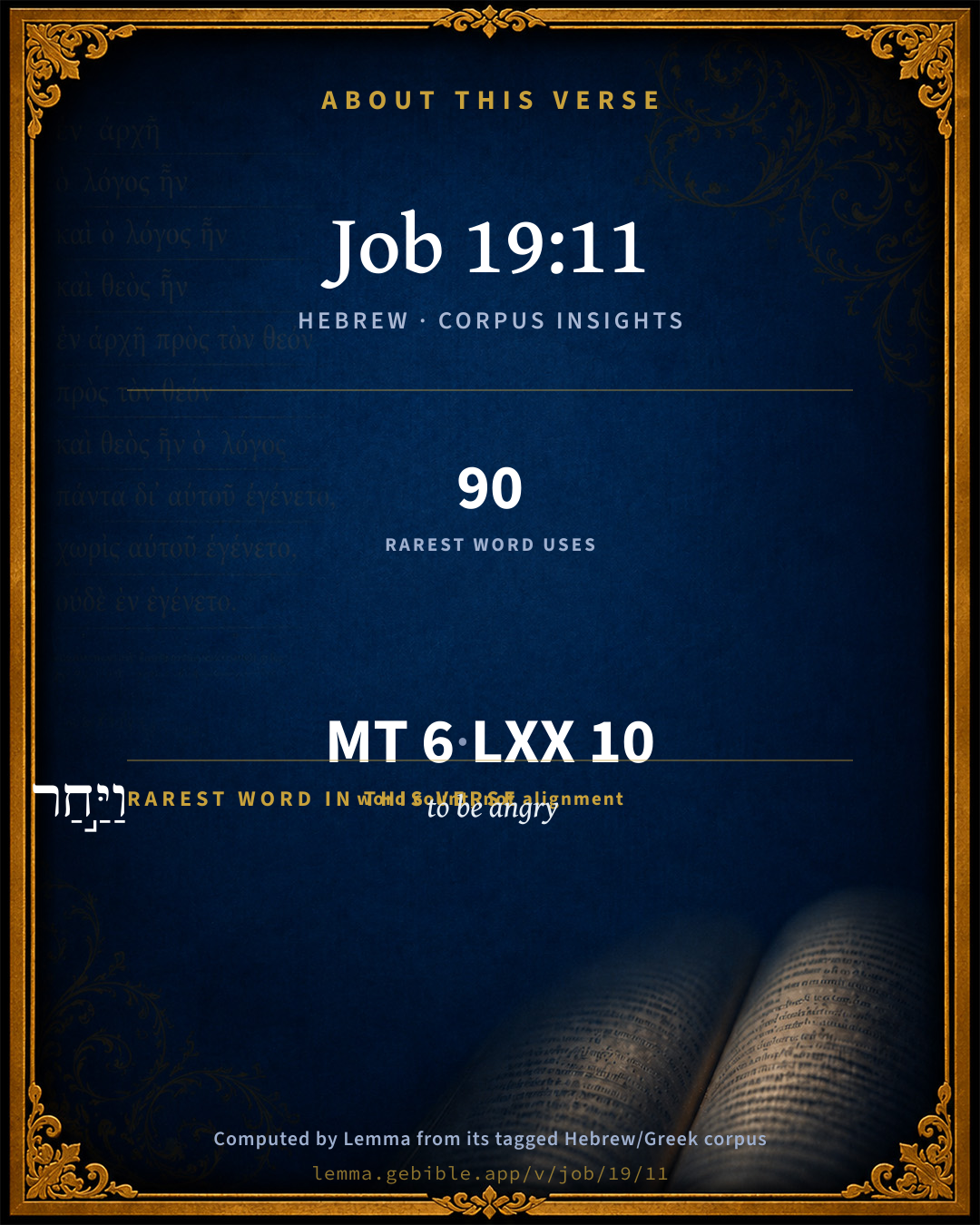
These counts appear in no published source. They are computed here, from the morphology-tagged text and Lemma’s own curated glosses. What Lemma adds →

6
words
5
distinct lemmas
Wisdom
section

Grammatical profile

  • 2 verbs
  • 2 nouns
  • 2 prepositions

Verb forms

  • וַיַּ֣חַר Hiphil · Sequential Imperfect
  • וַיַּחְשְׁבֵ֖נִי Qal · Sequential Imperfect

Hebrew & Septuagint length

In English translation the verse runs 14 words from the Hebrew and 15 from the Septuagint (LXX English) — closely comparable.

A rough comparison of the two English renderings, which tokenize alike — not a word-level alignment.

Word counts can differ between the Hebrew and the Greek without any difference in meaning — e.g. the Hebrew direct-object marker אֵת has no separate Greek word, and Greek often adds the article ὁ.

In the original languages it is 6 Hebrew tokens and 10 Greek tokens — but the two are counted differently (Hebrew bundles its prefixes and suffixes into one token; the Greek is in lemma form), so that isn’t a like-for-like length.

Cross-references

7

Topical passages linked to Job 19:11 in the Treasury of Scripture Knowledge — connected by theme and wording, ordered by reader-vote popularity; previews shown in the World English Bible.

  • Job 13:24 Why hide you your face, And hold me for your enemy?
  • Job 16:9 He has torn me in his wrath, and persecuted me; He has gnashed on me with his teeth: My adversary sharpens his eyes on me.
  • Job 33:10 Behold, he finds occasions against me, He counts me for his enemy:
  • Deuteronomy 32:22 For a fire is kindled in my anger, Burns to the lowest Sheol, Devours the earth with its increase, Sets on fire the foundations of the mountains.
  • Psalms 89:46 How long, Yahweh? Will you hide yourself forever? Will your wrath burn like fire?
  • Psalms 90:7 For we are consumed in your anger. We are troubled in your wrath.
  • Lamentations 2:5 The Lord is become as an enemy, he has swallowed up Israel; He has swallowed up all her palaces, he has destroyed his strongholds; He has multiplied in the daughter of Judah mourning and lamentation.

Cross-references courtesy of OpenBible.info (CC BY 4.0).

Hebrew and Greek witnesses Masoretic Hebrew ↔ Greek Septuagint

The same verse in the two great witnesses to the Old Testament, shown verse-for-verse.

These are two independent witnesses, not word-aligned to each other, and the Septuagint is shown in lemma (dictionary) form.

Hebrew Job 19:11 Masoretic · Westminster Leningrad Codex

וַיַּ֣חַר עָלַ֣י אַפּ֑וֹ וַיַּחְשְׁבֵ֖נִי ל֣וֹ כְצָרָֽיו

He has also kindled his wrath against me. He counts me among his adversaries.

World English Bible · Public Domain

Greek LXX Job 19:11 Septuagint · lemma form

δεινῶς δέ ἐγώ ὀργή χράω ἡγέομαι δέ ἐγώ ὥσπερ ἐχθρός

And he has dreadfully handled me in anger, and has counted me for an enemy.

LXX2012 (modern English Septuagint) · Public Domain

Hebrew: Westminster Leningrad Codex (CC BY 4.0). Greek: Septuagint (public domain); English from LXX2012 (modern English Septuagint) (Public Domain). How the Septuagint differs from the Hebrew →

Commentary

Notes on Job 19:11 from classic Christian and Jewish commentators (each source and its license shown beneath its notes). The classic Christian expositions comment on the surrounding passage and are grouped to its opening verse, so a note may address several verses; the Jewish commentaries on the Tanakh (Rashi and others) are per-verse, so they appear only where the commentator wrote on this verse.

Lemma curates 59 commentaries, every one of them public domain or Creative Commons licensed, each selected and text-cleaned for this edition rather than reprinted as found. About our sources →

Adam Clarke's Commentary

Verse 11. And he counteth me unto him as one of his enemies.] From the seventh to the thirteenth verse there seems to be an allusion to a hostile invasion, battles, sieges, c.

1. A neighbouring chief, without provocation, invades his neighbour's territories, and none of his friends will come to his help. "I cry out of wrong, but I am not heard," Job 19:7.

2. The foe has seized on all the passes, and he is hemmed up. "He hath fenced up my way that I cannot pass," Job 19:8.

3. He has surprised and carried by assault the regal city, seized and possessed the treasures. "He hath stripped me of my glory, and taken the crown from my head," Job 19:9.

4. All his armies are routed in the field, and his strong places carried. "He hath destroyed me on every side," Job 19:10.

5. The enemy proceeds to the greatest length of outrage, wasting every thing with fire and sword. "He hath kindled his wrath against me, and treateth me like one of his adversaries, Job 19:11.

6. He is cooped up in a small camp with the wrecks of his army and in this he is closely besieged by all the power of his foes, who encompass the place, and raise forts against it. "His troops come together, and raise up their way against me, and encamp round about my tabernacle."

7. Not receiving any assistance from friends or neighbours, he abandons all hope of being able to keep the field, escapes with the utmost difficulty, and is despised and neglected by his friends and domestics because he has been unfortunate. "I am escaped with the skin of my teeth," Job 19:20. "My kinsfolk have failed-all my intimate friends abhorred me," Job 19:14-19.

Adam Clarke's Commentary on the Bible (1810–1826) — public domain. Text from a community e-Sword/MySword module.

Trapp's Complete Commentary

John Trapp

Job 19:11 He hath also kindled his wrath against me, and he counteth me unto him as [one of] his enemies.

Ver. 11. He hath also kindled his wrath against me] Now if his wrath was kindled, yea, but a little, woe be to all those against whom it is bent. He will surely heap mischiefs upon them, he will spend his arrows upon them, Deu 32:22-23 Psa 2:12. Job felt them striking in the sides of his soul, even the envenomed arrows of the Almighty; and yet this was only a refiner’s fire, Mal 3:2, or, if a consuming fire, as Heb 12:29, yet it was to waste his corruptions only, to sever the sin which he hated from the Son whom he loved; to try and exercise his patience, &c., all which notwithstanding, he complaineth heavily about these spunks and sparks of divine displeasure.

And counteth me unto him as one of his enemies] Heb. As his enemies; not as a single enemy, but a rabble of rebels, an army of enemies, such as shall one day meet at Armageddon, their rendezvous. See Job 13:24.

John Trapp, A Commentary or Exposition upon All the Books of the Old and New Testament (1647–1656) — public domain. Text from a community e-Sword module.

Jamieson, Fausset & Brown

Robert Jamieson, A. R. Fausset & David Brown

enemies-- (Job 13:24; Lam 2:5).

Jamieson, Fausset & Brown — Commentary Critical and Explanatory on the Whole Bible (1871) — public domain (CC PDM 1.0). Text via the HelloAO Bible API.

Ellicott's Commentary for English Readers

(11) He hath also kindled . . .—Comp. Job_16:9; Job_16:12, &c.

A Bible Commentary for English Readers, edited by Charles John Ellicott (1878–1897) — public domain. Text from a community e-Sword module.

The Cambridge Bible for Schools and Colleges

gen. ed. J. J. S. Perowne

11–12. Figures of hostile assault; God directs charge after charge of His army against Him. The reference is to his afflictions, cf. ch. Job_10:17.

The Cambridge Bible for Schools and Colleges (gen. ed. J. J. S. Perowne; Cambridge University Press, 1878–1918) — public domain. Text from a community e-Sword module.

John Gill's Exposition

His troops come together,.... Afflictions which are many, and of which it may be said, as was at the birth of God, who had his name from the word here used, "a troop cometh": Gen 30:11; and these sometimes come together, or follow so quick one upon another, that there is scarce any interval between them, as did Job's afflictions; and they are God's hosts, his troops, his soldiers, which are at his command; and he says to them, as the centurion did to his, to the one, Go, and he goes, and to another, Come, and it comes:

and raise up their way against me; as an army, when it comes against a place, throws up a bank to raise their artillery upon, that they may play it to greater advantage; or make a broad causeway, for the soldiers to march abreast against it; or an high cast up way, as the word (y) signifies, over a ditch or dirty place in a hollow, that they may the better pass over: some read it, "they raise up their way upon me" (z); he opposing and standing in the way was crushed down by them, and trampled upon, and over whom they passed as on an highway, and in a beaten path; see Isa 51:23; but most render it, "against me"; for Job looked upon all his afflictions, as Jacob did Gen 42:36, to be against him, to militate against him, and threaten him with ruin, when they were all working for him, even for his good:

and encamp round about my tabernacle: as an army round about a city when besieging it. Job may have respect to the tabernacle of his body, as that is sometimes so called, Co2 5:1; and to the diseases of it; which being a complication, might be said to encamp about him, or surround him on all sides.

(y) "aggerant", Cocceius, Schultens; "straverunt", Montanus, Schmidt; a "via strata et elevata", Mercerus, Drusius. (z) "super me", Pagninus, Montanus, Mercerus, Schmidt, Michaelis.

John Gill's Exposition of the Whole Bible (1746–1763) — public domain (CC PDM 1.0). Text via the HelloAO Bible API.

Albert Barnes' Notes on the Bible

He hath also kindled his wrath - He is angry. Wrath in the Scriptures is usually represented as burning or inflamed - because like fire it destroys everything before it.

And he counteth me unto him as one of his enemies - He treats me as he would an enemy. The same complaint he elsewhere makes; see Job 13:24; perhaps also in Job 16:9. We are not to understand Job here as admitting that “he” was an enemy of God. He constantly maintained that he was not, but he was constrained to admit that God “treated him” as if he were his enemy, and he could not account for it. “On this ground,” therefore, he now maintains that his friends ought to show him compassion, instead of trying to prove that he “was” an enemy of God; they ought to pity a man who was so strangely and mysteriously afflicted, instead of increasing his sorrows by endeavoring to demonstrate that he was a man of eminent wickedness.

Albert Barnes' Notes on the Bible (1834–1885) — public domain. Text from a community e-Sword/MySword module.

Matthew Poole's English Annotations

He hath stirred up his wrath against me of his own accord, without any provocation of mine, human infirmity excepted.

He counteth me unto him as one of his enemies, i.e. he useth me as sharply as if I were an inveterate enemy of God and of all goodness, though he knoweth I am and have ever been a hearty lover and servant of him.

Matthew Poole's English Annotations on the Holy Bible (1683–1685) — public domain. Text from a community e-Sword/MySword module.

Whedon's Commentary on the Bible

Daniel D. Whedon

11. One of his enemies — Hebrew, his foes; not one, but several. God treats him as if he were many enemies in one.

Daniel D. Whedon (gen. ed.), Commentary on the Old and New Testaments (1874–1909) — public domain. Text from a community e-Sword module.

The Pulpit Commentary

He hath also kindled his wrath against me. It is not what has happened to him in the way of affliction and calamity that so much oppresses and crushes the patriarch, as the cause to which he, not unnaturally, ascribes his afflictions, vie. the wrath of God. Participating in the general creed of his time, he believes his sufferings to come direct from God, and to be proofs of God"s severe anger against him. He is not, however, prepared on this account to renounce God. "Though he slay me, yet will I trust in him" (Job_13:15) is still his inward sustaining thought and guiding principle. And he counteth me unto him as one of his enemies. Job felt himself treated as an enemy of God, and supposed that God must consider him such. He either had no glimpse of the cheering truth, "Whom the Lord loveth he chasteneth", (Heb_12:6) or he could not imagine that such woes as his were mere chastenings.

The Pulpit Commentary (1880–1919), ed. H.D.M. Spence-Jones & Joseph S. Exell — public domain. Text from a community e-Sword module.

Lesson kit

Teaching starters — assembled from the data on this page, not authored interpretation. Every prompt links to the verse data it draws on. Edit before teaching.

Job, in the Wisdom, opens this verse with 6 words (5 distinct Hebrew lemmas). Its most distinctive word is chârâh (“to be angry”). A historical commentator’s framing appears above. Read the whole chapter for the surrounding context.

Discussion questions

  1. What does “to be angry” (chârâh) contribute to the verse as a whole?
  2. How does Job 13:24, which shares this passage’s theme, read alongside this verse?
  3. These translations render this verse differently. What is at stake in choosing one wording over another?
  4. «וַיַּ֣חַר» is a Hiphil Sequential Imperfect verb. How does that grammatical form shape the action described?
  5. Compare how Adam Clarke's Commentary and Trapp's Complete Commentary read this verse. Where do they agree or differ?

Things to notice

Reading settings

Reading text

Shown beneath each verse's original-language words.

Old Testament
Old Testament edition

Read the OT as the Masoretic Hebrew (MT) or the Greek Septuagint (LXX).

English shown for the Greek Septuagint (in the Hebrew ↔ Greek comparison).

Comparing translations? Open the Compare panel on any verse page to stack up to four side by side.