
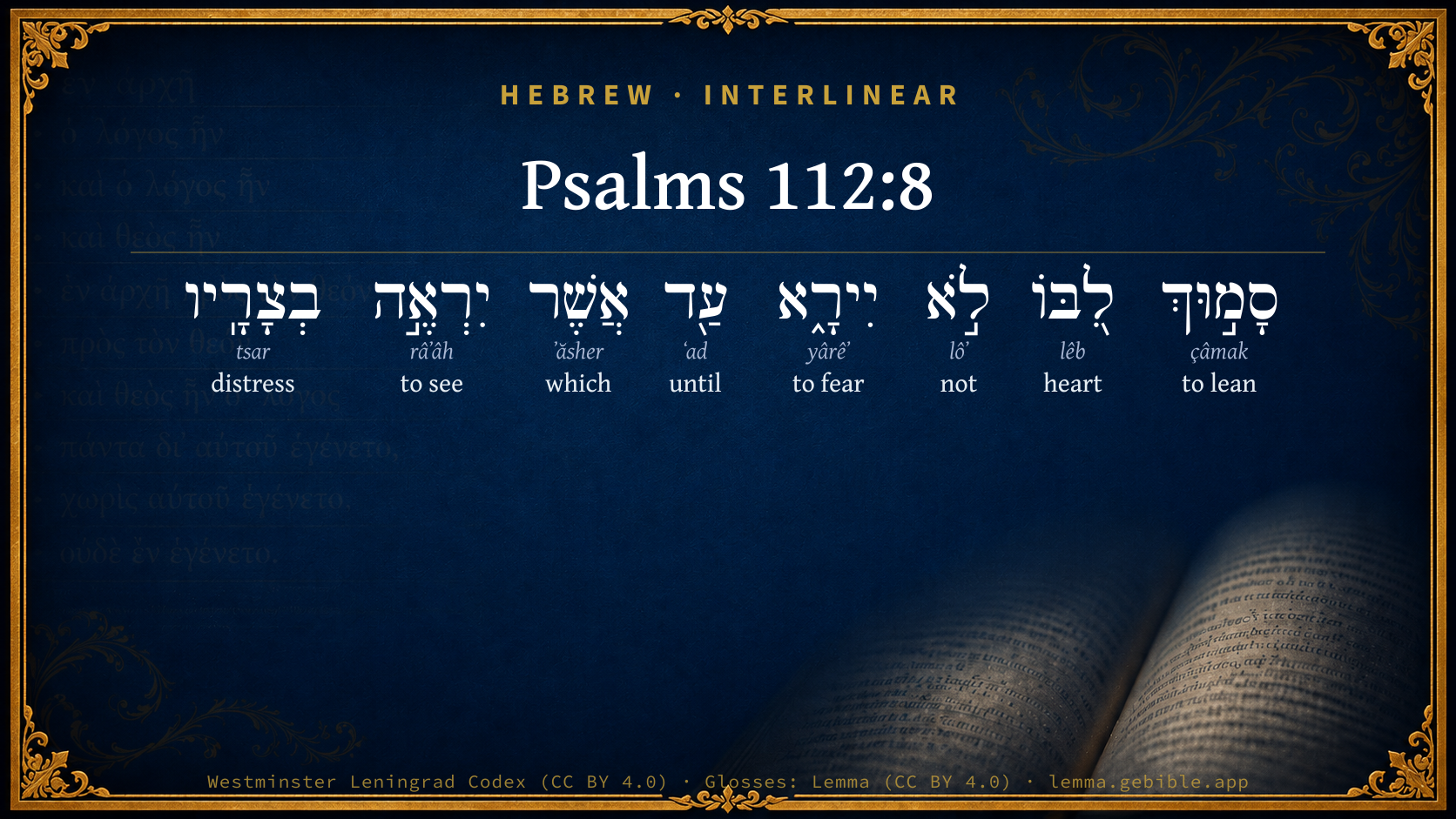
Psalms 112:8

Hebrew (Westminster Leningrad Codex) Psalms 112:8 appears in the Hebrew Old Testament. The text above is from the Westminster Leningrad Codex. Each word links to its Strong’s number, a concise gloss, and parsing drawn from the Open Scriptures Hebrew Bible morphology. Click any word for its full Brown-Driver-Briggs (BDB) entry.
Download image
Cite this verse

Psalms 112:8 (World English Bible). Public Domain. Lemma interlinear Bible study tool, https://lemma.gebible.app/v/psalms/112/8.

Show BibTeX & RIS
BibTeX
RIS
English Translation
His heart is established. He will not be afraid in the end when he sees his adversaries.
World English Bible · Public Domain
Download a study sheet

One document with this verse’s original text, its word-by-word gloss line, the meaning frame, cross-references with their text, attributed commentary, and full source and license credits — printable, and it pastes into notes with its structure intact.

This verse Autodidact and up

Study sheet (.html) Plain text (.txt)

A passage Seminary Student

Up to 50 verses in one chapter. A passage sheet keeps up to 6 commentary sources and 12 cross-references per verse, in the order this page ranks them, and says so on the sheet whenever that leaves anything out. Ask for a single verse and you get the Autodidact verse sheet above.

Everything on this page stays free to read, with no account — the sheet is a download of what is already on screen, not access to it.

Want to remove ads? Support Godless Engineer
Compare translations 3

The same verse in 3 English versions, stacked beneath the original-language interlinear above. Click any original word for its lexicon entry.

Each is an independent rendering of the whole verse — the interlinear is not word-aligned to these translations.

Highlighted words mark where these versions differ — a whole-verse word diff, not a word-by-word alignment.

  • World English Bible Public Domain
    His heart is established. He will not be afraid in the end when he sees his adversaries.
  • King James Version Public Domain
    His heart is established, he shall not be afraid, until he see his desire upon his enemies.
  • unfoldingWord Literal Text CC BY-SA 4.0
    His heart is upheld, he does not fear, until he looks over his adversaries.

unfoldingWord Literal Text — © unfoldingWord, licensed CC BY-SA 4.0. Word-aligned USFM3 via Door43 (git.door43.org/unfoldingWord/en_ult).

Versions to compare (up to 4)

3 of 4 selected

Show all 18 translations

Every available English version of this verse, each an independent rendering of the whole verse.

  • World English Bible Public Domain
    His heart is established. He will not be afraid in the end when he sees his adversaries.
  • Berean Standard Bible Public Domain
    His heart is assured; he does not fear, until he looks in triumph on his foes.
  • Majority Standard Bible Public Domain
    His heart is assured; he does not fear, until he looks in triumph on his foes.
  • King James Version Public Domain
    His heart is established, he shall not be afraid, until he see his desire upon his enemies.
  • American Standard Version (1901) Public Domain
    His heart is established, he shall not be afraid, Until he see `his desire' upon his adversaries.
  • Revised Version (1885) Public Domain
    His heart is established, he shall not be afraid, until he see his desire upon his adversaries.
  • Geneva Bible (1599) Public Domain
    His heart is stablished: therefore he will not feare, vntill he see his desire vpon his enemies.
  • Douay-Rheims (1899) Public Domain
    his heart is strengthened, he shall not be moved until he look over his enemies.
  • Young's Literal Translation Public Domain
    Sustained is his heart -- he feareth not, Till that he look on his adversaries.
  • Literal Standard Version CC BY-SA 4.0
    His heart is sustained—he does not fear, || Until he looks on his adversaries.
  • Unlocked Literal Bible CC BY-SA 4.0
    His heart is tranquil, without fear, until he looks in triumph over his adversaries.
  • unfoldingWord Literal Text CC BY-SA 4.0
    His heart is upheld, he does not fear, until he looks over his adversaries.
  • Darby Bible Public Domain
    His heart is maintained, he is not afraid, until he see [his desire] upon his oppressors.
  • World Messianic Bible Public Domain
    His heart is established. He will not be afraid in the end when he sees his adversaries.
  • Webster's Bible Public Domain
    His heart is established, he shall not be afraid, until he seeth his desire upon his enemies.
  • Free Bible Version CC BY-SA 4.0
    They are confident and brave, and see their enemies defeated.
  • Bible in Basic English Public Domain
    His heart is resting safely, he will have no fear, till he sees trouble come on his haters.
  • JPS Tanakh (1917) Public Domain
    His heart is established, he shall not be afraid, until he gaze upon his adversaries.

Literal Standard Version (2020), Covenant Press — licensed CC BY-SA 4.0. Text via the HelloAO Bible API (eBible.org). Unlocked Literal Bible (unfoldingWord) — licensed CC BY-SA 4.0. Text via the HelloAO Bible API (eBible.org). unfoldingWord Literal Text — © unfoldingWord, licensed CC BY-SA 4.0. Word-aligned USFM3 via Door43 (git.door43.org/unfoldingWord/en_ult). Free Bible Version, Dr. Jonathan Gallagher — licensed CC BY-SA 4.0. Text via the HelloAO Bible API (eBible.org).

Word by word

More ways to search: Search by grammar → Find every occurrence → Compare this word →

Practice this passage: Drill this verse → Learn its vocabulary →

About this verse

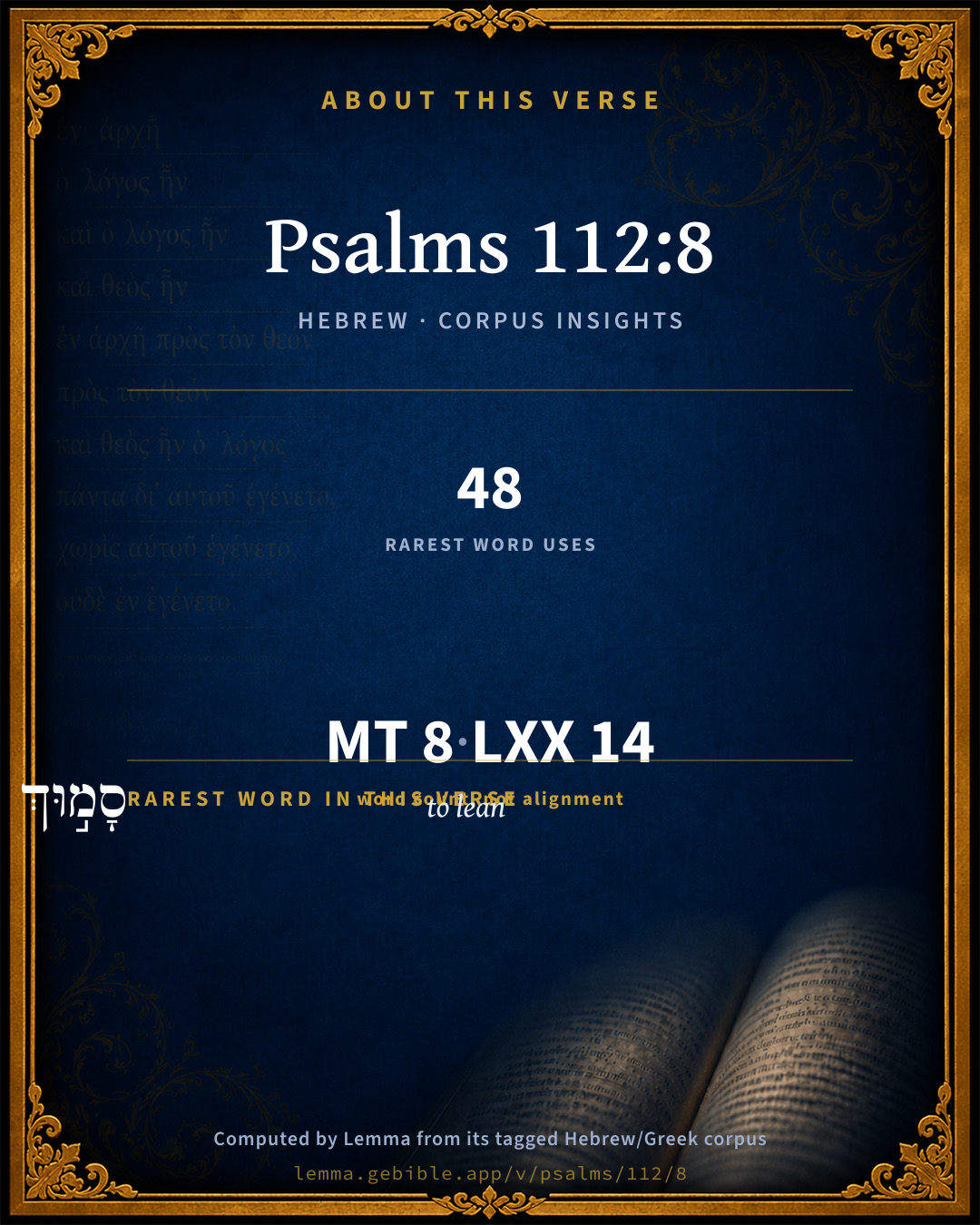
These counts appear in no published source. They are computed here, from the morphology-tagged text and Lemma’s own curated glosses. What Lemma adds →

8
words
8
distinct lemmas
Wisdom
section

Shared distinctive vocabulary

סָמ֣וּךְ to lean H5564 occurs in 47 verses of the Hebrew Bible. Also found in:

Grammatical profile

  • 3 verbs
  • 2 nouns
  • 1 preposition
  • 2 particles

Verb forms

  • סָמ֣וּךְ Qal · Participle Passive
  • יִירָ֑א Qal · Imperfect
  • יִרְאֶ֣ה Qal · Imperfect

Hebrew & Septuagint length

In English translation the verse runs 17 words from the Hebrew and 17 from the Septuagint (LXX English) — the same length.

A rough comparison of the two English renderings, which tokenize alike — not a word-level alignment.

Word counts can differ between the Hebrew and the Greek without any difference in meaning — e.g. the Hebrew direct-object marker אֵת has no separate Greek word, and Greek often adds the article ὁ.

In the original languages it is 8 Hebrew tokens and 14 Greek tokens — but the two are counted differently (Hebrew bundles its prefixes and suffixes into one token; the Greek is in lemma form), so that isn’t a like-for-like length.

Cross-references

8

Topical passages linked to Psalms 112:8 in the Treasury of Scripture Knowledge — connected by theme and wording, ordered by reader-vote popularity; previews shown in the World English Bible.

  • Psalms 31:24 Be strong, and let your heart take courage, All you who hope in Yahweh.
  • Psalms 59:10 My God will go before me with his loving kindness. God will let me look at my enemies in triumph.
  • Psalms 91:8 You will only look with your eyes, And see the recompense of the wicked.
  • Psalms 118:7 Yahweh is on my side among those who help me. Therefore I will look in triumph at those who hate me.
  • Hebrews 13:9 Don't be carried away by various and strange teachings, for it is good that the heart be established by grace, not by food, through which those who were so occupied were not benefited.
  • Psalms 92:11 My eye has also seen my enemies. My ears have heard of the wicked enemies who rise up against me.
  • Proverbs 3:33 Yahweh's curse is in the house of the wicked, But he blesses the habitation of the righteous.
  • Psalms 27:14 Wait for Yahweh. Be strong, and let your heart take courage. Yes, wait for Yahweh.

Cross-references courtesy of OpenBible.info (CC BY 4.0).

Hebrew and Greek witnesses Masoretic Hebrew ↔ Greek Septuagint

The same verse in the two great witnesses to the Old Testament, shown verse-for-verse.

You’re reading Greek Psalm 111 (Hebrew Psalm 112). The Septuagint counts the superscription, so verse numbers can differ from the Hebrew — chapter-level alignment, not verse-by-verse. Numbering follows Rahlfs.

These are two independent witnesses, not word-aligned to each other, and the Septuagint is shown in lemma (dictionary) form.

Hebrew Psalms 112:8 Masoretic · Westminster Leningrad Codex

סָמ֣וּךְ לִ֭בּוֹ לֹ֣א יִירָ֑א עַ֖ד אֲשֶׁר יִרְאֶ֣ה בְצָרָֽיו

His heart is established. He will not be afraid in the end when he sees his adversaries.

World English Bible · Public Domain

Greek LXX Greek Psalm 111:8 Septuagint · lemma form

στηρίζω ὁ καρδία αὐτός οὐ μή φοβέω ἕως ὅς ἐπιδέω ἐπί ὁ ἐχθρός αὐτός

His heart is established, he shall not fear, till he shall see his desire upon his enemies.

LXX2012 (modern English Septuagint) · Public Domain

Hebrew: Westminster Leningrad Codex (CC BY 4.0). Greek: Septuagint (public domain); English from LXX2012 (modern English Septuagint) (Public Domain). How the Septuagint differs from the Hebrew →

Commentary

Notes on Psalms 112:8 from classic Christian and Jewish commentators (each source and its license shown beneath its notes). The classic Christian expositions comment on the surrounding passage and are grouped to its opening verse, so a note may address several verses; the Jewish commentaries on the Tanakh (Rashi and others) are per-verse, so they appear only where the commentator wrote on this verse.

Lemma curates 59 commentaries, every one of them public domain or Creative Commons licensed, each selected and text-cleaned for this edition rather than reprinted as found. About our sources →

Ellicott's Commentary for English Readers

(8) Until he see.—See Note, Psa_59:10, and comp. Psa_112:8.

A Bible Commentary for English Readers, edited by Charles John Ellicott (1878–1897) — public domain. Text from a community e-Sword module.

Trapp's Complete Commentary

John Trapp

Psa 112:8 His heart [is] established, he shall not be afraid, until he see [his desire] upon his enemies.

Ver. 8. His heart is established] Heb. underpropped, shored up.

He shall not be afraid] Of any adverse power, Psa 3:6; Psa 27:1

Until he see his desire] Which his faith will once work out.

John Trapp, A Commentary or Exposition upon All the Books of the Old and New Testament (1647–1656) — public domain. Text from a community e-Sword module.

J. A. Alexander on Psalms

Joseph Addison Alexander

8. (Psa 112:8) Settled (is) his heart, he shall not fear, until he look upon his foes (with triumph). The first word is another expression borrowed from the foregoing psalm, but applied in a manner altogether different. See Psa 111:8, where the plural of the same participle is applied to God's commandments. The construction in the last clause is the idiomatic one of the verb see with the preposition in, which usually means to see with strong emotion, and especially with joy or triumph. See above, on Psa 50:23; Psa 54:7. Until does not imply that he shall then fear, but that there will then be no occasion so to do. See above, on Psa 110:1.

Joseph Addison Alexander, The Psalms Translated and Explained (1850) — public domain. Text from a community e-Sword module.

Tyndale Open Study Notes

Tyndale Open Resources

112:8 Because the godly joyfully expect God to prevail and rescue them, they face their foes triumphantly (59:10; 112:4; 118:7).

Tyndale Open Study Notes — © Tyndale Open Resources, licensed CC BY-SA 4.0. Text via the HelloAO Bible API.

Adam Clarke's Commentary

Verse 8. His heart is established] סמוך לבו samuch libbo, "his heart is propped up;" he is buttressed up by the strength of his Maker.

Adam Clarke's Commentary on the Bible (1810–1826) — public domain. Text from a community e-Sword/MySword module.

The Cambridge Bible for Schools and Colleges

gen. ed. J. J. S. Perowne

8. established] Cp. Psa_111:8; Isa_26:3, where the word for trusting used in Psa_112:7 also occurs.

until &c.] If he is attacked he is confident that in due time his cause, which is the cause of God and right, will triumph. Cp. Psa_91:8.

The Cambridge Bible for Schools and Colleges (gen. ed. J. J. S. Perowne; Cambridge University Press, 1878–1918) — public domain. Text from a community e-Sword module.

John Gill's Exposition

His heart is established,.... With the doctrine of grace; which is food unto it, and by which it is strengthened and nourished; it is established in the faith of Christ, both in the grace of faith, and in the doctrine of faith, even in all the doctrines of the Gospel; so that he is not as a child, tossed to and fro with every wind; his heart is established in the exercise of grace, and he is steadfast and immovable in the discharge of duty. This being the case,

he shall not be afraid, until he see his desire upon his enemies; until he looks them in the face boldly and confidently; or until he sees them all slain and destroyed, as the Israelites saw the Egyptians on the sea shore. We supply "his desire"; it might be put "vengeance", as in Psa 58:10, the punishment of God on wicked men, who are the enemies of the upright; and which they shall see with pleasure, because of the glory of divine justice conspicuous therein; see Rev 18:20 and even before this is brought about, while their enemies are oppressing them, insulting them, and triumphing over them, they shall not be afraid, as knowing the time is coming when the scene will be changed, and they shall triumph in their turn.

John Gill's Exposition of the Whole Bible (1746–1763) — public domain (CC PDM 1.0). Text via the HelloAO Bible API.

Albert Barnes' Notes on the Bible

His heart is established - Sustained; upheld. This is the same idea, though somewhat varied in form. The word means to sustain; to support; and the idea is, that there is some basis of support - some strength - which is not his own.

He shall not be afraid - When he is assailed by enemies.

Until he see his desire upon his enemies - This implies that he had nothing really to fear. He would certainly overcome his foes; and in the meantime he might look calmly on all their efforts to destroy him, for those efforts would be vain. So the believer now looks calmly on all his spiritual foes. He has nothing to fear, for he will overcome them all; he will certainly triumph; he will trample them all under his feet. He may well, therefore, endure these conflicts for a brief period, for the issue is certain, and the conflict will soon come to an end.

Albert Barnes' Notes on the Bible (1834–1885) — public domain. Text from a community e-Sword/MySword module.

Matthew Poole's English Annotations

And although his enemies be many, and mighty, and terrible, yet he shall confidently and cheerfully wait upon God, until he see their ruin and his own deliverance and safety.

Matthew Poole's English Annotations on the Holy Bible (1683–1685) — public domain. Text from a community e-Sword/MySword module.

The Treasury of David

Charles H. Spurgeon

Ver. 8. His heart is established. His love to God is deep and true, his confidence in God is firm and unmoved; his courage has a firm foundation, and is supported by Omnipotence. He has become settled by experience, and confirmed by years. He is not a rolling stone, but a pillar in the house of the Lord.

He shall not be afraid. He is ready to face any adversarya holy heart gives a brave face.

Until he see his desire upon his enemies. All through the conflict, even till he seizes the victory, he is devoid of fear. When the battle wavers, and the result seems doubtful, he nevertheless believes in God, and is a stranger to dismay. Grace makes him desire his enemies' good: though nature leads him to wish to see justice done to his cause, he does not desire for those who injure him anything by way of private revenge.

Ver. 8. His heart is established. Happy surely, is the man whose heart is thus established. Others may be politic, he only is wise; others may be fortunate, he only is great; others may drink deeper draughts of sensual pleasure, he only can eat of the tree of life, which is in the midst of the paradise of God. He is an image of that great Being whom he trusts...and in the midst of storms, and thunders, and earthquakes sits himself serene and undisturbed, bidding the prostrate world adore the Lord of the universe. George Gleig, 1803.

Ver. 8. Until he see his desire upon his enemies. His faith will not fail, nor shrink, nor change, while one by one his enemies are brought to the knowledge of the truth and the love of Christ, and he shall see his heart's desire fulfilled upon them, even that they may be saved. Plain Commentary.

Ver. 8. Until he see his desire upon his enemies. Or, according to the original, Until he looks upon his oppressors; that is, till he behold them securely, and, as we say, confidently looks in their faces; as being now no longer under their power, but being freed from their tyranny and oppression. Thomas Fenton.

Ver. 8. Heart establishment, the confidence which flows from it, the sight which shall be seen by him who possesses it.

Ver. 8.

1. The security of the righteous: "his heart is established."

2. His tranquillity: "he shall not be afraid; "and,

3. His expectancy: "until, "etc. G.R.

Psalms 112:9*

Charles H. Spurgeon's The Treasury of David (1869–1885) — public domain. Psalms only. Text from a community e-Sword/MySword module.

Whedon's Commentary on the Bible

Daniel D. Whedon

8. His enemies—His persecutors.

Daniel D. Whedon (gen. ed.), Commentary on the Old and New Testaments (1874–1909) — public domain. Text from a community e-Sword module.

The Pulpit Commentary

His heart is established. Almost a repetition of the phrase in ver. 7, "his heart is fixed seemingly, therefore, superfluous, but really emphasizing the point, which is of great moment (see the comment of Hengstenberg, and compare the "just man" of Horace, "Od.," 3:3, 2 1-8). He shall not be afraid. "Perfect love casteth out fear". (1Jn_4:18) He who feels himself always and altogether in the hands of a loving Father cannot be afraid of what is about to befall him. Until he see his desire upon his enemies. He knows that his enemies have no real power to harm him, and that ultimately he will "see his desire upon them;" i.e. will triumph over them. (see Psa_54:7 Psa_59:10, etc.)

The Pulpit Commentary (1880–1919), ed. H.D.M. Spence-Jones & Joseph S. Exell — public domain. Text from a community e-Sword module.

unfoldingWord translationNotes

Door43 World Missions Community

General Information:

The person who sings this song continues to describe a person who reveres Yahweh.

His heart is tranquil

"His heart is supported." Here the word "heart" refers to the person. Possible meanings are 1) "He is at peace" or 2) "He is confident" (See: Synecdoche)

his righteousness endures forever

"his righteous deeds will endure forever." See how you translated this in Psalms 112:3.

he will be exalted with honor

This can be stated in active form. AT: "Yahweh will exalt him by giving him honor" (See: Active or Passive)

translationWords

heart

fear

adversary

righteous

endure

eternity

exalt

honor

unfoldingWord translationNotes — © Distant Shores Media and the Door43 World Missions Community, licensed CC BY-SA 4.0. Source: git.door43.org/Door43/en_tn.

Rashi

Rabbi Shlomo Yitzchaki (Rashi)

His heart is steadfast He leans on and trusts in the Holy One, blessed be He.

Rashi on the Tanakh — English translations: “The Judaica Press complete Tanach with Rashi, translated by A. J. Rosenberg” (CC BY 4.0); “Pentateuch with Rashi's commentary by M. Rosenbaum and A.M. Silbermann, 1929-1934” (public domain); “The Metsudah Tanach series, Lakewood, N.J” (CC BY 4.0); and “The Book of Joshua, Metsudah Publications, 1997” (CC BY 4.0). Text via Sefaria.

Lesson kit

Teaching starters — assembled from the data on this page, not authored interpretation. Every prompt links to the verse data it draws on. Edit before teaching.

Psalms, in the Wisdom, opens this verse with 8 words (8 distinct Hebrew lemmas). Its most distinctive word is çâmak (“to lean”). A historical commentator’s framing appears above. Read the whole chapter for the surrounding context.

Discussion questions

  1. What does “to lean” (çâmak) contribute to the verse as a whole?
  2. Genesis 27:37 shares the word «to lean» with this verse. How do the two illuminate each other?
  3. These translations render this verse differently; the difference is in the English rendering, not the original. What questions does that raise?
  4. The verb «סָמ֣וּךְ» is Qal Participle Passive. How does its form color the action?
  5. Reading how Ellicott's Commentary for English Readers and Trapp's Complete Commentary read this verse, where do the two commentators agree and where do they part?

Things to notice

Reading settings

Reading text

Shown beneath each verse's original-language words.

Old Testament
Old Testament edition

Read the OT as the Masoretic Hebrew (MT) or the Greek Septuagint (LXX).

English shown for the Greek Septuagint (in the Hebrew ↔ Greek comparison).

Comparing translations? Open the Compare panel on any verse page to stack up to four side by side.