
Psalms 78:42

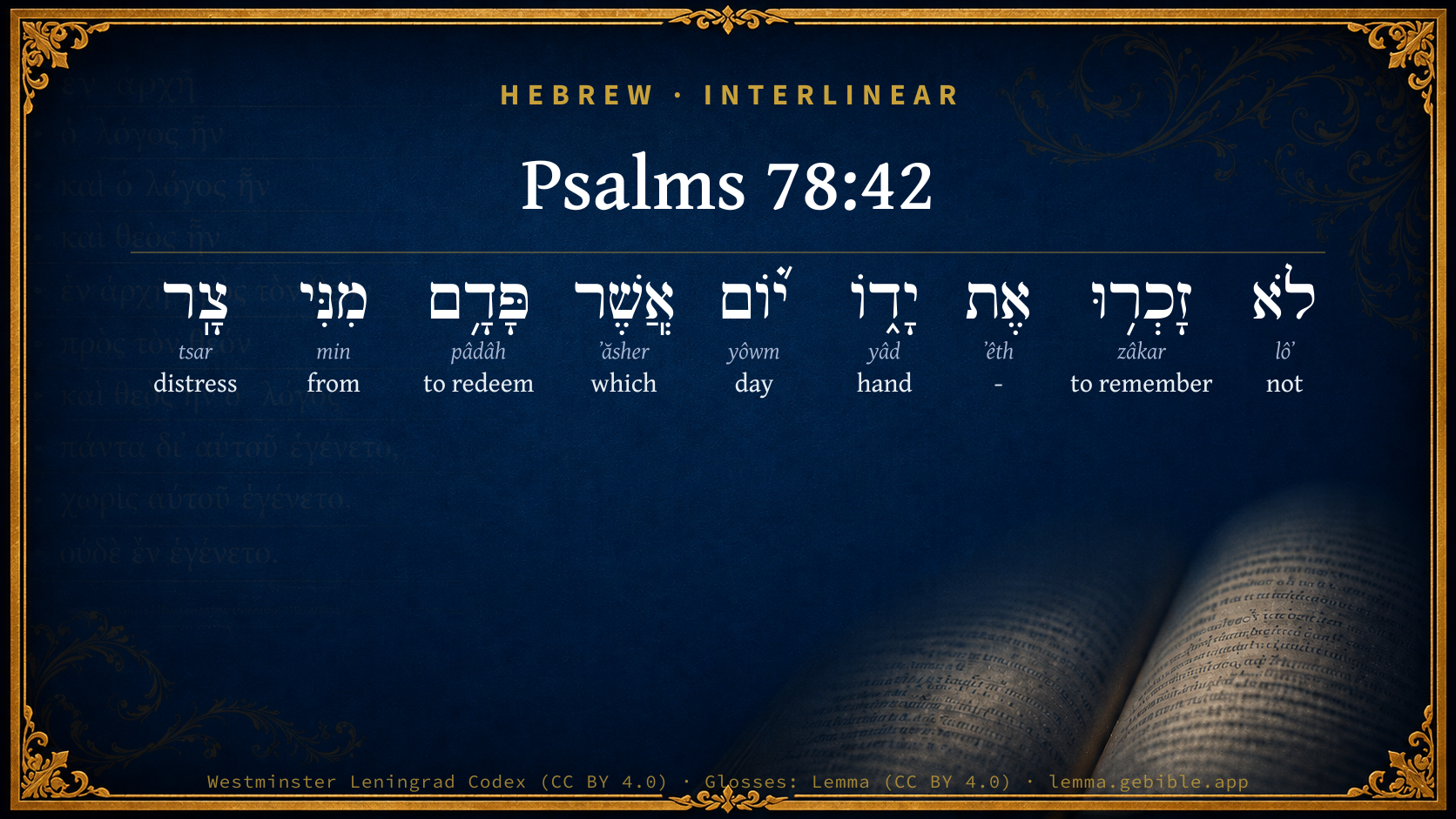
Hebrew (Westminster Leningrad Codex) Psalms 78:42 appears in the Hebrew Old Testament. The text above is from the Westminster Leningrad Codex. Each word links to its Strong’s number, a concise gloss, and parsing drawn from the Open Scriptures Hebrew Bible morphology. Click any word for its full Brown-Driver-Briggs (BDB) entry.
Download image
Cite this verse

Psalms 78:42 (World English Bible). Public Domain. Lemma interlinear Bible study tool, https://lemma.gebible.app/v/psalms/78/42.

Show BibTeX & RIS
BibTeX
RIS
English Translation
They didn't remember his hand, Nor the day when he redeemed them from the adversary;
World English Bible · Public Domain
Download a study sheet

One document with this verse’s original text, its word-by-word gloss line, the meaning frame, cross-references with their text, attributed commentary, and full source and license credits — printable, and it pastes into notes with its structure intact.

This verse Autodidact and up

Study sheet (.html) Plain text (.txt)

A passage Seminary Student

Up to 50 verses in one chapter. A passage sheet keeps up to 6 commentary sources and 12 cross-references per verse, in the order this page ranks them, and says so on the sheet whenever that leaves anything out. Ask for a single verse and you get the Autodidact verse sheet above.

Everything on this page stays free to read, with no account — the sheet is a download of what is already on screen, not access to it.

Want to remove ads? Support Godless Engineer
Compare translations 3

The same verse in 3 English versions, stacked beneath the original-language interlinear above. Click any original word for its lexicon entry.

Each is an independent rendering of the whole verse — the interlinear is not word-aligned to these translations.

Highlighted words mark where these versions differ — a whole-verse word diff, not a word-by-word alignment.

  • World English Bible Public Domain
    They didn't remember his hand, Nor the day when he redeemed them from the adversary;
  • King James Version Public Domain
    They remembered not his hand, nor the day when he delivered them from the enemy.
  • unfoldingWord Literal Text CC BY-SA 4.0
    They did not remember his hand, the day when he redeemed them from the adversary,

unfoldingWord Literal Text — © unfoldingWord, licensed CC BY-SA 4.0. Word-aligned USFM3 via Door43 (git.door43.org/unfoldingWord/en_ult).

Versions to compare (up to 4)

3 of 4 selected

Show all 18 translations

Every available English version of this verse, each an independent rendering of the whole verse.

  • World English Bible Public Domain
    They didn't remember his hand, Nor the day when he redeemed them from the adversary;
  • Berean Standard Bible Public Domain
    They did not remember His power—the day He redeemed them from the adversary,
  • Majority Standard Bible Public Domain
    They did not remember His power—the day He redeemed them from the adversary,
  • King James Version Public Domain
    They remembered not his hand, nor the day when he delivered them from the enemy.
  • American Standard Version (1901) Public Domain
    They remember not his hand, Nor the day when he redeemed them from the adversary;
  • Revised Version (1885) Public Domain
    They remembered not his hand, nor the day when he redeemed them from the adversary.
  • Geneva Bible (1599) Public Domain
    They remembered not his hand, nor the day when he deliuered them from the enemie,
  • Douay-Rheims (1899) Public Domain
    They remembered not his hand, in the day that he redeemed them from the hand of him that afflicted them:
  • Young's Literal Translation Public Domain
    They have not remembered His hand The day He ransomed them from the adversary.
  • Literal Standard Version CC BY-SA 4.0
    They have not remembered His hand || The day He ransomed them from the adversary.
  • Unlocked Literal Bible CC BY-SA 4.0
    They did not think about his power, how he had rescued them from the enemy
  • unfoldingWord Literal Text CC BY-SA 4.0
    They did not remember his hand, the day when he redeemed them from the adversary,
  • Darby Bible Public Domain
    They remembered not his hand, the day when he delivered them from the oppressor,
  • World Messianic Bible Public Domain
    They didn’t remember his hand, nor the day when he redeemed them from the adversary;
  • Webster's Bible Public Domain
    They remembered not his hand, nor the day when he delivered them from the enemy.
  • Free Bible Version CC BY-SA 4.0
    They did not remember his strength when he rescued them from their oppressors,
  • Bible in Basic English Public Domain
    They did not keep in mind the work of his hand, or the day when he took them from the power of their haters;
  • JPS Tanakh (1917) Public Domain
    They remembered not His hand, nor the day when He redeemed them from the adversary.

Literal Standard Version (2020), Covenant Press — licensed CC BY-SA 4.0. Text via the HelloAO Bible API (eBible.org). Unlocked Literal Bible (unfoldingWord) — licensed CC BY-SA 4.0. Text via the HelloAO Bible API (eBible.org). unfoldingWord Literal Text — © unfoldingWord, licensed CC BY-SA 4.0. Word-aligned USFM3 via Door43 (git.door43.org/unfoldingWord/en_ult). Free Bible Version, Dr. Jonathan Gallagher — licensed CC BY-SA 4.0. Text via the HelloAO Bible API (eBible.org).

Word by word

More ways to search: Search by grammar → Find every occurrence → Compare this word →

Practice this passage: Drill this verse → Learn its vocabulary →

About this verse

These counts appear in no published source. They are computed here, from the morphology-tagged text and Lemma’s own curated glosses. What Lemma adds →

9
words
9
distinct lemmas
Wisdom
section

Shared distinctive vocabulary

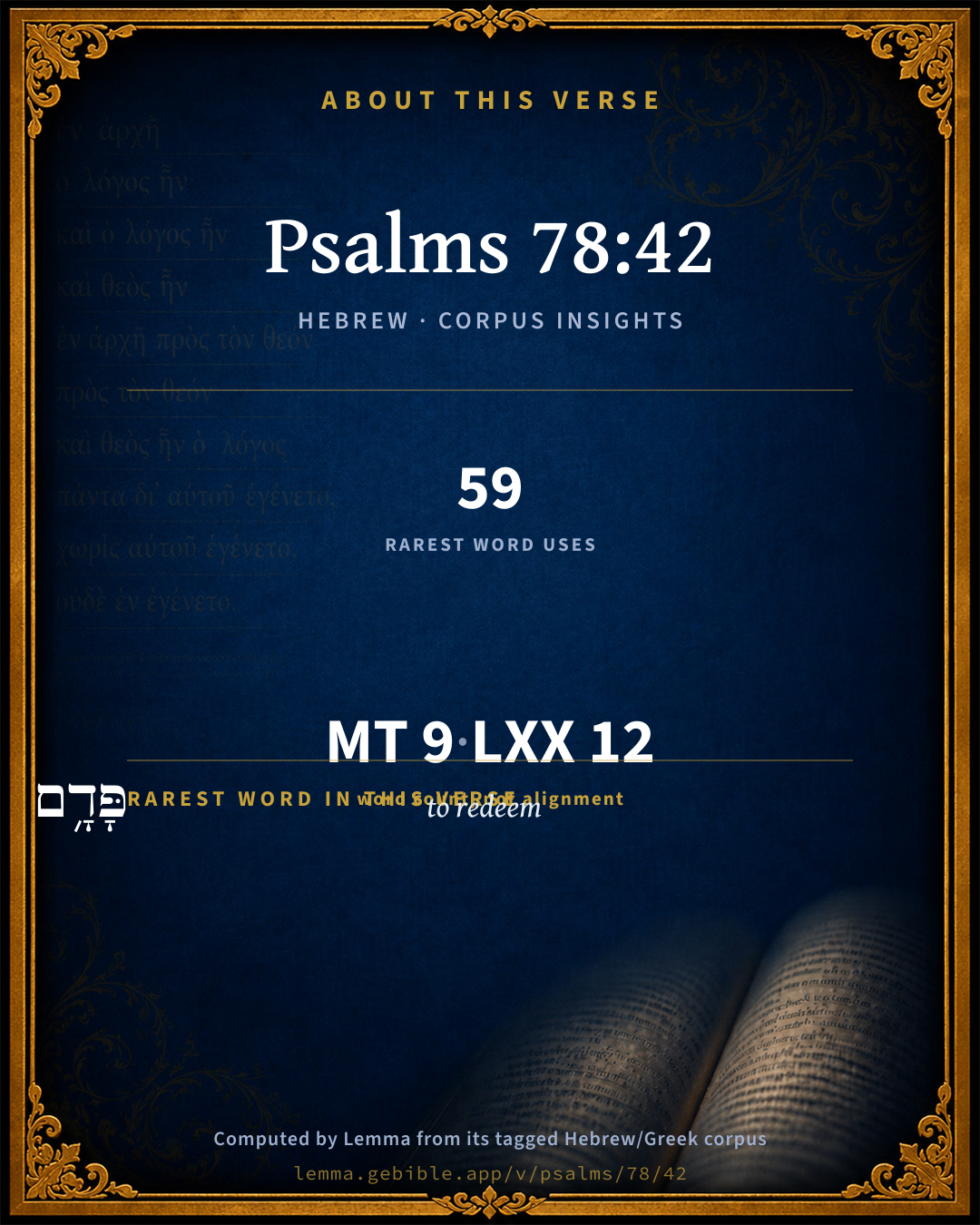
פָּדָ֥ם to redeem H6299 occurs in 48 verses of the Hebrew Bible. Also found in:

Grammatical profile

  • 2 verbs
  • 3 nouns
  • 1 preposition
  • 3 particles

Verb forms

  • זָכְר֥וּ Qal · Perfect
  • פָּדָ֥ם Qal · Perfect

Hebrew & Septuagint length

In English translation the verse runs 15 words from the Hebrew and 18 from the Septuagint (LXX English) — closely comparable.

A rough comparison of the two English renderings, which tokenize alike — not a word-level alignment.

Word counts can differ between the Hebrew and the Greek without any difference in meaning — e.g. the Hebrew direct-object marker אֵת has no separate Greek word, and Greek often adds the article ὁ.

In the original languages it is 9 Hebrew tokens and 12 Greek tokens — but the two are counted differently (Hebrew bundles its prefixes and suffixes into one token; the Greek is in lemma form), so that isn’t a like-for-like length.

Cross-references

10

Topical passages linked to Psalms 78:42 in the Treasury of Scripture Knowledge — connected by theme and wording, ordered by reader-vote popularity; previews shown in the World English Bible.

  • Judges 8:34 The children of Israel didn't remember Yahweh their God, who had delivered them out of the hand of all their enemies on every side;
  • Jeremiah 32:21 and brought forth your people Israel out of the land of Egypt with signs, and with wonders, and with a strong hand, and with an outstretched arm, and with great terror;
  • Exodus 14:12 Isn't this the word that we spoke to you in Egypt, saying, 'Leave us alone, that we may serve the Egyptians?' For it were better for us to serve the Egyptians, than that we should die in the wilderness."
  • Psalms 78:11 They forgot his doings, His wondrous works that he had shown them.
  • Psalms 106:7–10 Our fathers didn't understand your wonders in Egypt. They didn't remember the multitude of your loving kindnesses, But were rebellious at the sea, even at the Red Sea.
  • Psalms 136:10–15 To him who struck down the Egyptian firstborn; For his loving kindness endures forever;
  • Exodus 13:9 It shall be for a sign to you on your hand, and for a memorial between your eyes, that the law of Yahweh may be in your mouth; for with a strong hand Yahweh has brought you out of Egypt.
  • Isaiah 11:11 It shall happen in that day, that the Lord will set his hand again the second time to recover the remnant of his people, who shall remain, from Assyria, and from Egypt, and from Pathros, and from Cush, and from Elam, and from Shinar, and from Hamath, and from the islands of the sea.
  • Psalms 78:21–22 Therefore Yahweh heard, and was angry. A fire was kindled against Jacob, Anger also went up against Israel,
  • Exodus 14:30–31 Thus Yahweh saved Israel that day out of the hand of the Egyptians; and Israel saw the Egyptians dead on the seashore.

Cross-references courtesy of OpenBible.info (CC BY 4.0).

Hebrew and Greek witnesses Masoretic Hebrew ↔ Greek Septuagint

The same verse in the two great witnesses to the Old Testament, shown verse-for-verse.

You’re reading Greek Psalm 77 (Hebrew Psalm 78). The Septuagint counts the superscription, so verse numbers can differ from the Hebrew — chapter-level alignment, not verse-by-verse. Numbering follows Rahlfs.

These are two independent witnesses, not word-aligned to each other, and the Septuagint is shown in lemma (dictionary) form.

Hebrew Psalms 78:42 Masoretic · Westminster Leningrad Codex

לֹא זָכְר֥וּ אֶת יָד֑וֹ י֝֗וֹם אֲֽשֶׁר פָּדָ֥ם מִנִּי צָֽר

They didn't remember his hand, Nor the day when he redeemed them from the adversary;

World English Bible · Public Domain

Greek LXX Greek Psalm 77:42 Septuagint · lemma form

οὐ μιμνήσκω ὁ χείρ αὐτός ἡμέρα ὅς λυτρόω αὐτός ἐκ χείρ θλίβω

They remembered not his hand, the day in which he delivered them from the hand of the oppressor.

LXX2012 (modern English Septuagint) · Public Domain

On this verse, John Gill's Exposition discusses the Septuagint’s reading. Read the note in Commentary ↓

Hebrew: Westminster Leningrad Codex (CC BY 4.0). Greek: Septuagint (public domain); English from LXX2012 (modern English Septuagint) (Public Domain). How the Septuagint differs from the Hebrew →

Commentary

Notes on Psalms 78:42 from classic Christian and Jewish commentators (each source and its license shown beneath its notes). The classic Christian expositions comment on the surrounding passage and are grouped to its opening verse, so a note may address several verses; the Jewish commentaries on the Tanakh (Rashi and others) are per-verse, so they appear only where the commentator wrote on this verse.

Lemma curates 59 commentaries, every one of them public domain or Creative Commons licensed, each selected and text-cleaned for this edition rather than reprinted as found. About our sources →

Trapp's Complete Commentary

John Trapp

Psa 78:42 They remembered not his hand, [nor] the day when he delivered them from the enemy.

Ver. 42. They remembered not his hand] Forgetfulness is the root of rebellion and of all vice, as the Genevists well note here. Eaten bread is soon forgotten, Nihil citius senescit quam gratia (Seneca).

Nor the day when he delivered them] viz. From Pharaoh, but so soon as they had sucked the honey they despised the flower.

John Trapp, A Commentary or Exposition upon All the Books of the Old and New Testament (1647–1656) — public domain. Text from a community e-Sword module.

J. A. Alexander on Psalms

Joseph Addison Alexander

42. (Psa 78:42) They remembered not his hand, the day that he redeemed them from distress (or from the enemy). The psalmist still confounds or identifies the several generations as one aggregate or national person. The younger race remembered not the miraculous favours experienced by their prede cessors. His hand, the exertion of his power, a favourite Mosaic figure. See particularly Exo 7:5; Exo 13:9, Deu 7:8. The last clause admits of two constructions. The day may be in apposition with his hand, and a collateral object to the verb, as in the common version; or it may be an adverbial expression qualifying what precedes. "They remembered not how his power was exerted in the day that he redeemed them from the enemy." The essential meaning is the same in either case.

Joseph Addison Alexander, The Psalms Translated and Explained (1850) — public domain. Text from a community e-Sword module.

Geneva Bible (1599)

Geneva Bible translators

The forgetfulness of God’s benefits is the root of rebellion and all vice.

Geneva Bible (1599) marginal notes — public domain. Text via Bolls.life.

John Calvin's Commentaries

42. They remembered not his hand. The sacred writer still continues to upbraid the Israelites; for the simple remembrance of God’s benefits might have restrained them, had they not wilfully and perversely forgotten whatever they had experienced. From this impious forgetfulness proceed waywardness and all rebellion. The hand of God, as is well known, is by the figure metonomy taken for his power. In the deliverance of the chosen tribes from Egypt here celebrated, the hand of God was stretched forth in a new and an unusual manner. And their impiety, against which the prophet now inveighs, was rendered the more detestable, from the fact that they accounted as nothing, or soon forgat, that which no length of time ought to have effaced from their memory. Farther, he recounts certain examples of the power of God, which he calls first signs, and then miracles, (verse 43,) that, by the recital of these, he may again rebuke the shameful stupidity of the people. By both these words he expresses the same thing; but in the second clause of the verse, the word miracles gives additional emphasis, implying that, by such strange and unheard-of events, the Egyptians had at that time been stricken with such terror as ought not to have vanished so speedily from the minds of the Israelites.

John Calvin's Commentaries (1540-1563) — public domain. Text from the Calvin Translation Society English edition (1840s-50s) via the Christian Classics Ethereal Library (ccel.org). Calvin's coverage is partial (roughly two-thirds of the Bible); uncommented books and verses are honest gaps, never fabricated. The 19th-century editor's footnotes and remarks are omitted so the notes are faithfully Calvin's own voice.

Ellicott's Commentary for English Readers

(42) The reminiscence of the plagues that follows is not a complete enumeration, and does not proceed in the order of the historic narrative.

A Bible Commentary for English Readers, edited by Charles John Ellicott (1878–1897) — public domain. Text from a community e-Sword module.

The Cambridge Bible for Schools and Colleges

gen. ed. J. J. S. Perowne

42. his hand] His power exerted on their behalf. See Exo_3:19, and often. nor the day &c.] Nor the day when he redeemed them from the adversary (R.V.).

The Cambridge Bible for Schools and Colleges (gen. ed. J. J. S. Perowne; Cambridge University Press, 1878–1918) — public domain. Text from a community e-Sword module.

John Gill's Exposition

How he had wrought his signs in Egypt,.... The plagues which he brought upon the Egyptians, for refusing to let Israel go:

and his wonders in the field of Zoan, or in the country of Zoan, that is, Tanis, as the Targum renders it; so the Septuagint and Vulgate Latin versions; see Psa 78:12, an enumeration of these signs and wonders follows; but not of all, nor in the order in which they were: only seven are mentioned, with which compare the seven vials or last plagues, Rev 6:1.

John Gill's Exposition of the Whole Bible (1746–1763) — public domain (CC PDM 1.0). Text via the HelloAO Bible API.

Albert Barnes' Notes on the Bible

They remembered not his hand - His gracious interpositions; the manifestations of his power. They forgot that power had been exercised which showed that he was omnipotent - that there was no limit to his ability to aid them.

Nor the day when he delivered them from the enemy - The time when he rescued them. The power then manifested was sufficient to defend and deliver them in any new dangers that could befall them. The margin is, from affliction. The Hebrew will admit of either interpretation. The sense is not materially changed.

Albert Barnes' Notes on the Bible (1834–1885) — public domain. Text from a community e-Sword/MySword module.

Matthew Poole's English Annotations

His hand; the great and glorious works of his hand on their behalf.

Nor the day; nor that remarkable and never to be forgotten day, that self-same day, as it is called, Exo 12:41, which God had fixed four hundred years before, Gen 15:13, in which God delivered them from their greatest enemy, the tyrant Pharaoh.

Matthew Poole's English Annotations on the Holy Bible (1683–1685) — public domain. Text from a community e-Sword/MySword module.

The Treasury of David

Charles H. Spurgeon

Ver. 42. They remembered not his hand. Yet it must have been difficult to forget it. Such displays of divine power as those which smote Egypt with astonishment, it must have needed some more than usual effort to blot it from the tablets of memory. It is probably meant that they practically, rather than actually, forgot. He who forgets the natural returns of gratitude, may justly be charged with not remembering the obligation.

Nor the days when he delivered them from the enemy. The day itself was erased from their calendar, so far as any due result from it or return for it. Strange is the faculty of memory in its oblivion as well as its records. Sin perverts man's powers, makes them forceful only in wrong directions, and practically dead for righteous ends.

Ver. 42. They remembered not his hand, etc. God hates forgetfulness of his blessings. First, because he has commanded that we should not forget them, De 4:9 8:14. Secondly, because forgetfulness is a sign of contempt. Thirdly, it is the peculiarity of singular carelessness. Fourthly, it springs from unbelief. Fifthly, it is the greatest mark of ingratitude. Thomas Le Blanc.

Ver. 42. They remembered not his hand, etc. The rallying point of faith in time of trial is the primary manifestation of grace. To an Israelite a remembrance of the deliverance from Egypt is the test of active faith. In like manner, to the tried believer now it is the CROSS that furnishes the outlet of deliverance from the misty darkness with which Satan sometimes is permitted to envelope our conscience, when the Lord had not been kept watchfully before our face. Because Israel forgot that first deliverance, they went on frowardly in the way of evil. Because a Christian sometimes stops short of the Cross in his spiritual conflicts, he fails to defeat the enemy and remains unfruitful and unhappy, until by some special intervention of the great Restorer, he is again brought, in spirit, to that place where God first met him, and welcomed him in Jesus in the fulness of forgiveness and of peace. No intermediate experience, how truthful soever in its character, will meet his case. It is at the cross alone that we regain a thorough right mindedness about ourselves as well as about God. If we would glorify him, we must "hold fast the beginning of our confidence stedfast unto the end, "Heb 3:14. Arthur Pridham.

Ver. 42. They remembered not his hand, etc. Eaten bread is soon forgotten. Nihil citius senescit quam gratia. Nothing so soon grows stale as a favour. John Trapp.

Ver. 42. The day of days.

I. The enemy encountered on that day.

II. The conflict endured.

III. The deliverance accomplished.

IV. The joy experienced. B. D.

Charles H. Spurgeon's The Treasury of David (1869–1885) — public domain. Psalms only. Text from a community e-Sword/MySword module.

The Pulpit Commentary

They remembered not his hand; i.e. "his doings" (comp. ver. 11, they "forgat his works"). Nor the day when he delivered them from the enemy. "The day" intended is probably that of the drowning of the Egyptians in the Red Sea. (Exo_15:23) In this the Egyptian signs culminated.

The Pulpit Commentary (1880–1919), ed. H.D.M. Spence-Jones & Joseph S. Exell — public domain. Text from a community e-Sword module.

John Wesley's Explanatory Notes

Hand - The glorious works of his hand. Enemy - That remarkable day, in which God delivered them from their greatest enemy, Pharaoh.

John Wesley, Explanatory Notes Upon the Whole Bible (1754–1765) — public domain. Text via the GEBible commentary corpus.

unfoldingWord translationNotes

Door43 World Missions Community

General Information:

The writer speaks of how God had rescued the Israelites.

Zoan

a city in Egypt (See: How to Translate Names)

translationWords

power

terror

sign

Egypt

miracle

unfoldingWord translationNotes — © Distant Shores Media and the Door43 World Missions Community, licensed CC BY-SA 4.0. Source: git.door43.org/Door43/en_tn.

Lesson kit

Teaching starters — assembled from the data on this page, not authored interpretation. Every prompt links to the verse data it draws on. Edit before teaching.

Psalms, in the Wisdom, opens this verse with 9 words (9 distinct Hebrew lemmas). Its most distinctive word is pâdâh (“to redeem”). A historical commentator’s framing appears above. Read the whole chapter for the surrounding context.

Discussion questions

  1. What does “to redeem” (pâdâh) contribute to the verse as a whole?
  2. How does Exodus 13:13, which shares the word «to redeem», read alongside this verse?
  3. The translations on this page render this verse differently — a whole-verse word diff, not a word-by-word alignment. What might account for the different wordings?
  4. «זָכְר֥וּ» is a Qal Perfect verb. How does that grammatical form shape the action described?
  5. Compare how Trapp's Complete Commentary and J. A. Alexander on Psalms read this verse. Where do they agree or differ?

Things to notice

Reading settings

Reading text

Shown beneath each verse's original-language words.

Old Testament
Old Testament edition

Read the OT as the Masoretic Hebrew (MT) or the Greek Septuagint (LXX).

English shown for the Greek Septuagint (in the Hebrew ↔ Greek comparison).

Comparing translations? Open the Compare panel on any verse page to stack up to four side by side.