Isaiah 64:2

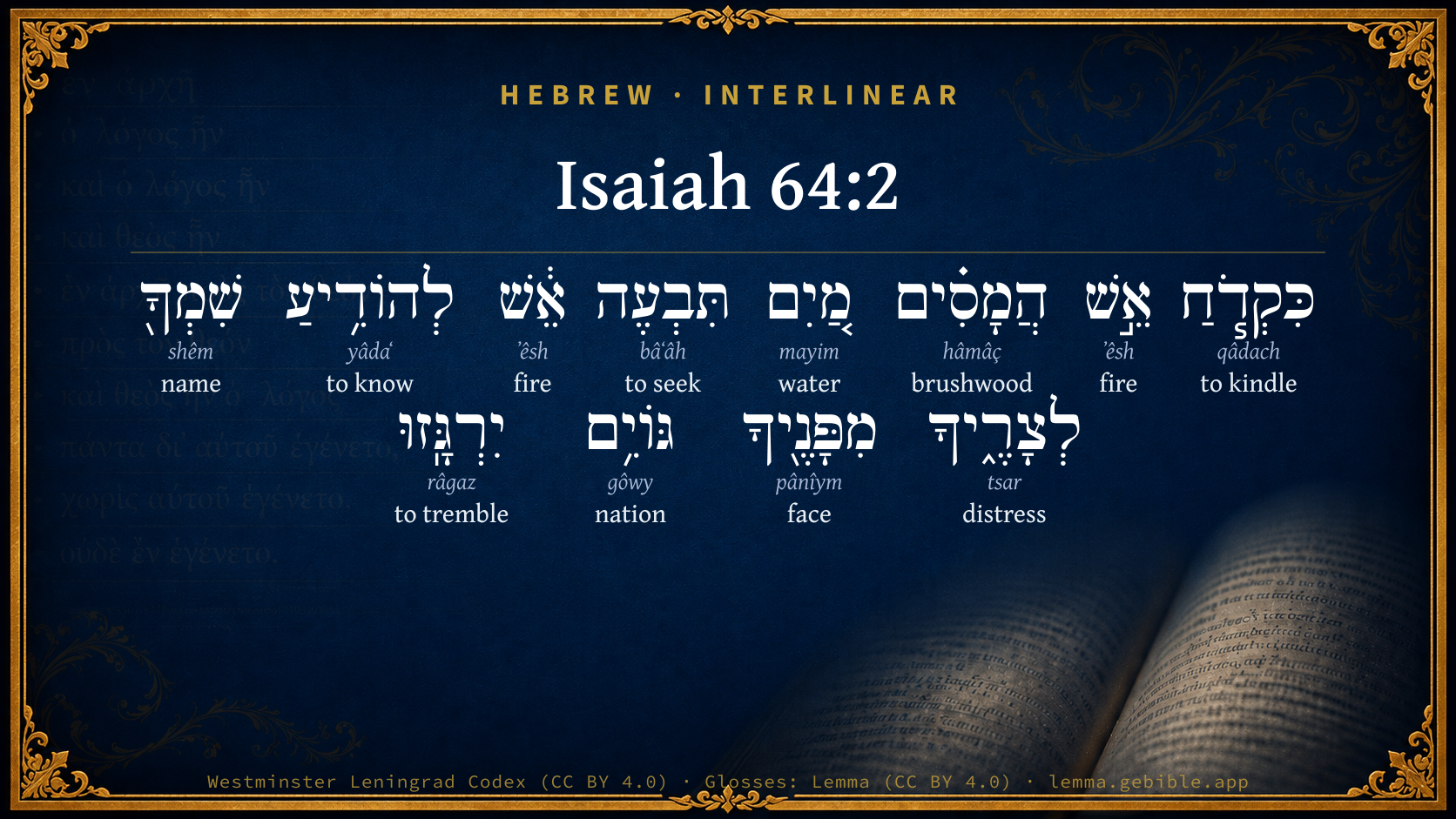
Hebrew (Westminster Leningrad Codex) Isaiah 64:2 appears in the Hebrew Old Testament. The text above is from the Westminster Leningrad Codex. Each word links to its Strong’s number, a concise gloss, and parsing drawn from the Open Scriptures Hebrew Bible morphology. Click any word for its full Brown-Driver-Briggs (BDB) entry.
Download image
Cite this verse

Isaiah 64:2 (World English Bible). Public Domain. Lemma interlinear Bible study tool, https://lemma.gebible.app/v/isaiah/64/2.

Show BibTeX & RIS
BibTeX
RIS
English Translation
as when fire kindles the brushwood, [and] the fire causes the waters to boil; to make your name known to your adversaries, that the nations may tremble at your presence!
World English Bible · Public Domain
Highlights
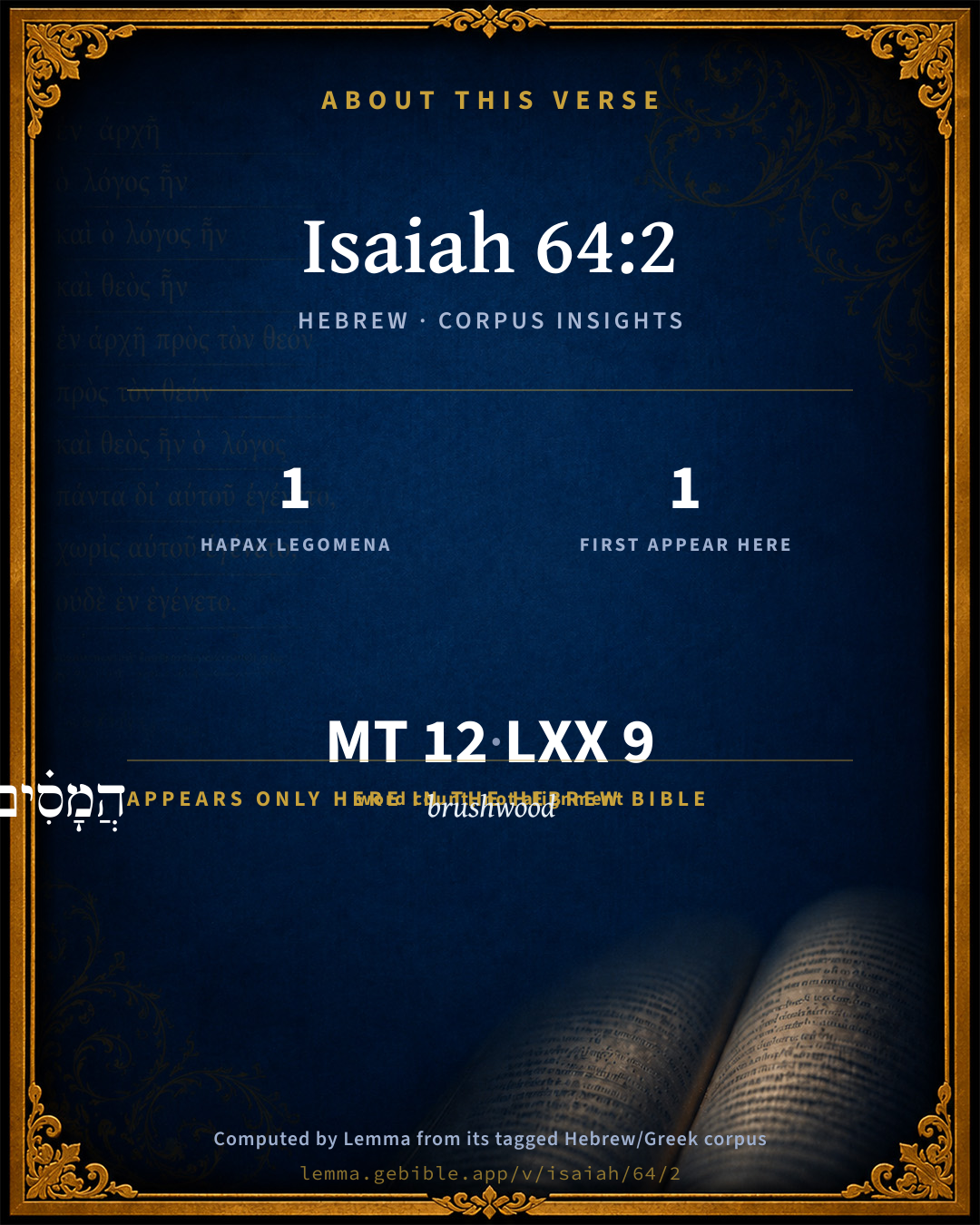
  • 1 hapax legomenon — only here in the Hebrew Bible
  • 1 first appearance in the Hebrew Bible
Full analysis ↓
Download a study sheet

One document with this verse’s original text, its word-by-word gloss line, the meaning frame, cross-references with their text, attributed commentary, and full source and license credits — printable, and it pastes into notes with its structure intact.

This verse Autodidact and up

Study sheet (.html) Plain text (.txt)

A passage Seminary Student

Up to 50 verses in one chapter. A passage sheet keeps up to 6 commentary sources and 12 cross-references per verse, in the order this page ranks them, and says so on the sheet whenever that leaves anything out. Ask for a single verse and you get the Autodidact verse sheet above.

Everything on this page stays free to read, with no account — the sheet is a download of what is already on screen, not access to it.

Want to remove ads? Support Godless Engineer
Compare translations 3

The same verse in 3 English versions, stacked beneath the original-language interlinear above. Click any original word for its lexicon entry.

Each is an independent rendering of the whole verse — the interlinear is not word-aligned to these translations.

Highlighted words mark where these versions differ — a whole-verse word diff, not a word-by-word alignment.

  • World English Bible Public Domain
    as when fire kindles the brushwood, [and] the fire causes the waters to boil; to make your name known to your adversaries, that the nations may tremble at your presence!
  • King James Version Public Domain
    As when the melting fire burneth, the fire causeth the waters to boil, to make thy name known to thine adversaries, that the nations may tremble at thy presence!
  • unfoldingWord Literal Text CC BY-SA 4.0
    As fire kindles brushwood, fire boils water, to make your name known to your adversaries, nations would tremble from your face.

unfoldingWord Literal Text — © unfoldingWord, licensed CC BY-SA 4.0. Word-aligned USFM3 via Door43 (git.door43.org/unfoldingWord/en_ult).

Versions to compare (up to 4)

3 of 4 selected

Show all 18 translations

Every available English version of this verse, each an independent rendering of the whole verse.

  • World English Bible Public Domain
    as when fire kindles the brushwood, [and] the fire causes the waters to boil; to make your name known to your adversaries, that the nations may tremble at your presence!
  • Berean Standard Bible Public Domain
    as fire kindles the brushwood and causes the water to boil, to make Your name known to Your enemies, so that the nations will tremble at Your presence!
  • Majority Standard Bible Public Domain
    as fire kindles the brushwood and causes the water to boil, to make Your name known to Your enemies, so that the nations will tremble at Your presence!
  • King James Version Public Domain
    As when the melting fire burneth, the fire causeth the waters to boil, to make thy name known to thine adversaries, that the nations may tremble at thy presence!
  • American Standard Version (1901) Public Domain
    as when fire kindleth the brushwood, `and' the fire causeth the waters to boil; to make thy name known to thine adversaries, that the nations may tremble at thy presence!
  • Revised Version (1885) Public Domain
    as when fire kindleth the brushwood, and the fire causeth the waters to boil: to make thy name known to thine adversaries, that the nations may tremble at thy presence.
  • Geneva Bible (1599) Public Domain
    As the melting fire burned, as the fire caused the waters to boyle, (that thou mightest declare thy Name to thy aduersaries) the people did tremble at thy presence.
  • Douay-Rheims (1899) Public Domain
    They would melt as at the burning of fire, the waters would burn with fire, that thy name might be made known to thy enemies: that the nations might tremble at thy presence.
  • Young's Literal Translation Public Domain
    (As fire kindleth stubble -- Fire causeth water to boil,) To make known Thy name to Thine adversaries, From Thy presence do nations tremble.
  • Literal Standard Version CC BY-SA 4.0
    (As fire kindles stubble—Fire causes water to boil), || To make Your Name known to Your adversaries, || Nations tremble from Your presence.
  • Unlocked Literal Bible CC BY-SA 4.0
    as when fire kindles the brushwood, or the fire makes water boil. Oh, that your name would be known by your adversaries, that the nations would tremble at your presence!
  • unfoldingWord Literal Text CC BY-SA 4.0
    As fire kindles brushwood, fire boils water, to make your name known to your adversaries, nations would tremble from your face.
  • Darby Bible Public Domain
    -- as fire kindleth brushwood, as the fire causeth water to boil, to make thy name known to thine adversaries, that the nations might tremble at thy presence!
  • World Messianic Bible Public Domain
    as when fire kindles the brushwood, and the fire causes the water to boil. Make your name known to your adversaries, that the nations may tremble at your presence!
  • Webster's Bible Public Domain
    \\64:3\\When thou didst terrible things which we looked not for, thou camest down, the mountains flowed down at thy presence.
  • Free Bible Version CC BY-SA 4.0
    In the same way that fire burns wood and makes water boil, make your reputation known to your enemies, so that nations will tremble in your presence!
  • Bible in Basic English Public Domain
    While you do acts of power for which we are not looking, and which have not come to the ears of men in the past.
  • JPS Tanakh (1917) Public Domain
    (64-1) As when fire kindleth the brush-wood, and the fire causeth the waters to boil; to make Thy name known to Thine adversaries, that the nations might tremble at Thy presence,

Literal Standard Version (2020), Covenant Press — licensed CC BY-SA 4.0. Text via the HelloAO Bible API (eBible.org). Unlocked Literal Bible (unfoldingWord) — licensed CC BY-SA 4.0. Text via the HelloAO Bible API (eBible.org). unfoldingWord Literal Text — © unfoldingWord, licensed CC BY-SA 4.0. Word-aligned USFM3 via Door43 (git.door43.org/unfoldingWord/en_ult). Free Bible Version, Dr. Jonathan Gallagher — licensed CC BY-SA 4.0. Text via the HelloAO Bible API (eBible.org).

Word by word

More ways to search: Search by grammar → Find every occurrence → Compare this word →

Practice this passage: Drill this verse → Learn its vocabulary →

הֲמָסִ֗ים
hâmâç
H2003
“brushwood”
Noun, Common, Masculine, Plural, Absolute
Part of Speech
Noun
Type
Common
Gender
Masculine
Number
Plural
State
Absolute
Full BDB Definition

Origin: from an unused root apparently meaning to crackle

TWOT: 508a

brushwood
  1. כִּקְדֹ֧חַ qâdach H6919 “like/as · to kindle” Preposition + Verb, Qal, Infinitive Construct
  2. אֵ֣שׁ ʼêsh H784 “fire” Noun, Common, Both, Singular, Absolute
  3. מַ֚יִם mayim H4325 “water(s)” Noun, Common, Masculine, Plural, Absolute
  4. תִּבְעֶה bâʻâh H1158 “to seek” Verb, Qal, Imperfect, 3rd Person, Feminine, Singular
  5. אֵ֔שׁ ʼêsh H784 “fire” Noun, Common, Both, Singular, Absolute
  6. לְהוֹדִ֥יעַ yâdaʻ H3045 “to know” Preposition + Verb, Hiphil, Infinitive Construct
  7. שִׁמְךָ֖ shêm H8034 “name · your” Noun, Common, Masculine, Singular, Construct + Suffix, Personal, 2nd Person, Masculine, Singular
  8. לְצָרֶ֑יךָ tsar H6862 “to/for · distresses · your” Preposition + Noun, Common, Masculine, Plural, Construct + Suffix, Personal, 2nd Person, Masculine, Singular
  9. מִפָּנֶ֖יךָ pânîym H6440 “from · face(s) · your” Preposition + Noun, Common, Both, Plural, Construct + Suffix, Personal, 2nd Person, Masculine, Singular
  10. גּוֹיִ֥ם gôwy H1471 “nations” Noun, Common, Masculine, Plural, Absolute
  11. יִרְגָּֽזוּ râgaz H7264 “to tremble” Verb, Qal, Imperfect, 3rd Person, Masculine, Plural

About this verse

These counts appear in no published source. They are computed here, from the morphology-tagged text and Lemma’s own curated glosses. What Lemma adds →

12
words
11
distinct lemmas
Prophets
section

Notable vocabulary

1 hapax legomenon — a word that appears only here in the entire Hebrew Bible:

  • הֲמָסִ֗ים brushwood H2003

First appearance in Scripture

This word makes its first canonical appearance in the Hebrew Bible here:

  • הֲמָסִ֗ים brushwood H2003

Shared distinctive vocabulary

כִּקְדֹ֧חַ to kindle H6919 occurs in 5 verses of the Hebrew Bible. Also found in:

Grammatical profile

  • 4 verbs
  • 8 nouns

Verb forms

  • כִּקְדֹ֧חַ Qal · Infinitive Construct
  • תִּבְעֶה Qal · Imperfect
  • לְהוֹדִ֥יעַ Hiphil · Infinitive Construct
  • יִרְגָּֽזוּ Qal · Imperfect

Repetition

A word recurs within this verse — often emphatic in Hebrew:

  • אֵ֣שׁ fire H784 ×2

Hebrew & Septuagint length

In English translation the verse runs 30 words from the Hebrew and 30 from the Septuagint (LXX English) — the same length.

A rough comparison of the two English renderings, which tokenize alike — not a word-level alignment.

Word counts can differ between the Hebrew and the Greek without any difference in meaning — e.g. the Hebrew direct-object marker אֵת has no separate Greek word, and Greek often adds the article ὁ.

In the original languages it is 12 Hebrew tokens and 9 Greek tokens — but the two are counted differently (Hebrew bundles its prefixes and suffixes into one token; the Greek is in lemma form), so that isn’t a like-for-like length.

Cross-references

27

Topical passages linked to Isaiah 64:2 in the Treasury of Scripture Knowledge — connected by theme and wording, ordered by reader-vote popularity; previews shown in the World English Bible.

  • Psalms 99:1 Yahweh reigns! Let the peoples tremble. He sits enthroned among the cherubim. Let the earth be moved.
  • Jeremiah 33:9 [This city] shall be to me for a name of joy, for a praise and for a glory, before all the nations of the earth, which shall hear all the good that I do to them, and shall fear and tremble for all the good and for all the peace that I procure to it.
  • Exodus 14:4 I will harden Pharaoh's heart, and he will follow after them; and I will get honor over Pharaoh, and over all his host; and the Egyptians shall know that I am Yahweh." They did so.
  • Psalms 46:10 "Be still, and know that I am God. I will be exalted among the nations. I will be exalted in the earth."
  • Psalms 102:15–16 So the nations will fear the name of Yahweh; All the kings of the earth your glory.
  • Isaiah 37:20 Now therefore, Yahweh our God, save us from his hand, that all the kingdoms of the earth may know that you are Yahweh, even you only.
  • Jeremiah 5:22 Don't you fear me? says Yahweh: won't you tremble at my presence, who have placed the sand for the bound of the sea, by a perpetual decree, that it can't pass it? and though the waves of it toss themselves, yet they can't prevail; though they roar, yet they can't pass over it.
  • Ezekiel 38:22–23 With pestilence and with blood will I enter into judgment with him; and I will rain on him, and on his hordes, and on the many peoples who are with him, an overflowing shower, and great hailstones, fire, and sulfur.
  • Daniel 4:32–37 and you shall be driven from men; and they dwelling shall be with the animals of the field; you shall be made to eat grass as oxen; and seven times shall pass over you; until you know that the Most High rules in the kingdom of men, and gives it to whoever he will.
  • Daniel 6:25–27 Then king Darius wrote to all the peoples, nations, and languages, who dwell in all the earth: Peace be multiplied to you.
  • Exodus 15:14–16 The peoples have heard. They tremble. Pangs have taken hold on the inhabitants of Philistia.
  • Deuteronomy 2:25 This day will I begin to put the dread of you and the fear of you on the peoples who are under the whole sky, who shall hear the report of you, and shall tremble, and be in anguish because of you.
  • 1 Samuel 17:46–47 This day will Yahweh deliver you into my hand; and I will strike you, and take your head from off you; and I will give the dead bodies of the host of the Philistines this day to the birds of the sky, and to the wild animals of the earth; that all the earth may know that there is a God in Israel,
  • 1 Kings 8:41–43 Moreover concerning the foreigner, who is not of your people Israel, when he shall come out of a far country for your name's sake
  • Psalms 9:20 Put them in fear, Yahweh. Let the nations know that they are only men. Selah.
  • Psalms 48:4–6 For, behold, the kings assembled themselves, They passed by together.
  • Psalms 67:1–2 May God be merciful to us, bless us, And cause his face to shine on us. Selah.
  • Psalms 79:10 Why should the nations say, "Where is their God?" Let it be known among the nations, before our eyes, That vengeance for your servants' blood is being poured out.
  • Psalms 83:13 My God, make them like tumbleweed; Like chaff before the wind.
  • Psalms 98:1–2 Sing to Yahweh a new song, For he has done marvelous things! His right hand, and his holy arm, have worked salvation for him.
  • Psalms 106:8 Nevertheless he saved them for his name's sake, That he might make his mighty power known.
  • Isaiah 63:12 who caused his glorious arm to go at the right hand of Moses? who divided the waters before them, to make himself an everlasting name?
  • Ezekiel 39:27–28 when I have brought them back from the peoples, and gathered them out of their enemies' lands, and am sanctified in them in the sight of many nations.
  • Daniel 4:1–3 Nebuchadnezzar the king, to all the peoples, nations, and languages, who dwell in all the earth: Peace be multiplied to you.
  • Joel 3:16–17 Yahweh will roar from Zion, And thunder from Jerusalem; And the heavens and the earth will shake; But Yahweh will be a refuge to his people, And a stronghold to the children of Israel.
  • Micah 7:15–17 "As in the days of your coming forth out of the land of Egypt, I will show them marvelous things."
  • Revelation 11:11–13 After the three and a half days, the breath of life from God entered into them, and they stood on their feet. Great fear fell on those who saw them.

Cross-references courtesy of OpenBible.info (CC BY 4.0).

Hebrew and Greek witnesses Masoretic Hebrew ↔ Greek Septuagint

The same verse in the two great witnesses to the Old Testament, shown verse-for-verse.

These are two independent witnesses, not word-aligned to each other, and the Septuagint is shown in lemma (dictionary) form.

Hebrew Isaiah 64:2 Masoretic · Westminster Leningrad Codex

כִּקְדֹ֧חַ אֵ֣שׁ הֲמָסִ֗ים מַ֚יִם תִּבְעֶה אֵ֔שׁ לְהוֹדִ֥יעַ שִׁמְךָ֖ לְצָרֶ֑יךָ מִפָּנֶ֖יךָ גּוֹיִ֥ם יִרְגָּֽזוּ

as when fire kindles the brushwood, [and] the fire causes the waters to boil; to make your name known to your adversaries, that the nations may tremble at your presence!

World English Bible · Public Domain

Greek LXX Isaiah 64:2 Septuagint · lemma form

ὅταν ποιέω ὁ ἔνδοξος τρόμος λαμβάνω ἀπό σύ ὄρος

as wax melts before the fire; and fire shall burn up the enemies, and your name shall be manifest among the adversaries: at your presence the nations shall be troubled,

LXX2012 (modern English Septuagint) · Public Domain

On this verse, Adam Clarke's Commentary discusses the Septuagint’s reading. Read the note in Commentary ↓

Hebrew: Westminster Leningrad Codex (CC BY 4.0). Greek: Septuagint (public domain); English from LXX2012 (modern English Septuagint) (Public Domain). How the Septuagint differs from the Hebrew →

Targum (Aramaic paraphrase)

1

The Targum is the ancient Jewish Aramaic paraphrase of the Hebrew Scriptures — an interpretive translation, not the Hebrew text itself. Onkelos (literal) and Pseudo-Jonathan (expansive) render the Torah, and Jonathan the Prophets. Coverage is partial: where no permissively-licensed English translation exists for a verse, only the Aramaic is shown. This is verse-level text, not a word-by-word alignment to the Hebrew.

  1. Targum Jonathan Prophets (Joshua–Malachi)
    בְּמַעְבְּדָךְ פְּרִישָׁן לָא סַבַּרְנָא לְהוֹן אִתְגְלִיתָא מִן קֳדָמָךְ טוּרַיָא זָעוּ:

    When Thou didst wonderful things, which we expected not, Thou didst reveal Thyself; the mountains trembled at Thy presence.

    Targum Jonathan — Aramaic: “Mikraot Gedolot” (public domain). English: “Sefaria Community Translation” (CC0 1.0 (public-domain dedication)); “London "Chaldee Paraphrase," 1871” (public domain). Text via Sefaria.

Commentary

Notes on Isaiah 64:2 from classic Christian and Jewish commentators (each source and its license shown beneath its notes). The classic Christian expositions comment on the surrounding passage and are grouped to its opening verse, so a note may address several verses; the Jewish commentaries on the Tanakh (Rashi and others) are per-verse, so they appear only where the commentator wrote on this verse.

Lemma curates 59 commentaries, every one of them public domain or Creative Commons licensed, each selected and text-cleaned for this edition rather than reprinted as found. About our sources →

Trapp's Complete Commentary

John Trapp

Isa 64:2 As [when] the melting fire burneth, the fire causeth the waters to boil, to make thy name known to thine adversaries, [that] the nations may tremble at thy presence!

Ver. 2. As when the melting fire burneth.] So let the mountains burn and boil at thy presence. Aristotle {a} reporteth that from the hill Etna there once ran down a torrent of fire, that consumed all the houses thereabout. The like is recorded of Vesuvius, and of Pietra Mala, a mountain in the highest part of the Apeninnes, which perpetually burneth; so Hecla and Hogla, in Iceland.

{a} De Mundo, cap. 6.

John Trapp, A Commentary or Exposition upon All the Books of the Old and New Testament (1647–1656) — public domain. Text from a community e-Sword module.

Geneva Bible (1599)

Geneva Bible translators

Meaning, the rain, hail, fire, thunder, and lightnings.

Geneva Bible (1599) marginal notes — public domain. Text via Bolls.life.

Jamieson, Fausset & Brown

Robert Jamieson, A. R. Fausset & David Brown

Oh, that Thy wrath would consume Thy foes as the fire. Rather, "as the fire burneth the dry brushwood" [GESENIUS].

Jamieson, Fausset & Brown — Commentary Critical and Explanatory on the Whole Bible (1871) — public domain (CC PDM 1.0). Text via the HelloAO Bible API.

Adam Clarke's Commentary

Verse 2. As when the melting fire burneth - "As the fire kindleth the dry fuel"] המסים hamasim. "It means dry stubble, and the root is המס hamas," says Rabbi Jonah, apud Sal. ben Melec in loc. Which is approved by Schultens, Orig. Heb. p. 30.

"The fire kindling the stubble does not seem like enough to the melting of the mountains to be brought as a simile to it. What if thus? -

'That the mountains might flow down at thy presence!

As the fire of things smelted burneth,

As the fire causeth the waters to boil - '

There is no doubt of the Hebrew words of the second line bearing that version." - Dr. JUBB.

I submit these different interpretations to the reader's judgment. For my own part I am inclined to think that the text is much corrupted in this place. The ancient Versions have not the least traces of either of the above interpretations. The Septuagint and Syriac agree exactly together in rendering this line by, "As the wax melted before the fire," which can by no means be reconciled with the present text. The Vulgate, for המסים hamasim, read ימסו yemasu.

That the nations] For גוים goyim, the nations, four MSS. (one of them ancient) have הרים harim, the mountains. - L.

Adam Clarke's Commentary on the Bible (1810–1826) — public domain. Text from a community e-Sword/MySword module.

Ellicott's Commentary for English Readers

(2) As when the melting fire burneth . . .—Better, as when fire Kindleth brushwood, as when fire causeth the water to boil. The two-fold action of material fire is used, as elsewhere, as a symbol of the “consuming fire” (Heb_12:29) of the wrath of Jehovah.

A Bible Commentary for English Readers, edited by Charles John Ellicott (1878–1897) — public domain. Text from a community e-Sword module.

The Cambridge Bible for Schools and Colleges

gen. ed. J. J. S. Perowne

2. Render: As fire kindleth brushwood, as fire maketh water boil, &c.

to make thy name known to thine adversaries &c.]—the purpose of the Theophany. Cf. ch. Isa_59:18-19.

The Cambridge Bible for Schools and Colleges (gen. ed. J. J. S. Perowne; Cambridge University Press, 1878–1918) — public domain. Text from a community e-Sword module.

John Gill's Exposition

As when the melting fire burneth,.... Or, "the fire of melting" (k); a strong vehement fire, as Kimchi, such as is used under a furnace for melting metals; though De Dieu thinks a slow gentle fire is intended, such as is sufficient to keep the liquor boiling; which he concludes from the use of the word in the Arabic language, which, according to an Arabic lexicographer (l) he quotes, so signifies; and to the same purpose Hottinger (m), by the help of the Arabic language, interprets the word of a small low noise, the hissing of a boiling pot; though, as Vitringa observes, could it be granted, which can not, that a slow fire raises great bubbles in water, such as when it boils; yet the fire, with which God consumes his enemies, in a figurative sense, is represented as most vehement and noisy. It seems much better, with R. Jonah, quoted by Kimchi, to understand it of "dry stubble", which makes a great blaze and noise, and causes water to boil and rise up in bubbles; and with this agree some other versions, which render it by "bavins" (n), dry sticks and branches of trees; which being kindled,

the fire causeth the waters to boil; as the fire, under the pot, causes the waters to boil in it; the church here prays that the wrath of God might break forth upon his and her enemies, like fire that melts metals, and boils water. The figures used seem to denote the fierceness and vehemency of it. The Targum is,

"as when thou sendedst thine anger as fire in the days of Elijah, the sea was melted, the fire licked up the water;''

as if the allusion was to the affair in Kg1 18:38, but rather the allusion is, as Kimchi and others think, to the fire that burnt on Mount Sinai, when the Lord descended on it, and the cloud which flowed with water, as the above writer supposes, and which both together caused the smoke:

to make thy name known to thine adversaries; his terrible name, in the destruction of them; his power and his glory:

that the nations may tremble at thy presence; as Sinai trembled when the Lord was on it; and as the antichristian states will when Christ appears, and the vials of his wrath will be poured out; and the Lord's people will be delivered, and the Jews particularly converted.

(k) "ignis liquefactionum", Calvin, Vatablus; "igne liquationum", Cocceius. (l) Eliduri in Lexico Arabico tradit "significare quemvis lenem et submissum strepitum", De Dieu. (m) "Quemadmodum accenso igne fit lenis submissusque strepitus, sibilus et stridor ferventis ollae, et ignis excitat bullas", Hottinger. Smegma Orientale, I. 1. c. 7. p. 146. (n) "Quemadmodum conflagrante igne cremia", Junius & Tremellius; "nam quum accendit ignis cremia", Piscator; "sicut ardente igne ex ramalibus", Grotius; "ut ignis cremia consumens strepero motu exsilit", Vitringa.

John Gill's Exposition of the Whole Bible (1746–1763) — public domain (CC PDM 1.0). Text via the HelloAO Bible API.

Albert Barnes' Notes on the Bible

As when the melting fire burneth - Margin, ‘The fire of meltings.’ Lowth renders it, ‘As when the fire kindleth the dry fuel.’ So Noyes, ‘As fire kindleth the dry stubble.’ The Septuagint render it: Ὡς κηρὸς ἀπὸ προσώπου πυρὸς τήκεται Hōs kēros apo prosōpou puros tēketai - ‘As wax is melted before the fire.’ So the Syriac renders it. The Hebrew word rendered here in the margin ‘meltings’ (המסים hămâsı̂ym), properly means, according to Gesenius, brushwood, twigs. So Saddias renders it. And the true idea here is, that the presence of Yahweh would cause the mountains to melt, as a fire consumes light and dry brushwood or stubble. Dr. Jubb supposes that the meaning is, ‘As the fire of things smelted burneth’ - an idea which would furnish a striking comparison, but there is much doubt whether the Hebrew will bear that construction.

The comparison is a very vivid and sublime one, as it is in the view given above - that the presence of Yahweh would set on fire the mountains, and cause them to flow down as under the operation of an intense heat. I do not know that there is reason to suppose that the prophet had any reference to a volcanic eruption, or that he was acquainted with such a phenomenon - though Syria and Palestine abounded in volcanic appearances, and the country around the Dead Sea is evidently volcanic (see Lyell’s Geology, i. 299); but the following description may furnish an illustration of what would be exhibited by the flowing down of the mountains at the presence of Yahweh, and may serve to show the force of the language which the prophet employs in these verses. It is a description of an eruption of Vesuvius in 1779, by Sir William Hamilton. ‘Jets of liquid lava,’ says he, ‘mixed with stones and scoriae, were thrown up to the height of at least 10,000 feet, having the appearance of a column of fire.

The falling matter being nearly as vividly inflamed as that which was continually issuing forth from the crater, formed with it one complete body of fire, which could not be less than two miles and a half in breadth, and of the extraordinary height above mentioned, casting a heat to the distance of at least six miles around it.’ Speaking of the lava which flowed from the mountain, he says, ‘At the point where it issued from an arched chasm in the side of the mountain, the vivid torrent rushed with the velocity of a flood. It was in perfect fusion, unattended with any scoriae on its surface, or any gross material not in a state of complete solution. It flowed with the translucency of honey, in regular channels, cut finer than art can imitate, and glowing with all the splendor of the sun’ (Lyell’s Geology, i. 316). Perhaps there can be conceived no more sublime representation of what was in the mind of the prophet than such an overflowing volcano. It should be observed, however, that Gesenius supposes that the word which is rendered Isa 64:1-3, ‘flow down’ (נזלוּ nāzolû), is derived, not from נזל nāzal, to flow, to run as liquids do; but from זלל zâlal, to shake, to tremble, to quake as mountains do in an earthquake. But it seems to me that the connection rather demands the former signification, as the principal elements in the figure is fire - and the office of fire is not to cause to tremble, but to burn or melt. The effect here described as illustrative of the presence of God, was that produced by intense burning heat.

The fire causeth the waters to boil - Such an effect was anticipated at the presence of Yahweh. The idea is still that of an intense heat, that should cause all obstacles to be consumed before the presence of the Lord. To illustrate this, the prophet speaks of that which is known to be most intense, that which causes water to boil; and the prayer is, that Yahweh would descend in the manner of such intense and glowing fire, in order that a the foes of the people might be destroyed, and all the obstacles to the restoration of his people removed. The exact point of the comparison, as I conceive, is the intensity of the heat, as emblematic of the majesty of Yahweh, and of the certain destruction of his foes.

To make thy name known - By the exhibition of thy majesty and glory.

Albert Barnes' Notes on the Bible (1834–1885) — public domain. Text from a community e-Sword/MySword module.

Haydock's Catholic Bible Commentary

They. Septuagint, "As wax melts before the fire, so also fire will burn the adversaries, and thy," &c. (Haydock) --- Burn. Sparks of fire seem to proceed from it.

George Leo Haydock (1774–1849), Haydock's Catholic Family Bible and Commentary, 1859 edition — public domain. Excludes Psalms (Douay-Rheims chapter numbering differs from Protestant) and Deuterocanonical books (Catholic canon only).

Matthew Poole's English Annotations

As when the melting fire burneth; come with such zeal for thy people, that the solid mountains may be no more before thy breath than metal that runs, or water that boils by the force of a vehement fire; and thus, for the most part, when God will take vengeance of his enemies, the Scripture expresseth him coming with fire.

Thy name known; thy power known, that thine enemies and persecutors of try church may know thy power, and that thy name may be dreaded among them; his name put for his power, Psa 106:8.

The nations; not the Babylonians only, but the nations round about.

Matthew Poole's English Annotations on the Holy Bible (1683–1685) — public domain. Text from a community e-Sword/MySword module.

Whedon's Commentary on the Bible

Daniel D. Whedon

2. The melting fire burneth… waters to boil — The point here is the quickness of the effect prayed for in Isa_64:1. As fire burns brush or boils water, so quick do Israel’s national foes tremble. Here are two figures: one of swift, rapid, roaring consumption by the flames, the other of violent agitation and tumult, like water boiling over glowing fires. “Melting fire” such as this the wicked cannot long endure. God’s majesty is similarly presented in Jdg_5:4-5; Psa_97:5; Mic_1:3-4; Hab_3:4-5.

Daniel D. Whedon (gen. ed.), Commentary on the Old and New Testaments (1874–1909) — public domain. Text from a community e-Sword module.

The Pulpit Commentary

As when the melting fire burneth, etc.; rather, as when fire kindles brushwood, and makes water to boil. Connect the similes with the last clause of ver. 1. The mountains shall be as powerless to resist Jehovah, as brushwood or water to resist fire. To make thy Name known. (comp. Isa_63:12) Such an "epiphany" as the Church prays for would make the Name of Jehovah known far and wide, exalting him high above all gods, and causing "the nationsi.e. the whole heathen world to "tremble at his presence" and refrain from injuring his people.

The Pulpit Commentary (1880–1919), ed. H.D.M. Spence-Jones & Joseph S. Exell — public domain. Text from a community e-Sword module.

John Wesley's Explanatory Notes

Fire - Come with such zeal for thy people, that the solid mountains may be no more before thy breath, than metal that runs, or water that boils by the force of a vehement fire. Known - That thine enemies may know thy power, and that thy name may be dreaded among them.

John Wesley, Explanatory Notes Upon the Whole Bible (1754–1765) — public domain. Text via the GEBible commentary corpus.

J. A. Alexander on Isaiah

Joseph Addison Alexander

“As fire kindles brush, fire boils water — to make known Thy name to Thine enemies, from before Thee nations shall tremble.” The last clause coheres directly with the preceding verse, while the first is a parenthetical comparison; for which cause some of the latest writers throw the last words of Isaiah 63 into this sentence. Either of two constructions may be here adopted — ‘as a fire of brushwood burns’, or, ‘as fire kindles brush’, the last of which is preferred by most interpreters, as simpler in itself, and because fire is the subject of the verb in the next clause also. The point of comparison in both these clauses is the rapidity and ease with which the effect is produced. The literal effect is described in the next words, ‘to make known Thy name’, (i.e., to manifest Thy being and Thine attributes to Thine enemies). In both parts of the sentence the construction passes as it were insensibly from the infinitive to the future, a transition not infrequent in Hebrew syntax.

Joseph Addison Alexander, The Prophecies of Isaiah (1846–1847; New York: Scribner, 1870–1878) — public domain. Text from a community e-Sword module.

Rashi

Rabbi Shlomo Yitzchaki (Rashi)

When You performed against the Egyptians and against all the adversaries awesome deeds, that we did not hope You would perform all those awesome deeds, for we were unworthy of them.

You descended to Mount Sinai, then mountains dripped from before You. In this manner, Dunash son of Labrat explained it.

Rashi on the Tanakh — English translations: “The Judaica Press complete Tanach with Rashi, translated by A. J. Rosenberg” (CC BY 4.0); “Pentateuch with Rashi's commentary by M. Rosenbaum and A.M. Silbermann, 1929-1934” (public domain); “The Metsudah Tanach series, Lakewood, N.J” (CC BY 4.0); and “The Book of Joshua, Metsudah Publications, 1997” (CC BY 4.0). Text via Sefaria.

Ibn Ezra

Rabbi Abraham ibn Ezra

בעשותך When thou didst.

נוראות Terrible things. It is an adjective, and a noun must be supplied. Comp. עזות rough words (Prov. 18:20).

לא נקוה Which we looked not for.

ירדת When thou camest down. מפניך הרים נזלו Then the mountains flowed down at Thy presence. Such things Thou hast already done in the past.

Ibn Ezra on the Tanakh — English translations: “Sefaria Community Translation” (CC0 1.0 (public-domain dedication)); “Yalkut, Sifsei Chachomim Chumash, Metsudah Publications, 2009” (CC BY 4.0); and “Commentary of Ibn Ezra on Isaiah - trans. by M. Friedlander, 1873” (public domain). Text via Sefaria.

Lesson kit

Teaching starters — assembled from the data on this page, not authored interpretation. Every prompt links to the verse data it draws on. Edit before teaching.

Isaiah, in the Prophets, opens this verse with 12 words (11 distinct Hebrew lemmas). Its most distinctive word is hâmâç (“brushwood”). A historical commentator’s framing appears above. Read the whole chapter for the surrounding context.

Discussion questions

  1. What does “brushwood” (hâmâç) contribute to the verse as a whole?
  2. 1 word here appears nowhere else in the Hebrew Bible. Why might the author reach for such rare wording?
  3. This is the first place “brushwood” appears in Scripture (first appears here). What does its debut here establish?
  4. How does Deuteronomy 32:22, which shares the word «to kindle», read alongside this verse?
  5. What does the repetition of “fire” (2× in this one verse) do in this verse?
  6. These translations render this verse differently; the difference is in the English rendering, not the original. What questions does that raise?
  7. «כִּקְדֹ֧חַ» is a Qal Infinitive Construct verb. How does that grammatical form shape the action described?
  8. Compare how Trapp's Complete Commentary and Geneva Bible (1599) read this verse. Where do they agree or differ?

Things to notice

  • 1 word in this verse appears nowhere else in the Hebrew Bible.
  • 1 word makes its first canonical appearance in Scripture here.
  • This verse counts 12 Hebrew ↔ 9 Greek words.
  • These translations choose different wording for 15 words in this verse.
  • “fire” occurs 2× in this single verse.

Reading settings

Reading text

Shown beneath each verse's original-language words.

Old Testament
Old Testament edition

Read the OT as the Masoretic Hebrew (MT) or the Greek Septuagint (LXX).

English shown for the Greek Septuagint (in the Hebrew ↔ Greek comparison).

Comparing translations? Open the Compare panel on any verse page to stack up to four side by side.