
Psalms 106:44

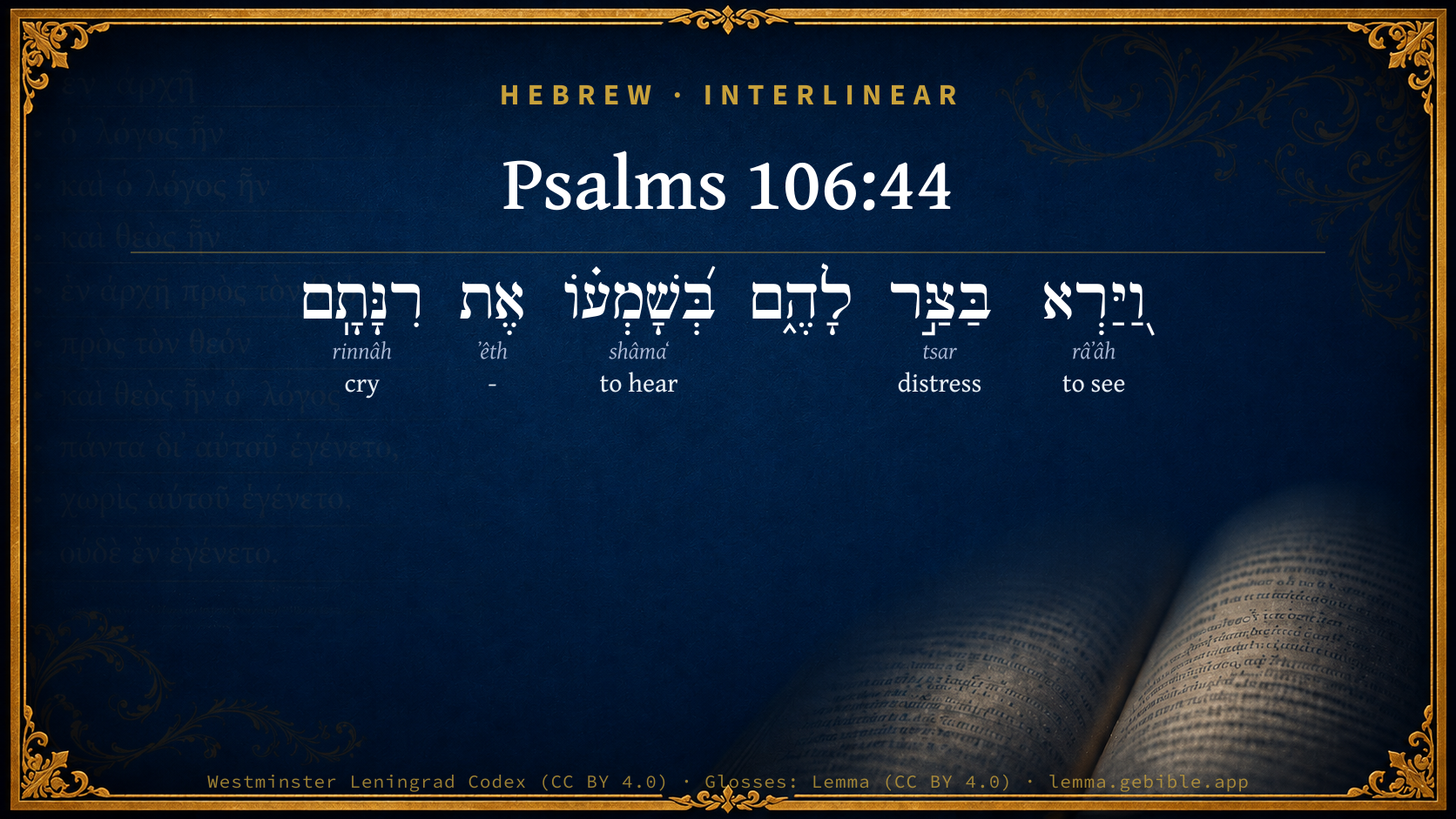
Hebrew (Westminster Leningrad Codex) Psalms 106:44 appears in the Hebrew Old Testament. The text above is from the Westminster Leningrad Codex. Each word links to its Strong’s number, a concise gloss, and parsing drawn from the Open Scriptures Hebrew Bible morphology. Click any word for its full Brown-Driver-Briggs (BDB) entry.
Download image
Cite this verse

Psalms 106:44 (World English Bible). Public Domain. Lemma interlinear Bible study tool, https://lemma.gebible.app/v/psalms/106/44.

Show BibTeX & RIS
BibTeX
RIS
English Translation
Nevertheless he regarded their distress, When he heard their cry.
World English Bible · Public Domain
Download a study sheet

One document with this verse’s original text, its word-by-word gloss line, the meaning frame, cross-references with their text, attributed commentary, and full source and license credits — printable, and it pastes into notes with its structure intact.

This verse Autodidact and up

Study sheet (.html) Plain text (.txt)

A passage Seminary Student

Up to 50 verses in one chapter. A passage sheet keeps up to 6 commentary sources and 12 cross-references per verse, in the order this page ranks them, and says so on the sheet whenever that leaves anything out. Ask for a single verse and you get the Autodidact verse sheet above.

Everything on this page stays free to read, with no account — the sheet is a download of what is already on screen, not access to it.

Want to remove ads? Support Godless Engineer
Compare translations 3

The same verse in 3 English versions, stacked beneath the original-language interlinear above. Click any original word for its lexicon entry.

Each is an independent rendering of the whole verse — the interlinear is not word-aligned to these translations.

Highlighted words mark where these versions differ — a whole-verse word diff, not a word-by-word alignment.

  • World English Bible Public Domain
    Nevertheless he regarded their distress, When he heard their cry.
  • King James Version Public Domain
    Nevertheless he regarded their affliction, when he heard their cry:
  • unfoldingWord Literal Text CC BY-SA 4.0
    Yet he saw in the narrow to them, when he was hearing their cry.

unfoldingWord Literal Text — © unfoldingWord, licensed CC BY-SA 4.0. Word-aligned USFM3 via Door43 (git.door43.org/unfoldingWord/en_ult).

Versions to compare (up to 4)

3 of 4 selected

Show all 18 translations

Every available English version of this verse, each an independent rendering of the whole verse.

  • World English Bible Public Domain
    Nevertheless he regarded their distress, When he heard their cry.
  • Berean Standard Bible Public Domain
    Nevertheless He heard their cry; He took note of their distress.
  • Majority Standard Bible Public Domain
    Nevertheless He heard their cry; He took note of their distress.
  • King James Version Public Domain
    Nevertheless he regarded their affliction, when he heard their cry:
  • American Standard Version (1901) Public Domain
    Nevertheless he regarded their distress, When he heard their cry:
  • Revised Version (1885) Public Domain
    Nevertheless he regarded their distress, when he heard their cry:
  • Geneva Bible (1599) Public Domain
    Yet hee sawe when they were in affliction, and he heard their crie.
  • Douay-Rheims (1899) Public Domain
    And he saw when they were in tribulation: and he heard their prayer.
  • Young's Literal Translation Public Domain
    And He looketh on their distress When He heareth their cry,
  • Literal Standard Version CC BY-SA 4.0
    And He looks on their distress || When He hears their cry,
  • Unlocked Literal Bible CC BY-SA 4.0
    Nevertheless, he paid attention to their distress when he heard their cry for help.
  • unfoldingWord Literal Text CC BY-SA 4.0
    Yet he saw in the narrow to them, when he was hearing their cry.
  • Darby Bible Public Domain
    But he regarded their distress, when he heard their cry;
  • World Messianic Bible Public Domain
    Nevertheless he regarded their distress, when he heard their cry.
  • Webster's Bible Public Domain
    Nevertheless he regarded their affliction, when he heard their cry:
  • Free Bible Version CC BY-SA 4.0
    Despite all this, the Lord was moved by their suffering; he heard their sad cries.
  • Bible in Basic English Public Domain
    But when their cry came to his ears, he had pity on their trouble:
  • JPS Tanakh (1917) Public Domain
    Nevertheless He looked upon their distress, when He heard their cry;

Literal Standard Version (2020), Covenant Press — licensed CC BY-SA 4.0. Text via the HelloAO Bible API (eBible.org). Unlocked Literal Bible (unfoldingWord) — licensed CC BY-SA 4.0. Text via the HelloAO Bible API (eBible.org). unfoldingWord Literal Text — © unfoldingWord, licensed CC BY-SA 4.0. Word-aligned USFM3 via Door43 (git.door43.org/unfoldingWord/en_ult). Free Bible Version, Dr. Jonathan Gallagher — licensed CC BY-SA 4.0. Text via the HelloAO Bible API (eBible.org).

Word by word

More ways to search: Search by grammar → Find every occurrence → Compare this word →

Practice this passage: Drill this verse → Learn its vocabulary →

About this verse

These counts appear in no published source. They are computed here, from the morphology-tagged text and Lemma’s own curated glosses. What Lemma adds →

6
words
5
distinct lemmas
Wisdom
section

Shared distinctive vocabulary

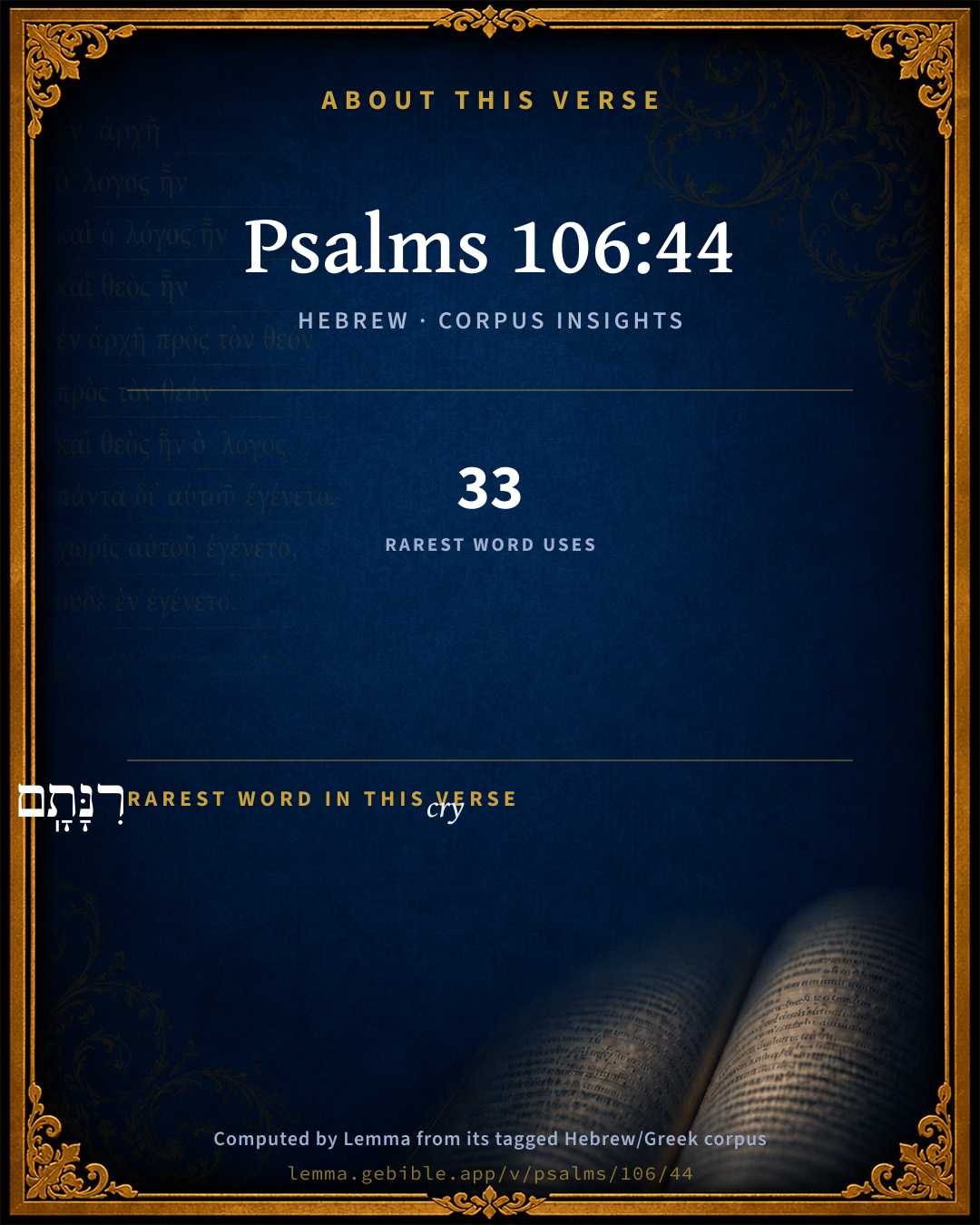
רִנָּתָֽם cry H7440 occurs in 33 verses of the Hebrew Bible. Also found in:

Grammatical profile

  • 2 verbs
  • 1 noun
  • 1 adjective
  • 1 preposition
  • 1 particle

Verb forms

  • וַ֭יַּרְא Qal · Sequential Imperfect
  • בְּ֝שָׁמְע֗וֹ Qal · Infinitive Construct

Hebrew & Septuagint length

In English translation the verse runs 10 words from the Hebrew and 12 from the Septuagint (LXX English) — closely comparable.

A rough comparison of the two English renderings, which tokenize alike — not a word-level alignment.

Word counts can differ between the Hebrew and the Greek without any difference in meaning — e.g. the Hebrew direct-object marker אֵת has no separate Greek word, and Greek often adds the article ὁ.

Cross-references

8

Topical passages linked to Psalms 106:44 in the Treasury of Scripture Knowledge — connected by theme and wording, ordered by reader-vote popularity; previews shown in the World English Bible.

  • Judges 3:9 When the children of Israel cried to Yahweh, Yahweh raised up a savior to the children of Israel, who saved them, even Othniel the son of Kenaz, Caleb's younger brother.
  • Judges 4:3 The children of Israel cried to Yahweh: for he had nine hundred chariots of iron; and twenty years he mightily oppressed the children of Israel.
  • Judges 2:18 When Yahweh raised them up judges, then Yahweh was with the judge, and saved them out of the hand of their enemies all the days of the judge: for it repented Yahweh because of their groaning by reason of those who oppressed them and vexed them.
  • Judges 6:6–10 Israel was brought very low because of Midian; and the children of Israel cried to Yahweh.
  • Judges 10:10–16 The children of Israel cried to Yahweh, saying, We have sinned against you, even because we have forsaken our God, and have served the Baals.
  • 1 Samuel 7:8–12 The children of Israel said to Samuel, "Don't cease to cry to Yahweh our God for us, that he will save us out of the hand of the Philistines."
  • 2 Kings 14:26–27 For Yahweh saw the affliction of Israel, that it was very bitter; for there was none shut up nor left at large, neither was there any helper for Israel.
  • Nehemiah 9:27–38 Therefore you delivered them into the hand of their adversaries, who distressed them: and in the time of their trouble, when they cried to you, you heard from heaven; and according to your manifold mercies you gave them saviors who saved them out of the hand of their adversaries.

Cross-references courtesy of OpenBible.info (CC BY 4.0).

Hebrew and Greek witnesses Masoretic Hebrew ↔ Greek Septuagint

The same verse in the two great witnesses to the Old Testament, shown verse-for-verse.

You’re reading Greek Psalm 105 (Hebrew Psalm 106). The Septuagint counts the superscription, so verse numbers can differ from the Hebrew — chapter-level alignment, not verse-by-verse. Numbering follows Rahlfs.

These are two independent witnesses, not word-aligned to each other, and the Septuagint is shown in lemma (dictionary) form.

Hebrew Psalms 106:44 Masoretic · Westminster Leningrad Codex

וַ֭יַּרְא בַּצַּ֣ר לָהֶ֑ם בְּ֝שָׁמְע֗וֹ אֶת רִנָּתָֽם

Nevertheless he regarded their distress, When he heard their cry.

World English Bible · Public Domain

Greek LXX Greek Psalm 105:44 Septuagint · lemma form

καί ὁράω ἐν ὁ θλίβω αὐτός ἐν ὁ αὐτός εἰςἀκούω ὁ δέησις αὐτός

You⌃ the Lord looked upon their affliction, when he heard their petition.

LXX2012 (modern English Septuagint) · Public Domain

Hebrew: Westminster Leningrad Codex (CC BY 4.0). Greek: Septuagint (public domain); English from LXX2012 (modern English Septuagint) (Public Domain). How the Septuagint differs from the Hebrew →

Commentary

Notes on Psalms 106:44 from classic Christian and Jewish commentators (each source and its license shown beneath its notes). The classic Christian expositions comment on the surrounding passage and are grouped to its opening verse, so a note may address several verses; the Jewish commentaries on the Tanakh (Rashi and others) are per-verse, so they appear only where the commentator wrote on this verse.

Lemma curates 59 commentaries, every one of them public domain or Creative Commons licensed, each selected and text-cleaned for this edition rather than reprinted as found. About our sources →

Trapp's Complete Commentary

John Trapp

Psa 106:44 Nevertheless he regarded their affliction, when he heard their cry:

Ver. 44. Nevertheless he regarded their affliction] See for proof hereof the whole Book of Judges, and take notice of God’s philanthropy, who heareth men’s afflictions, as he did Hagar’s, Gen 16:11, and is oft found of them that seek him not, Isa 65:1. See 2Ki 14:26-27.

When he heard their cry] Heb. their shrill outcry; not for joy (as the word is mostly taken), but for grief.

John Trapp, A Commentary or Exposition upon All the Books of the Old and New Testament (1647–1656) — public domain. Text from a community e-Sword module.

J. A. Alexander on Psalms

Joseph Addison Alexander

44. (Psa 106:44) And he has looked at their distress when he heard them cry. The idiomatic form of the original may thus be represented by a bald translation, and he saw in the distress to them in his hearing their cry. As this follows the brief statement of their downfall, there is much probability in the opinion, that it relates to the "tokens for good," which were granted to the exiled Jews in Babylon long before their actual restoration. With the first clause compare Exo 2:25; Exo 4:31, Deu 4:30, Psa 18:7; Psa 102:3.

Joseph Addison Alexander, The Psalms Translated and Explained (1850) — public domain. Text from a community e-Sword module.

John Gill's Exposition

And he remembered for them his covenant,.... At Sinai, according to Aben Ezra; rather that made with Abraham, Isaac, and Jacob; see Psa 105:8, not their covenant who promised to hear and do all that the Lord commanded, and did it not; but his covenant, his promise of giving them the good land, and settling them in it: the Lord is ever mindful of the covenant of his grace for his people, for their good; he remembers the promises he has made, where they are in Christ; and so as to fulfil and apply them; he remembers the blessings of it, the sure mercies of David, and gives them; he remembers for whom it is made, and never forgets them; he remembers with whom it is made, with his Son, the surety, messenger, and Mediator of it; he remembers that he is their covenant God and Father, and will be so for evermore; he remembers his lovingkindness, which has been ever of old, which is the source and foundation of it.

And repented according to the multitude of his mercies; his mercies temporal and spiritual are many; and there is an abundance of mercy displayed especially in spiritual ones, in redemption, in regeneration, and in the forgiveness of sin. Or "according to the abundance of his grace", or "gracious benefits" (e); there is an abundance of grace in his heart, in his Son, in his covenant, in salvation by Christ, and in every part of it; and which appears at conversion, as superabundant; and by this multitude of mercy, and abundance of grace, he is moved to "repent". This is sometimes denied of him; and indeed he never repents so as to change his mind, to alter his purposes, to revoke his promises or his gifts, these are all without repentance; but he sometimes changes his ways and his works, his conduct in Providence, and the course of it; and then he may be said to repent of the evil he threatened to do, or was doing, when he puts a stop to it; and instead of that bestows favours and blessings.

(e) "secundum amplitudinem, seu multitudinem gratiarum suarum", Cocceius, Gejerus.

John Gill's Exposition of the Whole Bible (1746–1763) — public domain (CC PDM 1.0). Text via the HelloAO Bible API.

Albert Barnes' Notes on the Bible

Nevertheless, he regarded their affliction - literally, “And he looked upon the trouble that was upon them;” or, “and he saw in the distress to them.” The meaning is, that he did not turn away from it; he saw the need of interposition, and he came to them.

When he heard their cry - literally, “In his hearing their cry.” Their cry for help came before him, and he did not refuse to look upon their affliction. The idea is, that he was attracted to their case by their loud cry for help; and that when he heard the cry, he did not refuse to look upon their low and sad condition. God assists us when we cry to him. We ask his attention to our troubles; we pray for his help; and when he hears the cry, he comes and saves us. He does not turn away, or treat our case as unworthy of his notice.

Albert Barnes' Notes on the Bible (1834–1885) — public domain. Text from a community e-Sword/MySword module.

The Treasury of David

Charles H. Spurgeon

Ver. 44-45. Sin in God's people.

1. Is very provoking to God.

2. Ensures chastisement.

3. Is to be sincerely mourned"their cry."

4. Will be graciously forgiven, and its effect removed. So the covenant promises.

Psalms 106:45*

Charles H. Spurgeon's The Treasury of David (1869–1885) — public domain. Psalms only. Text from a community e-Sword/MySword module.

The Pulpit Commentary

Nevertheless he regarded their affliction; or, "he saw them in their trouble," i.e. he looked on them, and had regard to them. (see 2Ki_17:13 2Ch_36:15) When he heard their cry. As God "heard the cry" of his people, when they suffered oppression in Egypt, (Exo_2:23 Exo_3:7, Exo_3:9) so also in their other oppressions, (Jud_1:3:9, 15 4:3 6:6 10:10 1Sa_12:10, 1Sa_12:11, etc) if they did but humble themselves and "cry" to him, he always hearkened and gave them deliverance. (1Ch_5:20 2Ch_12:7 2Ch_14:11, 12 20:4-24 32:20, 21 33:11-13)

Vers. 44, 45. The hope of the exile.

Israel in exile had no hope at all, but in the mercy and the faithfulness of her redeeming God. (Lev_26:41, Lev_26:42) When a human soul is far away from God, and can sing no song of joy in the "strange land" of sinful alienation; when it is brought very low with a sense of Divine disapproval, and of a future which it dare not face; when it shrinks from the society of those with whom it once had sweet and sacred fellowship, and shuns the eye of human piety; there is one thing to remember, one refuge in which to hide the boundless mercy and the inviolable Word of God. That will not fail a human soul at its very worst. Up that pathway there is an escape from the "lowest hell" to the highest heaven.

The Pulpit Commentary (1880–1919), ed. H.D.M. Spence-Jones & Joseph S. Exell — public domain. Text from a community e-Sword module.

Keil & Delitzsch

C. F. Keil & F. Delitzsch

The poet's range of vision here widens from the time of the judges to the history of the whole of the succeeding age down to the present; for the whole history of Israel has essentially the same fundamental character, viz., that Israel's unfaithfulness does not annul God's faithfulness. That verifies itself even now. That which Solomon in Kg1 8:50 prays for on behalf of his people when they may be betrayed into the hands of the enemy, has been fulfilled in the case of the dispersion of Israel in all countries (Psa 107:3), Babylonia, Egypt, etc.: God has turned the hearts of their oppressors towards them. On ראה ב, to regard compassionately, cf. Gen 29:32; Sa1 1:11. בּצּר לחם belong together, as in Psa 107:6, and frequently. רנּה is a cry of lamentation, as in Kg1 8:28 in Solomon's prayer at the dedication of the Temple. From this source comes Psa 106:6, and also from this source Psa 106:46, cf. Kg1 8:50 together with Neh 1:11. In ויּנּחם the drawing back of the tone does not take place, as in Gen 24:67. חסדו beside כּרב is not pointed by the Kerמ חסדּו, as in Psa 5:8; Psa 69:14, but as in Lam 3:32, according to Psa 106:7, Isa 63:7, חסדו: in accordance with the fulness (riches) of His manifold mercy or loving-kindness. The expression in Psa 106:46 is like Gen 43:14. Although the condition of the poet's fellow-countrymen in the dispersion may have been tolerable in itself, yet this involuntary scattering of the members of the nation is always a state of punishment. The poet prays in Psa 106:47 that God may be pleased to put an end to this.

Keil & Delitzsch — Biblical Commentary on the Old Testament (1861–1891) — public domain (CC PDM 1.0). Text via the HelloAO Bible API. (Old Testament only.)

unfoldingWord translationNotes

Door43 World Missions Community

Nevertheless, he

"Even though what I have just said is true, he." See how you translated this in Psalms 106:8.

their distress

"their affliction" or "their suffering"

called to mind

The phrase "call to mind" means to remember something. AT: "remembered" (See: Idiom)

He ... relented because of his steadfast love

"He ... decided that because he still loved them very much he would not punish them"

their conquerers

"their captors." This refers to the Isrealites' enemies who had taken them captive.

to have pity on them

"to be compassionate on them"

translationWords

call

mind

covenant faithfulness

unfoldingWord translationNotes — © Distant Shores Media and the Door43 World Missions Community, licensed CC BY-SA 4.0. Source: git.door43.org/Door43/en_tn.

Rashi

Rabbi Shlomo Yitzchaki (Rashi)

But He looked upon their distress On account of prayer.

when He heard their cries On account of the merit of the Patriarchs.

Rashi on the Tanakh — English translations: “The Judaica Press complete Tanach with Rashi, translated by A. J. Rosenberg” (CC BY 4.0); “Pentateuch with Rashi's commentary by M. Rosenbaum and A.M. Silbermann, 1929-1934” (public domain); “The Metsudah Tanach series, Lakewood, N.J” (CC BY 4.0); and “The Book of Joshua, Metsudah Publications, 1997” (CC BY 4.0). Text via Sefaria.

Lesson kit

Teaching starters — assembled from the data on this page, not authored interpretation. Every prompt links to the verse data it draws on. Edit before teaching.

Psalms, in the Wisdom, opens this verse with 6 words (5 distinct Hebrew lemmas). Its most distinctive word is rinnâh (“cry”). A historical commentator’s framing appears above. Read the whole chapter for the surrounding context.

Discussion questions

  1. The word rinnâh carries the sense “cry.” How does it shape the verse?
  2. How does 1 Kings 8:28, which shares the word «cry», read alongside this verse?
  3. These translations render this verse differently. What is at stake in choosing one wording over another?
  4. «וַ֭יַּרְא» is a Qal Sequential Imperfect verb. How does that grammatical form shape the action described?
  5. Compare how Trapp's Complete Commentary and J. A. Alexander on Psalms read this verse. Where do they agree or differ?

Things to notice

Reading settings

Reading text

Shown beneath each verse's original-language words.

Old Testament
Old Testament edition

Read the OT as the Masoretic Hebrew (MT) or the Greek Septuagint (LXX).

English shown for the Greek Septuagint (in the Hebrew ↔ Greek comparison).

Comparing translations? Open the Compare panel on any verse page to stack up to four side by side.