
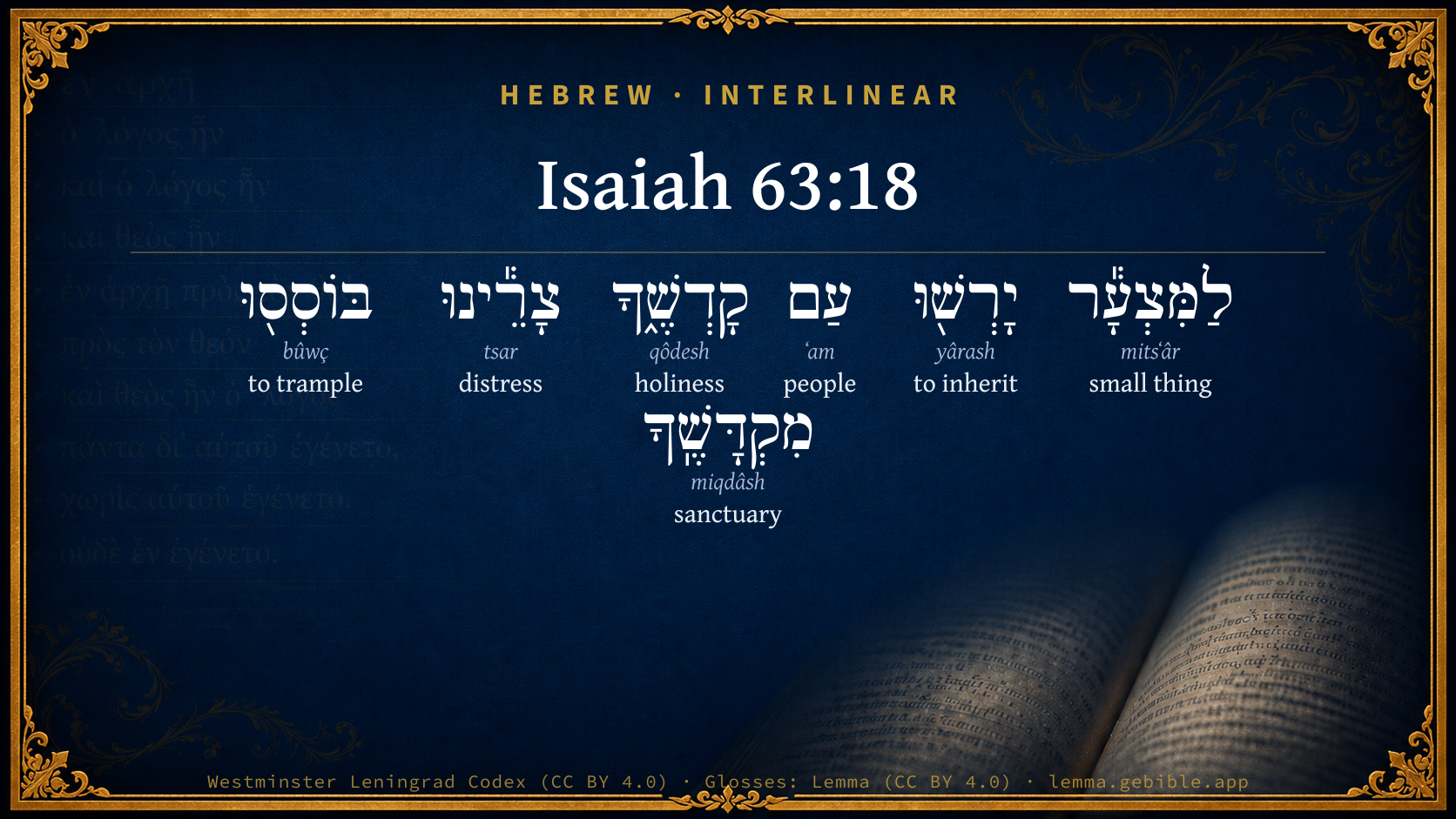
Isaiah 63:18

Hebrew (Westminster Leningrad Codex) Isaiah 63:18 appears in the Hebrew Old Testament. The text above is from the Westminster Leningrad Codex. Each word links to its Strong’s number, a concise gloss, and parsing drawn from the Open Scriptures Hebrew Bible morphology. Click any word for its full Brown-Driver-Briggs (BDB) entry.
Download image
Cite this verse

Isaiah 63:18 (World English Bible). Public Domain. Lemma interlinear Bible study tool, https://lemma.gebible.app/v/isaiah/63/18.

Show BibTeX & RIS
BibTeX
RIS
English Translation
Your holy people possessed [it] but a little while: our adversaries have trodden down your sanctuary.
World English Bible · Public Domain
Download a study sheet

One document with this verse’s original text, its word-by-word gloss line, the meaning frame, cross-references with their text, attributed commentary, and full source and license credits — printable, and it pastes into notes with its structure intact.

This verse Autodidact and up

Study sheet (.html) Plain text (.txt)

A passage Seminary Student

Up to 50 verses in one chapter. A passage sheet keeps up to 6 commentary sources and 12 cross-references per verse, in the order this page ranks them, and says so on the sheet whenever that leaves anything out. Ask for a single verse and you get the Autodidact verse sheet above.

Everything on this page stays free to read, with no account — the sheet is a download of what is already on screen, not access to it.

Want to remove ads? Support Godless Engineer
Compare translations 3

The same verse in 3 English versions, stacked beneath the original-language interlinear above. Click any original word for its lexicon entry.

Each is an independent rendering of the whole verse — the interlinear is not word-aligned to these translations.

Highlighted words mark where these versions differ — a whole-verse word diff, not a word-by-word alignment.

  • World English Bible Public Domain
    Your holy people possessed [it] but a little while: our adversaries have trodden down your sanctuary.
  • King James Version Public Domain
    The people of thy holiness have possessed it but a little while: our adversaries have trodden down thy sanctuary.
  • unfoldingWord Literal Text CC BY-SA 4.0
    For a little, the people of your holiness possessed; our adversaries have trampled your sanctuary.

unfoldingWord Literal Text — © unfoldingWord, licensed CC BY-SA 4.0. Word-aligned USFM3 via Door43 (git.door43.org/unfoldingWord/en_ult).

Versions to compare (up to 4)

3 of 4 selected

Show all 18 translations

Every available English version of this verse, each an independent rendering of the whole verse.

  • World English Bible Public Domain
    Your holy people possessed [it] but a little while: our adversaries have trodden down your sanctuary.
  • Berean Standard Bible Public Domain
    For a short while Your people possessed Your holy place, but our enemies have trampled Your sanctuary.
  • Majority Standard Bible Public Domain
    For a short while Your people possessed Your holy place, but our enemies have trampled Your sanctuary.
  • King James Version Public Domain
    The people of thy holiness have possessed it but a little while: our adversaries have trodden down thy sanctuary.
  • American Standard Version (1901) Public Domain
    Thy holy people possessed `it' but a little while: our adversaries have trodden down thy sanctuary.
  • Revised Version (1885) Public Domain
    Thy holy people possessed it but a little while: our adversaries have trodden down thy sanctuary.
  • Geneva Bible (1599) Public Domain
    The people of thine holinesse haue possessed it, but a litle while: for our aduersaries haue troden downe thy Sanctuarie.
  • Douay-Rheims (1899) Public Domain
    They have possessed thy holy people as nothing: our enemies have trodden down thy sanctuary.
  • Young's Literal Translation Public Domain
    For a little while did Thy holy people possess, Our adversaries have trodden down Thy sanctuary.
  • Literal Standard Version CC BY-SA 4.0
    For a little while Your holy people possessed, || Our adversaries have trodden down Your sanctuary.
  • Unlocked Literal Bible CC BY-SA 4.0
    Your people possessed your holy place for a short time, but then our enemies trampled it.
  • unfoldingWord Literal Text CC BY-SA 4.0
    For a little, the people of your holiness possessed; our adversaries have trampled your sanctuary.
  • Darby Bible Public Domain
    Thy holy people have possessed [it] but a little while: our adversaries have trodden down thy sanctuary.
  • World Messianic Bible Public Domain
    Your holy people possessed it but a little while. Our adversaries have trodden down your sanctuary.
  • Webster's Bible Public Domain
    The people of thy holiness have possessed it but a little while: our adversaries have trodden down thy sanctuary.
  • Free Bible Version CC BY-SA 4.0
    Your Temple belonged to us for a little while, but then our enemies invaded and destroyed it.
  • Bible in Basic English Public Domain
    Why have evil men gone over your holy place, so that it has been crushed under the feet of our haters?
  • JPS Tanakh (1917) Public Domain
    Thy holy people they have well nigh driven out, our adversaries have trodden down Thy sanctuary.

Literal Standard Version (2020), Covenant Press — licensed CC BY-SA 4.0. Text via the HelloAO Bible API (eBible.org). Unlocked Literal Bible (unfoldingWord) — licensed CC BY-SA 4.0. Text via the HelloAO Bible API (eBible.org). unfoldingWord Literal Text — © unfoldingWord, licensed CC BY-SA 4.0. Word-aligned USFM3 via Door43 (git.door43.org/unfoldingWord/en_ult). Free Bible Version, Dr. Jonathan Gallagher — licensed CC BY-SA 4.0. Text via the HelloAO Bible API (eBible.org).

Word by word

More ways to search: Search by grammar → Find every occurrence → Compare this word →

Practice this passage: Drill this verse → Learn its vocabulary →

About this verse

These counts appear in no published source. They are computed here, from the morphology-tagged text and Lemma’s own curated glosses. What Lemma adds →

7
words
7
distinct lemmas
Prophets
section

Notable vocabulary

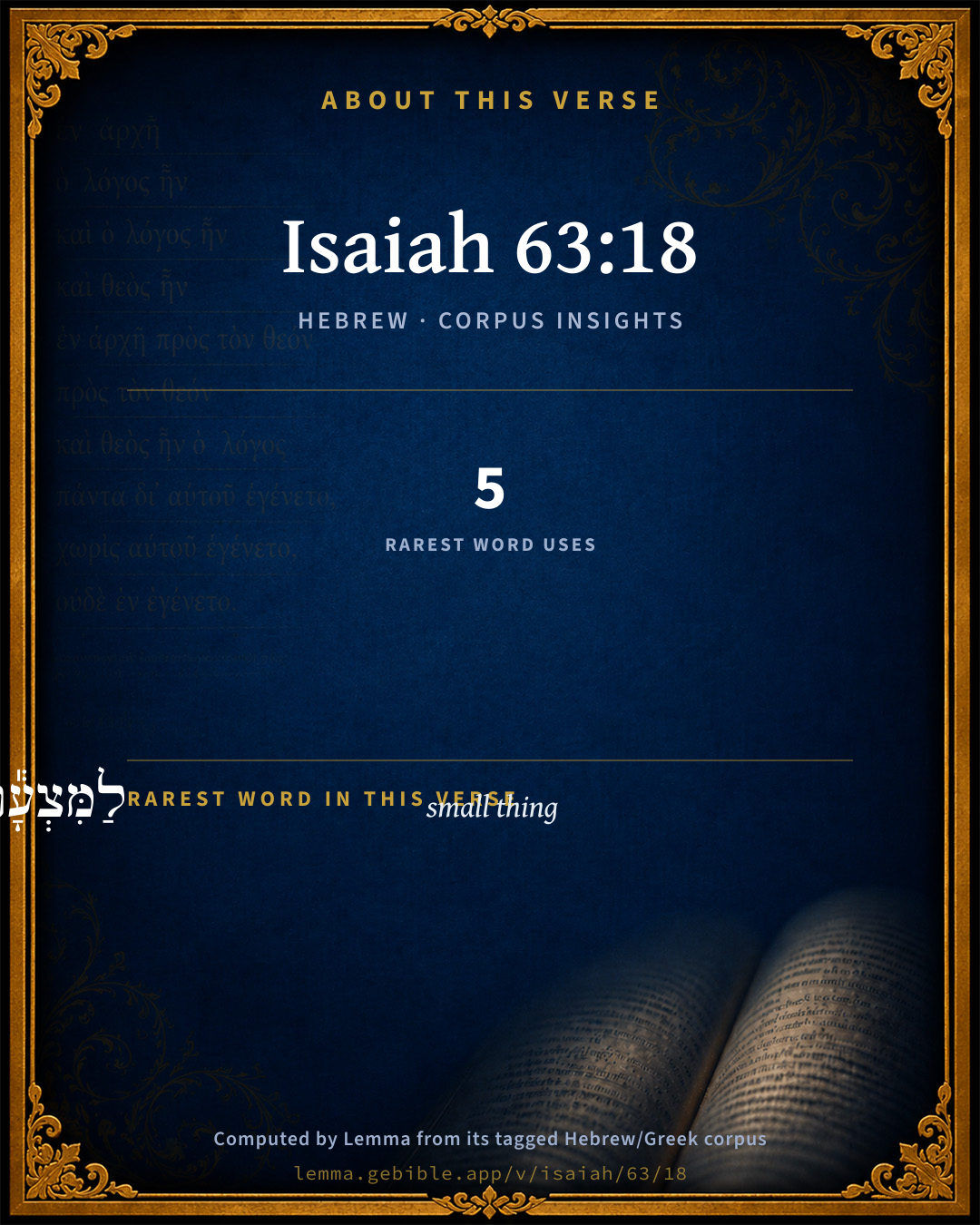
The rarest word here is לַמִּצְעָ֕ר small thing H4705 — appearing just 5 times in the whole Hebrew Bible.

Shared distinctive vocabulary

לַמִּצְעָ֕ר small thing H4705 occurs in 4 verses of the Hebrew Bible. Also found in:

Grammatical profile

  • 2 verbs
  • 5 nouns

Verb forms

  • יָרְשׁ֖וּ Qal · Perfect
  • בּוֹסְס֖וּ Polel · Perfect

Hebrew & Septuagint length

In English translation the verse runs 16 words from the Hebrew and 11 from the Septuagint (LXX English) — the Septuagint runs noticeably shorter here. See the side-by-side →

A rough comparison of the two English renderings, which tokenize alike — not a word-level alignment.

Word counts can differ between the Hebrew and the Greek without any difference in meaning — e.g. the Hebrew direct-object marker אֵת has no separate Greek word, and Greek often adds the article ὁ.

Cross-references

12

Topical passages linked to Isaiah 63:18 in the Treasury of Scripture Knowledge — connected by theme and wording, ordered by reader-vote popularity; previews shown in the World English Bible.

  • Psalms 74:3–7 Lift up your feet to the perpetual ruins, All the evil that the enemy has done in the sanctuary.
  • Exodus 19:4–6 'You have seen what I did to the Egyptians, and how I bore you on eagles' wings, and brought you to myself.
  • Deuteronomy 7:6 For you are a holy people to Yahweh your God: Yahweh your God has chosen you to be a people for his own possession, above all peoples who are on the face of the earth.
  • Deuteronomy 26:19 and to make you high above all nations that he has made, in praise, and in name, and in honor; and that you may be a holy people to Yahweh your God, as he has spoken.
  • Isaiah 62:12 They shall call them The holy people, The redeemed of Yahweh: and you shall be called Sought out, A city not forsaken.
  • Isaiah 64:11–12 Our holy and our beautiful house, where our fathers praised you, is burned with fire; and all our pleasant places are laid waste.
  • Lamentations 1:10 The adversary has spread out his hand on all her pleasant things: For she has seen that the nations are entered into her sanctuary, Concerning whom you did command that they should not enter into your assembly.
  • Lamentations 4:1 How is the gold become dim! [how] is the most pure gold changed! The stones of the sanctuary are poured out at the head of every street.
  • Daniel 8:24 His power shall be mighty, but not by his own power; and he shall destroy wonderfully, and shall prosper and do [his pleasure]; and he shall destroy the mighty ones and the holy people.
  • Matthew 24:2 But he answered them, "Don't you see all of these things? Most assuredly I tell you, there will not be left here one stone on another, that will not be thrown down."
  • 1 Peter 2:9 But you are a chosen race, a royal priesthood, a holy nation, a people for God's own possession, that you may show forth the excellencies of him who called you out of darkness into his marvelous light:
  • Revelation 11:2 Leave out the court which is outside of the temple, and don't measure it, for it has been given to the gentiles. They will tread the holy city under foot for forty-two months.

Cross-references courtesy of OpenBible.info (CC BY 4.0).

Hebrew and Greek witnesses Masoretic Hebrew ↔ Greek Septuagint

The same verse in the two great witnesses to the Old Testament, shown verse-for-verse.

Here the Septuagint runs noticeably shorter than the Hebrew — LXX2012 (modern English Septuagint) 11 words vs World English Bible 16. A rough length comparison of the two English translations, not a word-level alignment — read both below.

These are two independent witnesses, not word-aligned to each other, and the Septuagint is shown in lemma (dictionary) form.

Hebrew Isaiah 63:18 Masoretic · Westminster Leningrad Codex

לַמִּצְעָ֕ר יָרְשׁ֖וּ עַם קָדְשֶׁ֑ךָ צָרֵ֕ינוּ בּוֹסְס֖וּ מִקְדָּשֶֽׁךָ

Your holy people possessed [it] but a little while: our adversaries have trodden down your sanctuary.

World English Bible · Public Domain

Greek LXX Isaiah 63:18 Septuagint · lemma form

ἵνα μικρός κληρονομέω ὁ ὄρος ὁ ἅγιος σύ ὁ ὑπεναντίος ἐγώ καταπατέω ὁ ἁγίασμα σύ

that we may inherit a small part of your holy mountain.

LXX2012 (modern English Septuagint) · Public Domain

On this verse, Adam Clarke's Commentary discusses the Septuagint’s reading. Read the note in Commentary ↓

Hebrew: Westminster Leningrad Codex (CC BY 4.0). Greek: Septuagint (public domain); English from LXX2012 (modern English Septuagint) (Public Domain). How the Septuagint differs from the Hebrew →

Targum (Aramaic paraphrase)

1

The Targum is the ancient Jewish Aramaic paraphrase of the Hebrew Scriptures — an interpretive translation, not the Hebrew text itself. Onkelos (literal) and Pseudo-Jonathan (expansive) render the Torah, and Jonathan the Prophets. Coverage is partial: where no permissively-licensed English translation exists for a verse, only the Aramaic is shown. This is verse-level text, not a word-by-word alignment to the Hebrew.

  1. Targum Jonathan Prophets (Joshua–Malachi)
    בִּזְעֵיר דִירִיתוּ עַמָא דְקוּדְשָׁךְ בַּעֲלֵי דְבָבָנָא דוֹשִׁישׁוּ מַקְדָשָׁךְ:

    The people of Thy holiness have possessed Thy sanctuary but a little time, our adversaries have trodden it down.

    Targum Jonathan — Aramaic: “Mikraot Gedolot” (public domain). English: “Sefaria Community Translation” (CC0 1.0 (public-domain dedication)); “London "Chaldee Paraphrase," 1871” (public domain). Text via Sefaria.

Commentary

Notes on Isaiah 63:18 from classic Christian and Jewish commentators (each source and its license shown beneath its notes). The classic Christian expositions comment on the surrounding passage and are grouped to its opening verse, so a note may address several verses; the Jewish commentaries on the Tanakh (Rashi and others) are per-verse, so they appear only where the commentator wrote on this verse.

Lemma curates 59 commentaries, every one of them public domain or Creative Commons licensed, each selected and text-cleaned for this edition rather than reprinted as found. About our sources →

Trapp's Complete Commentary

John Trapp

Isa 63:18 The people of thy holiness have possessed [it] but a little while: our adversaries have trodden down thy sanctuary.

Ver. 18. The people of thine holiness have possessed it but a little while,] viz., In respect of that perpetuity promised them by thee; {Gen 17:8; Gen 26:3; Gen 28:13 Exo 32:13} besides the many calamities that have befallen us, whereby we have had small enjoyment of this thine inheritance. All the days of the afflicted are evil, {Pro 15:15} their life lifeless, and not to be reckoned on.

Our adversaries have trodden down thy sanctuary.] This they did in the days of Antiochus, but especially about the time of our Saviour’s incarnation; when the sceptre departed from Judah, Pompey with his army entered into the sanctuary; Herod got the government, the Romans set up their ensigns and statues in the holy of holies, &c. This desolation of the second temple the Jews do here bewail; but we have cause to rejoice, for that by Christ the whole world is now become a temple, and every place a goodly oratory. {1Ti 2:8}

John Trapp, A Commentary or Exposition upon All the Books of the Old and New Testament (1647–1656) — public domain. Text from a community e-Sword module.

Tyndale Open Study Notes

Tyndale Open Resources

63:18 The people were supposed to be holy, but their lack of holiness had led to destruction. • The holy place was the Temple, which the Babylonians destroyed in 586 BC (64:11; 2 Kgs 25:1-21).

Tyndale Open Study Notes — © Tyndale Open Resources, licensed CC BY-SA 4.0. Text via the HelloAO Bible API.

Geneva Bible (1599)

Geneva Bible translators

That is, in respect of the promise, which is perpetual: albeit they had now possessed the land of Canaan, a thousand and four hundred years: and thus they lament, to move God rather to remember his Covenant, than to punish their sins.

Geneva Bible (1599) marginal notes — public domain. Text via Bolls.life.

Jamieson, Fausset & Brown

Robert Jamieson, A. R. Fausset & David Brown

people of . . . holiness--Israel dedicated as holy unto God (Isa 62:12; Deu 7:6).

possessed--namely, the Holy Land, or Thy "sanctuary," taken from the following clause, which is parallel to this (compare Isa 64:10-11; Psa 74:6-8).

thy--an argument why God should help them; their cause is His cause.

Jamieson, Fausset & Brown — Commentary Critical and Explanatory on the Whole Bible (1871) — public domain (CC PDM 1.0). Text via the HelloAO Bible API.

Adam Clarke's Commentary

Verse 18. The people of thy holiness have possessed it but a little while - "It is little that they have taken possession of thy holy mountain"] The difficulty of the construction in this place is acknowledged on all hands. Vitringa prefers that sense as the least exceptionable which our translation has expressed; in which however there seems to be a great defect; that is, the want of that in the speaker's view must have been the principal part of the proposition, the object of the verb, the land, or it, as our translators supply it, which surely ought to have been expressed, and not to have been left to be supplied by the reader. In a word, I believe there is some mistake in the text; and here the Septuagint help us out; they had in their copy הר har, mountain, instead of עם am, people, του ορους του ἁγιου σου, the mountain of thy Holy One. "Not only have our enemies taken possession of Mount Sion, and trodden down thy sanctuary; even far worse than this has befallen us; thou hast long since utterly cast us off, and dost not consider us as thy peculiar people." - L.

Adam Clarke's Commentary on the Bible (1810–1826) — public domain. Text from a community e-Sword/MySword module.

Ellicott's Commentary for English Readers

(18) The people of thy holiness . . .—Better, For a little while have they possessed thy sanctuary, or, with a various reading, thy holy mountain. The plea is addressed to Jehovah, on the ground of His promise that the inheritance was to be an everlasting one. Compared with that promise, the period of possession, from Joshua and David to the fall of the monarchy, was but as a “little while.” (Comp. Psa_90:4.) The seeming failure of the promise was aggravated by the fact that the enemies of Israel had trodden down the sanctuary.

A Bible Commentary for English Readers, edited by Charles John Ellicott (1878–1897) — public domain. Text from a community e-Sword module.

The Cambridge Bible for Schools and Colleges

gen. ed. J. J. S. Perowne

18. The people … while] The want of an acc. to the verb excites suspicion, for it is hardly possible to take “thy sanctuary” as the obj. common to the two clauses. The text of the LXX., which reads “mountain” instead of “people” and has the verb in the first pers. plu., is perhaps to be preferred: For a little while have we possessed Thy holy mountain. Comp. ch. Isa_57:13.

The second part of the verse speaks of a desecration of the Temple, which apparently followed the possession of the land. The difficulty of reconciling these two facts has been pointed out in the Introductory Note above. If any destruction of the second Temple were known to have taken place about the time of Ezra, the circumstances would be explained. But the stronger statements in Isa_64:10-11 make it unlikely that if such a calamity had really happened it should not have been expressly mentioned, even in the meagre historical records which have been preserved of that period.

The Cambridge Bible for Schools and Colleges (gen. ed. J. J. S. Perowne; Cambridge University Press, 1878–1918) — public domain. Text from a community e-Sword module.

John Gill's Exposition

The people of thy holiness have possessed it but a little while,.... Either the land of Canaan, which the Jews, the Lord's holy people, whom he had separated from others, possessed about fourteen hundred years, which was but a little while in comparison of "for ever", as was promised; or they enjoyed it but a little while in peace and quiet, being often disturbed by their neighbours; or else the sanctuary, the temple, as it is to be supplied from the next clause, which stood but little more than four hundred years:

our adversaries have trodden down thy sanctuary; the temple; the first temple was destroyed by Nebuchadnezzar; and the second temple by the Romans; and Antiochus, and Pompey, and others, profaned it, by treading in it.

John Gill's Exposition of the Whole Bible (1746–1763) — public domain (CC PDM 1.0). Text via the HelloAO Bible API.

Albert Barnes' Notes on the Bible

The people of thy holiness - The people who have been received into solemn covenant with thee.

Have possessed it but a little while - That is, the land meaning that the time during which they had enjoyed a peaceable possession of it, compared with the perpetuity of the promise made, was short. Such is the idea given to the passage by our translators. But there is considerable variety in the interpretation of the passage among expositors. Lowth renders it:

It is little, that they have taken possession of thy holy mountain;

That our enemies have trodden down thy sanctuary.

Jerome renders it, ‘It is as nothing (quasi nihilum), they possess thy holy people; our enemies have trodden down thy sanctuary.’ The Septuagint renders it, ‘Return on account of thy servants, on account of the tribes of thine inheritance, that we may inherit thy holy mountains for a little time’ ἵνα μικρὸν κληρονομήσωμεν τοῦ ὄρους τοῦ ἁγίου hina mikron klēronomēsōmen tou orous tou hagiou). It has been generally felt that there was great difficulty in the place. See Vitringa. The sense seems to be that which occurs in our translation. The design is to furnish an argument for the divine interposition, and the meaning of the two verses may be expressed in the following paraphrase: ‘We implore thee to return unto us, and to put away thy wrath. As a reason for this, we urge that thy temple thy holy sanctuary - was possessed by thy people but a little time. For a brief period there we offered praise, and met with our God, and enjoyed his favor. Now thine enemies trample it down. They have come up and taken the land, and destroyed thy holy place Isa 64:11. We plead for thine interposition, because we are thy covenant people. Of old we have been thine. But as for them, they were never thine. They never yielded to thy laws. They were never called by thy name. There is, then, no reason why the temple and the land should be in their possession, and we earnestly pray that it may be restored to the tribes of thine ancient inheritance.’

Our adversaries - This whole prayer is supposed to be offered by the exiles near the close of their captivity. Of course the language is such as they would then use. The scene is laid in Babylon, and the object is to express the feelings which they would have then, and to furnish the model for the petitions which they would then urge. We are not, therefore, to suppose that the temple when Isaiah lived and wrote was in ruins, and the land in the possession of his foes. All this is seen in vision; and though a hundred and fifty years would occur before it would be realized, yet, according to the prophetic manner, he describes the scene as actually passing before him (see the Introduction, Section 7; compare the notes at Isa 64:11).

Albert Barnes' Notes on the Bible (1834–1885) — public domain. Text from a community e-Sword/MySword module.

Haydock's Catholic Bible Commentary

Nothing; holding them in the greatest contempt. Epiphanes though he should make them easily change their religion. His persecution lasted only three years and a half. --- Sanctuary. 1 Machabees i. 23, 49, 57., and iii. 45.

George Leo Haydock (1774–1849), Haydock's Catholic Family Bible and Commentary, 1859 edition — public domain. Excludes Psalms (Douay-Rheims chapter numbering differs from Protestant) and Deuterocanonical books (Catholic canon only).

Matthew Poole's English Annotations

The people of thy holiness; or, thy holy people, as being set apart for his servants; holiness being to be understood for a covenant separation from other people.

But a little while. i.e.

1. Comparatively to the promise, which was for ever, though they had possessed it about one thousand four hundred years. Or,

2. It seeming to them so, as things, especially such as are desirable, seem when they are past, Job 9:25,26; Psa 90 4. Or,

3. They enjoyed but small spaces of time in quietness, so they had small enjoyment of it. Or,

4. It may respect the temple, which stood but four hundred years.

Have trodden down thy sanctuary; the temple, called the sanctuary from the holiness of it; this our adversaries the Babylonians have trodden down, 2Ch 36:19; and this also implies their ruining of their whole ecclesiastical policy.

Matthew Poole's English Annotations on the Holy Bible (1683–1685) — public domain. Text from a community e-Sword/MySword module.

Whedon's Commentary on the Bible

Daniel D. Whedon

18, 19. The people of thy holiness — People adhering to principles of the divine holiness, is an expression stronger than the phrase, thy holy people, and is to be preferred. God’s interposition in their behalf is pleaded for in the preceding, and continued in this verse, on the ground that, as the covenant people with God, they held peaceable possession of the land of promise but a little while, because their sins had made him to become their enemy; but now that they return in penitence, they plead for spiritual and eternal possession on the ground of such having been the intent of the covenant on God’s part. Besides, the original and literal promised possession is now trodden down by foes, and this gives reason for his people’s stronger and more persistent pleading. Besides, still further, say they, We are thine. Thy foes are not thy people. They will not have thee as their ruler. We are of old. We belong to the line who always held sacred thy spiritual covenant. Yet “but a little while” have we held spiritual possession.

Daniel D. Whedon (gen. ed.), Commentary on the Old and New Testaments (1874–1909) — public domain. Text from a community e-Sword module.

The Pulpit Commentary

The people of thy holiness; or, thy holy people. (comp. Isa_62:9 Isa_63:15:64:11) Some critics read har, "mountain," instead of am, "people," and translate, "But for a little while have they" (i.e. thy servants) "had possession of thy holy mountain." The general meaning is the same in either case. "Israel, God"s people, has held Palestine but for a little while a few centuries and now the heathen have been allowed to make themselves masters of it. (comp. Ezr_10:8)

The Pulpit Commentary (1880–1919), ed. H.D.M. Spence-Jones & Joseph S. Exell — public domain. Text from a community e-Sword module.

John Wesley's Explanatory Notes

People - The people set apart for his servants. A little while - Comparatively to the promise, which was forever. Sanctuary - The temple.

John Wesley, Explanatory Notes Upon the Whole Bible (1754–1765) — public domain. Text via the GEBible commentary corpus.

Keil & Delitzsch

C. F. Keil & F. Delitzsch

But the existing condition of Israel looks like a withdrawal of this grace; and it is impossible that these contrasts should cease, unless Jehovah comes down from heaven as the deliverer of His people. Isa 63:8, Isa 63:19 (Isa 64:1). "For a little time Thy holy people was in possession. Our adversaries have trodden down Thy sanctuary. We have become such as He who is from everlasting has not ruled over, upon whom Thy name was not called. O that Thou wouldst rend the heaven, come down, the mountains would shake before thy countenance." It is very natural to try whether yâreshū may not have tsârēnū for its subject (cf., Jer 49:2); but all the attempts made to explain the words on this supposition, show that lammits‛âr is at variance with the idea that yâreshū refers to the foes. Compare, for example, Jerome's rendering "quasi nihilum (i.e., ad nihil et absque allo labore) possederunt populum sanctum tuum;" that of Cocceius, "propemodum ad haereditatem;" and that of Stier, "for a little they possess entirely Thy holy nation." Mits‛âr is the harsher form for miz‛âr, which the prophet uses in Isa 10:25; Isa 16:14; Isa 29:17 for a contemptibly small space of time; and as ל is commonly used to denote the time to which, towards which, within which, and through which, anything occurs (cf., Ch2 11:17; Ch2 29:17; Ewald, 217, d), lammits‛âr may signify for a (lit. the well-known) short time (per breve tempus; like εἰς ἐπ ̓κατ ̓ ἐνιαυτόν, a year long). If miqdâsh could mean the holy land, as Hitzig and others suppose, miqdâshekhâ might be the common object of both sentences (Ewald, 351, p. 838). But miqdash Jehovah (the sanctuary of Jehovah) is the place of His abode and worship; and "taking possession of the temple" is hardly an admissible expression. On the other hand, yârash hâ'ârets, to take possession of the (holy) land, is so common a phrase (e.g., Isa 60:21; Isa 65:9; Psa 44:4), that with the words "Thy holy people possessed for a little (time)" we naturally supply the holy land as the object. The order of the words in the two clauses is chiastic. The two strikingly different subjects touch one another as the two inner members. Of the perfects, the first expresses the more remote past, the second the nearer past, as in Isa 60:10. The two clauses of the v. rhyme - the holiest thing in the possession of the people, which was holy according to the choice and calling of Jehovah, being brought into the greatest prominence; bōsēs = πατεῖν, Luk 21:24; Rev 11:2. Hahn's objection, that the time between the conquest of the land and the Chaldean catastrophe could not be called mits‛âr (a little while), may be answered, from the fact that a time which is long in itself shrinks up when looked back upon or recalled, and that as an actual fact from the time of David and Solomon, when Israel really rejoiced in the possession of the land, the coming catastrophe began to be foreboded by many significant preludes.

The lamentation in Isa 63:19 proceeds from the same feeling which caused the better portion of the past to vanish before the long continuance of the mournful present. Hitzig renders היינוּ "we were;" Hahn, "we shall be;" but here, where the speaker is not looking back, as in Isa 26:17, at a state of things which has come to an end, but rather at one which is still going on, it signifies "we have become." The passage is rendered correctly in S.: ἐγενήθημεν (or better, γεγόναμεν) ὡς ἀπ ̓αἰῶνος ὧν οὐκ ἐξουσίασας οὐδὲ ἐπικλήθη τὸ ὄνομά σου αὐτοῖς. The virtual predicate to hâyı̄nū commences with mē‛ōlâm: "we have become such (or like such persons) as," etc.; which would be fully expressed by אשׁר כּעם, or merely כּעשׁר, or without אשׁר, and simply by transposing the words, וגו משׁלתּ כּלא (cf., Oba 1:16): compare the virtual subject אהבו יהוה in Isa 48:14, and the virtual object בשׁמי יקרא in Isa 41:25 (Ewald, 333, b). Every form of "as if" is intentionally omitted. The relation in which Jehovah placed Himself to Israel, viz., as its King, and as to His own people called by His name, appears not only as though it had been dissolved, but as though it had never existed at all. The existing state of Israel is a complete practical denial of any such relation. Deeper tones than these no lamentation could possibly utter, and hence the immediate utterance of the sigh which goes up to heaven: "O that Thou wouldst rend heaven!" It is extremely awkward to begin a fresh chapter with כּקדח ("as when the melting fire burneth"); at the same time, the Masoretic division of the vv. is unassailable.

(Note: In the Hebrew Bibles, Isa 64:1-12 commences at the second v. of our version; and the first v. is attached to Isa 63:19 of the previous chapter. - Tr.)

For Isa 63:19 (Isa 64:1) could not be attached to Isa 64:1-2, since this v. would be immensely overladen; moreover, this sigh really belongs to Isa 63:19 (Isa 63:19), and ascends out of the depth of the lamentation uttered there. On utinam discideris = discinderes, see at Isa 48:18. The wish presupposes that the gracious presence of God had been withdrawn from Israel, and that Israel felt itself to be separated from the world beyond by a thick party-wall, resembling an impenetrable black cloud. The closing member of the optative clause is generally rendered (utinam) a facie tua montes diffluerent (e.g., Rosenmller after the lxx τακήσονται), or more correctly, defluerent (Jerome), as nâzal means to flow down, not to melt. The meaning therefore would be, "O that they might flow down, as it were to the ground melting in the fire" (Hitzig). The form nâzollu cannot be directly derived from nâzal, if taken in this sense; for it is a pure fancy that nâzōllū may be a modification of the pausal נזלוּ with ō for ā, and the so-called dagesh affectuosum). Stier invents a verb med. o. נזל. The more probable supposition is, that it is a niphal formed from zâlāl = nâzal (Ewald, 193, c). But zâlal signifies to hang down slack, to sway to and fro (hence zōlēl, lightly esteemed, and zalzallı̄m, Isa 18:5, pliable branches), like zūl in Isa 46:6, to shake, to pour down;

(Note: Just as the Greek has in addition to σαλ-εὐειν the much simpler and more root-like σεἰ-ειν; so the Semitic has, besides זל, the roots זא, זע: compare the Arabic סלסל, זאזע, זעזע, all three denoting restless motion.)

and nâzōllu, if derived from this, yields the appropriate sense concuterentur (compare the Arabic zalzala, which is commonly applied to an earthquake). The nearest niphal form would be נזלּוּ (or resolved, נזלוּ, Jdg 5:5); but instead of the a of the second syllable, the niphal of the verbs ע has sometimes o, like the verb ע ו (e.g., נגלּוּ, Isa 34:4; Ges. 67, Anm. 5).

Keil & Delitzsch — Biblical Commentary on the Old Testament (1861–1891) — public domain (CC PDM 1.0). Text via the HelloAO Bible API. (Old Testament only.)

J. A. Alexander on Isaiah

Joseph Addison Alexander

“For a little Thy holy people possessed, our enemies trod down Thy sanctuary.” The sense of this verse is extremely dubious. The modern writers are agreed in making holy people the subject of the verb, and supplying the object from the other clause, Thy sanctuary. According to the usual construction of the sentence it assigns as a reason for Jehovah’s interference, the short time during which the chosen people had possessed the land of promise. It is agreed that the verse describes a subjection to enemies. The question is whether this subjection is itself described as temporary, or the peaceable possession which preceded it. In no case can an argument be drawn from it to prove that this whole passage has respect to the Jews in their present dispersion: first, because the sufferings of the church in after ages are frequently presented under figures drawn from the peculiar institutions of the old economy; and secondly, because the early history of Israel is as much the early history of the Christian church as of the Jewish nation, so that we have as much right. as the Jews to lament the profanation of the Holy Land, and more cause to pray for its recovery by Christendom, than they for its restoration to themselves.

Joseph Addison Alexander, The Prophecies of Isaiah (1846–1847; New York: Scribner, 1870–1878) — public domain. Text from a community e-Sword module.

Kretzmann's Popular Commentary

Paul E. Kretzmann

A Plea for God’s Interference

v. 18. The people of Thy holiness have possessed it but a little while, rather, "Down to a small remnant they," the enemies, "possess Thy holy people," using the inheritance of Israel to their own advantage. Our adversaries have trodden down Thy Sanctuary, not only the Temple proper, but the entire Holy City.

v. 19. We are Thine; Thou never barest rule over them, they were not called by Thy name, or, in a circumscription suggested by the original, We have become as those over whom Thou hast not ruled, who are not called by Thy name, a complaint which places the present miserable position of Israel into the strongest contrast with the former happiness

Paul E. Kretzmann, Popular Commentary of the Bible (1921–1924) — public domain. Text from a community e-Sword module.

unfoldingWord translationNotes

Door43 World Missions Community

General Information:

The people of Israel continue speaking.

who were never called by your name

This can be stated in active form. The word "name" refers to a family relationship. AT: "who never belonged to your family" (See: Active or Passive and Metonymy)

We have become ... called by your name

Some modern versions interpret this passage differently: "We are like the people over whom you have not ruled, like those who have not been called by your name."

translationWords

people of God

holy place

rule

call

name

unfoldingWord translationNotes — © Distant Shores Media and the Door43 World Missions Community, licensed CC BY-SA 4.0. Source: git.door43.org/Door43/en_tn.

Rashi

Rabbi Shlomo Yitzchaki (Rashi)

For [but] a short time, Your holy people inherited They had their greatness and their inheritance for a short time.

trampled [The term בוססו denotes] trampled underfoot.

Rashi on the Tanakh — English translations: “The Judaica Press complete Tanach with Rashi, translated by A. J. Rosenberg” (CC BY 4.0); “Pentateuch with Rashi's commentary by M. Rosenbaum and A.M. Silbermann, 1929-1934” (public domain); “The Metsudah Tanach series, Lakewood, N.J” (CC BY 4.0); and “The Book of Joshua, Metsudah Publications, 1997” (CC BY 4.0). Text via Sefaria.

Ibn Ezra

Rabbi Abraham ibn Ezra

למצער A little while.

למצער ידשו עם קדשך The people of thy holiness have possessed the holy land but for a little while, and now the enemies have trodden down, etc. Some explain the verse thus: The people of Thy holiness has been dispossessed (by the enemy) for a small thing, or for a short time, and this latter explanation is right.

Ibn Ezra on the Tanakh — English translations: “Sefaria Community Translation” (CC0 1.0 (public-domain dedication)); “Yalkut, Sifsei Chachomim Chumash, Metsudah Publications, 2009” (CC BY 4.0); and “Commentary of Ibn Ezra on Isaiah - trans. by M. Friedlander, 1873” (public domain). Text via Sefaria.

Lesson kit

Teaching starters — assembled from the data on this page, not authored interpretation. Every prompt links to the verse data it draws on. Edit before teaching.

Isaiah, in the Prophets, opens this verse with 7 words (7 distinct Hebrew lemmas). Its most distinctive word is mitsʻâr (“small thing”). The Greek Septuagint runs shorter here. A historical commentator’s framing appears above. Read the whole chapter for the surrounding context.

Discussion questions

  1. The word mitsʻâr carries the sense “small thing.” How does it shape the verse?
  2. How does Genesis 19:20, which shares the word «small thing», read alongside this verse?
  3. The Septuagint runs shorter here than the Hebrew. What might account for the difference?
  4. These translations render this verse differently. What is at stake in choosing one wording over another?
  5. «יָרְשׁ֖וּ» is a Qal Perfect verb. How does that grammatical form shape the action described?
  6. Compare how Trapp's Complete Commentary and Tyndale Open Study Notes read this verse. Where do they agree or differ?

Things to notice

Reading settings

Reading text

Shown beneath each verse's original-language words.

Old Testament
Old Testament edition

Read the OT as the Masoretic Hebrew (MT) or the Greek Septuagint (LXX).

English shown for the Greek Septuagint (in the Hebrew ↔ Greek comparison).

Comparing translations? Open the Compare panel on any verse page to stack up to four side by side.