
Psalms 60:11

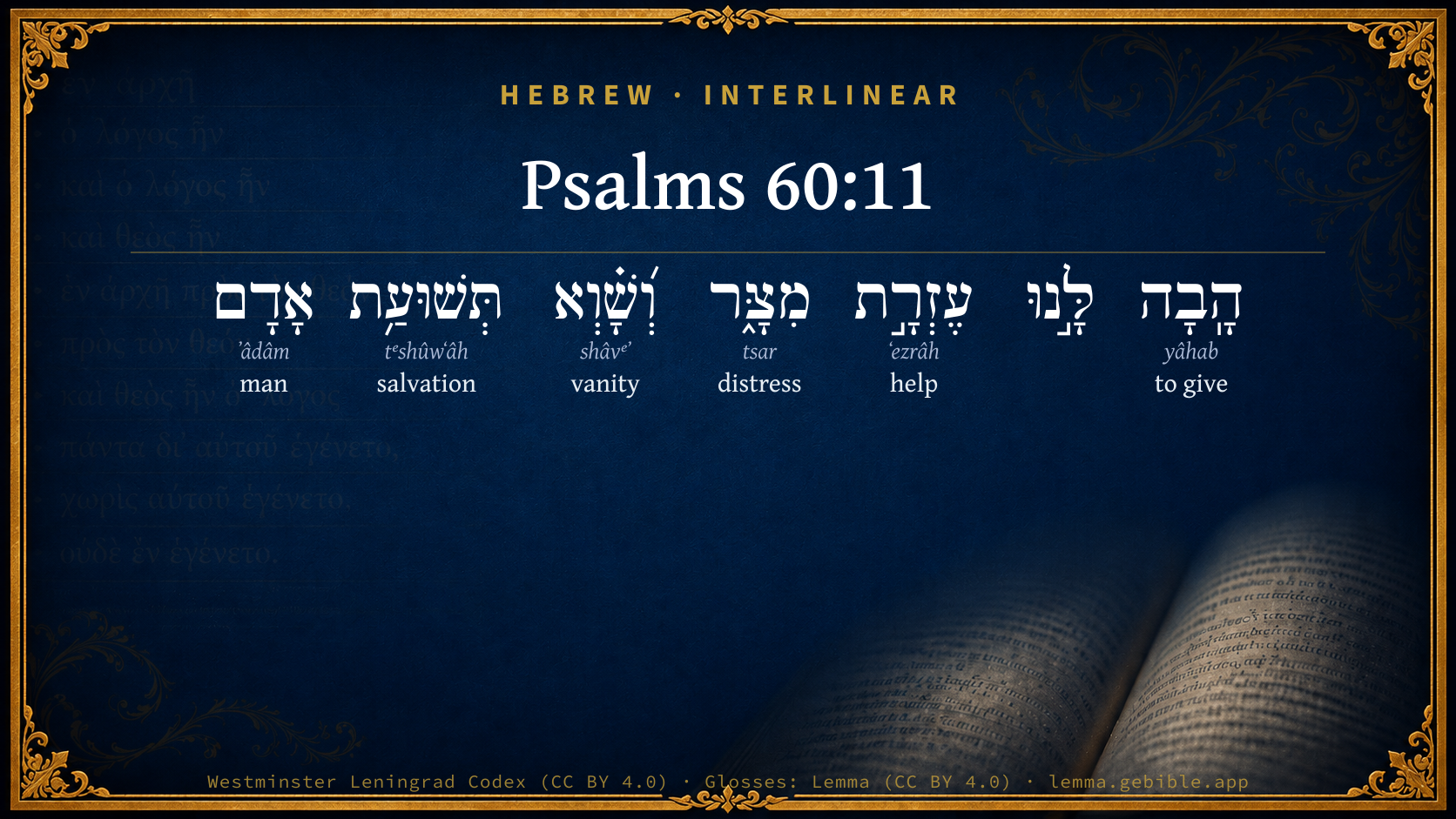
Hebrew (Westminster Leningrad Codex) Psalms 60:11 appears in the Hebrew Old Testament. The text above is from the Westminster Leningrad Codex. Each word links to its Strong’s number, a concise gloss, and parsing drawn from the Open Scriptures Hebrew Bible morphology. Click any word for its full Brown-Driver-Briggs (BDB) entry.
Download image
Cite this verse

Psalms 60:11 (World English Bible). Public Domain. Lemma interlinear Bible study tool, https://lemma.gebible.app/v/psalms/60/11.

Show BibTeX & RIS
BibTeX
RIS
English Translation
Give us help against the adversary, For the help of man is vain.
World English Bible · Public Domain
Download a study sheet

One document with this verse’s original text, its word-by-word gloss line, the meaning frame, cross-references with their text, attributed commentary, and full source and license credits — printable, and it pastes into notes with its structure intact.

This verse Autodidact and up

Study sheet (.html) Plain text (.txt)

A passage Seminary Student

Up to 50 verses in one chapter. A passage sheet keeps up to 6 commentary sources and 12 cross-references per verse, in the order this page ranks them, and says so on the sheet whenever that leaves anything out. Ask for a single verse and you get the Autodidact verse sheet above.

Everything on this page stays free to read, with no account — the sheet is a download of what is already on screen, not access to it.

Want to remove ads? Support Godless Engineer
Compare translations 3

The same verse in 3 English versions, stacked beneath the original-language interlinear above. Click any original word for its lexicon entry.

Each is an independent rendering of the whole verse — the interlinear is not word-aligned to these translations.

Highlighted words mark where these versions differ — a whole-verse word diff, not a word-by-word alignment.

  • World English Bible Public Domain
    Give us help against the adversary, For the help of man is vain.
  • King James Version Public Domain
    Give us help from trouble: for vain is the help of man.
  • unfoldingWord Literal Text CC BY-SA 4.0
    Give help against the enemy to us, for the salvation of man futility.

unfoldingWord Literal Text — © unfoldingWord, licensed CC BY-SA 4.0. Word-aligned USFM3 via Door43 (git.door43.org/unfoldingWord/en_ult).

Versions to compare (up to 4)

3 of 4 selected

Show all 18 translations

Every available English version of this verse, each an independent rendering of the whole verse.

  • World English Bible Public Domain
    Give us help against the adversary, For the help of man is vain.
  • Berean Standard Bible Public Domain
    Give us aid against the enemy, for the help of man is worthless.
  • Majority Standard Bible Public Domain
    Give us aid against the enemy, for the help of man is worthless.
  • King James Version Public Domain
    Give us help from trouble: for vain is the help of man.
  • American Standard Version (1901) Public Domain
    Give us help against the adversary; For vain is the help of man.
  • Revised Version (1885) Public Domain
    Give us help against the adversary: for vain is the help of man.
  • Geneva Bible (1599) Public Domain
    Giue vs helpe against trouble: for vaine is the helpe of man.
  • Douay-Rheims (1899) Public Domain
    Who will bring me into the strong city? who will lead me into Edom?
  • Young's Literal Translation Public Domain
    Give to us help from adversity, And vain `is' the deliverance of man.
  • Literal Standard Version CC BY-SA 4.0
    Give to us help from adversity, || And the deliverance of man [is] vain.
  • Unlocked Literal Bible CC BY-SA 4.0
    Give us help against the enemy, for man's help is futile.
  • unfoldingWord Literal Text CC BY-SA 4.0
    Give help against the enemy to us, for the salvation of man futility.
  • Darby Bible Public Domain
    Give us help from trouble; for vain is man's deliverance.
  • World Messianic Bible Public Domain
    Give us help against the adversary, for the help of man is vain.
  • Webster's Bible Public Domain
    \\60:9\\Who will bring me into the strong city? who will lead me into Edom?
  • Free Bible Version CC BY-SA 4.0
    Please give us help against our enemies, for human help is worthless.
  • Bible in Basic English Public Domain
    Give us help in our trouble; for there is no help in man.
  • JPS Tanakh (1917) Public Domain
    (60-13) Give us help against the adversary; for vain is the help of man.

Literal Standard Version (2020), Covenant Press — licensed CC BY-SA 4.0. Text via the HelloAO Bible API (eBible.org). Unlocked Literal Bible (unfoldingWord) — licensed CC BY-SA 4.0. Text via the HelloAO Bible API (eBible.org). unfoldingWord Literal Text — © unfoldingWord, licensed CC BY-SA 4.0. Word-aligned USFM3 via Door43 (git.door43.org/unfoldingWord/en_ult). Free Bible Version, Dr. Jonathan Gallagher — licensed CC BY-SA 4.0. Text via the HelloAO Bible API (eBible.org).

Word by word

More ways to search: Search by grammar → Find every occurrence → Compare this word →

Practice this passage: Drill this verse → Learn its vocabulary →

About this verse

These counts appear in no published source. They are computed here, from the morphology-tagged text and Lemma’s own curated glosses. What Lemma adds →

7
words
6
distinct lemmas
Wisdom
section

Shared distinctive vocabulary

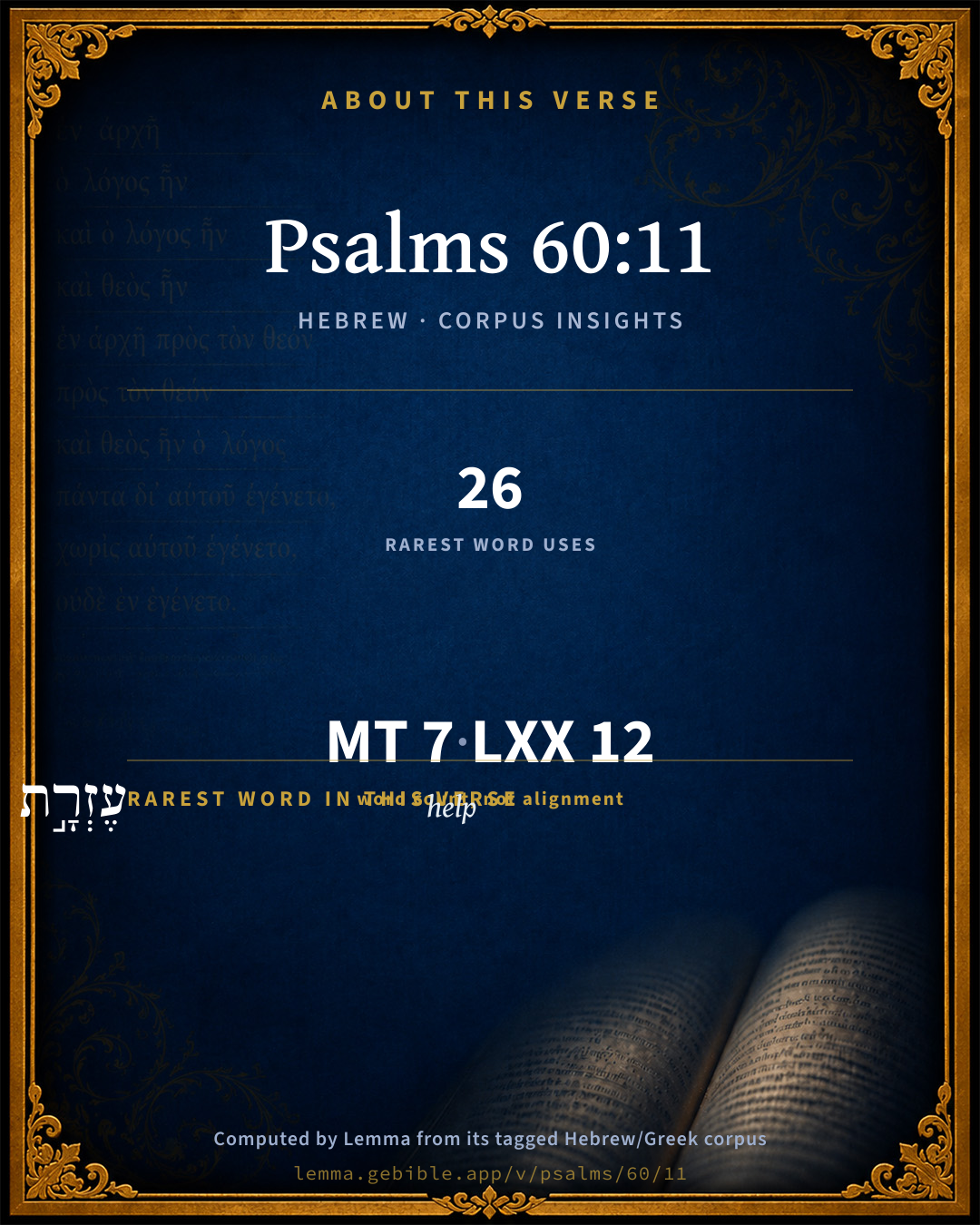
עֶזְרָ֣ת help H5833 occurs in 25 verses of the Hebrew Bible. Also found in:

Grammatical profile

  • 1 verb
  • 5 nouns
  • 1 preposition

Verb forms

  • הָֽבָה Qal · Imperative

Hebrew & Septuagint length

In English translation the verse runs 13 words from the Hebrew and 12 from the Septuagint (LXX English) — closely comparable.

A rough comparison of the two English renderings, which tokenize alike — not a word-level alignment.

Word counts can differ between the Hebrew and the Greek without any difference in meaning — e.g. the Hebrew direct-object marker אֵת has no separate Greek word, and Greek often adds the article ὁ.

In the original languages it is 7 Hebrew tokens and 12 Greek tokens — but the two are counted differently (Hebrew bundles its prefixes and suffixes into one token; the Greek is in lemma form), so that isn’t a like-for-like length.

Cross-references

8

Topical passages linked to Psalms 60:11 in the Treasury of Scripture Knowledge — connected by theme and wording, ordered by reader-vote popularity; previews shown in the World English Bible.

  • Psalms 146:3 Don't put your trust in princes, Each a son of man in whom there is no help.
  • Psalms 108:12 Give us help against the enemy, For the help of man is vain.
  • Psalms 124:1–3 If it had not been Yahweh who was on our side, Let Israel now say,
  • Psalms 130:8 He will redeem Israel from all their sins.
  • Isaiah 30:7 For Egypt helps in vain, and to no purpose: therefore have I called her Rahab who sits still.
  • Psalms 62:1 My soul rests in God alone. My salvation is from him.
  • Isaiah 31:3 Now the Egyptians are men, and not God; and their horses flesh, and not spirit: and when Yahweh shall stretch out his hand, both he who helps shall stumble, and he who is helped shall fall, and they all shall be consumed together.
  • Psalms 25:22 Redeem Israel, God, Out all of his troubles.

Cross-references courtesy of OpenBible.info (CC BY 4.0).

Hebrew and Greek witnesses Masoretic Hebrew ↔ Greek Septuagint

The same verse in the two great witnesses to the Old Testament, shown verse-for-verse.

You’re reading Greek Psalm 59 (Hebrew Psalm 60). The Septuagint counts the superscription, so verse numbers can differ from the Hebrew — chapter-level alignment, not verse-by-verse. Numbering follows Rahlfs.

These are two independent witnesses, not word-aligned to each other, and the Septuagint is shown in lemma (dictionary) form.

Hebrew Psalms 60:11 Masoretic · Westminster Leningrad Codex

הָֽבָה לָּ֣נוּ עֶזְרָ֣ת מִצָּ֑ר וְ֝שָׁ֗וְא תְּשׁוּעַ֥ת אָדָם

Give us help against the adversary, For the help of man is vain.

World English Bible · Public Domain

Greek LXX Greek Psalm 59:11 Septuagint · lemma form

τίς ἀποἄγω ἐγώ εἰς πόλις περιοχή τίς ὁδηγέω ἐγώ ἕως ὁ ιδουμαία

Give us help from trouble: for vain is the deliverance of man.

LXX2012 (modern English Septuagint) · Public Domain

Hebrew: Westminster Leningrad Codex (CC BY 4.0). Greek: Septuagint (public domain); English from LXX2012 (modern English Septuagint) (Public Domain). How the Septuagint differs from the Hebrew →

Commentary

Notes on Psalms 60:11 from classic Christian and Jewish commentators (each source and its license shown beneath its notes). The classic Christian expositions comment on the surrounding passage and are grouped to its opening verse, so a note may address several verses; the Jewish commentaries on the Tanakh (Rashi and others) are per-verse, so they appear only where the commentator wrote on this verse.

Lemma curates 59 commentaries, every one of them public domain or Creative Commons licensed, each selected and text-cleaned for this edition rather than reprinted as found. About our sources →

Trapp's Complete Commentary

John Trapp

Psa 60:11 Give us help from trouble: for vain [is] the help of man.

Ver. 11. Give us help from trouble] Give it us whensoever we need it; as hitherto thou very graciously hast done.

For vain is the help of man] As they had lately experimented in Saul, a king of their own choosing, but not able to save them from those proud Philistines. No more could the Romans the Britons, oppressed by their northern enemies. They sent Aetius, the Roman praefect of Gaul, and thus complained to him: The barbarous enemy beateth us to the sea, the sea beateth us back to the enemy; between these two kinds of deaths we are either murdered or drowned (Dan. Chron.). But their implorations prevailed not; for Aetius at that time had enough to do to keep his own head, and Valentinian, the empire. The saint’s comfort is, that where human help faileth Divine beginneth, as Philo told his countrymen, when rejected by Caius the emperor.

John Trapp, A Commentary or Exposition upon All the Books of the Old and New Testament (1647–1656) — public domain. Text from a community e-Sword module.

The Biblical Illustrator

Joseph S. Exell

Psa_60:11

Give us help from trouble: for vain is the help of man.

Help in God in all times of trouble

If a man had a long and perilous journey to take, in which he would be exposed to many difficulties and great dangers, would he not most thankfully receive from any one the kind offer of direction and assistance, that he might perform it with success and security? The life of man is such a journey, during which he is exposed to many difficulties and dangers.

I. In the world we must expect tribulation. As fallen creatures, we are constantly liable to infirmities, affliction, and disappointment.

II. Vain is the help of man. Man may not have the ability nor the inclination to help us in our worldly troubles. Man may not feel for our misery, nor be disposed to aid us in our distress. He may promise us his assistance, and yes desert us in the very time of need. Vain is the help of man. Man may endeavour to help; but it is so feeble, as to be of no real service. God, and God alone, can remove the burden, or support us under it.

III. How is this help to be obtained? By humble, fervent, and believing prayer. Give us help in trouble, for vain is the help of man. It is freely bestowed in Christ Jesus to all that need it and seek it of God in humble and fervent prayer. (C. Davy.)

The common in human life

I. A common human condition. Trouble. He has, almost from birth to death, to walk in the midst of trouble--troubles personal and social, material and spiritual--troubles of body, troubles of intellect, troubles of conscience.

1. Those that are spiritually pernicious--tending only to intensify the rebellion of the soul, harden the conscience, etc.

2. Those that are spiritually beneficent. To all regenerate and Christly men troubles are morally disciplinary (Heb_12:11).

II. A common human instinct. Give us help from trouble. Man in great trouble instinctively cries to the Supreme for help. Even irrational creatures seem to shriek for help in trouble. Tyndall says of the hare, when the greyhound is almost upon her, that she abandons hope through her own efforts, and screams convulsively into space for help. Mans instinct is of a higher kind. The space into which he cries in trial is not empty. He sees a God in it. This instinct is as deep as the soul and as wide as humanity. It is developed by saint, by savage, and by sage.

1. This instinct implies a constitutional, an ineradicable belief in the existence, personality, accessibleness and entreatability of a God.

2. This instinct shows that prayer is not against the laws of nature, but one with it. As sure as the sun will rise, men will pray.

III. A common human experience. Vain is the help of man.

1. He cannot give an effective deliverance from trouble. That which makes anguish is the state of the soul--disordered affections, guilt of conscience, moral regrets, and dark forebodings. Unless these are removed the troubles remain.

2. He cannot give a permanent deliverance from trouble. Whatever alleviation he may afford to the sufferer, it can be only temporary. Let our prayer therefore be, Give us help from trouble; for vain is the help of man. (Homilist.)

.

Psa_61:1-8

The Biblical Illustrator, edited by Joseph S. Exell (c. 1880s–1900s) — public domain. Text from a community e-Sword module.

Joseph Benson's Commentary

Psa 60:11-12. Give us help from trouble — Do not frustrate these hopes, but afford us thy help against the Syrians also 2Sa 8:5, who now distress us; for vain is the help of man — No human force is able to deliver us; nor have we any confidence in it, but in thee alone. Observe well, reader, then only are we qualified to receive help from God, when we are brought to own the insufficiency of all creatures to do that for us which we expect him to do. Through God we shall do valiantly — Through his help we shall behave ourselves courageously, and do valiant acts; for he it is that shall tread down our enemies — And not we ourselves. Though we do ever so valiantly, the success must be attributed entirely to him. All our victories, as well as our valour, are from him, and therefore at his feet all our crowns must be laid. Observe again, reader, as it is only through God, and by the influence of his grace, that we can, at any time, do valiantly; as it is he that puts strength into us, and inspires us, who of ourselves are weak and timorous, with true courage and resolution; so confidence in him is the best principle, and chief means of this courage and fortitude. But we must remember this confidence must be so far from superseding, that it must encourage and quicken our endeavours in the way of duty. For though it is God that performeth all things for us, and worketh in us to will and to do, yet we must be workers together with him.

Joseph Benson's Commentary on the Old and New Testaments (1811–1818) — public domain. Text from a community e-Sword module.

J. A. Alexander on Psalms

Joseph Addison Alexander

13. (Psa 60:11). Give us help from trouble (or from the enemy); and (the rather because) vain (is) the salvation of man, i.e. the deliverance which man affords. The causal particle, for, because, which seems necessary to connect the clauses, is implied but not expressed in Hebrew. The second noun may either mean distress, as in Psa 4:1; Psa 18:6, or one who gives distress, a persecuting or oppressing enemy, as in Psa 3:1; Psa 13:4; Psa 27:2; Psa 27:12; Psa 44:5; Psa 44:7; Psa 44:10. Either sense would be appropriate, but the latter is strongly recommended by its occurrence in the next verse.

Joseph Addison Alexander, The Psalms Translated and Explained (1850) — public domain. Text from a community e-Sword module.

Jamieson, Fausset & Brown

Robert Jamieson, A. R. Fausset & David Brown

Hence he closes with a prayer for success, and an assurance of a hearing.

Next: Psalms Chapter 61

Jamieson, Fausset & Brown — Commentary Critical and Explanatory on the Whole Bible (1871) — public domain (CC PDM 1.0). Text via the HelloAO Bible API.

Adam Clarke's Commentary

Verse 11. Give us help from trouble: for vain is the help of man.] We have done all we can do, and have trusted too much in ourselves; now, Lord, undertake for us.

Adam Clarke's Commentary on the Bible (1810–1826) — public domain. Text from a community e-Sword/MySword module.

John Calvin's Commentaries

11 Give us help from trouble: for vain is the help of man. Again he reverts to the exercise of prayer, or rather is led to it naturally by the very confidence of hope, which we have seen that he entertained. He expresses his conviction, that should God extend his help, it would be sufficient of itself, although no assistance should be received from any other quarter. Literally it reads, Give us help from trouble, and vain is the help of man “O God,” as if he had said, “when pleased to put forth thy might, thou needest none to help thee; and when, therefore, once assured of an interest in thy favor, there is no reason why we should desire the aid of man. All other resources of a worldly nature vanish before the brightness of thy power.” The copulative in the verse, however, has been generally resolved into the causal particle, and I have not scrupled to follow the common practice. It were well if the sentiment expressed were effectually engraven upon our hearts. Why is it almost universally the case with men that they are either staggered in their resolution, or buoy themselves up with confidences, vain, because not derived from God, but just because they have no apprehension of that salvation which he can extend, which is of itself sufficient, and without which, any earthly succor is entirely ineffectual? In contrasting the help of God with that of man, he employs language not strictly correct, for, in reality, there is no such thing as a power in man to deliver at all. But, in our ignorance, we conceive as if there were various kinds of help in the world, and he uses the word in accommodation to our false ideas. God, in accomplishing our preservation, may use the agency of man, but he reserves it to himself, as his peculiar prerogative, to deliver, and will not suffer them to rob him of his glory. The deliverance which comes to us in this manner through human agency must properly be ascribed to God. All that David meant to assert is, that such confidences as are not derived from God are worthless and vain. And to confirm this position, he declares in the last verse of the psalm, that as, on the one hand, we can do nothing without him, so, on the other, we can do all things by his help. Two things are implied in the expression, through God we shall do valiantly; first, that if God withdraw his favor, any supposed strength which is in man will soon fail; and, on the other hand, that those whose sufficiency is derived from God only are armed with courage to overcome every difficulty. To show that it is no mere half credit which he gives God, he adds, in words which ascribe the whole work to him, that it is he who shall tread down our enemies Thus, even in our controversy with creatures like ourselves, we are not at liberty to share the honor of success with God; and must it not be accounted greater sacrilege still when men set free will in opposition to divine grace, and speak of their concurring equally with God in the matter of procuring eternal salvation? Those who arrogate the least fraction of strength to themselves apart from God, only ruin themselves through their own pride.

John Calvin's Commentaries (1540-1563) — public domain. Text from the Calvin Translation Society English edition (1840s-50s) via the Christian Classics Ethereal Library (ccel.org). Calvin's coverage is partial (roughly two-thirds of the Bible); uncommented books and verses are honest gaps, never fabricated. The 19th-century editor's footnotes and remarks are omitted so the notes are faithfully Calvin's own voice.

The Cambridge Bible for Schools and Colleges

gen. ed. J. J. S. Perowne

11. Give us help from trouble] Or, as R.V., Give us help against the adversary. Cp. Psa_60:12.

for vain is the help of man] Lit. salvation. It is a delusion (cp. Psa_33:17) to look to human strength for victory. See Psa_44:6-7; 1Sa_17:47; Jer_17:5; and cp. Jdg_7:4; Jdg_7:7; 1Sa_14:6; 2Ch_14:11; 1Ma_3:16 ff.

The Cambridge Bible for Schools and Colleges (gen. ed. J. J. S. Perowne; Cambridge University Press, 1878–1918) — public domain. Text from a community e-Sword module.

John Gill's Exposition

Give us help from trouble,.... To have trouble is the common lot of all men, but especially of the people of God. They have some troubles which others have not, arising from indwelling sin, Satan's temptations, and the hidings of God's face; and as for outward troubles, they have generally the greatest share of them, which are certain to them by the appointment of God, and the legacy of Christ; though they are needful and for their good, and lie in their way to heaven. But perhaps here is particularly meant the time of trouble, which will be a little before the destruction of antichrist; which will be great, and none like it; will be the time of Jacob's trouble, though he shall be saved out of it, Jer 30:7. This will be the time of the slaying of the witnesses, the hour of temptation, that will try the inhabitants of the Christian world; and when the saints, as they do in all their times of trouble, will seek to the Lord for help, in whom it is, and who has promised it, and gives it seasonably, and which is owing wholly to his own grace and goodness; and therefore it is asked that he would "give" it;

for vain is the help of man: or "the salvation of man" (w); man himself is a vain thing; vanity itself, yea, lighter than vanity; even man at his best state, and the greatest among men; and therefore it is a vain thing to expect help and salvation from men, for indeed there is none in them; only in the Lord God is the salvation of his people, both temporal and spiritual.

(w) "salus hominis", V. L. Pagninus, Montanus, &c.

John Gill's Exposition of the Whole Bible (1746–1763) — public domain (CC PDM 1.0). Text via the HelloAO Bible API.

Albert Barnes' Notes on the Bible

Give us help from trouble - From the troubles which have now come upon us and overwhelmed us.

For vain is the help of man - Margin, salvation. The idea is, that they would look in vain to man to assist them in their present difficulties. They must depend on God alone. What is here said of temporal troubles is true as absolutely in the matter of salvation. When we are burdened with the consciousness of guilt, and trembling under the apprehension of the wrath to come, it is not man that can aid us. Our help is in God alone. Man can neither guide, comfort, pardon, nor save; and in vain should we look to any man, or to all people, for aid. We must look to God alone: to God as the only one who can remove guilt from the soul; who can give peace to the troubled heart; who can deliver us - from condemnation and ruin.

Albert Barnes' Notes on the Bible (1834–1885) — public domain. Text from a community e-Sword/MySword module.

Matthew Poole's English Annotations

Though I have some reputation for valour and conduct, and though my people are very numerous, and now united under me, yet all this will avail little or nothing without thy almighty help.

Matthew Poole's English Annotations on the Holy Bible (1683–1685) — public domain. Text from a community e-Sword/MySword module.

The Treasury of David

Charles H. Spurgeon

Ver. 11. Give us help from trouble. Help us to overcome the disasters of civil strife and foreign invasion; save us from further incursions from without and division within. Do thou, O Lord, work this deliverance,

for vain is the help of man. We have painfully learned the utter impotence of armies, kings, and nations without thine help. Our banners trailed in the mire have proven our weakness without thee, but yonder standard borne aloft before us shall witness to our valour now that thou hast come to our rescue. How sweetly will this verse suit the tried people of God as a frequent ejaculation. We know how true it is.

Ver. 11. For vain is the help of man. As they had lately experimented in Saul, a king of their own choosing, but not able to save them from those proud Philistines. John Trapp.

Ver. 11. So long as sight and reason find footing in matters, there is no place for faith and hope; the abundance of human helps puts not grace to proof, but the strength of faith is in the absence of them all. A man is stronger when he goeth on his feet alone, than when he standeth by a grip in his infancy, or leaneth on a staff in his old age: the two feet of faith and hope serve us best when we are fixed on the Rock of Sion alone. William Struther.

None.

Psalms 60:12*

Charles H. Spurgeon's The Treasury of David (1869–1885) — public domain. Psalms only. Text from a community e-Sword/MySword module.

The Pulpit Commentary

Give us help from trouble. Faith combats doubt, and, overcoming it, finds an utterance us help now, whatever thou hast done in the past." Our trouble is great. "Help us from it." For vain is the help of man. We have, therefore, no hope but in thee.

The Pulpit Commentary (1880–1919), ed. H.D.M. Spence-Jones & Joseph S. Exell — public domain. Text from a community e-Sword module.

Rashi

Rabbi Shlomo Yitzchaki (Rashi)

Who will bring me to a fortified city then to a fortified city, to conquer the city of Rome; if You will not help me against the fortress of Edom, who will bring me and who will lead me upon them? (Shem Ephraim suggests this emendation: If You will not help me now to conquer Edom, upon which You have now led me.) In other commentaries, I found as follows: upon the fortresses of Edom, upon whom You have led me now.

Rashi on the Tanakh — English translations: “The Judaica Press complete Tanach with Rashi, translated by A. J. Rosenberg” (CC BY 4.0); “Pentateuch with Rashi's commentary by M. Rosenbaum and A.M. Silbermann, 1929-1934” (public domain); “The Metsudah Tanach series, Lakewood, N.J” (CC BY 4.0); and “The Book of Joshua, Metsudah Publications, 1997” (CC BY 4.0). Text via Sefaria.

Lesson kit

Teaching starters — assembled from the data on this page, not authored interpretation. Every prompt links to the verse data it draws on. Edit before teaching.

Psalms, in the Wisdom, opens this verse with 7 words (6 distinct Hebrew lemmas). Its most distinctive word is ʻezrâh (“help”). A historical commentator’s framing appears above. Read the whole chapter for the surrounding context.

Discussion questions

  1. How does “help” (ʻezrâh) shape what this verse is saying?
  2. Judges 5:23 shares the word «help» with this verse. How do the two illuminate each other?
  3. These translations render this verse differently. What is at stake in choosing one wording over another?
  4. The verb «הָֽבָה» is Qal Imperative. How does its form color the action?
  5. Reading how Trapp's Complete Commentary and The Biblical Illustrator read this verse, where do the two commentators agree and where do they part?

Things to notice

Reading settings

Reading text

Shown beneath each verse's original-language words.

Old Testament
Old Testament edition

Read the OT as the Masoretic Hebrew (MT) or the Greek Septuagint (LXX).

English shown for the Greek Septuagint (in the Hebrew ↔ Greek comparison).

Comparing translations? Open the Compare panel on any verse page to stack up to four side by side.