
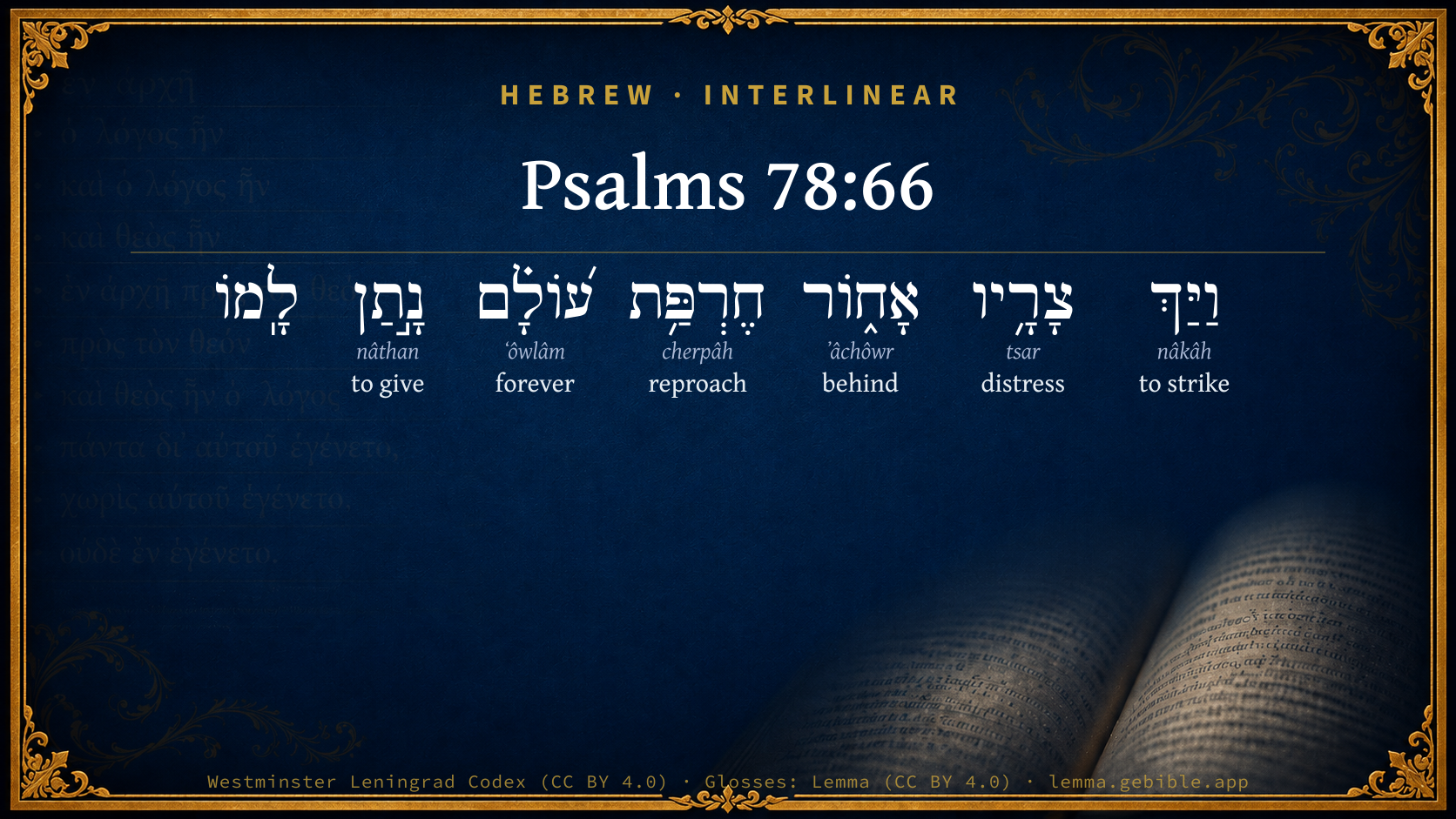
Psalms 78:66

Hebrew (Westminster Leningrad Codex) Psalms 78:66 appears in the Hebrew Old Testament. The text above is from the Westminster Leningrad Codex. Each word links to its Strong’s number, a concise gloss, and parsing drawn from the Open Scriptures Hebrew Bible morphology. Click any word for its full Brown-Driver-Briggs (BDB) entry.
Download image
Cite this verse

Psalms 78:66 (World English Bible). Public Domain. Lemma interlinear Bible study tool, https://lemma.gebible.app/v/psalms/78/66.

Show BibTeX & RIS
BibTeX
RIS
English Translation
He struck his adversaries backward. He put them to a perpetual reproach.
World English Bible · Public Domain
Download a study sheet

One document with this verse’s original text, its word-by-word gloss line, the meaning frame, cross-references with their text, attributed commentary, and full source and license credits — printable, and it pastes into notes with its structure intact.

This verse Autodidact and up

Study sheet (.html) Plain text (.txt)

A passage Seminary Student

Up to 50 verses in one chapter. A passage sheet keeps up to 6 commentary sources and 12 cross-references per verse, in the order this page ranks them, and says so on the sheet whenever that leaves anything out. Ask for a single verse and you get the Autodidact verse sheet above.

Everything on this page stays free to read, with no account — the sheet is a download of what is already on screen, not access to it.

Want to remove ads? Support Godless Engineer
Compare translations 3

The same verse in 3 English versions, stacked beneath the original-language interlinear above. Click any original word for its lexicon entry.

Each is an independent rendering of the whole verse — the interlinear is not word-aligned to these translations.

Highlighted words mark where these versions differ — a whole-verse word diff, not a word-by-word alignment.

  • World English Bible Public Domain
    He struck his adversaries backward. He put them to a perpetual reproach.
  • King James Version Public Domain
    And he smote his enemies in the hinder parts: he put them to a perpetual reproach.
  • unfoldingWord Literal Text CC BY-SA 4.0
    And he struck his adversaries backward; he gave to them a reproach of perpetuity.

unfoldingWord Literal Text — © unfoldingWord, licensed CC BY-SA 4.0. Word-aligned USFM3 via Door43 (git.door43.org/unfoldingWord/en_ult).

Versions to compare (up to 4)

3 of 4 selected

Show all 18 translations

Every available English version of this verse, each an independent rendering of the whole verse.

  • World English Bible Public Domain
    He struck his adversaries backward. He put them to a perpetual reproach.
  • Berean Standard Bible Public Domain
    He beat back His foes; He put them to everlasting shame.
  • Majority Standard Bible Public Domain
    He beat back His foes; He put them to everlasting shame.
  • King James Version Public Domain
    And he smote his enemies in the hinder parts: he put them to a perpetual reproach.
  • American Standard Version (1901) Public Domain
    And he smote his adversaries backward: He put them to a perpetual reproach.
  • Revised Version (1885) Public Domain
    And he smote his adversaries backward: he put them to a perpetual reproach.
  • Geneva Bible (1599) Public Domain
    And smote his enemies in the hinder parts, and put them to a perpetuall shame.
  • Douay-Rheims (1899) Public Domain
    And he smote his enemies on the hinder parts: he put them to an everlasting reproach.
  • Young's Literal Translation Public Domain
    And He smiteth His adversaries backward, A reproach age-during He hath put on them,
  • Literal Standard Version CC BY-SA 4.0
    And He strikes His adversaries backward, || He has put a continuous reproach on them,
  • Unlocked Literal Bible CC BY-SA 4.0
    He drove his adversaries back; he put them to everlasting shame.
  • unfoldingWord Literal Text CC BY-SA 4.0
    And he struck his adversaries backward; he gave to them a reproach of perpetuity.
  • Darby Bible Public Domain
    And he smote his adversaries in the hinder part, and put them to everlasting reproach.
  • World Messianic Bible Public Domain
    He struck his adversaries backward. He put them to a perpetual reproach.
  • Webster's Bible Public Domain
    And he smote his enemies in the hinder part: he put them to a perpetual reproach.
  • Free Bible Version CC BY-SA 4.0
    He defeated his enemies, striking them on the back, causing them everlasting shame.
  • Bible in Basic English Public Domain
    His haters were turned back by his blows and shamed for ever.
  • JPS Tanakh (1917) Public Domain
    And He smote His adversaries backward; He put upon them a perpetual reproach.

Literal Standard Version (2020), Covenant Press — licensed CC BY-SA 4.0. Text via the HelloAO Bible API (eBible.org). Unlocked Literal Bible (unfoldingWord) — licensed CC BY-SA 4.0. Text via the HelloAO Bible API (eBible.org). unfoldingWord Literal Text — © unfoldingWord, licensed CC BY-SA 4.0. Word-aligned USFM3 via Door43 (git.door43.org/unfoldingWord/en_ult). Free Bible Version, Dr. Jonathan Gallagher — licensed CC BY-SA 4.0. Text via the HelloAO Bible API (eBible.org).

Word by word

More ways to search: Search by grammar → Find every occurrence → Compare this word →

Practice this passage: Drill this verse → Learn its vocabulary →

About this verse

These counts appear in no published source. They are computed here, from the morphology-tagged text and Lemma’s own curated glosses. What Lemma adds →

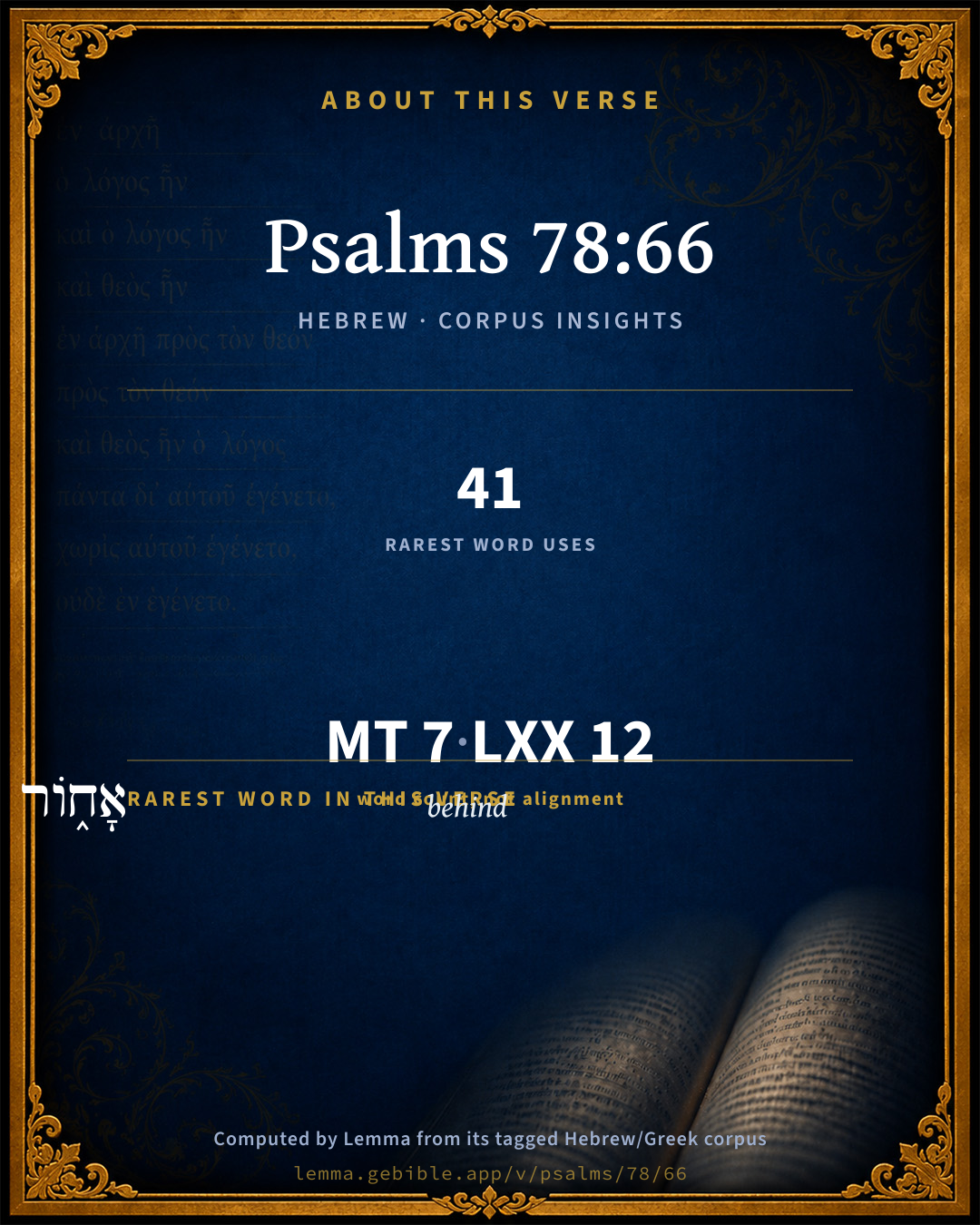
7
words
6
distinct lemmas
Wisdom
section

Shared distinctive vocabulary

אָח֑וֹר behind H268 occurs in 41 verses of the Hebrew Bible. Also found in:

Grammatical profile

  • 2 verbs
  • 4 nouns
  • 1 preposition

Verb forms

  • וַיַּךְ Hiphil · Sequential Imperfect
  • נָ֣תַן Qal · Perfect

Hebrew & Septuagint length

In English translation the verse runs 12 words from the Hebrew and 16 from the Septuagint (LXX English) — closely comparable.

A rough comparison of the two English renderings, which tokenize alike — not a word-level alignment.

Word counts can differ between the Hebrew and the Greek without any difference in meaning — e.g. the Hebrew direct-object marker אֵת has no separate Greek word, and Greek often adds the article ὁ.

In the original languages it is 7 Hebrew tokens and 12 Greek tokens — but the two are counted differently (Hebrew bundles its prefixes and suffixes into one token; the Greek is in lemma form), so that isn’t a like-for-like length.

Cross-references

4

Topical passages linked to Psalms 78:66 in the Treasury of Scripture Knowledge — connected by theme and wording, ordered by reader-vote popularity; previews shown in the World English Bible.

  • 1 Samuel 5:6 But the hand of Yahweh was heavy on them of Ashdod, and he destroyed them, and struck them with tumors, even Ashdod and the borders of it.
  • Job 40:12 Look on everyone who is proud, and humble him. Crush the wicked in their place.
  • Jeremiah 23:40 and I will bring an everlasting reproach on you, and a perpetual shame, which shall not be forgotten.
  • 1 Samuel 6:4 Then they said, "What shall be the trespass-offering which we shall return to him?" They said, "Five golden tumors, and five golden mice, [according to] the number of the lords of the Philistines; for one plague was on you all, and on your lords.

Cross-references courtesy of OpenBible.info (CC BY 4.0).

Hebrew and Greek witnesses Masoretic Hebrew ↔ Greek Septuagint

The same verse in the two great witnesses to the Old Testament, shown verse-for-verse.

You’re reading Greek Psalm 77 (Hebrew Psalm 78). The Septuagint counts the superscription, so verse numbers can differ from the Hebrew — chapter-level alignment, not verse-by-verse. Numbering follows Rahlfs.

These are two independent witnesses, not word-aligned to each other, and the Septuagint is shown in lemma (dictionary) form.

Hebrew Psalms 78:66 Masoretic · Westminster Leningrad Codex

וַיַּךְ צָרָ֥יו אָח֑וֹר חֶרְפַּ֥ת ע֝וֹלָ֗ם נָ֣תַן לָֽמוֹ

He struck his adversaries backward. He put them to a perpetual reproach.

World English Bible · Public Domain

Greek LXX Greek Psalm 77:66 Septuagint · lemma form

καί πατάσσω ὁ ἐχθρός αὐτός εἰς ὁ ὀπίσω ὄνειδος αἰώνιος δίδωμι αὐτός

And he struck his enemies in the hinder parts: he brought on them a perpetual reproach.

LXX2012 (modern English Septuagint) · Public Domain

Hebrew: Westminster Leningrad Codex (CC BY 4.0). Greek: Septuagint (public domain); English from LXX2012 (modern English Septuagint) (Public Domain). How the Septuagint differs from the Hebrew →

Commentary

Notes on Psalms 78:66 from classic Christian and Jewish commentators (each source and its license shown beneath its notes). The classic Christian expositions comment on the surrounding passage and are grouped to its opening verse, so a note may address several verses; the Jewish commentaries on the Tanakh (Rashi and others) are per-verse, so they appear only where the commentator wrote on this verse.

Lemma curates 59 commentaries, every one of them public domain or Creative Commons licensed, each selected and text-cleaned for this edition rather than reprinted as found. About our sources →

Trapp's Complete Commentary

John Trapp

Psa 78:66 And he smote his enemies in the hinder parts: he put them to a perpetual reproach.

Ver. 66. And he smote his enemies in the hinder parts] viz. With emerods, 1Sa 5:6; 1Sa 5:9; 1Sa 5:12, infami podicis ignominia affecit illos, he punished them, as we do puny boys on their posteriors.

John Trapp, A Commentary or Exposition upon All the Books of the Old and New Testament (1647–1656) — public domain. Text from a community e-Sword module.

J. A. Alexander on Psalms

Joseph Addison Alexander

66. (Psa 78:66) And he struck his foes back (and) disgrace of eternity gave them. The idea of driving his assailants back, repelling or repulsing them, is worthier in itself, and better suited to the context than the one expressed in the English Bible. Perpetual dishonour was in fact the doom of the Philistines from the time of the events in question. The successes particularly meant are those of Saul and David. Gave them, or to them, as their portion.

Joseph Addison Alexander, The Psalms Translated and Explained (1850) — public domain. Text from a community e-Sword module.

Adam Clarke's Commentary

Verse 66. He smote his enemies in the hinder part] This refers to the hemorrhoids with which he afflicted the Philistines. See the note on 1Sa 5:6-10.

Adam Clarke's Commentary on the Bible (1810–1826) — public domain. Text from a community e-Sword/MySword module.

Ellicott's Commentary for English Readers

(66) He smote.—Possibly an allusion to 1Sa_5:9, or else to the repeated defeats of the Philistines under Saul and David.

A Bible Commentary for English Readers, edited by Charles John Ellicott (1878–1897) — public domain. Text from a community e-Sword module.

The Cambridge Bible for Schools and Colleges

gen. ed. J. J. S. Perowne

66. And he smote &c.] Render with R.V., And he smote his adversaries backward, a general allusion to the victories over the Philistines and other enemies of Israel under Samuel, Saul, and David. The A.V. follows Jewish authorities in seeing a reference to 1Sa_5:6 ff.

The Cambridge Bible for Schools and Colleges (gen. ed. J. J. S. Perowne; Cambridge University Press, 1878–1918) — public domain. Text from a community e-Sword module.

John Gill's Exposition

Moreover, he refused the tabernacle of Joseph,.... That is, the tabernacle of Moses, which had been for a long time at Shiloh, a city in the tribe of Ephraim, the son of Joseph; when the ark was brought back by the Philistines, it was not returned to Shiloh, but carried to Kirjathjearim, where it remained twenty years, and after that was had to Zion, the city of David, Sa1 7:1, so the Targum,

"and he rejected the tabernacle which he had stretched out in the border of Joseph;''

he did not refuse the tabernacle, or remove his presence from it; but he refused the place it had been in, or refused that it should be any more there:

and chose not the tribe of Ephraim: the same thing is designed as before; the meaning is, not that he rejected the tribe of Ephraim from being one of the tribes of Israel; nor does it refer to the revolt of Ephraim, or the ten tribes, from the pure worship of God to idolatry, and their separation from the two tribes of Judah and Benjamin; or to their being carried captive into Assyria; since this historical narration reaches no further than the reign of David, or the time of Solomon at furthest; whereas the facts mentioned were a long time afterwards; nor does it regard the removal of government from the tribe of Ephraim, which was the seat of it in the times of Joshua, of which tribe he was, Num 13:8, though this tribe was overlooked in the choice of a king, one of the tribe of Benjamin being first chosen; and when he was rejected, then one of the tribe of Judah; but this purely, at least principally, intends that it was the will of God that the seat of worship should not be in this tribe any longer; that the ark and tabernacle should be no more there: perhaps the Ephraimites were more culpable, and more provoked the Lord with their idolatry, than the other tribes, since they are first and last taken notice of as the objects of the divine resentment in this account; see Psa 78:9.

John Gill's Exposition of the Whole Bible (1746–1763) — public domain (CC PDM 1.0). Text via the HelloAO Bible API.

Albert Barnes' Notes on the Bible

And he smote his enemies in the hinder part - From behind; that is, as they fled. There are two ideas here: one, that they fled at his approach, or turned their backs; the other, that as they fled, he smote and destroyed them.

He put them to a perpetual reproach - As discomfited; as defeated and scattered; as unable to contend with him. The allusion is, probably, to the victories of David, occurring after the events related in the preceding verses.

Albert Barnes' Notes on the Bible (1834–1885) — public domain. Text from a community e-Sword/MySword module.

Matthew Poole's English Annotations

Smote his enemies in the hinder part, with the disease of the emerods, which was both painful and shameful. He caused them to perpetuate their own reproach by sending back the ark of God with their golden emerods, the lasting monuments of their shame.

Matthew Poole's English Annotations on the Holy Bible (1683–1685) — public domain. Text from a community e-Sword/MySword module.

The Treasury of David

Charles H. Spurgeon

Ver. 66. He smote his enemies in the hinder parts. The emerods rendered them ridiculous, and their numerous defeats made them yet more so. They fled but were overtaken and wounded in the back to their eternal disgrace.

He put them to a perpetual reproach. Orientals are not very refined, and we can well believe that the haemorrhoids were the subject of many a taunt against the Philistines, as also were their frequent defeats by Israel until at last they were crushed under, never to exist again as a distinct nation.

Ver. 66. He smote his enemies in the hinder parts. This has reference to the Philistines being smitten with haemorrhoids, or piles, whilst the ark was retained a captive by them, 1Sa 5:6, 12...The Greek version, as quoted by Suidas, is, he smote his enemies on the back parts of the seat; signifying, he says, a disease modestly expressed. John Gill.

Charles H. Spurgeon's The Treasury of David (1869–1885) — public domain. Psalms only. Text from a community e-Sword/MySword module.

Whedon's Commentary on the Bible

Daniel D. Whedon

66. He smote his enemies in the hinder parts—The language admits of a twofold sense. First, that of wounding a retreating enemy in the back—an ineffaceable disgrace. Secondly, of smiting them with the painful and loathsome disease called the hemorrhoids—as God did the Philistines. 1Sa_5:6-7; 1Sa_5:12; 1Sa_6:4, where see notes. The disease was reproachful both in its nature and severity, for the purpose was, as stated, to “put them to endless shame.”

Daniel D. Whedon (gen. ed.), Commentary on the Old and New Testaments (1874–1909) — public domain. Text from a community e-Sword module.

The Pulpit Commentary

And he smote his enemies in the hinder parts; rather, backward, so that they fled before him. (comp. Psa_40:14 Psa_70:2, etc.) There is no allusion to 1Sa_5:6-12. The reference is rather to the many victories of Israel over the Philistines, which began under Samuel, (1Sa_7:10) and continued under Saul and David. He put them to a perpetual reproach. Covered them, that is, with shame and disgrace. The shame culminated, perhaps, in David"s victory over Goliath. (1Sa_17:40-51)

The Pulpit Commentary (1880–1919), ed. H.D.M. Spence-Jones & Joseph S. Exell — public domain. Text from a community e-Sword module.

John Wesley's Explanatory Notes

Smote - Them with the piles. Reproach - He caused them to perpetuate their own reproach by sending back the ark of God with their golden emrods, the lasting monuments of their shame.

John Wesley, Explanatory Notes Upon the Whole Bible (1754–1765) — public domain. Text via the GEBible commentary corpus.

Rashi

Rabbi Shlomo Yitzchaki (Rashi)

And He smote His adversaries from the rear Plagues of the rear with hemorrhoids, which is a disgrace of perpetual ridicule for them.

Rashi on the Tanakh — English translations: “The Judaica Press complete Tanach with Rashi, translated by A. J. Rosenberg” (CC BY 4.0); “Pentateuch with Rashi's commentary by M. Rosenbaum and A.M. Silbermann, 1929-1934” (public domain); “The Metsudah Tanach series, Lakewood, N.J” (CC BY 4.0); and “The Book of Joshua, Metsudah Publications, 1997” (CC BY 4.0). Text via Sefaria.

Lesson kit

Teaching starters — assembled from the data on this page, not authored interpretation. Every prompt links to the verse data it draws on. Edit before teaching.

Psalms, in the Wisdom, opens this verse with 7 words (6 distinct Hebrew lemmas). Its most distinctive word is ʼâchôwr (“behind”). A historical commentator’s framing appears above. Read the whole chapter for the surrounding context.

Discussion questions

  1. What does “behind” (ʼâchôwr) contribute to the verse as a whole?
  2. How does Genesis 49:17, which shares the word «behind», read alongside this verse?
  3. The translations on this page render this verse differently — a whole-verse word diff, not a word-by-word alignment. What might account for the different wordings?
  4. «וַיַּךְ» is a Hiphil Sequential Imperfect verb. How does that grammatical form shape the action described?
  5. Compare how Trapp's Complete Commentary and J. A. Alexander on Psalms read this verse. Where do they agree or differ?

Things to notice

Reading settings

Reading text

Shown beneath each verse's original-language words.

Old Testament
Old Testament edition

Read the OT as the Masoretic Hebrew (MT) or the Greek Septuagint (LXX).

English shown for the Greek Septuagint (in the Hebrew ↔ Greek comparison).

Comparing translations? Open the Compare panel on any verse page to stack up to four side by side.