
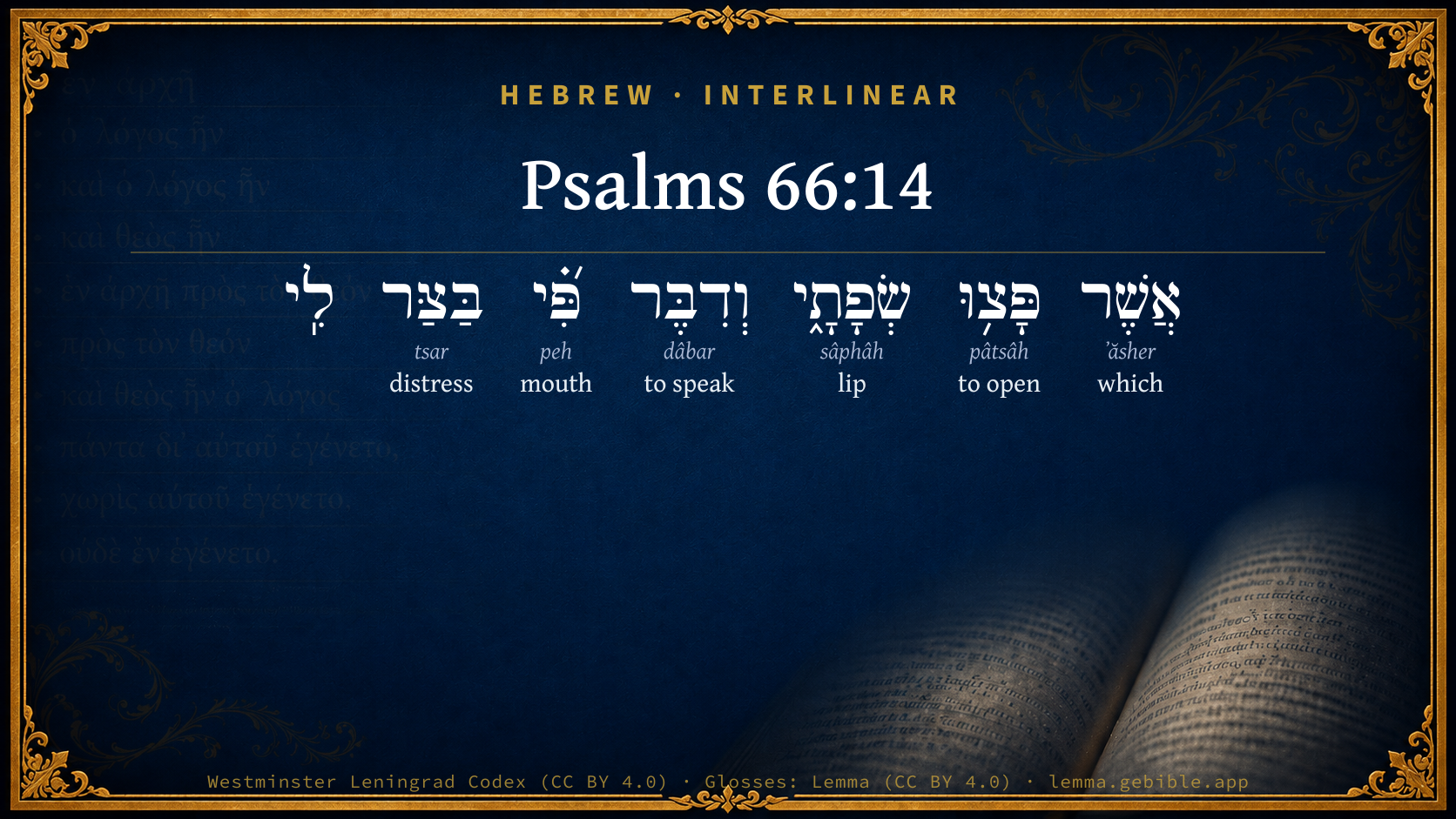
Psalms 66:14

Hebrew (Westminster Leningrad Codex) Psalms 66:14 appears in the Hebrew Old Testament. The text above is from the Westminster Leningrad Codex. Each word links to its Strong’s number, a concise gloss, and parsing drawn from the Open Scriptures Hebrew Bible morphology. Click any word for its full Brown-Driver-Briggs (BDB) entry.
Download image
Cite this verse

Psalms 66:14 (World English Bible). Public Domain. Lemma interlinear Bible study tool, https://lemma.gebible.app/v/psalms/66/14.

Show BibTeX & RIS
BibTeX
RIS
English Translation
which my lips promised, And my mouth spoke, when I was in distress.
World English Bible · Public Domain
Download a study sheet

One document with this verse’s original text, its word-by-word gloss line, the meaning frame, cross-references with their text, attributed commentary, and full source and license credits — printable, and it pastes into notes with its structure intact.

This verse Autodidact and up

Study sheet (.html) Plain text (.txt)

A passage Seminary Student

Up to 50 verses in one chapter. A passage sheet keeps up to 6 commentary sources and 12 cross-references per verse, in the order this page ranks them, and says so on the sheet whenever that leaves anything out. Ask for a single verse and you get the Autodidact verse sheet above.

Everything on this page stays free to read, with no account — the sheet is a download of what is already on screen, not access to it.

Want to remove ads? Support Godless Engineer
Compare translations 3

The same verse in 3 English versions, stacked beneath the original-language interlinear above. Click any original word for its lexicon entry.

Each is an independent rendering of the whole verse — the interlinear is not word-aligned to these translations.

Highlighted words mark where these versions differ — a whole-verse word diff, not a word-by-word alignment.

  • World English Bible Public Domain
    which my lips promised, And my mouth spoke, when I was in distress.
  • King James Version Public Domain
    Which my lips have uttered, and my mouth hath spoken, when I was in trouble.
  • unfoldingWord Literal Text CC BY-SA 4.0
    which my lips opened and my mouth spoke when trouble to me.

unfoldingWord Literal Text — © unfoldingWord, licensed CC BY-SA 4.0. Word-aligned USFM3 via Door43 (git.door43.org/unfoldingWord/en_ult).

Versions to compare (up to 4)

3 of 4 selected

Show all 18 translations

Every available English version of this verse, each an independent rendering of the whole verse.

  • World English Bible Public Domain
    which my lips promised, And my mouth spoke, when I was in distress.
  • Berean Standard Bible Public Domain
    the vows that my lips promised and my mouth spoke in my distress.
  • Majority Standard Bible Public Domain
    the vows that my lips promised and my mouth spoke in my distress.
  • King James Version Public Domain
    Which my lips have uttered, and my mouth hath spoken, when I was in trouble.
  • American Standard Version (1901) Public Domain
    Which my lips uttered, And my mouth spake, when I was in distress.
  • Revised Version (1885) Public Domain
    Which my lips have uttered, and my mouth hath spoken, when I was in distress.
  • Geneva Bible (1599) Public Domain
    Which my lippes haue promised, and my mouth hath spoken in mine affliction.
  • Douay-Rheims (1899) Public Domain
    which my lips have uttered, And my mouth hath spoken, when I was in trouble.
  • Young's Literal Translation Public Domain
    For opened were my lips, And my mouth spake in my distress:
  • Literal Standard Version CC BY-SA 4.0
    For my lips were opened, || And my mouth spoke in my distress:
  • Unlocked Literal Bible CC BY-SA 4.0
    which my lips promised and my mouth spoke when I was in distress.
  • unfoldingWord Literal Text CC BY-SA 4.0
    which my lips opened and my mouth spoke when trouble to me.
  • Darby Bible Public Domain
    Which my lips have uttered, and my mouth hath spoken, when I was in trouble.
  • World Messianic Bible Public Domain
    which my lips promised, and my mouth spoke, when I was in distress.
  • Webster's Bible Public Domain
    Which my lips have uttered, and my mouth hath spoken, when I was in trouble.
  • Free Bible Version CC BY-SA 4.0
    the promises I made when I was in trouble.
  • Bible in Basic English Public Domain
    Keeping the word which came from my lips, and which my mouth said, when I was in trouble.
  • JPS Tanakh (1917) Public Domain
    Which my lips have uttered, and my mouth hath spoken, when I was in distress.

Literal Standard Version (2020), Covenant Press — licensed CC BY-SA 4.0. Text via the HelloAO Bible API (eBible.org). Unlocked Literal Bible (unfoldingWord) — licensed CC BY-SA 4.0. Text via the HelloAO Bible API (eBible.org). unfoldingWord Literal Text — © unfoldingWord, licensed CC BY-SA 4.0. Word-aligned USFM3 via Door43 (git.door43.org/unfoldingWord/en_ult). Free Bible Version, Dr. Jonathan Gallagher — licensed CC BY-SA 4.0. Text via the HelloAO Bible API (eBible.org).

Word by word

More ways to search: Search by grammar → Find every occurrence → Compare this word →

Practice this passage: Drill this verse → Learn its vocabulary →

About this verse

These counts appear in no published source. They are computed here, from the morphology-tagged text and Lemma’s own curated glosses. What Lemma adds →

7
words
6
distinct lemmas
Wisdom
section

Notable vocabulary

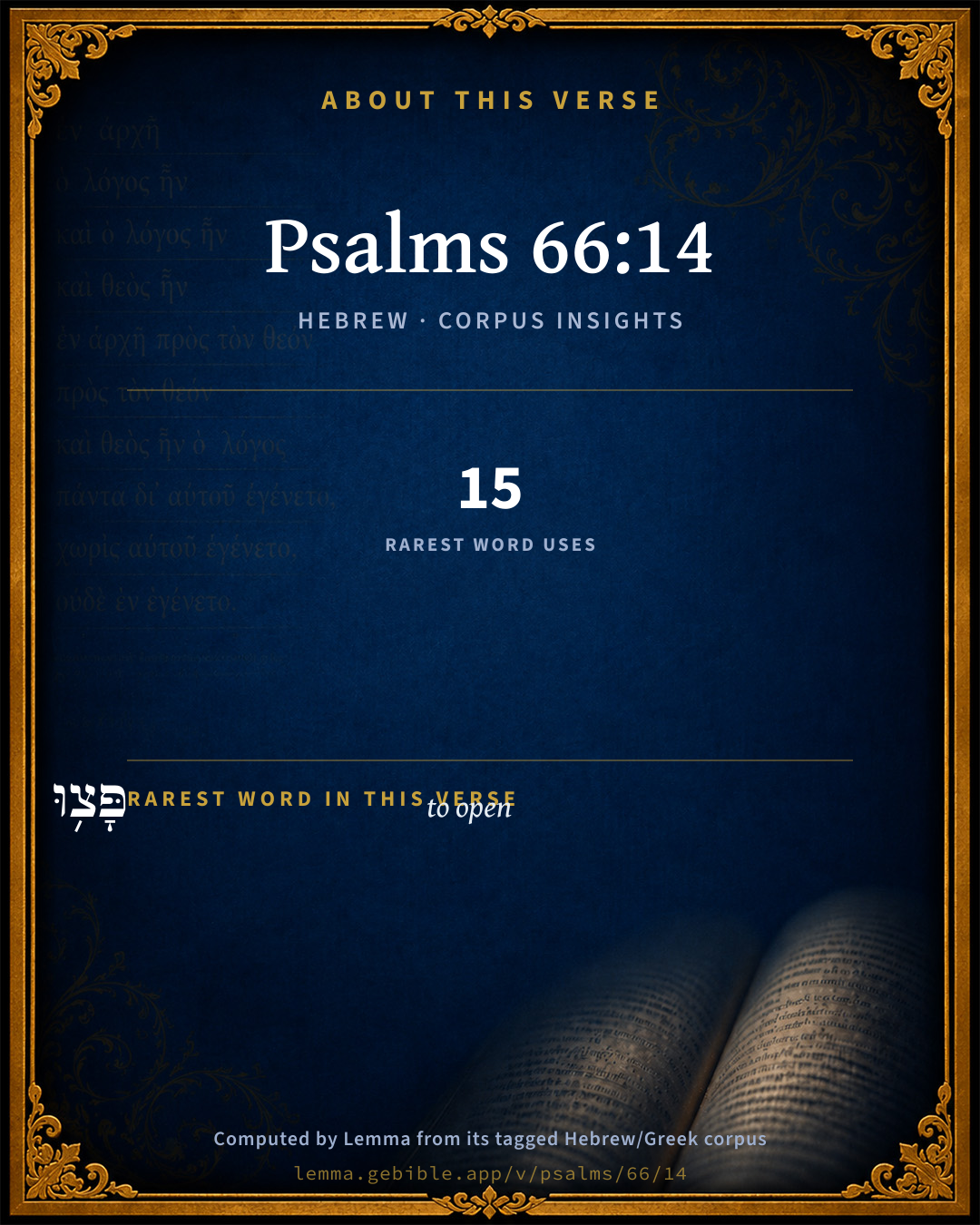
The rarest word here is פָּצ֥וּ to open H6475 — appearing just 15 times in the whole Hebrew Bible.

Shared distinctive vocabulary

פָּצ֥וּ to open H6475 occurs in 15 verses of the Hebrew Bible. Also found in:

Grammatical profile

  • 2 verbs
  • 2 nouns
  • 1 adjective
  • 1 preposition
  • 1 particle

Verb forms

  • פָּצ֥וּ Qal · Perfect
  • וְדִבֶּר Piel · Perfect

Hebrew & Septuagint length

In English translation the verse runs 13 words from the Hebrew and 11 from the Septuagint (LXX English) — closely comparable.

A rough comparison of the two English renderings, which tokenize alike — not a word-level alignment.

Word counts can differ between the Hebrew and the Greek without any difference in meaning — e.g. the Hebrew direct-object marker אֵת has no separate Greek word, and Greek often adds the article ὁ.

Cross-references

9

Topical passages linked to Psalms 66:14 in the Treasury of Scripture Knowledge — connected by theme and wording, ordered by reader-vote popularity; previews shown in the World English Bible.

  • Judges 11:35–36 It happened, when he saw her, that he tore his clothes, and said, Alas, my daughter! you have brought me very low, and you are one of those who trouble me; for I have opened my mouth to Yahweh, and I can't go back.
  • 1 Samuel 1:11 She vowed a vow, and said, Yahweh of hosts, if you will indeed look on the affliction of your handmaid, and remember me, and not forget your handmaid, but will give to your handmaid a man-child, then I will give him to Yahweh all the days of his life, and there shall no razor come on his head.
  • Psalms 18:6 In my distress I called on Yahweh, And cried to my God. He heard my voice out of his temple, My cry before him came into his ears.
  • Numbers 30:2 When a man vows a vow to Yahweh, or swears an oath to bind his soul with a bond, he shall not break his word; he shall do according to all that proceeds out of his mouth.
  • Numbers 30:8 But if her husband disallow her in the day that he hears it, then he shall make void her vow which is on her, and the rash utterance of her lips, with which she has bound her soul: and Yahweh will forgive her.
  • 2 Samuel 22:7 In my distress I called on Yahweh; Yes, I called to my God: He heard my voice out of his temple, My cry [came] into his ears.
  • Genesis 28:20–22 Jacob vowed a vow, saying, "If God will be with me, and will keep me in this way that I go, and will give me bread to eat, and clothing to put on,
  • Genesis 35:3 Let us arise, and go up to Bethel. I will make there an altar to God, who answered me in the day of my distress, and was with me in the way which I went."
  • Numbers 30:12 But if her husband made them null and void in the day that he heard them, then whatever proceeded out of her lips concerning her vows, or concerning the bond of her soul, shall not stand: her husband has made them void; and Yahweh will forgive her.

Cross-references courtesy of OpenBible.info (CC BY 4.0).

Hebrew and Greek witnesses Masoretic Hebrew ↔ Greek Septuagint

The same verse in the two great witnesses to the Old Testament, shown verse-for-verse.

You’re reading Greek Psalm 65 (Hebrew Psalm 66). The Septuagint counts the superscription, so verse numbers can differ from the Hebrew — chapter-level alignment, not verse-by-verse. Numbering follows Rahlfs.

These are two independent witnesses, not word-aligned to each other, and the Septuagint is shown in lemma (dictionary) form.

Hebrew Psalms 66:14 Masoretic · Westminster Leningrad Codex

אֲשֶׁר פָּצ֥וּ שְׂפָתָ֑י וְדִבֶּר פִּ֝֗י בַּצַּר לִֽי

which my lips promised, And my mouth spoke, when I was in distress.

World English Bible · Public Domain

Greek LXX Greek Psalm 65:14 Septuagint · lemma form

ὅς διαστέλλω ὁ χεῖλος ἐγώ καί λαλέω ὁ στόμα ἐγώ ἐν ὁ θλῖψις ἐγώ

which my lips framed, and my mouth uttered in my affliction.

LXX2012 (modern English Septuagint) · Public Domain

Hebrew: Westminster Leningrad Codex (CC BY 4.0). Greek: Septuagint (public domain); English from LXX2012 (modern English Septuagint) (Public Domain). How the Septuagint differs from the Hebrew →

Commentary

Notes on Psalms 66:14 from classic Christian and Jewish commentators (each source and its license shown beneath its notes). The classic Christian expositions comment on the surrounding passage and are grouped to its opening verse, so a note may address several verses; the Jewish commentaries on the Tanakh (Rashi and others) are per-verse, so they appear only where the commentator wrote on this verse.

Lemma curates 59 commentaries, every one of them public domain or Creative Commons licensed, each selected and text-cleaned for this edition rather than reprinted as found. About our sources →

Trapp's Complete Commentary

John Trapp

Psa 66:14 Which my lips have uttered, and my mouth hath spoken, when I was in trouble.

Ver. 14. Which my lips have uttered] Heb. have opened, that is, which I have uttered diductis labiis, with lips wide open. Videmus qualiter vota nuncupari soleant, saith Vatablus, Here we see after what sort vows use to be made, when we are under any pressing affliction; but when once delivered, how heavily many come off in point of payment.

And my mouth hath spoken when I was in trouble] Then men will promise anything for ease and release. But what saith the Italian proverb? Sciapato il morbo, fraudato il Santo, when the disease is cured the saint is defrauded. Horace calleth upon Mecaenas, who in his sickness had vowed to build a temple,

- Reddere victimas

Aedemque votivam memento:

Nos humilem feriemus agnam.

John Trapp, A Commentary or Exposition upon All the Books of the Old and New Testament (1647–1656) — public domain. Text from a community e-Sword module.

J. A. Alexander on Psalms

Joseph Addison Alexander

14. (Psa 66:14) Which my lips uttered and my mouth spake in my distress. The first verb is a very strong and expressive one, in this connection not unlike our familiar phrases, bolted, blurted out, implying that he spoke from some irresistible impulse, and thus suggesting what is afterwards explicitly affirmed, that the vows in question were occasioned by extreme distress. The Hebrew verb originally means to open or distend the lips, whether as a gesture of mockery (Lam 2:16), or menace (Psa 22:14), or for the purpose of articulate speech (Job 35:16). That its absolute use, in special reference to vows spontaneously and hastily uttered, was familiar to the ancients, may be seen from Jdg 11:35-36. In my distress; the original expression is, in the distress to me. See above, on Psa 18:6.

Joseph Addison Alexander, The Psalms Translated and Explained (1850) — public domain. Text from a community e-Sword module.

Adam Clarke's Commentary

Verse 14. When I was in trouble.] This is generally the time when good resolutions are formed, and vows made; but how often are these forgotten when affliction and calamity are removed!

Adam Clarke's Commentary on the Bible (1810–1826) — public domain. Text from a community e-Sword/MySword module.

Ellicott's Commentary for English Readers

(14) Uttered.—Literally, opened.

A Bible Commentary for English Readers, edited by Charles John Ellicott (1878–1897) — public domain. Text from a community e-Sword module.

The Cambridge Bible for Schools and Colleges

gen. ed. J. J. S. Perowne

14. Wherewith my lips opened,

And which my mouth spake, when I was in distress.

For the first line cp. Jdg_11:35 f; but there is no reason to suppose that rash vows are here meant.

The Cambridge Bible for Schools and Colleges (gen. ed. J. J. S. Perowne; Cambridge University Press, 1878–1918) — public domain. Text from a community e-Sword module.

John Gill's Exposition

Which my lips have uttered,.... Or "opened" (e); publicly and distinctly declared, and from which there is no going back; see Jdg 11:33;

and my mouth hath spoken when I was in trouble; this refers to the time when the people of God were under antichristian tyranny and bondage; and when they vowed and promised, that, if the Lord would deliver them, they would give him all praise and glory.

(e) "aperuerunt", Pagninus, Montanus, Vatablus, Gejerus.

John Gill's Exposition of the Whole Bible (1746–1763) — public domain (CC PDM 1.0). Text via the HelloAO Bible API.

Albert Barnes' Notes on the Bible

Which my lips have uttered ... - Margin, “opened.” The Hebrew word, however - פצה pâtsâh - means properly to tear apart; to rend; and then, to open wide, as the mouth, for example - or the throat, - as wild beasts do, Psa 22:13. Then it means to open the mouth in scorn Lam 2:16; Lam 3:46; and then, to utter hasty words, Job 35:16. The idea would be expressed by us by the phrases to bolt or blurt out; to utter hastily; or, to utter from a heart full and overflowing to utter with very little care as to the language employed. It is the fullness of the heart which would be suggested by the word, and not a nice choice of expressions. The idea is, that the heart was full; and that the vows were made under the influence of deep emotion, when the heart was so full that it could not but speak, and when there was very little attention to the language. It was not a calm and studied selection of words. Such vows are not less acceptable to God than those which are made in the best-selected language. Not a little of the most popular sacred poetry in all tongues is of this nature; and when refined down to the nicest rules of art it ceases to be popular, or to meet the needs of the soul, and is laid aside. The psalmist here means to say, that though these vows were the result of deep feeling - of warm, gushing emotion - rather than of calm and thoughtful reflection, yet there was no disposition to disown or repudiate them now. They were made in the depth of feeling - in real sincerity - and there was a purpose fairly to carry them out.

When I was in trouble - When the people were in captivity, languishing in a foreign land. Vows made in trouble - in sickness, in bereavement, in times of public calamity - should be faithfully performed when health and prosperity visit us again; but, alas, how often are they forgotten!

Albert Barnes' Notes on the Bible (1834–1885) — public domain. Text from a community e-Sword/MySword module.

Matthew Poole's English Annotations

Hitherto he spoke in the plural number, but now he begins to speak in the singular number; but still the speech is continued of the same person or persons; only sometimes the whole body speaks, and sometimes one man speaks in the name of all the rest.

Matthew Poole's English Annotations on the Holy Bible (1683–1685) — public domain. Text from a community e-Sword/MySword module.

The Treasury of David

Charles H. Spurgeon

Ver. 14. Which my lips have uttered, or vehemently declared; blurted out, as we say in common speech. His vows had been wrung from him; extreme distress burst open the doors of his lips, and out rushed the vow like a long pent up torrent, which had at last found a vent. What we were so eager to vow, we should be equally earnest to perform; but alas! many a vow runs so fast in words that it lames itself for deeds.

And my mouth hath spoken. He had made the promise public, and had no desire to go back; an honest man is always ready to acknowledge a debt.

When I was in trouble. Distress suggested the vow; God in answer to the vow removed the distress, and now the votary desires to make good his promise. It is well for each man to remember that he was in trouble: proud spirits are apt to speak as if the road had always been smooth for them, as if no dog dare bark at their nobility, and scarce a drop of rain would venture to besprinkle their splendour; yet these very upstarts were probably once so low in spirits and condition that they would have been glad enough of the help of those they now despise. Even great Caesar, whose look did awe the world, must have his trouble and become weak as other men; so that his enemy could say in bitterness, "when the fit was on him, I did mark how he did shake." Of the strong and vigorous man the nurse could tell a tale of weakness, and his wife could say of the boaster, "I did hear him groan; his coward lips did from their colour fly." All men have trouble, but they act not in the same manner while under it; the profane take to swearing and the godly to praying. Both bad and good have been known to resort to vowing, but the one is a liar unto God, and the other a conscientious respecter of his word.

Ver. 14. Which my lips have uttered. Hebrew, have opened; that is which I have uttered, diductis labiis, with lips wide open. Videmus qualiter vota nuncupari soleant, saith Vatablus. Here we see after what sort vows used to be made, when we are under any pressing affliction; but when once delivered, how heavily many come off in point of payment. John Trapp.

Ver. 14. Express mention is made of opened lips to indicate that the vows were made with great vehemence of mind, and in a state of need and pressure; so that his lips were broken through and widely opened. For the root, huk contains the idea of opening anything with violence; to break open, as the Latin expression is, rumpere labia. Hermann Venema.

Charles H. Spurgeon's The Treasury of David (1869–1885) — public domain. Psalms only. Text from a community e-Sword/MySword module.

The Pulpit Commentary

Which my lips have uttered, and my mouth hath spoken, when I was in trouble. Vows were commonly made in a time of trouble, or, at any rate, of difficulty. (see Jud_1:11:30, 31 1Sa_1:11)

The Pulpit Commentary (1880–1919), ed. H.D.M. Spence-Jones & Joseph S. Exell — public domain. Text from a community e-Sword module.

Lesson kit

Teaching starters — assembled from the data on this page, not authored interpretation. Every prompt links to the verse data it draws on. Edit before teaching.

Psalms, in the Wisdom, opens this verse with 7 words (6 distinct Hebrew lemmas). Its most distinctive word is pâtsâh (“to open”). A historical commentator’s framing appears above. Read the whole chapter for the surrounding context.

Discussion questions

  1. How does “to open” (pâtsâh) shape what this verse is saying?
  2. How does Genesis 4:11, which shares the word «to open», read alongside this verse?
  3. These translations render this verse differently; the difference is in the English rendering, not the original. What questions does that raise?
  4. «פָּצ֥וּ» is a Qal Perfect verb. How does that grammatical form shape the action described?
  5. Compare how Trapp's Complete Commentary and J. A. Alexander on Psalms read this verse. Where do they agree or differ?

Things to notice

Reading settings

Reading text

Shown beneath each verse's original-language words.

Old Testament
Old Testament edition

Read the OT as the Masoretic Hebrew (MT) or the Greek Septuagint (LXX).

English shown for the Greek Septuagint (in the Hebrew ↔ Greek comparison).

Comparing translations? Open the Compare panel on any verse page to stack up to four side by side.