
Psalms 78:61

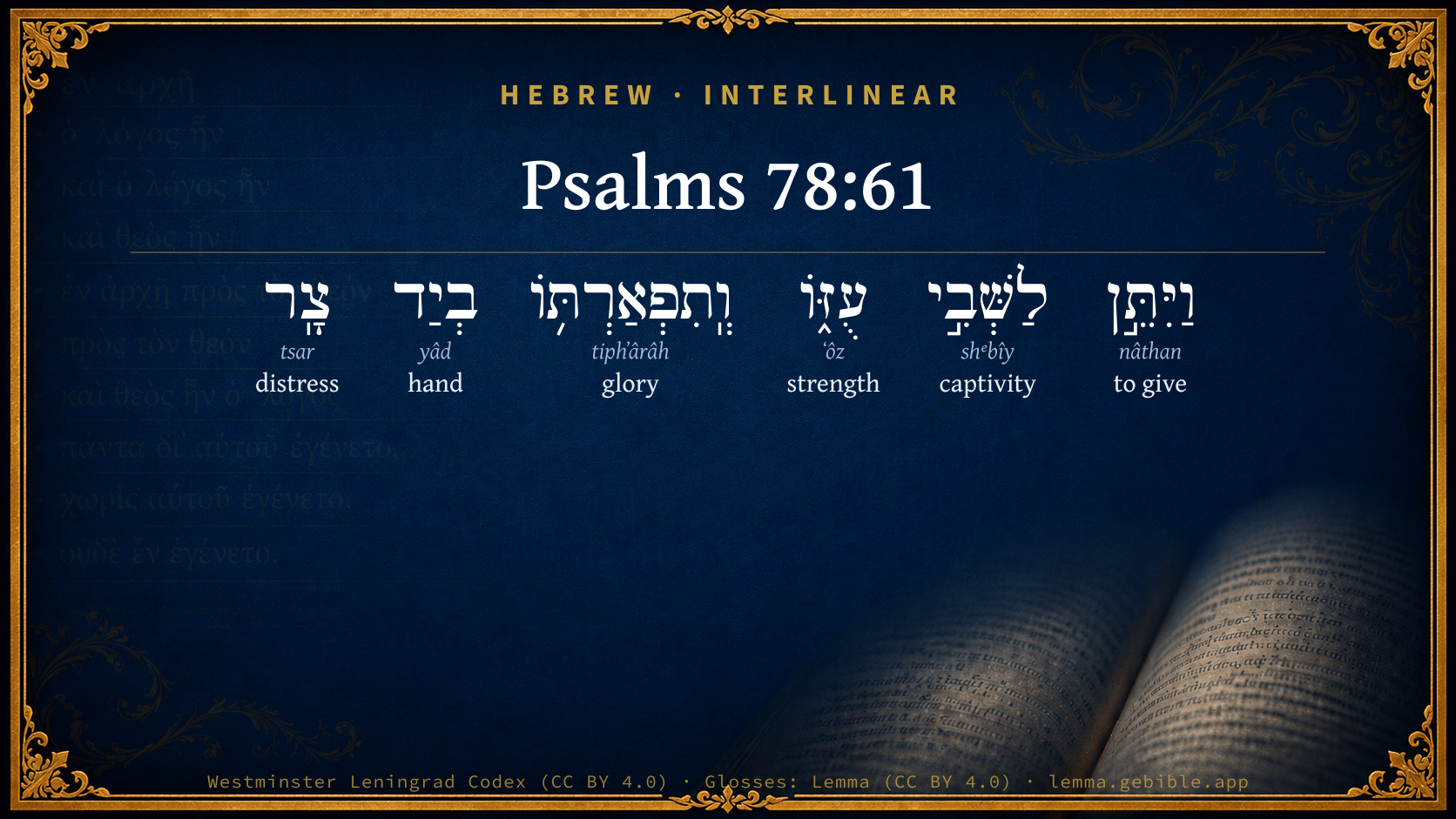
Hebrew (Westminster Leningrad Codex) Psalms 78:61 appears in the Hebrew Old Testament. The text above is from the Westminster Leningrad Codex. Each word links to its Strong’s number, a concise gloss, and parsing drawn from the Open Scriptures Hebrew Bible morphology. Click any word for its full Brown-Driver-Briggs (BDB) entry.
Download image
Cite this verse

Psalms 78:61 (World English Bible). Public Domain. Lemma interlinear Bible study tool, https://lemma.gebible.app/v/psalms/78/61.

Show BibTeX & RIS
BibTeX
RIS
English Translation
And delivered his strength into captivity, His glory into the adversary's hand.
World English Bible · Public Domain
Download a study sheet

One document with this verse’s original text, its word-by-word gloss line, the meaning frame, cross-references with their text, attributed commentary, and full source and license credits — printable, and it pastes into notes with its structure intact.

This verse Autodidact and up

Study sheet (.html) Plain text (.txt)

A passage Seminary Student

Up to 50 verses in one chapter. A passage sheet keeps up to 6 commentary sources and 12 cross-references per verse, in the order this page ranks them, and says so on the sheet whenever that leaves anything out. Ask for a single verse and you get the Autodidact verse sheet above.

Everything on this page stays free to read, with no account — the sheet is a download of what is already on screen, not access to it.

Want to remove ads? Support Godless Engineer
Compare translations 3

The same verse in 3 English versions, stacked beneath the original-language interlinear above. Click any original word for its lexicon entry.

Each is an independent rendering of the whole verse — the interlinear is not word-aligned to these translations.

Highlighted words mark where these versions differ — a whole-verse word diff, not a word-by-word alignment.

  • World English Bible Public Domain
    And delivered his strength into captivity, His glory into the adversary's hand.
  • King James Version Public Domain
    And delivered his strength into captivity, and his glory into the enemy's hand.
  • unfoldingWord Literal Text CC BY-SA 4.0
    And he gave his strength to captivity and his splendor into the hand of the enemy.

unfoldingWord Literal Text — © unfoldingWord, licensed CC BY-SA 4.0. Word-aligned USFM3 via Door43 (git.door43.org/unfoldingWord/en_ult).

Versions to compare (up to 4)

3 of 4 selected

Show all 18 translations

Every available English version of this verse, each an independent rendering of the whole verse.

  • World English Bible Public Domain
    And delivered his strength into captivity, His glory into the adversary's hand.
  • Berean Standard Bible Public Domain
    He delivered His strength to captivity, and His splendor to the hand of the adversary.
  • Majority Standard Bible Public Domain
    He delivered His strength to captivity, and His splendor to the hand of the adversary.
  • King James Version Public Domain
    And delivered his strength into captivity, and his glory into the enemy's hand.
  • American Standard Version (1901) Public Domain
    And delivered his strength into captivity, And his glory into the adversary's hand.
  • Revised Version (1885) Public Domain
    And delivered his strength into captivity, and his glory into the adversary’s hand.
  • Geneva Bible (1599) Public Domain
    And deliuered his power into captiuitie, and his beautie into the enemies hand.
  • Douay-Rheims (1899) Public Domain
    And he delivered their strength into captivity: and their beauty into the hands of the enemy.
  • Young's Literal Translation Public Domain
    And He giveth His strength to captivity, And His beauty into the hand of an adversary,
  • Literal Standard Version CC BY-SA 4.0
    And He gives His strength to captivity, || And His beauty into the hand of an adversary,
  • Unlocked Literal Bible CC BY-SA 4.0
    He allowed his strength to be captured and gave his glory into the enemy's hand.
  • unfoldingWord Literal Text CC BY-SA 4.0
    And he gave his strength to captivity and his splendor into the hand of the enemy.
  • Darby Bible Public Domain
    And gave his strength into captivity, and his glory into the hand of the oppressor;
  • World Messianic Bible Public Domain
    and delivered his strength into captivity, his glory into the adversary’s hand.
  • Webster's Bible Public Domain
    And delivered his strength into captivity, and his glory into the enemy's hand.
  • Free Bible Version CC BY-SA 4.0
    He surrendered the Ark of his power, allowing it to be captured; handing it over into enemy hands.
  • Bible in Basic English Public Domain
    And he let his strength be taken prisoner, and gave his glory into the hands of his hater.
  • JPS Tanakh (1917) Public Domain
    And delivered His strength into captivity, and His glory into the adversary's hand.

Literal Standard Version (2020), Covenant Press — licensed CC BY-SA 4.0. Text via the HelloAO Bible API (eBible.org). Unlocked Literal Bible (unfoldingWord) — licensed CC BY-SA 4.0. Text via the HelloAO Bible API (eBible.org). unfoldingWord Literal Text — © unfoldingWord, licensed CC BY-SA 4.0. Word-aligned USFM3 via Door43 (git.door43.org/unfoldingWord/en_ult). Free Bible Version, Dr. Jonathan Gallagher — licensed CC BY-SA 4.0. Text via the HelloAO Bible API (eBible.org).

Word by word

More ways to search: Search by grammar → Find every occurrence → Compare this word →

Practice this passage: Drill this verse → Learn its vocabulary →

About this verse

These counts appear in no published source. They are computed here, from the morphology-tagged text and Lemma’s own curated glosses. What Lemma adds →

6
words
6
distinct lemmas
Wisdom
section

Shared distinctive vocabulary

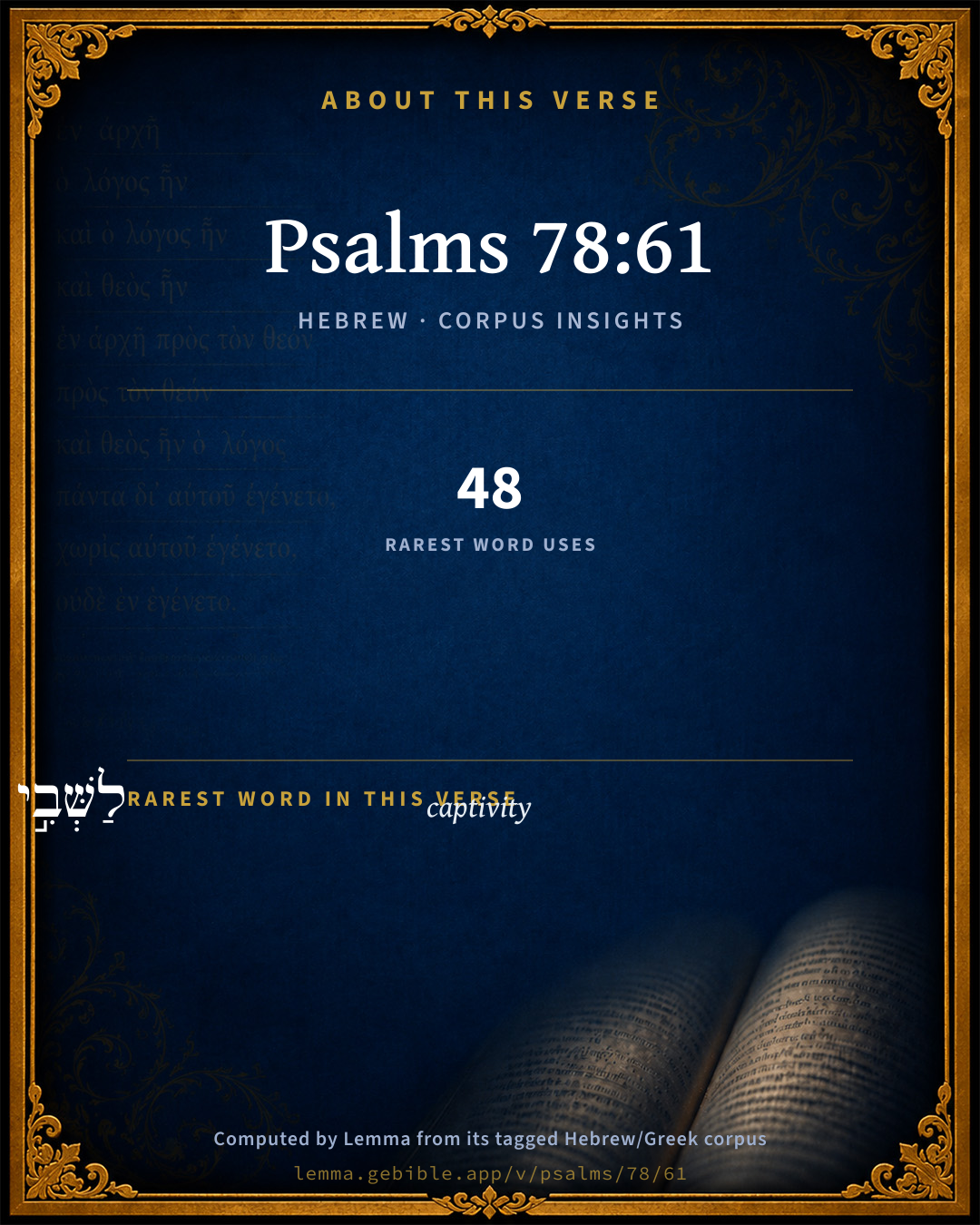
לַשְּׁבִ֣י captivity H7628 occurs in 46 verses of the Hebrew Bible. Also found in:

Grammatical profile

  • 1 verb
  • 5 nouns

Verb forms

  • וַיִּתֵּ֣ן Qal · Sequential Imperfect

Hebrew & Septuagint length

In English translation the verse runs 12 words from the Hebrew and 14 from the Septuagint (LXX English) — closely comparable.

A rough comparison of the two English renderings, which tokenize alike — not a word-level alignment.

Word counts can differ between the Hebrew and the Greek without any difference in meaning — e.g. the Hebrew direct-object marker אֵת has no separate Greek word, and Greek often adds the article ὁ.

Cross-references

8

Topical passages linked to Psalms 78:61 in the Treasury of Scripture Knowledge — connected by theme and wording, ordered by reader-vote popularity; previews shown in the World English Bible.

  • Psalms 132:8 Arise, Yahweh, into your resting place; You, and the ark of your strength.
  • Exodus 40:34 Then the cloud covered the tent of meeting, and the glory of Yahweh filled the tent.
  • Judges 18:30 The children of Dan set up for themselves the engraved image: and Jonathan, the son of Gershom, the son of Moses, he and his sons were priests to the tribe of the Danites until the day of the captivity of the land.
  • 1 Samuel 4:17 He who brought the news answered, Israel is fled before the Philistines, and there has been also a great slaughter among the people, and your two sons also, Hophni and Phinehas, are dead, and the ark of God is taken.
  • 1 Samuel 4:21–5:2 She named the child Ichabod, saying, The glory is departed from Israel; because the ark of God was taken, and because of her father-in-law and her husband.
  • 2 Chronicles 6:41 Now therefore arise, Yahweh God, into your resting-place, you, and the ark of your strength: let your priests, Yahweh God, be clothed with salvation, and let your saints rejoice in goodness.
  • Psalms 24:7 Lift up your heads, you gates; Be lifted up, you everlasting doors: The King of glory will come in.
  • Psalms 63:2 So I have seen you in the sanctuary, Watching your power and your glory.

Cross-references courtesy of OpenBible.info (CC BY 4.0).

Hebrew and Greek witnesses Masoretic Hebrew ↔ Greek Septuagint

The same verse in the two great witnesses to the Old Testament, shown verse-for-verse.

You’re reading Greek Psalm 77 (Hebrew Psalm 78). The Septuagint counts the superscription, so verse numbers can differ from the Hebrew — chapter-level alignment, not verse-by-verse. Numbering follows Rahlfs.

These are two independent witnesses, not word-aligned to each other, and the Septuagint is shown in lemma (dictionary) form.

Hebrew Psalms 78:61 Masoretic · Westminster Leningrad Codex

וַיִּתֵּ֣ן לַשְּׁבִ֣י עֻזּ֑וֹ וְֽתִפְאַרְתּ֥וֹ בְיַד צָֽר

And delivered his strength into captivity, His glory into the adversary's hand.

World English Bible · Public Domain

Greek LXX Greek Psalm 77:61 Septuagint · lemma form

καί παραδίδωμι εἰς αἰχμαλωσία ὁ ἰσχύς αὐτός καί ὁ καλλονή αὐτός εἰς χείρ ἐχθρός

And he gave their strength into captivity, and their beauty into the enemy's hand.

LXX2012 (modern English Septuagint) · Public Domain

Hebrew: Westminster Leningrad Codex (CC BY 4.0). Greek: Septuagint (public domain); English from LXX2012 (modern English Septuagint) (Public Domain). How the Septuagint differs from the Hebrew →

Commentary

Notes on Psalms 78:61 from classic Christian and Jewish commentators (each source and its license shown beneath its notes). The classic Christian expositions comment on the surrounding passage and are grouped to its opening verse, so a note may address several verses; the Jewish commentaries on the Tanakh (Rashi and others) are per-verse, so they appear only where the commentator wrote on this verse.

Lemma curates 59 commentaries, every one of them public domain or Creative Commons licensed, each selected and text-cleaned for this edition rather than reprinted as found. About our sources →

Trapp's Complete Commentary

John Trapp

Psa 78:61 And delivered his strength into captivity, and his glory into the enemy’s hand.

Ver. 61. And delivered his strength … his glory, &c.] i.e. His ark, which is elsewhere called the strength of God, 1Ch 16:11 2Ch 6:41, and the glory of God, Psa 26:8; Psa 63:3, because out of it he was wont to declare his power and glory, and to make himself visible after a sort.

John Trapp, A Commentary or Exposition upon All the Books of the Old and New Testament (1647–1656) — public domain. Text from a community e-Sword module.

J. A. Alexander on Psalms

Joseph Addison Alexander

61. (Psa 78:61) And gave up to captivity his strength, and his beauty into the foeman's hand. This is a still more distinct allusion to the capture of the ark by the Philistines (1Sa 4:17). The pronouns admit of two constructions, as they may be referred either to God or Israel. In the former case, the ark is called his strength, because it was the symbol of his saving presence and a pledge for the exertion of his power to protect and save his people. It is called his beauty or honour, as it marked the place where God was pleased to manifest his glory. At the same time it was Israel's strength, because it was considered as ensuring the divine protection (1Sa 4:3), and his glory, because the possession of this symbol was his highest honour (1Sa 4:21). Both these senses are so perfectly appropriate, that it is not easy to choose either, to the entire exclusion of the other.

Joseph Addison Alexander, The Psalms Translated and Explained (1850) — public domain. Text from a community e-Sword module.

Geneva Bible (1599)

Geneva Bible translators

The Ark is called his power and beauty, because thereby he defended his people, and beautifully appeared unto them.

Geneva Bible (1599) marginal notes — public domain. Text via Bolls.life.

John Calvin's Commentaries

61. And he delivered his strength into captivity. In this verse, the same subject is prosecuted: it is declared, that the strength of God, by which the Israelites had been shielded and defended, was at that time in captivity. Not that his power could only be exerted in connection with the outward symbol; but instead of opposing their enemies as he had formerly done, it was now his will that the grace by which he had preserved his people should, so to speak, be led captive. This, however, is not to be understood as implying that the Philistines had made God their prisoner. The meaning simply is, that the Israelites were deprived of the protection of God, in consequence of which they fell into the hands of their enemies, even as an army is put to flight when the general is taken prisoner. The ark is also termed the beauty of God; because, being in himself invisible, he made it the symbol of his presence, or, as it were, a mirror in which he might be seen. It is a bold, and at first sight, an absurd hyperbole, to say that the strength of God was taken prisoner by the Philistines; but it is expressly used for the purpose of aggravating the wickedness of the people. As he had been accustomed mightily to display the power of his arm in aiding them, the offenses with which he had been provoked must have been of a very heinous character, when he suffered that symbol of his power to be forcibly carried away by a heathen army. We are taught by the prophet Jeremiah, (Jeremiah 7:12,) that what is here related of Shiloh, is addressed as a warning to all those who, flattering themselves upon false grounds, that they enjoy the presence of God, are lifted up with vain confidence: “But go ye now unto my place which was in Shiloh, where I set my name at the first, and see what I did to it for the wickedness of my people Israel.” If, therefore, when God approaches us familiarly, we do not sincerely receive him with that reverence which becomes us, we have ground to fear that what happened to the people of Shiloh will happen also to us. So much the more disgusting, then, is the boasting of the Pope and his adherents, who support the claims of Rome as the special dwelling-place of God, from the fact, that the Church in former times flourished in that city. It is to be remembered, — what they seem to forget, — that Christ, who is the true temple of the Godhead, was born in Bethlehem, and brought up in Nazareth, and that he dwelt and preached in Capernaum and Jerusalem; and yet the miserable desolation of all these cities affords a dreadful testimony of the wrath of God.

John Calvin's Commentaries (1540-1563) — public domain. Text from the Calvin Translation Society English edition (1840s-50s) via the Christian Classics Ethereal Library (ccel.org). Calvin's coverage is partial (roughly two-thirds of the Bible); uncommented books and verses are honest gaps, never fabricated. The 19th-century editor's footnotes and remarks are omitted so the notes are faithfully Calvin's own voice.

The Cambridge Bible for Schools and Colleges

gen. ed. J. J. S. Perowne

61. his strength … his glory] The Ark, the symbol and seat of His majesty (1Sa_4:21 f.; Psa_132:8), was suffered to fall into the hands of the Philistines (1Sa_4:11 ff.).

the enemy’s hand] The adversary’s hand. (R.V.)

The Cambridge Bible for Schools and Colleges (gen. ed. J. J. S. Perowne; Cambridge University Press, 1878–1918) — public domain. Text from a community e-Sword module.

John Gill's Exposition

He gave his people over also to the sword,.... To those that kill with the sword, as the Targum; that is, to the Philistines, when there fell of them thirty thousand men at once, Sa1 4:10.

and was wroth with his inheritance; and the above showed that he was, though they were his inheritance, his portion and possession, and he had chosen them for it, Psa 33:12.

John Gill's Exposition of the Whole Bible (1746–1763) — public domain (CC PDM 1.0). Text via the HelloAO Bible API.

Albert Barnes' Notes on the Bible

And delivered his strength into captivity - That is, the ark, considered as the symbol of his power. This constituted the defense of the people; this was the emblem of the presence of God, which, when with them, was their real protection. The allusion here is to the time when the ark was taken by the Philistines in the days of Eli. See 1Sa 4:3-11.

And his glory - That which was emblematic of his glory, to wit, the ark.

Into the enemy’s hand - The hand or power of the Philistines.

Albert Barnes' Notes on the Bible (1834–1885) — public domain. Text from a community e-Sword/MySword module.

Matthew Poole's English Annotations

His strength, to wit, the ark, called God’s strength, 1Ch 16:11, and the ark of his strength, Psa 132:8, because it was the sign and pledge of his strength or power put forth on his people’s behalf.

His glory; so the ark is called, as being the monument and seat of God’s glorious presence, and an instrument of his glorious works.

The enemy; namely, the Philistines; of which see 1Sa 4.

Matthew Poole's English Annotations on the Holy Bible (1683–1685) — public domain. Text from a community e-Sword/MySword module.

The Treasury of David

Charles H. Spurgeon

Ver. 61. And delivered his strength into captivity. The ark was captured by the Philistines in battle, only because the Lord for the punishment of Israel chose to deliver it into their hands, otherwise they could have had no power at all against it. The token of the divine presence is here poetically called "his strength; ", and, indeed, the presence of the Lord is his strength among his people. It was a black day when the mercyseat was removed, when the cherubim took flight, and Israel's palladium was carried away.

And his glory into the enemy's hand. The ark was the place for the revealed glory of God, and his enemies exulted greatly when they bore it away into their own cities. Nothing could more clearly have shown the divine displeasure. It seemed to say that Jehovah would sooner dwell among his avowed adversaries than among so false a people as Israel; he would sooner bear the insults of Philistia than the treacheries of Ephraim. This was a fearful downfall for the favoured nation, and it was followed by dire judgments of most appalling nature. When God is gone all is gone. No calamity can equal the withdrawal of the divine presence from a people. O Israel, how art thou brought low! Who shall help thee now that thy God has left thee!

Ver. 61. And delivered his strength into captivity, etc. He calls the ark the strength of God, not because the virtue of God was shut up therein, or was so bound to it that he could not, unless through it, be powerful and strong: but because his presence, whose symbol the ark was, had always revealed its virtue and might to Israel, in the perpetual defence and various deliverances of that people. After the same manner he calls it the beauty or glory of God, because God by his own presence declared his glory among the people, and desired that it should be conspicuous by this external symbol. Mollerus.

Charles H. Spurgeon's The Treasury of David (1869–1885) — public domain. Psalms only. Text from a community e-Sword/MySword module.

Whedon's Commentary on the Bible

Daniel D. Whedon

61. His strength—The ark of the covenant, the most holy emblem of God’s power, holiness, and presence with his people. An obvious reference to the capture of the ark by the Philistines. 1 Samuel 4

Daniel D. Whedon (gen. ed.), Commentary on the Old and New Testaments (1874–1909) — public domain. Text from a community e-Sword module.

The Pulpit Commentary

And delivered his strength into captivity, and his glory into the enemy"s hand. God"s "strength" and "glory" is the ark of the covenant (compare the expression in 1Sa_4:21, 1Sa_4:22, "The glory is departed from Israel"). (For the capture and "captivity" of the ark, see 1Sa_4:17, and 5, 6)

The Pulpit Commentary (1880–1919), ed. H.D.M. Spence-Jones & Joseph S. Exell — public domain. Text from a community e-Sword module.

John Wesley's Explanatory Notes

His strength - The ark, called God's strength, 1 Chron. xvi, 11, because it was the sign and pledge of his strength put forth on his people's behalf. Glory - So the ark is called, as being the monument and seat of God's glorious presence. Enemies - The Philistines.

John Wesley, Explanatory Notes Upon the Whole Bible (1754–1765) — public domain. Text via the GEBible commentary corpus.

Rashi

Rabbi Shlomo Yitzchaki (Rashi)

He delivered His might into captivity He delivered the Ark and the tablets into the hands of the Philistines.

Rashi on the Tanakh — English translations: “The Judaica Press complete Tanach with Rashi, translated by A. J. Rosenberg” (CC BY 4.0); “Pentateuch with Rashi's commentary by M. Rosenbaum and A.M. Silbermann, 1929-1934” (public domain); “The Metsudah Tanach series, Lakewood, N.J” (CC BY 4.0); and “The Book of Joshua, Metsudah Publications, 1997” (CC BY 4.0). Text via Sefaria.

Lesson kit

Teaching starters — assembled from the data on this page, not authored interpretation. Every prompt links to the verse data it draws on. Edit before teaching.

Psalms, in the Wisdom, opens this verse with 6 words (6 distinct Hebrew lemmas). Its most distinctive word is shᵉbîy (“captivity”). A historical commentator’s framing appears above. Read the whole chapter for the surrounding context.

Discussion questions

  1. How does “captivity” (shᵉbîy) shape what this verse is saying?
  2. Exodus 12:29 shares the word «captivity» with this verse. How do the two illuminate each other?
  3. These translations render this verse differently; the difference is in the English rendering, not the original. What questions does that raise?
  4. The verb «וַיִּתֵּ֣ן» is Qal Sequential Imperfect. How does its form color the action?
  5. Reading how Trapp's Complete Commentary and J. A. Alexander on Psalms read this verse, where do the two commentators agree and where do they part?

Things to notice

Reading settings

Reading text

Shown beneath each verse's original-language words.

Old Testament
Old Testament edition

Read the OT as the Masoretic Hebrew (MT) or the Greek Septuagint (LXX).

English shown for the Greek Septuagint (in the Hebrew ↔ Greek comparison).

Comparing translations? Open the Compare panel on any verse page to stack up to four side by side.