
Psalms 107:2

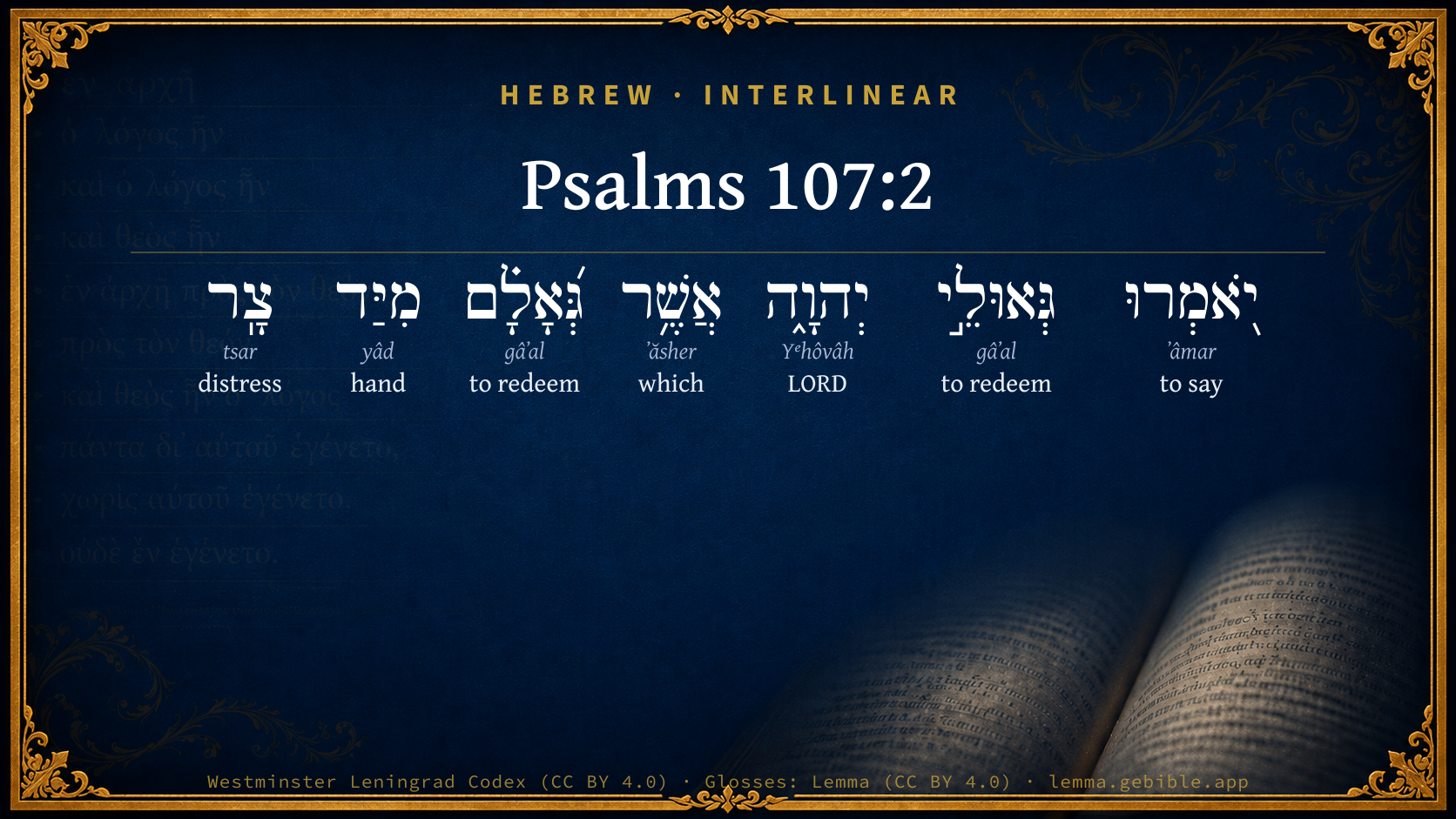
Hebrew (Westminster Leningrad Codex) Psalms 107:2 appears in the Hebrew Old Testament. The text above is from the Westminster Leningrad Codex. Each word links to its Strong’s number, a concise gloss, and parsing drawn from the Open Scriptures Hebrew Bible morphology. Click any word for its full Brown-Driver-Briggs (BDB) entry.
Download image
Cite this verse

Psalms 107:2 (World English Bible). Public Domain. Lemma interlinear Bible study tool, https://lemma.gebible.app/v/psalms/107/2.

Show BibTeX & RIS
BibTeX
RIS
English Translation
Let the redeemed by Yahweh say so, Whom he has redeemed from the hand of the adversary,
World English Bible · Public Domain
Download a study sheet

One document with this verse’s original text, its word-by-word gloss line, the meaning frame, cross-references with their text, attributed commentary, and full source and license credits — printable, and it pastes into notes with its structure intact.

This verse Autodidact and up

Study sheet (.html) Plain text (.txt)

A passage Seminary Student

Up to 50 verses in one chapter. A passage sheet keeps up to 6 commentary sources and 12 cross-references per verse, in the order this page ranks them, and says so on the sheet whenever that leaves anything out. Ask for a single verse and you get the Autodidact verse sheet above.

Everything on this page stays free to read, with no account — the sheet is a download of what is already on screen, not access to it.

Want to remove ads? Support Godless Engineer
Compare translations 3

The same verse in 3 English versions, stacked beneath the original-language interlinear above. Click any original word for its lexicon entry.

Each is an independent rendering of the whole verse — the interlinear is not word-aligned to these translations.

Highlighted words mark where these versions differ — a whole-verse word diff, not a word-by-word alignment.

  • World English Bible Public Domain
    Let the redeemed by Yahweh say so, Whom he has redeemed from the hand of the adversary,
  • King James Version Public Domain
    Let the redeemed of the LORD say so, whom he hath redeemed from the hand of the enemy;
  • unfoldingWord Literal Text CC BY-SA 4.0
    Let the redeemed of Yahweh say, who he rescued them from the hand of the opponent.

unfoldingWord Literal Text — © unfoldingWord, licensed CC BY-SA 4.0. Word-aligned USFM3 via Door43 (git.door43.org/unfoldingWord/en_ult).

Versions to compare (up to 4)

3 of 4 selected

Show all 18 translations

Every available English version of this verse, each an independent rendering of the whole verse.

  • World English Bible Public Domain
    Let the redeemed by Yahweh say so, Whom he has redeemed from the hand of the adversary,
  • Berean Standard Bible Public Domain
    Let the redeemed of the LORD say so, whom He has redeemed from the hand of the enemy
  • Majority Standard Bible Public Domain
    Let the redeemed of the LORD say so, whom He has redeemed from the hand of the enemy
  • King James Version Public Domain
    Let the redeemed of the LORD say so, whom he hath redeemed from the hand of the enemy;
  • American Standard Version (1901) Public Domain
    Let the redeemed of Jehovah say `so', Whom he hath redeemed from the hand of the adversary,
  • Revised Version (1885) Public Domain
    Let the redeemed of the LORD say so, whom he hath redeemed from the hand of the adversary;
  • Geneva Bible (1599) Public Domain
    Let them, which haue bene redeemed of the Lord, shewe how he hath deliuered them from the hand of the oppressour,
  • Douay-Rheims (1899) Public Domain
    Let them say so that have been redeemed by the Lord, whom he hath redeemed from the hand of the enemy: and gathered out of the countries.
  • Young's Literal Translation Public Domain
    Let the redeemed of Jehovah say, Whom He redeemed from the hand of an adversary.
  • Literal Standard Version CC BY-SA 4.0
    Let the redeemed of YHWH say [so], || Whom He redeemed from the hand of an adversary.
  • Unlocked Literal Bible CC BY-SA 4.0
    Let the redeemed of Yahweh speak out, those he has rescued from the hand of the enemy.
  • unfoldingWord Literal Text CC BY-SA 4.0
    Let the redeemed of Yahweh say, who he rescued them from the hand of the opponent.
  • Darby Bible Public Domain
    Let the redeemed of Jehovah say so, whom he hath redeemed from the hand of the oppressor,
  • World Messianic Bible Public Domain
    Let the redeemed by the LORD say so, whom he has redeemed from the hand of the adversary,
  • Webster's Bible Public Domain
    Let the redeemed of the LORD say so, whom he hath redeemed from the hand of the enemy;
  • Free Bible Version CC BY-SA 4.0
    Let those the Lord has saved say that they are saved; those he has rescued from the power of the enemy.
  • Bible in Basic English Public Domain
    Let those whose cause the Lord has taken up say so, his people whom he has taken out of the hands of their haters;
  • JPS Tanakh (1917) Public Domain
    So let the redeemed of the LORD say, whom He hath redeemed from the hand of the adversary;

Literal Standard Version (2020), Covenant Press — licensed CC BY-SA 4.0. Text via the HelloAO Bible API (eBible.org). Unlocked Literal Bible (unfoldingWord) — licensed CC BY-SA 4.0. Text via the HelloAO Bible API (eBible.org). unfoldingWord Literal Text — © unfoldingWord, licensed CC BY-SA 4.0. Word-aligned USFM3 via Door43 (git.door43.org/unfoldingWord/en_ult). Free Bible Version, Dr. Jonathan Gallagher — licensed CC BY-SA 4.0. Text via the HelloAO Bible API (eBible.org).

Word by word

More ways to search: Search by grammar → Find every occurrence → Compare this word →

Practice this passage: Drill this verse → Learn its vocabulary →

גְּאוּלֵ֣י
gâʼal
H1350
“redeemed”
Verb, Qal, Participle Passive, Masculine, Plural, Construct
Part of Speech
Verb
Stem
Qal
Form
Participle Passive
Gender
Masculine
Number
Plural
State
Construct
Full BDB Definition

Origin: a primitive root

TWOT: 300

to redeem, act as kinsman-redeemer, avenge, revenge, ransom, do the part of a kinsman - (Qal) - to act as kinsman, do the part of next of kin, act as kinsman-redeemer - by marrying brother's widow to beget a child for him, to redeem from slavery, to redeem land, to exact vengeance - to redeem (by payment) - to redeem (with God as subject) - individuals from death - Israel from Egyptian bondage - Israel from exile - (Niphal) - to redeem oneself - to be redeemed
  1. יֹ֭אמְרוּ ʼâmar H559 “to say” Verb, Qal, Imperfect, 3rd Person, Masculine, Plural
  2. יְהוָ֑ה Yᵉhôvâh H3068 “LORD” Noun, Proper
  3. אֲשֶׁ֥ר ʼăsher H834 “which” Particle, Relative
  4. גְּ֝אָלָ֗ם gâʼal H1350 “to redeem · them” Verb, Qal, Perfect, 3rd Person, Masculine, Singular + Suffix, Personal, 3rd Person, Masculine, Plural
  5. מִיַּד yâd H3027 “from · hand of” Preposition + Noun, Common, Both, Singular, Construct
  6. צָֽר tsar H6862 “distress” Noun, Common, Masculine, Singular, Absolute

About this verse

These counts appear in no published source. They are computed here, from the morphology-tagged text and Lemma’s own curated glosses. What Lemma adds →

7
words
6
distinct lemmas
Wisdom
section

Grammatical profile

  • 3 verbs
  • 3 nouns
  • 1 particle

Verb forms

  • יֹ֭אמְרוּ Qal · Imperfect
  • גְּאוּלֵ֣י Qal · Participle Passive
  • גְּ֝אָלָ֗ם Qal · Perfect

Repetition

A word recurs within this verse — often emphatic in Hebrew:

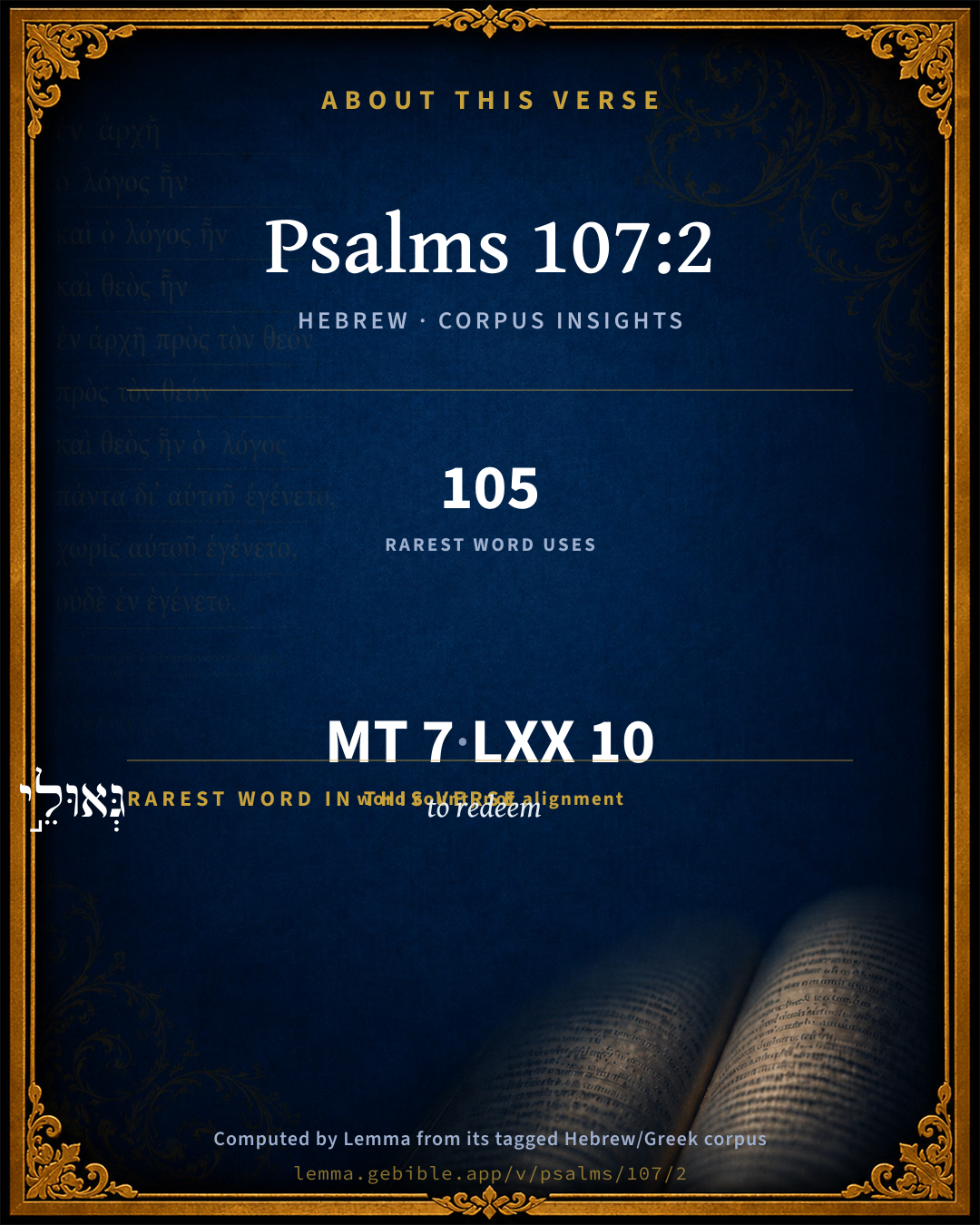
  • גְּאוּלֵ֣י to redeem H1350 ×2

Hebrew & Septuagint length

In English translation the verse runs 17 words from the Hebrew and 21 from the Septuagint (LXX English) — closely comparable.

A rough comparison of the two English renderings, which tokenize alike — not a word-level alignment.

Word counts can differ between the Hebrew and the Greek without any difference in meaning — e.g. the Hebrew direct-object marker אֵת has no separate Greek word, and Greek often adds the article ὁ.

In the original languages it is 7 Hebrew tokens and 10 Greek tokens — but the two are counted differently (Hebrew bundles its prefixes and suffixes into one token; the Greek is in lemma form), so that isn’t a like-for-like length.

Cross-references

20

Topical passages linked to Psalms 107:2 in the Treasury of Scripture Knowledge — connected by theme and wording, ordered by reader-vote popularity; previews shown in the World English Bible.

  • 1 Peter 1:18–19 knowing that you were redeemed, not with corruptible things, with silver or gold, from the useless way of life handed down from your fathers,
  • Luke 1:74 To grant to us that we, being delivered out of the hand of our enemies, should serve him without fear,
  • Galatians 3:13 Christ redeemed us from the curse of the law, having become a curse for us. For it is written, "Cursed is everyone who hangs on a tree,"
  • Psalms 31:5 Into your hand I commend my spirit. You redeem me, Yahweh, God of truth.
  • Psalms 106:10 He saved them from the hand of him who hated them, And redeemed them from the hand of the enemy.
  • Titus 2:14 who gave himself for us, that he might redeem us from all iniquity, and purify for himself a people for his own possession, zealous for good works.
  • Isaiah 44:22 I have blotted out, as a thick cloud, your transgressions, and, as a cloud, your sins: return to me; for I have redeemed you.
  • Isaiah 35:9 No lion shall be there, nor shall any ravenous animal go up thereon; they shall not be found there; but the redeemed shall walk [there]:
  • Isaiah 43:1 But now thus says Yahweh who created you, Jacob, and he who formed you, Israel: Don't be afraid, for I have redeemed you; I have called you by your name, you are mine.
  • Luke 1:68 "Blessed be the Lord, the God of Israel, For he has visited and worked redemption for his people;
  • Deuteronomy 7:8 but because Yahweh loves you, and because he would keep the oath which he swore to your fathers, has Yahweh brought you out with a mighty hand, and redeemed you out of the house of bondage, from the hand of Pharaoh king of Egypt.
  • Isaiah 62:12 They shall call them The holy people, The redeemed of Yahweh: and you shall be called Sought out, A city not forsaken.
  • Jeremiah 15:21 I will deliver you out of the hand of the wicked, and I will redeem you out of the hand of the terrible.
  • Jeremiah 31:11 For Yahweh has ransomed Jacob, and redeemed him from the hand of him who was stronger than he.
  • Exodus 15:16 Terror and dread falls on them. By the greatness of your arm they are as still as a stone; Until your people pass over, Yahweh, Until the people pass over who you have purchased.
  • Deuteronomy 15:15 You shall remember that you were a bondservant in the land of Egypt, and Yahweh your God redeemed you: therefore I command you this thing today.
  • Psalms 130:8 He will redeem Israel from all their sins.
  • Isaiah 63:4 For the day of vengeance was in my heart, and the year of my redeemed is come.
  • Luke 24:21 But we were hoping that it was he who would redeem Israel. Yes, and besides all this, it is now the third day since these things happened.
  • Micah 4:10 Be in pain, and labor to bring forth, daughter of Zion, Like a woman in travail; For now you will go forth out of the city, And will dwell in the field, And will come even to Babylon. There you will be rescued. There Yahweh will redeem you from the hand of your enemies.

Cross-references courtesy of OpenBible.info (CC BY 4.0).

Hebrew and Greek witnesses Masoretic Hebrew ↔ Greek Septuagint

The same verse in the two great witnesses to the Old Testament, shown verse-for-verse.

You’re reading Greek Psalm 106 (Hebrew Psalm 107). The Septuagint counts the superscription, so verse numbers can differ from the Hebrew — chapter-level alignment, not verse-by-verse. Numbering follows Rahlfs.

These are two independent witnesses, not word-aligned to each other, and the Septuagint is shown in lemma (dictionary) form.

Hebrew Psalms 107:2 Masoretic · Westminster Leningrad Codex

יֹ֭אמְרוּ גְּאוּלֵ֣י יְהוָ֑ה אֲשֶׁ֥ר גְּ֝אָלָ֗ם מִיַּד צָֽר

Let the redeemed by Yahweh say so, Whom he has redeemed from the hand of the adversary,

World English Bible · Public Domain

Greek LXX Greek Psalm 106:2 Septuagint · lemma form

εἶπον ὁ λυτρόω ὑπό κύριος ὅς λυτρόω ἐκ χείρ ἐχθρός

Let them say so who have been redeemed by the Lord, whom he has redeemed from the hand of the enemy;

LXX2012 (modern English Septuagint) · Public Domain

Hebrew: Westminster Leningrad Codex (CC BY 4.0). Greek: Septuagint (public domain); English from LXX2012 (modern English Septuagint) (Public Domain). How the Septuagint differs from the Hebrew →

Commentary

Notes on Psalms 107:2 from classic Christian and Jewish commentators (each source and its license shown beneath its notes). The classic Christian expositions comment on the surrounding passage and are grouped to its opening verse, so a note may address several verses; the Jewish commentaries on the Tanakh (Rashi and others) are per-verse, so they appear only where the commentator wrote on this verse.

Lemma curates 59 commentaries, every one of them public domain or Creative Commons licensed, each selected and text-cleaned for this edition rather than reprinted as found. About our sources →

Trapp's Complete Commentary

John Trapp

Psa 107:2 Let the redeemed of the LORD say [so], whom he hath redeemed from the hand of the enemy;

Ver. 2. Let the redeemed of the Lord] Four sorts of whom are afterwards instanced: 1. exiles; 2. prisoners; 3. sick persons; 4. seamen. These and the like must praise him in a special manner for their deliverance.

From the hand of the enemy] Or, of distress.

John Trapp, A Commentary or Exposition upon All the Books of the Old and New Testament (1647–1656) — public domain. Text from a community e-Sword module.

The Biblical Illustrator

Joseph S. Exell

Psa_107:2

Let the redeemed of the Lord say so.

Say so

An overture, an antiphon, a doxology is this psalm, and in my text the psalmist calls for an outspoken religion, and requests all who have been rescued and blessed no longer to hide the glorious facts, but to publish them, and, as far as possible, let all the world know about it. Let the redeemed of the Lord say so. If you have in your heart the pearl of great price, why not let others see it? If you got off the wreck in the breakers, why not tell of the crew and the stout lifeboat that safely landed you? If from the fourth storey you are rescued in time of conflagration, why not tell of the fireman and the ladder down which be carried you? If you have a mansion in heaven awaiting you, why not show the deed to those who may by the same process get a home on the same boulevard? By the last two words of my text the psalmist calls upon all of us who have received any mercy at the hand of God to stop impersonating the asylums for the dumb, and, in the presence of men, women, angels, devils, and all worlds, say so. What a thrill went through the meeting in Portland, Oregon, when an ex-Attorney-General of the United States arose and said: Last night I got up and asked the prayers of Gods people. I feel now perfectly satisfied. The burden is rolled off and all gone, and I feel that I could run or fly into the arms of Jesus Christ! What a confirmation would come if all who had answers to prayers would speak out! If all merchants in tight places because of hard times would tell how, in response to supplication, they got the money to pay the note! If all parents who prayed for a wandering son to come home would tell how, not long after, they heard the boys hand on the latch of the front door! This psalm from which I take my text mentions several classes of persons who ought to be outspoken; among them all those who go on a journey. What an opportunity you have, you who spend so much of your time on rail-trains or on shipboard, whether on lake or river or seal Spread the story of Gods goodness and your own redemption wherever you go. (T. De Witt Talmage.)

The duty of confessing indebtedness

A heart without gratitude is like a grate filled with fuel unlighted, and the room all the colder because of the unfulfilled promise of glow and warmth. A grateful heart is one in which the fire of holy love is kindled. Let those who have received favours and feel their obligation either to God or man, give some expression of it. The world is filled with illustrations of the propriety of such acknowledgments. You must have observed how in great campaigns it is customary for commanders to make honourable mention of those who have distinguished themselves by successful valour--not for the purpose of ministering to the soldiers pride or flattering his vanity, but for awarding him a tribute founded in justice and truth. It is right that the soldier who has stood upon the bloody front of battle and vindicated his valour and patriotism should receive the grateful acknowledgment of the country he has served. The leader of brave men is not content with thinking well of the prowess of those who have done nobly; he proclaims it as something due to those who have struggled and triumphed. In kind words from such a source there is both inspiration and reward. There was something pathetic in the appeal which a little boy made to his father, when he cried, I often do wrong, I know, and then you scold me and I deserve it; but, father, sometimes I do my best to do right! Wont you let me know when I do please you? Let the discriminating parent, pleased with the childs progress in any right direction--say so. So, too, there are parents who have to wait long for the recognition of their devotion to their children--a devotion which gathers into itself the prayers, the anguish, the sacrifices of body, soul, and spirit. An old Virginia minister said lately, Men of my profession see much of the tragic side of life. I have seen men die in battle, have seen children die, but no death ever seemed so pathetic to me as the death of an aged mother in my church. The children gathered around her bedside. The oldest son took her in his arms. He said, You have been a good mother to us. That was not much to say, was it? It was much to her, who had never heard anything like it. A flush came ever her pallid face, and with husky voice she whispered, My son, you never said so before! The text directs our thought and affection to what we owe to the very Father of mercies. His mercy endureth for ever. How illimitably broad is the field which is thus opened before us--the field of the Divine mercy! It is like the field of creation. In that field the telescope cannot pierce to depths of space where shining worlds do not declare the glory of God--nor can the microscope search out a point which is not still bright with evidences of His handiwork. The eye of sense looks out and everywhere goodness and mercy rise before it, until the horizon shuts down and bounds the vision. And then the eye of faith opens, and new fields, measureless and glorious, meet its gaze, until, in its turn, its powers fail. Yes, its powers fail, but the field has not failed; onward it stretches, illimitably, and over it the redeemed shall range with every new delight to all eternity. Gods mercy is from everlasting, and so the treasures of memory will ever be increasing; it is to everlasting, and so the anticipations of hope can never be diminished. (M. D. Hoge, D.D.)

Acknowledge the goodness of God

We need appreciation and the expression of it in our religious life. Let the redeemed of the Lord say so! Redemption and all implied in it is surely a gift that demands acknowledgment! If you were struggling in the grip of some mysterious or deadly disease, and after many disappointments at last you found a doctor who understood your case, conquered the disease, and set you in perfect health again, what would you do? You would blazon that doctors name abroad, you would tell everybody of his skill, you would speak of yourself as a living illustration of his healing power.

Redemption acknowledged

At the Isthmian Games, A.D. 197, Flaminius caused a trumpet to command silence and a crier to proclaim that the Roman Senate restored to the Grecians their lands, laws, and liberties. So astonished were the people that they asked the crier to repeat it. Then a shout arose that was heard from Corinth to the sea. (H. O. Mackey.)

The Biblical Illustrator, edited by Joseph S. Exell (c. 1880s–1900s) — public domain. Text from a community e-Sword module.

J. A. Alexander on Psalms

Joseph Addison Alexander

2. (Psa 107:2) (So) say the Redeemed of Jehovah, whom he has redeemed from the hand of distress (or of the enemy). What they are to say is not the exhortation in the first clause, but the reason for it in the last clause, of the foregoing verse. Let them acknowledge his unceasing mercy, who have just experienced so remarkable a proof of it. The ambiguous word should probably be taken in the same sense which it elsewhere has throughout this psalm. See below, Psa 107:6; Psa 107:13; Psa 107:19; Psa 107:28, and compare Psa 106:44. Indeed, the two senses may be reconciled by simply supposing the distress to be personified. Compare the unambiguous expression in Psa 106:10. The Redeemed of the Lord is a favourite expression of Isaiah (Isa 35:9-10; Isa 62:12; Isa 63:3).

Joseph Addison Alexander, The Psalms Translated and Explained (1850) — public domain. Text from a community e-Sword module.

Tyndale Open Study Notes

Tyndale Open Resources

107:2 The redeemed might be all who came out of exile.

Tyndale Open Study Notes — © Tyndale Open Resources, licensed CC BY-SA 4.0. Text via the HelloAO Bible API.

Geneva Bible (1599)

Geneva Bible translators

As this was true in the Jews, so there is none of God’s elect, that feel not his help in their necessity.

Geneva Bible (1599) marginal notes — public domain. Text via Bolls.life.

Adam Clarke's Commentary

Verse 2. Let the redeemed of the Lord say so] For they have had the fullest proof of this goodness, in being saved by the continuing stream of his mercy.

Adam Clarke's Commentary on the Bible (1810–1826) — public domain. Text from a community e-Sword/MySword module.

Ellicott's Commentary for English Readers

(2) Redeemed of the Lord.—See for this grand expression, for which so high a destiny was prepared, Isa_62:12; and comp. Isa_63:4; Isa_35:9.

A Bible Commentary for English Readers, edited by Charles John Ellicott (1878–1897) — public domain. Text from a community e-Sword module.

John Gill's Exposition

Let the redeemed of the Lord say so,.... That the Lord is good, and his mercy everlasting; since their redemption is a proof of his goodness, and an instance of his mercy; this is not to be understood of the Israelites redeemed from Egyptian bondage, or from the Babylonish captivity, though they had abundant reason to say as above; but rather of all such who are delivered from any sort of slavery, bondage, and confinement; whether from the power of a disease, or from a prison, or from wicked and unreasonable men; and from captivity in an enemy's country, where they have been used very severely; and as the providence of God is concerned in all such deliverances, thanks should be given him: it seems best to understand it of those who are spiritually redeemed by Christ, this phrase being frequently used of such, Isa 35:10, who may be said to be so, since Christ is the author of their redemption; they are redeemed, not by themselves, nor by any creature, but by the Lord; who being their God, and near kinsman, had a right to redeem them, and, being God, was able to do it, and who has effected it by his precious blood; so that he has a right unto them and a property in them, which this phrase also suggests; and for all which they have great reason to praise the Lord and his goodness, and sing the new song of redeeming love. Whom he hath redeemed from the hand of the enemy from all their sins which war against their souls; from Satan their implacable adversary, who is stronger than they; from the law, which curses and threatens them with damnation and death; from death itself, the last enemy, and indeed from the hand of all their enemies, be they who they may.

, who may be said to be so, since Christ is the author of their redemption; they are redeemed, not by themselves, nor by any creature, but by the Lord; who being their God, and near kinsman, had a right to redeem them, and, being God, was able to do it, and who has effected it by his precious blood; so that he has a right unto them and a property in them, which this phrase also suggests; and for all which they have great reason to praise the Lord and his goodness, and sing the new song of redeeming love. Whom he hath redeemed from the hand of the enemy from all their sins which war against their souls; from Satan their implacable adversary, who is stronger than they; from the law, which curses and threatens them with damnation and death; from death itself, the last enemy, and indeed from the hand of all their enemies, be they who they may.

Psalms 107:3

psa 107:3

psa 107:3

psa 107:3And gathered them out of the lands,.... This cannot have respect to the bringing of the children of Israel out of Egypt; for they were not then brought out of several countries, but from one land only: nor to the Babylonish captivity; for, though some might be gathered out of different provinces, yet not from east, west, north, and south, as here expressed. It best suits with the gathering of the redeemed in the effectual calling, and particularly the calling of the Gentiles in Gospel times; to which the title of the Syriac version before mentioned has respect. The elect of God are gathered in consequence of being redeemed, Zac 10:8, they are gathered out of the world, and from among the men of it; they are gathered to Christ, and by him; they are gathered into his churches, and to communion with them, and to a participation of all privileges and ordinances: and this is usually done by the ministering of the Gospel, which is sent into all the world for this purpose; and a distinguishing blessing of grace it is to be gathered out from the rest of the world, and favoured with such rich mercies. Such have reason to adore the grace of God, and to show forth his praise, who has called them by his grace, and separated them from others for himself.

From the east and from the west, and from the north and from the south; or, "from the sea" (f); the southern sea, as the Targum; or the Red sea, the Arabian or Persian sea. The elect of God, and redeemed of the Lord, lie in all parts of the world; and from thence they are gathered by the ministry of the word unto Christ: this was fulfilled in the first times of the Gospel, and will be more so in the latter day; see Isa 43:5.

(f) "et a mari", Pagninus, Montanus, Tigurine version, &c.

John Gill's Exposition of the Whole Bible (1746–1763) — public domain (CC PDM 1.0). Text via the HelloAO Bible API.

Albert Barnes' Notes on the Bible

Let the redeemed of the Lord say so - They are especially qualified to say so; they have special occasion to say so; they can and will appreciate this trait in his character. The word rendered “redeemed” here - from גאל gā'al - means “delivered, rescued,” without reference to any price paid for the deliverance. It refers here not to a ransom from “sin,” but to deliverance from “danger.” The probable allusion is to the deliverance from the captivity in Babylon. Compare the notes at Isa 43:3.

Whom he hath redeemed from the hand of the enemy - the power of the enemy. That is, He has saved them from their enemies, and has not suffered them to be destroyed by them. What is here said is true in the most eminent sense of those who are redeemed by the blood of the Son of God, and who are made heirs of salvation. Every consideration makes it proper that they should praise the Lord. Of all on earth, they have most occasion for such praise; of all among people, it may be presumed that they will be best qualified to appreciate the goodness of the Lord.

Albert Barnes' Notes on the Bible (1834–1885) — public domain. Text from a community e-Sword/MySword module.

Matthew Poole's English Annotations

The redeemed of the Lord; all they whom God hath redeemed, as it is expressed in the next clause, or delivered from all the following calamities.

Say so, to wit, that the Lord is good, &c., as it is Psa 107:1.

Of the enemy; of such as had taken them captives, either in battle, or in their travels, to which they were led by their own inclinations, or by their necessary occasions.

Matthew Poole's English Annotations on the Holy Bible (1683–1685) — public domain. Text from a community e-Sword/MySword module.

The Treasury of David

Charles H. Spurgeon

Ver. 2. Let the redeemed of the LORD say so. Whatever others may think or say, the redeemed have overwhelming reasons for declaring the goodness of the Lord. Theirs is a peculiar redemption, and for it they ought to render peculiar praise. The Redeemer is so glorious, the ransom price so immense, and the redemption so complete, that they are under sevenfold obligations to give thanks unto the Lord, and to exhort others to do so. Let them not only feel so but say so; let them both sing and bid their fellows sing.

Whom he hath redeemed from the hand of the enemy. Snatched by superior power away from fierce oppressions, they are bound above all men to adore the Lord, their Liberator. Theirs is a divine redemption, "he hath redeemed" them, and no one else has done it. His own unaided arm has wrought out their deliverance. Should not emancipated slaves be grateful to the hand which set them free? What gratitude can suffice for a deliverance from the power of sin, death, and hell? In heaven itself there is no sweeter hymn than that whose burden is, "Thou hast redeemed us unto God by thy blood."

Ver. 2. Redeemed. Moses has given us in the law a clear and full idea of what we are to understand by the word gal, here rendered "redeemed." If any person was either sold for a slave or carried away for a captive, then his kinsman, who was nearest to him in blood, had the right and equity of redemption. But no other person was suffered to redeem. And such a kinsman was called "the redeemer", when he paid down the price for which his relation was sold to be a slave, or paid the ransom for which he was led captive. And there is another remarkable instance in the law, wherein it was provided, that in any case any person was found murdered, then the nearest to him in blood was to prosecute the murderer, and to bring him to justice, and this nearest relation thus avenging the murder is called by the same name, a redeemer. And how beautifully is the office of our great Redeemer represented under these three instances; he was to us such a Redeemer in spirituals, as these were in temrporals: for sin had brought all mankind into slavery and captivity, and had murdered us ...This most high God, who was also man, united in one Christ, came into the world to redeem us, and the same person being both God and man, must merit for us as God in what he did for us as man. Accordingly, by the merits of his obedience and sufferings, he paid the price our redemption, and we were no longer the servants of sin; and by his most precious blood shed upon the cross, by his death and resurrection, he overcame both death, and him who had the power of death, and by delivering us in this manner from slavery and captivity, he fulfilled the third part of the Redeemer's office: for Satan was the murderer from the beginning, who had given both body and soul a mortal wound of sin, which was certain death and eternal misery, and the Redeemer came to avenge the murder. He took our cause in hand, as being our nearest kinsman, and it cost him his own life to avenge ours. William Romaine.

Ver. 2. From the hand of the enemy. From all their sins which war against their souls; from Satan their implacable adversary, who is stronger than they; from the law, which threatens and curses them with damnation and death; from death itself, the last enemy, and indeed from the hand of all their enemies, be they who they may. John Gill.

Psalms 107:3*

Charles H. Spurgeon's The Treasury of David (1869–1885) — public domain. Psalms only. Text from a community e-Sword/MySword module.

Whedon's Commentary on the Bible

Daniel D. Whedon

2. Let the redeemed—The call is specially to Israel, not to the nations.

Daniel D. Whedon (gen. ed.), Commentary on the Old and New Testaments (1874–1909) — public domain. Text from a community e-Sword module.

The Pulpit Commentary

Let the redeemed of the Lord say so. "The redeemed of the Lord" in this place are those whom the Lord has just delivered out of exile and captivity. (comp. Isa_44:22-24 Isa_51:11 Jer_31:11 Zec_10:8, etc.) The writer calls on them to give voice to the thanksgiving of ver. 1. Whom he hath redeemed from the hand of the enemy; i.e. of Babylon.

HOMILIES BY R. TUCK Ver. 2. The Lord"s people are a redeemed people.

"The ransomed of Jehovah" (Perowne). This has been well called "the psalm of life." While its figures are partly suggested by the history of Israel, it is a meditative rather than historical psalm. "It presents to us, first, a magnificent series of pictures of various crises of human life of the distress which throws men at such times on God in prayer, and of his gracious answer of deliverance; and next, a more thoughtful contemplation of God"s government of the world by blessing and chastisement, by exaltation of the meek and humiliation of the proud." It is evidently composed by one of the returned exiles, and represents the pious feeling of a man who is rejoicing in some new and wonderful redemption of God. In the light of the new experience he reads his own life, and the story of his race, and he can see that God has always been, in every sphere, the Redeemer, Deliverer, and Ransomer. God has a fourfold claim to be called the "Redeemer" of his people.

I GOD"S CLAIM ON THE GROUND OF THE GREAT REDEMPTION. That was the deliverance of Israel from the Egyptian bondage. Of it Israel was ever kept in mind by the Passover rite; by Divine revelations; by appeals of psalmist and prophet. It was a great redemption in view of

(1) the distress from which it delivered;

(2) the wisdom and power displayed in it;

(3) the issues to which it led.

Israel was bound to regard itself as a redeemed people, bound in allegiance to its Redeemer, who is to be served by thankful, loving obedience.

II GOD"S CLAIM ON THE GROUND OF THE MANY REDEMPTIONS.

1. These appear to view in the wilderness-journey, when again and again God delivered the people from their circumstances, their enemies, and themselves.

2. They appear to view in the period of the Judges, when God graciously responded to penitence and prayer, and raised up national deliverers.

3. They appear to view in the period of the prophets, when God held back again and again his threatened judgments. The true reading of each individual life shows the same ever delivering, rescuing, redeeming God.

III GOD"S CLAIM ON THE GROUND OF HIS LATEST REDEMPTION. That, to the psalmist, was the rescue from the Babylonish captivity. A wonderful restoration considered as to

(1) its time,

(2) unexpected manner,

(3) important issues,

(4) fulfillment of promises.

The feature of it that most pleased the psalmist was the gathering of the scattered Israelites, and the uniting of representatives from all the tribes to form the new nation.

IV GOD"S CLAIM ON THE GROUND OF HIS SPIRITUAL REDEMPTION. That which was wrought by the agency of the Lord Jesus Christ. The soul-redemption, of which all other redemptions could be only the foreshadowing and illustration. Jesus reveals God the Redeemer. R.T.

The Pulpit Commentary (1880–1919), ed. H.D.M. Spence-Jones & Joseph S. Exell — public domain. Text from a community e-Sword module.

Scofield Reference Notes

C. I. Scofield

redeemed

Heb. "goel," Redemp. (Kinsman type). (See Scofield "Isa 59:20").

The Scofield Reference Bible (1917 edition), notes by C. I. Scofield — public domain. Text from a community e-Sword module.

Rashi

Rabbi Shlomo Yitzchaki (Rashi)

Those redeemed by the Lord shall say it when He redeems them from the hands of an oppressor.

Rashi on the Tanakh — English translations: “The Judaica Press complete Tanach with Rashi, translated by A. J. Rosenberg” (CC BY 4.0); “Pentateuch with Rashi's commentary by M. Rosenbaum and A.M. Silbermann, 1929-1934” (public domain); “The Metsudah Tanach series, Lakewood, N.J” (CC BY 4.0); and “The Book of Joshua, Metsudah Publications, 1997” (CC BY 4.0). Text via Sefaria.

Lesson kit

Teaching starters — assembled from the data on this page, not authored interpretation. Every prompt links to the verse data it draws on. Edit before teaching.

Psalms, in the Wisdom, opens this verse with 7 words (6 distinct Hebrew lemmas). Its most distinctive word is gâʼal (“to redeem”). A historical commentator’s framing appears above. Read the whole chapter for the surrounding context.

Discussion questions

  1. The word gâʼal carries the sense “to redeem.” How does it shape the verse?
  2. 1 Peter 1:18–19 shares this passage’s theme. How do the two illuminate each other?
  3. “to redeem” occurs 2× in this one verse. What is the effect of the repetition?
  4. These translations render this verse differently; the difference is in the English rendering, not the original. What questions does that raise?
  5. The verb «יֹ֭אמְרוּ» is Qal Imperfect. How does its form color the action?
  6. Reading how Trapp's Complete Commentary and The Biblical Illustrator read this verse, where do the two commentators agree and where do they part?

Things to notice

Reading settings

Reading text

Shown beneath each verse's original-language words.

Old Testament
Old Testament edition

Read the OT as the Masoretic Hebrew (MT) or the Greek Septuagint (LXX).

English shown for the Greek Septuagint (in the Hebrew ↔ Greek comparison).

Comparing translations? Open the Compare panel on any verse page to stack up to four side by side.