
Job 6:23

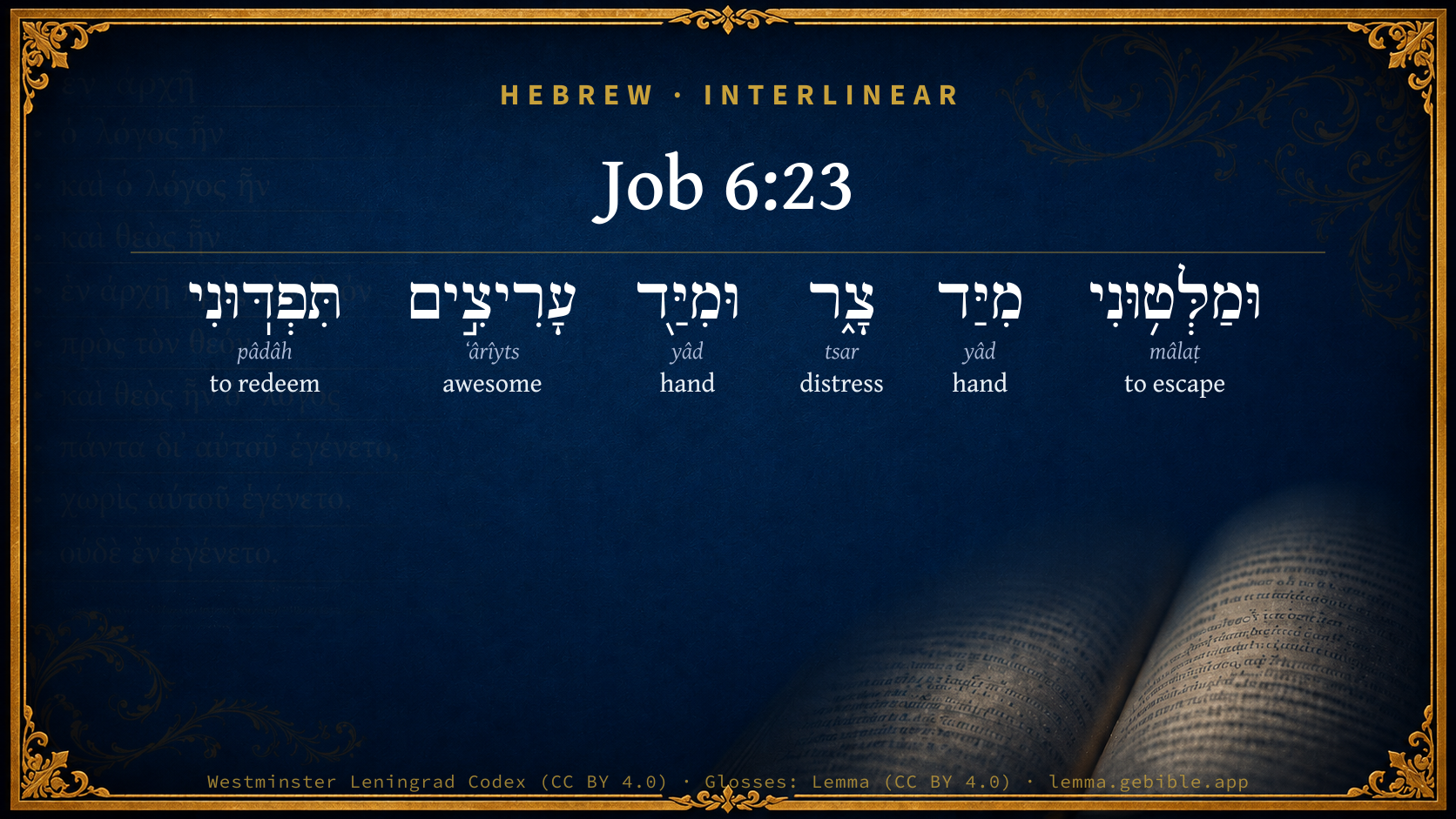
Hebrew (Westminster Leningrad Codex) Job 6:23 appears in the Hebrew Old Testament. The text above is from the Westminster Leningrad Codex. Each word links to its Strong’s number, a concise gloss, and parsing drawn from the Open Scriptures Hebrew Bible morphology. Click any word for its full Brown-Driver-Briggs (BDB) entry.
Download image
Cite this verse

Job 6:23 (World English Bible). Public Domain. Lemma interlinear Bible study tool, https://lemma.gebible.app/v/job/6/23.

Show BibTeX & RIS
BibTeX
RIS
English Translation
Or, 'Deliver me from the adversary's hand?' Or, 'Redeem me from the hand of the oppressors?'
World English Bible · Public Domain
Highlights
  • 1 first appearance in the Hebrew Bible
Full analysis ↓
Download a study sheet

One document with this verse’s original text, its word-by-word gloss line, the meaning frame, cross-references with their text, attributed commentary, and full source and license credits — printable, and it pastes into notes with its structure intact.

This verse Autodidact and up

Study sheet (.html) Plain text (.txt)

A passage Seminary Student

Up to 50 verses in one chapter. A passage sheet keeps up to 6 commentary sources and 12 cross-references per verse, in the order this page ranks them, and says so on the sheet whenever that leaves anything out. Ask for a single verse and you get the Autodidact verse sheet above.

Everything on this page stays free to read, with no account — the sheet is a download of what is already on screen, not access to it.

Want to remove ads? Support Godless Engineer
Compare translations 3

The same verse in 3 English versions, stacked beneath the original-language interlinear above. Click any original word for its lexicon entry.

Each is an independent rendering of the whole verse — the interlinear is not word-aligned to these translations.

Highlighted words mark where these versions differ — a whole-verse word diff, not a word-by-word alignment.

  • World English Bible Public Domain
    Or, 'Deliver me from the adversary's hand?' Or, 'Redeem me from the hand of the oppressors?'
  • King James Version Public Domain
    Or, Deliver me from the enemy's hand? or, Redeem me from the hand of the mighty?
  • unfoldingWord Literal Text CC BY-SA 4.0
    Or, ‘Save me from the hand of the enemy’? Or, ‘From the hand of the oppressors rescue me’?

unfoldingWord Literal Text — © unfoldingWord, licensed CC BY-SA 4.0. Word-aligned USFM3 via Door43 (git.door43.org/unfoldingWord/en_ult).

Versions to compare (up to 4)

3 of 4 selected

Show all 18 translations

Every available English version of this verse, each an independent rendering of the whole verse.

  • World English Bible Public Domain
    Or, 'Deliver me from the adversary's hand?' Or, 'Redeem me from the hand of the oppressors?'
  • Berean Standard Bible Public Domain
    deliver me from the hand of the enemy; redeem me from the grasp of the ruthless’?
  • Majority Standard Bible Public Domain
    deliver me from the hand of the enemy; redeem me from the grasp of the ruthless’?
  • King James Version Public Domain
    Or, Deliver me from the enemy's hand? or, Redeem me from the hand of the mighty?
  • American Standard Version (1901) Public Domain
    Or, Deliver me from the adversary's hand? Or, Redeem me from the hand of the oppressors?
  • Revised Version (1885) Public Domain
    Or, Deliver me from the adversary’s hand? or, Redeem me from the hand of the oppressors?
  • Geneva Bible (1599) Public Domain
    And deliuer me from the enemies hande, or ransome me out of the hand of tyrants?
  • Douay-Rheims (1899) Public Domain
    Or deliver me from the hand of the enemy, and rescue me out of the hand of the mighty?
  • Young's Literal Translation Public Domain
    And, Deliver me from the hand of an adversary? And, From the hand of terrible ones ransom me?
  • Literal Standard Version CC BY-SA 4.0
    And, Deliver me from the hand of an adversary? And, Ransom me from the hand of terrible ones?
  • Unlocked Literal Bible CC BY-SA 4.0
    Or, 'Save me from my adversary's hand?' Or, 'Ransom me from the hand of my oppressors?'
  • unfoldingWord Literal Text CC BY-SA 4.0
    Or, ‘Save me from the hand of the enemy’? Or, ‘From the hand of the oppressors rescue me’?
  • Darby Bible Public Domain
    Or, rescue me from the hand of the oppressor, and redeem me from the hand of the violent?
  • World Messianic Bible Public Domain
    or, ‘Deliver me from the adversary’s hand’? or, ‘Redeem me from the hand of the oppressors’?
  • Webster's Bible Public Domain
    Or, Deliver me from the enemy's hand? or, Redeem me from the hand of the mighty?
  • Free Bible Version CC BY-SA 4.0
    Have I asked you to rescue me from an enemy? Have I told you to save me from my oppressors?
  • Bible in Basic English Public Domain
    Or, Get me out of the power of my hater? or, Give money so that I may be free from the power of the cruel ones?
  • JPS Tanakh (1917) Public Domain
    or: 'Deliver me from the adversary's hand'? or: 'Redeem me from the hand of the oppressors'?

Literal Standard Version (2020), Covenant Press — licensed CC BY-SA 4.0. Text via the HelloAO Bible API (eBible.org). Unlocked Literal Bible (unfoldingWord) — licensed CC BY-SA 4.0. Text via the HelloAO Bible API (eBible.org). unfoldingWord Literal Text — © unfoldingWord, licensed CC BY-SA 4.0. Word-aligned USFM3 via Door43 (git.door43.org/unfoldingWord/en_ult). Free Bible Version, Dr. Jonathan Gallagher — licensed CC BY-SA 4.0. Text via the HelloAO Bible API (eBible.org).

Word by word

More ways to search: Search by grammar → Find every occurrence → Compare this word →

Practice this passage: Drill this verse → Learn its vocabulary →

About this verse

These counts appear in no published source. They are computed here, from the morphology-tagged text and Lemma’s own curated glosses. What Lemma adds →

6
words
5
distinct lemmas
Wisdom
section

Notable vocabulary

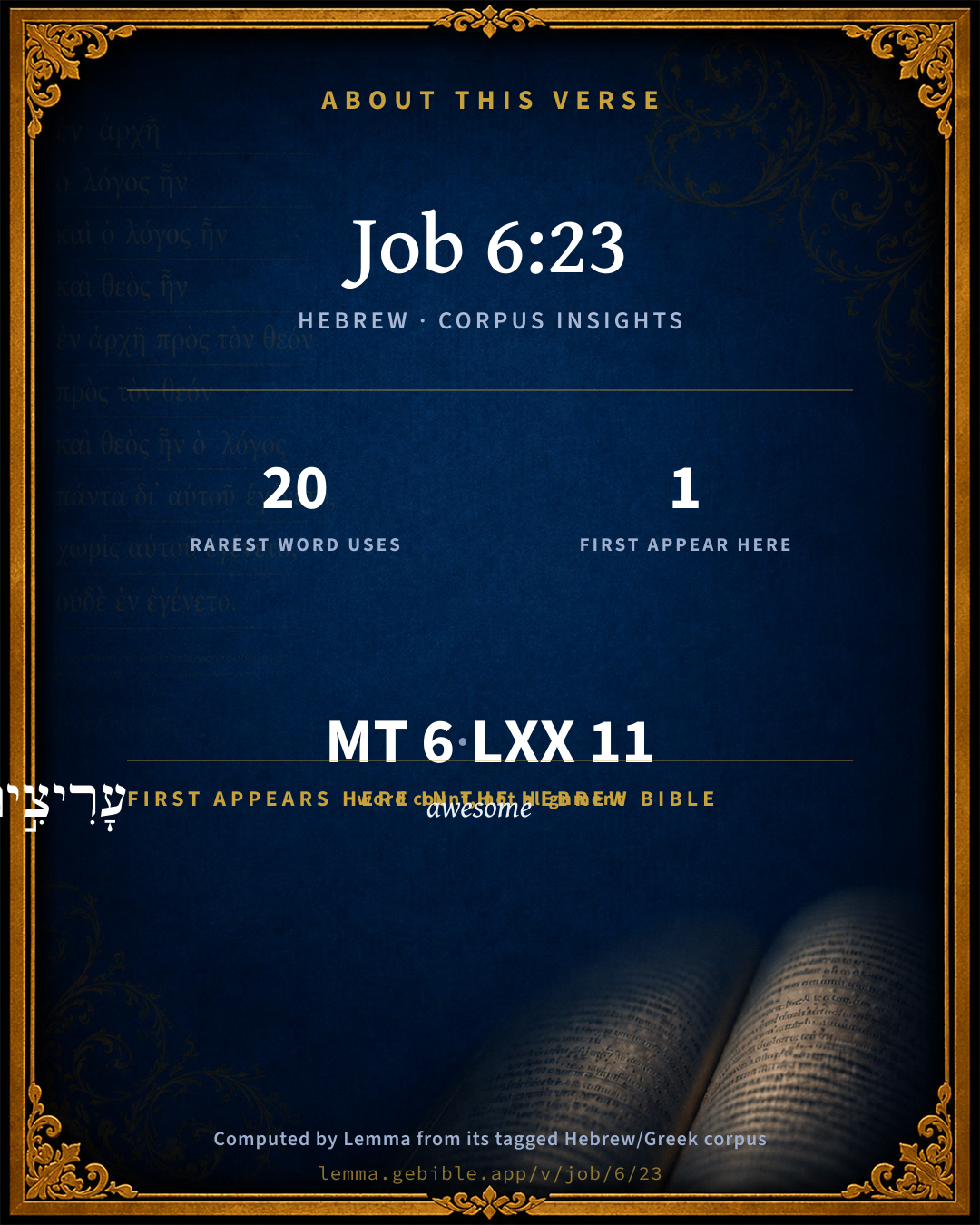
The rarest word here is עָרִיצִ֣ים awesome H6184 — appearing just 20 times in the whole Hebrew Bible.

First appearance in Scripture

This word makes its first canonical appearance in the Hebrew Bible here:

  • עָרִיצִ֣ים awesome H6184

Shared distinctive vocabulary

עָרִיצִ֣ים awesome H6184 occurs in 20 verses of the Hebrew Bible. Also found in:

Grammatical profile

  • 2 verbs
  • 3 nouns
  • 1 adjective

Verb forms

  • וּמַלְּט֥וּנִי Piel · Imperative
  • תִּפְדּֽוּנִי Qal · Imperfect

Repetition

A word recurs within this verse — often emphatic in Hebrew:

  • מִיַּד hand H3027 ×2

Hebrew & Septuagint length

In English translation the verse runs 16 words from the Hebrew and 16 from the Septuagint (LXX English) — the same length.

A rough comparison of the two English renderings, which tokenize alike — not a word-level alignment.

Word counts can differ between the Hebrew and the Greek without any difference in meaning — e.g. the Hebrew direct-object marker אֵת has no separate Greek word, and Greek often adds the article ὁ.

In the original languages it is 6 Hebrew tokens and 11 Greek tokens — but the two are counted differently (Hebrew bundles its prefixes and suffixes into one token; the Greek is in lemma form), so that isn’t a like-for-like length.

Cross-references

7

Topical passages linked to Job 6:23 in the Treasury of Scripture Knowledge — connected by theme and wording, ordered by reader-vote popularity; previews shown in the World English Bible.

  • Job 5:20 In famine he will redeem you from death; In war, from the power of the sword.
  • Psalms 49:7–8 None of them can by any means redeem his brother, Nor give God a ransom for him.
  • Psalms 49:15 But God will redeem my soul from the power of Sheol, For he will receive me. Selah.
  • Psalms 107:2 Let the redeemed by Yahweh say so, Whom he has redeemed from the hand of the adversary,
  • Jeremiah 15:21 I will deliver you out of the hand of the wicked, and I will redeem you out of the hand of the terrible.
  • Leviticus 25:48 after he is sold he may be redeemed. One of his brothers may redeem him;
  • Nehemiah 5:8 I said to them, We after our ability have redeemed our brothers the Jews, that were sold to the nations; and would you even sell your brothers, and should they be sold to us? Then held they their peace, and found never a word.

Cross-references courtesy of OpenBible.info (CC BY 4.0).

Hebrew and Greek witnesses Masoretic Hebrew ↔ Greek Septuagint

The same verse in the two great witnesses to the Old Testament, shown verse-for-verse.

These are two independent witnesses, not word-aligned to each other, and the Septuagint is shown in lemma (dictionary) form.

Hebrew Job 6:23 Masoretic · Westminster Leningrad Codex

וּמַלְּט֥וּנִי מִיַּד צָ֑ר וּמִיַּ֖ד עָרִיצִ֣ים תִּפְדּֽוּנִי

Or, 'Deliver me from the adversary's hand?' Or, 'Redeem me from the hand of the oppressors?'

World English Bible · Public Domain

Greek LXX Job 6:23 Septuagint · lemma form

ὥστε σώζω ἐγώ ἐκ ἐχθρός ἤ ἐκ χείρ δυνάστης ῥύομαι ἐγώ

to deliver me from enemies, or to rescue me from the hand of the mighty ones?

LXX2012 (modern English Septuagint) · Public Domain

Hebrew: Westminster Leningrad Codex (CC BY 4.0). Greek: Septuagint (public domain); English from LXX2012 (modern English Septuagint) (Public Domain). How the Septuagint differs from the Hebrew →

Commentary

Notes on Job 6:23 from classic Christian and Jewish commentators (each source and its license shown beneath its notes). The classic Christian expositions comment on the surrounding passage and are grouped to its opening verse, so a note may address several verses; the Jewish commentaries on the Tanakh (Rashi and others) are per-verse, so they appear only where the commentator wrote on this verse.

Lemma curates 59 commentaries, every one of them public domain or Creative Commons licensed, each selected and text-cleaned for this edition rather than reprinted as found. About our sources →

Trapp's Complete Commentary

John Trapp

Job 6:23 Or, Deliver me from the enemy’s hand? or, Redeem me from the hand of the mighty?

Ver. 23. Or, Deliver me from the enemy’s hand? &c.] Rescue me, ransom me from those that have robbed and wronged me; fetch back my lost goods by price or force. The word rendered mighty signifieth also formidable, terrible, breach makers. The word is opened by St Paul, Php 1:28; where he useth a metaphor from horses snorting (πτυρομενοι) and starting when frighted.

John Trapp, A Commentary or Exposition upon All the Books of the Old and New Testament (1647–1656) — public domain. Text from a community e-Sword module.

Jamieson, Fausset & Brown

Robert Jamieson, A. R. Fausset & David Brown

the mighty--the oppressor, or creditor, in whose power the debtor was [UMBREIT].

Jamieson, Fausset & Brown — Commentary Critical and Explanatory on the Whole Bible (1871) — public domain (CC PDM 1.0). Text via the HelloAO Bible API.

Adam Clarke's Commentary

Verse 23. Or, Deliver me] Did I send to you to come and avenge me of the destroyers of my property, or to rescue my substance out of the hands of my enemies?

Adam Clarke's Commentary on the Bible (1810–1826) — public domain. Text from a community e-Sword/MySword module.

The Cambridge Bible for Schools and Colleges

gen. ed. J. J. S. Perowne

23. hand of the mighty] that is, the powerful robber, who held his captives to ransom.

The Cambridge Bible for Schools and Colleges (gen. ed. J. J. S. Perowne; Cambridge University Press, 1878–1918) — public domain. Text from a community e-Sword module.

John Gill's Exposition

Teach me, and I will hold my tongue,.... Job having made his defence, and which he thought a sufficient one to acquit him of the charge against him; yet to show that he was not stubborn and flexible, but was open to conviction, and ready to attend and hearken to what might be further said, desires to be taught and instructed in the way of his duty; suggesting that, upon being convinced of his mistakes, he should ingenuously acknowledge them: good men are desirous of being taught both of God and men; they are not above instruction, or think themselves wiser than their teachers; they are willing to receive knowledge, not only from their superiors, but from their equals, and even from those that are inferior to them, as Job from his friends, though they had been unkind to him, and bore very hard upon him; and he promises that while they were speaking he would be silent, and not noisy, and clamorous, nor interrupt nor contradict them; but would patiently and attentively listen to what they said, and seriously consider it, and weigh it well in his mind; and, should he be convinced thereby, would no longer continue his complaints unto God, nor murmur at his providences; and would cease reflecting on them his friends, and no more charge them with deceit, perfidy, and unkindness; and by his silence would acknowledge his guilt, and not pertinaciously stand in an evil matter, but lay his hand on his mouth; hold his tongue, as our English phrase is, a Graecism (z); that is, be silent, as in Hebrew; and even take shame to himself, and in this way confess his iniquity, and do so no more:

and cause me to understand wherein I have erred; not that he allowed that he was in an error; for all that he says, both before and after, shows that he thought himself free from any; only, that whereas there was a possibility that he might be in one, he should be glad to have it pointed out; for he would not willingly and obstinately continue therein: error is common to human nature; the best of men are liable to mistakes; and those are so frequent and numerous, that many of them escape notice; "who can understand his errors?" Psa 19:12; wherefore wise and good men will esteem it a favour to have their errors pointed out to them, and their mistakes rectified; and it becomes men of capacity and ability to take some pains to do this, since he that converts one that has erred, whether in principle or practice, saves a soul from death, and covers a multitude of sins; Jam 5:19; Job is desirous, that if he had imbibed or uttered any error in principle, any thing unbecoming the Divine Being, contrary to his perfections, or to the holy religion which he professed, or was guilty of any in practice, in his conduct and behaviour, especially under the present providence, that it might be clearly made out unto him, and he should at once frankly and freely own it, retract and relinquish it.

(z) , Aelian. Var. Hist. l. 2. c. 2.

John Gill's Exposition of the Whole Bible (1746–1763) — public domain (CC PDM 1.0). Text via the HelloAO Bible API.

Albert Barnes' Notes on the Bible

Or, Deliver me out of the enemy’s hand? - At no time have I called on you to rescue me from a foe.

Or, Redeem me? - That is, rescue me from the hand of robbers. The meaning is, that he was in no way beholden to them; he had never called on them for assistance; and there was therefore no claim which they could now have to afflict him further by their reflections. There seems to be something peevish in these remarks; and we need not attempt to justify the spirit which dictated them.

Albert Barnes' Notes on the Bible (1834–1885) — public domain. Text from a community e-Sword/MySword module.

Matthew Poole's English Annotations

Deliver me by power and the force of your arms, as Abraham delivered Lot.

Redeem me by price, or ransom.

Matthew Poole's English Annotations on the Holy Bible (1683–1685) — public domain. Text from a community e-Sword/MySword module.

Whedon's Commentary on the Bible

Daniel D. Whedon

23. Or, Deliver me — He had not asked for alms to relieve his distress, nor for money for purposes of bribery, nor for help to pay his ransom from an enemy, nor that his friends should interpose against the mighty. He had asked absolutely nothing at their hands either before or since his crushing calamity. As he was under no obligations he had reason to expect better treatment.

Daniel D. Whedon (gen. ed.), Commentary on the Old and New Testaments (1874–1909) — public domain. Text from a community e-Sword module.

The Pulpit Commentary

Or, Deliver me from the enemy"s hand? rather, from the hand of the violent man. Or, Redeem me from the hand of the mighty? literally, of the oppressor (see the Revised Version). Job had not called on his friends to do any of these things. He had not worn out their patience by asking now for this, and now for that. But he had expected their compassion, and this was denied him.

The Pulpit Commentary (1880–1919), ed. H.D.M. Spence-Jones & Joseph S. Exell — public domain. Text from a community e-Sword module.

John Wesley's Explanatory Notes

Deliver - By the force of your arms, as Abraham delivered Lot. Redeem - By price or ransom.

John Wesley, Explanatory Notes Upon the Whole Bible (1754–1765) — public domain. Text via the GEBible commentary corpus.

Scofield Reference Notes

C. I. Scofield

redeem

See note; Exo 14:30; Isa 59:20. (See Scofield "Exo 14:30") See Scofield "Isa 59:20"

The Scofield Reference Bible (1917 edition), notes by C. I. Scofield — public domain. Text from a community e-Sword module.

Lesson kit

Teaching starters — assembled from the data on this page, not authored interpretation. Every prompt links to the verse data it draws on. Edit before teaching.

Job, in the Wisdom, opens this verse with 6 words (5 distinct Hebrew lemmas). Its most distinctive word is ʻârîyts (“awesome”). A historical commentator’s framing appears above. Read the whole chapter for the surrounding context.

Discussion questions

  1. How does “awesome” (ʻârîyts) shape what this verse is saying?
  2. The word “awesome” first appears here in Scripture. What is being introduced at this debut?
  3. Job 15:20 shares the word «awesome» with this verse. How do the two illuminate each other?
  4. “hand” occurs 2× in this one verse. What is the effect of the repetition?
  5. These translations render this verse differently. What is at stake in choosing one wording over another?
  6. The verb «וּמַלְּט֥וּנִי» is Piel Imperative. How does its form color the action?
  7. Reading how Trapp's Complete Commentary and Jamieson, Fausset & Brown read this verse, where do the two commentators agree and where do they part?

Things to notice

Reading settings

Reading text

Shown beneath each verse's original-language words.

Old Testament
Old Testament edition

Read the OT as the Masoretic Hebrew (MT) or the Greek Septuagint (LXX).

English shown for the Greek Septuagint (in the Hebrew ↔ Greek comparison).

Comparing translations? Open the Compare panel on any verse page to stack up to four side by side.