Isaiah 5:28

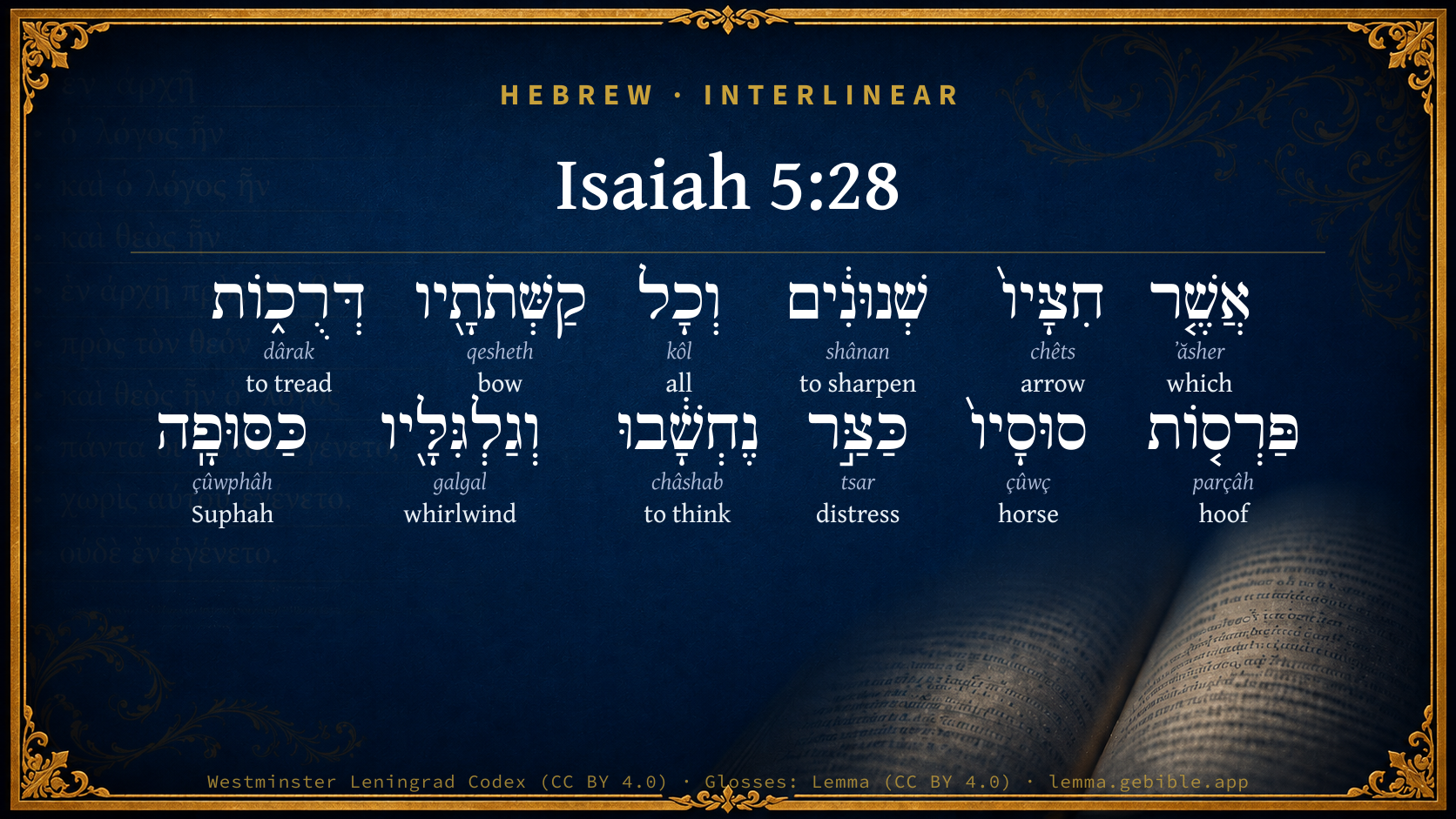
Hebrew (Westminster Leningrad Codex) Isaiah 5:28 appears in the Hebrew Old Testament. The text above is from the Westminster Leningrad Codex. Each word links to its Strong’s number, a concise gloss, and parsing drawn from the Open Scriptures Hebrew Bible morphology. Click any word for its full Brown-Driver-Briggs (BDB) entry.
Download image
Cite this verse

Isaiah 5:28 (World English Bible). Public Domain. Lemma interlinear Bible study tool, https://lemma.gebible.app/v/isaiah/5/28.

Show BibTeX & RIS
BibTeX
RIS
English Translation
Whose arrows are sharp, And all their bows bent. Their horses' hoofs will be like flint, And their wheels like a whirlwind.
World English Bible · Public Domain
Download a study sheet

One document with this verse’s original text, its word-by-word gloss line, the meaning frame, cross-references with their text, attributed commentary, and full source and license credits — printable, and it pastes into notes with its structure intact.

This verse Autodidact and up

Study sheet (.html) Plain text (.txt)

A passage Seminary Student

Up to 50 verses in one chapter. A passage sheet keeps up to 6 commentary sources and 12 cross-references per verse, in the order this page ranks them, and says so on the sheet whenever that leaves anything out. Ask for a single verse and you get the Autodidact verse sheet above.

Everything on this page stays free to read, with no account — the sheet is a download of what is already on screen, not access to it.

Want to remove ads? Support Godless Engineer
Compare translations 3

The same verse in 3 English versions, stacked beneath the original-language interlinear above. Click any original word for its lexicon entry.

Each is an independent rendering of the whole verse — the interlinear is not word-aligned to these translations.

Highlighted words mark where these versions differ — a whole-verse word diff, not a word-by-word alignment.

  • World English Bible Public Domain
    Whose arrows are sharp, And all their bows bent. Their horses' hoofs will be like flint, And their wheels like a whirlwind.
  • King James Version Public Domain
    Whose arrows are sharp, and all their bows bent, their horses' hoofs shall be counted like flint, and their wheels like a whirlwind:
  • unfoldingWord Literal Text CC BY-SA 4.0
    who, his arrows are sharpened and all of his bows have been trod. The hooves of its horses are reckoned like flint and its wheels, like a whirlwind.

unfoldingWord Literal Text — © unfoldingWord, licensed CC BY-SA 4.0. Word-aligned USFM3 via Door43 (git.door43.org/unfoldingWord/en_ult).

Versions to compare (up to 4)

3 of 4 selected

Show all 18 translations

Every available English version of this verse, each an independent rendering of the whole verse.

  • World English Bible Public Domain
    Whose arrows are sharp, And all their bows bent. Their horses' hoofs will be like flint, And their wheels like a whirlwind.
  • Berean Standard Bible Public Domain
    Their arrows are sharpened, and all their bows are strung. The hooves of their horses are like flint; their chariot wheels are like a whirlwind.
  • Majority Standard Bible Public Domain
    Their arrows are sharpened, and all their bows are strung. The hooves of their horses are like flint; their chariot wheels are like a whirlwind.
  • King James Version Public Domain
    Whose arrows are sharp, and all their bows bent, their horses' hoofs shall be counted like flint, and their wheels like a whirlwind:
  • American Standard Version (1901) Public Domain
    whose arrows are sharp, and all their bows bent; their horses' hoofs shall be accounted as flint, and their wheels as a whirlwind:
  • Revised Version (1885) Public Domain
    whose arrows are sharp, and all their bows bent; their horses’ hoofs shall be counted like flint, and their wheels like a whirlwind:
  • Geneva Bible (1599) Public Domain
    Whose arrowes shall be sharpe, and all his bowes bent: his horse hoofes shall be thought like flint, and his wheeles like a whirlewinde.
  • Douay-Rheims (1899) Public Domain
    Their arrows are sharp, and all their bows are bent. The hoofs of their horses shall be like the hint, and their wheels like the violence of a tempest.
  • Young's Literal Translation Public Domain
    Whose arrows `are' sharp, and all its bows bent, Hoofs of its horses as flint have been reckoned, And its wheels as a hurricane!
  • Literal Standard Version CC BY-SA 4.0
    Whose arrows [are] sharp, and all its bows bent, || Hooves of its horses have been reckoned as flint, || And its wheels as a windstorm!
  • Unlocked Literal Bible CC BY-SA 4.0
    Their arrows are sharp and all their bows are bent; their horses' hooves are like flint, and their chariot wheels like storms.
  • unfoldingWord Literal Text CC BY-SA 4.0
    who, his arrows are sharpened and all of his bows have been trod. The hooves of its horses are reckoned like flint and its wheels, like a whirlwind.
  • Darby Bible Public Domain
    their arrows are sharp, and all their bows bent; their horses' hoofs are reckoned as the flint, and their wheels as a whirlwind.
  • World Messianic Bible Public Domain
    whose arrows are sharp, and all their bows bent. Their horses’ hoofs will be like flint, and their wheels like a whirlwind.
  • Webster's Bible Public Domain
    Whose arrows are sharp, and all their bows bent, their horses' hoofs shall be counted like flint, and their wheels like a whirlwind:
  • Free Bible Version CC BY-SA 4.0
    Their arrows are already sharpened, and all their bows have been strung. The hooves of their horses are hard as flint; their chariot wheels spin like a whirlwind.
  • Bible in Basic English Public Domain
    Their arrows are sharp, and every bow is bent: the feet of their horses are like rock, and their wheels are like a rushing storm.
  • JPS Tanakh (1917) Public Domain
    Whose arrows are sharp, and all their bows bent; their horses' hoofs shall be counted like flint, and their wheels like a whirlwind;

Literal Standard Version (2020), Covenant Press — licensed CC BY-SA 4.0. Text via the HelloAO Bible API (eBible.org). Unlocked Literal Bible (unfoldingWord) — licensed CC BY-SA 4.0. Text via the HelloAO Bible API (eBible.org). unfoldingWord Literal Text — © unfoldingWord, licensed CC BY-SA 4.0. Word-aligned USFM3 via Door43 (git.door43.org/unfoldingWord/en_ult). Free Bible Version, Dr. Jonathan Gallagher — licensed CC BY-SA 4.0. Text via the HelloAO Bible API (eBible.org).

Word by word

More ways to search: Search by grammar → Find every occurrence → Compare this word →

Practice this passage: Drill this verse → Learn its vocabulary →

שְׁנוּנִ֔ים
shânan
H8150
“sharpened”
Verb, Qal, Participle Passive, Masculine, Plural, Absolute
Part of Speech
Verb
Stem
Qal
Form
Participle Passive
Gender
Masculine
Number
Plural
State
Absolute
Full BDB Definition

Origin: a primitive root

TWOT: 2422

to sharpen, whet - (Qal) to whet, sharpen - (Piel) to sharpen, teach (incisively) - (Hithpolel) to be pierced
  1. אֲשֶׁ֤ר ʼăsher H834 “which” Particle, Relative
  2. חִצָּיו֙ chêts H2671 “arrows · his” Noun, Common, Masculine, Plural, Construct + Suffix, Personal, 3rd Person, Masculine, Singular
  3. וְכָל kôl H3605 “and · all of” Conjunction + Noun, Common, Masculine, Singular, Construct
  4. קַשְּׁתֹתָ֖יו qesheth H7198 “bows · his” Noun, Common, Feminine, Plural, Construct + Suffix, Personal, 3rd Person, Masculine, Singular
  5. דְּרֻכ֑וֹת dârak H1869 “trodden” Verb, Qal, Participle Passive, Feminine, Plural, Absolute
  6. פַּרְס֤וֹת parçâh H6541 “hooves of” Noun, Common, Feminine, Plural, Construct
  7. סוּסָיו֙ çûwç H5483 “horses · his” Noun, Common, Masculine, Plural, Construct + Suffix, Personal, 3rd Person, Masculine, Singular
  8. כַּצַּ֣ר tsar H6862 “like/as the · distress” Preposition, Determined + Noun, Common, Masculine, Singular, Absolute
  9. נֶחְשָׁ֔בוּ châshab H2803 “to think” Verb, Niphal, Perfect, 3rd Person, Common, Plural
  10. וְגַלְגִּלָּ֖יו galgal H1534 “and · whirlwinds · his” Conjunction + Noun, Common, Masculine, Plural, Construct + Suffix, Personal, 3rd Person, Masculine, Singular
  11. כַּסּוּפָֽה çûwphâh H5492 “like/as the · Suphah” Preposition, Determined + Noun, Common, Feminine, Singular, Absolute

About this verse

These counts appear in no published source. They are computed here, from the morphology-tagged text and Lemma’s own curated glosses. What Lemma adds →

12
words
12
distinct lemmas
Prophets
section

Notable vocabulary

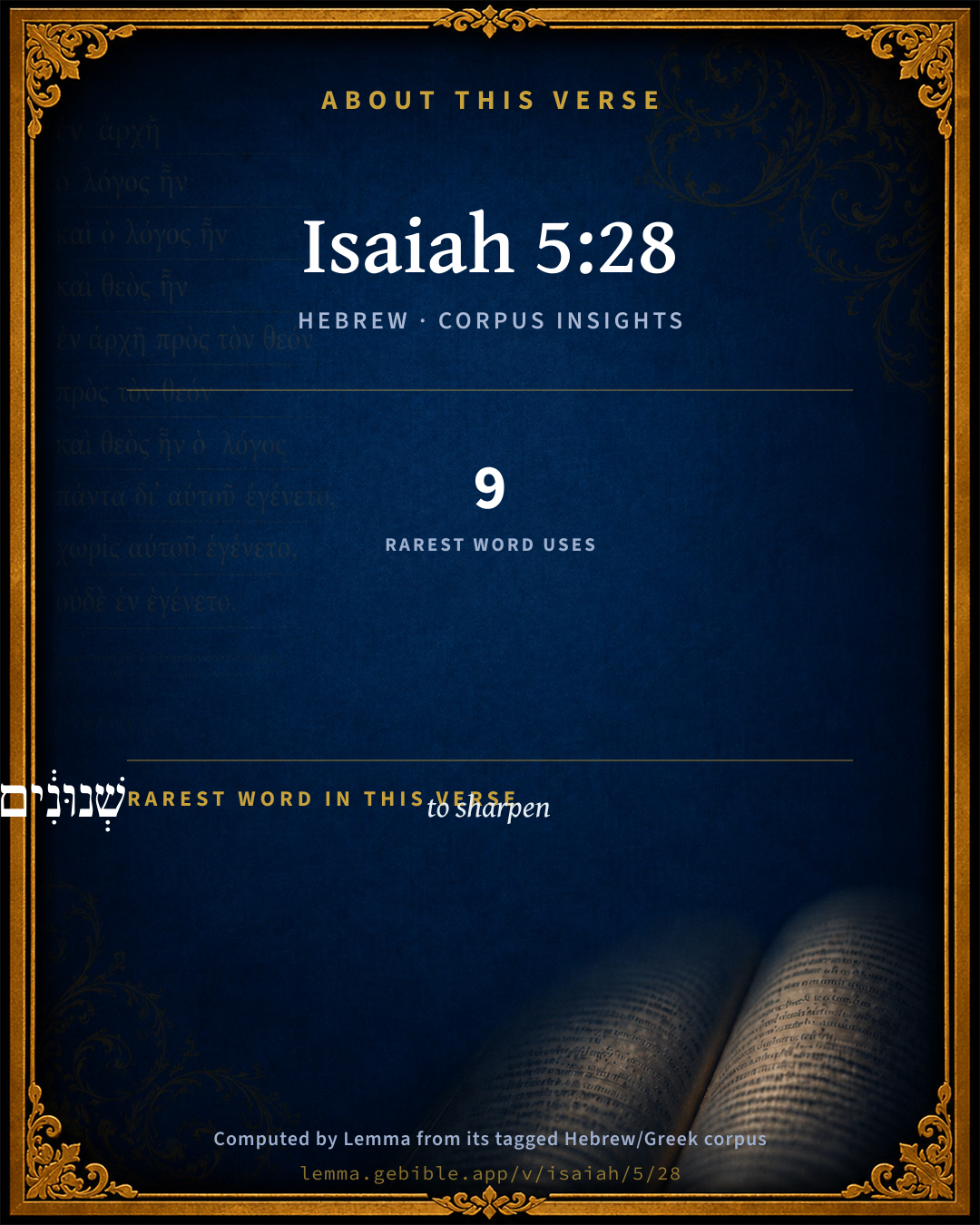
The rarest word here is שְׁנוּנִ֔ים to sharpen H8150 — appearing just 9 times in the whole Hebrew Bible.

Shared distinctive vocabulary

שְׁנוּנִ֔ים to sharpen H8150 occurs in 9 verses of the Hebrew Bible. Also found in:

Grammatical profile

  • 3 verbs
  • 8 nouns
  • 1 particle

Verb forms

  • שְׁנוּנִ֔ים Qal · Participle Passive
  • דְּרֻכ֑וֹת Qal · Participle Passive
  • נֶחְשָׁ֔בוּ Niphal · Perfect

Hebrew & Septuagint length

In English translation the verse runs 22 words from the Hebrew and 22 from the Septuagint (LXX English) — the same length.

A rough comparison of the two English renderings, which tokenize alike — not a word-level alignment.

Word counts can differ between the Hebrew and the Greek without any difference in meaning — e.g. the Hebrew direct-object marker אֵת has no separate Greek word, and Greek often adds the article ὁ.

Cross-references

11

Topical passages linked to Isaiah 5:28 in the Treasury of Scripture Knowledge — connected by theme and wording, ordered by reader-vote popularity; previews shown in the World English Bible.

  • Psalms 45:5 Your arrows are sharp. The nations fall under you, with arrows in the heart of the king's enemies.
  • Ezekiel 21:9–11 Son of man, prophesy, and say, Thus says Yahweh: Say, A sword, a sword, it is sharpened, and also furbished;
  • Nahum 2:3–4 The shield of his mighty men is made red. The valiant men are in scarlet. The chariots flash with steel in the day of his preparation, and the pine spears are brandished.
  • Judges 5:22 Then did the horse hoofs stamp By reason of the prancings, the prancings of their strong ones.
  • Psalms 7:12–13 If a man doesn't relent, he will sharpen his sword; He has bent and strung his bow.
  • Psalms 120:4 Sharp arrows of the mighty, With coals of juniper.
  • Isaiah 21:1 The burden of the wilderness of the sea. As whirlwinds in the South sweep through, it comes from the wilderness, from an awesome land.
  • Jeremiah 5:16 Their quiver is an open tomb, they are all mighty men.
  • Jeremiah 47:3 At the noise of the stamping of the hoofs of his strong ones, at the rushing of his chariots, at the rumbling of his wheels, the fathers don't look back to their children for feebleness of hands;
  • Micah 4:13 Arise and thresh, daughter of Zion; For I will make your horn iron, And I will make your hoofs brass; And you will beat in pieces many peoples: And I will devote their gain to Yahweh, And their substance to the Lord of the whole earth.
  • Nahum 3:2 The noise of the whip, the noise of the rattling of wheels, prancing horses, and bounding chariots,

Cross-references courtesy of OpenBible.info (CC BY 4.0).

Hebrew and Greek witnesses Masoretic Hebrew ↔ Greek Septuagint

The same verse in the two great witnesses to the Old Testament, shown verse-for-verse.

These are two independent witnesses, not word-aligned to each other, and the Septuagint is shown in lemma (dictionary) form.

Hebrew Isaiah 5:28 Masoretic · Westminster Leningrad Codex

אֲשֶׁ֤ר חִצָּיו֙ שְׁנוּנִ֔ים וְכָל קַשְּׁתֹתָ֖יו דְּרֻכ֑וֹת פַּרְס֤וֹת סוּסָיו֙ כַּצַּ֣ר נֶחְשָׁ֔בוּ וְגַלְגִּלָּ֖יו כַּסּוּפָֽה

Whose arrows are sharp, And all their bows bent. Their horses' hoofs will be like flint, And their wheels like a whirlwind.

World English Bible · Public Domain

Greek LXX Isaiah 5:28 Septuagint · lemma form

ὅς ὁ βέλος ὀξύς εἰμί καί ὁ τόξον αὐτός ἐντείνω ὁ πούς ὁ ἵππος αὐτός ὡς στερεός πέτρα λογίζομαι ὁ τροχός ὁ ἅρμα αὐτός ὡς καταιγίς

Whose arrows are sharp, and their bows bent; their horses' hoofs are counted as solid rock: their chariot-wheels are as a storm.

LXX2012 (modern English Septuagint) · Public Domain

On this verse, John Gill's Exposition discusses the Septuagint’s reading. Read the note in Commentary ↓

Hebrew: Westminster Leningrad Codex (CC BY 4.0). Greek: Septuagint (public domain); English from LXX2012 (modern English Septuagint) (Public Domain). How the Septuagint differs from the Hebrew →

Targum (Aramaic paraphrase)

1

The Targum is the ancient Jewish Aramaic paraphrase of the Hebrew Scriptures — an interpretive translation, not the Hebrew text itself. Onkelos (literal) and Pseudo-Jonathan (expansive) render the Torah, and Jonathan the Prophets. Coverage is partial: where no permissively-licensed English translation exists for a verse, only the Aramaic is shown. This is verse-level text, not a word-by-word alignment to the Hebrew.

  1. Targum Jonathan Prophets (Joshua–Malachi)
    דִי גִירוֹהִי מְחַרְפִין וְכָל קַשְׁתָּתֵיהּ מְתִיחָן פַּרְסַת סוּסְוָתֵיהּ כְּטָנָרָא תַקִיפִין וְגַלְגְלוֹהִי קַלִילִין הָא כְעַלְעוֹלָא:

    Whose arrows are sharp, and their bows bent, their horses' hoofs strong like flint, and their wheels swift, behold, like a whirlwind.

    Targum Jonathan — Aramaic: “Mikraot Gedolot” (public domain). English: “Sefaria Community Translation” (CC0 1.0 (public-domain dedication)); “London "Chaldee Paraphrase," 1871” (public domain). Text via Sefaria.

Commentary

Notes on Isaiah 5:28 from classic Christian and Jewish commentators (each source and its license shown beneath its notes). The classic Christian expositions comment on the surrounding passage and are grouped to its opening verse, so a note may address several verses; the Jewish commentaries on the Tanakh (Rashi and others) are per-verse, so they appear only where the commentator wrote on this verse.

Lemma curates 59 commentaries, every one of them public domain or Creative Commons licensed, each selected and text-cleaned for this edition rather than reprinted as found. About our sources →

Trapp's Complete Commentary

John Trapp

Isa 5:28 Whose arrows [are] sharp, and all their bows bent, their horses’ hoofs shall be counted like flint, and their wheels like a whirlwind:

Ver. 28. Whose arrows are sharp.] Or, Sharpened, sc., to wound the deeper.

Their horses’ hoofs.] Judea was a stony country; but hard to hard will not easily break.

John Trapp, A Commentary or Exposition upon All the Books of the Old and New Testament (1647–1656) — public domain. Text from a community e-Sword module.

Jamieson, Fausset & Brown

Robert Jamieson, A. R. Fausset & David Brown

bent--ready for battle.

hoofs . . . flint--The ancients did not shoe their horses: hence the value of hard hoofs for long marches.

wheels--of their chariots. The Assyrian army abounded in cavalry and chariots (Isa 22:6-7; Isa 36:8).

Jamieson, Fausset & Brown — Commentary Critical and Explanatory on the Whole Bible (1871) — public domain (CC PDM 1.0). Text via the HelloAO Bible API.

Adam Clarke's Commentary

Verse 28. Their horses' hoofs shall be counted like flint - "The hoofs of their horses shall be counted as adamant"] The shoeing of horses with iron plates nailed to the hoof is quite a modern practice, and was unknown to the ancients, as appears from the silence of the Greek and Roman writers, especially those that treat of horse medicine, who could not have passed over a matter so obvious and of such importance that now the whole science takes its name from it, being called by us farriery. The horseshoes of leather and iron which are mentioned; the silver and gold shoes with which Nero and Poppaea shod their mules, used occasionally to preserve the hoofs of delicate cattle, or for vanity, were of a very different kind; they enclosed the whole hoof as in a case, or as a shoe does a man's foot, and were bound or tied on. For this reason the strength, firmness and solidity of a horse's hoof was of much greater importance with them than with us, and was esteemed one of the first praises of a fine horse. Xenophon says that a good horse's hoof is hard, hollow, and sounds upon the ground like a cymbal. Hence the χαλκοποδες ιπποι, of Homer, and Virgil's solido graviter sonat ungula cornu. And Xenophon gives directions for hardening the horses' hoofs by making the pavement on which he stands in the stable with roundheaded stones. For want of this artificial defence to the foot which our horses have, Amos, Am 6:12, speaks of it as a thing as much impracticable to make horses run upon a hard rock as to plough up the same rock with oxen: -

"Shall horses run upon a rock?

Shall one plough it up with oxen?"

These circumstances must be taken into consideration in order to give us a full notion of the propriety and force of the image by which the prophet sets forth the strength and excellence of the Babylonish cavalry, which made a great part of the strength of the Assyrian army. Xenop. Cyrop. lib. ii.

Like a whirlwind] כסופה cassuphah, like the stormy blast. Here sense and sound are well connected.

Adam Clarke's Commentary on the Bible (1810–1826) — public domain. Text from a community e-Sword/MySword module.

The Cambridge Bible for Schools and Colleges

gen. ed. J. J. S. Perowne

28. bows bent] which was done only for immediate action. his horses’ hoofs … flint] Therefore he will not shrink from riding them on the rocky soil of Palestine, which was extremely unfavourable to the use of horses (Amo_6:12). Similar allusions are frequent in ancient literature (κρατερώνυχες ἵπποι) the shoeing of horses being unknown in antiquity. The bows and arrows, cavalry and chariots, are all characteristic of the Assyrians.

The Cambridge Bible for Schools and Colleges (gen. ed. J. J. S. Perowne; Cambridge University Press, 1878–1918) — public domain. Text from a community e-Sword module.

John Gill's Exposition

Whose arrows are sharp, and all their bows bent,.... Ready to shoot their arrows upon any occasion; and which being sharp, penetrated deep, and were deadly. This includes all kind of warlike instruments, with which they should come furnished, and ready prepared to do execution:

their horses' hoofs shall be counted like flint; by those who rode upon them; who knowing how strong and firm they were, and that they were not worn out, nor hurt by the length of the way they came, would not spare to make haste upon them:

and their wheels like a whirlwind; that is, the wheels of their chariots, they used in battle, as Aben Ezra, Jarchi, and Kimchi, interpret it; and so the Septuagint and Arabic versions render it: this metaphor denotes both the swiftness with which they should come, and the noise and rattling they should make, and the power and force in bearing down all before them. The Targum is,

"and his wheels swift as a tempest.''

John Gill's Exposition of the Whole Bible (1746–1763) — public domain (CC PDM 1.0). Text via the HelloAO Bible API.

Albert Barnes' Notes on the Bible

Whose arrows are sharp - Bows and arrows were the common instruments of fighting at a distance. Arrows were, of course, made sharp, and usually pointed with iron, for the purpose of penetrating the shields or coats of mail which were used to guard against them.

And all their bows bent - All ready for battle.

Their horses’ hoofs shall be counted like flint - It is supposed that the ancients did not usually shoe their horses. Hence, a hard, solid hoof would add greatly to the value of a horse. The prophet here means, that their horses would be prepared for any fatigue, or any expedition; see a full description of horses and chariots in Bochart’s “Hieroz.” P. i. lib. ii. ch. viii. ix.

And their wheels like a whirlwind - That is, the wheels of their chariots shall be swift as the wind, and they shall raise a cloud of dust like a whirlwind. This comparison was very common, as it is now; see “Bochart.” See, also, a magnificent description of a war-horse in Job 39:19-25.

Albert Barnes' Notes on the Bible (1834–1885) — public domain. Text from a community e-Sword/MySword module.

Haydock's Catholic Bible Commentary

Hoofs. They were hardened, but not shod. (Xenophon) (Amos vi. 13.)

George Leo Haydock (1774–1849), Haydock's Catholic Family Bible and Commentary, 1859 edition — public domain. Excludes Psalms (Douay-Rheims chapter numbering differs from Protestant) and Deuterocanonical books (Catholic canon only).

Matthew Poole's English Annotations

Whose arrows are sharp, and all their bows bent; who are every way furnished and ready for my work, waiting only for my command.

Their horses’ hoofs shall be counted like flint, because they shall not be broken or battered by the length or stoutness and ruggedness of the way.

Their wheels like a whirlwind; partly for the swiftness of their march, and partly for the force and violence of their chariots in battle.

Matthew Poole's English Annotations on the Holy Bible (1683–1685) — public domain. Text from a community e-Sword/MySword module.

The Pulpit Commentary

Whose arrows are sharp, and all their bows bent. The special weapon of the Assyrian soldiers is the bow. From the king in his chariot to the light-armed recruit just pressed into the service, all fight mainly with this weapon, more particularly in the earlier times (see "Ancient Monarchies," vol. 1. pp. 414, 423, 424-437, etc.). Swords and spears are also known, but comparatively little used. Their horses" hoofs... like flint. Hard, strong, and solid, as was most necessary when shoeing was unknown. Their wheels like a whirlwind. Sennacherib (Isa_37:24) is represented as boasting of the "multitude of his chariots;" and both the sculptures and the inscriptions of Assyria show that the chariot throe was numerous, and was regarded as more important than any other. The king always went to battle in a chariot. For the comparison of the rush of chariot-wheels to a whirlwind. (see below, Isa_66:15; and comp. Jer_4:13)

The Pulpit Commentary (1880–1919), ed. H.D.M. Spence-Jones & Joseph S. Exell — public domain. Text from a community e-Sword module.

John Wesley's Explanatory Notes

Bent - Who are every way furnished and ready for my work, waiting only for my command. Flint - Because they shall not be broken or battered by the length or stonyness and ruggedness of the way. Whirlwind - For the swiftness of their march, and for the force and violence of their chariots in battle.

John Wesley, Explanatory Notes Upon the Whole Bible (1754–1765) — public domain. Text via the GEBible commentary corpus.

Keil & Delitzsch

C. F. Keil & F. Delitzsch

The prophet then proceeds to describe their weapons and war-chariots. "He whose arrows are sharpened, and all his bows strung; the hoofs of his horses are counted like flint, and his wheels like the whirlwind." In the prophet's view they are coming nearer and nearer. For he sees that they have brought the sharpened arrows in their quivers (Isa 22:6); and the fact that all their bows are already trodden (namely, as their length was equal to a man's height, by treading upon the string with the left foot, as we may learn from Arrian's Indica), proves that they are near to the goal. The correct reading in Jablonsky (according to Kimchi's Lex. cf., Michlal yofi) is קשּׁתתיו with dagesh dirimens, as in Psa 37:15 (Ges. 20, 2, b). As the custom of shoeing horses was not practised in ancient times, firm hoofs (ὃπλαι καρτεραί, according to Xenophon's Hippikos) were one of the most important points in a good horse. And the horses of the enemy that was now drawing near to Judah had hoofs that would be found like flint (tzar, only used here, equivalent to the Arabic zirr). Homer designates such horses Chalkopodes, brazen-footed. And the two wheels of the war-chariots, to which they were harnessed, turned with such velocity, and overthrew everything before them with such violence, that it seemed not merely as if a whirlwind drove them forward, but as if they were the whirlwind itself (Isa 66:15; Jer 4:13). Nahum compares them to lightning (Isa 2:5). Thus far the prophet's description has moved on, as if by forced marches, in clauses of from two to four words each. It now changes into a heavy, stealthy pace, and then in a few clauses springs like a wild beast upon its prey.

Keil & Delitzsch — Biblical Commentary on the Old Testament (1861–1891) — public domain (CC PDM 1.0). Text via the HelloAO Bible API. (Old Testament only.)

J. A. Alexander on Isaiah

Joseph Addison Alexander

The description is continued, but with special reference to their weapons and their means of conveyance. For the former, bows and arrows are here put; and for the latter, horses and chariots (see Isa 2:7). “Whose arrows are sharpened and all his bows bent (literally trod upon); the hoofs of his horses like flint (or adamant) are reckoned, and his wheels like a whirlwind,” in rapidity and violence of motion. From what is said of the bows immediately afterwards, the prominent idea would seem to be not that the arrows were sharp, but that they were already sharpened, implying present readiness for use. The bows being trod upon has reference to the ancient mode of stringing, or rather of shooting, the bow being large and made of metal or hard wood. Arrian says expressly, in describing the use of the bow by the Indian infantry, "placing it on the ground, and stepping on it with the left foot, so they shoot, drawing the string back to a great distance."

Joseph Addison Alexander, The Prophecies of Isaiah (1846–1847; New York: Scribner, 1870–1878) — public domain. Text from a community e-Sword module.

Rashi

Rabbi Shlomo Yitzchaki (Rashi)

like flint Jonathan renders: like a rock, similar to צור.

and his wheels the wheels of his chariots.

Rashi on the Tanakh — English translations: “The Judaica Press complete Tanach with Rashi, translated by A. J. Rosenberg” (CC BY 4.0); “Pentateuch with Rashi's commentary by M. Rosenbaum and A.M. Silbermann, 1929-1934” (public domain); “The Metsudah Tanach series, Lakewood, N.J” (CC BY 4.0); and “The Book of Joshua, Metsudah Publications, 1997” (CC BY 4.0). Text via Sefaria.

Ibn Ezra

Rabbi Abraham ibn Ezra

כצר Like flint; comp. צורים flint (Jos. 5:3); the form of the noun varies.

וגלגליו The wheels of his chariots; they are known. סופה ═ כסופה כמוץ. As the chaff of the storm. They will come as quickly as the chaff driven by the storm.

Ibn Ezra on the Tanakh — English translations: “Sefaria Community Translation” (CC0 1.0 (public-domain dedication)); “Yalkut, Sifsei Chachomim Chumash, Metsudah Publications, 2009” (CC BY 4.0); and “Commentary of Ibn Ezra on Isaiah - trans. by M. Friedlander, 1873” (public domain). Text via Sefaria.

Lesson kit

Teaching starters — assembled from the data on this page, not authored interpretation. Every prompt links to the verse data it draws on. Edit before teaching.

Isaiah, in the Prophets, opens this verse with 12 words (12 distinct Hebrew lemmas). Its most distinctive word is shânan (“to sharpen”). A historical commentator’s framing appears above. Read the whole chapter for the surrounding context.

Discussion questions

  1. What does “to sharpen” (shânan) contribute to the verse as a whole?
  2. Deuteronomy 6:7 shares the word «to sharpen» with this verse. How do the two illuminate each other?
  3. These translations render this verse differently. What is at stake in choosing one wording over another?
  4. The verb «שְׁנוּנִ֔ים» is Qal Participle Passive. How does its form color the action?
  5. Reading how Trapp's Complete Commentary and Jamieson, Fausset & Brown read this verse, where do the two commentators agree and where do they part?

Things to notice

Reading settings

Reading text

Shown beneath each verse's original-language words.

Old Testament
Old Testament edition

Read the OT as the Masoretic Hebrew (MT) or the Greek Septuagint (LXX).

English shown for the Greek Septuagint (in the Hebrew ↔ Greek comparison).

Comparing translations? Open the Compare panel on any verse page to stack up to four side by side.