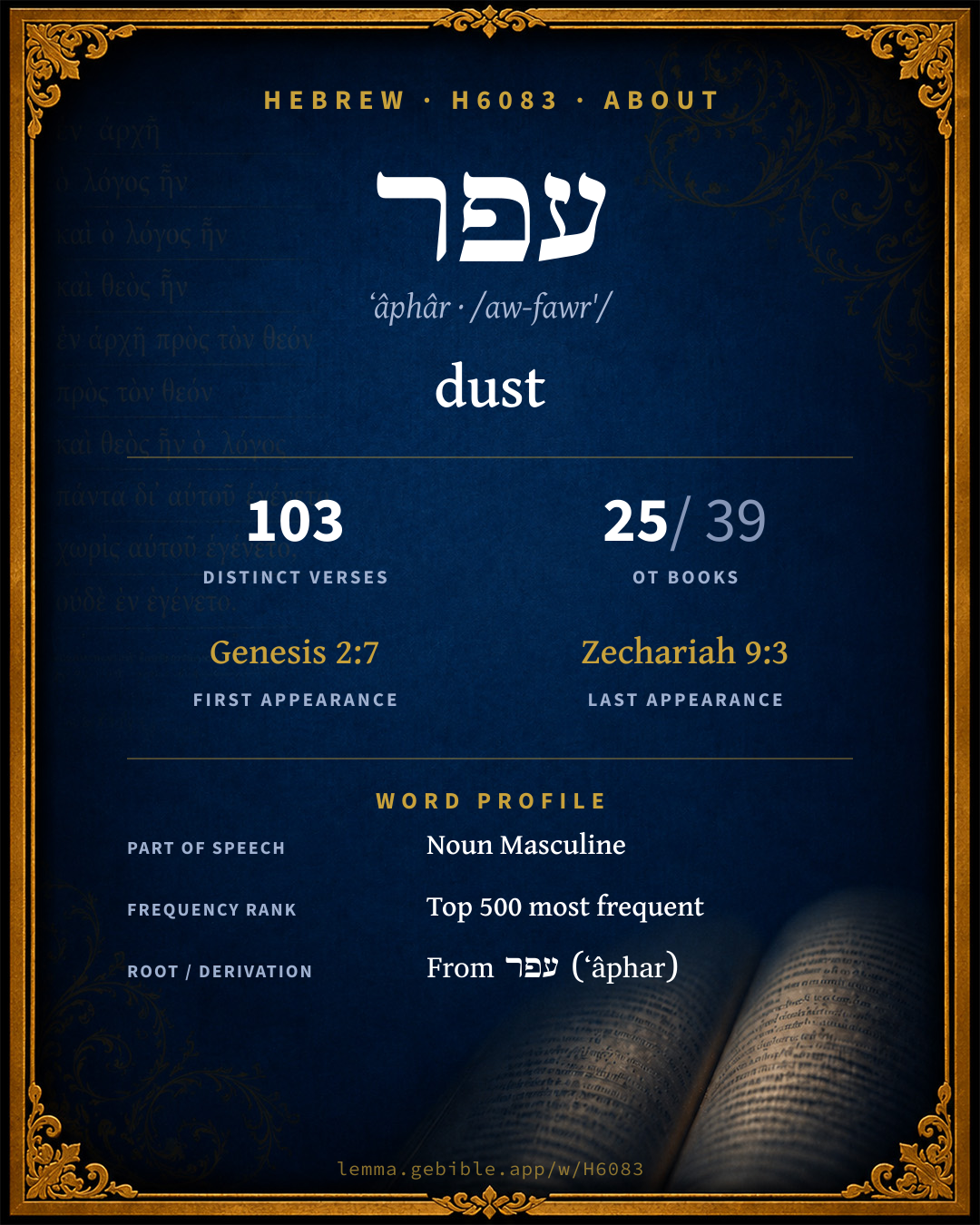
עָפָר
dust
also: dry earth, powder, ashes, earth fuller range ↓
Full lexicon entry — Brown-Driver-Briggs (BDB)
From Brown-Driver-Briggs (BDB)
Where this word appears
See every Absolute-state word in the Hebrew Bible →
Grammar key — what these labels mean
Part of speech
- Noun
- A naming word — a person, place, thing, or idea.
Noun type
- Common
- A common noun — a general class of person, place, or thing (“king,” “city,” “water”), not a specific name.
State
- Absolute
- The independent form of a noun, not bound to a following word.
- Construct
- A noun bound to a following noun in a possessive / “of” relationship (the construct chain).
Gender
- Masculine
- Grammatically masculine.
Number
- Singular
- One.
- Plural
- More than one (in Hebrew, generally three or more).
Grammatical forms
- Noun, Common, Masculine, Singular, Absolute 81 times (74%)
- Noun, Common, Masculine, Singular, Construct 27 times (25%)
- Noun, Common, Masculine, Plural, Construct 2 times (2%)
Parsed forms decoded from the imported morphology (morphhb / Westminster Leningrad Codex — WLC text public domain, morphhb tagging CC BY 4.0), counted across 110 parsed occurrences — not distinct verses.
Every verse where H6083 appears — 103 distinct verses across 25 books. Click any verse to open its interlinear word-by-word view. Verse text shown in the World English Bible for context — . Each verse’s Hebrew form is shown with its reference; the English is not keyword-highlighted, since the data carries no word-level English alignment. Use “Compare translations” on any verse to read it across multiple English versions. This concordance covers the Hebrew Bible; Septuagint (Greek Old Testament) occurrences are not indexed here.
Genesis 7 verses
- Genesis 2:7 עָפָר֙ n c ms Yahweh God formed man from the dust of the ground, and breathed into his nostrils the breath of life; and man became a living soul.
- Genesis 3:14 וְ/עָפָ֥ר conj + n c ms Yahweh God said to the serpent, "Because you have done this, cursed are you above all cattle, and above every animal of the field. On your belly shall you go, and you shall eat dust all the days of your life.
- Genesis 3:19 עָפָ֣ר עָפָ֖ר n c ms n c ms By the sweat of your face will you eat bread until you return to the ground, for out of it you were taken. For you are dust, and to dust you shall return."
- Genesis 13:16 כַּ/עֲפַ֣ר עֲפַ֣ר prep + n c ms cs n c ms cs I will make your offspring as the dust of the earth, so that if a man can number the dust of the earth, then your seed may also be numbered.
- Genesis 18:27 עָפָ֥ר n c ms Abraham answered, "See now, I have taken it on myself to speak to the Lord, who am but dust and ashes.
- Genesis 26:15 עָפָֽר n c ms Now all the wells which his father's servants had dug in the days of Abraham his father, the Philistines had stopped, and filled with earth.
- Genesis 28:14 כַּ/עֲפַ֣ר prep + n c ms cs Your seed will be as the dust of the earth, and you will spread abroad to the west, and to the east, and to the north, and to the south. In you and in your seed will all the families of the earth be blessed.
Exodus 2 verses
- Exodus 8:16 עֲפַ֣ר n c ms cs Yahweh said to Moses, "Tell Aaron, 'Stretch out your rod, and strike the dust of the earth, that it may become lice throughout all the land of Egypt.'"
- Exodus 8:17 עֲפַ֣ר עֲפַ֥ר n c ms cs n c ms cs They did so; and Aaron stretched out his hand with his rod, and struck the dust of the earth, and there were lice on man, and on animal; all the dust of the earth became lice throughout all the land of Egypt.
Leviticus 4 verses
- Leviticus 14:41 הֶֽ/עָפָר֙ ptcl def.art + n c ms and he shall cause the inside of the house to be scraped round about, and they shall pour out the mortar, that they scraped off, outside of the city into an unclean place.
- Leviticus 14:42 וְ/עָפָ֥ר conj + n c ms They shall take other stones, and put them in the place of those stones; and he shall take other mortar, and shall plaster the house.
- Leviticus 14:45 עֲפַ֣ר n c ms cs He shall break down the house, its stones, and its timber, and all the house's mortar. He shall carry them out of the city into an unclean place.
- Leviticus 17:13 בֶּ/עָפָֽר prep det + n c ms "'Whatever man there is of the children of Israel, or of the strangers who live as foreigners among them, who takes in hunting any animal or bird that may be eaten; he shall pour out its blood, and cover it with dust.
Numbers 3 verses
- Numbers 5:17 הֶֽ/עָפָ֗ר ptcl def.art + n c ms and the priest shall take holy water in an earthen vessel; and of the dust that is on the floor of the tabernacle the priest shall take, and put it into the water.
- Numbers 19:17 מֵ/עֲפַ֖ר prep + n c ms cs For the unclean they shall take of the ashes of the burning of the sin-offering; and running water shall be put thereto in a vessel:
- Numbers 23:10 עֲפַ֣ר n c ms cs Who can count the dust of Jacob, Or number the fourth part of Israel? Let me die the death of the righteous, Let my last end be like his!
Deuteronomy 3 verses
- Deuteronomy 9:21 לְ/עָפָ֑ר עֲפָר֔/וֹ prep + n c ms n c ms cs + sfx pers 3ms I took your sin, the calf which you had made, and burnt it with fire, and stamped it, grinding it very small, until it was as fine as dust: and I cast the dust of it into the brook that descended out of the mountain.
- Deuteronomy 28:24 וְ/עָפָ֑ר conj + n c ms Yahweh will make the rain of your land powder and dust: from the sky shall it come down on you, until you are destroyed.
- Deuteronomy 32:24 עָפָֽר n c ms [They shall be] wasted with hunger, and devoured with burning heat Bitter destruction; The teeth of animals will I send on them, With the poison of crawling things of the dust.
Joshua 1 verse
1 Samuel 1 verse
2 Samuel 2 verses
- 2 Samuel 16:13 בֶּ/עָפָֽר prep det + n c ms So David and his men went by the way; and Shimei went along on the hill-side over against him, and cursed as he went, and threw stones at him, and cast dust.
- 2 Samuel 22:43 כַּ/עֲפַר prep + n c ms cs Then did I beat them small as the dust of the earth, I did crush them as the mire of the streets, and did spread them abroad.
1 Kings 3 verses
- 1 Kings 16:2 הֶ֣/עָפָ֔ר ptcl def.art + n c ms Because I exalted you out of the dust, and made you prince over my people Israel, and you have walked in the way of Jeroboam, and have made my people Israel to sin, to provoke me to anger with their sins;
- 1 Kings 18:38 הֶ/עָפָ֑ר ptcl def.art + n c ms Then the fire of Yahweh fell, and consumed the burnt offering, and the wood, and the stones, and the dust, and licked up the water that was in the trench.
- 1 Kings 20:10 עֲפַ֣ר n c ms cs Ben Hadad sent to him, and said, The gods do so to me, and more also, if the dust of Samaria shall suffice for handfuls for all the people who follow me.
2 Kings 5 verses
- 2 Kings 13:7 כֶּֽ/עָפָ֖ר prep det + n c ms For he didn't leave to Jehoahaz of the people save fifty horsemen, and ten chariots, and ten thousand footmen; for the king of Syria destroyed them, and made them like the dust in threshing.
- 2 Kings 23:4 עֲפָרָ֖/ם n c ms cs + sfx pers 3mp The king commanded Hilkiah the high priest, and the priests of the second order, and the keepers of the threshold, to bring forth out of the temple of Yahweh all the vessels that were made for Baal, and for the Asherah, and for all the host of the sky, and he burned them outside of Jerusalem in the fields of the Kidron, and carried the ashes of them to Bethel.
- 2 Kings 23:6 לְ/עָפָ֑ר עֲפָרָ֔/הּ prep + n c ms n c ms cs + sfx pers 3fs He brought out the Asherah from the house of Yahweh, outside of Jerusalem, to the brook Kidron, and burned it at the brook Kidron, and beat it to dust, and cast the dust of it on the graves of the common people.
- 2 Kings 23:12 עֲפָרָ֖/ם n c ms cs + sfx pers 3mp The altars that were on the roof of the upper chamber of Ahaz, which the kings of Judah had made, and the altars which Manasseh had made in the two courts of the house of Yahweh, did the king break down, and beat [them] down from there, and cast the dust of them into the brook Kidron.
- 2 Kings 23:15 לְ/עָפָ֖ר prep + n c ms Moreover the altar that was at Bethel, and the high place which Jeroboam the son of Nebat, who made Israel to sin, had made, even that altar and the high place he broke down; and he burned the high place and beat it to dust, and burned the Asherah.
2 Chronicles 1 verse
Nehemiah 2 verses
- Nehemiah 4:2 הֶ/עָפָ֖ר ptcl def.art + n c ms He spoke before his brothers and the army of Samaria, and said, What are these feeble Jews doing? will they fortify themselves? will they sacrifice? will they make an end in a day? will they revive the stones out of the heaps of rubbish, seeing they are burned?
- Nehemiah 4:10 וְ/הֶ/עָפָ֖ר conj + ptcl def.art + n c ms Judah said, The strength of the bearers of burdens is decayed, and there is much rubbish; so that we are not able to build the wall.
Job 26 verses
- Job 2:12 עָפָ֛ר n c ms When they lifted up their eyes from a distance, and didn't recognize him, they raised their voices, and wept; and they each tore his robe, and sprinkled dust on their heads toward the sky.
- Job 4:19 בֶּ/עָפָ֥ר prep det + n c ms How much more, those who dwell in houses of clay, Whose foundation is in the dust, Who are crushed before the moth!
- Job 5:6 מֵ/עָפָ֣ר prep + n c ms For affliction doesn't come forth from the dust, Neither does trouble spring out of the ground;
- Job 7:5 עָפָ֑ר n c ms My flesh is clothed with worms and clods of dust. My skin closes up, and breaks out afresh.
- Job 7:21 לֶ/עָפָ֣ר prep det + n c ms Why do you not pardon my disobedience, and take away my iniquity? For now shall I lie down in the dust. You will seek me diligently, but I shall not be."
- Job 8:19 וּ֝/מֵ/עָפָ֗ר conj + prep + n c ms Behold, this is the joy of his way: Out of the earth shall others spring.
- Job 10:9 עָפָ֥ר n c ms Remember, I beg you, that you have fashioned me as clay. Will you bring me into dust again?
- Job 14:8 וּ֝/בֶ/עָפָ֗ר conj + prep det + n c ms Though the root of it grows old in the earth, And the stock of it dies in the ground;
- Job 14:19 עֲפַר n c ms cs The waters wear the stones; The torrents of it wash away the dust of the earth: So you destroy the hope of man.
- Job 16:15 בֶ/עָפָ֣ר prep + n c ms I have sewed sackcloth on my skin, And have thrust my horn in the dust.
- Job 17:16 עָפָ֣ר n c ms Shall it go down with me to the gates of Sheol, Or descend together into the dust?"
- Job 19:25 עָפָ֥ר n c ms But as for me, I know that my Redeemer lives. In the end, he will stand upon the earth.
- Job 20:11 עָפָ֥ר n c ms His bones are full of his youth, But youth shall lie down with him in the dust.
- Job 21:26 עָפָ֣ר n c ms They lie down alike in the dust, The worm covers them.
- Job 22:24 עָפָ֥ר n c ms Lay your treasure in the dust, The gold of Ophir among the stones of the brooks.
- Job 27:16 כֶּ/עָפָ֣ר prep det + n c ms Though he heap up silver as the dust, And prepare clothing as the clay;
- Job 28:2 מֵ/עָפָ֣ר prep + n c ms Iron is taken out of the earth, And copper is smelted out of the ore.
- Job 28:6 וְ/עַפְרֹ֖ת conj + n c mp cs Sapphires come from its rocks. It has dust of gold.
- Job 30:6 עָפָ֣ר n c ms So that they dwell in frightful valleys, And in holes of the earth and of the rocks.
- Job 30:19 כֶּ/עָפָ֥ר prep det + n c ms He has cast me into the mire. I have become like dust and ashes.
- Job 34:15 עָפָ֥ר n c ms All flesh would perish together, And man would turn again to dust.
- Job 38:38 עָ֭פָר n c ms When the dust runs into a mass, And the clods of earth stick together?
- Job 39:14 עָפָ֥ר n c ms For she leaves her eggs on the earth, Warms them in the dust,
- Job 40:13 בֶּ/עָפָ֣ר prep det + n c ms Hide them in the dust together. Bind their faces in the hidden place.
- Job 41:33 עָפָ֥ר n c ms On earth there is not his equal, That is made without fear.
- Job 42:6 עָפָ֥ר n c ms Therefore I abhor myself, And repent in dust and ashes."
Psalms 13 verses
- Psalms 7:5 לֶ/עָפָ֖ר prep det + n c ms Let the enemy pursue my soul, and overtake it; Yes, let him tread my life down to the earth, And lay my glory in the dust. Selah.
- Psalms 18:42 כְּ/עָפָ֥ר prep + n c ms Then I beat them small as the dust before the wind. I cast them out as the mire of the streets.
- Psalms 22:15 וְֽ/לַ/עֲפַר conj + prep + n c ms cs My strength is dried up like a potsherd. My tongue sticks to the roof of my mouth. You have brought me into the dust of death.
- Psalms 22:29 עָפָ֑ר n c ms All the rich ones of the earth shall eat and worship. All those who go down to the dust shall bow before him, Even he who can't keep his soul alive.
- Psalms 30:9 עָפָ֑ר n c ms "What profit is there in my destruction, if I go down to the pit? Shall the dust praise you? Shall it declare your truth?
- Psalms 44:25 לֶ/עָפָ֣ר prep det + n c ms For our soul is bowed down to the dust. Our body cleaves to the earth.
- Psalms 72:9 עָפָ֥ר n c ms Those who dwell in the wilderness shall bow before him. His enemies shall lick the dust.
- Psalms 78:27 כֶּ/עָפָ֣ר prep det + n c ms He rained also flesh on them as the dust; Winged birds as the sand of the seas.
- Psalms 102:14 עֲפָרָ֥/הּ n c ms cs + sfx pers 3fs For your servants take pleasure in her stones, And have pity on her dust.
- Psalms 103:14 עָפָ֥ר n c ms For he knows how we are made. He remembers that we are dust.
- Psalms 104:29 עֲפָרָ֥/ם n c ms cs + sfx pers 3mp You hide your face: they are troubled; You take away their breath: they die, and return to the dust.
- Psalms 113:7 מֵ/עָפָ֣ר prep + n c ms He raises up the poor out of the dust. Lifts up the needy from the ash heap;
- Psalms 119:25 לֶ/עָפָ֣ר prep det + n c ms My soul is laid low in the dust. Revive me according to your word!
Proverbs 1 verse
Ecclesiastes 2 verses
Isaiah 14 verses
- Isaiah 2:10 בֶּֽ/עָפָ֑ר prep det + n c ms Enter into the rock, And hide in the dust, From before the terror of Yahweh, And from the glory of his majesty.
- Isaiah 2:19 עָפָ֑ר n c ms Men shall go into the caves of the rocks, And into the holes of the earth, From before the terror of Yahweh, And from the glory of his majesty, When he arises to shake the earth mightily.
- Isaiah 25:12 עָפָֽר n c ms The high fortress of your walls has he brought down, laid low, and brought to the ground, even to the dust.
- Isaiah 26:5 עָפָֽר n c ms For he has brought down those who dwell on high, the lofty city: he lays it low, he lays it low even to the ground; he brings it even to the dust.
- Isaiah 26:19 עָפָ֗ר n c ms Your dead shall live; my dead bodies shall arise. Awake and sing, you who dwell in the dust; for your dew is [as] the dew of herbs, and the earth shall cast forth the dead.
- Isaiah 29:4 וּ/מֵֽ/עָפָ֖ר וּ/מֵ/עָפָ֖ר conj + prep + n c ms conj + prep + n c ms You shall be brought down, and shall speak out of the ground, and your speech shall be low out of the dust; and your voice shall be as of one who has a familiar spirit, out of the ground, and your speech shall whisper out of the dust.
- Isaiah 34:7 וַ/עֲפָרָ֖/ם conj + n c ms cs + sfx pers 3mp The wild-oxen shall come down with them, and the bulls with the bulls: and their land shall be drunken with blood, and their dust made fat with fatness.
- Isaiah 34:9 וַ/עֲפָרָ֖/הּ conj + n c ms cs + sfx pers 3fs The streams of [Edom] shall be turned into pitch, and the dust of it into sulfur, and the land of it shall become burning pitch.
- Isaiah 40:12 עֲפַ֣ר n c ms cs Who has measured the waters in the hollow of his hand, and meted out the sky with the span, and comprehended the dust of the earth in a measure, and weighed the mountains in scales, and the hills in a balance?
- Isaiah 41:2 כֶּֽ/עָפָר֙ prep det + n c ms Who has raised up one from the east, whom he calls in righteousness to his foot? he gives nations before him, and makes him rule over kings; he gives them as the dust to his sword, as the driven stubble to his bow.
- Isaiah 47:1 עָפָ֗ר n c ms Come down, and sit in the dust, virgin daughter of Babylon; sit on the ground without a throne, daughter of the Chaldeans: for you shall no more be called tender and delicate.
- Isaiah 49:23 וַ/עֲפַ֥ר conj + n c ms cs Kings shall be your nursing fathers, and their queens your nursing mothers: they shall bow down to you with their faces to the earth, and lick the dust of your feet; and you shall know that I am Yahweh; and those who wait for me shall not be disappointed.
- Isaiah 52:2 מֵ/עָפָ֛ר prep + n c ms Shake yourself from the dust; arise, sit [on your throne], Jerusalem: loose yourself from the bonds of your neck, captive daughter of Zion.
- Isaiah 65:25 עָפָ֣ר n c ms The wolf and the lamb shall feed together, and the lion shall eat straw like the ox; and dust shall be the serpent's food. They shall not hurt nor destroy in all my holy mountain, says Yahweh.
Lamentations 2 verses
- Lamentations 2:10 עָפָר֙ n c ms The elders of the daughter of Zion sit on the ground, they keep silence; They have cast up dust on their heads; they have girded themselves with sackcloth: The virgins of Jerusalem hang down their heads to the ground.
- Lamentations 3:29 בֶּֽ/עָפָר֙ prep det + n c ms Let him put his mouth in the dust, if so be there may be hope.
Ezekiel 4 verses
- Ezekiel 24:7 עָפָֽר n c ms For her blood is in the midst of her; she set it on the bare rock; she didn't pour it on the ground, to cover it with dust.
- Ezekiel 26:4 עֲפָרָ֖/הּ n c ms cs + sfx pers 3fs They shall destroy the walls of Tyre, and break down her towers: I will also scrape her dust from her, and make her a bare rock.
- Ezekiel 26:12 וַֽ/עֲפָרֵ֔/ךְ conj + n c ms cs + sfx pers 2fs They shall make a spoil of your riches, and make a prey of your merchandise; and they shall break down your walls, and destroy your pleasant houses; and they shall lay your stones and your timber and your dust in the midst of the waters.
- Ezekiel 27:30 עָֽפָר֙ n c ms and shall cause their voice to be heard over you, and shall cry bitterly, and shall cast up dust on their heads, they shall wallow themselves in the ashes:
Daniel 1 verse
Amos 1 verse
Micah 2 verses
- Micah 1:10 עָפָ֖ר n c ms Don't tell it in Gath, Don't weep at all. At Beth Ophrah I have rolled myself in the dust.
- Micah 7:17 עָפָר֙ n c ms They will lick the dust like a serpent. Like crawling things of the earth they shall come trembling out of their dens. They will come with fear to Yahweh our God, And will be afraid because of you.
Habakkuk 1 verse
Zephaniah 1 verse
Zechariah 1 verse
About this entry
At a glance — auto-summarized from this page’s data, not written by a person. Every figure links to its source below. This summary describes the numbers; it doesn’t interpret them.
עפר — transliterated ʻâphâr — is a Hebrew noun carrying the sense “dust.” Alongside “dust” the lexicon also lists “dry earth”, “powder”, and “ashes” — part of its full sense range. With 103 verses in 25 books, it is a common word in the Hebrew Bible. Its uses concentrate in Job (25% of all occurrences). Debuting at Genesis 2:7, it then recurs through the corpus. See the sense tree, 103-verse concordance, and the renderings breakdown below.
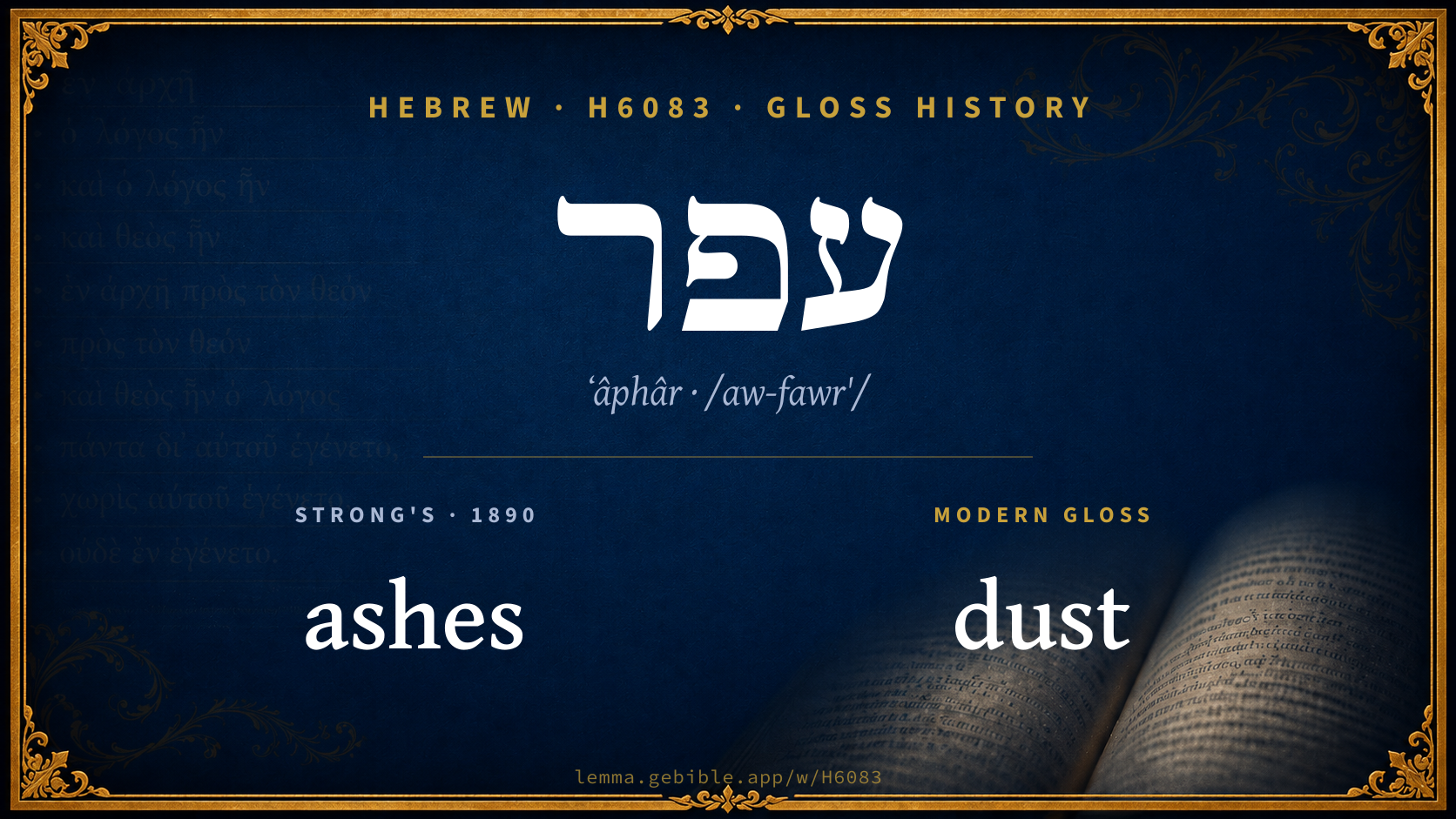
Gloss history
Strong's 1890 vs modern scholarship
About this word
Strong's H6083 catalogs a Hebrew word from the Hebrew Old Testament.
These counts are not copied from any lexicon or concordance. They are computed here, from the morphology-tagged Hebrew Old Testament. What Lemma adds →
- 103
- distinct verses
- The word appears in 103 distinct verses.
- 25 / 39
- OT books
- The word appears in 25 of 39 Old Testament books.
- #396
- by frequency
- Top 500 most frequent Hebrew words (rank 396 of 8,640 Hebrew words by occurrence).
View all 103 occurrences in the concordance →
By section of the Old Testament
By traditional corpus
Conventional, traditional groupings — biblical authorship is debated, so this is a traditional corpus grouping, not an authorship claim. Each share is this word’s portion of its verses in that division of the Hebrew canon. Each figure is a share of the word’s 103 distinct verses.
- Writings (Ketuvim) 48 verses · 47%
- Prophets (Nevi'im) 36 verses · 35%
- Torah (Pentateuch) 19 verses · 18%
How translations render this word
Counts come from each version’s own published word-to-Strong’s tagging or interlinear alignment — an approximate guide to how each version renders this word, not a word-level alignment the data otherwise carries. Because each total is that version’s own tagged count, the per-version totals vary from one another and need not match the appearance or distinct-verse counts above. These counts may also differ from a printed concordance because Lemma counts each distinctly tagged rendering and does not collapse phrase taggings into a single head-word total. This is a fixed set of word-tagged versions (KJV, ASV, BSB, ULT) and does not change with the reading translation you choose elsewhere. Each version’s license is shown beside its name below (and on Sources).
- King James Version: Dust 73×, Earth 6×, Ashes 2×
- American Standard Version: Dust 69×, Earth 6×, Ashes 2×
- Berean Standard Bible: Dust 68×, Soil 6×, Like dust 5×
- unfoldingWord Literal Text: Dust 67×, Dust of 13×, And 7×
King James Version Public Domain
Renders H6083 across 110 tagged occurrences — most commonly:
Plus 17 renderings that appear only once — usually multi-word phrases or single function words the recovered tagging swept in, not distinct renderings.
American Standard Version Public Domain
Renders H6083 across 109 tagged occurrences — most commonly:
Plus 26 renderings that appear only once — usually multi-word phrases or single function words the recovered tagging swept in, not distinct renderings.
Berean Standard Bible Public Domain
Renders H6083 across 110 tagged occurrences — most commonly:
Plus 13 renderings that appear only once — usually multi-word phrases or single function words the recovered tagging swept in, not distinct renderings.
unfoldingWord Literal Text CC BY-SA 4.0
Renders H6083 across 116 tagged occurrences — most commonly:
Plus 13 renderings that appear only once — usually multi-word phrases or single function words the recovered tagging swept in, not distinct renderings.
16 senses and sub-senses in the full BDB
What do BDB’s symbols mean?
BDB uses these scholarly abbreviations:
| Symbol | Meaning |
|---|---|
| 𝔊 | the Septuagint (the ancient Greek translation, LXX) |
| 𝔙 | the Vulgate (the Latin translation) |
| 𝔖 | the Syriac version (the Peshitta) |
| 𝔗 | the Targum (the Aramaic translation) |
| ψ | the Psalms |
| √ | root (the underlying root or stem) |
| ‖ | parallel passage (a synonymous or contrasted parallel) |
| † | the dagger: every passage where the word occurs is cited |
The 16 senses and sub-senses the full Brown-Driver-Briggs lexicon distinguishes for this word, in lexicon order (not ranked by frequency), with BDB’s own verbatim wording and sub-sense lettering. Shown in Hebrew script with BDB’s own scholarly abbreviations. The condensed entry is in the Lexicon Entry tab. See also the Forms in the corpus table below.
- 1. lit.:
- a. dry, loose earth, thrown (in malice) 2 S 16:13 (‖ אֲבָנִים); וַיַּעֲלוּ ע׳ עַל־רֹאשׁ Jos 7:6 (JE; sign of grief), so Ez 27:30; La 2:10, and (c. זָרַק) Jb 2:12; loose earth (on surface of ground) 1 K 18:38; Am 2:7; Is 34:7, 9; Lv 17:13 (H) Ez 24:7 (in fig.), Nu 5:17; Jb 14:19; 38:38; 39:14; Gn 26:15 (R), made into siege works Hb 1:10; of sand-storm Dt 28:24 (+ אָבָק); as serpent’s food, token of punishment and humiliation, Gn 3:14 (J) Is 65:25 (cf. Mi 7:17 2 e infr.); ז̇חֲלֵי ע׳ Dt 32:24 (poem; cf. 2 e). e.g. 2 Samuel 16:13
- b. specif. as material of human body Gn 2:7; 3:19 (J), Ec 3:20, cf. Jb 4:19; 8:19 ψ 103:14, to which it returns (שׁוּב אֶל־) Gn 3:19; Jb 10:9 ψ 104:29 Ec 3:20; so (c. עַל) Jb 34:15; Ec 12:7. e.g. Genesis 2:7
- c. = surface of ground Ex 8:12, 13(×2) (P; ע׳ הָאָרֶץ), Jb 19:25; Is 25:12; 26:5 (both ‖ אֶרֶץ), surface of (whole) earth Jb 41:25, מְחִלוֹת ע׳ Is 2:19 (for hiding), so ע׳ alone v 10, cf. חֹרֵי ע׳ Jb 30:6; = soil, Jb 5:6; 7:5; 14:8. e.g. Exodus 8:12
- d. powder of anything pulverized Dt 9:21(×2) (cf. דָּ֑ק ‖ Ex 32:20), 2 K 23:6(×2), 12, 15, so in sim. 2 S 22:43 = ψ 18:43, hence = ashes v 4; Nu 19:17. e.g. Deuteronomy 9:21
- e. debris, of ruined city 1 K 20:10; Ez 26:4, 12; Ne 3:34; 4:4 ψ 102:15. The foll. are late: e.g. 1 Kings 20:10
- f. earth of the grave: לֶע׳ אֶשְׁכַּב Jb 7:21, so (c. עַל) 20:11; 21:26, cf. 17:16; יוֹרְדֵי ע׳ ψ 22:30, שֹׁכְנֵי ע׳ Is 26:19, יְשֵׁנֵי אַדְמַת־ע׳ Dn 12:2; עֲפַר־מָוֶת ψ 22:16; ע׳ in fig. ψ 30:10. e.g. Job 7:21
- g. mortar (i.e. dried mud) for plastering houses Lv 14:41, 42, 45 (P). e.g. Leviticus 14:41
- h. (iron-) ore Jb 28:2; עַפְרֹת זָהָב v 6 golddust (but v. סַפִּיר). e.g. Job 28:2
- i. material of earth Is 40:12, cf. ראֹשׁ עַפְרֹת תֵּבֵל Pr 8:26 the first of the earth- particles of the world. e.g. Isaiah 40:12
- 2. fig.:
- a. of abundance Gn 13:16(×2); 28:14 (all J) 2 Ch 1:9; Jb 27:16 ψ 78:27 (‖ חוֹל יַמִּים), cf. עֲפַר יַעֲקֹב Nu 23:10 (JE); with added idea of commonness, worthlessness Zp 1:17; Zc 9:3. e.g. Genesis 13:16
- b. of worthlessness (alone) Jb 22:24. e.g. Job 22:24
- c. sim. of the scattered, dispersed 2 K 13:7; כֶּע׳ Is 41:2 (so van d. H. Ginsb; Baer כֵּע׳; on meaning v. Du Che, reading תְּשִׂימֵם for יִתֵּן). e.g. 2 Kings 13:7
- d. of self-abasement Gn 18:27 (+ אֵפֶר), וְנִחַמְתִּי עַל־ע׳ וָאֵפֶר Jb 42:6, יִתֵּן בֶּע׳ פִּיהוּ La 3:29. e.g. Genesis 18:27
- e. of humiliation (sitting or lying in dust) Is 29:4; 47:1; Mi 1:10; Jb 16:15; 40:13 ψ 7:6; 44:26; 119:25, sim. Jb 30:19; licking dust ψ 72:9 Is 49:23; Mi 7:17, cf. TelAm. tikalu ipra (of enemies, v. WklAltor. Forsch. iii. 291; also of serpent 1 a supr.); of י׳ raising from the dust 1 S 2:8 = ψ 113:7, 1 K 16:2; of lifting oneself Is 52:2. e.g. Isaiah 29:4
Senses from the full Brown-Driver-Briggs lexicon (Brown, Driver, Briggs; Oxford 1906 — public domain), digitized via Sefaria, supplemented by the OpenScriptures HebrewLexicon (CC BY 4.0). Full attribution on Sources.
Word origin
n.m. Lv 14:42 dry earth, dust;—abs. ע׳ Gn 2:7 +, cstr. עֲפַר Gn 13:16 +; sf. עֲפָרֵךְ Ez 26:12, עֲפָרוֹ Dt 9:21, etc.; pl. cstr. עַפְרֹת Jb 28:6; Pr 8:26;—
— Brown-Driver-Briggs (Oxford 1906, public domain), digitized via Sefaria, supplemented by the OpenScriptures HebrewLexicon (CC BY 4.0). See Sources.
Derived from עפר (ʻâphar) (H6080) — to dust.
Jastrow Dictionary
A second Hebrew/Aramaic lexicon for comparison, covering Aramaic and post-biblical (Talmudic, Targumic, Midrashic) usage that the biblical-Hebrew BDB does not. Matched by lemma rather than by Strong’s number, so a lemma may carry more than one Jastrow headword (shown separately below), and the entries cover usage well beyond the Bible.
עֹפֶר
- , pl. עֳפָרִים, v. עוֹפֶר.
עָפַר
- , Pi. עִיפֵּר (b. h.; to cast dust, cover with mud.
- to be soiled. Lam. R. introd. (R. Abbahu 6) והם ישנים … ומִתְעַפְּרִים בעפר they sleep on the bare earth and become soiled with dust; ib. to III, 13.
עָפָר
- עפר to be thick, dust, mud, sand, mortar. Gen. R. s. 14 (ref. to Gen. II, 7) ע׳ זכר אדמה נקבה היוצר מביא ע׳ זכר וכ׳ ‘afar represents the male element, ădamah, the female; the potter takes male dust (coarse sand) and female earth (soft clay), in order that the vessels be strong. Sot. II, 2 נוטל ע׳ מתחתיה he (the priest) takes earth from under it (the marble slab). Ib. 16ᵃ מצינו אפר שקרוי ע׳ we find that ashes are likewise called ‘afar; Ḥull. 88ᵇ; Gen. R. s. 49ᵇ. Ib. עֲפַר סוטה the dust used in preparing the Water of Jealousy; עֲ׳ כיסוי the earth or ashes used for covering up the blood at slaughtering (Lev. XVII, 13); Num. R. s. 9. Ib. זכתה … ואנכי ע׳ ואפר לא זכתה תחזור לעַפְרָהּ if she is worthy (innocent), let a son descend from her like Abraham, of whom it is written, ‘And I am dust and ashes’ (Gen. XVIII, 27); if she is unworthy, let her return to her native dust. Ib. עֲ׳ זהב העגל the gold dust of the calf. Y. B. Mets. VIII, end, 11ᵈ ע׳ שחור black potter’s earth; a. fr.—Gen. R. s. 94 עַפְרוֹ של יצחק (ed. Wil. אֶפְרוֹ), v. אֵפֶר.—Pl. עֲפָרוֹת, constr. עַפְרוֹת. Num. R. l. c. (ref. to ומן העפר, Num. V, 17) [read:] זהו ע׳ הזהב אשר טחן this refers to the gold dust which he (Moses) made by grinding (Deut. IX, 21). Gen. R. s. 26 שהיו בקיאים בע׳ וכ׳ they were experts on the qualities of soil like serpents; a. e. e.g. Genesis 2:7
A Dictionary of the Targumim, the Talmud Babli and Yerushalmi, and the Midrashic Literature (Marcus Jastrow; London, Luzac, 1903) — Public Domain. Digitized via Sefaria. Digitized via Sefaria. Full attribution on Sources.
Forms in the corpus
The 64 distinct written forms H6083 takes in the Hebrew Bible, most frequent first — each parse links to that state’s occurrences in the concordance. Hebrew forms include their vowel points and cantillation, so a single lemma takes many written forms.
The 60 most common forms are shown; 4 rarer forms follow in the full concordance.
Same root — word family
Other BDB entries built from the same root as H6083, grouped by Strong’s listed origin. These share a root / origin per the lexicon — not necessarily a shared meaning. Each links to that word’s own entry.
Derives from
Shares the same root
Derived from this word
Compare all same-root words → They share a root, not necessarily a meaning.
Septuagint verse parallels
This word appears in 93 verses that also exist in the Greek Old Testament (Septuagint), out of the 103 Hebrew verses it occurs in. You can read those verses in Greek by switching the Old Testament edition to the Septuagint.
Read these verses in the Septuagint
- Genesis 2:7
- Exodus 8:16
- Leviticus 14:41
- Numbers 5:17
- Deuteronomy 9:21
- Joshua 7:6
- 1 Samuel 2:8
- 2 Samuel 16:13
- 1 Kings 16:2
- 2 Kings 13:7
- 2 Chronicles 1:9
- Job 2:12
This is a verse-level parallel only — the same verses exist in both the Hebrew and Greek Old Testaments. No word-level Hebrew↔Greek correspondence is claimed: the data carries no such alignment, so no Greek word is shown as this Hebrew word’s translation. Coverage is not total — the Septuagint omits the deuterocanon and renumbers the Psalms, so some Hebrew verses have no direct Greek parallel.