
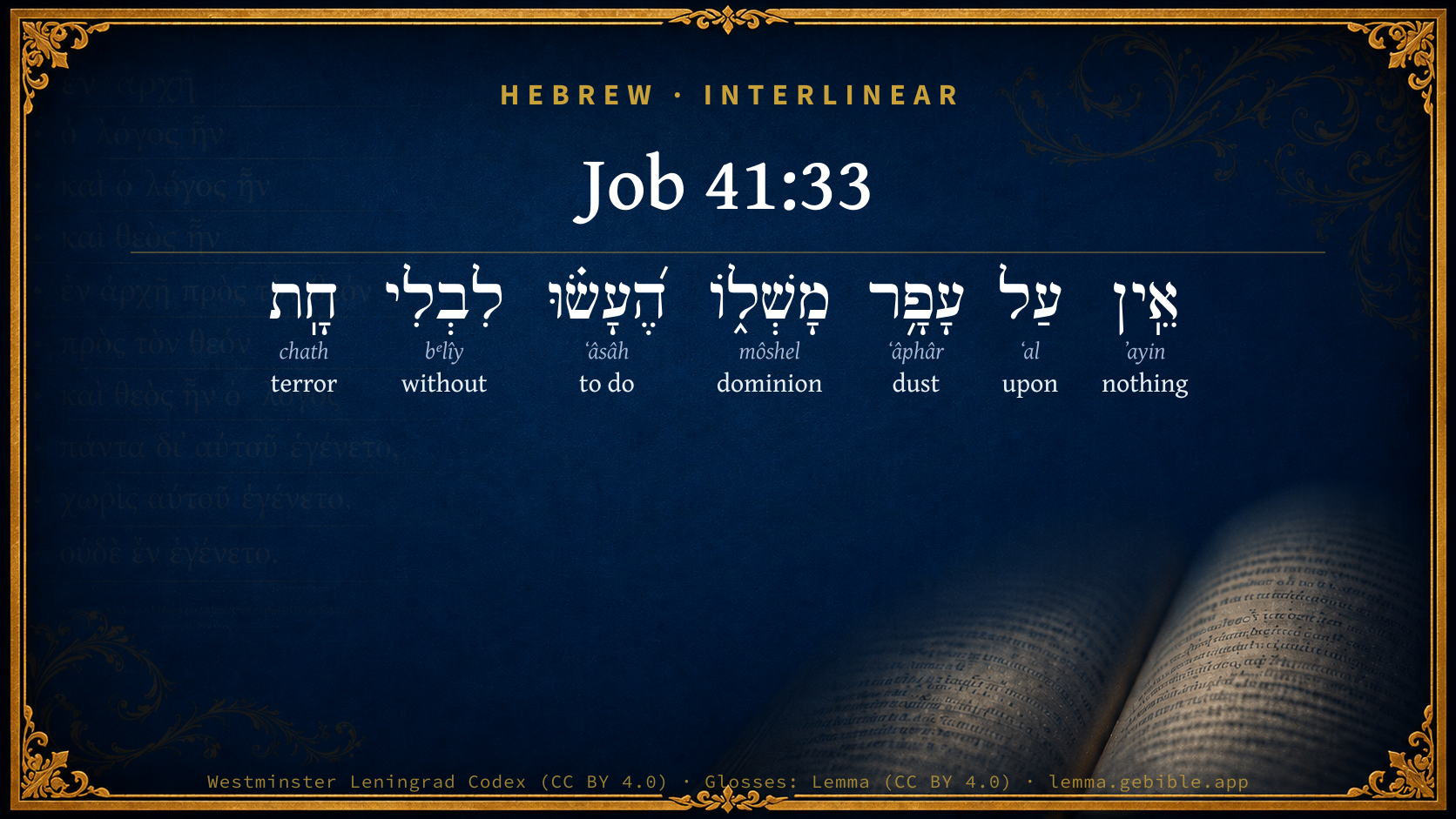
Job 41:33

Hebrew (Westminster Leningrad Codex) Job 41:33 appears in the Hebrew Old Testament. The text above is from the Westminster Leningrad Codex. Each word links to its Strong’s number, a concise gloss, and parsing drawn from the Open Scriptures Hebrew Bible morphology. Click any word for its full Brown-Driver-Briggs (BDB) entry.
Download image
Cite this verse

Job 41:33 (World English Bible). Public Domain. Lemma interlinear Bible study tool, https://lemma.gebible.app/v/job/41/33.

Show BibTeX & RIS
BibTeX
RIS
English Translation
On earth there is not his equal, That is made without fear.
World English Bible · Public Domain
Highlights
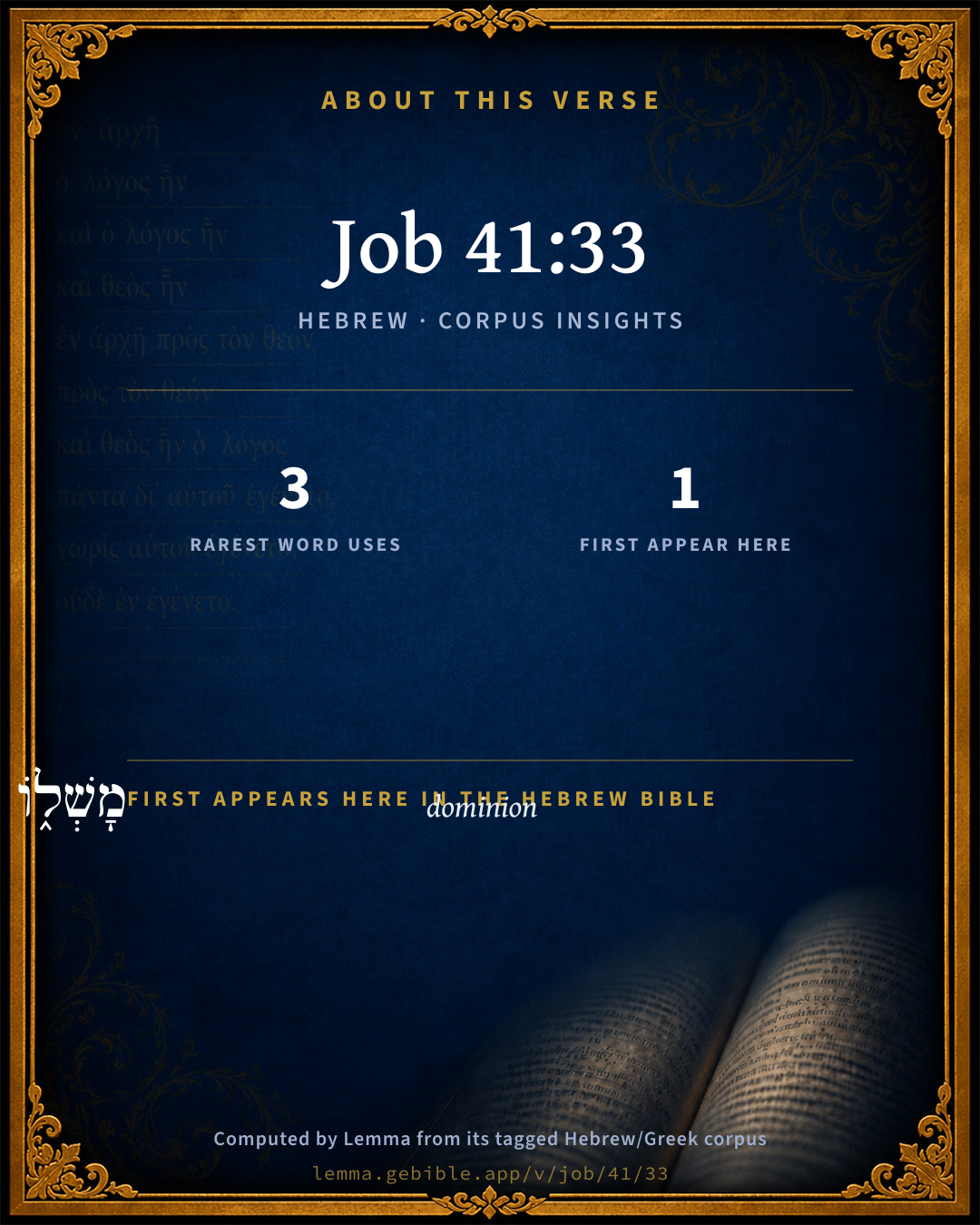
  • 1 first appearance in the Hebrew Bible
Full analysis ↓
Download a study sheet

One document with this verse’s original text, its word-by-word gloss line, the meaning frame, cross-references with their text, attributed commentary, and full source and license credits — printable, and it pastes into notes with its structure intact.

This verse Autodidact and up

Study sheet (.html) Plain text (.txt)

A passage Seminary Student

Up to 50 verses in one chapter. A passage sheet keeps up to 6 commentary sources and 12 cross-references per verse, in the order this page ranks them, and says so on the sheet whenever that leaves anything out. Ask for a single verse and you get the Autodidact verse sheet above.

Everything on this page stays free to read, with no account — the sheet is a download of what is already on screen, not access to it.

Want to remove ads? Support Godless Engineer
Compare translations 3

The same verse in 3 English versions, stacked beneath the original-language interlinear above. Click any original word for its lexicon entry.

Each is an independent rendering of the whole verse — the interlinear is not word-aligned to these translations.

Highlighted words mark where these versions differ — a whole-verse word diff, not a word-by-word alignment.

  • World English Bible Public Domain
    On earth there is not his equal, That is made without fear.
  • King James Version Public Domain
    Upon earth there is not his like, who is made without fear.
  • unfoldingWord Literal Text CC BY-SA 4.0
    Upon the dust there is not its equal, the one made without fear.

unfoldingWord Literal Text — © unfoldingWord, licensed CC BY-SA 4.0. Word-aligned USFM3 via Door43 (git.door43.org/unfoldingWord/en_ult).

Versions to compare (up to 4)

3 of 4 selected

Show all 14 translations

Every available English version of this verse, each an independent rendering of the whole verse.

  • World English Bible Public Domain
    On earth there is not his equal, That is made without fear.
  • Berean Standard Bible Public Domain
    Nothing on earth is his equal—a creature devoid of fear!
  • Majority Standard Bible Public Domain
    Nothing on earth is his equal—a creature devoid of fear!
  • King James Version Public Domain
    Upon earth there is not his like, who is made without fear.
  • American Standard Version (1901) Public Domain
    Upon earth there is not his like, That is made without fear.
  • Revised Version (1885) Public Domain
    Upon earth there is not his like, that is made without fear.
  • Young's Literal Translation Public Domain
    There is not on the earth his like, That is made without terror.
  • Literal Standard Version CC BY-SA 4.0
    There is not on the earth his like, || That is made without terror.
  • Unlocked Literal Bible CC BY-SA 4.0
    On earth there is no equal to him, who has been made to live without fear.
  • unfoldingWord Literal Text CC BY-SA 4.0
    Upon the dust there is not its equal, the one made without fear.
  • Darby Bible Public Domain
    Upon earth there is not his like, who is made without fear.
  • World Messianic Bible Public Domain
    On earth there is not his equal, that is made without fear.
  • Free Bible Version CC BY-SA 4.0
    There is nothing on earth like it: a creature that has no fear.
  • JPS Tanakh (1917) Public Domain
    (41-25) Upon earth there is not his like, who is made to be fearless.

Literal Standard Version (2020), Covenant Press — licensed CC BY-SA 4.0. Text via the HelloAO Bible API (eBible.org). Unlocked Literal Bible (unfoldingWord) — licensed CC BY-SA 4.0. Text via the HelloAO Bible API (eBible.org). unfoldingWord Literal Text — © unfoldingWord, licensed CC BY-SA 4.0. Word-aligned USFM3 via Door43 (git.door43.org/unfoldingWord/en_ult). Free Bible Version, Dr. Jonathan Gallagher — licensed CC BY-SA 4.0. Text via the HelloAO Bible API (eBible.org).

Word by word

More ways to search: Search by grammar → Find every occurrence → Compare this word →

Practice this passage: Drill this verse → Learn its vocabulary →

About this verse

These counts appear in no published source. They are computed here, from the morphology-tagged text and Lemma’s own curated glosses. What Lemma adds →

7
words
7
distinct lemmas
Wisdom
section

Notable vocabulary

The rarest word here is מָשְׁל֑וֹ dominion H4915 — appearing just 3 times in the whole Hebrew Bible.

First appearance in Scripture

This word makes its first canonical appearance in the Hebrew Bible here:

  • מָשְׁל֑וֹ dominion H4915

Shared distinctive vocabulary

מָשְׁל֑וֹ dominion H4915 occurs in 3 verses of the Hebrew Bible. Also found in:

Grammatical profile

  • 1 verb
  • 3 nouns
  • 1 preposition
  • 2 particles

Verb forms

  • הֶ֝עָשׂ֗וּ Qal · Participle Passive

Cross-references

1

Topical passages linked to Job 41:33 in the Treasury of Scripture Knowledge — connected by theme and wording, ordered by reader-vote popularity; previews shown in the World English Bible.

  • Job 40:19 He is the chief of the ways of God. He who made him gives him his sword.

Cross-references courtesy of OpenBible.info (CC BY 4.0).

Hebrew and Greek witnesses Masoretic Hebrew ↔ Greek Septuagint

The same verse in the two great witnesses to the Old Testament, shown verse-for-verse.

These are two independent witnesses, not word-aligned to each other, and the Septuagint is shown in lemma (dictionary) form.

Hebrew Job 41:33 Masoretic · Westminster Leningrad Codex

אֵֽין עַל עָפָ֥ר מָשְׁל֑וֹ הֶ֝עָשׂ֗וּ לִבְלִי חָֽת

On earth there is not his equal, That is made without fear.

World English Bible · Public Domain

On this verse, Albert Barnes' Notes on the Bible discusses the Septuagint’s reading. Read the note in Commentary ↓

Hebrew: Westminster Leningrad Codex (CC BY 4.0). Greek: Septuagint (public domain); English from a public-domain English Septuagint. How the Septuagint differs from the Hebrew →

Commentary

Notes on Job 41:33 from classic Christian and Jewish commentators (each source and its license shown beneath its notes). The classic Christian expositions comment on the surrounding passage and are grouped to its opening verse, so a note may address several verses; the Jewish commentaries on the Tanakh (Rashi and others) are per-verse, so they appear only where the commentator wrote on this verse.

Lemma curates 59 commentaries, every one of them public domain or Creative Commons licensed, each selected and text-cleaned for this edition rather than reprinted as found. About our sources →

Trapp's Complete Commentary

John Trapp

Job 41:33 Upon earth there is not his like, who is made without fear.

Ver. 33. Upon earth there is not his like] Heb. There is no comparison of him. Much was said before of behemoth, but leviathan is far beyond him for size and strength; which yet Mercer noteth to be the work of God, and not of nature, quod humor solvat et infirmet; and therefore in reason earthly creatures would be harder and stronger than those in the sea.

Who is made without fear] He seems not to come into the world but to fear nothing, and to defy all things. No creature carrieth itself so stately or stoutly as the whale.

John Trapp, A Commentary or Exposition upon All the Books of the Old and New Testament (1647–1656) — public domain. Text from a community e-Sword module.

The Biblical Illustrator

Joseph S. Exell

Job_41:33-34

Upon the earth there is not his like.

The supremacy of leviathan

The lion is often spoken of as the king of the forest, or the king of beasts, and in a similar sense the leviathan is here spoken of as at the head of the animal creation. He is afraid of none of them; he is subdued by none of them; he is the prey of none of them. The whole argument, therefore, closes with this statement, that he is at the head of the animal creation; and it was by this magnificent description of the power of the creatures which God had made, that it was intended to impress the mind of Job with a sense of the majesty and power of the Creator. It had the effect. He was overawed with the conviction of the greatness of God, and he saw how wrong it had been for him to presume to call in question the justice, or sit in judgment on the doings of such a Being. God did not, indeed, go into an examination of the various points which had been the subject of controversy; He did not explain the nature of His moral administration so as to relieve the mind from perplexity; but He evidently meant to leave the impression that He was vast and incomprehensible in His government, infinite in power, and had a right to dispose of His creation as He pleased. No one can doubt that God could, with infinite ease, have so explained the nature of His administration as to flee the mind from perplexity, and so as to have resolved the difficulties which hung over the various subjects which had come into debate between Job and his friends. Why He did not do this is nowhere stated, and can only be the subject of conjecture. It is possible, however, that the following suggestions may do something to show the reasons why this was not done.

1. We are to remember the early period of the world when these transactions occurred, and when this Book was composed. It was in the infancy of society, and when little light had gleamed on the human mind in regard to questions of morals and religion.

2. In that state of things it is not probable that either Job or his friends would have been able to comprehend the principles in accordance with which the wicked are permitted to flourish, and the righteous are so much afflicted, if they had been stated. Much higher knowledge than they then possessed about the future world was necessary to understand the subject which then agitated their minds. It could not have been done without a very decided reference to the future state, where all these inequalities are to be removed.

3. It has been the general plan of God to communicate knowledge by degrees: to impart it when men have had full demonstration of their own imbecility, and when they feel the need of Divine teaching; and to reserve the great truths of religion for an advanced period of the world. In accordance with this arrangement, God has been pleased to keep in reserve, from age to age, certain great and momentous truths, and such as were particularly adapted to throw light on the subjects of discussion between Job and his friends. They are the truths pertaining to the resurrection of the body; the retributions of the Day of Judgment; the glories of heaven and the woes of hell, where all the inequalities of the present state may receive their final and equal adjustment. These great truths were reserved for the triumph and glory of Christianity; and to have stated them in the time of Job would have been to have anticipated the most important revelations of that system. The truths of which we are now in possession would have relieved much of the anxiety then felt, and solved most of these questions; but the world was not then in the proper state for their revelation.

4. It was a very proper lesson to be taught men, to bow with submission, to a sovereign God, without knowing the reason of His doings. No lesson, perhaps, could be learnt of higher value than this. To a proud, self-confident, philosophic mind, a mind prone to rely on its own resources and trust to its own deductions, it was of the highest importance to inculcate the duty of submission to will and sovereignty. This is a lesson which we often have to learn in life, and which almost all the trying dispensations of providence are fitted to teach us. It is not because God has no reason for what He does; it is not because He intends we shall never know the reason: but it is because it is our duty to bow with submission to His will, and to acquiesce in His right to reign, even when we cannot see the reason of His doings. Could we reason it out, and then submit because we saw the reason, our submission would not be to our Makers pleasure, but to the deductions of our own minds. Hence, all along, He so deals with man, by concealing the reason of His doings, as to bring him to submission to His authority, and to humble all human pride. To this termination all the reasonings of the Almighty in this Book are conducted; and after the exhibition of His power in the tempest, after His sublime description of His own works, after His appeal to the numerous things which are, in fact, incomprehensible to man, we feel that God is great--that it is presumptuous in man to sit in judgment on His works, and that the mind, no matter what it does, should bow before Him with profound veneration and silence. (Albert Barnes.)

.

The Biblical Illustrator, edited by Joseph S. Exell (c. 1880s–1900s) — public domain. Text from a community e-Sword module.

Joseph Benson's Commentary

Job 41:33. Upon the earth there is not his like — No creature in this world is comparable to him for strength and terror. Or the earth is here distinguished from the sea; for the Hebrew, אין על עפר משׁלו, een gnal gnapar mashelo, may be properly rendered, His dominion is not upon the earth; namely, but upon the waters. Houbigant renders it, His dwelling is not upon the dust; which, as he understands it of the crocodile, he supposes to express the amphibious nature of the animal, which, although it is observed every day at morning and evening to come out of the waters, and to continue awhile on the land, yet, properly speaking, is an inhabitant of the waters, and it is well for man that he is so; for if such a terrible creature were allowed to roam and ravage upon this earth, it would be an unsafe and uncomfortable habitation for the children of men, for whom it is intended. Who is made without fear — Fears no enemy, as being sensible of his own invincible strength. But לבלי חת, libli chath, may be rendered, so as he cannot be bruised, or broken; namely, because of his prodigious hardness, of which we have spoken before.

Joseph Benson's Commentary on the Old and New Testaments (1811–1818) — public domain. Text from a community e-Sword module.

Jamieson, Fausset & Brown

Robert Jamieson, A. R. Fausset & David Brown

who--being one who, &c.

Jamieson, Fausset & Brown — Commentary Critical and Explanatory on the Whole Bible (1871) — public domain (CC PDM 1.0). Text via the HelloAO Bible API.

Adam Clarke's Commentary

Verse 33. Upon earth there is not his like] There is no creature among terrestrial animals so thoroughly dangerous, so exceedingly strong, and so difficult to be wounded or slain.

Who is made without fear.] Perhaps there is no creature who is at all acquainted with man, so totally destitute of fear as the crocodile.

Adam Clarke's Commentary on the Bible (1810–1826) — public domain. Text from a community e-Sword/MySword module.

Ellicott's Commentary for English Readers

(33, 34) Upon earth there is not his like.—Some have proposed to take away the last two verses of Job 41 from their connection with the crocodile, and to transpose them, referring them to man, so as to come before Job_41:8, understanding them thus: “There is one whose like is not upon earth, who is made without dread. He seeth every high thing, and is king over all the proud beasts. To Him then I say (Job_41:8), Lay thine hand upon him; remember the battle, and do so no more. Lo! his hope is deceived. Is he indeed cast down at the very eight of him? He is not so cruel to himself that he should rouse him up. Who then can stand before me? Who hath first given to me, that I should have to repay him? That which is under the whole heavens is mine.” It cannot be denied that this makes very good sense, but it seems to be too great a liberty to take with the text as we find it to adopt this as the true order of the verses; for in that case, what is there that we might not deal with in a like manner? Those who advocate this transposition in the order of the verses would also place Job_40:1-5 so as to follow Job_40:6, in this manner: “Then Job answered the Lord and said, I know that thou canst do everything, and that no purpose can be withholden from thee, or that no purpose of thine can be restrained.” Then the next words come in as the implied answer of God: “Who is this that hideth my counsel for want of knowledge?” To which Job replies: “Therefore (I confess that) I have uttered without understanding things too wonderful for me, which I knew not.” Again God replies, as in Job_38:3; Job_40:7 : “Hear, I beseech thee and I will speak, I will demand of thee, and declare thou unto me; to which Job answers: “I have heard of thee by the hearing of the ear, but now mine eye seeth thee. Wherefore I abhor what I have said, and repent it in dust and ashes.” Then the Lord answered Job and said, “Is he that contended with the Almighty reproved? Does he acknowledge his discomfiture? He that argueth with God, let him answer this question.” Then Job answered the Lord and said, “Behold I am vile. What shall I answer thee? I lay my hand before my mouth; once I have spoken, but I will not answer; yea twice, but I will not do so again.” There is a certain amount of sharpness and point obtained in thus making this confession the climax of the poem, and a kind of formal consistency is secured in regarding this resolution as Job’s last utterance instead of making him speak again, as he does, according to the present order, in Job_42:2. But this consistency is formal rather than real, inasmuch as there is no inconsistency in the tone of Job_42:2 seqq., and the promise of Job_40:5. Whatever advantage may be derived from the re-arrangement will be a matter for individual taste rather to decide, which will vary with the individual; and at all events, the climax of Job_42:6 as it stands is a very noble one, and we may question whether we can heighten its grandeur.

A Bible Commentary for English Readers, edited by Charles John Ellicott (1878–1897) — public domain. Text from a community e-Sword module.

The Cambridge Bible for Schools and Colleges

gen. ed. J. J. S. Perowne

33. who is made] That is, he who is made without fear—so as to fear nothing.

33, 34. He has no rival, he is king among the proud beasts.

The Cambridge Bible for Schools and Colleges (gen. ed. J. J. S. Perowne; Cambridge University Press, 1878–1918) — public domain. Text from a community e-Sword module.

John Gill's Exposition

He beholdeth all high things,.... Or "who beholdeth all high things"; even he that made leviathan, that is, God, as the above interpreter: he does that which Job was bid to do, and could not; beholds everyone that is proud, and abases him, Job 40:11; and therefore he ought to acknowledge his sovereignty and superiority over him, and submit to him;

he is a king over all the children of pride: the proud angels that fell, and all the proud sons of men; proud monarchs and potentates of the earth, such as Nebuchadnezzar and others, Dan 4:31. But interpreters generally understand all this either of the crocodile, or of a fish of the whale kind. Bochart observes, that the crocodile, though it has short legs, will behold, and meet unterrified, beasts abundantly taller than itself, and with one stroke of its tail break their legs and bring them low; and will destroy not only men, but all sorts of beasts, as elephants, camels, horses, oxen, boars, and every animal whatsoever. But others apply this to the whale, which beholds the tossing waves of the sea, which mount up to heaven; the clouds of heaven on high over it; the lofty cliffs or shores, and ships of the greatest bulk and height; and which, when it lifts up itself above the water, equals the high masts of ships, and is abundantly superior to all the tribes of watery animals, or the beasts of the sea. But this seems not wholly to come up to the expressions here used. Upon the whole, as there are some things that agree with the crocodile, and not the whale; and others that agree with the whale, of one sort or another, and not with the crocodile; it is uncertain which is meant, and it seems as if neither of them were intended: and to me very probable is the opinion of Johannes Camerensis (c), and to which the learned Schultens most inclines, that the leviathan is the dragon of the land sort, called leviathan, the piercing serpent, as distinct from the dragon in the sea, Isa 27:1; which agrees with the description of the leviathan in the whole: as its prodigious size; its terrible countenance; its wide jaws; its three forked tongue; its three rows of sharp teeth; its being covered all over, back and belly, with thick scales, not to be penetrated by arrows and darts; its flaming eyes, its fiery breath, and being most terrible to all, and fearless of every creature; it will engage with any, and conquer and kill an elephant (d); hence in Ethiopia dragons have no other names than elephant killers: and so it may be said to be king over all the children of pride; of all which proof may be given from various writers, as Pliny (e), Aelianus (f), Philostratus (g), and others; and particularly the dragon Attilius Regulus, the Roman general, killed near Bagrade in Africa, is a proof itself of almost all the above articles, as Osorius (h) has described it; nor is it any objection that the leviathan is represented as being in the sea, since the dragon, even the land dragon, will plunge into rivers, and is often found in lakes called seas, and in maritime places, and will go into the sea itself, as Pliny (i) and Philostratus (k) relate. To which may be added, that this creature was found among the Troglodytes (l) who lived near the Red sea, and not far from Arabia, where Job dwelt, and so might be well known by him: and besides, of all creatures, it is the most lively emblem of the devil, which all the ancient Christian writers make leviathan to be; and Satan is expressly called the dragon in Rev 12:3. So Suidas (m) says, the devil is called a dragon in Job. But be the leviathan what it may, it certainly is an illustrious instance of the power of God in making it; and therefore Job and every other man ought to submit to him that made it, in all things, and be humble under his mighty hand; owning freely, that it is his right hand, and his only, and not man's, that can save, either in a temporal or spiritual sense; for which end this and the behemoth are instanced in.

(See definition for 03882. Editor.)

(c) Apud Pinedam, in v. 1. (d) Isidor. Origin l. 12. c. 4. (e) Nat. Hist. l. 8. c. 14. (f) De Animal. l. 2. c. 21. & l. 10. c. 48. & l. 15. c. 21. & l. 16. c. 39. (g) Vit. Apollon. l. 3. c. 2. Vid. Ovid. Metamorph. l. 3. Fab. 1. (h) Hist. l. 4. c. 8. (i) Nat. Hist. l. 8. c. 13. (k) Ut supra. (Vit. Apollon. l. 3. c. 2. Vid. Ovid. Metamorph. l. 3. Fab. 1.) (l) Plin. Nat. Hist. l. 8. c. 11, 12. & l. 31. c. 2. (m) In voce & in voce

Next: Job Chapter 42

John Gill's Exposition of the Whole Bible (1746–1763) — public domain (CC PDM 1.0). Text via the HelloAO Bible API.

Albert Barnes' Notes on the Bible

Upon earth there is not his like - Hebrew, “Upon the dust.” The meaning is, that no other animal can be compared with him; or the land does not produce such a monster as this. For size, strength, ferocity, courage, and formidableness, no animal will hear a comparison with him. This can be true only of some such fierce creature as the crocodile.

Who is made without fear - Margin, “Or, behave themselves with fear.” The meaning is, that he is created not to be afraid; he has no dread of others In this respect he is unlike other animals. The Septuagint renders this, “He is made to be sported with by my angels.”

Albert Barnes' Notes on the Bible (1834–1885) — public domain. Text from a community e-Sword/MySword module.

Matthew Poole's English Annotations

Upon earth; either,

1. Strictly so called, as it is distinguished from the sea or rivers. There is no land creature comparable to him for strength and courage. Or,

2. Largely taken. No creature equals him in all points. Or, upon the dust, as the word properly signifies, i.e. among the things that creep in the dust, among which this may in some sort be numbered for the shortness of its feet. But this were no great honour to it, to be the chief of creeping things; and therefore the former translation seems more proper for the present design of magnifying this creature above all others.

Who is made without fear; fears no enemy, as being full of courage, and sensible of his own invincible strength. Or, so as he cannot be bruised or broken, by reason of his prodigious hardness, of which I have spoken before.

Matthew Poole's English Annotations on the Holy Bible (1683–1685) — public domain. Text from a community e-Sword/MySword module.

Whedon's Commentary on the Bible

Daniel D. Whedon

33. Upon earth there is not his like — Thus the Septuagint, Delitzsch, and Umbreit. The word משׁלו, his like, may also signify “his ruler,” (Hitzig, Ewald, etc.,) and the sentence be read literally, There is not on the dust his ruler: among beasts and among men he has no king. The reason is obliquely given for the honour accorded the two monsters, of crowning the tableau held up from nature; the one is a firstling of God’s works; the other is one of nature’s monarchs, which acknowledges no superior.

Daniel D. Whedon (gen. ed.), Commentary on the Old and New Testaments (1874–1909) — public domain. Text from a community e-Sword module.

The Pulpit Commentary

Upon earth there is not his like, who is made without fear (comp. vers. 24-29).

The Pulpit Commentary (1880–1919), ed. H.D.M. Spence-Jones & Joseph S. Exell — public domain. Text from a community e-Sword module.

unfoldingWord translationNotes

Door43 World Missions Community

there is no equal to him

"no other creature is like Leviathan"

He sees everything that is proud

"He is very, very proud"

him ... He

The words "him" and "he" refer to Leviathan.

he is king over all the sons of pride

Leviathan is spoken of as if he were a person who is able to become king and be proud. AT: "Leviathan has more reason to be proud than anyone else on earth" (See: Personification)

translationWords

life

king

son

unfoldingWord translationNotes — © Distant Shores Media and the Door43 World Missions Community, licensed CC BY-SA 4.0. Source: git.door43.org/Door43/en_tn.

Lesson kit

Teaching starters — assembled from the data on this page, not authored interpretation. Every prompt links to the verse data it draws on. Edit before teaching.

Job, in the Wisdom, opens this verse with 7 words (7 distinct Hebrew lemmas). Its most distinctive word is môshel (“dominion”). A historical commentator’s framing appears above. Read the whole chapter for the surrounding context.

Discussion questions

  1. What does “dominion” (môshel) contribute to the verse as a whole?
  2. The word “dominion” first appears here in Scripture. What is being introduced at this debut?
  3. Daniel 11:4 shares the word «dominion» with this verse. How do the two illuminate each other?
  4. These translations render this verse differently; the difference is in the English rendering, not the original. What questions does that raise?
  5. The verb «הֶ֝עָשׂ֗וּ» is Qal Participle Passive. How does its form color the action?
  6. Reading how Trapp's Complete Commentary and The Biblical Illustrator read this verse, where do the two commentators agree and where do they part?

Things to notice

  • 1 word makes its first canonical appearance in Scripture here.
  • These translations choose different wording for 7 words in this verse.
  • 7 distinct Hebrew lemmas span 7 words in this verse.

Reading settings

Reading text

Shown beneath each verse's original-language words.

Old Testament
Old Testament edition

Read the OT as the Masoretic Hebrew (MT) or the Greek Septuagint (LXX).

English shown for the Greek Septuagint (in the Hebrew ↔ Greek comparison).

Comparing translations? Open the Compare panel on any verse page to stack up to four side by side.