Isaiah 2:10

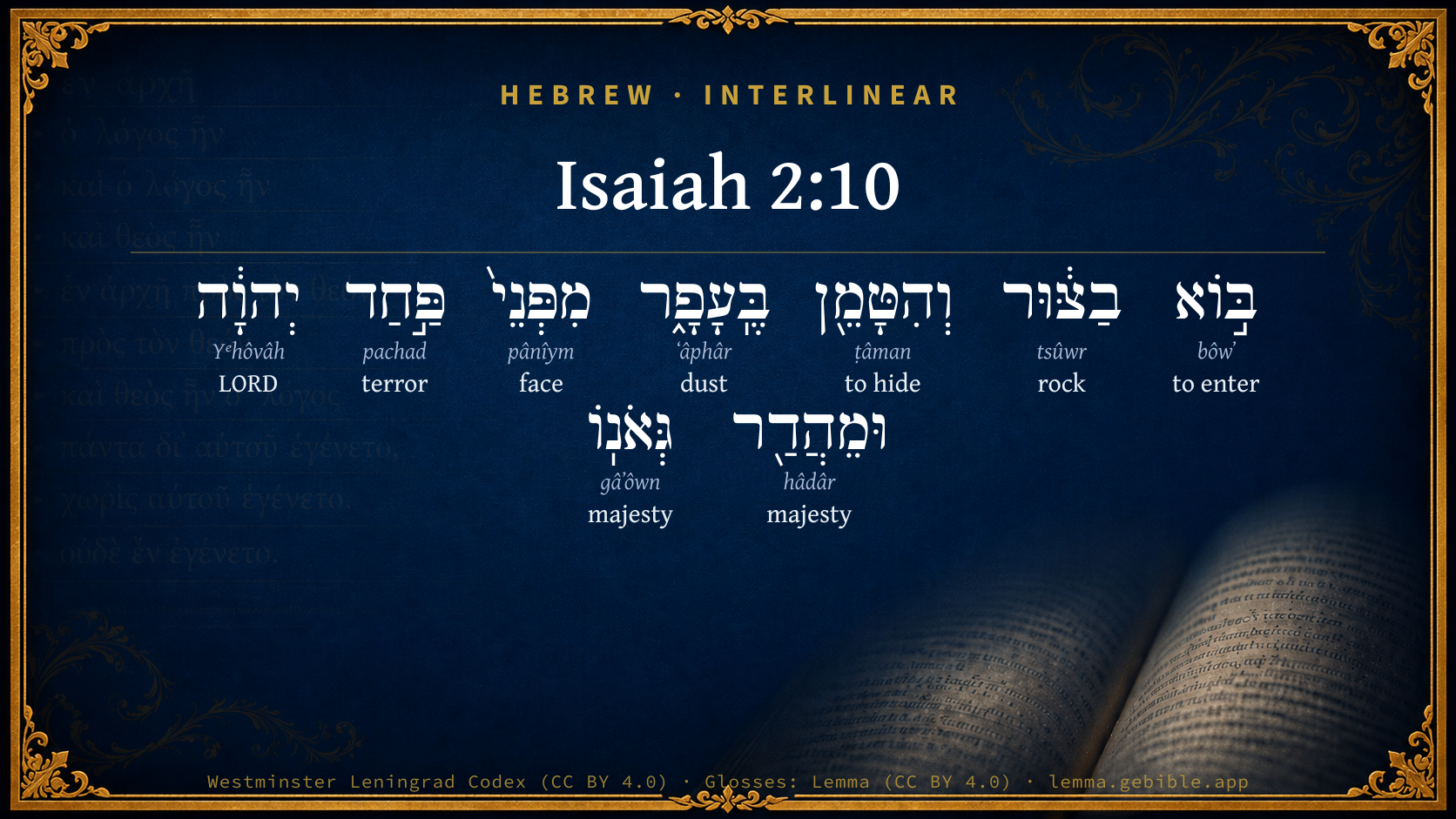
Hebrew (Westminster Leningrad Codex) Isaiah 2:10 appears in the Hebrew Old Testament. The text above is from the Westminster Leningrad Codex. Each word links to its Strong’s number, a concise gloss, and parsing drawn from the Open Scriptures Hebrew Bible morphology. Click any word for its full Brown-Driver-Briggs (BDB) entry.
Download image
Cite this verse

Isaiah 2:10 (World English Bible). Public Domain. Lemma interlinear Bible study tool, https://lemma.gebible.app/v/isaiah/2/10.

Show BibTeX & RIS
BibTeX
RIS
English Translation
Enter into the rock, And hide in the dust, From before the terror of Yahweh, And from the glory of his majesty.
World English Bible · Public Domain
Download a study sheet

One document with this verse’s original text, its word-by-word gloss line, the meaning frame, cross-references with their text, attributed commentary, and full source and license credits — printable, and it pastes into notes with its structure intact.

This verse Autodidact and up

Study sheet (.html) Plain text (.txt)

A passage Seminary Student

Up to 50 verses in one chapter. A passage sheet keeps up to 6 commentary sources and 12 cross-references per verse, in the order this page ranks them, and says so on the sheet whenever that leaves anything out. Ask for a single verse and you get the Autodidact verse sheet above.

Everything on this page stays free to read, with no account — the sheet is a download of what is already on screen, not access to it.

Want to remove ads? Support Godless Engineer
Compare translations 3

The same verse in 3 English versions, stacked beneath the original-language interlinear above. Click any original word for its lexicon entry.

Each is an independent rendering of the whole verse — the interlinear is not word-aligned to these translations.

Highlighted words mark where these versions differ — a whole-verse word diff, not a word-by-word alignment.

  • World English Bible Public Domain
    Enter into the rock, And hide in the dust, From before the terror of Yahweh, And from the glory of his majesty.
  • King James Version Public Domain
    Enter into the rock, and hide thee in the dust, for fear of the LORD, and for the glory of his majesty.
  • unfoldingWord Literal Text CC BY-SA 4.0
    Go into the rock and hide in the ground from the face of the terror of Yahweh and from the splendor of his majesty!

unfoldingWord Literal Text — © unfoldingWord, licensed CC BY-SA 4.0. Word-aligned USFM3 via Door43 (git.door43.org/unfoldingWord/en_ult).

Versions to compare (up to 4)

3 of 4 selected

Show all 18 translations

Every available English version of this verse, each an independent rendering of the whole verse.

  • World English Bible Public Domain
    Enter into the rock, And hide in the dust, From before the terror of Yahweh, And from the glory of his majesty.
  • Berean Standard Bible Public Domain
    Go into the rocks and hide in the dust from the terror of the LORD and the splendor of His majesty.
  • Majority Standard Bible Public Domain
    Go into the rocks and hide in the dust from the terror of the LORD and the splendor of His majesty.
  • King James Version Public Domain
    Enter into the rock, and hide thee in the dust, for fear of the LORD, and for the glory of his majesty.
  • American Standard Version (1901) Public Domain
    Enter into the rock, and hide thee in the dust, from before the terror of Jehovah, and from the glory of his majesty.
  • Revised Version (1885) Public Domain
    Enter into the rock, and hide thee in the dust, from before the terror of the LORD, and from the glory of his majesty.
  • Geneva Bible (1599) Public Domain
    Enter into the rocke, and hide thee in the dust from before the feare of the Lord, and from the glory of his maiestie.
  • Douay-Rheims (1899) Public Domain
    Enter thou into the rock, and hide thee in the pit from the face of the fear of the Lord, and from the glory of his majesty.
  • Young's Literal Translation Public Domain
    Enter into a rock, and be hidden in dust, Because of the fear of Jehovah, And because of the honour of His excellency.
  • Literal Standard Version CC BY-SA 4.0
    Enter into a rock, and be hidden in dust, || Because of the fear of YHWH, || And because of the honor of His excellence.
  • Unlocked Literal Bible CC BY-SA 4.0
    Go into the rocky places and hide in the ground from the terror of Yahweh and from the glory of his majesty.
  • unfoldingWord Literal Text CC BY-SA 4.0
    Go into the rock and hide in the ground from the face of the terror of Yahweh and from the splendor of his majesty!
  • Darby Bible Public Domain
    Enter into the rock, and hide thee in the dust, from before the terror of Jehovah, and from the glory of his majesty.
  • World Messianic Bible Public Domain
    Enter into the rock, and hide in the dust, from before the terror of the LORD, and from the glory of his majesty.
  • Webster's Bible Public Domain
    Enter into the rock, and hide thee in the dust, for fear of the LORD, and for the glory of his majesty.
  • Free Bible Version CC BY-SA 4.0
    Run away into rock caves, hide underground from the terrifying presence of the Lord, from the glory of his majesty.
  • Bible in Basic English Public Domain
    Go into a hole in the rock, covering yourselves with dust, in fear of the Lord, before the glory of his power.
  • JPS Tanakh (1917) Public Domain
    Enter into the rock, and hide thee in the dust, from before the terror of the LORD, and from the glory of His majesty.

Literal Standard Version (2020), Covenant Press — licensed CC BY-SA 4.0. Text via the HelloAO Bible API (eBible.org). Unlocked Literal Bible (unfoldingWord) — licensed CC BY-SA 4.0. Text via the HelloAO Bible API (eBible.org). unfoldingWord Literal Text — © unfoldingWord, licensed CC BY-SA 4.0. Word-aligned USFM3 via Door43 (git.door43.org/unfoldingWord/en_ult). Free Bible Version, Dr. Jonathan Gallagher — licensed CC BY-SA 4.0. Text via the HelloAO Bible API (eBible.org).

Word by word

More ways to search: Search by grammar → Find every occurrence → Compare this word →

Practice this passage: Drill this verse → Learn its vocabulary →

וּמֵהֲדַ֖ר
hâdâr
H1926
“and · from · majesty of”
Conjunction + Preposition + Noun, Common, Masculine, Singular, Construct
Part of Speech
Conjunction + Preposition + Noun
Type
Common
Gender
Masculine
Number
Singular
State
Construct
Full BDB Definition

Origin: from H1921

TWOT: 477b

ornament, splendour, honour - ornament - splendour, majesty - honour, glory
  1. בּ֣וֹא bôwʼ H935 “enter” Verb, Qal, Imperative, 2nd Person, Masculine, Singular
  2. בַצּ֔וּר tsûwr H6697 “in/at the · rock” Preposition, Determined + Noun, Common, Masculine, Singular, Absolute
  3. וְהִטָּמֵ֖ן ṭâman H2934 “and · hide” Conjunction + Verb, Niphal, Imperative, 2nd Person, Masculine, Singular
  4. בֶּֽעָפָ֑ר ʻâphâr H6083 “in/at the · dust” Preposition, Determined + Noun, Common, Masculine, Singular, Absolute
  5. מִפְּנֵי֙ pânîym H6440 “from · face(s) of” Preposition + Noun, Common, Both, Plural, Construct
  6. פַּ֣חַד pachad H6343 “terror of” Noun, Common, Masculine, Singular, Construct
  7. יְהוָ֔ה Yᵉhôvâh H3068 “LORD” Noun, Proper
  8. גְּאֹנֽוֹ gâʼôwn H1347 “majesty · his” Noun, Common, Masculine, Singular, Construct + Suffix, Personal, 3rd Person, Masculine, Singular

About this verse

These counts appear in no published source. They are computed here, from the morphology-tagged text and Lemma’s own curated glosses. What Lemma adds →

9
words
9
distinct lemmas
Prophets
section

Shared distinctive vocabulary

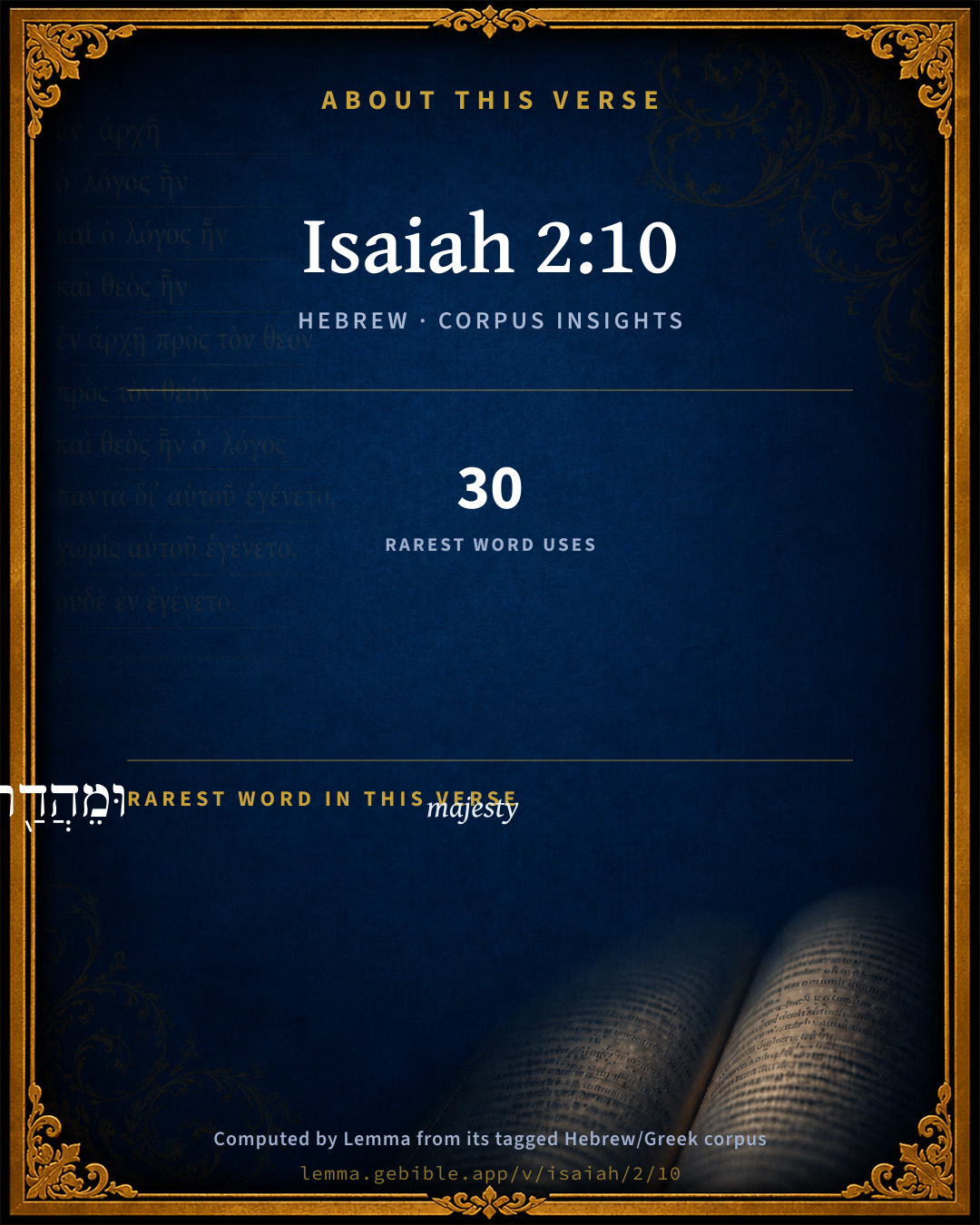
וּמֵהֲדַ֖ר majesty H1926 occurs in 29 verses of the Hebrew Bible. Also found in:

Grammatical profile

  • 2 verbs
  • 7 nouns

Verb forms

  • בּ֣וֹא Qal · Imperative
  • וְהִטָּמֵ֖ן Niphal · Imperative

Hebrew & Septuagint length

In English translation the verse runs 22 words from the Hebrew and 36 from the Septuagint (LXX English) — the Septuagint runs noticeably longer here. See the side-by-side →

A rough comparison of the two English renderings, which tokenize alike — not a word-level alignment.

Word counts can differ between the Hebrew and the Greek without any difference in meaning — e.g. the Hebrew direct-object marker אֵת has no separate Greek word, and Greek often adds the article ὁ.

Cross-references

17

Topical passages linked to Isaiah 2:10 in the Treasury of Scripture Knowledge — connected by theme and wording, ordered by reader-vote popularity; previews shown in the World English Bible.

  • Revelation 6:15–16 The kings of the earth, the princes, the commanding officers, the rich, the strong, and every slave and free person, hid themselves in the caves and in the rocks of the mountains.
  • Isaiah 2:19–21 Men shall go into the caves of the rocks, And into the holes of the earth, From before the terror of Yahweh, And from the glory of his majesty, When he arises to shake the earth mightily.
  • Hosea 10:8 The high places also of Aven, the sin of Israel, will be destroyed. The thorn and the thistle will come up on their altars. They will tell the mountains, "Cover us!" and the hills, "Fall on us!"
  • Luke 23:30 Then they will begin to tell the mountains, 'Fall on us!' and tell the hills, 'Cover us.'
  • Judges 6:1–2 The children of Israel did that which was evil in the sight of Yahweh: and Yahweh delivered them into the hand of Midian seven years.
  • Job 37:22–24 Out of the north comes golden splendor; With God is awesome majesty.
  • Isaiah 6:3–5 One called to another, and said, "Holy, holy, holy, is Yahweh of Hosts! The whole earth is full of his glory!"
  • Jeremiah 10:7 Who should not fear you, King of the nations? for to you does it appertain; because among all the wise men of the nations, and in all their royal estate, there is none like you.
  • Revelation 15:3–4 They sang the song of Moses, the servant of God, and the song of the Lamb, saying, "Great and marvelous are your works, Lord God, the Almighty; Righteous and true are your ways, you King of the nations.
  • Job 30:5–6 They are driven forth from the midst of men; They cry after them as after a thief;
  • Job 31:23 For calamity from God is a terror to me, By reason of his majesty I can do nothing.
  • Psalms 90:11 Who knows the power of your anger, Your wrath according to the fear that is due to you?
  • Isaiah 10:3 What will you do in the day of visitation, and in the desolation which shall come from far? to whom will you flee for help? and where will you leave your glory?
  • Isaiah 42:22 But this is a people robbed and plundered; they are all of them snared in holes, and they are hid in prison-houses: they are for a prey, and none delivers; for a spoil, and none says, Restore.
  • Jeremiah 10:10 But Yahweh is the true God; he is the living God, and an everlasting King: at his wrath the earth trembles, and the nations are not able to abide his indignation.
  • Luke 12:5 But I will warn you whom you should fear. Fear him, who after he has killed, has power to cast into Gehenna. Yes, I tell you, fear him.
  • 2 Thessalonians 1:9 who will pay the penalty: eternal destruction from the face of the Lord and from the glory of his might,

Cross-references courtesy of OpenBible.info (CC BY 4.0).

Hebrew and Greek witnesses Masoretic Hebrew ↔ Greek Septuagint

The same verse in the two great witnesses to the Old Testament, shown verse-for-verse.

Here the Septuagint runs noticeably longer than the Hebrew — LXX2012 (modern English Septuagint) 36 words vs World English Bible 22. A rough length comparison of the two English translations, not a word-level alignment — read both below.

These are two independent witnesses, not word-aligned to each other, and the Septuagint is shown in lemma (dictionary) form.

Hebrew Isaiah 2:10 Masoretic · Westminster Leningrad Codex

בּ֣וֹא בַצּ֔וּר וְהִטָּמֵ֖ן בֶּֽעָפָ֑ר מִפְּנֵי֙ פַּ֣חַד יְהוָ֔ה וּמֵהֲדַ֖ר גְּאֹנֽוֹ

Enter into the rock, And hide in the dust, From before the terror of Yahweh, And from the glory of his majesty.

World English Bible · Public Domain

Greek LXX Isaiah 2:10 Septuagint · lemma form

καί νῦν εἰςἔρχομαι εἰς ὁ πέτρα καί κρύπτω εἰς ὁ γῆ ἀπό πρόσωπον ὁ φόβος κύριος καί ἀπό ὁ δόξα ὁ ἰσχύς αὐτός ὅταν ἀναἵστημι θραύω ὁ γῆ

Now therefore enter you⌃ into the rocks, and hide yourselves in the earth, for fear of the Lord, and by reason of the glory of his might, when he shall arise to strike terribly the earth.

LXX2012 (modern English Septuagint) · Public Domain

On this verse, The Cambridge Bible for Schools and Colleges discusses the Septuagint’s reading. Read the note in Commentary ↓

Hebrew: Westminster Leningrad Codex (CC BY 4.0). Greek: Septuagint (public domain); English from LXX2012 (modern English Septuagint) (Public Domain). How the Septuagint differs from the Hebrew →

Targum (Aramaic paraphrase)

1

The Targum is the ancient Jewish Aramaic paraphrase of the Hebrew Scriptures — an interpretive translation, not the Hebrew text itself. Onkelos (literal) and Pseudo-Jonathan (expansive) render the Torah, and Jonathan the Prophets. Coverage is partial: where no permissively-licensed English translation exists for a verse, only the Aramaic is shown. This is verse-level text, not a word-by-word alignment to the Hebrew.

  1. Targum Jonathan Prophets (Joshua–Malachi)
    וְיַעֲלוּן לְמֶעֱרַק בְּמַעֲרַק בְּטִנָרָא וּלְאִטַמָרָא בְּעַפְרָא מִן קֳדָם דְחִילָא דַייָ וּמִזִיו יְקָרֵיהּ:

    They shall enter into the rock in order to flee with a flight, and to be hidden in the dust, for fear of the Lord, and for the brightness of His glory.

    Targum Jonathan — Aramaic: “Mikraot Gedolot” (public domain). English: “Sefaria Community Translation” (CC0 1.0 (public-domain dedication)); “London "Chaldee Paraphrase," 1871” (public domain). Text via Sefaria.

Commentary

Notes on Isaiah 2:10 from classic Christian and Jewish commentators (each source and its license shown beneath its notes). The classic Christian expositions comment on the surrounding passage and are grouped to its opening verse, so a note may address several verses; the Jewish commentaries on the Tanakh (Rashi and others) are per-verse, so they appear only where the commentator wrote on this verse.

Lemma curates 59 commentaries, every one of them public domain or Creative Commons licensed, each selected and text-cleaned for this edition rather than reprinted as found. About our sources →

Matthew Henry's Commentary

The prophet here goes on to show what a desolation would be brought upon their land when God should have forsaken them. This may refer particularly to their destruction by the Chaldeans first, and afterwards by the Romans, or it may have a general respect to the method God takes to awaken and humble proud sinners, and to put them out of conceit with that which they delighted in and depended on more than God. We are here told that sooner or later God will find out a way,

I. To startle and awaken secure sinners, who cry peace to themselves, and bid defiance to God and his judgments (Isa 2:10): "Enter into the rock; God will attack you with such terrible judgments, and strike you with such terrible apprehensions of them, that you shall be forced to enter into the rock, and hide yourself in the dust, for fear of the Lord. You shall lose all your courage, and tremble at the shaking of a leaf; your heart shall fail you for fear (Luk 21:26), and you shall flee when none pursues," Pro 28:1. To the same purport, Isa 2:19. They shall go into the holes of the rocks, and into the caves of the earth, the darkest the deepest places; they shall call to the rocks and mountains to fall on them, and rather crush them than not cover them, Hos 10:8. It was so particularly at the destruction of Jerusalem by the Romans (Luk 23:30) and of the persecuting pagan powers, Rev 6:16. And all for fear of the Lord, and of the glory of his majesty, looking upon him then to be a consuming fire and themselves as stubble before him, when he arises to shake terribly the earth, to shake the wicked out of it (Job 38:13), and to shake all those earthly props and supports with which they have buoyed themselves up, to shake them from under them. Note, 1. With God is terrible majesty, and the glory of it is such as sooner or later will oblige us all to flee before him. 2. Those that will not fear God and flee to him will be forced to fear him and flee from him to a refuge of lies. 3. It is folly for those that are pursued by the wrath of God to think to escape it, and to hide or shelter themselves from it. 4. The things of the earth are things that will be shaken; they are subject to concussions, and hastening towards a dissolution. 5. The shaking of the earth is, and will be, a terrible thing to those who set their affections wholly on things of the earth. 6. It will be in vain to think of finding refuge in the caves of the earth when the earth itself is shaken; there will be no shelter then but in God and in things above.

II. To humble and abase proud sinners, that look big, and think highly of themselves, and scornfully of all about them (Isa 2:11): The lofty looks of man shall be humbled. The eyes that aim high, the countenance in which the pride of the heart shows itself, shall be cast down in shame and despair. And the haughtiness of men shall be bowed down, their spirits shall be broken, and they shall be crest-fallen, and those things which they were proud of they shall be ashamed of. It is repeated (Isa 2:17), The loftiness of man shall be bowed down. Note, Pride will, one way or other, have a fall. Men's haughtiness will be brought down, either by the grace of God convincing them of the evil of their pride, and clothing them with humility, or by the providence of God depriving them of all those things they were proud of and laying them low. Our Saviour often laid it down for a maxim that he who exalts himself shall be abased; he shall either abase himself in true repentance or God will abase him and pour contempt upon him. Now here we are told,

1. Why this shall be done: because the Lord alone will be exalted. Note, Proud men shall be vilified because the Lord alone will be magnified. It is for the honour of God's power to humble the proud; by this he proves himself to be God, and disproves Job's pretensions to rival with him, Job 40:11-14. Behold every one that is proud, and abase him; then will I also confess unto thee. It is likewise for the honour of his justice. Proud men stand in competition with God, who is jealous for his own glory, and will not suffer men either to take to themselves or give to another that which is due to him only. They likewise stand in opposition to God; they resist him, and therefore he resists them; for he will be exalted among the heathen (Psa 46:10), and there is a day coming in which he alone will be exalted, when he shall have put down all opposing rule, principality, and power, Co1 15:24.

2. How this shall be done: by humbling judgments, that shall mortify men, and bring them down (Isa 2:12): The day of the Lord of hosts, the day of his wrath and judgment, shall be upon every one that is proud. He now laughs at their insolence because he sees that his day is coming, this day, which will be upon them ere they are aware, Psa 37:13. This day of the Lord is here said to be upon all the cedars of Lebanon, that are high and lifted up. Jerome observes that the cedars are said to praise God (Psa 148:9) and are trees of the Lord (Psa 104:16), of his planting (Isa 41:19), and yet here God's wrath fastens upon the cedars, which denotes (says he) that some of every rank of men, some great men, will be saved, and some perish. It is brought in as an instance of the strength of God's voice that it breaks the cedars (Psa 29:5), and here the day of the Lord is said to be upon the cedars, those of Lebanon, they were the straightest and statliest, - upon the oaks, those of Bashan, that were the strongest and sturdiest, - upon the natural elevations and fortresses, the highest mountains and the hills that are lifted up (Isa 2:14), that overtop the valleys and seem to push the skies, - and upon the artificial fastnesses, every high tower and every fenced wall, Isa 2:15. Understand these, (1.) As representing the proud people themselves, that are in their own apprehensions like the cedars and the oaks, firmly rooted, and not to be stirred by any storm, and looking on all around them as shrubs; these are the high mountains and the lofty hills that seem to fill the earth, that are gazed on by all, and think themselves immovable, but lie most obnoxious to God's thunderstrokes. Feriuntique summos fulmina montes - The highest hills are most exposed to lightning. And before the power of God's wrath these mountains are scattered and these hills bow and melt like wax, Hab 3:6; Psa 68:8. These vaunting men, who are as high towers in which the noisy bells are hung, on which the thundering murdering cannon are planted - these fenced walls, that fortify themselves with their native hardiness, and intrench themselves in their fastnesses - shall be brought down. (2.) As particularizing the things they are proud of, in which they trust, and of which they make their boast. The day of the Lord shall be upon those very things in which they put their confidence as their strength and security; he will take from the all their armour wherein they trusted. Did the inhabitants of Lebanon glory in their cedars, and those of Bashan in their oaks, such as no country could equal? The day of the Lord should rend those cedars, those oaks, and the houses built of them. Did Jerusalem glory in the mountains that were round about it, as its impregnable fortifications, or in its walls and bulwarks? These should be levelled and laid low in the day of the Lord. Besides those things that were for their strength and safety they were proud, [1.] Of their trade abroad; but the day of the Lord shall be upon all the ships of Tarshish; they shall be broken as Jehoshaphat's were, shall founder at sea or be ship-wrecked in harbour. Zebulun was a haven of ships, but should now no more rejoice in his going out. When God is bringing ruin upon a people he can sink all the branches of their revenue. [2.] Of their ornaments at home; but the day of the Lord shall be upon all pleasant pictures, the painting of their ships (so some understand it) or the curious pieces of painting they brought home in their ships from other countries, perhaps from Greece, which afterwards was famous for painters. Upon every thing that is beautiful to behold; so some read it. Perhaps they were the pictures of their relations, and for that reason pleasant, or of their gods, which to the idolaters were delectable things; or they admired them for the fineness of their colours or strokes. There is no harm in making pictures, nor in adorning our rooms with them, provided they transgress not either the second or the seventh commandment. But to place our pictures among our pleasant things, to be fond of them and proud of them, to spend that upon them which should be laid out in charity, and to set out hearts upon them, as it ill becomes those who have so many substantial things to take pleasure in, so it tends to provoke God to strip us of all such vain ornaments.

III. To make idolaters ashamed of their idols, and of all the affection they have had for them and the respect they have paid to them (Isa 2:18): The idols he shall utterly abolish. When the Lord alone shall be exalted (Isa 2:17) he will not only pour contempt upon proud men, who like Pharaoh exalt themselves against him, but much more upon all pretended deities, who are rivals with him for divine honours. They shall be abolished, utterly abolished. Their friends shall desert them; their enemies shall destroy them; so that, one way or other, an utter riddance shall be made of them. See here, 1. The vanity of false gods; they cannot secure themselves, so far are they from being able to secure their worshippers. 2. The victory of the true God over them; for great is the truth and will prevail. Dagon fell before the ark, and Baal before the Lord God of Elijah. The gods of the heathen shall be famished (Zep 2:11), and by degrees shall perish, Jer 10:11. The rightful Sovereign will triumph over all pretenders. And, as God will abolish idols, so their worshippers shall abandon them, either from a gracious conviction of their vanity and falsehood (as Ephraim when he said, What have I to do any more with idols?) or from a late and sad experience of their inability to help them, and a woeful despair of relief by them, Isa 2:20. When men are themselves frightened by the judgments of God into the holes of the rocks and caves of the earth, and find that they do thus in vain shift for their own safety, they shall cast their idols, which they have made their gods, and hoped to make their friends in the time of need, to the moles and to the bats, any where out of sight, that, being freed from the incumbrance of them, they may go into the clefts of the rocks, for fear of the Lord, Isa 2:21. Note, (1.) Those that will not be reasoned out of their sins sooner or later shall be frightened out of them. (2.) God can make men sick of those idols that they have been most fond of, even the idols of silver and the idols of gold, the most precious. Covetous men make silver and gold their idols, money their god; but the time may come when they may feel it as much their burden as ever they made it their confidence, and may find themselves as much exposed by it as ever they hoped they should be guarded by it, when it tempts their enemy, sinks their ship, or retards their flight. There was a time when the mariners threw the wares, and even the wheat into the sea (Jon 1:5; Act 27:38), and the Syrians cast away their garments for haste, Kg2 7:15. Or men may cast it away out of indignation at themselves for leaning upon such a broken reed. See Eze 7:19. The idolaters here throw away their idols because they are ashamed of them and of their own folly in trusting to them, or because they are afraid of having them found in their possession when the judgments of God are abroad; as the thief throws away his stolen goods then he is searched for or pursued. (3.) The darkest holes, where the moles and the bats lodge, are the fittest places for idols, that have eyes and see not; and God can force men to cast their own idols there (Isa 30:22), when they are ashamed of the oaks which they have desired, ch. 1. 29. Moab shall be ashamed of Chemosh, as the house of Israel was ashamed of Bethel, Jer 48:13. (4.) It is possible that sin may be both loathed and left and yet not truly repented of - loathed because surfeited on, left because there is no opportunity of committing it, yet not repented of out of any love to God, but only from a slavish fear of his wrath.

IV. To make those that have trusted in an arm of flesh ashamed of their confidence (Isa 2:22): "Cease from man. The providences of God concerning you shall speak this aloud to you, and therefore take warning beforehand, that you may prevent the uneasiness and shame of disappointment; and consider, 1. How weak man is: His breath is in his nostrils, puffed out every moment, soon gone for good and all." Man is a dying creature, and may die quickly; our nostrils, in which our breath is, are of the outward parts of the body; what is there is like one standing at the door, ready to depart; nay the doors of the nostrils are always open, the breath in them may slip away ere we are aware, in a moment. Wherein then is man to be accounted of? Alas! no reckoning is to be made of him, for he is not what he seems to be, what he pretends to be, what we fancy him to be. Man is like vanity, nay, he is vanity, he is altogether vanity, he is less, he is lighter, than vanity, when weighed in the balance of the sanctuary. "2. How wise therefore those are that cease from man;" it is our duty, it is our interest, to do so. "Put not your trust in man, nor make even the greatest and mightiest of men your confidence; cease to do so. Let not your eye be to the power of man, for it is finite and limited, derived and depending; it is not from him that your judgment proceeds. Let not him be your fear, let not him be your hope; but look up to the power of God, to which all the powers of men are subject and subordinate; dread his wrath, secure his favour, take him for your help, and let your hope be in the Lord your God."

Matthew Henry's Commentary on the Whole Bible (1708–1710) — public domain (CC PDM 1.0). Text via the HelloAO Bible API.

The Cambridge Bible for Schools and Colleges

gen. ed. J. J. S. Perowne

10. Enter into the rock] The clefts and caverns (see Isa_2:19; Isa_2:21) which abounded in the limestone rock of Palestine were used as natural hiding-places in time of invasion (Jdg_6:2; 1Sa_13:6; 1Sa_14:11). Cf. the still more impressive representation, Hos_10:8.

10, 11. It is doubtful whether these verses should be connected with what precedes or with what follows. Each is of the nature of a refrain verse: note the resemblances in 10, 19, 21 and in 11, 17. (In the LXX. Isa_2:10 ends with “to terrify the earth,” as 19, 21.) Although no strophic arrangement can be traced, the verses obviously express the keynote of this part of the discourse.

The Cambridge Bible for Schools and Colleges (gen. ed. J. J. S. Perowne; Cambridge University Press, 1878–1918) — public domain. Text from a community e-Sword module.

Trapp's Complete Commentary

John Trapp

Isa 2:10 Enter into the rock, and hide thee in the dust, for fear of the LORD, and for the glory of his majesty.

Ver. 10. Enter into the rock, and hide thee,] q.d., Do if thou canst; go where thou thinkest thou mayest be most secret and secure; but God’s hand will surely find thee and ferret thee out, as it did the five kings of Canaan, hid in the cave of Makkedah, {Jos 10:16-17} and as it did the wretched Jews, who were by the Romans pulled out of their privies and other lurking holes to the slaughter, at the last destruction of Jerusalem. Hoc autem perpetuo invenies apud peccatores, saith Oecolampadius here. This is ever usual with sinful persons, to desire to flee from God, but he meeteth them at every turn, as he did Adam, Cain, Jonah, &c. The safest way is to flee from God’s anger to God’s grace. Bloodletting is a cure of bleeding, and a burn a cure against a burn; and running to God is the way to escape him, as to close and get in with him that would strike you, doth avoid the blow. {a}

For fear of the Lord, and for the glory.] Heb., From before the fear of the Lord, and from the glory of his majesty; so the Chaldean and Roman for cesare {b} called. See 2Th 1:10, which seemeth to be taken from this text.

{a} Dr Rain.

{b} A mnemonic term for the first mood of the second figure of syllogisms, in which the major premiss and the conclusion are universal negatives, and the minor a universal affirmative.

John Trapp, A Commentary or Exposition upon All the Books of the Old and New Testament (1647–1656) — public domain. Text from a community e-Sword module.

The Biblical Illustrator

Joseph S. Exell

Isa_2:10

Enter into the rock and hide thee in the dust

The sinners ignominy before the manifestation of Gods glory

No other course is now left open for them but to follow the sarcastic command of the prophet: Creep into the rock, and bury thyself in the dust, before the dread look of Jehovah, and before the glory of His majesty! The nation that was supposed to be a glorious one shall and must creep away and hide itself ignominiously, when the glory of God which it had rejected, but which alone is true glory, is judicially manifested.

It must conceal itself in holes of the rocks as if from a host of foes (Jdg_6:2; 1Sa_13:6; 1Sa_14:11), and bury themselves with their faces in the sand, as from the deadly simoom of the desert, that they may but avoid the necessity of enduring this intolerable sight. (F. Delitzsch, D. D.)

The Biblical Illustrator, edited by Joseph S. Exell (c. 1880s–1900s) — public domain. Text from a community e-Sword module.

Joseph Benson's Commentary

Isa 2:10-11. Enter into the rock, &c. — Such calamities are coming upon you, that you will be ready to hide yourselves in rocks and caves of the earth, for fear of the glorious and terrible judgments of God. The lofty looks of man shall be humbled — The eyes that looked high; the countenance, in which the pride of the heart had showed itself, shall be cast down in shame and despair. The haughtiness of men shall be bowed down — Judicially, as they prostrated themselves before their idols voluntarily, the punishment being suited to their sin. And the Lord alone shall be exalted — The justice and power of Jehovah shall be magnified, and the impotence and vanity of all other gods shall be detected, at the same time that the self-confidence, self-sufficiency, and vain glory of man are abased and vilified.

Joseph Benson's Commentary on the Old and New Testaments (1811–1818) — public domain. Text from a community e-Sword module.

The Preacher's Complete Homiletical Commentary

Joseph S. Exell (gen. ed.)

THE SINNER’S DANGER AND REFUGE

Isa_2:10. Enter into the rock, and hide thee in the dust, for fear of the Lord, and for the glory of His majesty.

This is the counsel which the prophet gives his fellow-countrymen, in view of the desolations which God was about to send upon their land on account of their sins. He sees God’s judgments sweeping down upon them like an invading army, and therefore he cries to them, “Flee into the caverns in the mountains:” like the Simoom, and therefore he cries to them, “Hide yourselves in the dust: bow down before the destroying blast from which it is impossible to escape. God has been silent, as if He were indifferent to your transgressions, but now He is coming forth, in all the terrors of His majesty to requite the evil doers according to their works” [532] The counsel is, of course, metaphorical; the rocks and the dust could afford no refuge from an angry God. The summons is to profound and penitential humility, the proper attitude of man to God. It is a summons, therefore, which may be fitly addressed to all men.

[532] “The iniquity of Ephraim is bound up, their sin is hid” (Hos_13:12). Not that his sin was hid from God, but his sin is hid; that is, it is recorded, it is laid up against a day of reckoning. That this is the meaning, is clear by the foregoing words, his iniquity is bound up: as the clerk of the assizes binds up the indictments of malefactors in a bundle, and, at the assizes, brings out the indictments, and reads them in court, so God binds up men’s sins in a bundle; and, at the day of judgment, this bundle shall be opened, and all their sins brought to light before men and angels.—Watson, 1696.

I. Profound humility in regard to God would be befitting in us as creatures, even were we absolutely without sin. Such humility is reasonable—

1. In view of our relation to and dependence upon God. He is our Maker; we are daily pensioners on His bounty; we are the instruments with which He carries out His purposes (Isa_10:15).

2. In view of His position as the Ruler of the universe.

3. In view of the transcendent excellencies of His character. The pupils of a great artist, such as Raphael, the associates of a great patriot, such as Washington, are filled with involuntary admiration and veneration for him. They feel themselves to be as nothing in comparison with him. How much more should we feel so in comparison with God! Those sinless beings who see Him as He is show us by their conduct what would be befitting in us even were we also without spot or stain (Isa_6:2-3).

II. But as sinners that which is befitting in us is, not only profound, but penitential humility. To live without any sense of guilt in our hearts—with indifference to the fact that we have broken God’s laws and are exposed to His judgments—is itself a gross iniquity; it is an outrageous defiance of the Majesty in whose presence we are. What would be said of a rebel who in the presence of his outraged sovereign should absolutely ignore him? Would not this be regarded as a repetition of his offence in the most aggravated form? But is not this precisely the offence which every stout-hearted sinner daily commits? As sinners there are two things especially incumbent upon us.

1. To humbly acknowledge that we are exposed to the Divine judgments, and need a refuge therefrom. There are two ways of contemplating the Day of Judgment:

(1) As a certain and solemn fact in the history of our race. Contemplating it thus, we may show argumentatively that such an event ought to occur; and we may anticipate to some extent the principles upon which the Judge, when He shall have summoned mankind before His bar, will proceed. We may do this, and be merely theological or rhetorical. Or

(2) we may regard it as a certain and terrible fact in our own history. And it is thus that we should regard it. It is we who are to stand before the great White Throne. A realisation of this fact will powerfully affect our feelings and our conduct; we shall

(1) acknowledge, at the least, that we need a refuge. And we shall be prepared

(2) thankfully to avail ourselves of the refuge which God in His mercy has provided for us. With yet greater fulness and definiteness of meaning God’s messengers can repeat the prophet’s counsel, “Enter into the rock, &c.” The sinner’s refuge is the Son of God, “the Rock of our salvation.” Our refuge from God as our Judge is God Himself as our Saviour. It is as such that He now reveals Himself to us. “Behold now is the day of salvation;” but the day of judgment is at hand! Ere it burst upon us, let us flee unto “the Rock of Israel” (Isa_30:29) crying to Him, with penitent confession of our sins,

“Rock of Ages, cleft for me,

Let me hide myself in Thee.”

The Preacher's Complete Homiletical Commentary (gen. ed. Joseph S. Exell; Funk & Wagnalls, c. 1892) — public domain (pre-1929). A full-Bible homiletical/sermon-outline anthology covering 65 of 66 books (2 John is absent from the source module). Text from a community e-Sword module.

Tyndale Open Study Notes

Tyndale Open Resources

2:10 In the day of God’s judgment, people will seek refuge in caves in the rocks, natural hiding places in the rocky land of Judah, rather than repent in humility before almighty God. Kings and leaders as well as slaves and free persons will seek protection from judgment (see also Rev 6:15). • The terror of the Lord refers to God’s unbridled wrath against wickedness that will be revealed on the day of the Lord’s judgment. The prophecy shifts from Israel (Isa 2:5-6) to humanity at large. The Lord is against anything and anyone that exalts and trusts in human structures and beliefs rather than in him (2:11-12, 22).

Tyndale Open Study Notes — © Tyndale Open Resources, licensed CC BY-SA 4.0. Text via the HelloAO Bible API.

Jamieson, Fausset & Brown

Robert Jamieson, A. R. Fausset & David Brown

Poetical form of expressing that, such were their sins, they would be obliged by God's judgments to seek a hiding-place from His wrath (Rev 6:15-16).

dust--equivalent to "caves of the earth," or dust (Isa 2:19).

for fear, &c.--literally, "from the face of the terror of the Lord."

Jamieson, Fausset & Brown — Commentary Critical and Explanatory on the Whole Bible (1871) — public domain (CC PDM 1.0). Text via the HelloAO Bible API.

Adam Clarke's Commentary

Verse 10. "When he ariseth to strike the earth with terror."] On the authority of the Septuagint, confirmed by the Arabic and an ancient MS., I have added here to the text a line, which in the 19th and 21st verses Isa 2:19; Isa 2:21 is repeated together with the preceding line, and has, I think, evidently been omitted by mistake in this place. The MS. here varies only in one letter from the reading of the other two verses; it has בארץ baarets, instead of הארץ haarets. None of De Rossi's MSS. confirm this addition. The line added is, When he ariseth to strike the earth with terror.

Adam Clarke's Commentary on the Bible (1810–1826) — public domain. Text from a community e-Sword/MySword module.

Ellicott's Commentary for English Readers

(10) Enter into the rock.—The limestone caverns of Palestine were natural asylums in times of terror and dismay (Jdg_6:2; Jdg_15:8; 1Sa_13:6; 1Sa_14:11; 1Sa_24:3; 1Ki_18:4). Here, as in Mic_1:4, we may probably trace the impression left by the earthquake under Uzziah (Amo_1:1), when the people fled in terror from the city (Zec_14:5). Isaiah foresees the recurrence of a like panic in the future.

A Bible Commentary for English Readers, edited by Charles John Ellicott (1878–1897) — public domain. Text from a community e-Sword module.

John Gill's Exposition

Enter into the rock, and hide thee in the dust,.... As it was when Rome Pagan was destroyed, the kings, princes, and freemen called to the rocks to fall on them and hide them, Rev 6:15 so it will be at the downfall of Rome Papal, when the kings and merchants of the earth, who have been concerned therewith, will stand afar off, as for fear of her torment, Rev 18:10.

so for fear of the Lord, and for the glory of his majesty; lest he should pour out his wrath and vengeance upon them, and be a consuming fire to them, before whose glory and majesty they will not be able to stand; for this is to be understood not of a filial reverence of God, but of a servile fear of punishment; and these words are sarcastically said, suggesting that rocks and mountains will be no protection or security for them.

John Gill's Exposition of the Whole Bible (1746–1763) — public domain (CC PDM 1.0). Text via the HelloAO Bible API.

Albert Barnes' Notes on the Bible

Enter into the rock - That is, into the “holes or caverns” in the rocks, as a place of refuge and safety; compare Isa 2:19, and Rev 6:15-16. In times of invasion by an enemy, it was natural to flee to the fastnesses or to the caverns of rocks for refuge. This expression is highly figurative and poetic. The prophet warns them to flee from danger. The sense is, that such were their crimes that they would certainly be punished; and he advises them to flee to a place of safety.

And hide thee in the dust - In Isa 2:19, this is ‘caves of the dust.’ It is parallel to the former, and probably has a similar meaning. But “may” there not be reference here to the mode prevailing in the East of avoiding the monsoon or poisonous heated wind that passes over the desert? Travelers there, in order to be safe, are obliged to throw themselves down, and to place their mouths close to the earth until it has passed.

For fear of the Lord - Hebrew ‘From the face of the terror of the Lord.’ That is, the punishment which God will inflict will sweep over the land, producing fear and terror.

And for the glory ... - That is, the honor or splendor which will attend him when he comes forth to inflict judgment on the people; Isa 2:19-20.

Albert Barnes' Notes on the Bible (1834–1885) — public domain. Text from a community e-Sword/MySword module.

Haydock's Catholic Bible Commentary

Rock. Screen thyself if thou canst. He alludes to the kingdom of Israel, which was ruined by idolatry, ver. 18, 20.

George Leo Haydock (1774–1849), Haydock's Catholic Family Bible and Commentary, 1859 edition — public domain. Excludes Psalms (Douay-Rheims chapter numbering differs from Protestant) and Deuterocanonical books (Catholic canon only).

Matthew Poole's English Annotations

Enter into the rock, and hide thee in the dust: this is spoken ironically, and with derision. The sense is, Such dreadful calamities are coming upon you, that you will be ready to hide yourselves in rocks and caves of the earth, but all to no purpose.

For fear of the Lord, and for the glory of his majesty; for fear of the glorious and terrible judgments of God.

Matthew Poole's English Annotations on the Holy Bible (1683–1685) — public domain. Text from a community e-Sword/MySword module.

Whedon's Commentary on the Bible

Daniel D. Whedon

10. Enter into the rock — Natural and artificial caves are very numerous in the soft cretaceous rocks of Palestine. Into these people fled on the approach of an invading army. To the shelter afforded by these the people are now exhorted to fly, that they may, if possible, avoid the wrath coming upon them. Occasion for fright is the greater now that Jehovah is coming in judgment.

Hide thee in the dust — In Isa_2:19 is the mention of “caves of the earth,” or “dust,” gathered during ages in the cave-bottoms. This probably is what is meant here. Yet allusion may be made to the storms of dust common in the East. The blasts of Jehovah’s fiery judgment may be meant, and the direction may be to fall to the ground with face downward, as travellers do in sand storms, till the heated blast has spent itself. If this is meant, the imagery is beautiful. It matters little which allusion was intended, either illustrates well.

For fear — Hebrew, “From the face of the terror of the Lord.” That is, Do what is directed to escape from the terror, etc., or the punishment which God will cause to sweep over the land. And for the glory, etc. — See Isa_2:19-21.

Daniel D. Whedon (gen. ed.), Commentary on the Old and New Testaments (1874–1909) — public domain. Text from a community e-Sword module.

The Pulpit Commentary

Enter into the rock. The limestone rocks of Palestine are full of extensive caverns, to which the Israelites often betook themselves in times of danger. (see Jud_1:6:2 1Sa_13:6 1Sa_22:1, etc.) The prophet exhorts them to flee thither now, but without stating what exactly is the peril (comp. vers. 19, 21). Hide thee in the dust. Not "the dust of humiliation" (Kay), but "the dust of the earth", (Gen_2:7) put here for the earth itself, as in ver. 19. For fear of the Lord; rather, from before the terror of Jehovah. Some awful manifestation of Jehovah"s power is intended, its nature being still kept back and shrouded in darkness.

Vers. 10, 11. Shame for the sinner.

We can more easily bear suffering than shame. Man has great powers of physical endurance. But we dread shame as we dread nothing else. There was the keenest distress in that old and cruel way of treating some criminals. They were put in the pillory. They were lifted up on a stage in the market-place. A frame was fastened round the neck and wrists, which left the head and hands exposed. Crowds gathered below, and scorned the poor man, throwing at him all manner of vile things, and then raising the laugh at his soiled and bemired face. The shame of such a punishment must have been very hard to bear. The chapter before us intimates that this intenser kind of punishment, this shame and humiliation, awaits all who forsake or neglect the living God, and serve the idols of their own pleasure. The Law of God must indeed rise up to vindicate its claims and execute its sanctions; it must lift up its hand to smite. But there is something more solemn than that; the Law shall come to the sinner himself one day. It shall look upon him with its look of inward purity and outraged love; it shall be the look of his God. That will be a flash of the eternal light; it will reveal to him the blackness of his heart, and pride will be, once for all, crushed; vain confidences will drop out of his hands, and, putting those hands on his face, he will cry m his shame, "O rock, hide me from the fear of the Lord, and from the glory of his majesty." The fear of coming shame ought to deter men from evil.

I RIGHT AND WRONG ARE READILY CONFOUNDED IN THIS WORLD. "Woe unto those who call evil good, and good evil," disturbing thus the foundations of morals, and confusing the testimony of men"s consciences. Evil and good are opposites, contradictories; they meet nowhere, they blend no how. Few men question the distinction between right and wrong, but many ask on what ground the distinction rests; and "Is it possible for us men clearly to recognize the distinction?" Are there no finer shades of circumstance which occasion difficulty and confusion? In this complicated state of society do we not need some very clear, sharp, precise test? And is there any such? There is. The right, the true, is everything with which we can associate the presence and inspection of God, without feeling either sense of unfitness or fear. In order to discover the contents and qualities of a substance, the chemist will add some testing fluid to it, and by the effect produced he learns the qualities. That we can do to test the rightness or wrongness of any act of life. Add the thought of God to it. But the fact stares us in the face that good and evil are now sadly confounded.

1. It is often so when the movements of life are made without befitting consideration. Into so many undertakings we are simply borne by the press of social customs, the example of our neighbors, or the influence of excitement; and we have actually stepped over the borderland of the right before we have quite realized our position.

2. It is often so because the false can put on such appearances as will suffice to deceive us. "Even Satan himself is transformed into an angel of light.

3. And it is often so because the wrong bias of our souls even makes us willing to see fancied goodness in the false. So often the wrong offers a present gratification of passion, and so stills opposition and effects its evil design.

II SOONER OR LATER THE FALSENESS OF THE FALSE, AND THE TRUTHFULNESS OF THE TRUE, MUST BE MANIFESTED; and that manifestation must prove an overwhelming shame to all who have served the false. The time of the manifestation is called "the day of God." In some sense the present is man"s day. His voice is loud now; his will is strong now; his pleasures abundant; and God seems to be still. Wrong riots, and God seems to hold aloof. Sin rules, and in forbearance God restrains himself. And yet the truth is that God"s day is an eternal now; it is always close at hand. It may be shown that God"s day comes

(1) in the time of our conversion;

(2) in the humbling of our first sight of the cross;

(3) in the time of the sinner"s remorse;

(4) in the time of national calamity;

(5) and in what is spoken of in Scripture as "the day of judgment.

Men may do in this twilight time of earth, deceiving themselves, and being deceived, in this dim, uncertain light, this mingled shade and shine. If they want to do wrong, it is only to push it a little further into the shadow, and then they cannot well see what it is. But men would blush to do their wrongs in the full blaze of day. They will hide their heads in shame when God dispels the shadows, and makes the revealing light of his day rest on their lives. R.T.

The Pulpit Commentary (1880–1919), ed. H.D.M. Spence-Jones & Joseph S. Exell — public domain. Text from a community e-Sword module.

John Wesley's Explanatory Notes

Enter - Such calamities are coming upon you, that you will be ready to hide yourselves in rocks and caves of the earth, for fear of the glorious and terrible judgments of God.

John Wesley, Explanatory Notes Upon the Whole Bible (1754–1765) — public domain. Text via the GEBible commentary corpus.

J. A. Alexander on Isaiah

Joseph Addison Alexander

Instead of simply predicting that their sinful course should be interrupted by a terrible manifestation of God’s presence, the Prophet views Him as already come or near at hand, and addressing the people as an individual, or singling out one of their number, exhorts him to take refuge under ground or in the rocks, an advice peculiarly significant in Palestine, a country full of caves, often used, if not originally made, for this very purpose (1Sa 13:6; 1Sa 14:11; Jdg 6:2). “Go into the rock and hide thee in the dust, from before the terror of Jehovah and from the glory of His majesty.” The nouns in the last clause differ, according to their derivation, very much as sublimity and beauty do in English, and express in combination the idea of sublime beauty or beautiful sublimity. The tone of this address is not sarcastic but terrific. By the terror of Jehovah seems to be intended not the feeling of fear which He inspires but some terrible manifestation of His presence. The preposition, therefore, should not be taken in the vague sense of for, on account of but in its proper local sense of from, before, or from before.

Joseph Addison Alexander, The Prophecies of Isaiah (1846–1847; New York: Scribner, 1870–1878) — public domain. Text from a community e-Sword module.

Kretzmann's Popular Commentary

Paul E. Kretzmann

The Majesty of God in his Final Revelation

v. 10. Enter into the rock, as people hide before a cruel enemy, and hide thee in the dust, as the travelers in the wilderness throw themselves down when the simoom, or sirocco, bears down upon them, for fear of the Lord and for the glory of His majesty. When the terror of God will strike the world, when the Lord will be revealed in the glory of His majesty, then all willful sinners, all idolaters, all servants of mammon, and all rebellious men, who have let the love of the world fill their hearts, will be filled with terror and heaped with shame.

v. 11. The lofty looks of man shall be humbled, every gesture indicating pride will be forgotten, and the haughtiness of men shall be bowed down, humbled into the dust, and the Lord alone shall be exalted in that day, standing secure in the perfection of His essence.

v. 12. For the day of the Lord of hosts, the final Day of Judgment, shall be upon every one that is proud and lofty, and upon every one that is lifted up, the day being, as it were, kept in reserve by the Lord, to come as a surprise upon the haughty despisers of His grace; and he, every proud sinner, shall be brought low, Cf Joe 1:15; Joe 3:4;

v. 13. and upon all the cedars of Lebanon that are high and lifted up, pictures and emblems of the proud sinners, and upon all the oaks of Bashan, the rich pastureland east of Jordan,

v. 14. and upon all the high mountains, and upon all the hills that are lifted up, every creature that excels in majesty and beauty in the world,

v. 15. and upon every high tower, and upon every fenced wall, products of men’s ambition and pride,

v. 16. and upon all the ships of Tarshish, the finest instruments of commerce in the ancient days, and upon all pleasant pictures, works produced to satisfy man’s lust of the eyes. In short, what human art and human science have produced under the incentive of human ambition, pride, and haughtiness will be destroyed in that great Day of Judgment.

v. 17. And the loftiness of man shall be bowed down, since all the objects of man’s pride will be destroyed, and the haughtiness of men shall be made low; and the Lord alone shall be exalted in that day, the highest and most glorious in the majesty of His essence.

v. 18. And the Idols He shall utterly abolish, literally, "they will be changed," they will vanish away, their vanity will be apparent before all men.

v. 19. And they, the idolaters, shall go into the holes of the rocks and into the caves of the earth, in cellars or cisterns dug into the ground, for fear of the Lord and for the glory of His majesty, when He ariseth to shake terribly the earth. Cf Luk 23:30.

v. 20. In that day, under the influence of a repentance which comes too late, a man shall cast his idols of silver and his idols of gold, which they made each one for himself to worship, to the moles and to the bats, into the first convenient crevice, in an effort to rid himself of their incriminating presence;

v. 21. to go into the clefts of the rocks, and into the tops of the ragged rocks, his terror driving him to seek safety anywhere and everywhere, for fear of the Lord, namely, dread of the inevitable punishment, and for the glory of His majesty, when He ariseth to shake terribly the earth, to spread terror throughout the world, for His wrath will find His enemies in the most remote corners and hiding-places of the earth.

v. 22. Cease ye from man, whose breath is in his nostrils, all men are admonished not to place their trust in man, weak and powerless as he is in all that he undertakes, dependent upon a breath which quickly disappears; for wherein is he to be accounted of? All human props may and will be taken away in the twinkling of an eye. It is good at all times to trust in the Lord and not to put confidence in man, especially in view of the coming Judgment, which will show the vanity of man’s pride and of all his accomplishments.

Paul E. Kretzmann, Popular Commentary of the Bible (1921–1924) — public domain. Text from a community e-Sword module.

Rashi

Rabbi Shlomo Yitzchaki (Rashi)

Come into the rock To come into the rock to escape in the cracks of the rocks.

and hide in the dust and to hide in the dust.

Rashi on the Tanakh — English translations: “The Judaica Press complete Tanach with Rashi, translated by A. J. Rosenberg” (CC BY 4.0); “Pentateuch with Rashi's commentary by M. Rosenbaum and A.M. Silbermann, 1929-1934” (public domain); “The Metsudah Tanach series, Lakewood, N.J” (CC BY 4.0); and “The Book of Joshua, Metsudah Publications, 1997” (CC BY 4.0). Text via Sefaria.

Ibn Ezra

Rabbi Abraham ibn Ezra

בא Infinitive: ‘ to enter ’ (comp. Hab. 2:3); or imperative: enter; the advice which they will give each other.

הטמן The same; infinitive or imperative. It is the Niphal of טמן

Ibn Ezra on the Tanakh — English translations: “Sefaria Community Translation” (CC0 1.0 (public-domain dedication)); “Yalkut, Sifsei Chachomim Chumash, Metsudah Publications, 2009” (CC BY 4.0); and “Commentary of Ibn Ezra on Isaiah - trans. by M. Friedlander, 1873” (public domain). Text via Sefaria.

Lesson kit

Teaching starters — assembled from the data on this page, not authored interpretation. Every prompt links to the verse data it draws on. Edit before teaching.

Isaiah, in the Prophets, opens this verse with 9 words (9 distinct Hebrew lemmas). Its most distinctive word is hâdâr (“majesty”). The Greek Septuagint runs longer here. A historical commentator’s framing appears above. Read the whole chapter for the surrounding context.

Discussion questions

  1. The word hâdâr carries the sense “majesty.” How does it shape the verse?
  2. Leviticus 23:40 shares the word «majesty» with this verse. How do the two illuminate each other?
  3. Compared with the Hebrew, the Septuagint runs longer here. What questions does that raise?
  4. These translations render this verse differently. What is at stake in choosing one wording over another?
  5. The verb «בּ֣וֹא» is Qal Imperative. How does its form color the action?
  6. Reading how Matthew Henry's Commentary and The Cambridge Bible for Schools and Colleges read this verse, where do the two commentators agree and where do they part?

Things to notice

Reading settings

Reading text

Shown beneath each verse's original-language words.

Old Testament
Old Testament edition

Read the OT as the Masoretic Hebrew (MT) or the Greek Septuagint (LXX).

English shown for the Greek Septuagint (in the Hebrew ↔ Greek comparison).

Comparing translations? Open the Compare panel on any verse page to stack up to four side by side.