
Psalms 102:14

Hebrew (Westminster Leningrad Codex) Psalms 102:14 appears in the Hebrew Old Testament. The text above is from the Westminster Leningrad Codex. Each word links to its Strong’s number, a concise gloss, and parsing drawn from the Open Scriptures Hebrew Bible morphology. Click any word for its full Brown-Driver-Briggs (BDB) entry.
Download image
Cite this verse

Psalms 102:14 (World English Bible). Public Domain. Lemma interlinear Bible study tool, https://lemma.gebible.app/v/psalms/102/14.

Show BibTeX & RIS
BibTeX
RIS
English Translation
For your servants take pleasure in her stones, And have pity on her dust.
World English Bible · Public Domain
Download a study sheet

One document with this verse’s original text, its word-by-word gloss line, the meaning frame, cross-references with their text, attributed commentary, and full source and license credits — printable, and it pastes into notes with its structure intact.

This verse Autodidact and up

Study sheet (.html) Plain text (.txt)

A passage Seminary Student

Up to 50 verses in one chapter. A passage sheet keeps up to 6 commentary sources and 12 cross-references per verse, in the order this page ranks them, and says so on the sheet whenever that leaves anything out. Ask for a single verse and you get the Autodidact verse sheet above.

Everything on this page stays free to read, with no account — the sheet is a download of what is already on screen, not access to it.

Want to remove ads? Support Godless Engineer
Compare translations 3

The same verse in 3 English versions, stacked beneath the original-language interlinear above. Click any original word for its lexicon entry.

Each is an independent rendering of the whole verse — the interlinear is not word-aligned to these translations.

Highlighted words mark where these versions differ — a whole-verse word diff, not a word-by-word alignment.

  • World English Bible Public Domain
    For your servants take pleasure in her stones, And have pity on her dust.
  • King James Version Public Domain
    For thy servants take pleasure in her stones, and favour the dust thereof.
  • unfoldingWord Literal Text CC BY-SA 4.0
    For your servants cherish her stones and favor her dust.

unfoldingWord Literal Text — © unfoldingWord, licensed CC BY-SA 4.0. Word-aligned USFM3 via Door43 (git.door43.org/unfoldingWord/en_ult).

Versions to compare (up to 4)

3 of 4 selected

Show all 18 translations

Every available English version of this verse, each an independent rendering of the whole verse.

  • World English Bible Public Domain
    For your servants take pleasure in her stones, And have pity on her dust.
  • Berean Standard Bible Public Domain
    For Your servants delight in her stones and take pity on her dust.
  • Majority Standard Bible Public Domain
    For Your servants delight in her stones and take pity on her dust.
  • King James Version Public Domain
    For thy servants take pleasure in her stones, and favour the dust thereof.
  • American Standard Version (1901) Public Domain
    For thy servants take pleasure in her stones, And have pity upon her dust.
  • Revised Version (1885) Public Domain
    For thy servants take pleasure in her stones, and have pity upon her dust.
  • Geneva Bible (1599) Public Domain
    For thy seruants delite in the stones thereof, and haue pitie on the dust thereof.
  • Douay-Rheims (1899) Public Domain
    Thou shalt arise and have mercy on Sion: for it is time to have mercy on it, for the time is come.
  • Young's Literal Translation Public Domain
    For Thy servants have been pleased with her stones, And her dust they favour.
  • Literal Standard Version CC BY-SA 4.0
    For Your servants have been pleased with her stones, || And they favor her dust.
  • Unlocked Literal Bible CC BY-SA 4.0
    For your servants hold her stones dear and feel compassion for the dust of her ruins.
  • unfoldingWord Literal Text CC BY-SA 4.0
    For your servants cherish her stones and favor her dust.
  • Darby Bible Public Domain
    For thy servants take pleasure in her stones, and favour her dust.
  • World Messianic Bible Public Domain
    For your servants take pleasure in her stones, and have pity on her dust.
  • Webster's Bible Public Domain
    \\102:13\\Thou shalt arise, and have mercy upon Zion: for the time to favor her, yes, the set time, is come.
  • Free Bible Version CC BY-SA 4.0
    For the people who follow you love its stones; they value even its dust!
  • Bible in Basic English Public Domain
    For your servants take pleasure in her stones, looking with love on her dust.
  • JPS Tanakh (1917) Public Domain
    (102-15) For Thy servants take pleasure in her stones, and love her dust.

Literal Standard Version (2020), Covenant Press — licensed CC BY-SA 4.0. Text via the HelloAO Bible API (eBible.org). Unlocked Literal Bible (unfoldingWord) — licensed CC BY-SA 4.0. Text via the HelloAO Bible API (eBible.org). unfoldingWord Literal Text — © unfoldingWord, licensed CC BY-SA 4.0. Word-aligned USFM3 via Door43 (git.door43.org/unfoldingWord/en_ult). Free Bible Version, Dr. Jonathan Gallagher — licensed CC BY-SA 4.0. Text via the HelloAO Bible API (eBible.org).

Word by word

More ways to search: Search by grammar → Find every occurrence → Compare this word →

Practice this passage: Drill this verse → Learn its vocabulary →

רָצ֣וּ
râtsâh
H7521
“to be pleased”
Verb, Qal, Perfect, 3rd Person, Common, Plural
Part of Speech
Verb
Stem
Qal
Form
Perfect
Person
3rd Person
Gender
Common
Number
Plural
Full BDB Definition

Origin: a primitive root

TWOT: 2207

to be pleased with, be favourable to, accept favourably - (Qal) - to be pleased with, be favourable to - to accept - to be pleased, be determined - to make acceptable, satisfy - to please - (Niphal) to be accepted, be pleased with - (Piel) to seek favour of - (Hiphil) to please, pay off - (Hithpael) to make oneself acceptable or pleasing
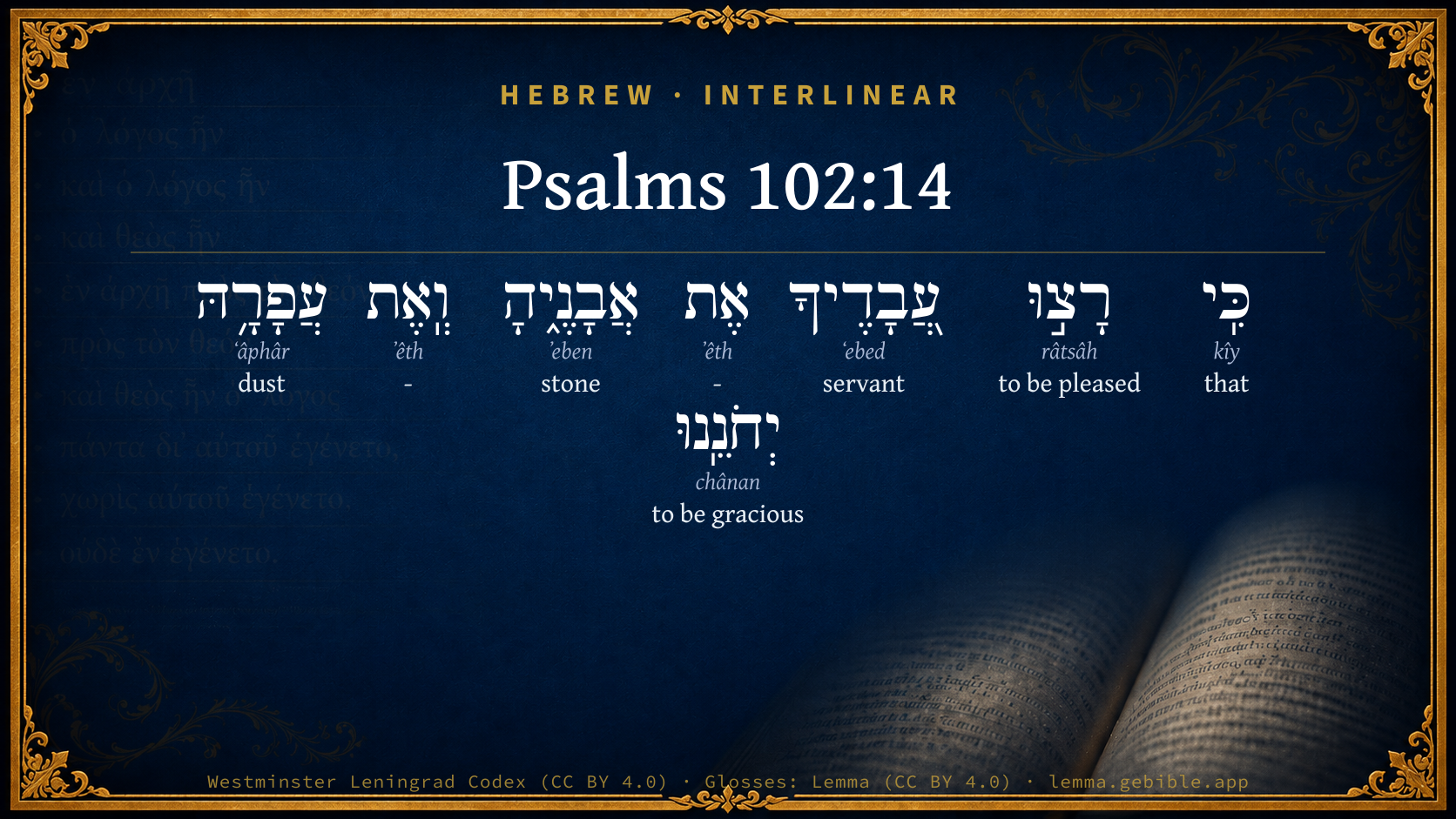
  1. כִּֽי kîy H3588 “that” Conjunction
  2. עֲ֭בָדֶיךָ ʻebed H5650 “servants · your” Noun, Common, Masculine, Plural, Construct + Suffix, Personal, 2nd Person, Masculine, Singular
  3. אֶת ʼêth H853 “-” Particle, Direct Object
  4. אֲבָנֶ֑יהָ ʼeben H68 “stones · her” Noun, Common, Feminine, Plural, Construct + Suffix, Personal, 3rd Person, Feminine, Singular
  5. וְֽאֶת ʼêth H853 “and · -” Conjunction + Particle, Direct Object
  6. עֲפָרָ֥הּ ʻâphâr H6083 “dust · her” Noun, Common, Masculine, Singular, Construct + Suffix, Personal, 3rd Person, Feminine, Singular
  7. יְחֹנֵֽנוּ chânan H2603 “to be gracious” Verb, Poel, Imperfect, 3rd Person, Masculine, Plural

About this verse

These counts appear in no published source. They are computed here, from the morphology-tagged text and Lemma’s own curated glosses. What Lemma adds →

8
words
7
distinct lemmas
Wisdom
section

Shared distinctive vocabulary

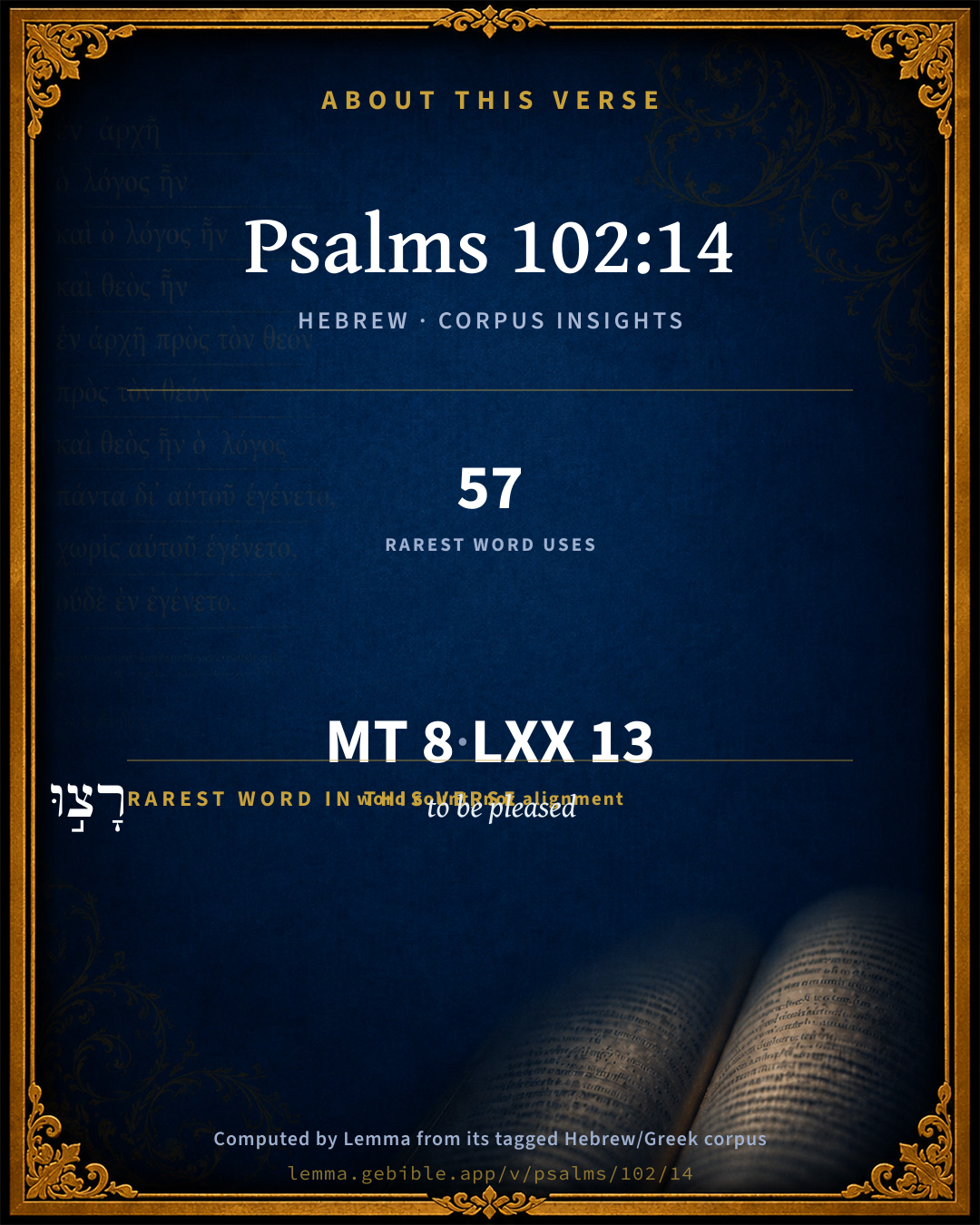
רָצ֣וּ to be pleased H7521 occurs in 55 verses of the Hebrew Bible. Also found in:

Grammatical profile

  • 2 verbs
  • 3 nouns
  • 1 conjunction
  • 2 particles

Verb forms

  • רָצ֣וּ Qal · Perfect
  • יְחֹנֵֽנוּ Poel · Imperfect

Hebrew & Septuagint length

In English translation the verse runs 14 words from the Hebrew and 15 from the Septuagint (LXX English) — closely comparable.

A rough comparison of the two English renderings, which tokenize alike — not a word-level alignment.

Word counts can differ between the Hebrew and the Greek without any difference in meaning — e.g. the Hebrew direct-object marker אֵת has no separate Greek word, and Greek often adds the article ὁ.

In the original languages it is 8 Hebrew tokens and 13 Greek tokens — but the two are counted differently (Hebrew bundles its prefixes and suffixes into one token; the Greek is in lemma form), so that isn’t a like-for-like length.

Cross-references

13

Topical passages linked to Psalms 102:14 in the Treasury of Scripture Knowledge — connected by theme and wording, ordered by reader-vote popularity; previews shown in the World English Bible.

  • Nehemiah 4:2 He spoke before his brothers and the army of Samaria, and said, What are these feeble Jews doing? will they fortify themselves? will they sacrifice? will they make an end in a day? will they revive the stones out of the heaps of rubbish, seeing they are burned?
  • Ezra 1:5 Then rose up the heads of fathers' [houses] of Judah and Benjamin, and the priests, and the Levites, even all whose spirit God had stirred to go up to build the house of Yahweh which is in Jerusalem.
  • Ezra 3:1–3 When the seventh month was come, and the children of Israel were in the cities, the people gathered themselves together as one man to Jerusalem.
  • Ezra 7:27 Blessed be Yahweh, the God of our fathers, who has put such a thing as this in the king's heart, to beautify the house of Yahweh which is in Jerusalem;
  • Nehemiah 1:3 They said to me, The remnant who are left of the captivity there in the province are in great affliction and reproach: the wall of Jerusalem also is broken down, and the gates of it are burned with fire.
  • Nehemiah 2:3 I said to the king, Let the king live forever: why should not my face be sad, when the city, the place of my fathers' tombs, lies waste, and the gates of it are consumed with fire?
  • Nehemiah 2:17 Then said I to them, You see the evil case that we are in, how Jerusalem lies waste, and the gates of it are burned with fire: come, and let us build up the wall of Jerusalem, that we be no more a reproach.
  • Nehemiah 4:6 So we built the wall; and all the wall was joined together to half [the height] of it: for the people had a mind to work.
  • Nehemiah 4:10 Judah said, The strength of the bearers of burdens is decayed, and there is much rubbish; so that we are not able to build the wall.
  • Psalms 79:1 God, the nations have come into your inheritance. They have defiled your holy temple. They have laid Jerusalem in heaps.
  • Psalms 79:7–10 For they have devoured Jacob, And destroyed his homeland.
  • Psalms 137:5–6 If I forget you, Jerusalem, Let my right hand forget its skill.
  • Daniel 9:16 Lord, according to all your righteousness, let your anger and please let your wrath be turned away from your city Jerusalem, your holy mountain; because for our sins, and for the iniquities of our fathers, Jerusalem and your people are become a reproach to all who are round about us.

Cross-references courtesy of OpenBible.info (CC BY 4.0).

Hebrew and Greek witnesses Masoretic Hebrew ↔ Greek Septuagint

The same verse in the two great witnesses to the Old Testament, shown verse-for-verse.

You’re reading Greek Psalm 101 (Hebrew Psalm 102). The Septuagint counts the superscription, so verse numbers can differ from the Hebrew — chapter-level alignment, not verse-by-verse. Numbering follows Rahlfs.

These are two independent witnesses, not word-aligned to each other, and the Septuagint is shown in lemma (dictionary) form.

Hebrew Psalms 102:14 Masoretic · Westminster Leningrad Codex

כִּֽי רָצ֣וּ עֲ֭בָדֶיךָ אֶת אֲבָנֶ֑יהָ וְֽאֶת עֲפָרָ֥הּ יְחֹנֵֽנוּ

For your servants take pleasure in her stones, And have pity on her dust.

World English Bible · Public Domain

Greek LXX Greek Psalm 101:14 Septuagint · lemma form

σύ ἀναἵστημι οἰκτείρω ὁ σιων ὅτι καιρός ὁ οἰκτείρω αὐτός ὅτι ἥκω καιρός

For your servants have taken pleasure in her stones, and they shall pity her dust.

LXX2012 (modern English Septuagint) · Public Domain

Hebrew: Westminster Leningrad Codex (CC BY 4.0). Greek: Septuagint (public domain); English from LXX2012 (modern English Septuagint) (Public Domain). How the Septuagint differs from the Hebrew →

Commentary

Notes on Psalms 102:14 from classic Christian and Jewish commentators (each source and its license shown beneath its notes). The classic Christian expositions comment on the surrounding passage and are grouped to its opening verse, so a note may address several verses; the Jewish commentaries on the Tanakh (Rashi and others) are per-verse, so they appear only where the commentator wrote on this verse.

Lemma curates 59 commentaries, every one of them public domain or Creative Commons licensed, each selected and text-cleaned for this edition rather than reprinted as found. About our sources →

Trapp's Complete Commentary

John Trapp

Psa 102:14 For thy servants take pleasure in her stones, and favour the dust thereof.

Ver. 14. For thy servants take pleasure in her stones] They pity her, and wish her welfare; much more then dost thou. He argueth from that sweet, tender, melting frame of spirit that was found in the faithful, which is but a reflex of that far sweeter that is in God.

And favour the dust thereof] The ruins and the rubbish, heartily desiring and expecting a re-edification and restoration, whereof they had a sweet promise, Amo 9:9, and for the spiritual temple to be built of Jews and Gentiles, they had many more. See all that followeth.

John Trapp, A Commentary or Exposition upon All the Books of the Old and New Testament (1647–1656) — public domain. Text from a community e-Sword module.

The Biblical Illustrator

Joseph S. Exell

Psa_102:14

For Thy servants take pleasure in her stones, and favour the dust thereof.

The secret of the stones

Stones and dust! Stones that have fallen out of place and lie scattered on the ground; dust that flies on every wind and drops back again into crevice and heap. Stones that are chipped and stained with smoke and fire and blood; dust, the final form of great things, the last remainder of vanished glories. There is nothing specially interesting or attractive about these things; you would not go out of the way to view them. Yet to a certain few they are beautiful with a beauty neither nature nor art can give. They are the stones of a temple that once smoked with sacrifice and rang with resounding psalms. It is the dust of a shrine that once reared its head into the sky, and centred in itself the national pride and worship.

I. Bricks and stones and mortar are neither interesting nor impressive materials. Scattered about over yards and fields, they have no attraction for any one except the boys of the neighbourhood. But bring them together, combine them, and their condition is at once altered, and the commonplace things become a force whose power all men must acknowledge. Weld them into the monument of some illustrious statesman, and crowds will gather round it and garland it with flowers. Build them into some cathedral of vast proportions, and the effect is overwhelming; you sink into insignificance, and feel like an ant crawling over its floor. Fashion them into some mighty sepulchre to hold the dust of some uncrowned king, and pilgrims from the far places of the earth will come to gaze upon it.

II. The temple stones have a power over us, but the secret of their power is not so much in them as in that with which they are identified. It may be found partly in the memories which cluster about them. Round those stones of the Temple there hung for the Jew memories of his two great kings, David and Solomon--memories of the full tide of national prosperity and the zenith of their power as an empire; of the great priests and prophets who had ruled them; of the oracles and revelations in national need; of great days of festival; and of sacrifice, confession, and pardon. And our less ancient and less historic fanes are full of memories, less splendid, but equally dear. There is the memory of one long since dead, who first guided our little feet up the aisle. There is the memory of the saintly men who first taught us how sweet and strong and beautiful human character could be. There is the memory of friendships formed there and loves born there which have been woven into our lives, and are part of our lives for ever. There is the memory of that great hour when we first discovered Christ was real and living, and knew what it was to believe and be saved.

III. It is customary for some to look upon this affection with scarcely veiled contempt. They call it love for bricks and mortar, and dub it superstition and sentiment. Instead of being a superstition or sentiment, this attachment to Gods house is one of the great forces which make for the building of character. Love of the temple is love of the best and highest, and its harvest is nobility of character and righteousness of life. Let us use our wisdom, our intellects, our energy, and our wealth to make the temple increasingly dear. Let us make it so beautiful, its service so attractive, its ministry so strong, its power so Christlike that the love for the stones of His house--which is one of the strongest formative and conserving forces in the lives of men and nations--may be the common and binding sentiment of all classes of men. (C. E. Stone.)

The Biblical Illustrator, edited by Joseph S. Exell (c. 1880s–1900s) — public domain. Text from a community e-Sword module.

J. A. Alexander on Psalms

Joseph Addison Alexander

15. (Psa 102:14) When thy servants love her stones, and her dust regard with favour. Both verbs in Hebrew mean to favour, or more strongly to delight in, to take pleasure in. See above, Psa 62:4; Psa 85:1. Stones and dust are here put for ruins or rubbish, as in Neh 4:2; Neh 4:10. The verse may be understood as a condition or a premonition of her restoration, that before it takes place, God will fill his servants with affectionate concern for her desolate condition. The same sense may be obtained without de parting from the usual sense of the particle. Thou wilt have mercy upon Zion, FOR thy servants already look with interest and strong desire on her ruins, a sure sign of the approaching restoration.

Joseph Addison Alexander, The Psalms Translated and Explained (1850) — public domain. Text from a community e-Sword module.

Geneva Bible (1599)

Geneva Bible translators

The more that the Church is in misery and desolation, the more ought the faithful to love and pity it.

Geneva Bible (1599) marginal notes — public domain. Text via Bolls.life.

Adam Clarke's Commentary

Verse 14. Thy servants take pleasure in her stones] Though Jerusalem was at this time in a heap of ruins, yet even her rubbish was sacred in the eyes of the pious; for this had been the city of the great King.

Adam Clarke's Commentary on the Bible (1810–1826) — public domain. Text from a community e-Sword/MySword module.

John Calvin's Commentaries

14. For thy servants take pleasure in her stones To restrict this to Cyrus and Darius is altogether unsuitable. It is not at all wonderful to find the Jewish doctors hunting, with excessive eagerness, after foolish subtilties; but I am surprised that some of our modern commentators subscribe to such a poor and cold interpretation. I am aware that, in some places, the unbelieving and the wicked are called the servants of God, as in Jeremiah 25:9, because God makes use of them as instruments for executing his judgments. Nay, I admit that Cyrus is called by name God’s chosen servant, (Isaiah 44:28) but the Holy Spirit would not have bestowed so honorable a title, either on him or Darius, without some qualification. Besides, it is probable that this psalm was composed before the edict was published, which granted the people liberty to return to their native country. It therefore follows, that God’s people alone are included in the catalogue of his servants, because it is their purpose, during the whole of their life, to obey his will in all things. The prophet, I have no doubt, speaks in general of the whole Church, intimating that this was not the wish entertained merely by one man, but was shared by the whole body of the Church. The more effectually to induce God to listen to his prayer, he calls upon all the godly, who were then in the world, to join with him in the same request. It, unquestionably, very much contributes to increase the confidence of success, when supplications are made by all the people of God together, as if in the person of one man, according to what the Apostle Paul declares,

“Ye also, helping together by prayer for us, that, for the gift bestowed upon us, by the means of many persons, thanks may be given by many on our behalf.” (2 Corinthians 1:11)

Farther, when the deformed materials which remained of the ruins of the temple and city are emphatically termed the stones of Zion, this is designed to intimate, not only that the faithful in time past were affected with the outward splendor of the temple, when, besides attracting the eyes of men, it had power to ravish with admiration all their senses, but also, that although the temple was destroyed, and nothing was to be seen where it stood but hideous desolation, yet their attachment to it continued unalterable, and they acknowledged the glory of God, in its crumbling stones and decayed rubbish. As the temple was built by the appointment of God, and as he had promised its restoration, it was, doubtless, proper and becoming that the godly should not withdraw their affections from its ruins. Meanwhile, as an antidote against the discouraging influence of the taunting mockery of the heathen, they required to look into the Divine word for something else than what presented itself to their bodily eyes. Knowing that the very site of the temple was consecrated to God, and that that sacred edifice was to be rebuilt on the same spot, they did not cease to regard it with reverence, although its stones lay in disorder, mutilated and broken, and heaps of useless rubbish were to be seen scattered here and there. The sadder the desolation is to which the Church has been brought, the less ought our affections to be alienated from her. Yea, rather, this compassion which the faithful then exercised, ought to draw from us sighs and groans; and would to God that the melancholy description in this passage were not so applicable to our own time as it is! He, no doubt, has his churches erected in some places, where he is purely worshipped; but, if we cast our eyes upon the whole world, we behold his word every where trampled under foot, and his worship defiled by countless abominations. Such being the case, his holy temple is assuredly every where demolished, and in a state of wretched desolation; yea, even those small churches in which he dwells are torn and scattered. What are these humble erections, when compared with that splendid edifice described by Isaiah, Ezekiel, and Zechariah? But no desolation ought to prevent us from loving the very stones and dust of the Church. Let us leave the Papists to be proud of their altars, their huge buildings, and their other exhibitions of pomp and splendor; for all that heathenish magnificence is nothing else but an abomination in the sight of God and his angels, whereas the ruins of the true temple are sacred.

John Calvin's Commentaries (1540-1563) — public domain. Text from the Calvin Translation Society English edition (1840s-50s) via the Christian Classics Ethereal Library (ccel.org). Calvin's coverage is partial (roughly two-thirds of the Bible); uncommented books and verses are honest gaps, never fabricated. The 19th-century editor's footnotes and remarks are omitted so the notes are faithfully Calvin's own voice.

Ellicott's Commentary for English Readers

(14) Stones . . . dust.—This touching description of the devotion of the Jews to their ruined city is best illustrated by the actual history in Nehemiah 3, 4, and by the scenes so often described by travellers at the “wailing place” in modern Jerusalem.

A Bible Commentary for English Readers, edited by Charles John Ellicott (1878–1897) — public domain. Text from a community e-Sword module.

The Cambridge Bible for Schools and Colleges

gen. ed. J. J. S. Perowne

14. For thy servants have affection for her stones,

And for her dust are they moved with pity.

Another argument to move Jehovah’s compassion. His servants look with yearning love towards Zion in its ruin. Even the broken stones and scattered heaps of rubbish which are all that remain of it are very dear to them. The language resembles that of Sanballat’s contemptuous taunt: “Will they revive the stones out of the heaps of rubbish?” Heb. dust, Neh_4:2; cp. Psa_102:10, “there is much rubbish,” Heb. dust.

The Cambridge Bible for Schools and Colleges (gen. ed. J. J. S. Perowne; Cambridge University Press, 1878–1918) — public domain. Text from a community e-Sword module.

John Gill's Exposition

So the Heathen shall fear the name of the Lord,.... Whose name is reverend, and to be feared; especially the glorious and fearful name "Jehovah", expressive of the divine existence, of his eternity and immutability; though the name of the Lord frequently signifies himself, and here particularly the Messiah, the Son of God, in whom the name of the Lord is; the King of saints, whom all men will fear in the latter day, when the set time to favour Zion is come; will stand in awe of him, be careful of offending him, and will serve and worship him; even the very Heathen, who knew not God, and had no fear of him before their eyes, or in their hearts; the Pagan nations, whose kingdoms will become the kingdoms of our Lord, and of his Christ; see Rev 11:15.

and all the kings of the earth thy glory; which may be supplied thus, either "all the kings of the earth shall see thy glory", or shall fear thee because of "thy glory"; the glory of Christ's person, as the Son of God; the glory of his offices, as Prophet, Priest, and King; especially the glory of his kingly office, to which that of the kings of the earth is not to be compared; the glory of his works of creation, providence, and redemption; and as it will be held forth in the Gospel, with which the earth will now be full, and so be filled with the glory of the Lord, Psa 72:19, and will be so remarkable and conspicuous as to be taken notice of by the kings of the earth, even by all of them, who, when the glory of the Lord shall be risen in Zion, will come to the brightness of it, and look upon it, and admire it, and fear because of it, Isa 60:1.

John Gill's Exposition of the Whole Bible (1746–1763) — public domain (CC PDM 1.0). Text via the HelloAO Bible API.

Albert Barnes' Notes on the Bible

For thy servants take pleasure in her stones - Those who profess to be thy servants; thy friends. This was the “evidence” to the mind of the psalmist that God was about to visit his people, and to rebuild Jerusalem. It was an “awakened interest” among the professed people of God, leading them to manifest their love for Zion, and for all that pertained to her - a love for the very stones that lay in undistinguished heaps where the city once stood - the piles of rubbish where the walls and dwellings had once been. The people of God in their captivity began to look with strong interest on these very ruins, and with an earnest wish that from these ruins the city may again arise, and the walls be rebuilt.

And favor the dust thereof - literally, pity - or, show compassion for. They no longer look with indifference on these ruins of Zion. They look with a tender heart on the very dust of those ruins. They feel that a wrong has been done to Zion; they ardently desire its restoration to its former splendor and glory. They long for a return to it as to their home. They are weary with their captivity, and they are anxiously waiting for the time when they may revisit their native land. This would seem to refer to an awakened interest on the subject, caused perhaps in part by the fact that it could be ascertained (see Dan 9:2) that the period of the captivity was about to end, and partly by an influence on their hearts from on high, awakening in them a deeper love for Zion - a revival of pure religion. The practical truth taught here is, that an indication of a coming revival of religion is often manifested by the increased attention to the subject among its professed friends; by the desire in their hearts that it may be so; by tenderness, pity, compassion among them in view of abounding desolations, the coldness of the church, and the prevalence of iniquity; by their looking with interest on that which had before been neglected, like shapeless ruins - the prayer-meeting, the communion, the sanctuary; by a conscious returning love in their hearts for all that pertains to religion, however unimportant it may be in the eyes of the world, or however it may be despised. A surrounding world would look with unconcern on the ruins of Jerusalem; a friend of God, in whose heart religion was revived, would look with the most tender concern even on that rubbish, and those ruins. So it is in a revival of religion, when God is about to visit his church in mercy. Everything in regard to the church becomes an object of deep interest.

Albert Barnes' Notes on the Bible (1834–1885) — public domain. Text from a community e-Sword/MySword module.

Matthew Poole's English Annotations

Thy people value the dust and rubbish of the holy city more than all the palaces of the earth, and passionately desire that it may be rebuilt.

Matthew Poole's English Annotations on the Holy Bible (1683–1685) — public domain. Text from a community e-Sword/MySword module.

The Treasury of David

Charles H. Spurgeon

Ver. 14. For thy servants take pleasure in her stones, and favour the dust thereof. They delight in her so greatly that even her rubbish is dear to them. It was a good omen for Jerusalem when the captives began to feel a home-sickness, and began to sigh after her. We may expect the modern Jews to be restored to their own land when the love of their country begins to sway them, and casts out the love of gain. To the church of God no token can be more full of hope than to see the members thereof deeply interested in all that concerns her; no prosperity is likely to rest upon a church when carelessness about ordinances, enterprises, and services is manifest; but when even the least and lowest matter connected with the Lord's work is carefully attended to, we may be sure that tne set time to favour Zion is come. The poorest church member, the most grievous backslider, the most ignorant convert, should be precious in our sight, because forming a part, although possibly a very feeble part, of the new Jerusalem. If we do not care about the prosperity of the church to which we belong, need we wonder if the blessing of the Lord is withheld?

Ver. 14. For thy servants take pleasure in her stones. That is, they are still attached to her, and regard her with extreme affection, although in ruins. Jerusalem itself affords at this day a touching illustration of this passage. There is reason to believe that a considerable portion of the lower part of the walls which enclose the present mosque of Omar, which occupies the site of the ancient Jewish temple, are the same, or at least the southern, western, and eastern sides are the same as those of Solomon's temple. At one part where the remains of this old wall are the most considerable and of the most massive characterwhere two courses of masonry, composed of massive blocks of stone, rising to the height of thirty feetis what is called the Wailing Place of the Jews. "Here, "says Dr. Olin, "at the foot of the wall, is an open place paved with flags, where the Jews assemble every Friday, and in small numbers on other days, for the purpose of praying and bewailing the desolations of their holy places. Neither the Jews nor Christians are allowed to enter the Haram, which is consecrated to Mohammedan worship, and this part of the wall is the nearest approach they can make to what they regard as the precise spot within the forbidden enclosure upon which the ancient temple stood. They keep the pavement swept with great care, and take off their shoes, as on holy ground. Standing or kneeling with their faces towards the ancient wall, they gaze in silence upon its venerable stones, or pour forth their complaints in half-suppressed, though audible tones. This, to me, was always a most affecting sight, and I repeated my visit to this interesting spot to enjoy and sympathise with the melancholy yet pleasing spectacle. The poor people sometimes sobbed aloud, and still found tears to pour out for the desolations of their `beautiful house.' `If I forget thee, O Jerusalem, let my right hand forget her cunning. If I do not remember thee, let my tongue cleave to the roof of my mouth; if I prefer not Jerusalem above my chief joy.'" Kitto's Pictorial Bible.

Psalms 102:15*

Charles H. Spurgeon's The Treasury of David (1869–1885) — public domain. Psalms only. Text from a community e-Sword/MySword module.

Whedon's Commentary on the Bible

Daniel D. Whedon

14. Take pleasure in her stones… favour the dust—Not the “stones” to be prepared for the new city and temple, but the ruins of the old, as left by Nebuchadnezzar’s army. See Psa_79:1; Psa_74:2-3. The “stones” and “dust”—rubbish and debris of the old city—are still dear to them. Their hearts lingered here. Psa_137:5-6. So the spiritual Zion, the true Church, in glory or in reproach is dear to the hearts of all her true children.

Daniel D. Whedon (gen. ed.), Commentary on the Old and New Testaments (1874–1909) — public domain. Text from a community e-Sword module.

The Pulpit Commentary

For thy servants take pleasure in her stones. (comp. Isa_64:10, 11 Lam_4:1 Neh_2:13 Neh_4:2) To this day the same affection is shown by Israelite pilgrims at the "Jews" Wailing Place." And favour (rather, pity) the dust thereof. The rubbish in which the stones lay (Neh_4:2) seems to be intended.

The Pulpit Commentary (1880–1919), ed. H.D.M. Spence-Jones & Joseph S. Exell — public domain. Text from a community e-Sword module.

Rashi

Rabbi Shlomo Yitzchaki (Rashi)

You will rise, You will have mercy on Zion for it is time to favor it For so You promised (Deut. 32:36): “When He sees that their power is gone,” and it is indeed gone.

Rashi on the Tanakh — English translations: “The Judaica Press complete Tanach with Rashi, translated by A. J. Rosenberg” (CC BY 4.0); “Pentateuch with Rashi's commentary by M. Rosenbaum and A.M. Silbermann, 1929-1934” (public domain); “The Metsudah Tanach series, Lakewood, N.J” (CC BY 4.0); and “The Book of Joshua, Metsudah Publications, 1997” (CC BY 4.0). Text via Sefaria.

Lesson kit

Teaching starters — assembled from the data on this page, not authored interpretation. Every prompt links to the verse data it draws on. Edit before teaching.

Psalms, in the Wisdom, opens this verse with 8 words (7 distinct Hebrew lemmas). Its most distinctive word is râtsâh (“to be pleased”). A historical commentator’s framing appears above. Read the whole chapter for the surrounding context.

Discussion questions

  1. What does “to be pleased” (râtsâh) contribute to the verse as a whole?
  2. Genesis 33:10 shares the word «to be pleased» with this verse. How do the two illuminate each other?
  3. The translations on this page render this verse differently — a whole-verse word diff, not a word-by-word alignment. What might account for the different wordings?
  4. The verb «רָצ֣וּ» is Qal Perfect. How does its form color the action?
  5. Reading how Trapp's Complete Commentary and The Biblical Illustrator read this verse, where do the two commentators agree and where do they part?

Things to notice

Reading settings

Reading text

Shown beneath each verse's original-language words.

Old Testament
Old Testament edition

Read the OT as the Masoretic Hebrew (MT) or the Greek Septuagint (LXX).

English shown for the Greek Septuagint (in the Hebrew ↔ Greek comparison).

Comparing translations? Open the Compare panel on any verse page to stack up to four side by side.