Ezekiel 24:7

Hebrew (Westminster Leningrad Codex) Ezekiel 24:7 appears in the Hebrew Old Testament. The text above is from the Westminster Leningrad Codex. Each word links to its Strong’s number, a concise gloss, and parsing drawn from the Open Scriptures Hebrew Bible morphology. Click any word for its full Brown-Driver-Briggs (BDB) entry.
Download image
Cite this verse

Ezekiel 24:7 (World English Bible). Public Domain. Lemma interlinear Bible study tool, https://lemma.gebible.app/v/ezekiel/24/7.

Show BibTeX & RIS
BibTeX
RIS
English Translation
For her blood is in the midst of her; she set it on the bare rock; she didn't pour it on the ground, to cover it with dust.
World English Bible · Public Domain
Download a study sheet

One document with this verse’s original text, its word-by-word gloss line, the meaning frame, cross-references with their text, attributed commentary, and full source and license credits — printable, and it pastes into notes with its structure intact.

This verse Autodidact and up

Study sheet (.html) Plain text (.txt)

A passage Seminary Student

Up to 50 verses in one chapter. A passage sheet keeps up to 6 commentary sources and 12 cross-references per verse, in the order this page ranks them, and says so on the sheet whenever that leaves anything out. Ask for a single verse and you get the Autodidact verse sheet above.

Everything on this page stays free to read, with no account — the sheet is a download of what is already on screen, not access to it.

Want to remove ads? Support Godless Engineer
Compare translations 3

The same verse in 3 English versions, stacked beneath the original-language interlinear above. Click any original word for its lexicon entry.

Each is an independent rendering of the whole verse — the interlinear is not word-aligned to these translations.

Highlighted words mark where these versions differ — a whole-verse word diff, not a word-by-word alignment.

  • World English Bible Public Domain
    For her blood is in the midst of her; she set it on the bare rock; she didn't pour it on the ground, to cover it with dust.
  • King James Version Public Domain
    For her blood is in the midst of her; she set it upon the top of a rock; she poured it not upon the ground, to cover it with dust;
  • unfoldingWord Literal Text CC BY-SA 4.0
    For her blood is in the midst of her. She has set it on the smooth rock; she has not poured it out on the ground to cover it with dust,

unfoldingWord Literal Text — © unfoldingWord, licensed CC BY-SA 4.0. Word-aligned USFM3 via Door43 (git.door43.org/unfoldingWord/en_ult).

Versions to compare (up to 4)

3 of 4 selected

Show all 18 translations

Every available English version of this verse, each an independent rendering of the whole verse.

  • World English Bible Public Domain
    For her blood is in the midst of her; she set it on the bare rock; she didn't pour it on the ground, to cover it with dust.
  • Berean Standard Bible Public Domain
    For the blood she shed is still within her; she poured it out on the bare rock; she did not pour it on the ground to cover it with dust.
  • Majority Standard Bible Public Domain
    For the blood she shed is still within her; she poured it out on the bare rock; she did not pour it on the ground to cover it with dust.
  • King James Version Public Domain
    For her blood is in the midst of her; she set it upon the top of a rock; she poured it not upon the ground, to cover it with dust;
  • American Standard Version (1901) Public Domain
    For her blood is in the midst of her; she set it upon the bare rock; she poured it not upon the ground, to cover it with dust.
  • Revised Version (1885) Public Domain
    For her blood is in the midst of her; she set it upon the bare rock; she poured it not upon the ground, to cover it with dust;
  • Geneva Bible (1599) Public Domain
    For her blood is in the middes of her: shee set it vpon an high rocke, and powred it not vpon on the ground to couer it with dust,
  • Douay-Rheims (1899) Public Domain
    For her blood is in the midst of her, she hath shed it upon the smooth rock: she hath not shed it upon the ground, that it might be covered with dust.
  • Young's Literal Translation Public Domain
    For her blood in her midst hath been, On a clear place of a rock she hath set it, She hath not poured it on the earth, To cover it over with dust.
  • Literal Standard Version CC BY-SA 4.0
    For her blood has been in her midst, || She has set it on a clear place of a rock, || She has not poured it on the earth, || To cover it over with dust.
  • Unlocked Literal Bible CC BY-SA 4.0
    For her blood is in the midst of her. She has set it on the smooth rock; she has not poured it out on the ground to cover it with dust,
  • unfoldingWord Literal Text CC BY-SA 4.0
    For her blood is in the midst of her. She has set it on the smooth rock; she has not poured it out on the ground to cover it with dust,
  • Darby Bible Public Domain
    for her blood is in the midst of her; she set it upon the bare rock; she poured it not upon the ground, to cover it with dust.
  • World Messianic Bible Public Domain
    “‘“For the blood she shed is in the middle of her. She set it on the bare rock. She didn’t pour it on the ground, to cover it with dust.
  • Webster's Bible Public Domain
    For her blood is in the midst of her; she set it upon the top of a rock; she poured it not upon the ground, to cover it with dust;
  • Free Bible Version CC BY-SA 4.0
    For the blood she shed is still inside the city. She shed it openly on bare rock—she didn't even spill it on the ground and cover it up with dirt.
  • Bible in Basic English Public Domain
    For her blood is in her; she has put it on the open rock not draining it on to the earth so that it might be covered with dust;
  • JPS Tanakh (1917) Public Domain
    For her blood is in the midst of her; she set it upon the bare rock; she poured it not upon the ground, to cover it with dust;

Literal Standard Version (2020), Covenant Press — licensed CC BY-SA 4.0. Text via the HelloAO Bible API (eBible.org). Unlocked Literal Bible (unfoldingWord) — licensed CC BY-SA 4.0. Text via the HelloAO Bible API (eBible.org). unfoldingWord Literal Text — © unfoldingWord, licensed CC BY-SA 4.0. Word-aligned USFM3 via Door43 (git.door43.org/unfoldingWord/en_ult). Free Bible Version, Dr. Jonathan Gallagher — licensed CC BY-SA 4.0. Text via the HelloAO Bible API (eBible.org).

Word by word

More ways to search: Search by grammar → Find every occurrence → Compare this word →

Practice this passage: Drill this verse → Learn its vocabulary →

צְחִ֥יחַ
tsᵉchîyach
H6706
“glow of”
Noun, Common, Masculine, Singular, Construct
Part of Speech
Noun
Type
Common
Gender
Masculine
Number
Singular
State
Construct
Full BDB Definition

Origin: from H6705

TWOT: 1903b

shining or glaring surface, glow
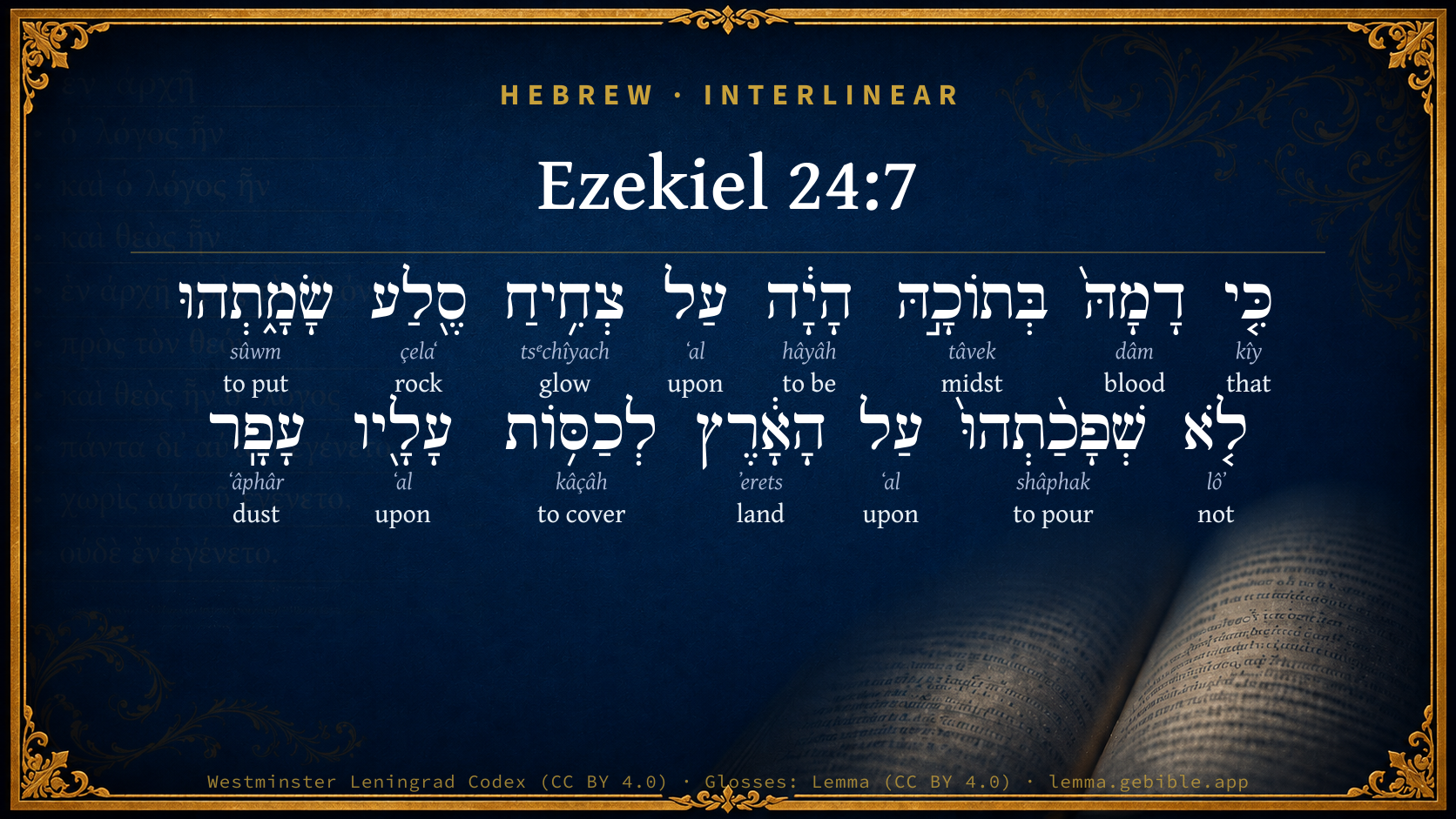
  1. כִּ֤י kîy H3588 “that” Conjunction
  2. דָמָהּ֙ dâm H1818 “blood · her” Noun, Common, Masculine, Singular, Construct + Suffix, Personal, 3rd Person, Feminine, Singular
  3. בְּתוֹכָ֣הּ tâvek H8432 “in/at · midst · her” Preposition + Noun, Common, Masculine, Singular, Construct + Suffix, Personal, 3rd Person, Feminine, Singular
  4. הָיָ֔ה hâyâh H1961 “to be” Verb, Qal, Perfect, 3rd Person, Masculine, Singular
  5. עַל ʻal H5921 “upon” Preposition
  6. סֶ֖לַע çelaʻ H5553 “rock” Noun, Common, Masculine, Singular, Absolute
  7. שָׂמָ֑תְהוּ sûwm H7760 “to put · him” Verb, Qal, Perfect, 3rd Person, Feminine, Singular + Suffix, Personal, 3rd Person, Masculine, Singular
  8. לֹ֤א lôʼ H3808 “not” Particle, Negative
  9. שְׁפָכַ֨תְהוּ֙ shâphak H8210 “to pour · him” Verb, Qal, Perfect, 3rd Person, Feminine, Singular + Suffix, Personal, 3rd Person, Masculine, Singular
  10. עַל ʻal H5921 “upon” Preposition
  11. הָאָ֔רֶץ ʼerets H776 “the · land” Particle, Definite Article + Noun, Common, Both, Singular, Absolute
  12. לְכַסּ֥וֹת kâçâh H3680 “to cover” Preposition + Verb, Piel, Infinitive Construct
  13. עָלָ֖יו ʻal H5921 “upon · him” Preposition + Suffix, Personal, 3rd Person, Masculine, Singular
  14. עָפָֽר ʻâphâr H6083 “dust” Noun, Common, Masculine, Singular, Absolute

About this verse

These counts appear in no published source. They are computed here, from the morphology-tagged text and Lemma’s own curated glosses. What Lemma adds →

15
words
13
distinct lemmas
Prophets
section

Notable vocabulary

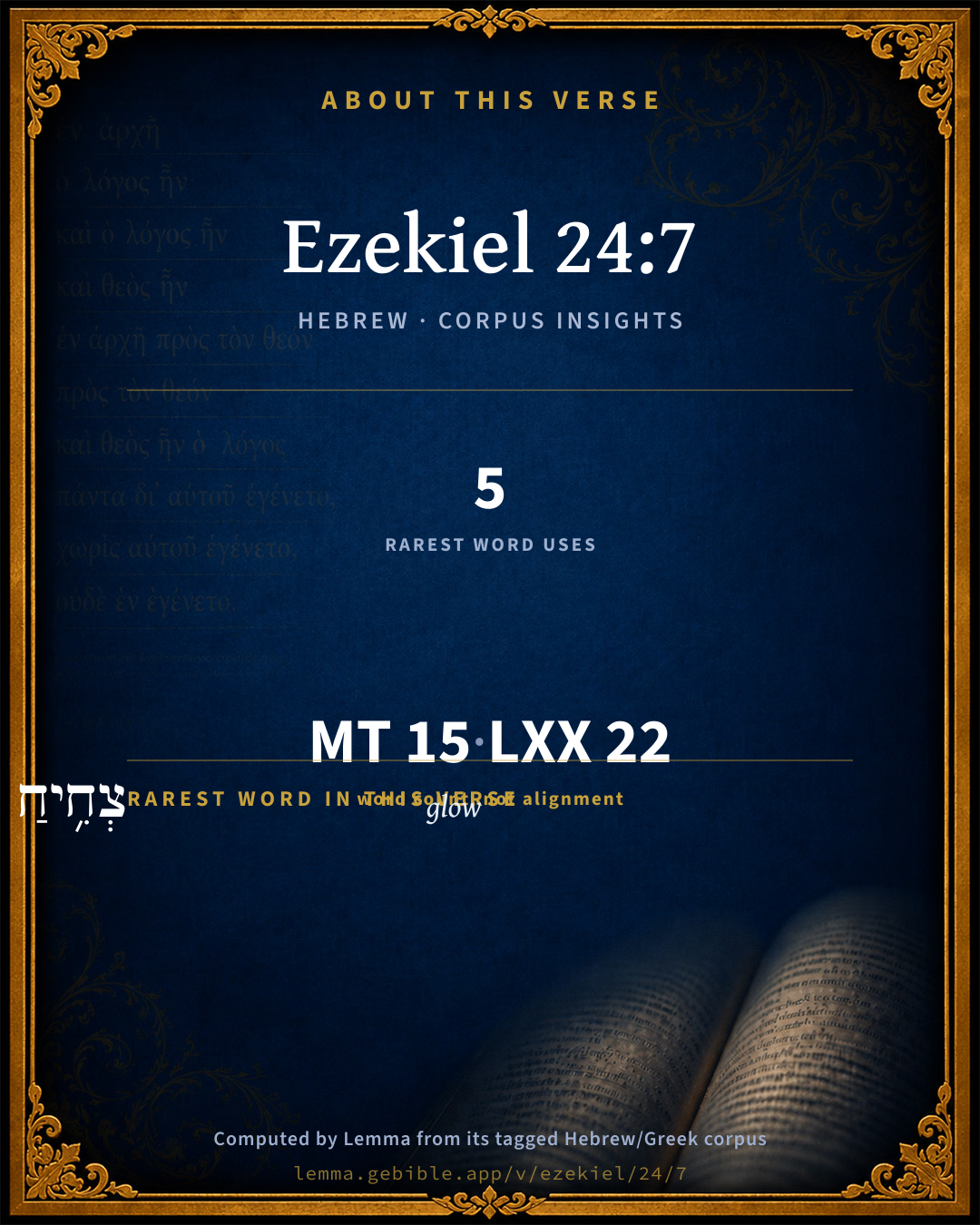
The rarest word here is צְחִ֥יחַ glow H6706 — appearing just 5 times in the whole Hebrew Bible.

Shared distinctive vocabulary

צְחִ֥יחַ glow H6706 occurs in 5 verses of the Hebrew Bible. Also found in:

Grammatical profile

  • 4 verbs
  • 6 nouns
  • 3 prepositions
  • 1 conjunction
  • 1 particle

Verb forms

  • הָיָ֔ה Qal · Perfect
  • שָׂמָ֑תְהוּ Qal · Perfect
  • שְׁפָכַ֨תְהוּ֙ Qal · Perfect
  • לְכַסּ֥וֹת Piel · Infinitive Construct

Repetition

A word recurs within this verse — often emphatic in Hebrew:

Hebrew & Septuagint length

In English translation the verse runs 28 words from the Hebrew and 33 from the Septuagint (LXX English) — closely comparable.

A rough comparison of the two English renderings, which tokenize alike — not a word-level alignment.

Word counts can differ between the Hebrew and the Greek without any difference in meaning — e.g. the Hebrew direct-object marker אֵת has no separate Greek word, and Greek often adds the article ὁ.

In the original languages it is 15 Hebrew tokens and 22 Greek tokens — but the two are counted differently (Hebrew bundles its prefixes and suffixes into one token; the Greek is in lemma form), so that isn’t a like-for-like length.

Cross-references

9

Topical passages linked to Ezekiel 24:7 in the Treasury of Scripture Knowledge — connected by theme and wording, ordered by reader-vote popularity; previews shown in the World English Bible.

  • Leviticus 17:13 "'Whatever man there is of the children of Israel, or of the strangers who live as foreigners among them, who takes in hunting any animal or bird that may be eaten; he shall pour out its blood, and cover it with dust.
  • Deuteronomy 12:16 Only you shall not eat the blood; you shall pour it out on the earth as water.
  • Deuteronomy 12:24 You shall not eat it; you shall pour it out on the earth as water.
  • 1 Kings 21:19 You shall speak to him, saying, Thus says Yahweh, Have you killed and also taken possession? You shall speak to him, saying, Thus says Yahweh, In the place where dogs licked the blood of Naboth shall dogs lick your blood, even yours.
  • Job 16:18 "Earth, don't cover my blood, Let my cry have no place to rest.
  • Isaiah 3:9 The look of their faces testify against them. They parade their sin like Sodom. They don't hide it. Woe to their soul! For they have brought disaster upon themselves.
  • Isaiah 26:21 For, behold, Yahweh comes forth out of his place to punish the inhabitants of the earth for their iniquity: the earth also shall disclose her blood, and shall no more cover her slain.
  • Jeremiah 2:34 Also in your skirts is found the blood of the souls of the innocent poor: you did not find them breaking in; but it is because of all these things.
  • Jeremiah 6:15 Were they ashamed when they had committed abomination? nay, they were not at all ashamed, neither could they blush: therefore they shall fall among those who fall; at the time that I visit them they shall be cast down, says Yahweh.

Cross-references courtesy of OpenBible.info (CC BY 4.0).

Hebrew and Greek witnesses Masoretic Hebrew ↔ Greek Septuagint

The same verse in the two great witnesses to the Old Testament, shown verse-for-verse.

These are two independent witnesses, not word-aligned to each other, and the Septuagint is shown in lemma (dictionary) form.

Hebrew Ezekiel 24:7 Masoretic · Westminster Leningrad Codex

כִּ֤י דָמָהּ֙ בְּתוֹכָ֣הּ הָיָ֔ה עַל צְחִ֥יחַ סֶ֖לַע שָׂמָ֑תְהוּ לֹ֤א שְׁפָכַ֨תְהוּ֙ עַל הָאָ֔רֶץ לְכַסּ֥וֹת עָלָ֖יו עָפָֽר

For her blood is in the midst of her; she set it on the bare rock; she didn't pour it on the ground, to cover it with dust.

World English Bible · Public Domain

Greek LXX Ezekiel 24:7 Septuagint · lemma form

ὅτι αἷμα αὐτός ἐν μέσος αὐτός εἰμί ἐπί λεωπετρία τάσσω αὐτός οὐ ἐκχέω αὐτός ἐπί ὁ γῆ ὁ καλύπτω ἐπί αὐτός γῆ

For her blood is in the midst of her; I have set it upon a smooth rock: I have not poured it out upon the earth, so that the earth should cover it;

LXX2012 (modern English Septuagint) · Public Domain

On this verse, Haydock's Catholic Bible Commentary discusses the Septuagint’s reading. Read the note in Commentary ↓

Hebrew: Westminster Leningrad Codex (CC BY 4.0). Greek: Septuagint (public domain); English from LXX2012 (modern English Septuagint) (Public Domain). How the Septuagint differs from the Hebrew →

Targum (Aramaic paraphrase)

1

The Targum is the ancient Jewish Aramaic paraphrase of the Hebrew Scriptures — an interpretive translation, not the Hebrew text itself. Onkelos (literal) and Pseudo-Jonathan (expansive) render the Torah, and Jonathan the Prophets. Coverage is partial: where no permissively-licensed English translation exists for a verse, only the Aramaic is shown. This is verse-level text, not a word-by-word alignment to the Hebrew.

  1. Targum Jonathan Prophets (Joshua–Malachi)
    אֲרֵי דַם זַכַּאי דְאִתְאַשַׁד בְּגַוָהּ בְּזֵידוּ וּבִדְרַע מְרוֹמָם שְׁפַכְתֵּיהּ לָא שְׁפַכְתֵּיהּ בְּשָׁלוּ לְמֶעְבַּד עֲלוֹהִי תְּיוּבָא:

    (no public-domain English translation for this verse)

    Targum Jonathan — Aramaic: “Mikraot Gedolot” (public domain). English: “Sefaria Community Translation” (CC0 1.0 (public-domain dedication)); “London "Chaldee Paraphrase," 1871” (public domain). Text via Sefaria.

Commentary

Notes on Ezekiel 24:7 from classic Christian and Jewish commentators (each source and its license shown beneath its notes). The classic Christian expositions comment on the surrounding passage and are grouped to its opening verse, so a note may address several verses; the Jewish commentaries on the Tanakh (Rashi and others) are per-verse, so they appear only where the commentator wrote on this verse.

Lemma curates 59 commentaries, every one of them public domain or Creative Commons licensed, each selected and text-cleaned for this edition rather than reprinted as found. About our sources →

Trapp's Complete Commentary

John Trapp

Eze 24:7 For her blood is in the midst of her; she set it upon the top of a rock; she poured it not upon the ground, to cover it with dust;

Ver. 7. For her blood is in the midst of her.] She careth not who knows of her murders and oppressions. He seemeth to allude to that law, that blood being let out of a beast should be covered in the ground.

She set it upon the top of a rock.] Super limpidissimam petram, saith the Vulgate, as glorying in it. So Abimelech slew all his brethren upon one stone; {Jdg 9:5} the Jews crucified our Saviour on Mount Calvary.

She poured it not.] Pudet et non esse impudentem. It is shameful not to be shameless.

John Trapp, A Commentary or Exposition upon All the Books of the Old and New Testament (1647–1656) — public domain. Text from a community e-Sword module.

Geneva Bible (1599)

Geneva Bible translators

The city showed her cruelty to all the world, and was not ashamed thereof, neither yet hid it.

Geneva Bible (1599) marginal notes — public domain. Text via Bolls.life.

Jamieson, Fausset & Brown

Robert Jamieson, A. R. Fausset & David Brown

upon the top of a rock--or, "the dry, bare, exposed rock," so as to be conspicuous to all. Blood poured on a rock is not so soon absorbed as blood poured on the earth. The law ordered the blood even of a beast or fowl to be "covered with the dust" (Lev 17:13); but Jerusalem was so shameless as to be at no pains to cover up the blood of innocent men slain in her. Blood, as the consummation of all sin, presupposes every other form of guilt.

Jamieson, Fausset & Brown — Commentary Critical and Explanatory on the Whole Bible (1871) — public domain (CC PDM 1.0). Text via the HelloAO Bible API.

Adam Clarke's Commentary

Verse 7. For her blood is in the midst of her] She gloried in her idol sacrifices; she offered them upon a rock, where the blood should remain evident; and she poured none upon the ground to cover it with dust, in horror of that moral evil that required the blood of an innocent creature to be shed, in order to the atonement of the offender's guilt. To "cover the blood of the victim," was a command of the law, Le 17:13; De 12:24.

Adam Clarke's Commentary on the Bible (1810–1826) — public domain. Text from a community e-Sword/MySword module.

Ellicott's Commentary for English Readers

(7) Upon the top of a rock.—Crimes of violence are continually charged upon Jerusalem (Eze_22:12-13; Eze_23:37, &c.), but here she is further reproached with such indifference to these crimes that she did not even care to cover them decently. It was required in the law that the blood even of the sacrifices (Lev_4:7; Lev_16:15, &c.) and of animals slain for food (Deu_12:16) should be poured upon the ground, that it might be absorbed and covered out of sight; but Jerusalem had put the blood of her victims upon the hard rock, and not even covered it with dust, thus glorying in her shame. (Comp. Job_16:18; Isa_26:21.)

A Bible Commentary for English Readers, edited by Charles John Ellicott (1878–1897) — public domain. Text from a community e-Sword module.

The Cambridge Bible for Schools and Colleges

gen. ed. J. J. S. Perowne

7. top of a rock] a bare rock. Job_16:18, “O earth cover not my blood.” Blood uncovered cries for vengeance. Cf. Lev_17:13; Deu_12:16. On the idea of the openness of Jerusalem’s sin cf. Isa_3:9, “They declare their sin as Sodom, they hide it not.”

The Cambridge Bible for Schools and Colleges (gen. ed. J. J. S. Perowne; Cambridge University Press, 1878–1918) — public domain. Text from a community e-Sword module.

John Gill's Exposition

For her blood is in the midst of her,.... The blood of innocent persons shed in the midst of her, openly and publicly, cried for vengeance:

she set it upon the top of a rock; where it could not soak in, as when spilled upon soft earth: this denotes her openness and impudence in shedding blood, as not being ashamed of it, or afraid of punishment for it, but as rather glorying in it; perhaps there may be some allusion to the tops of hills and mountains, where idolatry was committed, attended with shedding human blood:

she poured it not upon the ground, to cover it with dust; she did not take any methods to hide her sin; having no sense of the heinousness of it, nor any consciousness of guilt, or any remorse or repentance; respect is had to a law which obliged to cover blood shed with dust, Lev 17:13. The Targum of the whole is,

"because innocent blood which is shed in the midst of her; with pride and with a high arm she shed it; she shed it not through ignorance, that she might repent of it.''

John Gill's Exposition of the Whole Bible (1746–1763) — public domain (CC PDM 1.0). Text via the HelloAO Bible API.

Albert Barnes' Notes on the Bible

The top of a rock - The blood was poured upon a naked, dry, rock where it could not be absorbed or unnoticed.

Albert Barnes' Notes on the Bible (1834–1885) — public domain. Text from a community e-Sword/MySword module.

Haydock's Catholic Bible Commentary

She hath. Septuagint, "I have let it corrupt upon. I have not," &c., (ver. 8.; Haydock) as if God spoke. The Jews had committed murder without fear. They had naturally a horror for blood, and the law ordered even that of beasts to be covered, Leviticus xvii. 13. Now innocent blood cries for vengeance, Genesis iv. 10. The punishment shall be as visible as the crime, ver. 8.

George Leo Haydock (1774–1849), Haydock's Catholic Family Bible and Commentary, 1859 edition — public domain. Excludes Psalms (Douay-Rheims chapter numbering differs from Protestant) and Deuterocanonical books (Catholic canon only).

Matthew Poole's English Annotations

Her blood, innocent blood which she hath shed,

is in the midst of her; openly and publicly, without fear, or shame, or reluctance.

Set it upon the top of a rock, where it might be long seen, cared not to hide her murders, as the next words clear it.

Poured it not upon the ground, to cover it with dust: with cruelty and inhumanity they did murder, for when the law directed that the blood of beast or fowl killed should be poured on the earth, and covered with dust, Lev 17:13, these butchers of innocent ones leave their blood uncovered, whether in a boasting manner, or for terror, I will not say, but this aggravates the sin.

Matthew Poole's English Annotations on the Holy Bible (1683–1685) — public domain. Text from a community e-Sword/MySword module.

Whedon's Commentary on the Bible

Daniel D. Whedon

7. Top of a rock — The blood of her idol sacrifices was not hidden, but was offered in plain view on the “naked rock;” so shall her own blood be poured out (Eze_24:8).

Daniel D. Whedon (gen. ed.), Commentary on the Old and New Testaments (1874–1909) — public domain. Text from a community e-Sword module.

The Pulpit Commentary

The parable is for a moment interrupted, and Jerusalem is the murderess who has shed blood, not where the earth might cover it, (Isa_26:21) but as on the top of a rock visible in the sight of all men.

The Pulpit Commentary (1880–1919), ed. H.D.M. Spence-Jones & Joseph S. Exell — public domain. Text from a community e-Sword module.

John Wesley's Explanatory Notes

The blood - Innocent blood which she hath shed. The top of a rock - Where it might be long seen. To cover it - These butchers of innocent ones leave their blood uncovered.

John Wesley, Explanatory Notes Upon the Whole Bible (1754–1765) — public domain. Text via the GEBible commentary corpus.

unfoldingWord translationNotes

Door43 World Missions Community

General Information:

Yahweh continues telling a parable to Ezekiel about a cooking pot that represents Jerusalem. This parable continues through Ezekiel 24:14. (See: Parables)

For her blood is in the midst of her

This means that the blood from those who were murdered in Jerusalem is still there. AT: "For the blood of those who were murdered among her is still there" (See: Assumed Knowledge and Implicit Information)

her

The word "her" refers to Jerusalem, which is represented by the cooking pot.

She has set it on the smooth rock; she has not poured it out on the ground to cover it with dust

This personifies Jerusalem as a person who murdered the people and chose where to put their blood. AT: "They were murdered on the smooth rocks; not on the dirt where the dust would hide their blood" or "Their blood fell on the smooth rocks; it did not fall on the ground where the dust would cover it" (See: Personification)

has set it on the smooth rock

"has put the blood on bare rocks"

so it brings fury up to exact vengeance

Here Yahweh is speaking about himself taking revenge on those who murdered the people in Jerusalem. AT: "in order that I could see it and then be angry and get revenge" (See: Assumed Knowledge and Implicit Information)

so it could not be covered

This can be stated in active form. AT: "so that no one could cover it" (See: Active or Passive)

translationWords

wrath

avenge

unfoldingWord translationNotes — © Distant Shores Media and the Door43 World Missions Community, licensed CC BY-SA 4.0. Source: git.door43.org/Door43/en_tn.

Rashi

Rabbi Shlomo Yitzchaki (Rashi)

smooth [Heb. צְחִיחַ,] smoothness.

she did not pour it out on the ground, etc. Jonathan paraphrased: with willful wickedness and with an arm raised on high did she shed it; she did not shed it unintentionally to repent of it. Our Rabbis (Git. 57b, Pesikta d’Rav Kahana 122a) explained it as referring to the blood of Zechariah the son of Jehoiada. They did not treat it as the blood of the deer or the blood of the gazelle.

Rashi on the Tanakh — English translations: “The Judaica Press complete Tanach with Rashi, translated by A. J. Rosenberg” (CC BY 4.0); “Pentateuch with Rashi's commentary by M. Rosenbaum and A.M. Silbermann, 1929-1934” (public domain); “The Metsudah Tanach series, Lakewood, N.J” (CC BY 4.0); and “The Book of Joshua, Metsudah Publications, 1997” (CC BY 4.0). Text via Sefaria.

Lesson kit

Teaching starters — assembled from the data on this page, not authored interpretation. Every prompt links to the verse data it draws on. Edit before teaching.

Ezekiel, in the Prophets, opens this verse with 15 words (13 distinct Hebrew lemmas). Its most distinctive word is tsᵉchîyach (“glow”). A historical commentator’s framing appears above. Read the whole chapter for the surrounding context.

Discussion questions

  1. What does “glow” (tsᵉchîyach) contribute to the verse as a whole?
  2. Nehemiah 4:13 shares the word «glow» with this verse. How do the two illuminate each other?
  3. “upon” occurs 3× in this one verse. What is the effect of the repetition?
  4. These translations render this verse differently. What is at stake in choosing one wording over another?
  5. The verb «הָיָ֔ה» is Qal Perfect. How does its form color the action?
  6. Reading how Trapp's Complete Commentary and Geneva Bible (1599) read this verse, where do the two commentators agree and where do they part?

Things to notice

Reading settings

Reading text

Shown beneath each verse's original-language words.

Old Testament
Old Testament edition

Read the OT as the Masoretic Hebrew (MT) or the Greek Septuagint (LXX).

English shown for the Greek Septuagint (in the Hebrew ↔ Greek comparison).

Comparing translations? Open the Compare panel on any verse page to stack up to four side by side.