
Isaiah 29:4

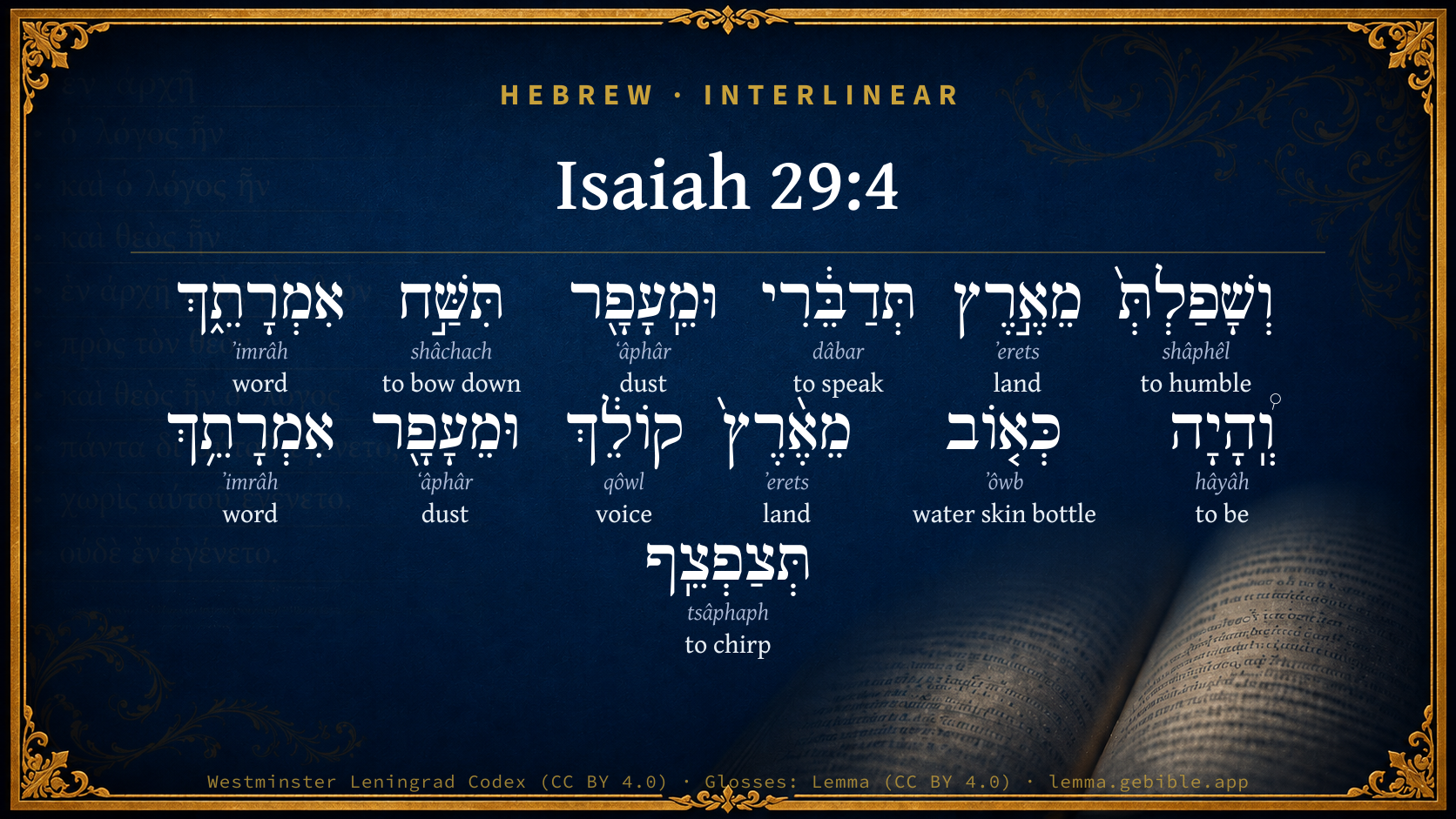
Hebrew (Westminster Leningrad Codex) Isaiah 29:4 appears in the Hebrew Old Testament. The text above is from the Westminster Leningrad Codex. Each word links to its Strong’s number, a concise gloss, and parsing drawn from the Open Scriptures Hebrew Bible morphology. Click any word for its full Brown-Driver-Briggs (BDB) entry.
Download image
Cite this verse

Isaiah 29:4 (World English Bible). Public Domain. Lemma interlinear Bible study tool, https://lemma.gebible.app/v/isaiah/29/4.

Show BibTeX & RIS
BibTeX
RIS
English Translation
You shall be brought down, and shall speak out of the ground, and your speech shall be low out of the dust; and your voice shall be as of one who has a familiar spirit, out of the ground, and your speech shall whisper out of the dust.
World English Bible · Public Domain
Download a study sheet

One document with this verse’s original text, its word-by-word gloss line, the meaning frame, cross-references with their text, attributed commentary, and full source and license credits — printable, and it pastes into notes with its structure intact.

This verse Autodidact and up

Study sheet (.html) Plain text (.txt)

A passage Seminary Student

Up to 50 verses in one chapter. A passage sheet keeps up to 6 commentary sources and 12 cross-references per verse, in the order this page ranks them, and says so on the sheet whenever that leaves anything out. Ask for a single verse and you get the Autodidact verse sheet above.

Everything on this page stays free to read, with no account — the sheet is a download of what is already on screen, not access to it.

Want to remove ads? Support Godless Engineer
Compare translations 3

The same verse in 3 English versions, stacked beneath the original-language interlinear above. Click any original word for its lexicon entry.

Each is an independent rendering of the whole verse — the interlinear is not word-aligned to these translations.

Highlighted words mark where these versions differ — a whole-verse word diff, not a word-by-word alignment.

  • World English Bible Public Domain
    You shall be brought down, and shall speak out of the ground, and your speech shall be low out of the dust; and your voice shall be as of one who has a familiar spirit, out of the ground, and your speech shall whisper out of the dust.
  • King James Version Public Domain
    And thou shalt be brought down, and shalt speak out of the ground, and thy speech shall be low out of the dust, and thy voice shall be, as of one that hath a familiar spirit, out of the ground, and thy speech shall whisper out of the dust.
  • unfoldingWord Literal Text CC BY-SA 4.0
    And you will become low; you will speak from the ground, and your speech will be low from the dust. And your voice will be like a ritual pit from the earth, and your speech will chirp from the dust. q1

unfoldingWord Literal Text — © unfoldingWord, licensed CC BY-SA 4.0. Word-aligned USFM3 via Door43 (git.door43.org/unfoldingWord/en_ult).

Versions to compare (up to 4)

3 of 4 selected

Show all 18 translations

Every available English version of this verse, each an independent rendering of the whole verse.

  • World English Bible Public Domain
    You shall be brought down, and shall speak out of the ground, and your speech shall be low out of the dust; and your voice shall be as of one who has a familiar spirit, out of the ground, and your speech shall whisper out of the dust.
  • Berean Standard Bible Public Domain
    You will be brought low, you will speak from the ground, and out of the dust your words will be muffled. Your voice will be like a spirit from the ground; your speech will whisper out of the dust.
  • Majority Standard Bible Public Domain
    You will be brought low, you will speak from the ground, and out of the dust your words will be muffled. Your voice will be like a spirit from the ground; your speech will whisper out of the dust.
  • King James Version Public Domain
    And thou shalt be brought down, and shalt speak out of the ground, and thy speech shall be low out of the dust, and thy voice shall be, as of one that hath a familiar spirit, out of the ground, and thy speech shall whisper out of the dust.
  • American Standard Version (1901) Public Domain
    And thou shalt be brought down, and shalt speak out of the ground, and thy speech shall be low out of the dust; and thy voice shall be as of one that hath a familiar spirit, out of the ground, and thy speech shall whisper out of the dust.
  • Revised Version (1885) Public Domain
    And thou shalt be brought down, and shalt speak out of the ground, and thy speech shall be low out of the dust; and thy voice shall be as of one that hath a familiar spirit, out of the ground, and thy speech shall whisper out of the dust.
  • Geneva Bible (1599) Public Domain
    So shalt thou be humbled, and shalt speake out of the ground, and thy speach shalbe as out of the dust: thy voyce also shall be out of the ground like him that hath a spirite of diuination, and thy talking shall whisper out of the dust.
  • Douay-Rheims (1899) Public Domain
    Thou shalt be brought down, thou shalt speak out of the earth, and thy speech shall be heard out of the ground: and thy voice shall be from the earth like that of the python, and out of the ground thy speech shall mutter.
  • Young's Literal Translation Public Domain
    And thou hast been low, From the earth thou speakest, And from the dust makest thy saying low, And thy voice hath been from the earth, As one having a familiar spirit, And from the dust thy saying whisperest,
  • Literal Standard Version CC BY-SA 4.0
    And you have been low, || You speak from the earth, || And make your saying low from the dust, || And your voice has been from the earth, || As one having a familiar spirit, || And your saying whispers from the dust,
  • Unlocked Literal Bible CC BY-SA 4.0
    You will be brought down and will speak from the ground; your speech will be low from the dust. Your voice will sound like a spirit that speaks from the ground, and out of the dust your speech will whisper.
  • unfoldingWord Literal Text CC BY-SA 4.0
    And you will become low; you will speak from the ground, and your speech will be low from the dust. And your voice will be like a ritual pit from the earth, and your speech will chirp from the dust. q1
  • Darby Bible Public Domain
    And thou shalt be brought low, thou shalt speak out of the ground, and thy speech shall come low out of the dust, and thy voice shall be as of one that hath a familiar spirit, out of the ground, and thy speech shall whisper out of the dust.
  • World Messianic Bible Public Domain
    You will be brought down, and will speak out of the ground. Your speech will mumble out of the dust. Your voice will be as of one who has a familiar spirit, out of the ground, and your speech will whisper out of the dust.
  • Webster's Bible Public Domain
    And thou shalt be brought down, and shalt speak out of the ground, and thy speech shall be low out of the dust, and thy voice shall be, as of one that hath a familiar spirit, out of the ground, and thy speech shall whisper out of the dust.
  • Free Bible Version CC BY-SA 4.0
    You will be brought down, you will speak from where you're lying on the ground, mumbling in the dust. Your words will come like a ghost from the grave; your voice will be a whisper from the dust.
  • Bible in Basic English Public Domain
    And you will be made low, and your voice will come out of the earth, and your words will be low out of the dust; and your voice will come out of the earth like that of a spirit, making bird-like noises out of the dust.
  • JPS Tanakh (1917) Public Domain
    And brought down thou shalt speak out of the ground, and thy speech shall be low out of the dust; and thy voice shall be as of a ghost out of the ground, and thy speech shall chirp out of the dust.

Literal Standard Version (2020), Covenant Press — licensed CC BY-SA 4.0. Text via the HelloAO Bible API (eBible.org). Unlocked Literal Bible (unfoldingWord) — licensed CC BY-SA 4.0. Text via the HelloAO Bible API (eBible.org). unfoldingWord Literal Text — © unfoldingWord, licensed CC BY-SA 4.0. Word-aligned USFM3 via Door43 (git.door43.org/unfoldingWord/en_ult). Free Bible Version, Dr. Jonathan Gallagher — licensed CC BY-SA 4.0. Text via the HelloAO Bible API (eBible.org).

Word by word

More ways to search: Search by grammar → Find every occurrence → Compare this word →

Practice this passage: Drill this verse → Learn its vocabulary →

תְּצַפְצֵֽף
tsâphaph
H6850
“to chirp”
Verb, Pilpel, Imperfect, 3rd Person, Feminine, Singular
Part of Speech
Verb
Stem
Pilpel
Form
Imperfect
Person
3rd Person
Gender
Feminine
Number
Singular
Full BDB Definition

Origin: a primitive root

TWOT: 1957

(Pilpel) to chirp, peep - of birds - of ghosts
  1. וְשָׁפַלְתְּ֙ shâphêl H8213 “and · to humble” Conjunction + Verb, Qal, Sequential Perfect, 2nd Person, Feminine, Singular
  2. מֵאֶ֣רֶץ ʼerets H776 “from · land” Preposition + Noun, Common, Both, Singular, Absolute
  3. תְּדַבֵּ֔רִי dâbar H1696 “to speak” Verb, Piel, Imperfect, 2nd Person, Feminine, Singular
  4. וּמֵֽעָפָ֖ר ʻâphâr H6083 “and · from · dust” Conjunction + Preposition + Noun, Common, Masculine, Singular, Absolute
  5. תִּשַּׁ֣ח shâchach H7817 “to bow down” Verb, Niphal, Imperfect, 3rd Person, Feminine, Singular
  6. אִמְרָתֵ֑ךְ ʼimrâh H565 “word · your” Noun, Common, Feminine, Singular, Construct + Suffix, Personal, 2nd Person, Feminine, Singular
  7. וְֽ֠הָיָה hâyâh H1961 “and · to be” Conjunction + Verb, Qal, Sequential Perfect, 3rd Person, Masculine, Singular
  8. כְּא֤וֹב ʼôwb H178 “like/as · water skin bottle” Preposition + Noun, Common, Masculine, Singular, Absolute
  9. מֵאֶ֨רֶץ֙ ʼerets H776 “from · land” Preposition + Noun, Common, Both, Singular, Absolute
  10. קוֹלֵ֔ךְ qôwl H6963 “voice · your” Noun, Common, Masculine, Singular, Construct + Suffix, Personal, 2nd Person, Feminine, Singular
  11. וּמֵעָפָ֖ר ʻâphâr H6083 “and · from · dust” Conjunction + Preposition + Noun, Common, Masculine, Singular, Absolute
  12. אִמְרָתֵ֥ךְ ʼimrâh H565 “word · your” Noun, Common, Feminine, Singular, Construct + Suffix, Personal, 2nd Person, Feminine, Singular

About this verse

These counts appear in no published source. They are computed here, from the morphology-tagged text and Lemma’s own curated glosses. What Lemma adds →

13
words
10
distinct lemmas
Prophets
section

Notable vocabulary

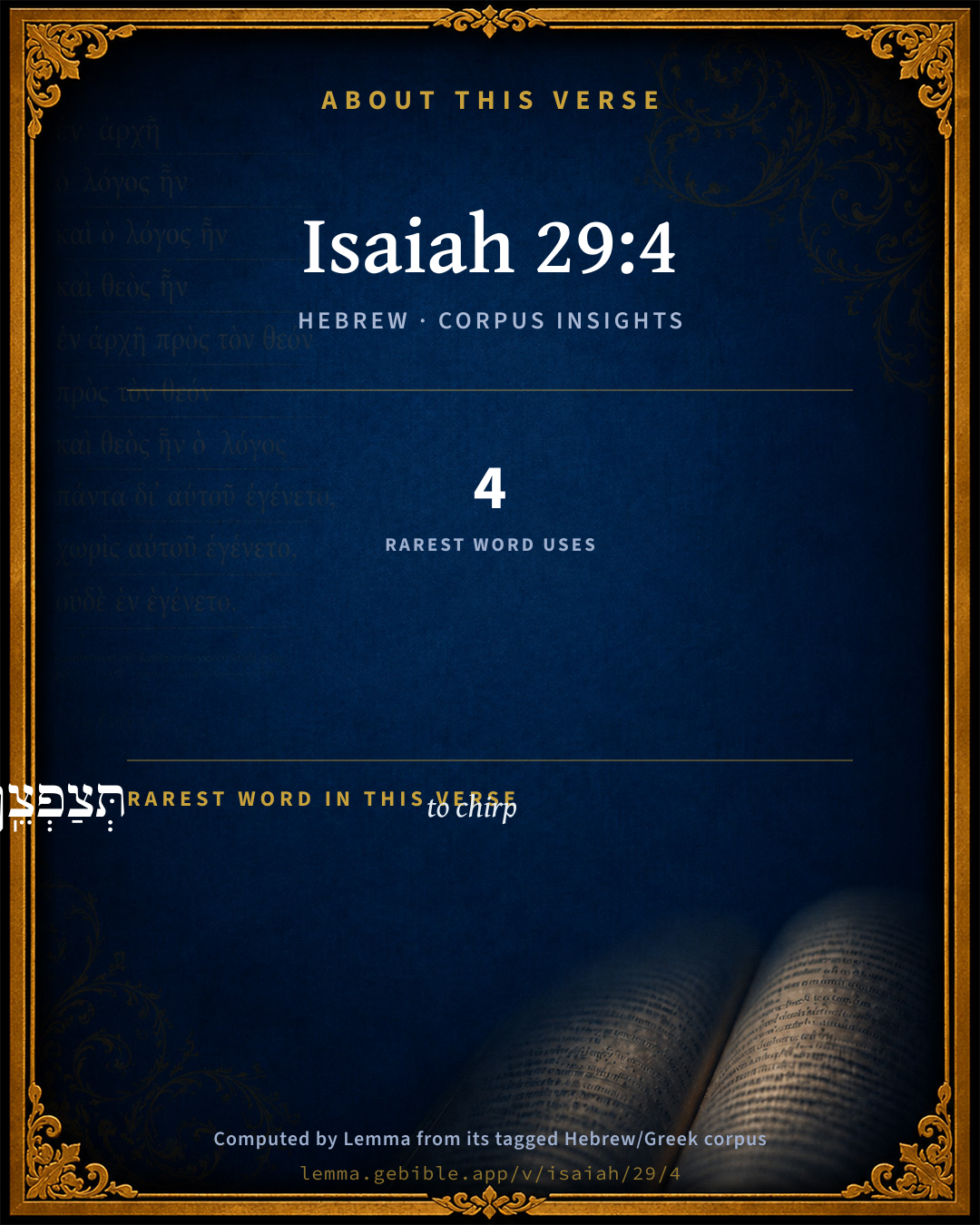
The rarest word here is תְּצַפְצֵֽף to chirp H6850 — appearing just 4 times in the whole Hebrew Bible.

Shared distinctive vocabulary

תְּצַפְצֵֽף to chirp H6850 occurs in 4 verses of the Hebrew Bible. Also found in:

Grammatical profile

  • 5 verbs
  • 8 nouns

Verb forms

  • וְשָׁפַלְתְּ֙ Qal · Sequential Perfect
  • תְּדַבֵּ֔רִי Piel · Imperfect
  • תִּשַּׁ֣ח Niphal · Imperfect
  • וְֽ֠הָיָה Qal · Sequential Perfect
  • תְּצַפְצֵֽף Pilpel · Imperfect

Repetition

Words recur within this verse — often emphatic in Hebrew:

  • מֵאֶ֣רֶץ land H776 ×2
  • וּמֵֽעָפָ֖ר dust H6083 ×2
  • אִמְרָתֵ֑ךְ word H565 ×2

Hebrew & Septuagint length

In English translation the verse runs 48 words from the Hebrew and 41 from the Septuagint (LXX English) — closely comparable.

A rough comparison of the two English renderings, which tokenize alike — not a word-level alignment.

Word counts can differ between the Hebrew and the Greek without any difference in meaning — e.g. the Hebrew direct-object marker אֵת has no separate Greek word, and Greek often adds the article ὁ.

Cross-references

6

Topical passages linked to Isaiah 29:4 in the Treasury of Scripture Knowledge — connected by theme and wording, ordered by reader-vote popularity; previews shown in the World English Bible.

  • Isaiah 8:19 When they shall tell you, "Consult with those who have familiar spirits and with the wizards, who chirp and who mutter:" shouldn't a people consult with their God? on behalf of the living [should they consult] with the dead?
  • Psalms 44:25 For our soul is bowed down to the dust. Our body cleaves to the earth.
  • Isaiah 3:8 For Jerusalem is ruined, and Judah is fallen; Because their tongue and their doings are against Yahweh, To provoke the eyes of his glory.
  • Isaiah 2:11–21 The lofty looks of man will be brought low, The haughtiness of men will be bowed down, And Yahweh alone will be exalted in that day.
  • Isaiah 51:23 and I will put it into the hand of those who afflict you, who have said to your soul, Bow down, that we may go over; and you have laid your back as the ground, and as the street, to those who go over.
  • Lamentations 1:9 Her filthiness was in her skirts; she didn't remember her latter end; Therefore is she come down wonderfully; she has no comforter: See, Yahweh, my affliction; for the enemy has magnified himself.

Cross-references courtesy of OpenBible.info (CC BY 4.0).

Hebrew and Greek witnesses Masoretic Hebrew ↔ Greek Septuagint

The same verse in the two great witnesses to the Old Testament, shown verse-for-verse.

These are two independent witnesses, not word-aligned to each other, and the Septuagint is shown in lemma (dictionary) form.

Hebrew Isaiah 29:4 Masoretic · Westminster Leningrad Codex

וְשָׁפַלְתְּ֙ מֵאֶ֣רֶץ תְּדַבֵּ֔רִי וּמֵֽעָפָ֖ר תִּשַּׁ֣ח אִמְרָתֵ֑ךְ וְֽ֠הָיָה כְּא֤וֹב מֵאֶ֨רֶץ֙ קוֹלֵ֔ךְ וּמֵעָפָ֖ר אִמְרָתֵ֥ךְ תְּצַפְצֵֽף

You shall be brought down, and shall speak out of the ground, and your speech shall be low out of the dust; and your voice shall be as of one who has a familiar spirit, out of the ground, and your speech shall whisper out of the dust.

World English Bible · Public Domain

Greek LXX Isaiah 29:4 Septuagint · lemma form

καί ταπεινόω ὁ λόγος σύ εἰς ὁ γῆ καί εἰς ὁ γῆ ὁ λόγος σύ δύω καί εἰμί ὡς ὁ φωνέω ἐκ ὁ γῆ ὁ φωνή σύ καί πρός ὁ ἔδαφος ὁ φωνή σύ ἀσθενέω

And your words shall be brought down to the earth, and your words shall sink down to the earth, and your voice shall be as they that speak out of the earth, and your voice shall be lowered to the ground.

LXX2012 (modern English Septuagint) · Public Domain

Hebrew: Westminster Leningrad Codex (CC BY 4.0). Greek: Septuagint (public domain); English from LXX2012 (modern English Septuagint) (Public Domain). How the Septuagint differs from the Hebrew →

Targum (Aramaic paraphrase)

1

The Targum is the ancient Jewish Aramaic paraphrase of the Hebrew Scriptures — an interpretive translation, not the Hebrew text itself. Onkelos (literal) and Pseudo-Jonathan (expansive) render the Torah, and Jonathan the Prophets. Coverage is partial: where no permissively-licensed English translation exists for a verse, only the Aramaic is shown. This is verse-level text, not a word-by-word alignment to the Hebrew.

  1. Targum Jonathan Prophets (Joshua–Malachi)
    וְתִמְאֲכִין מֵאַרְעָא תְמַלְלִין וּמֵעַפְרָא יִנְצְפָן מִלַיִךְ וִיהֵי כְּאוֹב מֵאַרְעָא קָלַיִךְ וּמֵעַפְרָא מִלַיִךְ יִנְצְפָן:

    And thou shalt be brought low, and shalt speak from beneath the earth, thy words shall gibber from the dust; and thy voice shall come like that of a necromancer out of the ground; yea, thy words shall gibber from the dust.

    Targum Jonathan — Aramaic: “Mikraot Gedolot” (public domain). English: “Sefaria Community Translation” (CC0 1.0 (public-domain dedication)); “London "Chaldee Paraphrase," 1871” (public domain). Text via Sefaria.

Commentary

Notes on Isaiah 29:4 from classic Christian and Jewish commentators (each source and its license shown beneath its notes). The classic Christian expositions comment on the surrounding passage and are grouped to its opening verse, so a note may address several verses; the Jewish commentaries on the Tanakh (Rashi and others) are per-verse, so they appear only where the commentator wrote on this verse.

Lemma curates 59 commentaries, every one of them public domain or Creative Commons licensed, each selected and text-cleaned for this edition rather than reprinted as found. About our sources →

Trapp's Complete Commentary

John Trapp

Isa 29:4 And thou shalt be brought down, [and] shalt speak out of the ground, and thy speech shall be low out of the dust, and thy voice shall be, as of one that hath a familiar spirit, out of the ground, and thy speech shall whisper out of the dust.

Ver. 4. And thou, shalt be brought down.] From those lofty pinnacles of self-exaltation whereunto thy pride hath perched thee.

And speak out of the ground.] Humillime et submissime, thou shalt speak supplication, with a low voice (as broken men), who wast wont to face the heavens, and speak in spite of God and men, speak big words, bubbles of words. See Jer 46:22.

And thy voice shall be as one that hath a familiar spirit.] Cuius vox est gracilis, flebilis, hiulca, confusa, gemebunda.

Out of the ground.] As the devil at Delphi did.

John Trapp, A Commentary or Exposition upon All the Books of the Old and New Testament (1647–1656) — public domain. Text from a community e-Sword module.

Tyndale Open Study Notes

Tyndale Open Resources

29:4 God’s goal was to destroy the sinful pride of the people of Jerusalem. Their voice would rise as if from the grave. Through the Assyrians, God would humble his people, but he would not abandon them.

Tyndale Open Study Notes — © Tyndale Open Resources, licensed CC BY-SA 4.0. Text via the HelloAO Bible API.

Geneva Bible (1599)

Geneva Bible translators

Thy speech shall be no more so lofty, but abased and low as the very charmers, which are in low places, and whisper, so that their voice can scarce be heard.

Geneva Bible (1599) marginal notes — public domain. Text via Bolls.life.

Jamieson, Fausset & Brown

Robert Jamieson, A. R. Fausset & David Brown

Jerusalem shall be as a captive, humbled to the dust. Her voice shall come from the earth as that of the spirit-charmers or necromancers (Isa 8:19), faint and shrill, as the voice of the dead was supposed to be. Ventriloquism was doubtless the trick caused to make the voice appear to come from the earth (Isa 19:3). An appropriate retribution that Jerusalem, which consulted necromancers, should be made like them!

Jamieson, Fausset & Brown — Commentary Critical and Explanatory on the Whole Bible (1871) — public domain (CC PDM 1.0). Text via the HelloAO Bible API.

Adam Clarke's Commentary

Verse 4. And thy speech shall be low out of the dust - "And from out of the dust thou shalt utter a feeble speech"] That the souls of the dead uttered a feeble stridulous sound, very different from the natural human voice, was a popular notion among the heathens as well as among the Jews. This appears from several passages of their poets; Homer, Virgil, Horace. The pretenders to the art of necromancy, who were chiefly women, had an art of speaking with a feigned voice, so as to deceive those who applied to them, by making them believe that it was the voice of the ghost. They had a way of uttering sounds, as if they were formed, not by the organs of speech, but deep in the chest, or in the belly; and were thence called εγγαστριμυθοι, ventriloqui: they could make the voice seem to come from beneath the ground, from a distant part, in another direction, and not from themselves; the better to impose upon those who consulted them. Εξεπιτηδες το γενος τουτο τον αμυδρον ηχον επιτηδευονται, ἱνα δια την ασαφειαν της φωνης τον του ψευδους αποδιδρασκωσιν ελεγχον. Psellus De Daemonibus, apud Bochart, i. p. 731. "These people studiously acquire, and affect on purpose, this sort of obscure sound; that by the uncertainty of the voice they may the better escape being detected in the cheat." From these arts of the necromancers the popular notion seems to have arisen, that the ghost's voice was a weak, stridulous, almost inarticulate sort of sound, very different from the speech of the living.

Adam Clarke's Commentary on the Bible (1810–1826) — public domain. Text from a community e-Sword/MySword module.

Ellicott's Commentary for English Readers

(4) Shalt speak out of the ground.—The words paint the panic of the besieged, the words pointing probably to Sennacherib’s invasion. They spoke in whispers, like the voice of the spectres which men heard in the secret chambers of the soothsayers. The war-cry of the brave was changed into the feeble tones of those that “peep and mutter.” (See Note on Isa_8:19.)

A Bible Commentary for English Readers, edited by Charles John Ellicott (1878–1897) — public domain. Text from a community e-Sword module.

John Gill's Exposition

And thou shalt be brought down,.... To the ground, and laid level with it, even the city of Jerusalem, as it was by the Romans; and as it was predicted by Christ it would, Luk 19:44 though some understand this of the humbling of the inhabitants of it, by the appearance of Sennacherib's army before it, and of which they interpret the following clauses:

and shalt speak out of the ground, and thy speech shall be low out of the dust; which some explain of the submissive language of Hezekiah to Sennacherib, and of his messengers to Rabshakeh, Kg2 18:14 as Aben Ezra and Kimchi; but it is expressive of the great famine in Jerusalem, at the time of its siege by the Romans, when the inhabitants were so reduced by it, as that they were scarce able to speak as to be heard, and could not stand upon their legs, but fell to the ground, and lay in the dust, uttering from thence their speech, with a faint and feeble voice:

and thy voice shall be as one that hath a familiar spirit, out of the ground, and thy speech shall whisper out of the dust: or peep and chirp, as little birds, as Jarchi and Kimchi, as those did that had familiar spirits; and as the Heathen oracles were delivered, as if they came out of the bellies of those that spoke, or out of caves and hollow places in the earth; and this was in just retaliation to these people, who imitated such practices, and made use of such spirits; see Isa 8:19.

John Gill's Exposition of the Whole Bible (1746–1763) — public domain (CC PDM 1.0). Text via the HelloAO Bible API.

Albert Barnes' Notes on the Bible

And shalt speak out of the ground - (see the note at Isa 8:19). The sense here is, that Jerusalem, that had been accustomed to pride itself on its strength I would be greatly humbled and subdued. Its loud and lofty tone would be changed. It would use the suppressed language of fear and alarm as if it spoke from the dust, or in a shrill small voice, like the pretended conversers with the dead.

And thy speech shall whisper out of the dust - Margin, ‘Peep,’ or ‘Chirp,’ (see the note at Isa 8:19).

Albert Barnes' Notes on the Bible (1834–1885) — public domain. Text from a community e-Sword/MySword module.

Haydock's Catholic Bible Commentary

The Python. The diviner by a spirit. (Challoner) --- Jerusalem shall hardly dare to make a noise. (Calmet)

George Leo Haydock (1774–1849), Haydock's Catholic Family Bible and Commentary, 1859 edition — public domain. Excludes Psalms (Douay-Rheims chapter numbering differs from Protestant) and Deuterocanonical books (Catholic canon only).

Matthew Poole's English Annotations

Thy speech shall be low out of the dust; thou who now speakest so loftily and scornfully against the Lord’s prophets and others, shalt be humbled and confounded, and afraid and ashamed to speak aloud, and shalt in a submissive manner, and with a low voice, beg the favour of thine enemies.

Thy voice shall be, as of one that hath a familiar spirit, out of the ground; who, that they might possess the people with a kind of reverence and horror, used to speak and deliver their answers with a low voice, either out of their bellies, or from some dark cave under the ground.

Matthew Poole's English Annotations on the Holy Bible (1683–1685) — public domain. Text from a community e-Sword/MySword module.

Whedon's Commentary on the Bible

Daniel D. Whedon

4. Shall be brought down — Jerusalem, accustomed to feel secure from its strength, is personified as lying flat to the ground, like a man prostrate.

Thy speech shall be low — Its utmost humility is meant, reduced by starvation till so weak as to speak only in low whispers, or with low undertone, like ventriloquists who feign to speak with the dead. The whole city is in this condition, unable to speak above a breath.

Daniel D. Whedon (gen. ed.), Commentary on the Old and New Testaments (1874–1909) — public domain. Text from a community e-Sword module.

The Pulpit Commentary

Thy speech shall be low. The feeble cries of a people wasted and worn out by a long siege are intended. These cries would resemble those which seemed to come out of the ground when a necromancer professed to raise a ghost. The Hebrew ohv is used both of the necromancers (Lev_19:31 Lev_20:6, etc.) and of the ghosts which they professed to raise. (1Sa_28:7, 8 2Ki_20:6, etc.) Here the "ghost" is spoken of. Thy speech shall whisper; literally, chirp. (comp. Isa_8:19) The word used occurs only in Isaiah.

The Pulpit Commentary (1880–1919), ed. H.D.M. Spence-Jones & Joseph S. Exell — public domain. Text from a community e-Sword module.

John Wesley's Explanatory Notes

And thou - Thou who now speakest so loftily, shall be humbled, and with a low voice, beg the favour of thine enemies. As one - Who, that they might possess the people with a kind of reverence and horror, used to deliver their answers with a low voice, from some cave under the ground.

John Wesley, Explanatory Notes Upon the Whole Bible (1754–1765) — public domain. Text via the GEBible commentary corpus.

J. A. Alexander on Isaiah

Joseph Addison Alexander

“And thou shalt be brought down, out of the ground shalt thou speak, and thy speech shall be low out of the dust, and thy voice shall be like (the voice of) a spirit, out of the ground, and out of the dust shall thy speech mutter.” The simple meaning naturally suggested by the words is, that the person here addressed, to wit, the city or its population, should be weakened and humbled. The last verb properly denotes any feeble inarticulate sound, and is applied in Isa 10:14 and Isa 38:14 to the chirping or twittering of birds.

Joseph Addison Alexander, The Prophecies of Isaiah (1846–1847; New York: Scribner, 1870–1878) — public domain. Text from a community e-Sword module.

Rashi

Rabbi Shlomo Yitzchaki (Rashi)

from the earth shall you speak It shall appear as though the speech that comes out of your mouth comes from below the ground.

shall your speech chirp to supplicate to Me, and because of your supplication, My mercies shall be aroused.

צִפְצוּף is an expression of a whispering (var. weak) voice like the voice of small birds.

Rashi on the Tanakh — English translations: “The Judaica Press complete Tanach with Rashi, translated by A. J. Rosenberg” (CC BY 4.0); “Pentateuch with Rashi's commentary by M. Rosenbaum and A.M. Silbermann, 1929-1934” (public domain); “The Metsudah Tanach series, Lakewood, N.J” (CC BY 4.0); and “The Book of Joshua, Metsudah Publications, 1997” (CC BY 4.0). Text via Sefaria.

Ibn Ezra

Rabbi Abraham ibn Ezra

And thou shalt be brought down. This applies to the words of Hezekiah’s messengers to Rabshakeh.

Thou shalt speak out of the ground. Thou shalt speak so, as if the voice came from the depth of the earth.

כאב As a potter. Comp. כאבת as bottles.—The potter, because of his vocation, speaks from below.

Ibn Ezra on the Tanakh — English translations: “Sefaria Community Translation” (CC0 1.0 (public-domain dedication)); “Yalkut, Sifsei Chachomim Chumash, Metsudah Publications, 2009” (CC BY 4.0); and “Commentary of Ibn Ezra on Isaiah - trans. by M. Friedlander, 1873” (public domain). Text via Sefaria.

Lesson kit

Teaching starters — assembled from the data on this page, not authored interpretation. Every prompt links to the verse data it draws on. Edit before teaching.

Isaiah, in the Prophets, opens this verse with 13 words (10 distinct Hebrew lemmas). Its most distinctive word is tsâphaph (“to chirp”). A historical commentator’s framing appears above. Read the whole chapter for the surrounding context.

Discussion questions

  1. The word tsâphaph carries the sense “to chirp.” How does it shape the verse?
  2. Isaiah 8:19 shares the word «to chirp» with this verse. How do the two illuminate each other?
  3. “land” occurs 2× in this one verse. What is the effect of the repetition?
  4. The translations on this page render this verse differently — a whole-verse word diff, not a word-by-word alignment. What might account for the different wordings?
  5. The verb «וְשָׁפַלְתְּ֙» is Qal Sequential Perfect. How does its form color the action?
  6. Reading how Trapp's Complete Commentary and Tyndale Open Study Notes read this verse, where do the two commentators agree and where do they part?

Things to notice

Reading settings

Reading text

Shown beneath each verse's original-language words.

Old Testament
Old Testament edition

Read the OT as the Masoretic Hebrew (MT) or the Greek Septuagint (LXX).

English shown for the Greek Septuagint (in the Hebrew ↔ Greek comparison).

Comparing translations? Open the Compare panel on any verse page to stack up to four side by side.