
Job 10:9

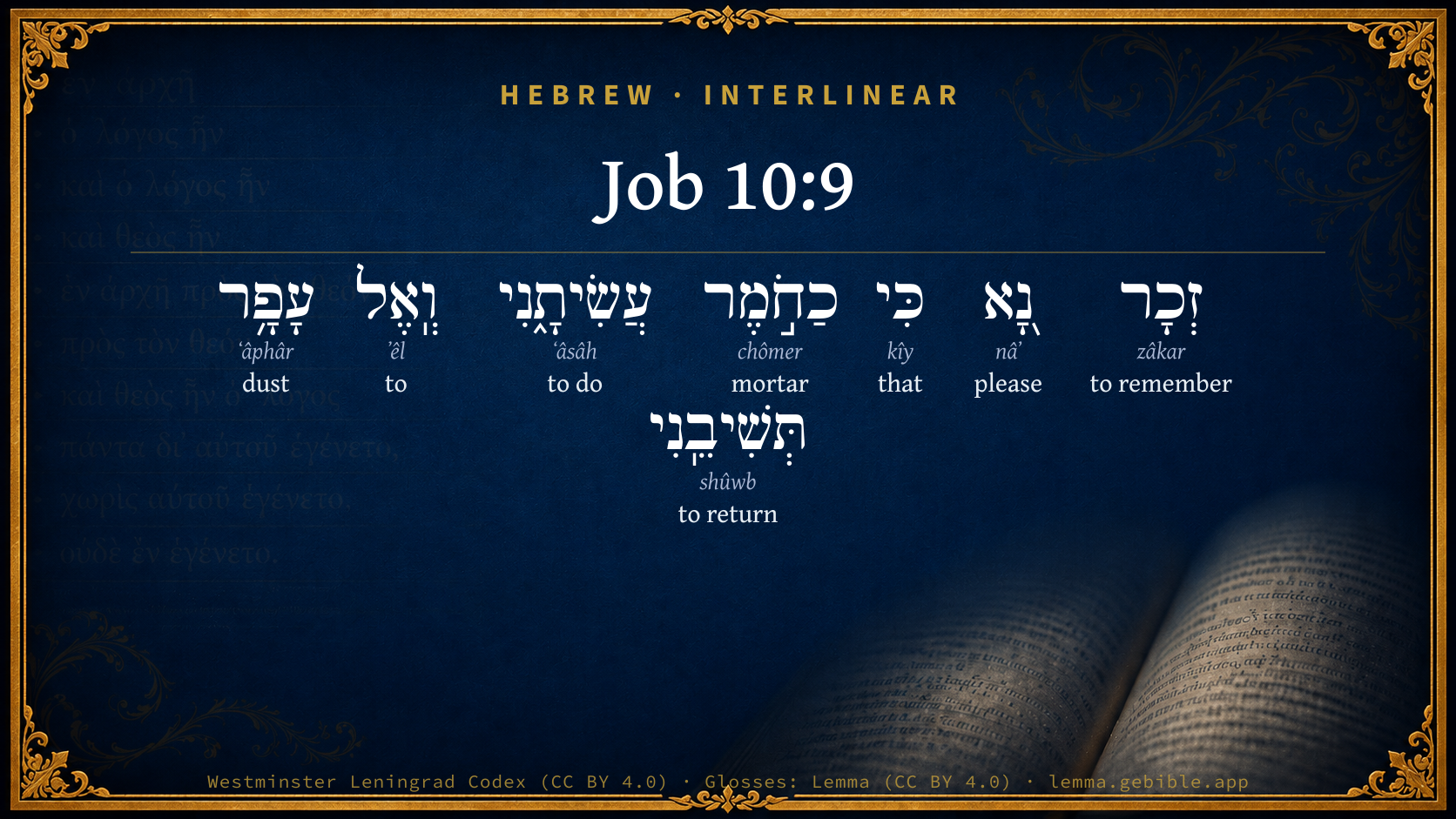
Hebrew (Westminster Leningrad Codex) Job 10:9 appears in the Hebrew Old Testament. The text above is from the Westminster Leningrad Codex. Each word links to its Strong’s number, a concise gloss, and parsing drawn from the Open Scriptures Hebrew Bible morphology. Click any word for its full Brown-Driver-Briggs (BDB) entry.
Download image
Cite this verse

Job 10:9 (World English Bible). Public Domain. Lemma interlinear Bible study tool, https://lemma.gebible.app/v/job/10/9.

Show BibTeX & RIS
BibTeX
RIS
English Translation
Remember, I beg you, that you have fashioned me as clay. Will you bring me into dust again?
World English Bible · Public Domain
Download a study sheet

One document with this verse’s original text, its word-by-word gloss line, the meaning frame, cross-references with their text, attributed commentary, and full source and license credits — printable, and it pastes into notes with its structure intact.

This verse Autodidact and up

Study sheet (.html) Plain text (.txt)

A passage Seminary Student

Up to 50 verses in one chapter. A passage sheet keeps up to 6 commentary sources and 12 cross-references per verse, in the order this page ranks them, and says so on the sheet whenever that leaves anything out. Ask for a single verse and you get the Autodidact verse sheet above.

Everything on this page stays free to read, with no account — the sheet is a download of what is already on screen, not access to it.

Want to remove ads? Support Godless Engineer
Compare translations 3

The same verse in 3 English versions, stacked beneath the original-language interlinear above. Click any original word for its lexicon entry.

Each is an independent rendering of the whole verse — the interlinear is not word-aligned to these translations.

Highlighted words mark where these versions differ — a whole-verse word diff, not a word-by-word alignment.

  • World English Bible Public Domain
    Remember, I beg you, that you have fashioned me as clay. Will you bring me into dust again?
  • King James Version Public Domain
    Remember, I beseech thee, that thou hast made me as the clay; and wilt thou bring me into dust again?
  • unfoldingWord Literal Text CC BY-SA 4.0
    Remember, please, that you made me like clay, and will you turn me into dust?

unfoldingWord Literal Text — © unfoldingWord, licensed CC BY-SA 4.0. Word-aligned USFM3 via Door43 (git.door43.org/unfoldingWord/en_ult).

Versions to compare (up to 4)

3 of 4 selected

Show all 18 translations

Every available English version of this verse, each an independent rendering of the whole verse.

  • World English Bible Public Domain
    Remember, I beg you, that you have fashioned me as clay. Will you bring me into dust again?
  • Berean Standard Bible Public Domain
    Please remember that You molded me like clay. Would You now return me to dust?
  • Majority Standard Bible Public Domain
    Please remember that You molded me like clay. Would You now return me to dust?
  • King James Version Public Domain
    Remember, I beseech thee, that thou hast made me as the clay; and wilt thou bring me into dust again?
  • American Standard Version (1901) Public Domain
    Remember, I beseech thee, that thou hast fashioned me as clay; And wilt thou bring me into dust again?
  • Revised Version (1885) Public Domain
    Remember, I beseech thee, that thou hast fashioned me as clay; and wilt thou bring me into dust again?
  • Geneva Bible (1599) Public Domain
    Remember, I pray thee, that thou hast made me as the clay, and wilt thou bring me into dust againe?
  • Douay-Rheims (1899) Public Domain
    Remember, I beseech thee, that thou hast made me as the clay, and thou wilt bring me into dust again.
  • Young's Literal Translation Public Domain
    Remember, I pray Thee, That as clay Thou hast made me, And unto dust Thou dost bring me back.
  • Literal Standard Version CC BY-SA 4.0
    Please remember || That You have made me as clay, || And You bring me back to dust.
  • Unlocked Literal Bible CC BY-SA 4.0
    Call to mind, I beg you, that you have fashioned me like clay; will you bring me into dust again?
  • unfoldingWord Literal Text CC BY-SA 4.0
    Remember, please, that you made me like clay, and will you turn me into dust?
  • Darby Bible Public Domain
    Remember, I beseech thee, that thou hast made me as clay, and wilt bring me into dust again.
  • World Messianic Bible Public Domain
    Remember, I beg you, that you have fashioned me as clay. Will you bring me into dust again?
  • Webster's Bible Public Domain
    Remember, I beseech thee, that thou hast made me as the clay; and wilt thou bring me into dust again?
  • Free Bible Version CC BY-SA 4.0
    Remember that you shaped me like a piece of clay—are you now going to turn me back into dust?
  • Bible in Basic English Public Domain
    O keep in mind that you made me out of earth; and will you send me back again to dust?
  • JPS Tanakh (1917) Public Domain
    Remember, I beseech Thee, that Thou hast fashioned me as clay; and wilt Thou bring me into dust again?

Literal Standard Version (2020), Covenant Press — licensed CC BY-SA 4.0. Text via the HelloAO Bible API (eBible.org). Unlocked Literal Bible (unfoldingWord) — licensed CC BY-SA 4.0. Text via the HelloAO Bible API (eBible.org). unfoldingWord Literal Text — © unfoldingWord, licensed CC BY-SA 4.0. Word-aligned USFM3 via Door43 (git.door43.org/unfoldingWord/en_ult). Free Bible Version, Dr. Jonathan Gallagher — licensed CC BY-SA 4.0. Text via the HelloAO Bible API (eBible.org).

Word by word

More ways to search: Search by grammar → Find every occurrence → Compare this word →

Practice this passage: Drill this verse → Learn its vocabulary →

כַחֹ֣מֶר
chômer
H2563
“like/as the · mortar”
Preposition, Determined + Noun, Common, Masculine, Singular, Absolute
Part of Speech
Preposition + Noun
Type
Common
Gender
Masculine
Number
Singular
State
Absolute
Full BDB Definition

Origin: from H2560

TWOT: TWOT- 683c

cement, mortar, clay - mortar, cement - clay - mire - heap - swelling, surging (of water) - homer - a unit of dry measure about 65 imperial gallons (300 liters)
  1. זְכָר zâkar H2142 “remember” Verb, Qal, Imperative, 2nd Person, Masculine, Singular
  2. נָ֭א nâʼ H4994 “please” Particle, Exhortation
  3. כִּי kîy H3588 “that” Conjunction
  4. עֲשִׂיתָ֑נִי ʻâsâh H6213 “to do · me” Verb, Qal, Perfect, 2nd Person, Masculine, Singular + Suffix, Personal, 1st Person, Common, Singular
  5. וְֽאֶל ʼêl H413 “and · to” Conjunction + Preposition
  6. עָפָ֥ר ʻâphâr H6083 “dust” Noun, Common, Masculine, Singular, Absolute
  7. תְּשִׁיבֵֽנִי shûwb H7725 “to return · me” Verb, Hiphil, Imperfect, 2nd Person, Masculine, Singular + Suffix, Personal, 1st Person, Common, Singular

About this verse

These counts appear in no published source. They are computed here, from the morphology-tagged text and Lemma’s own curated glosses. What Lemma adds →

8
words
8
distinct lemmas
Wisdom
section

Shared distinctive vocabulary

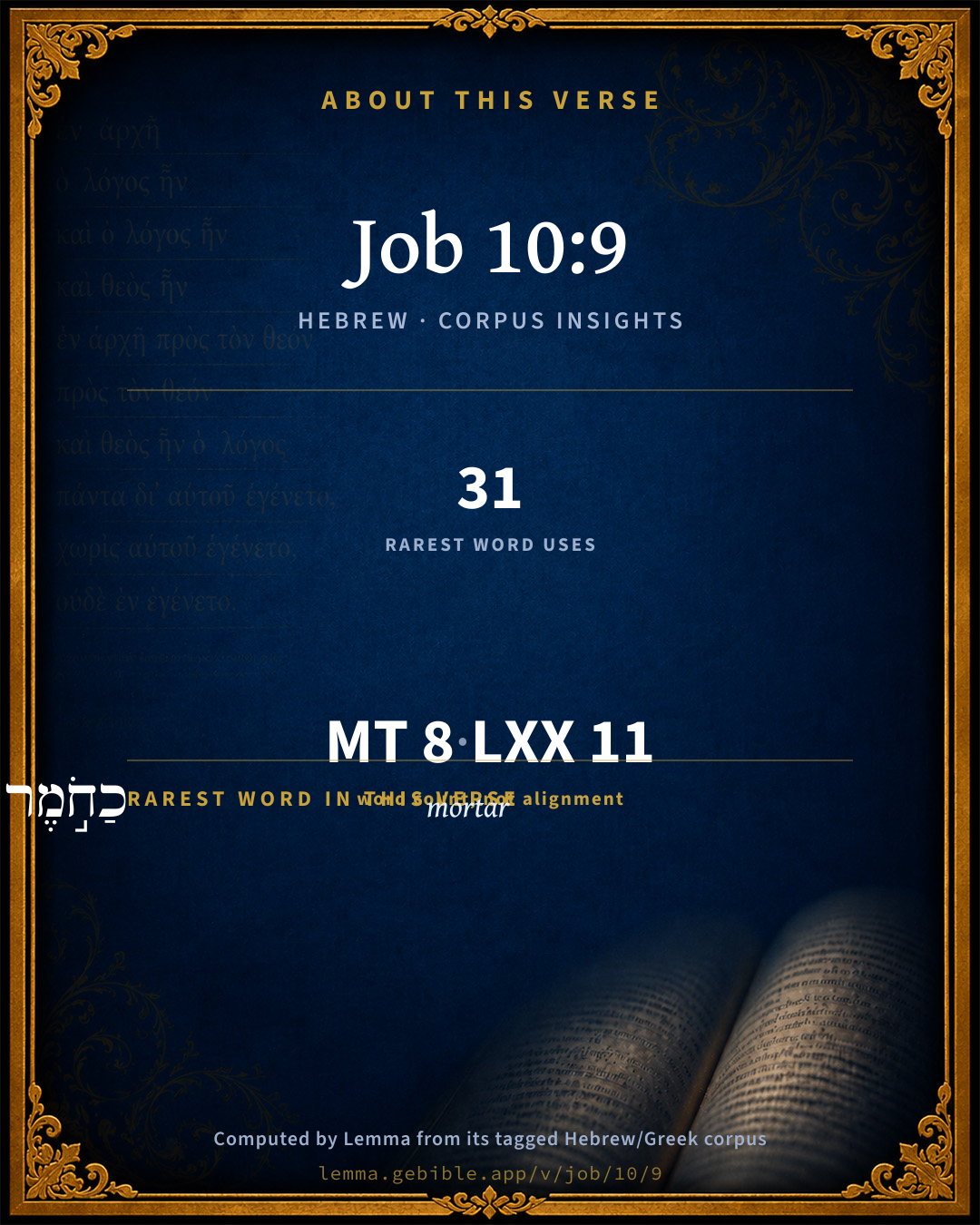
כַחֹ֣מֶר mortar H2563 occurs in 26 verses of the Hebrew Bible. Also found in:

Grammatical profile

  • 3 verbs
  • 2 nouns
  • 1 preposition
  • 1 conjunction
  • 1 particle

Verb forms

  • זְכָר Qal · Imperative
  • עֲשִׂיתָ֑נִי Qal · Perfect
  • תְּשִׁיבֵֽנִי Hiphil · Imperfect

Hebrew & Septuagint length

In English translation the verse runs 18 words from the Hebrew and 16 from the Septuagint (LXX English) — closely comparable.

A rough comparison of the two English renderings, which tokenize alike — not a word-level alignment.

Word counts can differ between the Hebrew and the Greek without any difference in meaning — e.g. the Hebrew direct-object marker אֵת has no separate Greek word, and Greek often adds the article ὁ.

In the original languages it is 8 Hebrew tokens and 11 Greek tokens — but the two are counted differently (Hebrew bundles its prefixes and suffixes into one token; the Greek is in lemma form), so that isn’t a like-for-like length.

Cross-references

15

Topical passages linked to Job 10:9 in the Treasury of Scripture Knowledge — connected by theme and wording, ordered by reader-vote popularity; previews shown in the World English Bible.

  • Genesis 2:7 Yahweh God formed man from the dust of the ground, and breathed into his nostrils the breath of life; and man became a living soul.
  • Isaiah 64:8 But now, Yahweh, you are our Father; we are the clay, and you our potter; and we all are the work of your hand.
  • Genesis 3:19 By the sweat of your face will you eat bread until you return to the ground, for out of it you were taken. For you are dust, and to dust you shall return."
  • Ecclesiastes 12:7 And the dust returns to the earth as it was, And the spirit returns to God who gave it.
  • Psalms 25:6–7 Yahweh, remember your tender mercies and your loving kindness, For they are from old times.
  • Isaiah 45:9 Woe to him who strives with his Maker--a potsherd among the potsherds of the earth! Shall the clay ask him who fashions it, "What are you making?" or your work, "He has no hands?"
  • Jeremiah 18:6 House of Israel, can't I do with you as this potter? says Yahweh. Behold, as the clay in the potter's hand, so are you in my hand, house of Israel.
  • Romans 9:21 Or hasn't the potter a right over the clay, from the same lump to make one part a vessel for honor, and another for dishonor?
  • Job 7:7 Oh remember that my life is a breath. My eye shall no more see good.
  • Job 17:14 If I have said to corruption, 'You are my father;' To the worm, 'My mother,' and 'my sister;'
  • Psalms 22:15 My strength is dried up like a potsherd. My tongue sticks to the roof of my mouth. You have brought me into the dust of death.
  • Psalms 25:18 Consider my affliction and my travail. Forgive all my sins.
  • Psalms 89:47 Remember how short my time is! For what vanity have you created all the children of men!
  • Psalms 90:3 You turn man to destruction, saying, "Return, you children of men."
  • Psalms 106:4 Remember me, Yahweh, with the favor that you show to your people. Visit me with your salvation,

Cross-references courtesy of OpenBible.info (CC BY 4.0).

Hebrew and Greek witnesses Masoretic Hebrew ↔ Greek Septuagint

The same verse in the two great witnesses to the Old Testament, shown verse-for-verse.

These are two independent witnesses, not word-aligned to each other, and the Septuagint is shown in lemma (dictionary) form.

Hebrew Job 10:9 Masoretic · Westminster Leningrad Codex

זְכָר נָ֭א כִּי כַחֹ֣מֶר עֲשִׂיתָ֑נִי וְֽאֶל עָפָ֥ר תְּשִׁיבֵֽנִי

Remember, I beg you, that you have fashioned me as clay. Will you bring me into dust again?

World English Bible · Public Domain

Greek LXX Job 10:9 Septuagint · lemma form

μιμνήσκω ὅτι πηλός ἐγώ πλάσσω εἰς δέ γῆ ἐγώ πάλιν ἀποστρέφω

Remember that you have made me as clay, and you do turn me again to earth.

LXX2012 (modern English Septuagint) · Public Domain

Hebrew: Westminster Leningrad Codex (CC BY 4.0). Greek: Septuagint (public domain); English from LXX2012 (modern English Septuagint) (Public Domain). How the Septuagint differs from the Hebrew →

Commentary

Notes on Job 10:9 from classic Christian and Jewish commentators (each source and its license shown beneath its notes). The classic Christian expositions comment on the surrounding passage and are grouped to its opening verse, so a note may address several verses; the Jewish commentaries on the Tanakh (Rashi and others) are per-verse, so they appear only where the commentator wrote on this verse.

Lemma curates 59 commentaries, every one of them public domain or Creative Commons licensed, each selected and text-cleaned for this edition rather than reprinted as found. About our sources →

Trapp's Complete Commentary

John Trapp

Job 10:9 Remember, I beseech thee, that thou hast made me as the clay; and wilt thou bring me into dust again?

Ver. 9. Remember, I beseech thee, that thou hast made me as the clay] Remembrance and foreknowledge are not properly in God. {See Trapp on "Job 10:4"} But he is said to remember us when he relieveth us, Psa 136:23; Psa 9:18 1Sa 1:19. "That thou hast made me," &c., viz. in those protoplasts, my first parents, formed out of the ground, Gen 2:7, whence the heathen philosopher could say, that man is nothing else but a piece of clay weakly made up: or thou hast wrought me like clay, sc. in the womb, where thou hast framed and formed my body, as the potter worketh his clay, well tempered, into an earthen vessel, πηλος κομφως πεφυραμενος (Arrian. in Epict.). Here, then, Job inminds the Lord (by the matter whereof he was made) of the frailty, vility, and impurity of his nature ( Lutum enim conspureat omnia, sic et. caro), to move him to a mitigating of his misery. See Psa 103:14; Psa 78:39.

Wilt thou bring me into the dust again?] viz. By those grievous torments; or, And that thou wilt bring me into dust again; for so thou hast said, To dust shalt thou return, Gen 3:19. And it is appointed for all men once to die, Heb 9:27. Oh, therefore, that I might have some small rest and respite before I go hence, and be no more seen, Psa 39:12-13.

John Trapp, A Commentary or Exposition upon All the Books of the Old and New Testament (1647–1656) — public domain. Text from a community e-Sword module.

Joseph Benson's Commentary

Job 10:9. Remember, thou hast made me as the clay — I was formed by thee as a potter makes a vessel of clay; so this may note both the frailty of man’s nature, which of itself decays and perishes, and doth not need such violent shocks to overthrow it; and the excellence of the divine artifice commended from the meanness of the materials; which is an argument why God should not destroy it. And will thou bring me? &c. — Or, rather, without an interrogation, thou wilt bring me into dust again — Out of which I was made: I must die by the course of nature, and by the sentence of thy law; and, therefore, while I do live, give me some ease and comfort.

Joseph Benson's Commentary on the Old and New Testaments (1811–1818) — public domain. Text from a community e-Sword module.

Geneva Bible (1599)

Geneva Bible translators

As brittle as a pot of clay.

Geneva Bible (1599) marginal notes — public domain. Text via Bolls.life.

Jamieson, Fausset & Brown

Robert Jamieson, A. R. Fausset & David Brown

clay--Job 10:10 proves that the reference here is, not so much to the perishable nature of the materials, as to their wonderful fashioning by the divine potter.

Jamieson, Fausset & Brown — Commentary Critical and Explanatory on the Whole Bible (1871) — public domain (CC PDM 1.0). Text via the HelloAO Bible API.

Adam Clarke's Commentary

Verse 9. Thou hast made me as the clay] Thou hast fashioned me, according to thy own mind, out of a mass of clay: after so much skill and pains expended, men might naturally suppose they were to have a permanent being; but thou hast decreed to turn them into dust!

Adam Clarke's Commentary on the Bible (1810–1826) — public domain. Text from a community e-Sword/MySword module.

Ellicott's Commentary for English Readers

(9) Into dust.—Comp. Psa_22:15.

A Bible Commentary for English Readers, edited by Charles John Ellicott (1878–1897) — public domain. Text from a community e-Sword module.

The Cambridge Bible for Schools and Colleges

gen. ed. J. J. S. Perowne

9. The figure is that of a potter who has lavished infinite care upon his vessel, and now reduces his work of elaborate skill and exquisite ornament into dust again.

The Cambridge Bible for Schools and Colleges (gen. ed. J. J. S. Perowne; Cambridge University Press, 1878–1918) — public domain. Text from a community e-Sword module.

John Gill's Exposition

Hast thou not poured me out as milk,.... Expressing, in modest terms, his conception from the seed of his parents, comparable to milk, from being a liquid, and for its colour:

and curdled me like cheese? that of the female being mixed with, and heated by the male, is hardened like the curd of which a cheese is made, and begins to receive a form as that, and becomes an embryo: and naturalists (k) make use of the same expressions when speaking of these things; and in this way most interpreters carry the sense of the words; but Schultens observes that milk is an emblem of purity and holiness, see Lam 4:7; and so this may respect the original pure formation of man, who came out of his Maker's hands a pure, holy and upright creature, made after his image and in his likeness, created in righteousness and holiness, and so, like milk, pure and white; or rather the regeneration and sanctification of Job personally, and which might be very early, as in Jeremiah, John the Baptist, and others; or however, he was filled and adorned with the gifts and graces of the spirit of God, was washed and cleansed, and sanctified and justified; and had his conversation in the world in all simplicity and godly sincerity, being preserved from gross enormities in life; was a man that feared God and eschewed evil, and had not only the form of godliness, but the power of it; and was established and confirmed in and by the grace of God, and was strong in the exercise of it; and from hence he argues with God, should such a vessel of grace, whom he had made so pure and holy, and had so consolidated and strengthened in a spiritual and religious way, be crushed and destroyed at once?

(k) "Sic semen maris dicitur" Aristot. de Gen. Animal. l. 1. c. 20. "coagulum". Plin. Nat. Hist. l. 7. c. 15. Gell. Noct. Attic. l. 3. c. 16.

John Gill's Exposition of the Whole Bible (1746–1763) — public domain (CC PDM 1.0). Text via the HelloAO Bible API.

Albert Barnes' Notes on the Bible

Remember, I beseech thee, that thou hast made me as the clay - There is evident allusion here to the creation of man, and to the fact that he was moulded from the dust of the earth - a fact which would be preserved by tradition; see Gen 2:7. The fact that God had moulded the human form as the potter moulds the clay, is one that is often referred to in the Scriptures; compare Rom 9:20-21. The object of Job in this is, probably, to recall the fact that God, out of clay, had formed the noble structure, man, and to ask whether it was his intention to reduce that structure again to its former worthless condition - to destroy its beauty, and to efface the remembrance of his workmanship? Was it becoming God thus to blot out every memorial of his own power and skill in moulding the human frame?

Albert Barnes' Notes on the Bible (1834–1885) — public domain. Text from a community e-Sword/MySword module.

Matthew Poole's English Annotations

As the clay, i.e. of the clay; the note of similitude here expressing the truth of things, as it doth Joh 1:14, and elsewhere, as hath been before observed. Or, as a potter maketh a vessel of the clay; and so this may note both the frailty of man’s nature, which of itself decays and perisheth, and doth not need such violent shocks and storms to overthrow it; and the excellency of the Divine artifice, commended from the meanness of the materials out of which it was made; which is an argument why God should not destroy it.

Wilt thou bring me into dust again? wilt thou now causelessly and violently destroy thy own work? But the words are and may be read without an interrogation, and

thou wilt bring me into dust again, out of which I was made: I must die by the course of nature, and by the sentence of thy law; and therefore whilst I do live give me some ease and comfort.

Matthew Poole's English Annotations on the Holy Bible (1683–1685) — public domain. Text from a community e-Sword/MySword module.

Whedon's Commentary on the Bible

Daniel D. Whedon

9. As the clay — A favourite figure of the Scripture, Job_33:6; Isa_29:16; Isa_45:9; Jer_18:6; Rom_9:20-21. The idea of destroying him naturally calls to the mind of Job the case of a potter, who, after skilfully elaborating some work of beauty, prizes it too highly to dash it wantonly to the earth. The mystery of death evidently presses upon his mind. God has made him out of clay — a masterpiece of skill, wisdom, and power — why should he bring him into dust again? Job recalls the sentence against Adam, and uses substantially the same words — “Unto dust shall thou return.” Gen_3:19.

Daniel D. Whedon (gen. ed.), Commentary on the Old and New Testaments (1874–1909) — public domain. Text from a community e-Sword module.

The Pulpit Commentary

Remember, I beseech thee, that thou hast made me as the clay; rather, that thou hast fashioned me as day; i.e. "Thou hast formed me, as a potter fashions a pot out of clay." This is scarcely a reference to Gen_3:19, but rather an early use of what became a stock metaphor. (Isa_29:16 Isa_30:14 Isa_45:9 Isa_64:8 Jer_18:6 Rom 9:21-2:9, etc.) And wilt thou bring us into dust again? After having fashioned me out of clay into a human form, wilt thou undo thine own work, crumble me into powder, and make me mere dust once more?

The Pulpit Commentary (1880–1919), ed. H.D.M. Spence-Jones & Joseph S. Exell — public domain. Text from a community e-Sword module.

John Wesley's Explanatory Notes

Clay - As a potter makes a vessel of clay; so this may note both the frailty of man's nature, which of itself decays and perishes, and doth not need such violent shocks to overthrow it; and the excellency of the Divine artifice commended from the meanness of the materials; which is an argument why God should not destroy it. Again - I must die by the course of nature, and therefore while I do live, give me some ease and comfort.

John Wesley, Explanatory Notes Upon the Whole Bible (1754–1765) — public domain. Text via the GEBible commentary corpus.

Rashi

Rabbi Shlomo Yitzchaki (Rashi)

You will return me in the end.

Rashi on the Tanakh — English translations: “The Judaica Press complete Tanach with Rashi, translated by A. J. Rosenberg” (CC BY 4.0); “Pentateuch with Rashi's commentary by M. Rosenbaum and A.M. Silbermann, 1929-1934” (public domain); “The Metsudah Tanach series, Lakewood, N.J” (CC BY 4.0); and “The Book of Joshua, Metsudah Publications, 1997” (CC BY 4.0). Text via Sefaria.

Lesson kit

Teaching starters — assembled from the data on this page, not authored interpretation. Every prompt links to the verse data it draws on. Edit before teaching.

Job, in the Wisdom, opens this verse with 8 words (8 distinct Hebrew lemmas). Its most distinctive word is chômer (“mortar”). A historical commentator’s framing appears above. Read the whole chapter for the surrounding context.

Discussion questions

  1. What does “mortar” (chômer) contribute to the verse as a whole?
  2. How does Genesis 11:3, which shares the word «mortar», read alongside this verse?
  3. These translations render this verse differently; the difference is in the English rendering, not the original. What questions does that raise?
  4. «זְכָר» is a Qal Imperative verb. How does that grammatical form shape the action described?
  5. Compare how Trapp's Complete Commentary and Joseph Benson's Commentary read this verse. Where do they agree or differ?

Things to notice

Reading settings

Reading text

Shown beneath each verse's original-language words.

Old Testament
Old Testament edition

Read the OT as the Masoretic Hebrew (MT) or the Greek Septuagint (LXX).

English shown for the Greek Septuagint (in the Hebrew ↔ Greek comparison).

Comparing translations? Open the Compare panel on any verse page to stack up to four side by side.