
Isaiah 40:12

Hebrew (Westminster Leningrad Codex) Isaiah 40:12 appears in the Hebrew Old Testament. The text above is from the Westminster Leningrad Codex. Each word links to its Strong’s number, a concise gloss, and parsing drawn from the Open Scriptures Hebrew Bible morphology. Click any word for its full Brown-Driver-Briggs (BDB) entry.
Download image
Cite this verse

Isaiah 40:12 (World English Bible). Public Domain. Lemma interlinear Bible study tool, https://lemma.gebible.app/v/isaiah/40/12.

Show BibTeX & RIS
BibTeX
RIS
English Translation
Who has measured the waters in the hollow of his hand, and meted out the sky with the span, and comprehended the dust of the earth in a measure, and weighed the mountains in scales, and the hills in a balance?
World English Bible · Public Domain
Download a study sheet

One document with this verse’s original text, its word-by-word gloss line, the meaning frame, cross-references with their text, attributed commentary, and full source and license credits — printable, and it pastes into notes with its structure intact.

This verse Autodidact and up

Study sheet (.html) Plain text (.txt)

A passage Seminary Student

Up to 50 verses in one chapter. A passage sheet keeps up to 6 commentary sources and 12 cross-references per verse, in the order this page ranks them, and says so on the sheet whenever that leaves anything out. Ask for a single verse and you get the Autodidact verse sheet above.

Everything on this page stays free to read, with no account — the sheet is a download of what is already on screen, not access to it.

Want to remove ads? Support Godless Engineer
Compare translations 3

The same verse in 3 English versions, stacked beneath the original-language interlinear above. Click any original word for its lexicon entry.

Each is an independent rendering of the whole verse — the interlinear is not word-aligned to these translations.

Highlighted words mark where these versions differ — a whole-verse word diff, not a word-by-word alignment.

  • World English Bible Public Domain
    Who has measured the waters in the hollow of his hand, and meted out the sky with the span, and comprehended the dust of the earth in a measure, and weighed the mountains in scales, and the hills in a balance?
  • King James Version Public Domain
    Who hath measured the waters in the hollow of his hand, and meted out heaven with the span, and comprehended the dust of the earth in a measure, and weighed the mountains in scales, and the hills in a balance?
  • unfoldingWord Literal Text CC BY-SA 4.0
    Who has measured the waters in his palm or measured the heavens with a span or held the dust of the earth in a triple or weighed the mountains in a scale or the hills in a balance?

unfoldingWord Literal Text — © unfoldingWord, licensed CC BY-SA 4.0. Word-aligned USFM3 via Door43 (git.door43.org/unfoldingWord/en_ult).

Versions to compare (up to 4)

3 of 4 selected

Show all 18 translations

Every available English version of this verse, each an independent rendering of the whole verse.

  • World English Bible Public Domain
    Who has measured the waters in the hollow of his hand, and meted out the sky with the span, and comprehended the dust of the earth in a measure, and weighed the mountains in scales, and the hills in a balance?
  • Berean Standard Bible Public Domain
    Who has measured the waters in the hollow of his hand, or marked off the heavens with the span of his hand? Who has held the dust of the earth in a basket, or weighed the mountains on a scale and the hills with a balance?
  • Majority Standard Bible Public Domain
    Who has measured the waters in the hollow of his hand, or marked off the heavens with the span of his hand? Who has held the dust of the earth in a basket, or weighed the mountains on a scale and the hills with a balance?
  • King James Version Public Domain
    Who hath measured the waters in the hollow of his hand, and meted out heaven with the span, and comprehended the dust of the earth in a measure, and weighed the mountains in scales, and the hills in a balance?
  • American Standard Version (1901) Public Domain
    Who hath measured the waters in the hollow of his hand, and meted out heaven with the span, and comprehended the dust of the earth in a measure, and weighed the mountains in scales, and the hills in a balance?
  • Revised Version (1885) Public Domain
    Who hath measured the waters in the hollow of his hand, and meted out heaven with the span, and comprehended the dust of the earth in a measure, and weighed the mountains in scales, and the hills in a balance?
  • Geneva Bible (1599) Public Domain
    Who hath measured the waters in his fist? and counted heauen with the spanne, and comprehended the dust of the earth in a measure? and weighed ye mountaines in a weight, and the hilles in a balance?
  • Douay-Rheims (1899) Public Domain
    Who hath measured the waters in the hollow of his hand, and weighed the heavens with his palm? who hath poised with three fingers the bulk of the earth, and weighed the mountains in scales, and the hills in a balance?
  • Young's Literal Translation Public Domain
    Who hath measured in the hollow of his hand the waters? And the heavens by a span hath meted out, And comprehended in a measure the dust of the earth, And hath weighed in scales the mountains, And the hills in a balance?
  • Literal Standard Version CC BY-SA 4.0
    Who has measured the waters in the hollow of His hand, || And has meted out the heavens by a span, || And comprehended the dust of the earth in a measure, || And has weighed the mountains in scales, || And the hills in a balance?
  • Unlocked Literal Bible CC BY-SA 4.0
    Who has measured the waters in the hollow of his hand, measured the sky with the span of his hand, held the dust of the earth in a basket, weighed the mountains in scales, or the hills in a balance?
  • unfoldingWord Literal Text CC BY-SA 4.0
    Who has measured the waters in his palm or measured the heavens with a span or held the dust of the earth in a triple or weighed the mountains in a scale or the hills in a balance?
  • Darby Bible Public Domain
    Who hath measured the waters in the hollow of his hand, and meted out the heavens with [his] span, and grasped the dust of the earth in a measure, and weighed the mountains in a balance, and the hills in scales?
  • World Messianic Bible Public Domain
    Who has measured the waters in the hollow of his hand, and marked off the sky with his span, and calculated the dust of the earth in a measuring basket, and weighed the mountains in scales, and the hills in a balance?
  • Webster's Bible Public Domain
    Who hath measured the waters in the hollow of his hand, and measured heaven with the span, and comprehended the dust of the earth in a measure, and weighed the mountains in scales, and the hills in a balance?
  • Free Bible Version CC BY-SA 4.0
    Who has measured the waters he holds in the palm of his hand? Who has marked off the heavens with the span of his hand? Who has worked out the amount of dust of the earth? Who has weighed the mountains on a scale and the hills with a balance?
  • Bible in Basic English Public Domain
    In the hollow of whose hand have the waters been measured? and who is able to take the heavens in his stretched-out fingers? who has got together the dust of the earth in a measure? who has taken the weight of the mountains, or put the hills into the scales?
  • JPS Tanakh (1917) Public Domain
    Who hath measured the waters in the hollow of his hand, and meted out heaven with the span, and comprehended the dust of the earth in a measure, and weighed the mountains in scales, and the hills in a balance?

Literal Standard Version (2020), Covenant Press — licensed CC BY-SA 4.0. Text via the HelloAO Bible API (eBible.org). Unlocked Literal Bible (unfoldingWord) — licensed CC BY-SA 4.0. Text via the HelloAO Bible API (eBible.org). unfoldingWord Literal Text — © unfoldingWord, licensed CC BY-SA 4.0. Word-aligned USFM3 via Door43 (git.door43.org/unfoldingWord/en_ult). Free Bible Version, Dr. Jonathan Gallagher — licensed CC BY-SA 4.0. Text via the HelloAO Bible API (eBible.org).

Word by word

More ways to search: Search by grammar → Find every occurrence → Compare this word →

Practice this passage: Drill this verse → Learn its vocabulary →

בַּפֶּ֨לֶס֙
peleç
H6425
“in/at the · scale”
Preposition, Determined + Noun, Common, Masculine, Singular, Absolute
Part of Speech
Preposition + Noun
Type
Common
Gender
Masculine
Number
Singular
State
Absolute
Full BDB Definition

Origin: from H6424

TWOT: 1777a

balance, scale
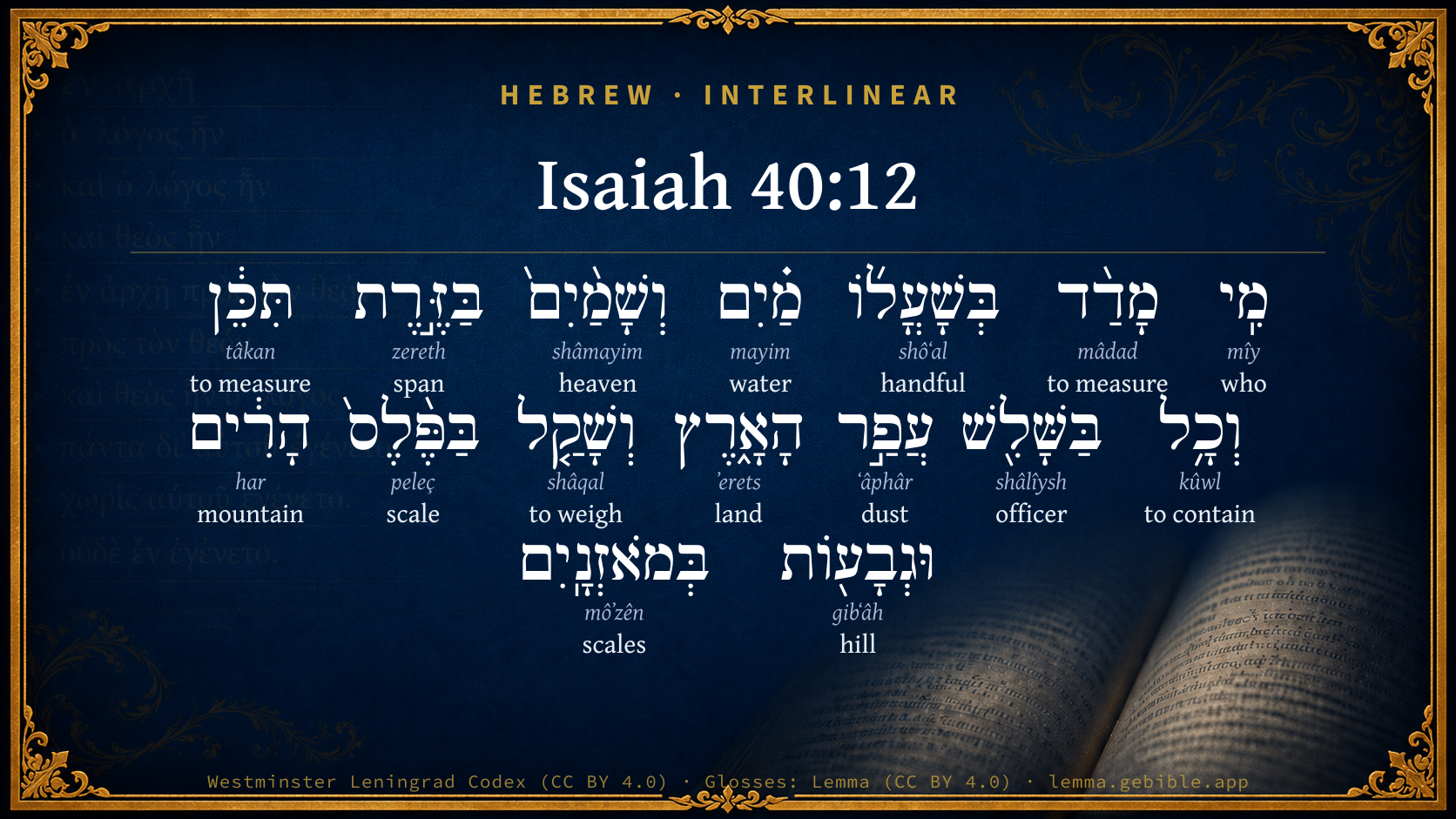
  1. מִֽי mîy H4310 “who” Particle, Interrogative
  2. מָדַ֨ד mâdad H4058 “to measure” Verb, Qal, Perfect, 3rd Person, Masculine, Singular
  3. בְּשָׁעֳל֜וֹ shôʻal H8168 “in/at · handful · his” Preposition + Noun, Common, Masculine, Singular, Construct + Suffix, Personal, 3rd Person, Masculine, Singular
  4. מַ֗יִם mayim H4325 “water(s)” Noun, Common, Masculine, Plural, Absolute
  5. וְשָׁמַ֨יִם֙ shâmayim H8064 “and · heaven(s)” Conjunction + Noun, Common, Masculine, Plural, Absolute
  6. בַּזֶּ֣רֶת zereth H2239 “in/at the · span” Preposition, Determined + Noun, Common, Feminine, Singular, Absolute
  7. תִּכֵּ֔ן tâkan H8505 “to measure” Verb, Piel, Perfect, 3rd Person, Masculine, Singular
  8. וְכָ֥ל kûwl H3557 “and · to contain” Conjunction + Verb, Qal, Perfect, 3rd Person, Masculine, Singular
  9. בַּשָּׁלִ֖שׁ shâlîysh H7991 “in/at the · officer” Preposition, Determined + Noun, Common, Masculine, Singular, Absolute
  10. עֲפַ֣ר ʻâphâr H6083 “dust of” Noun, Common, Masculine, Singular, Construct
  11. הָאָ֑רֶץ ʼerets H776 “the · land” Particle, Definite Article + Noun, Common, Both, Singular, Absolute
  12. וְשָׁקַ֤ל shâqal H8254 “and · to weigh” Conjunction + Verb, Qal, Sequential Perfect, 3rd Person, Masculine, Singular
  13. הָרִ֔ים har H2022 “mountains” Noun, Common, Masculine, Plural, Absolute
  14. וּגְבָע֖וֹת gibʻâh H1389 “and · hills” Conjunction + Noun, Common, Feminine, Plural, Absolute
  15. בְּמֹאזְנָֽיִם môʼzên H3976 “in/at · scales” Preposition + Noun, Common, Masculine, Dual, Absolute

About this verse

These counts appear in no published source. They are computed here, from the morphology-tagged text and Lemma’s own curated glosses. What Lemma adds →

16
words
16
distinct lemmas
Prophets
section

Notable vocabulary

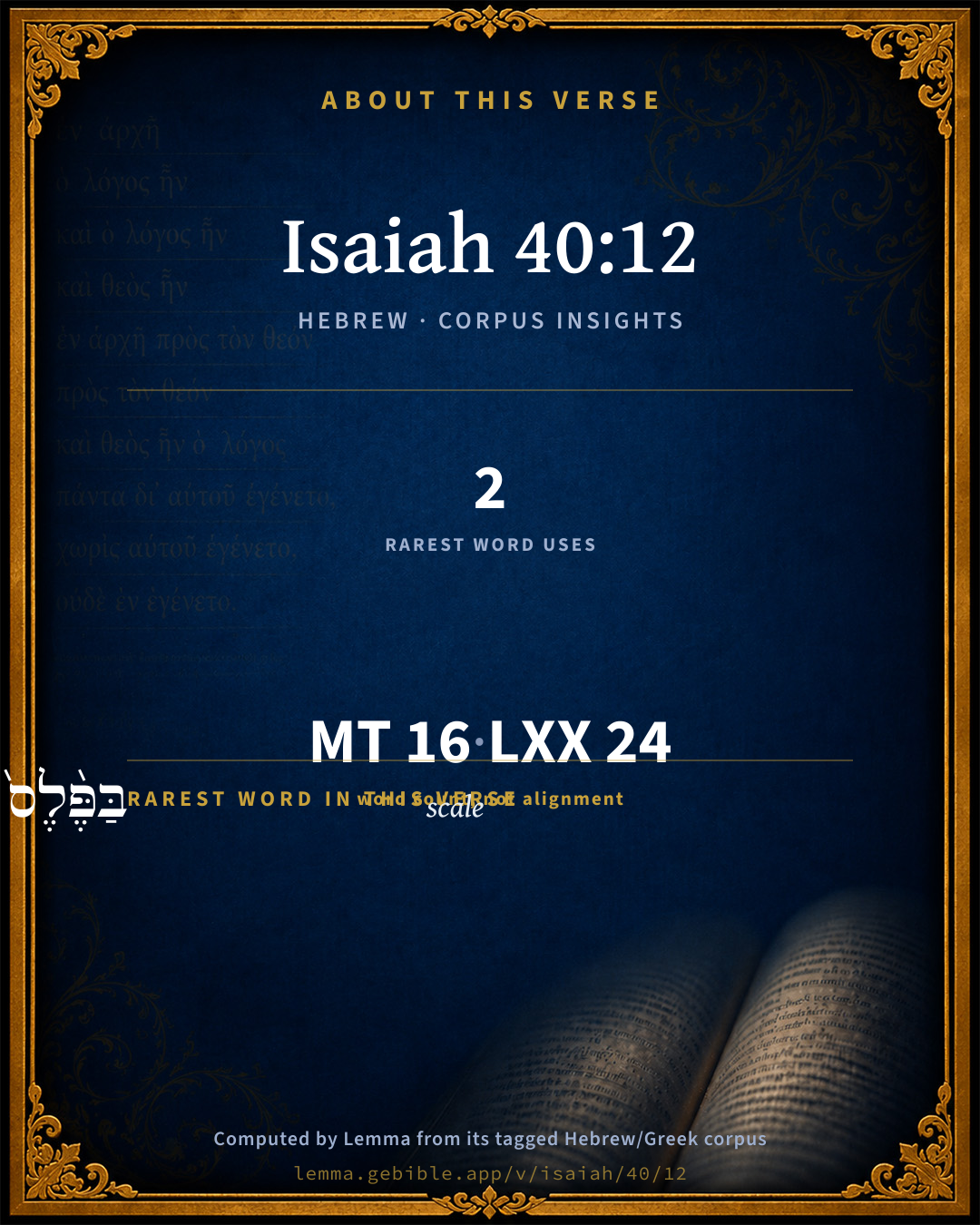
The rarest word here is בַּפֶּ֨לֶס֙ scale H6425 — appearing just 2 times in the whole Hebrew Bible.

Shared distinctive vocabulary

בַּפֶּ֨לֶס֙ scale H6425 occurs in 2 verses of the Hebrew Bible. Also found in:

Grammatical profile

  • 4 verbs
  • 11 nouns
  • 1 particle

Verb forms

  • מָדַ֨ד Qal · Perfect
  • תִּכֵּ֔ן Piel · Perfect
  • וְכָ֥ל Qal · Perfect
  • וְשָׁקַ֤ל Qal · Sequential Perfect

Hebrew & Septuagint length

In English translation the verse runs 41 words from the Hebrew and 34 from the Septuagint (LXX English) — closely comparable.

A rough comparison of the two English renderings, which tokenize alike — not a word-level alignment.

Word counts can differ between the Hebrew and the Greek without any difference in meaning — e.g. the Hebrew direct-object marker אֵת has no separate Greek word, and Greek often adds the article ὁ.

In the original languages it is 16 Hebrew tokens and 24 Greek tokens — but the two are counted differently (Hebrew bundles its prefixes and suffixes into one token; the Greek is in lemma form), so that isn’t a like-for-like length.

Cross-references

10

Topical passages linked to Isaiah 40:12 in the Treasury of Scripture Knowledge — connected by theme and wording, ordered by reader-vote popularity; previews shown in the World English Bible.

  • Proverbs 30:4 Who has ascended up into heaven, and descended? Who has gathered the wind in his fists? Who has bound the waters in his garment? Who has established all the ends of the earth? What is his name, and what is his son's name, if you know?
  • Hebrews 1:10–12 And, "You, Lord, in the beginning, laid the foundation of the earth. The heavens are the works of your hands.
  • Job 38:4–11 "Where were you when I laid the foundations of the earth? Declare, if you have understanding.
  • Psalms 102:25–26 Of old, you laid the foundation of the earth. The heavens are the work of your hands.
  • Isaiah 48:13 Yes, my hand has laid the foundation of the earth, and my right hand has spread out the heavens: when I call to them, they stand up together.
  • Proverbs 8:26–28 While as yet he had not made the earth, nor the fields, Nor the beginning of the dust of the world.
  • Job 11:7–9 "Can you fathom the mystery of God? Or can you probe the limits of the Almighty?
  • Job 28:25 He establishes the force of the wind; Yes, he measures out the waters by measure.
  • Revelation 20:11 I saw a great white throne, and him who sat on it, from whose face the earth and the heaven fled away. There was found no place for them.
  • Psalms 104:2–3 He covers himself with light as with a garment. He stretches out the heavens like a curtain.

Cross-references courtesy of OpenBible.info (CC BY 4.0).

Hebrew and Greek witnesses Masoretic Hebrew ↔ Greek Septuagint

The same verse in the two great witnesses to the Old Testament, shown verse-for-verse.

These are two independent witnesses, not word-aligned to each other, and the Septuagint is shown in lemma (dictionary) form.

Hebrew Isaiah 40:12 Masoretic · Westminster Leningrad Codex

מִֽי מָדַ֨ד בְּשָׁעֳל֜וֹ מַ֗יִם וְשָׁמַ֨יִם֙ בַּזֶּ֣רֶת תִּכֵּ֔ן וְכָ֥ל בַּשָּׁלִ֖שׁ עֲפַ֣ר הָאָ֑רֶץ וְשָׁקַ֤ל בַּפֶּ֨לֶס֙ הָרִ֔ים וּגְבָע֖וֹת בְּמֹאזְנָֽיִם

Who has measured the waters in the hollow of his hand, and meted out the sky with the span, and comprehended the dust of the earth in a measure, and weighed the mountains in scales, and the hills in a balance?

World English Bible · Public Domain

Greek LXX Isaiah 40:12 Septuagint · lemma form

τίς μετρέω ὁ χείρ ὁ ὕδωρ καί ὁ οὐρανός σπιθαμή καί πᾶς ὁ γῆ δράξ τίς ἵστημι ὁ ὄρος σταθμός καί ὁ νάπη ζυγός

Who has measured the water in his hand, and the heaven with a span, and all the earth in a handful? Who has weighed the mountains in scales, and the forests in a balance?

LXX2012 (modern English Septuagint) · Public Domain

Hebrew: Westminster Leningrad Codex (CC BY 4.0). Greek: Septuagint (public domain); English from LXX2012 (modern English Septuagint) (Public Domain). How the Septuagint differs from the Hebrew →

Targum (Aramaic paraphrase)

1

The Targum is the ancient Jewish Aramaic paraphrase of the Hebrew Scriptures — an interpretive translation, not the Hebrew text itself. Onkelos (literal) and Pseudo-Jonathan (expansive) render the Torah, and Jonathan the Prophets. Coverage is partial: where no permissively-licensed English translation exists for a verse, only the Aramaic is shown. This is verse-level text, not a word-by-word alignment to the Hebrew.

  1. Targum Jonathan Prophets (Joshua–Malachi)
    מַן אֲמַר אִלֵין קַיָם אֲמַר וַעֲבֵד דְכָל מֵי עַלְמָא חֲשִׁיבִין קֳדָמוֹהִי כְּטִפָּא בִשְׁעוֹלָא וּמִשְׁחַת שְׁמַיָא כְּאִלוּ בְּזֵירְתָא מְתַקְנִין וְעַפְרָא דְאַרְעָא כְּאִלוּ בִּמְכִילָא אִתְכַּל וְטוּרַיָא כְּאִלוּ מַתְקַל תַּקִילִין וְרָמָתָא כַּד בְּמוֹזְנַיָא:

    He who hath promised these things, shall confirm them: He hath spoken it, and He will do it; He in whose sight all the waters of the world are accounted as a drop in the hollow of the hand, and the expansion of the heavens as if they had been prepared with the span; and the dust of the earth as if measured in a measure, and the mountains as if weighed in scales, and the hills in a balance.

    Targum Jonathan — Aramaic: “Mikraot Gedolot” (public domain). English: “Sefaria Community Translation” (CC0 1.0 (public-domain dedication)); “London "Chaldee Paraphrase," 1871” (public domain). Text via Sefaria.

Commentary

Notes on Isaiah 40:12 from classic Christian and Jewish commentators (each source and its license shown beneath its notes). The classic Christian expositions comment on the surrounding passage and are grouped to its opening verse, so a note may address several verses; the Jewish commentaries on the Tanakh (Rashi and others) are per-verse, so they appear only where the commentator wrote on this verse.

Lemma curates 59 commentaries, every one of them public domain or Creative Commons licensed, each selected and text-cleaned for this edition rather than reprinted as found. About our sources →

Matthew Henry's Commentary

The scope of these verses is to show what a great and glorious being the Lord Jehovah is, who is Israel's God and Saviour. It comes in here, 1. To encourage his people that were captives in Babylon to hope in him, and to depend upon him for deliverance, though they were ever so weak and their oppressors ever so strong. 2. To engage them to cleave to him, and not to turn aside after other gods; for there are none to be compared with him. 3. To possess all those who receive the glad tidings of redemption by Christ with a holy awe and reverence of God. Though it was said (Isa 40:9), Behold your God, and (Isa 40:11) He shall feed his flock like a shepherd, yet these condescensions of his grace must not be thought of with any diminution to the transcendencies of his glory. Let us see how great our God is, and fear before him; for,

I. His power is unlimited, and what no creature can compare with, much less contend with, Isa 40:12. 1. He has a vast reach. View the celestial globe, and you are astonished at the extent of it; but the great God metes the heavens with a span; to him they are but a hand-breadth, so large-handed is he. View the terraqueous globe, and he has the command of that too. All the waters in the world he can measure in the hollow of his hand, where we can hold but a little water; and the dry land he easily manages, for he comprehends the dust of the earth in a measure, or with his three fingers; it is no more to him than a pugil, or that which we take up between our thumb and two fingers. 2. He has a vast strength, and can as easily move mountains and hills as the tradesman heaves his goods into the scales and out of them again; he poises them with his hand as exactly as if he weighed them in a pair of balances. This may refer to the work of creation, when the heavens were stretched out as exactly as that which is spanned, and the earth and waters were put together in just proportions, as if they had been measured, and the mountains made of such a weight as to serve for ballast to the globe, and no more. Or it may refer to the work of providence (which is a continued creation) and the consistency of all the creatures with each other.

II. His wisdom is unsearchable, and what no creature can give either information or direction to, Isa 40:13, Isa 40:14. As none can do what God has done and does, so none can assist him in the doing of it or suggest any thing to him which he thought not of. When the Lord by his Spirit made the world (Job 26:13) there was none that directed his Spirit, or gave him any advice, either what to do or how to do it. Nor does he need any counsellor to direct him in the government of the world, nor is there any with whom he consults, as the wisest kings do with those that know law and judgment, Est 1:13. God needs not to be told what is done, for he knows it perfectly; nor needs he be advised concerning what is to be done, for he knows both the right end and the proper means. This is much insisted upon here, because the poor captives had no politicians among them to manage their concerns at court or to put them in a way of gaining their liberty. "No matter," says the prophet, "you have a God to act for you, who needs not the assistance of statesmen." In the great work of our redemption by Christ matters were concerted before the world was, when there was one to teach God in the path of judgment, Co1 2:7.

III. The nations of the world are nothing in comparison of him, Isa 40:15, Isa 40:17. Take them all together, all the great and mighty nations of the earth, kings the most pompous, kingdoms the most populous, both the most wealthy; take the isles, the multitude of them, the isles of the Gentiles: Before him, when they stand in competition with him or in opposition to him, they are as a drop of the bucket compared with the vast ocean, or the small dust of the balance (which does not serve to turn it, and therefore is not regarded, it is so small) in comparison with all the dust of the earth. He takes them up, and throws them away from him, as a very little thing, not worth speaking of. They are all in his eye as nothing, as if they had no being at all; for they add nothing to his perfection and all-sufficiency. They are counted by him, and are to be counted by us in comparison of him, less than nothing, and vanity. When he pleases, he can as easily bring them all into nothing as at first he brought them out of nothing. When God has work to do he values not either the assistance or the resistance of any creature. They are all vanity; the word that is used for the chaos (Gen 1:2), to which they will at last be reduced. Let this beget in us high thoughts of God and low thoughts of this world, and engage us to make God, and not man, both our fear and our hope. This magnifies God's love to the world, that, though it is of such small account and value with him, yet, for the redemption of it, he gave his only-begotten Son, Joh 3:16.

IV. The services of the church can make no addition to him nor do they bear any proportion to his infinite perfections (Isa 40:16): Lebanon is not sufficient to burn; not the wood of it, to be for the fuel of the altar, though it be so well stocked with cedars; not the beasts of it, to be for sacrifices, though it be so well stocked with cattle, Isa 40:16. Whatever we honour God with, it falls infinitely short of the merit of his perfection; for he is exalted far above all blessing and praise, all burnt-offerings and sacrifices.

Matthew Henry's Commentary on the Whole Bible (1708–1710) — public domain (CC PDM 1.0). Text via the HelloAO Bible API.

Trapp's Complete Commentary

John Trapp

Isa 40:12 Who hath measured the waters in the hollow of his hand, and meted out heaven with the span, and comprehended the dust of the earth in a measure, and weighed the mountains in scales, and the hills in a balance?

Ver. 12. Who hath measured the waters.] Who but God alone. Totus est in hoc libro, ut confirmet nos in fide. God made heaven, earth, and sea, in number, weight, and measure, as an architect; therefore he wanteth neither power nor wisdom to work in and for his people.

And comprehended the dust of the earth in a measure.] In a tierce, or in "three fingers"; for he spoke before of the "hollow" and "span of God’s hand."

John Trapp, A Commentary or Exposition upon All the Books of the Old and New Testament (1647–1656) — public domain. Text from a community e-Sword module.

The Biblical Illustrator

Joseph S. Exell

Isa_40:12-28

Who hath measured the waters in the hollow of His hand?

--

The grandeur of God

The prophets notions of God are diffused through all the verses of the text. The prophets design in describing the Deity with so much magnificence is to discountenance idolatry, of which there are two sorts.

1. Religious idolatry, which consists in rendering that religious worship to a creature which is due to none but God.

2. Moral idolatry, which consists in distrusting the promises of God in dangerous crises, and in expecting that assistance from men which cannot but be expected from God. The portrait drawn by the prophet is infinitely inferior to his original. Ye will be fully convinced of this if ye attend to the following considerations of the grandeur of God.

I. THE SUBLIMITY OF HIS ESSENCE. The prophets mind was filled with this object. It is owing to this that he repeats the grand title of Jehovah, the Lord, which signifies I am by excellence, and which distinguisheth by four grand characters the essence of God from the essence of creatures.

1. The essence of God is independent in its cause. God is a self-existent being. We exist, but ours is only a borrowed existence, for existence is foreign from us.

2. The essence of God is universal in its extent. God possesseth the reality of every thing that exists. He is, as an ancient writer expresseth it, a boundless ocean of existence. From this ocean of existence all created beings, like so many rivulets, flow.

3. The essence of God is unchangeable in its exercise. Creatures only pass from nothing to existence, and from existence to nothing. We love to-day what we hated yesterday, and to-morrow we shall hate What to-day we love.

4. The Divine essence is eternal in its duration. Hast thou not known, saith our prophet, that He is the everlasting God, the Lord, the Creator of the ends of the earth?

II. THE IMMENSITY OF HIS WORKS (Isa_40:22; Isa_40:26). A novice is frightened at hearing what astronomers assert. Over all this universe God reigns.

III. THE EFFICIENCY OF HIS WILL. The idea of the real world conducts us to that of the possible world. The idea of a creative Being includes the idea of a Being whose will is efficient. But a Being whose will is self-efficient, is a Being who, by a single act of His will, can create all possible beings: that is, all, the existence of which implies no contradiction; there being no reason for limiting the power of a will that hath been once efficient of itself.

IV. THE MAGNIFICENCE OF SOME OF HIS MIGHTY ACTS, AT CERTAIN PERIODS, IN FAVOUR OF HIS CHURCH. The prophet had two of these periods in view. The first was the return of the Jews from that captivity in Babylon which he had denounced; and the second, the coming of the Messiah, of which their return from captivity was only a shadow. Such, then, are the grandeurs of God! Application--We observed that the prophets design was to render two sorts of idolatry odious: idolatry in religion, and idolatry in morals. Idolatry in religion consists in rendering those religious homages to creatures which are due to the Creator only. To discredit this kind of idolatry, the prophet contents himself with describing it. He shames the idolater by reminding him of the origin of idols, and of the pains taken to preserve them. A man is guilty of moral idolatry when, in dangerous crises, he says, My way is hid from the Lord; my judgment is passed over from my God. God is the sole arbiter of events. Whenever ye think that any more powerful being directs them to comfort you, ye put the creature in the Creator s place; whether ye do it in a manner more or less absurd; whether formidable armies, impregnable fortresses, and well-stored magazines; or whether a small circle of friends, an easy income, or a country house. The Jews were often guilty of the first sort of idolatry. The captivity in Babylon was the last curb to that fatal propensity. Thanks be to God that the light of the Gospel hath opened the eyes of a great number of Christians in regard to idolatry in religion. Ye who, in order to avert public calamities, satisfy yourselves with a few precautions of worldly prudence, and take no pains to extirpate those horrible crimes which provoke the vengeance of heaven to inflict punishments on public bodies; ye are guilty of this second kind of idolatry. Were your confidence placed in God, ye would endeavour to avert national judgments by purging the state of those wicked practices which are the surest forerunners and the principal causes of famine, and pestilence, and war. And thou, feeble mortal, lying on a sick-bed, already struggling with the king of terrors; thou, who tremblingly complainest, I am undone!--thou art guilty of this second kind of idolatry, that thou hast trusted in man and made flesh thine arm. Were God the object of thy trust, thou wouldest believe that though death is about to separate thee from man, it is about to unite thee to God. (J. Saurin.)

The incomparableness of the great God

To whom then will ye liken God?

I. THAT THE GREATEST THINGS IN THE MATERIAL WORLD ARE NOTHING TO HIM. The ocean is great, great in its depths, breadths, contents, occupying by far the largest portion of this globe of ours. But He hath measured the waters in the hollow of His hand. The heaven is great; its expanse is immeasurable, its worlds and systems baffle all arithmetic, but He meted out heaven with the span. The earth is great, great to us, though mere speck in the universe, and, it may be, an atom to other intelligences; but He comprehendeth the dust in a measure, etc. What is the universe to God? You may compare an atom to the Andes, a raindrop to the Atlantic, a spark to the central fires of the creation; but you cannot compare the universe, great as it is, to the Creator.

II. THAT THE GREATEST MINDS IN THE SPIRITUAL UNIVERSE ARE NOTHING TO HIM. Who hath directed the Spirit of the Lord, or being His counsellor hath taught Him? etc. (Isa_40:13-14). The Bible gives us to understand that there is a spiritual universe far greater than the material, of which the material is but the dim mirror and feeble instrument--a universe containing intelligences innumerable in multitude and incalculable in their gradations of strength and intelligence. But what spirit or spirits at the head or hierarchy of these intelligences has ever given Him counsel, instructed or influenced Him in any matter? He is uninstructible: the only Being in the universe who is so. He knows all. Sooner speak of a spark enlightening the sun, than speak of a universe of intelligences adding aught to the knowledge of God. He is absolutely original: the only Being in the universe who is so. We talk of original thinkers. Such creatures are mere fictions. He being so independent of all minds--

1. His universe must be regarded as the expression of Himself. No other being had a hand in it.

2. His laws are the revelation of Himself. No one counselled Him in His legislation.

3. His conduct is absolutely irresponsible, and He alone can be trusted with irresponsibility.

III. THAT THE GREATEST INSTITUTIONS IN HUMAN SOCIETY ARE NOTHING TO HIM. Nations are the greatest things in human institutions. But nations are as a drop of a bucket, and are counted as the small dust of the balance. What were the greatest nations of the old world, or the most powerful of modem times? What are the greatest nations that have ever been, or are, compared to Him? Nothing, emptiness. Oh, ye magnates of the world, ye kings of the earth, what are ye in the presence of God? Less than animalcula dancing in the sun.

IV. THAT THE GREATEST PRODUCTIONS OF HUMAN LABOUR ARE NOTHING TO HIM. There is, said an eloquent French preacher, nothing great but God. (Homilist.)

The transcendent One

The grand object of this sublime chapter seems to be to inspirit and to comfort the Jews in their Babylonian captivity. Their God in His transcendent greatness is brought under their notice for this purpose--

I. IN THE EXACTITUDE OF HIS OPERATIONS. He is here represented as measuring the waters, as spanning the heavens, as comprehending the very dust of the earth in a measure, as weighing the mountains in scales. As the physician adjusts in nicest proportions the elements in the medical dose, with which he hopes to cure his patient; the engineer every crank and wheel and pin in the machine which he has constructed for a certain purpose, so God--only in an Infinite degree--arranges all the parts of the complicated universe. It is seen in the atmosphere that surrounds this globe; were one of its constituent elements more or less than it is the whole would be disturbed. This is seen in the punctuality with which all the heavenly orbs perform their movements; they are never out of time. It is seen, in fact, in the unbroken uniformity with which all nature proceeds on its march.

1. This Divine exactitude should inspire us with unbounded confidence in His procedure. Because God works with such infinite precision, His works admit of no improvement.

2. This Divine exactitude should inspire us to imitate Him in this respect. When we act from blind impulse, or from imperfect reflection, we risk our wellbeing.

II. IN THE ALMIGHTINESS OF HIS POWER. He is here represented as holding the waters in the hollow of His hand. In thinking of this power we should remember--

1. That all this power is under the direction of intelligence. It is not a blind force, like the force of the storm or the tornado, but it is a force directed by the highest wisdom. Wisdom uses the whole as the smith uses his hammer on the anvil, as the mariner the rudder in the tempest.

2. That all this power is inspired by benevolence. The infinite is here portrayed.

III. IN THE INDEPENDENCY OF HIS MIND. With whom took He counsel, and who instructed Him? From this absolute mental independency of God the following things may be deduced--

1. That all His operations must originate in pure sovereignty. All that exists must be traced to the counsels of His own will, for He had no counsellor.

2. That all His laws must be a transcript of His mind. What they are He is; they are the history of Himself. Conclusion--What an argument is here for an entire surrender to, and a thorough acquiescence in, the Divine will. (Homilist.)

The greatness of Israels God

How little the palm of a man takes, how little the space which the span of a man can cover, how scanty the third of an ephah and for what insignificant measures a balance suffices, whether a steelyard (statera), or a retail balance (libra) consisting of two scales (lances). But what Jehovah measures with His palm and regulates with His span is nothing less than the waters below and the heavens above. He uses a shalish, in which the dust composing the earth finds place, and a balance in which He weighs the colossus of the mountains. (F. Delitzsch, D. D.)

God in relation to earth and ocean

Put two tablespoonfuls of water in the palm of your hand and it will overflow; but Isaiah indicates that God puts the Atlantic and the Pacific and the Arctic and the Antarctic and the Mediteranean and the Black Sea and all the waters of the earth in the hollow of His hand. The fingers the beach on one side, the wrist the beach on the other. He holdeth the water in the hollow of His hand. As you take a pinch of salt or powder between your thumb and two fingers, so Isaiah indicates God takes up the earth. He measures the dust of the earth. The original there indicates that God takes all the dust of all the continents between the thumb and two fingers. (T. De Witt Talmage, D. D.)

The great God in His relation to heaven and earth

There was an engineer by the name of Strasicrates who was in the employ of Alexander the Great, and he offered to hew a mountain in the shape of his master, the Emperor, the enormous figure to hold in the left hand a city of 10,000 inhabitants, while with the right hand it was to hold a basin large enough to collect all the mountain torrents. Alexander applauded his ingenuity, out forbade the enterprise because of its costliness. Yet I have to tell you that our King holds in His one hand all the cities of the earth, and with the other all the oceans, while He has the stars of heaven for a tiara. (T. DeWitt Talmage, D. D.)

God weighing the mountains

What are all the balances of earthly manipulation compared with the balances that Isaiah saw suspended when he saw God putting into the scales the Alps and the Apennines and Mount Washington and the Sierra Nevadas? You see the earth had to be ballasted. It would not do to have too much weight in Europe, or too much weight in Asia, or too much weight in Africa or in America; so when God made the mountains He weighed them. God knows the weight of the great ranges that cross the continents, the tons, the pounds avoirdupois, the ounces, the grains, the milligrammes. (T. De Witt Talmage, D. D.)

Why sayest thou?

The devout thought of these paragraphs passes in survey, first the earth (Isa_40:12-20); then the heavens (21-26); finally, the experience of the children of God in all ages (27-31).

I. THE TESTIMONY OF THE EARTH. It seems as though we are conducted to the shores of the Mediterranean, and stationed somewhere near the site of ancient Tyre. Before us spreads the Great Sea, as the Hebrews were wont to call it. Far across the waters, calm and tranquil, or heaving in memory of recent storms, sea and sky blend in the circle of the horizon. Now remember, says the prophet, Gods hands are so strong and great that all that ocean and all other oceans lie in them as a drop on a mans palm And this God is our God for ever and ever. All men may be in arms against thee: encircling thee with threats, and plotting to swallow thee up. But the nations are to Him as the drop of a bucket, and are counted as the small dust of the balance. Thou hast no reason, therefore, to be afraid.

II. THE TESTIMONY OF THY HEAVENS. The scene shifts to the heavens, and all that is therein. This is the antidote of fear. Sit in the heavenlies. Do not look from earth towards heaven, but from heaven towards earth. Let God, not man, be the standpoint of vision. But this is not all. To this inspired thinker, it seemed as though the blue skies were curtains that God had stretched out as a housewife gauze (see Revised Version, marg.), or the fabric of a tent within which the pilgrim rests. If creation be His tent, which He fills in all its parts, how puny are the greatest potentates of earth! The child of God need not be abashed before the greatest of earthly rulers. And even this is not all--day changes to night, and as the twilight deepens, the stars come out in their hosts; and suddenly, to the imagination of this lofty soul, the vault of heaven seems a pasture-land over which a vast flock is following its Shepherd, who calls each by name. What a sublime conception! Jehovah, the Shepherd of the stars, leading them through space; conducting them with such care and might that none falls out of rank, or is lacking. And will Jehovah do so much for stars, and nought for sons?

III. THE TESTIMONY OF THE SAINTS. Hast thou not heard? It has been a commonplace with every generation of Gods people, that the Lord fainteth not, neither is weary. He never takes up a case to drop it. He never begins to build a character to leave it when it is half complete. He may seem to forsake and to plunge the soul into needless trial; this, however, is no indication that He has tired of His charge, but only that He could not fulfil the highest blessedness of some soul He loved save by the sternest discipline. There is no searching of His understanding. There is another point on which all the saints are agreed, that neither weariness nor fainting are barriers to the forth-putting of Gods might. On the contrary, they possess an infinite attractiveness to His nature. (F. B. Meyer, B. A.)

Nature ministers to the suffering

Nature has always been the resort of the suffering. Elijah to Horeb; Christ to Olivet. And in these glowing paragraphs, which touch the high-water mark of sacred eloquence, we are led forth to stand in the curtained tent of Jehovah, to listen to the beat of the surf, and watch the march of the stars. (F. B. Meyer, B. A.)

The Biblical Illustrator, edited by Joseph S. Exell (c. 1880s–1900s) — public domain. Text from a community e-Sword module.

Joseph Benson's Commentary

Isa 40:12-14. Who hath measured the waters, &c. — Who can do this but God? And this discourse on God’s infinite power and wisdom is added, to give them the greater assurance, that he was able, as he had declared himself willing, to do those great and wonderful things which he had promised; and neither men nor false gods were able to hinder him. Who hath directed the Spirit of the Lord, &c. — Whom did God either need or take to advise him in any of his works, either of creation or the government of the world? Were they not all the effects of his own sole wisdom? Therefore, though all the nations of the world should conspire and contrive against him, and oppose this work of his, as indeed they will do, yet his own counsel shall confound all their devices, and he will carry on his work in spite of them. Who taught him in the path of judgment — How to conduct himself, and manage his affairs with good judgment and discretion? Bishop Lowth translates the verse, “Whom hath he consulted, that he should instruct him, and teach him the path of judgment; that he should impart to him science, and inform him in the way of understanding?” Thus the prophet, “in the most sublime manner, celebrates the divine majesty and greatness, but particularly his wisdom. Rapt into an ecstasy, after he had described the beginning and the nature of the new economy, he sees that there would be many men of worldly prudence, who would hesitate at the methods of the divine counsel, and that the pious themselves, considering the extent and firmness of the kingdom of Satan in the world, the obstinate prejudices of the Gentiles, and the power of idolatry, would have their fears and doubts of the effect and success of the kingdom of the Messiah; a spiritual kingdom, to be established without any external means, by the mere preaching of the word, and to oppose itself to whatever was great or strong among men. The prophet, therefore, recurs to these thoughts; teaching, first, that the divine counsel, though it might seem strange to carnal judgment, was yet founded in the sovereign and most perfect wisdom and knowledge of God, whereof the clearest proofs were discernible in the structure of this world; that God was wiser than men; that his counsel was maturely weighed; that it pertained to his wisdom and glory to establish and to promote his kingdom in the world, rather by this method than any other, that he might put to shame all carnal wisdom, both of the Jews and Gentiles; for that the foolishness of God, as it seems to carnal men, is wiser than men, and the weakness of God stronger than men, (1Co 1:22,) &c., therefore he knew that this method of establishing his kingdom would have its certain effect; that this word, this faith, would overcome the world, and subvert idolatry.” See Vitringa and Dodd.

Joseph Benson's Commentary on the Old and New Testaments (1811–1818) — public domain. Text from a community e-Sword module.

Keil & Delitzsch

C. F. Keil & F. Delitzsch

In order to bring His people to the full consciousness of the exaltation of Jehovah, the prophet asks in Isa 40:12, "Who hath measured the waters with the hollow of his hand, and regulated the heavens with a span, and taken up the dust of the earth in a third measure, and weighed the mountains with a steelyard, and hills with balances?" Jehovah, and He alone, has given to all these their proper quantities, their determinate form, and their proportionate place in the universe. How very little can a man hold in the hollow of his hand (shō‛al)!

(Note: The root שׁל, Arab. sl has the primary meaning of easily moving or being easily moved; then of being loose or slack, of hanging down, or sinking-a meaning which we meet with in שׁעל and שׁאל. Accordingly, shō‛al signifies the palm (i.e., the depression made by the hand), and she'ōl not literally a hollowing or cavity, but a depression or low ground.)

how very small is the space which a man's span will cover! how little is contained in the third of an ephah (shâlı̄sh; see at Psa 80:6)! and how trifling in either bulk or measure is the quantity you can weight in scales, whether it be a peles, i.e., a steelyard (statera), or mō'zenayim, a tradesman's balance (bilances), consisting of two scales.

(Note: According to the meaning, to level or equalize, which is one meaning of pillēs, the noun peles is applied not only to a level used to secure equilibrium, which is called mishqeleth in Isa 28:17, but also to a steelyard used for weighing, the beam of which consists of a lever with unequal arms, which flies up directly the weight is removed.)

But what Jehovah measures with the hollow of His hand, and with His span, is nothing less than the waters beneath and the heavens above. He carries a scoop, in which there is room for all the dust of which the earth consists, and a scale on which He has weighed the great colossal mountains.

Keil & Delitzsch — Biblical Commentary on the Old Testament (1861–1891) — public domain (CC PDM 1.0). Text via the HelloAO Bible API. (Old Testament only.)

Tyndale Open Study Notes

Tyndale Open Resources

40:12-17 Against the backdrop of Israel’s questions (spoken by the prophet), the Lord affirmed that he is the incomparable God, a wise and sovereign creator who rules over the nations.

40:12-13 These rhetorical questions evoke the answer “No one!” God alone created all that exists. He will judge creation (24:17), and he alone can and will restore creation through his salvation.

Tyndale Open Study Notes — © Tyndale Open Resources, licensed CC BY-SA 4.0. Text via the HelloAO Bible API.

Geneva Bible (1599)

Geneva Bible translators

Declaring that as God only hath all power, so doth he use the same for the defense and maintenance of his Church.

Geneva Bible (1599) marginal notes — public domain. Text via Bolls.life.

Jamieson, Fausset & Brown

Robert Jamieson, A. R. Fausset & David Brown

Lest the Jews should suppose that He who was just before described as a "shepherd" is a mere man, He is now described as GOD.

Who--Who else but GOD could do so? Therefore, though the redemption and restoration of His people, foretold here, was a work beyond man's power, they should not doubt its fulfilment since all things are possible to Him who can accurately regulate the proportion of the waters as if He had measured them with His hand (compare Isa 40:15). But MAURER translates: "Who can measure," &c., that is, How immeasurable are the works of God? The former is a better explanation (Job 28:25; Pro 30:4).

span--the space from the end of the thumb to the end of the middle finger extended; God measures the vast heavens as one would measure a small object with his span.

dust of the earth--All the earth is to Him but as a few grains of dust contained in a small measure (literally, "the third part of a larger measure").

hills in a balance--adjusted in their right proportions and places, as exactly as if He had weighed them out.

Jamieson, Fausset & Brown — Commentary Critical and Explanatory on the Whole Bible (1871) — public domain (CC PDM 1.0). Text via the HelloAO Bible API.

Ellicott's Commentary for English Readers

(12) Who hath measured . . .?—Another section opens, expanding the thought of the eternal majesty of Jehovah, as contrasted with the vanity of the idols, or “no-gods,” of the heathen. The whole passage in form and thought supplies once more a parallelism with Job_38:4; Job_38:25; Job_38:37. The whole image is divinely anthropomorphic. The Creator is the great Work-master (Wis_13:1) of the universe, ordering all things, like a human artificer, by number and weight and measure. The mountains of the earth are as dust in the scales of the Infinite.

A Bible Commentary for English Readers, edited by Charles John Ellicott (1878–1897) — public domain. Text from a community e-Sword module.

The Cambridge Bible for Schools and Colleges

gen. ed. J. J. S. Perowne

12. Who can vie with Jehovah in power? The point of these questions lies in the smallness of the measures figured as being used by Jehovah in creating the universe,—the hollow of the hand, the span, etc. Logically, the questions are not quite on the same line as those in Isa_40:13 f. There the answer required is a simple negative: “No one”; here the meaning is, “What sort of Being must He be who actually measured” etc.

meted out] Lit. “weighed out” (as Job_28:25); see on “directed,” (Isa_40:13). The word for comprehended has in New Hebr. and Aram. the sense of “measure” and is probably so used here,—the only instance in the O.T.

a measure] means “a third part,” a tierce, but obviously a small measure, probably a third of an ephah.

scales and balance might be better transposed; the first word denotes probably a “steelyard,” the second the ordinary pair of scales.

The conception of the universe as measured out by its Creator appears to include two things. There is first the idea of order, adjustment and proportion in Nature, suggesting intelligence at work in the making of the world. But the more important thought is that of the infinite power which has carried through these vast operations as easily as man handles his smallest instruments of precision. The passage is not a demonstration of the existence of God, but assuming that He exists and is the Creator of all things, the prophet seeks to convey to his readers some impression of His Omnipotence, which is so conspicuously displayed in the accurate determination of the great masses and expanses of the material world.

12–14. The argument for the infinitude of God opens with a series of rhetorical questions, not needing to be answered, but intended to raise the thoughts of despondent Israelites to the contemplation of the true nature of the God they worshipped. For a different purpose, namely, to humble the pride of human reason, the Almighty Himself addresses a similar series of interrogations to Job (Isa_38:4 ff.).

The Cambridge Bible for Schools and Colleges (gen. ed. J. J. S. Perowne; Cambridge University Press, 1878–1918) — public domain. Text from a community e-Sword module.

John Gill's Exposition

Who hath measured the waters in the hollow of his hand?.... The following account of the power, wisdom, and all sufficiency of God, and which is to be understood of Christ, is to show that he is equal to the work of redemption and salvation he has engaged in, and was about to come and perform, and that he is able to do it, as well as to execute his office as a shepherd; and also to observe, that though his rich grace and goodness he had condescended to take upon him the work of a saviour, and the office of a shepherd, yet this was not to be interpreted as if he had lost his dignity and glory as a divine Person, or as if that was in the least diminished; for he was no other than that infinite Being, "who has measured the waters in the hollow of his hand"; the waters of the seas, for which he has provided a receptacle, where he has collected and put them together; the dimensions of which are exactly known to him, and the vast confluence of water is no more in his hands than so much water as a man can hold in the hollow of his hand, in his fist, or hand contracted:

and meted out heaven with the span; which he has stretched out as a curtain, Isa 40:22, and the measure of which is but one hand's breadth with him; and is no more to him than stretching out a carpet or canopy; and as easily measured by him as a piece of cloth is by a man with the span of his hand, or any measuring rule or yard:

and comprehended the dust of the earth in a measure; the word (r) used signifies the third part of some larger measure, as of a sextarius, as some; or of an ephah, or bath as others; or of some other measure not known; See Gill on Psa 80:5. The Vulgate Latin version renders it, "with three fingers"; and the sense may be, that the dust of the earth, or the earth itself, which is but dust, is no more with the Lord than so much earth or dust as a man can hold between his thumb and two fingers; and in like manner is the whole earth comprehended by the Lord:

and weighed the mountains in scales, and the hills in a balance; as easily as a man can throw in his goods into a pair of scales, and take the true weight of them, with equal ease did the Lord raise the mountains and the hills in a proper proportion, and has so exactly poised them, as if he had weighed them in a pair of scales; this seems to hint at the use of mountains and hills to be a sort of ballast to the earth, and shows the original formation of them from the beginning. The answer to the above question is, that it was the same divine Person of whom it is said, "behold your God, and who should come with a strong hand, and feed his flock."

(r) "in mensura ternaria", Montanus; "trientali", Junius & Tremellius, Piscator, Cocceius, Vitringa.

John Gill's Exposition of the Whole Bible (1746–1763) — public domain (CC PDM 1.0). Text via the HelloAO Bible API.

Albert Barnes' Notes on the Bible

Who hath measured - The object in this and the following verses to Isa 40:26, is to show the greatness, power, and majesty of God, by strong contrast with his creatures, and more especially with idols. Perhaps the prophet designed to meet and answer an implied objection: that the work of deliverance was so great that it could not be accomplished. The answer was, that God had made all things; that he was infinitely great; that he had entire control over all the nations; and that he could, therefore, remove all obstacles out of the way, and accomplish his great and gracious purposes. By man it could not be done; nor had idol-gods any power to do it; but the Creator and upholder of all could effect this purpose with infinite case. At the same time that the argument here is one that is entirely conclusive, the passage, regarded as a description of the power and majesty of God, is one of vast sublimity and grandeur; nor is there any portion of the Sacred Volume that is more suited to impress the mind with a sense of the majesty and glory of Yahweh. The question, ‘who hath measured,’ is designed to imply that the thing referred to here was that which had never been done, and could never be done by man; and the argument is, that although that which the prophet predicted was a work which surpassed human power, yet it could be done by that God who had measured the waters in the hollow of his hand. The word ‘waters’ here refers evidently to the vast collection of waters in the deep - the mighty ocean, together with all the waters in the running streams, and in the clouds. See Gen 1:6, where the firmament is said to have been made to divide the waters from the waters. A reference to the waters above the heavens occurs in Psa 148:4 :

Praise him, ye heavens of heavens,

And ye waters that be above the heavens.

And in Pro 30:4, a Similar description of the power and majesty of God occurs:

Who hath gathered the wind in his fists?

Who hath bound the waters in a garment?

Who hath established all the ends of the earth?

And in Job 26:8 :

He bindeth up the waters in his thick clouds;

And the cloud is not rent under them.

The word ‘waters’ here, therefore, may include all the water on the earth, and in the sky. The words, ‘the hollow of his hand,’ mean properly the hand as it is closed, forming a hollow or a cavity by which water can be taken up. The idea is, that God can take up the vast oceans, and all the waters in the lakes, streams, and clouds, in the palm of his hand, as we take up the smallest quantity in ours.

And meted out heaven - The word rendered ‘meted,’ that is, measured (כון kûn), means properly to stand erect, to set up, or make erect; to found, fit, adjust, dispose, form, create. It usually has the idea of fitting or disposing. The word ‘span’ (זרת zeret) denotes the space from the end of the thumb to the end of the middle finger, when extended - usually about nine inches. The idea is, that Yahweh was able to compass or grasp the heavens, though so vast, as one can compass or measure a small object with the span. What an illustration of the vastness and illimitable nature of God!

And comprehended - And measured (כל kôl from כוּל kûl, to hold or contain); ‘Lo, the heavens, and the heaven of heavens cannot contain thee’ 1Ki 8:27.

The dust of the earth - All the earth; all the dust that composes the globe.

In a measure - (בשׁלשׁ bâshâlı̂sh) Properly three; and then the third part of anything. Jerome supposes that it means the three fngers, and that the sense is, that God takes up all the dust of the earth in the first three fingers of the hand. But the more probable signification is, that the word denotes that which was the third part of some other measure, as of an ephah, or bath. In Psa 80:5, the word is used to denote a large measure:

Thou feedest them with the bread of tears,

And givest them tears to drink in great measure ( שׁלישׁ shâlı̂ysh).

The idea is, that God is so great that he can measure all the dust of the earth as easily as we can measure a small quantity of grain with a measure.

And weighed the mountains in scales - The idea here is substantially the same. It is, that God is so mighty that he can weigh the lofty mountains, as we weigh a light object in scales, or in a balance; and perhaps, also, that he has disposed them on the earth as if he had weighed them out, and adapted them to their proper places and situations Throughout this entire passage, there is not only the idea of majesty and power in God, but there is also the idea that he has suited or adjusted everything by his wisdom and power, and adapted it to the condition and needs of his creatures.

Albert Barnes' Notes on the Bible (1834–1885) — public domain. Text from a community e-Sword/MySword module.

Haydock's Catholic Bible Commentary

Who. He now proceeds to shew the difference between God and idols. --- Fingers, is not expressed in Hebrew, which may denote the epha, Psalm lxxix. 6. (Calmet) --- God’s power and goodness in the works of the creation, shew what he will do for man. (Worthington)

George Leo Haydock (1774–1849), Haydock's Catholic Family Bible and Commentary, 1859 edition — public domain. Excludes Psalms (Douay-Rheims chapter numbering differs from Protestant) and Deuterocanonical books (Catholic canon only).

Matthew Poole's English Annotations

Who hath measured the waters in the hollow of his hand? i.e. who can measure them? for indicative verbs in the Hebrew language are oft taken potentially. Who can do this and the following things but God! And this discourse of God’s infinite power and wisdom is here conveniently added, to give them the greater assurance that God was able, as he had declared himself willing, to do these great and wonderful things which he had promised; and that neither men nor false gods were able to hinder him in it. God is here compared to a mighty giant, supposed to be so big that he can take up and hold all the waters of the sea and rivers of the whole world in one hand, and span the heavens, and then take up and weigh the whole earth with the other hand.

Matthew Poole's English Annotations on the Holy Bible (1683–1685) — public domain. Text from a community e-Sword/MySword module.

Whedon's Commentary on the Bible

Daniel D. Whedon

12-14. In the presence and hearing of the Jewish people, the prophet asks,

Who hath measured… meted… comprehended — The verbs are in the past tense, and the last is better rendered as here written (comprehended) because it, on the whole, expresses not what is physical, as do the other terms employed, but what is spiritual or mental.

Who hath directed — To the question respecting God’s omnipotence, is one added respecting his omniscience: who, besides himself, can regulate the movements of His will, intellect, boundless power, and matchless wisdom? This general idea runs on, showing God’s infinite sufficiency in himself, and how vain human assumptions of being in possible communication with God as his counsellor. This thought is referred to by Paul, (Rom_11:34; 1Co_2:16,) to show in both cases, as here, the inconceivable absurdity of attempting comparison of man with God.

Daniel D. Whedon (gen. ed.), Commentary on the Old and New Testaments (1874–1909) — public domain. Text from a community e-Sword module.

The Pulpit Commentary

Vers. 12-31. THE MIGHT AND GREATNESS OF GOD CONTRASTED WITH THE WEAKNESS OF MAN AND THE FUTILITY OF IDOLS. If captive Israel is to be induced to turn" to God, and so hasten the time of its restoration to his favour and to its own land, it must be by rising to a worthy conception of the nature and attributes of the Almighty. The prophet, therefore, in the remainder of this chapter, paints in glorious language the power and greatness, dud at the same time the mercy, of God, contrasting him with man (vers. 15-17, 23, 28-31), with idols (vers. 19, 20), and with the framework of material things (vers. 21, 22, 26), and showing his infinite superiority to each and all. In contrasting him with man, he takes occasion to bring into prominence his goodness and loving-kindness to man, to whom he imparts a portion of his own might and strength (vers. 29-31).

Who hath measured the waters?. (comp. Pro_30:4 Job_38:4-6) The might of God is especially shown in creation, which Isaiah assumes to be God"s work. How infinitely above man must he be, who arranged in such perfection, "by measure and number and weight", (RAPC Wis 11:20) the earth, the waters, and the heavens, so proportioning each to each as to produce that admirable order and regularity which the intelligent observer cannot but note in the material universe as among its chief characteristics! In the hollow of his hand. The anthropomorphism is strong, no doubt, but softened by the preceding mention (in ver. 10) of God"s "arm," and by the comparison of God to a shepherd (in ver. 11). Isaiah"s exalted notion of God renders him fearless with regard to anthropomorphism. And meted out heaven with the span; rather, with a span. (comp. Isa_48:13, "My right hand hath spanned the heavens

And comprehended the dust of the earth in a measure; literally, in a tierce (as in the margin). The measure intended is probably the seah, which was the third part of an ephah, and held about three gallons. The seah was "the ordinary measure for household purposes." In scales... in a balance. The peles, here translated "scales," is probably the steelyard, while the mozenaim is "the balance" or "pair of scales" ordinarily used for weighing. God metes out all things with measures, scales, and balances of his own, which are proportioned to his greatness.

Vers. 12, 22, 26. God in creation.

Creation tells of God in many ways. "The heavens declare the glory of God; and the firmament showeth his handywork: day unto day uttereth speech, and night unto night showeth knowledge". (Psa_19:1, Psa_19:2) "The invisible things of him from the creation of the world are clearly seen, being understood by the things that are made, even his eternal power and Godhead". (Rom_1:20) Here we have noted especially

I GOD"S MARVELLOUSNESS IN CREATION.

1. The very act of creation is the most marvellous of all marvels. For what is creation but the production of something out of nothing? a seeming contradiction, at any rate a strange paradox. Isaiah affects strongly the use of the word bara, (Isa_4:5 Isa_40:26 Isa_41:20 Isa_45:8, Isa_45:12, Isa_45:18, etc.) which, if not confined to the sense of "producing out of nothing," at any rate includes that sense (Gesenius, "Lex. Hebrews," ad voc.).

2. And the marvellousness of creation is enhanced by the vastness of creation: sun, moon, planets, stars; the incalculable distances of space the nebulae, either unformed stars, or infinitely distant solar systems like that of which our system forms a part; the Milky Way, or outer edge of our own system, set so thick with stars that they seem to form a continuous girdle of light.

3. The perfect order of creation: all things weighed out and measured by God"s hand in set proportions one to another; all keeping their appointed courses without collision or confusion; observing their respective times and seasons; displaying an infinite variety, which, however, is all ordered and regulated.

4. And by the unity of creation: all of it from one hand, from one mind, working without assistance, without counsel (vers. 13, 14), from its own inexhaustible stores of wisdom and knowledge; and all of it subject to that one mind and obeying its every behest (ver. 26).

II GOD"S GOODNESS IN CREATION. God does not leave his creation alone, to stand or fall by its own inherent strength. Every part of it is upheld by him, maintained in existence by him, enabled by him to perform the task which he has set it. The "way" of no part of his creation is "hid from him" (ver. 27). Each star is known by name, and the starry hosts are marshalled "by number," and led forth in their stately march, so that "not one faileth" (ver. 26). So with his moral creatures. They too are upheld; "power" and "strength" are given to them continually (ver. 29); he who sustains them is "never faint, never weary;" a way is contrived for them by which they may "renew their strength" (ver. 31). Doubtless there is this difference. Material things are absolutely upheld, and prevented from failing; God"s moral creation is not absolutely upheld. It is given a sufficiency of help, (2Co_12:9) but is not compelled to accept the gift. If man wills to perish, he must perish. Though God"s grace is "sufficient for him," he can reject that grace he can thwart the will of God, who "wouldeth not that any should perish, but that all should come to repentance." Were it otherwise, he would be a machine, and not a moral being.

Vers. 12-18. Jehovah incomparable.

I HIS POWER OVER NATURE. The boldest imagery to express this thought: the "hollow of his hand;" his "span;" his "tierce," a small measure; his scales, with which he weighs the volumes of sea and laud, and measures the vast extent of heaven without an effort, as we use the hand to weigh or to span! Far from taking offence at such figures, we feel them to be truthful, appropriate, sublime. The Creator is infinitely superior to his world. Vastness of space may overwhelm our imagination, but not his. His thought holds with ease the universe as a whole and in all its parts. "Thou hast ordered all things by measure and number and weight". (RAPC Wis 11:20) Vain the "materialistic" dreams of students occupied too much with the physical and the phenomenal. The physical is the expression of the intellectual; the phenomenal but the "appearance" of the real; the creation, the "garb we see God by." How much truer to what a spiritual religion teaches us is this view than that which would direct our wonder and our worship to the mere splendours of the material world, rather than to the great creative and informing spirit of the world! Isaiah, contemptuously speaking of the sea as held in God"s hand, as one might hold a drop of water, is a better poet than Byron, who apostrophizes the sea as a living being.

II THE ORIGINALITY OF HIS MIND. A theological difficulty is supposed to be alluded to. "Who hath regulated the mind of Jehovah? Was he himself absolutely free? May not Omnipotence itself be subject to conditions? May there not be an equal or superior power to whose counsels he must defer?" (Cheyne). Distinctly the prophet, without arguing the question, denies the truth of such a hypothesis. By the Spirit of God we mean the mind of God, which is "The life and light of all this wondrous world we see.

The world is not "dead matter," but the creation of that intelligence, the vast poem, inspired by Divine thoughts that breathe and burn. Love is the last ground of all things, and conscience and intelligence are its ministers. God"s Being is simple, unique, absolutely original. In a like sense to that which we say the works of a great poet are his unassisted productions, does the prophet say the world is the work of God. "Contrast the Babylonian myth of a joint action of Bel and the gods in the creation of man; and the Iranian of co-creatorship of Ormuzd and the Amshaspands;" or the crude cosmogonic notions of the Greeks. All parts of the world, all habitable lands and nations, are dependent on him, derived from his will, subject to his power. How, then, can earth"s noblest products add anything to his riches, or further illustrate the glory of One to whom they already belong? The poverty of Judah in wood may be contrasted with the rich forests of Lebanon; but even Lebanon could not yield enough for his honour, if that honour is to be measured by the extent of the offerings. The nations, and all that is great and imposing in their life, are nought in his eyes; chaos may designate them in this contemptuous view. In short, he is incomparable. No illustration, analogy, similitude, ever thrown forth from the poet-soul and imagination in mankind, as no picture of painter, image of sculptor, will here avail. Nay, there must be moments when the very forms of thought into which everything must be thrown that we may see it at all, and even last of all, the richest and purest musical harmonies, must be set aside as inadequate. "All are too mean to speak his worth, Too mean to set our Maker forth.

Nothing can surpass the simplicity and the sublimity of this view of God. Nothing less lofty will satisfy our intelligence or meet the yearnings of our heart. The idolatry we are so ready to lavish upon the finite object is the poor caricature of that immense delight which God demands we should enjoy in the thought of him, and which we cannot be satisfied until we have attained. J.

Vers. 12-17. The greatness of God and the littleness of man.

These most eloquent words, so impressive as they stand that it seems undesirable to touch them in the way of analyzing them, may speak to us of

I THE IMMEASURABLE GREATNESS OF GOD.

1. His Divine majesty. All that is most vast and powerful in the universe the sea, the heavens, the land, the mountains, etc. is small and slight indeed when compared with him; his surroundings, his possessions, all bespeak his unapproachable majesty.

2. His Divine power. Such is his boundless strength that he can hold up the waters in the hollow of his hand, can "take up the isles as a very little thing." What cannot he accomplish to whom this is easy?

3. His Divine knowledge. Power rests on knowledge; God is able to do all things because he knows all things. He can tell what is the measure of "the dust of the earth." He cannot be taught anything by any being, for all knowledge is his already (vers. 13, 14); greatest things and least, the weight of the mountains, the number of the grains of dust, etc., are known to him.

4. His Divine wisdom. "Who hath taught him in the path of judgment?" (ver. 14). Perfect wisdom, the secret of right action, of the direction of greatest affairs, of prevision and provision, of ruling and overruling, is at his command. His wisdom is incapable of increase; it is absolutely complete.

II HUMAN LITTLENESS. "The nations are as a drop of a bucket" (ver. 15). We note, as corresponding with God"s greatness:

1. Our insignificance. We may find ourselves mean and humble enough when compared with our fellow-men; most certainly we do when we bring ourselves, our circumstances, our authority, into comparison with him.

2. Our impotence. How very little can the strongest and most influential men effect! how much less those whose lives are spent in lowly spheres!

3. Our ignorance. We want men to direct our spirit, to counsel us, to teach us knowledge. There are few men from whom we have not something to learn. We need to be acquiring knowledge, not in the time specially devoted to study, but all day long and all life through.

4. Our foolishness. We do not know how to conduct our own affairs wisely, and are continually making larger or smaller mistakes: how much more so in our conduct of other men"s affairs! Therefore we do well:

(1) To retain truest and deepest reverence of spirit; filial confidence and joy in God must always be made consistent with profoundest adoration.

(2) To accept without question the truth he has revealed to us in his Word.

(3) To trust his guidance in the direction of our lives, however dark and inexplicable some passages may seem.

(4) To work on cheerfully and hopefully, though a successful issue appear exceedingly remote. C.

The Pulpit Commentary (1880–1919), ed. H.D.M. Spence-Jones & Joseph S. Exell — public domain. Text from a community e-Sword module.

John Wesley's Explanatory Notes

Who hath - Who can do this but God? And this discourse of God's infinite power and wisdom, is added to give them the greater assurance, that God was able to do the wonderful things, he had promised.

John Wesley, Explanatory Notes Upon the Whole Bible (1754–1765) — public domain. Text via the GEBible commentary corpus.

J. A. Alexander on Isaiah

Joseph Addison Alexander

“Who hath measured the waters in the hollow of his hand, and meted out heaven with the span, and comprehended in a measure the, dust of the earth, and weighed in a balance the mountains, and the hills in scales?” There are two directly opposite opinions as to the general idea here expressed. Some understand the question as an indirect negation of the possibility of doing what is here described. The implied answer, upon this hypothesis, is, ‘No one,’ and the verse is equivalent to the exclamation, ‘How immense are the works of God!’ The other and more usual interpretation understands the question thus: ‘Who (but God) has measured or can measure etc.?’ Thus understood, the verse, so far from affirming the immensity of God’s works, represents them as little in comparison with Him, Who measures and distributes them with perfect ease. The first explanation derives some countenance from the analogy of the next verse, where the question certainly involves an absolute negation, and is tantamount to saying, that no one does or can do what is there described. But this consideration is not sufficient to outweigh the argument in favor of the other explanation, arising from its greater simplicity and obviousness in this connection. In order to convey the idea of immensity, the largest measures, not the smallest, would have been employed. An object might be too large to be weighed in scales, or held in the hollow of a man’s hand, and yet very far from being immense or even vast in its dimensions. On the other hand, the smallness of the measure is entirely appropriate as showing the immensity of God Himself, Who can deal with the whole universe as man deals with the most minute and trivial objects. A handful is here put for the receptacle or measure of that quantity. The span is mentioned as a natural and universal measure of length. The terms used in the English Bible, scales and balance, are retained above but transposed, in order to adhere more closely to the form of the original, in which the first word is a singular while the other is a dual, strictly denoting pair of scales. The dust of the earth seems to be here put poetically for the earth itself. The literal comprehension of the earth in this specific measure is impossible, and all that the words were intended to suggest is a comparison between the customary measurement of common things by man, and the analogous control which is exercised by God over all his works.

Joseph Addison Alexander, The Prophecies of Isaiah (1846–1847; New York: Scribner, 1870–1878) — public domain. Text from a community e-Sword module.

Kretzmann's Popular Commentary

Paul E. Kretzmann

Jehovah the Supreme Ruler.

The connection of thought between this section and the foregoing one is this, that the majesty and glory of God over against the idolatry of the heathen nations guarantees the security and the deliverance of the believers of all times.

v. 12. Who hath measured the waters in the hollow of his hand? fixing the quantity of all the water in ocean, seas, and streams, and meted out heaven with the span, the measure between the thumb and middle finger, and comprehended the dust of the earth in a measure, the third part of an ephah, and weighed the mountains in scales and the hills in a balance? Before the exalted Lord and Ruler of the universe the whole earth and all it contains are insignificant, amount to nothing or next to nothing, yet it was His good pleasure to weigh them out and to adjust them in their proper relation.

v. 13. Who hath directed the Spirit of the Lord? Who can measure and understand Him, or, being His counselor, hath taught Him? advising Him on the basis of his understanding of the Lord’s mind. Cf Rom 11:34. The fundamental principle of education is here stated: Understanding the pupil and giving him instruction, teaching him to discriminate and to perform the works of His government properly. It is preposterous that God should need or seek the counsel of any man.

v. 14. With whom took He counsel, and who instructed Him, so that He learned discrimination, and taught Him in the path of judgment, and taught Him knowledge, so that He could apply His wisdom in the right manner, and showed to Him the way of understanding? so that His knowing could be translated into the right kind of doing. This thought is even more outside of the pale of possibility, for the Lord is immensely exalted above all human beings even at the highest point of their enlightenment, as the text shows in the next section.

v. 15. Behold, the nations are as a drop of a bucket, clinging to the bottom of the bucket when it is emptied, and are counted as the small dust of the balance, like a grain of sand in the pan. Behold, He taketh up the isles as a very little thing, like a mote that is carried upward. The prophet uses the very strongest comparisons to indicate the immeasurable distance by which even the imagination of man stays behind and fails to reach the exaltation of Jehovah.

v. 16. And Lebanon is not sufficient to burn, to supply fuel enough for worthy sacrifices to the glory of God, nor the beasts thereof sufficient for a burnt offering, the untold number of animals with which these forests abounded would not be enough fittingly to honor Him by their sacrifice.

v. 17. All nations before Him are as nothing, their entire sum and substance totaling only so much before Him; and they are counted to Him less than nothing and vanity. Therefore the prophet inserts the question which, at the same time, introduces the new section of this chapter,

v. 18. To whom, then, will ye liken God? Why try to make comparisons, which, at best, are so utterly inadequate and futile? Or what likeness will ye compare unto Him? How foolish to try to represent Him by one of the idols whom the prophet now proceeds to describe.

v. 19. The workman melteth a graven image, casting it in molds, and the goldsmith spreadeth it over with gold, in a plating of the more precious metal, and casteth silver chains, as ornaments on the figure.

v. 20. He that is so impoverished that he hath no oblation, that is, the heathen priest who is supported by such gifts, chooseth a tree that will not rot, the most durable wood; he seeketh unto him a cunning workman to prepare a graven image, to set it up in the proper manner, that shall not be moved, so that the idol would fall to the ground. Note the irony of the prophet which is in evidence throughout, followed by disgust, which shows itself in a number of questions expressing great displeasure.

v. 21. Have ye not known? Have ye not heard? The facts which the prophet has in mind could and should be well known to all whom the prophet’s words might reach. Hath it not been told you from the beginning? Have ye not understood from the foundations of the earth? God alone has established the earth and laid its foundations and no idol ever even approached him, much less was worthy of being compared with Him. This God is now described by the prophet.

v. 22. It is He that sitteth upon the circle of the earth, highly exalted above the globe of this puny world, and the inhabitants thereof are as grasshoppers, so insignificant and despicable in comparison with Him; that stretcheth out the heavens as a curtain, the reference being to the awning which is drawn over the court of Oriental houses for shelter in rain or hot weather, and spreadeth them out as a tent to dwell in;

v. 23. that bringeth the princes to nothing, their power being helpless before Him; He maketh the judges of the earth as vanity, nothingness, an empty show.

v. 24. Yea, they shall not be planted; yea, they shall not be sown; yea, their stock shall not take root in the earth, that is, hardly have they, in their own opinion, gained a foothold, believing themselves to be safe without the Lord, and He shall also blow upon them, and they shall wither, and the whirlwind shall take them away as stubble, as chaff in a tornado, absolutely helpless before Him who is the Ruler of the universe. Therefore the Lord now bids men consider His incomparable majesty and glory.

v. 25. To whom, then, will ye liken Me or shall I be equal? saith the Holy One. It is a vain and fruitless task even to compare the wisdom and power of individuals and of nations with that of the Lord; for he is the Possessor of limitless power and wisdom.

v. 26. Lift up your eyes on high, namely, to the heights of heaven, to the starry firmament, and behold who hath created these things, all the heavenly bodies, that bringeth out their host by number, like a shepherd leading his sheep to the meadow. He calleth them all by names by the greatness of His might, for that He is strong in power; not one faileth, He takes care, by virtue of His might and of His goodness, that not one is left behind. How readily will He, therefore, will His love and goodness, surround His children everywhere with His protection! Cf Psa 147:4; Mat 10:30.

v. 27. Why sayest thou, O Jacob, and speakest, O Israel, all the believers everywhere, when evil days come upon them, My way is hid from the Lord, and my judgment is passed over from my God? the complaint often being made by Christians that the Lord takes no interest in them, that He disregards their case, that He neglects them, passing by their distress without noticing it. The reproachful question is followed by an emphatic statement, also in the form of a question,

v. 28. Hast thou not known? It surely had been proclaimed often enough. Hast thou not heard that the everlasting God, who is unchangeable from eternity to eternity, the Lord, the covenant God, the Creator of the ends of the earth, that is, of the whole world with all that it contains, fainteth not, neither is weary? He never so much as begins to abandon His vigilant care for His children, much less will He fail in it. There is no searching of His understanding, it cannot be fathomed by the finite mind of any human being. This fact, then, should inspire His people with the strongest confidence.

v. 29. He giveth power to the faint, sustaining them when they are about to sink down; and to them that have no might He increaseth strength, that is, to those who are utterly helpless He imparts power.

v. 30. Even the youths, those in the prime of their young manhood, shall faint and be weary, namely, when depending on their own strength, and the young men, those excelling in youthful vigor and energy, shall utterly fall, for mere human might and power is, after all, subject to weariness and decay.

v. 31. But they that wait upon the Lord, putting all their trust in Him alone, shall renew their strength, gaining new spiritual power from day to day; they shall mount up with wings as eagles, the birds who have ever been types of almost limitless strength, Psa 103:5; they shall run and not be weary; and they shall walk and not faint, finishing their course with the strength imparted to them from on high, victorious to the last. 2Ti 4:7.

Paul E. Kretzmann, Popular Commentary of the Bible (1921–1924) — public domain. Text from a community e-Sword module.

unfoldingWord translationNotes

Door43 World Missions Community

Who has measured ... or the hills in a balance?

These rhetorical questions anticipate a negative answer and emphasize that only Yahweh is able to do these things. AT: "No one but Yahweh has measured ... and the hills in a balance." (See: Rhetorical Question)

measured the waters in the hollow of his hand

Yahweh knowing how much water is in the oceans is spoken of as if Yahweh held the water in his hand. (See: Metaphor)

measured the sky with the span of his hand

A "span" is the measure of length between the thumb and little finger when the hand is outstretched. Yahweh knowing the length of the sky is spoken of as if he measured it with his hand. (See: Metaphor)

held the dust of the earth in a basket

Yahweh knowing how much dust there is on the earth is spoken of as if he carried it in a basket. (See: Metaphor)

weighed the mountains in scales, or the hills in a balance?

Yahweh knowing how heavy the mountains are is spoken of as if he weighed them in scales and balances. (See: Metaphor)

translationWords

water

hand

heaven

unfoldingWord translationNotes — © Distant Shores Media and the Door43 World Missions Community, licensed CC BY-SA 4.0. Source: git.door43.org/Door43/en_tn.

Rashi

Rabbi Shlomo Yitzchaki (Rashi)

Who measured etc. He had the power to do all this, and surely He has the power to keep these promises.

with his gait Heb. בְּשָׁעֳלוֹ, with his walking, as it is said (Habakkuk 3:15): “You trod with Your horses in the sea.” Comp. (Num. 22:24) “In the path (בְּמִשְׁעוֹל) of the vineyards, a path (for walking).” Another explanation is that שַׁעַל is the name of a receptacle. Comp. (Ezekiel 13:19) “For measures (בְּשַׁעֲלוֹ) of barley.”

measured Amolad in O.F., an expression of measure and number. Comp. (Ex. 5:18) “And the number (וְתֹכֶן) of bricks you shall give.”

and measured by thirds Heb. בַּשָּׁלִשׁ, and measured by thirds, one third wilderness, one third civilization, and one third seas and rivers. Another interpretation: בַּשָּׁלִשׁ, from the thumb to the middle finger, the third of the fingers. Menahem explains it as the name of a vessel. Comp. (Ps. 80:6) “And You gave them to drink tears with a vessel (שָׁלִישׁ).”

and weighed mountains with a scale Everything according to the earth, a heavy mountain He inserted into hard earth, and the light ones into soft earth.

Rashi on the Tanakh — English translations: “The Judaica Press complete Tanach with Rashi, translated by A. J. Rosenberg” (CC BY 4.0); “Pentateuch with Rashi's commentary by M. Rosenbaum and A.M. Silbermann, 1929-1934” (public domain); “The Metsudah Tanach series, Lakewood, N.J” (CC BY 4.0); and “The Book of Joshua, Metsudah Publications, 1997” (CC BY 4.0). Text via Sefaria.

Ibn Ezra

Rabbi Abraham ibn Ezra

Who hath measured, etc. There are some that ask, How is it possible that such a thing shall happen? The answer is that the same Supreme Being will cause it to pass, who has created the whole universe, who knows the quantity of the water in the sea, as if He had measured it with His hand.

בשעלו In the hollow of His hand. Comp. כשעלי for handfuls (Ez. 13:19).

And meted out heaven with the span. He knows the measure of heaven, which He has stretched out like a curtain; He has created it with His omnipotence, according to His wisdom, as if He had measured it with the span. The words of the text are an anthropomorphism.

וכל And measured. Comp. וכלו, the Chaldean translation of וימדו and they measured (Ex. 16:18).

בשליש In a measure. שליש is very likely derived from שלש three, but we do not know at present the capacities of ancient measures. Comp. בשליש in great measure (Ps. Ixxx. 6). three measures.

בפלס In a balance. It is called in Arabic Kriston and consists of one long arm. The word פֶלֶס is of the same root as פַלֵּס weigh (Prov. 4:26).

וגבעות במאזנים And hills in scales. He places two hills in the two scales and weighs them against each other. All this is said figuratively.

Ibn Ezra on the Tanakh — English translations: “Sefaria Community Translation” (CC0 1.0 (public-domain dedication)); “Yalkut, Sifsei Chachomim Chumash, Metsudah Publications, 2009” (CC BY 4.0); and “Commentary of Ibn Ezra on Isaiah - trans. by M. Friedlander, 1873” (public domain). Text via Sefaria.

Lesson kit

Teaching starters — assembled from the data on this page, not authored interpretation. Every prompt links to the verse data it draws on. Edit before teaching.

Isaiah, in the Prophets, opens this verse with 16 words (16 distinct Hebrew lemmas). Its most distinctive word is peleç (“scale”). A historical commentator’s framing appears above. Read the whole chapter for the surrounding context.

Discussion questions

  1. How does “scale” (peleç) shape what this verse is saying?
  2. Proverbs 16:11 shares the word «scale» with this verse. How do the two illuminate each other?
  3. The translations on this page render this verse differently — a whole-verse word diff, not a word-by-word alignment. What might account for the different wordings?
  4. The verb «מָדַ֨ד» is Qal Perfect. How does its form color the action?
  5. Reading how Matthew Henry's Commentary and Trapp's Complete Commentary read this verse, where do the two commentators agree and where do they part?

Things to notice

Reading settings

Reading text

Shown beneath each verse's original-language words.

Old Testament
Old Testament edition

Read the OT as the Masoretic Hebrew (MT) or the Greek Septuagint (LXX).

English shown for the Greek Septuagint (in the Hebrew ↔ Greek comparison).

Comparing translations? Open the Compare panel on any verse page to stack up to four side by side.