
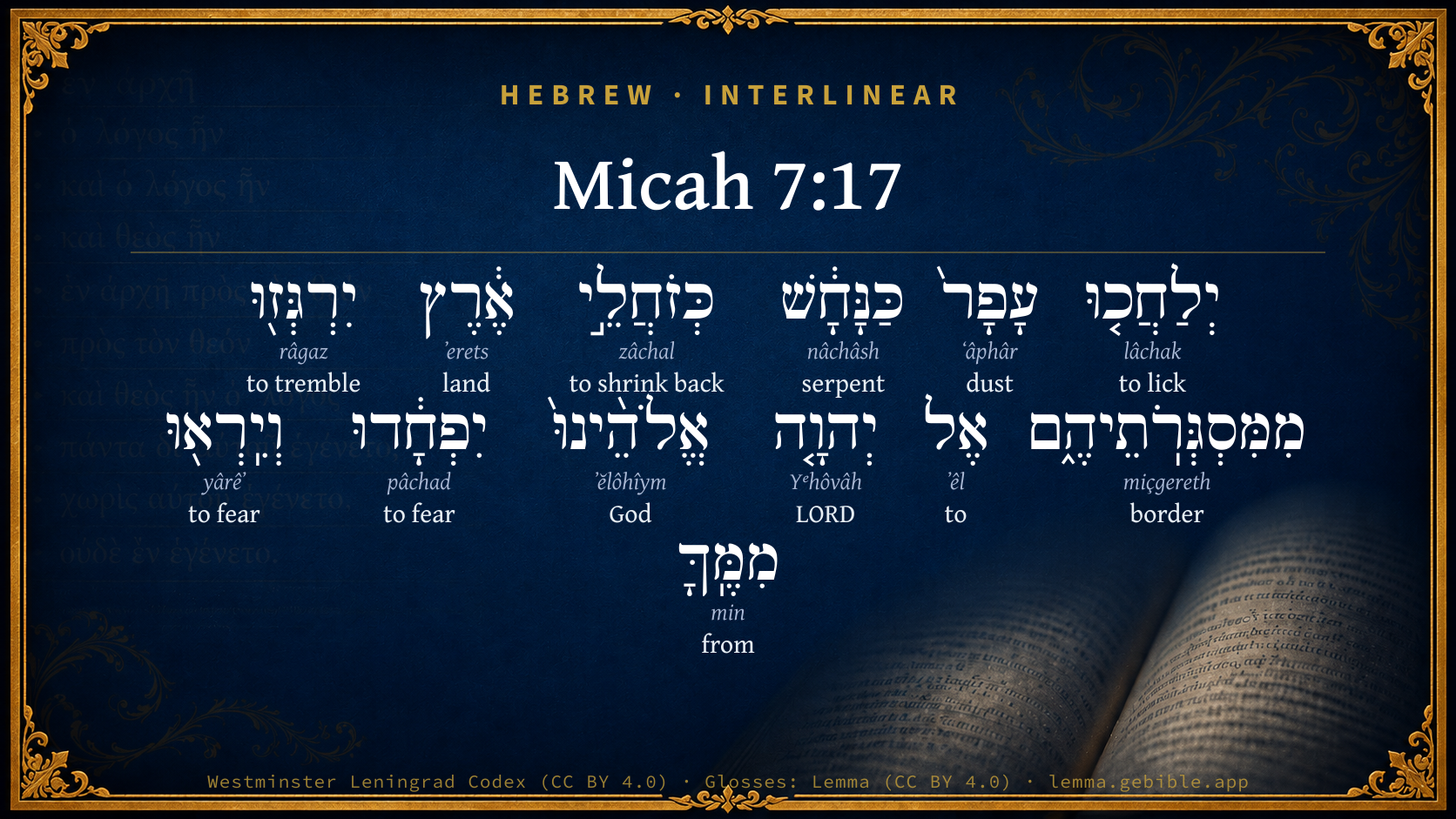
Micah 7:17

Hebrew (Westminster Leningrad Codex) Micah 7:17 appears in the Hebrew Old Testament. The text above is from the Westminster Leningrad Codex. Each word links to its Strong’s number, a concise gloss, and parsing drawn from the Open Scriptures Hebrew Bible morphology. Click any word for its full Brown-Driver-Briggs (BDB) entry.
Download image
Cite this verse

Micah 7:17 (World English Bible). Public Domain. Lemma interlinear Bible study tool, https://lemma.gebible.app/v/micah/7/17.

Show BibTeX & RIS
BibTeX
RIS
English Translation
They will lick the dust like a serpent. Like crawling things of the earth they shall come trembling out of their dens. They will come with fear to Yahweh our God, And will be afraid because of you.
World English Bible · Public Domain
Download a study sheet

One document with this verse’s original text, its word-by-word gloss line, the meaning frame, cross-references with their text, attributed commentary, and full source and license credits — printable, and it pastes into notes with its structure intact.

This verse Autodidact and up

Study sheet (.html) Plain text (.txt)

A passage Seminary Student

Up to 50 verses in one chapter. A passage sheet keeps up to 6 commentary sources and 12 cross-references per verse, in the order this page ranks them, and says so on the sheet whenever that leaves anything out. Ask for a single verse and you get the Autodidact verse sheet above.

Everything on this page stays free to read, with no account — the sheet is a download of what is already on screen, not access to it.

Want to remove ads? Support Godless Engineer
Compare translations 3

The same verse in 3 English versions, stacked beneath the original-language interlinear above. Click any original word for its lexicon entry.

Each is an independent rendering of the whole verse — the interlinear is not word-aligned to these translations.

Highlighted words mark where these versions differ — a whole-verse word diff, not a word-by-word alignment.

  • World English Bible Public Domain
    They will lick the dust like a serpent. Like crawling things of the earth they shall come trembling out of their dens. They will come with fear to Yahweh our God, And will be afraid because of you.
  • King James Version Public Domain
    They shall lick the dust like a serpent, they shall move out of their holes like worms of the earth: they shall be afraid of the LORD our God, and shall fear because of thee.
  • unfoldingWord Literal Text CC BY-SA 4.0
    They will lick the dust like a snake, like creatures that crawl on the earth. They will come out of their dens with fear; they will come with fear to you, Yahweh our God, and they will be afraid because of you.

unfoldingWord Literal Text — © unfoldingWord, licensed CC BY-SA 4.0. Word-aligned USFM3 via Door43 (git.door43.org/unfoldingWord/en_ult).

Versions to compare (up to 4)

3 of 4 selected

Show all 18 translations

Every available English version of this verse, each an independent rendering of the whole verse.

  • World English Bible Public Domain
    They will lick the dust like a serpent. Like crawling things of the earth they shall come trembling out of their dens. They will come with fear to Yahweh our God, And will be afraid because of you.
  • Berean Standard Bible Public Domain
    They will lick the dust like a snake, like reptiles slithering on the ground. They will crawl from their holes in the presence of the LORD our God; they will tremble in fear of You.
  • Majority Standard Bible Public Domain
    They will lick the dust like a snake, like reptiles slithering on the ground. They will come trembling from their strongholds in the presence of the LORD our God; they will tremble in fear of You.
  • King James Version Public Domain
    They shall lick the dust like a serpent, they shall move out of their holes like worms of the earth: they shall be afraid of the LORD our God, and shall fear because of thee.
  • American Standard Version (1901) Public Domain
    They shall lick the dust like a serpent; like crawling things of the earth they shall come trembling out of their close places; they shall come with fear unto Jehovah our God, and shall be afraid because of thee.
  • Revised Version (1885) Public Domain
    They shall lick the dust like a serpent; like crawling things of the earth they shall come trembling out of their close places: they shall come with fear unto the LORD our God, and shall be afraid because of thee.
  • Geneva Bible (1599) Public Domain
    They shall licke the dust like a serpent: they shall mooue out of their holes like wormes: they shalbe afraide of the Lord our God, and shall feare because of thee.
  • Douay-Rheims (1899) Public Domain
    They shall lick the dust like serpents, as the creeping things of the earth, they shall be disturbed in their houses: they shall dread the Lord our God, and shall fear thee.
  • Young's Literal Translation Public Domain
    They lick dust as a serpent, as fearful things of earth, They tremble from their enclosures, Of Jehovah our God they are afraid, Yea, they are afraid of Thee.
  • Literal Standard Version CC BY-SA 4.0
    They lick dust as a serpent, as fearful things of earth, || They tremble from their enclosures, || They are afraid of our God YHWH, || Indeed, they are afraid of You.
  • Unlocked Literal Bible CC BY-SA 4.0
    They will lick the dust like a snake, like creatures that crawl on the earth. They will come out of their dens with fear; they will come with fear to you, Yahweh our God, and they will be afraid because of you.
  • unfoldingWord Literal Text CC BY-SA 4.0
    They will lick the dust like a snake, like creatures that crawl on the earth. They will come out of their dens with fear; they will come with fear to you, Yahweh our God, and they will be afraid because of you.
  • Darby Bible Public Domain
    They shall lick dust like the serpent; like crawling things of the earth, they shall come trembling forth from their close places. They shall turn with fear to Jehovah our God, and shall be afraid because of thee.
  • World Messianic Bible Public Domain
    They will lick the dust like a serpent. Like crawling things of the earth, they will come trembling out of their dens. They will come with fear to the LORD our God, and will be afraid because of you.
  • Webster's Bible Public Domain
    They shall lick the dust like a serpent, they shall move out of their holes like worms of the earth: they shall be afraid of the LORD our God, and shall fear because of thee.
  • Free Bible Version CC BY-SA 4.0
    They will lick the dust like snakes; they will be like the creepy-crawlies of the earth. They will come trembling from their fortresses to meet the Lord our God, fearful and afraid before him.
  • Bible in Basic English Public Domain
    They will take dust as their food like a snake, like the things which go flat on the earth; they will come shaking with fear out of their secret places: they will come with fear to the Lord our God, full of fear because of you.
  • JPS Tanakh (1917) Public Domain
    They shall lick the dust like a serpent; like crawling things of the earth they shall come trembling out of their close places; they shall come with fear unto the LORD our God, and shall be afraid because of Thee.

Literal Standard Version (2020), Covenant Press — licensed CC BY-SA 4.0. Text via the HelloAO Bible API (eBible.org). Unlocked Literal Bible (unfoldingWord) — licensed CC BY-SA 4.0. Text via the HelloAO Bible API (eBible.org). unfoldingWord Literal Text — © unfoldingWord, licensed CC BY-SA 4.0. Word-aligned USFM3 via Door43 (git.door43.org/unfoldingWord/en_ult). Free Bible Version, Dr. Jonathan Gallagher — licensed CC BY-SA 4.0. Text via the HelloAO Bible API (eBible.org).

Word by word

More ways to search: Search by grammar → Find every occurrence → Compare this word →

Practice this passage: Drill this verse → Learn its vocabulary →

כְּזֹחֲלֵ֣י
zâchal
H2119
“like/as · shrinking back”
Preposition + Verb, Qal, Participle Active, Masculine, Plural, Construct
Part of Speech
Preposition + Verb
Stem
Qal
Form
Participle Active
Gender
Masculine
Number
Plural
State
Construct
Full BDB Definition

Origin: a primitive root

TWOT: 545

to shrink back, crawl away - (Qal) crawling, creeping (participle) (metonymy) - to fear, be afraid
  1. יְלַחֲכ֤וּ lâchak H3897 “to lick” Verb, Piel, Imperfect, 3rd Person, Masculine, Plural
  2. עָפָר֙ ʻâphâr H6083 “dust” Noun, Common, Masculine, Singular, Absolute
  3. כַּנָּחָ֔שׁ nâchâsh H5175 “like/as the · serpent” Preposition, Determined + Noun, Common, Masculine, Singular, Absolute
  4. אֶ֔רֶץ ʼerets H776 “land” Noun, Common, Both, Singular, Absolute
  5. יִרְגְּז֖וּ râgaz H7264 “to tremble” Verb, Qal, Imperfect, 3rd Person, Masculine, Plural
  6. מִמִּסְגְּרֹֽתֵיהֶ֑ם miçgereth H4526 “from · borders · their” Preposition + Noun, Common, Feminine, Plural, Construct + Suffix, Personal, 3rd Person, Masculine, Plural
  7. אֶל ʼêl H413 “to” Preposition
  8. יְהוָ֤ה Yᵉhôvâh H3068 “LORD” Noun, Proper
  9. אֱלֹהֵ֨ינוּ֙ ʼĕlôhîym H430 “God(s) · our” Noun, Common, Masculine, Plural, Construct + Suffix, Personal, 1st Person, Common, Plural
  10. יִפְחָ֔דוּ pâchad H6342 “to fear” Verb, Qal, Imperfect, 3rd Person, Masculine, Plural
  11. וְיִֽרְא֖וּ yârêʼ H3372 “and · to fear” Conjunction + Verb, Qal, Imperfect, 3rd Person, Masculine, Plural
  12. מִמֶּֽךָּ min H4480 “from · you” Preposition + Suffix, Personal, 2nd Person, Masculine, Singular

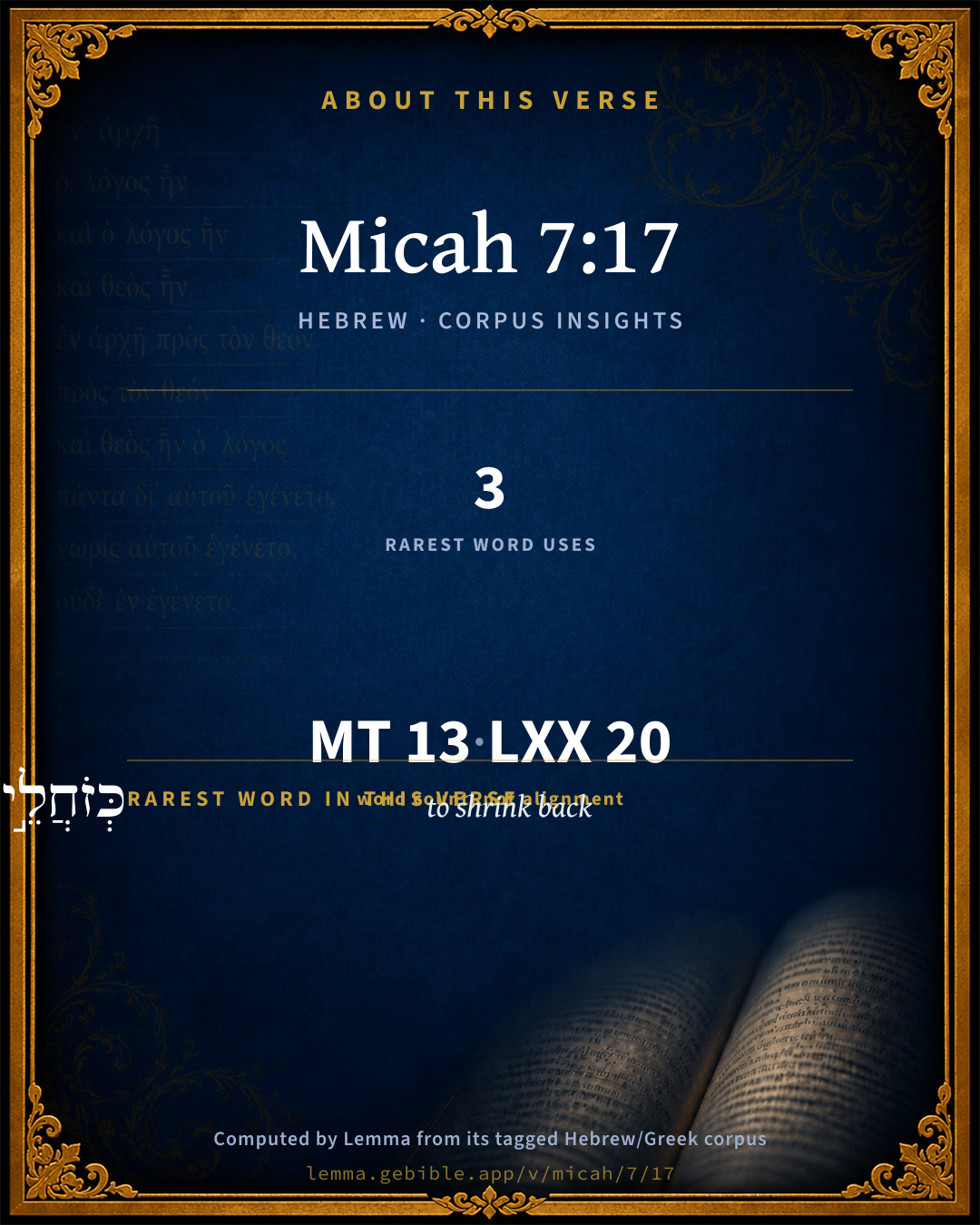
About this verse

These counts appear in no published source. They are computed here, from the morphology-tagged text and Lemma’s own curated glosses. What Lemma adds →

13
words
13
distinct lemmas
Prophets
section

Notable vocabulary

The rarest word here is כְּזֹחֲלֵ֣י to shrink back H2119 — appearing just 3 times in the whole Hebrew Bible.

Shared distinctive vocabulary

כְּזֹחֲלֵ֣י to shrink back H2119 occurs in 3 verses of the Hebrew Bible. Also found in:

Grammatical profile

  • 5 verbs
  • 6 nouns
  • 2 prepositions

Verb forms

  • יְלַחֲכ֤וּ Piel · Imperfect
  • כְּזֹחֲלֵ֣י Qal · Participle Active
  • יִרְגְּז֖וּ Qal · Imperfect
  • יִפְחָ֔דוּ Qal · Imperfect
  • וְיִֽרְא֖וּ Qal · Imperfect

Hebrew & Septuagint length

In English translation the verse runs 38 words from the Hebrew and 33 from the Septuagint (LXX English) — closely comparable.

A rough comparison of the two English renderings, which tokenize alike — not a word-level alignment.

Word counts can differ between the Hebrew and the Greek without any difference in meaning — e.g. the Hebrew direct-object marker אֵת has no separate Greek word, and Greek often adds the article ὁ.

In the original languages it is 13 Hebrew tokens and 20 Greek tokens — but the two are counted differently (Hebrew bundles its prefixes and suffixes into one token; the Greek is in lemma form), so that isn’t a like-for-like length.

Cross-references

21

Topical passages linked to Micah 7:17 in the Treasury of Scripture Knowledge — connected by theme and wording, ordered by reader-vote popularity; previews shown in the World English Bible.

  • Isaiah 49:23 Kings shall be your nursing fathers, and their queens your nursing mothers: they shall bow down to you with their faces to the earth, and lick the dust of your feet; and you shall know that I am Yahweh; and those who wait for me shall not be disappointed.
  • Psalms 72:9 Those who dwell in the wilderness shall bow before him. His enemies shall lick the dust.
  • Psalms 18:45 The foreigners shall fade away, And shall come trembling out of their close places.
  • Genesis 3:14–15 Yahweh God said to the serpent, "Because you have done this, cursed are you above all cattle, and above every animal of the field. On your belly shall you go, and you shall eat dust all the days of your life.
  • Revelation 6:15–17 The kings of the earth, the princes, the commanding officers, the rich, the strong, and every slave and free person, hid themselves in the caves and in the rocks of the mountains.
  • Exodus 15:14–16 The peoples have heard. They tremble. Pangs have taken hold on the inhabitants of Philistia.
  • Joshua 2:9–11 and she said to the men, I know that Yahweh has given you the land, and that the fear of you is fallen on us, and that all the inhabitants of the land melt away before you.
  • Joshua 9:24 They answered Joshua, and said, Because it was certainly told your servants, how that Yahweh your God commanded his servant Moses to give you all the land, and to destroy all the inhabitants of the land from before you; therefore we were sore afraid for our lives because of you, and have done this thing.
  • 1 Samuel 14:11 Both of them disclosed themselves to the garrison of the Philistines: and the Philistines said, Behold, the Hebrews come forth out of the holes where they had hid themselves.
  • Psalms 9:20 Put them in fear, Yahweh. Let the nations know that they are only men. Selah.
  • Isaiah 2:19–21 Men shall go into the caves of the rocks, And into the holes of the earth, From before the terror of Yahweh, And from the glory of his majesty, When he arises to shake the earth mightily.
  • Isaiah 25:3 Therefore shall a strong people glorify you; a city of awesome nations shall fear you.
  • Isaiah 59:19 So shall they fear the name of Yahweh from the west, and his glory from the rising of the sun; for he will come as a rushing stream, which the breath of Yahweh drives.
  • Isaiah 60:14 The sons of those who afflicted you shall come bending to you; and all those who despised you shall bow themselves down at the soles of your feet; and they shall call you The city of Yahweh, The Zion of the Holy One of Israel.
  • Isaiah 64:2 as when fire kindles the brushwood, [and] the fire causes the waters to boil; to make your name known to your adversaries, that the nations may tremble at your presence!
  • Isaiah 65:25 The wolf and the lamb shall feed together, and the lion shall eat straw like the ox; and dust shall be the serpent's food. They shall not hurt nor destroy in all my holy mountain, says Yahweh.
  • Jeremiah 16:16 Behold, I will send for many fishermen, says Yahweh, and they shall fish them up; and afterward I will send for many hunters, and they shall hunt them from every mountain, and from every hill, and out of the clefts of the rocks.
  • Jeremiah 33:9 [This city] shall be to me for a name of joy, for a praise and for a glory, before all the nations of the earth, which shall hear all the good that I do to them, and shall fear and tremble for all the good and for all the peace that I procure to it.
  • Lamentations 3:29 Let him put his mouth in the dust, if so be there may be hope.
  • Zechariah 14:5 You shall flee by the valley of my mountains; for the valley of the mountains shall reach to Azel; yes, you shall flee, just like you fled from before the earthquake in the days of Uzziah king of Judah. Yahweh my God will come, and all the holy ones with you.
  • Revelation 3:9 Behold, I give of the synagogue of Satan, of those who say they are Jews, and they are not, but lie. Behold, I will make them to come and worship before your feet, and to know that I have loved you.

Cross-references courtesy of OpenBible.info (CC BY 4.0).

Hebrew and Greek witnesses Masoretic Hebrew ↔ Greek Septuagint

The same verse in the two great witnesses to the Old Testament, shown verse-for-verse.

These are two independent witnesses, not word-aligned to each other, and the Septuagint is shown in lemma (dictionary) form.

Hebrew Micah 7:17 Masoretic · Westminster Leningrad Codex

יְלַחֲכ֤וּ עָפָר֙ כַּנָּחָ֔שׁ כְּזֹחֲלֵ֣י אֶ֔רֶץ יִרְגְּז֖וּ מִמִּסְגְּרֹֽתֵיהֶ֑ם אֶל יְהוָ֤ה אֱלֹהֵ֨ינוּ֙ יִפְחָ֔דוּ וְיִֽרְא֖וּ מִמֶּֽךָּ

They will lick the dust like a serpent. Like crawling things of the earth they shall come trembling out of their dens. They will come with fear to Yahweh our God, And will be afraid because of you.

World English Bible · Public Domain

Greek LXX Micah 7:17 Septuagint · lemma form

λείχω χοῦς ὡς ὄφις σύρω γῆ συνχέω ἐν συγκλεισμός αὐτός ἐπί ὁ κύριος θεός ἐγώ ἐκἵστημι καί φοβέω ἀπό σύ

They shall lick the dust as serpents crawling on the earth, they shall be confounded in their holes; they shall be amazed at the Lord our God, and will be afraid of you.

LXX2012 (modern English Septuagint) · Public Domain

Hebrew: Westminster Leningrad Codex (CC BY 4.0). Greek: Septuagint (public domain); English from LXX2012 (modern English Septuagint) (Public Domain). How the Septuagint differs from the Hebrew →

Targum (Aramaic paraphrase)

1

The Targum is the ancient Jewish Aramaic paraphrase of the Hebrew Scriptures — an interpretive translation, not the Hebrew text itself. Onkelos (literal) and Pseudo-Jonathan (expansive) render the Torah, and Jonathan the Prophets. Coverage is partial: where no permissively-licensed English translation exists for a verse, only the Aramaic is shown. This is verse-level text, not a word-by-word alignment to the Hebrew.

  1. Targum Jonathan Prophets (Joshua–Malachi)
    יִשְׁתַּטְחוּן עַל אַפֵּיהוֹן עַל אַרְעָא כְּחִוְיָא כְּזַחֲלֵי עַפְרָא יְזוּעוּן מִבִּרְנְיָתֵיהוֹן מִן קֳדָם יְיָ אֱלָהָנָא יִתַּבְרוּן וְיִדַחֲלוּן מִן קֳדָמָךְ:

    (no public-domain English translation for this verse)

    Targum Jonathan — Aramaic: “Mikraot Gedolot” (public domain). English: “Sefaria Community Translation” (CC0 1.0 (public-domain dedication)); “London "Chaldee Paraphrase," 1871” (public domain). Text via Sefaria.

Commentary

Notes on Micah 7:17 from classic Christian and Jewish commentators (each source and its license shown beneath its notes). The classic Christian expositions comment on the surrounding passage and are grouped to its opening verse, so a note may address several verses; the Jewish commentaries on the Tanakh (Rashi and others) are per-verse, so they appear only where the commentator wrote on this verse.

Lemma curates 59 commentaries, every one of them public domain or Creative Commons licensed, each selected and text-cleaned for this edition rather than reprinted as found. About our sources →

Trapp's Complete Commentary

John Trapp

Mic 7:17 They shall lick the dust like a serpent, they shall move out of their holes like worms of the earth: they shall be afraid of the LORD our God, and shall fear because of thee.

Ver. 17. They shall lick the dust like a serpent] That is, be reduced not only to extreme hunger and penury, but to utmost vility and baseness of condition, so as to lick the very dust. And whereas it is added, like a serpent, he puts them in mind of that old malediction, Gen. iii., and gives them to know, that as, like that old serpent, they have lifted themselves up against God, so will God cast them down again to the condition of serpents, and abase them to the very dust. See Psa 22:29; Psa 72:9 Isa 49:23.

They shall move out of their holes like worms (or creeping things) of the earth] They shall tumultuate, and be all on a huddle, like ants when their molehill is thrown up with a spade. The Hebrew word imports great commotion and bustle.

They shall be afraid of the Lord our God, and shall fear because of thee] O God, or, O Church, terrible as an army with banners. Impiety triumpheth in prosperity, trembleth in adversity: and contrarily, saith holy Greenham, since the fall, we tremble before God, angels, and good men. What have I to do with thee, thou man of God (said she), art thou come to call to mind my sin and to kill my son? At the siege of Mountabove, in France, the people of God within the walls ever before a sally sang a psalm: with which holy practice of theirs, the enemy becoming acquainted, when they heard them singing would so quake and tremble, crying, They come, they come, as though the wrath of God had been breaking out upon them.

John Trapp, A Commentary or Exposition upon All the Books of the Old and New Testament (1647–1656) — public domain. Text from a community e-Sword module.

Joseph Benson's Commentary

Mic 7:17. They shall lick the dust like a serpent — They shall fall to the earth through fear, and carry themselves very humbly and submissively toward God’s people. They shall move out of their holes like worms — They shall be afraid to stir out of their lurking-holes; and if they creep out like worms, they shall presently hide their heads again. They shall be afraid of the Lord our God — Overthrowing the Babylonish empire by Cyrus. This is expressed Isa 45:1, by loosing the loins of kings. And fear because of thee — When they shall see Almighty God appear so conspicuously in thy favour. The text is parallel to that of Jer 33:9, They shall fear and tremble for all the goodness and the prosperity that I procure unto it; that is, unto Jerusalem. Or, if the prophet be considered as addressing God, the meaning is, When they understand that it was long before denounced by the prophets that destruction should come upon them, and thy people be delivered, and they see all things tending to bring this to pass, then shall they begin to be afraid of thy power.

Joseph Benson's Commentary on the Old and New Testaments (1811–1818) — public domain. Text from a community e-Sword module.

Tyndale Open Study Notes

Tyndale Open Resources

7:17 Like snakes, the nations had struck at the heel of Israel (cp. Gen 3:14-15). The prophets regularly depicted foreign nations as poisonous, deceitful serpents (Isa 14:29; Jer 8:17; Ezek 29:1-3). Now these nations would be humbled (cp. Ps 72:9). Crawling and “eating dust” were metaphors for defeat and humiliation.

Tyndale Open Study Notes — © Tyndale Open Resources, licensed CC BY-SA 4.0. Text via the HelloAO Bible API.

Geneva Bible (1599)

Geneva Bible translators

They shall fall flat on the ground for fear.

Geneva Bible (1599) marginal notes — public domain. Text via Bolls.life.

Jamieson, Fausset & Brown

Robert Jamieson, A. R. Fausset & David Brown

lick the dust--in abject prostration as suppliants (Psa 72:9; compare Isa 49:23; Isa 65:25).

move out of their holes--As reptiles from their holes, they shall come forth from their hiding-places, or fortresses (Psa 18:45), to give themselves up to the conquerors. More literally, "they shall tremble from," that is, tremblingly come forth from their coverts.

like worms--reptiles or crawlers (Deu 32:24).

they shall be afraid of the Lord--or, they shall in fear turn with haste to the Lord. Thus the antithesis is brought out. They shall tremble forth from their holes: they shall in trepidation turn to the Lord for salvation (compare Note, see on Hos 3:5, and Jer 33:9).

fear because of thee--shall fear Thee, Jehovah (and so fear Israel as under Thy guardianship). There is a change here from speaking of God to speaking to God [MAURER]. Or rather, "shall fear thee, Israel" [HENDERSON].

Jamieson, Fausset & Brown — Commentary Critical and Explanatory on the Whole Bible (1871) — public domain (CC PDM 1.0). Text via the HelloAO Bible API.

John Calvin's Commentaries

He afterwards adds, They shall lick the dust as a serpent He intimates, that however the enemies of the Church may have proudly exalted themselves before, they shall then be cast down, and lie, as it were, on the ground; for to lick the dust is nothing else but to lie prostrate on the earth. They shall then be low and creeping like serpents; and then, They shall move themselves as worms and reptiles of the ground The verb רגז, regez, as it has been stated elsewhere, means to raise an uproar, to tumultuate, and it means also to move one’s self; and this latter meaning is the most suitable here, namely, that they shall go forth or move themselves from their enclosures; for the word סגר, sager, signifies to close up: and by enclosures he means hiding-places, though in the song of David, in Psalm 18:, the word is applied to citadels and other fortified places, —

‘Men,’ he says, ‘trembled from their fortresses;’

though they occupied well-fortified citadels, they yet were afraid, because the very fame of David had broken down their boldness. But as the Prophet speaks here of worms, I prefer this rendering, — ‘from their lurkingplaces;’ as though he said, “Though they have hitherto thought themselves safe in their enclosures, they shall yet move and flee away like worms and reptiles; for when the ground is dug, the worms immediately leap out, for they think that they are going to be taken; so also, when any one moves the ground, the reptiles come forth, and tremblingly run away in all directions.” And the Prophet says that, in like manner, the enemies of the Church, when the Lord shall arise for its help, shall be smitten with so much fear, that they shall in every direction run away. And this comparison ought to be carefully noticed, that is, when the Prophet compares powerful nations well exercised in wars, who before were audaciously raging, and were swollen with great pride — when he compares them to worms and reptiles of the ground, and also to serpents: he did this to show, that there will be nothing to hinder God from laying prostrate every exalted thing in the world, as soon as it shall please him to aid his Church.

And hence the Prophet adds, On account of Jehovah our God they shall treed, and they shall fear because of thee Here the Prophet shows, that the faithful ought not to distrust on account of their own weakness, but, on the contrary, to remember the infinite power of God. It is indeed right that the children of God should begin with diffidence, — sensible that they are nothing, and that all their strength is nothing; but they ought not to stop at their own weakness, but, on the contrary, to rise up to the contemplation of God’s power, that they may not doubt but that, when his power shall appear, their enemies shall be soon scattered. This is the reason why the Prophet here mentions the name of God, and then turns to address God himself. Tremble then shall they at Jehovah our God, that is, on account of Jehovah our God; and then Fear shall they because of thee. It now follows —

John Calvin's Commentaries (1540-1563) — public domain. Text from the Calvin Translation Society English edition (1840s-50s) via the Christian Classics Ethereal Library (ccel.org). Calvin's coverage is partial (roughly two-thirds of the Bible); uncommented books and verses are honest gaps, never fabricated. The 19th-century editor's footnotes and remarks are omitted so the notes are faithfully Calvin's own voice.

Ellicott's Commentary for English Readers

(17) They shall lick the dust like a serpent.—The doom of the determined enemies of the Lord and His people recalls that of Satan, the great enemy, as personified by the serpent. “Dust shalt thou eat all the days of thy life” (Gen_3:14).

A Bible Commentary for English Readers, edited by Charles John Ellicott (1878–1897) — public domain. Text from a community e-Sword module.

The Cambridge Bible for Schools and Colleges

gen. ed. J. J. S. Perowne

17. they shall move out of their holes] Rather, ‘they shall come trembling out of their fastnesses’ (same word as in Psa_18:46, where A. V. ‘close places’).

like worms] Lit., ‘like creepers’ (or rather, trailers). The same term occurs in Deu_32:24.

they shall be afraid of] Rather, ‘they shall turn with shuddering towards.’

The Cambridge Bible for Schools and Colleges (gen. ed. J. J. S. Perowne; Cambridge University Press, 1878–1918) — public domain. Text from a community e-Sword module.

John Gill's Exposition

They shall lick the dust like a serpent,.... Whose food is the dust of the earth, according to the curse pronounced on it, Gen 3:14; and which is either its, natural food it chooses to live on, as some serpents however are said (o) to do; or, going upon its belly, it cannot but take in a good deal of the dust of the earth along with its food; and hereby is signified the low, mean, abject, and cursed estate and condition of the seed of the serpent, wicked and ungodly men, the enemies of Christ and his people; who wilt be forced to yield subjection to him and his church, and will pretend the most profound respect for them, and the highest veneration of them. The allusion seems to be to the manner of the eastern nations, who, in complimenting their kings and great men, bowed so low to the ground with their faces, as to take up with their mouths the very dust of it. Particularly it is said of the Persians, that they first kiss the pavement on which the king treads, before they speak unto him, as Quistorpius on the place relates; and Valerius Maximus (p) says, that when Darius Hystaspis was declared king by the neighing of his horse, the rest of the six candidates alighted from their horses, and prostrated their bodies to the ground, as is the manner of the Persians, and saluted him king; and Herodotus (q) observes the same, custom among the Persians; and to this custom the poet Martial (r) refers; and Drusius says it is a custom in Asia to this day, that, when any go into the presence of a king, they kiss the ground, which is a token of the great veneration they have for him. The phrase is used of the enemies of the, Messiah, and of the converted Jews and Gentiles at the latter day, and is expressive of their great submission to them; see Psa 72:9;

they shall move out of their holes like worms of the earth; who put out their heads and draw them in again upon the least notice or approach of danger; or like serpents, as Jarchi and Kimchi, which lurk in holes, and creep out of them oft their bellies, or any other creeping things. The word (s) here used signifies a tremulous and tumultuous motion, like the wriggling of a worm out of the earth; or the hurry of ants, when their nests are kicked or thrown up: this is expressive of the confusion and perturbation of the enemies of the Lord and his people; of the Babylonians, who were obliged in a hurry to leave their palaces, as the Targum and Aben Ezra interpret their holes, and their fortresses and towers, and deliver them to the Medes and Persians; and of Gog and Magog, and the antichristian states, who will be obliged to abandon their places of abode, and creep out of sight, and be reduced to the lowest and meanest condition;

they shall be afraid of the Lord our God: because of the glory of his majesty, the greatness of his power, and for fear of his judgments:

and shall fear because of thee; O God, or Israel, as Kimchi; the church of God, whom they despised and reproached before; but now shall be seized with a panic, and live in the utmost dread of, because of the power and glory of God in the midst of them, and lest they should fall a sacrifice to them.

(o) Vid. Bochart. Hierozoic. par. 1. l. 1. c. 44. col. 27. (p) L. 7. c. 3. sect. 2. (q) Polymnia, sive l. 7. c. 12. (r) "Et turpes humilesque, supplicesque, Pictorum sola basiate regum". Epigram. l. 10. Ep. 71. (s) "contremiscent", Munster, Tigurine version, Cocceius; "frement, sive tumultuabuntur", Calvin; "trepide prorepent", Burkius.

John Gill's Exposition of the Whole Bible (1746–1763) — public domain (CC PDM 1.0). Text via the HelloAO Bible API.

Albert Barnes' Notes on the Bible

They shall lick the dust like a (the) serpent - To lick the dust, by itself, pictures the extreme humility of persons who east themselves down to the very earth (as in Psa 72:9; Isa 49:23). To lick it “like the serpent” seems rather to represent the condition of those who share the serpent’s doom Gen 3:14; Isa 65:25, whose lot, viz. earth and things of earth, they had chosen (Rup.): “They shall move out of their holes”, or, better, shall tremble, (that is, “come tremblingly,”) out of their close places , whether these be strong places or prisons, as the word, varied in one vowel means. If it be strong places, it means, that “the enemies of God’s people should, in confusion and tumltuously with fear, leave their strongholds, wherein they thought to be secure, not able to lift themselves up against God and those by Him sent against them.” “Like worms of the earth”, literally, creeping things, or, as we say, reptiles, contemptuously. “They shall be afraid of”, or rather come trembling to, the Lord our God; it is uot said their, but our God, who hath done so great things for us. And shall fear because of (literally, from) Thee, O Lord, of whom they had before said, Where is the Lord thy God?

It is doubtful, whether these last words express a “servile tear,” whereby a man turns away and flees from the person or thing which he fears, or whether they simply describe fear of God, the first step toward repentance. In Hosea’s words, “they shall fear toward the Lord and His goodness” Hos 3:5, the addition, and His goodness, determines the character of the fear. In Micah, it is not said that the fear brings them into any relation to God. lie is not spoken of; as becoming, any how, their God, and Micah closes by a thanksgiving, for God’s pardoning mercy, not to them but to His people.

And so the prophet ends, as he began, with the judgments of God; to those who would repent, chastisement, to the impenitent, punishment: “sentencing Samaria, guilty and not repenting” (Rup.), to perpetual captivity; to Jerusalem, guilty but repenting, promising restoration. So from the beginning of the world did God; so doth He; so shall He unto the end. So did He show Himself to Cain and Abel, who both, as we all, sinned in Adam. Cain, being impenitent, lie wholly cast away; Abel, being penitent,” and through faith offering a better sacrifice than Cain, and “bringing forth fruits worthy of repentance, He accepted.” So He hath foreshown as to the end Matt. 25. Rup.: “And that we may know how uniformly our Judge so distinguisheth, at the very moment of His own death while hanging between the two thieves, the one, impenitent and blaspheming, He left; to the other, penitent and confessing, He opened the gate of paradise; and, soon after, leaving the Jewish people unrepentant, He received the repentance of the Gentiles.” Thus the prophet parts with both out of sight; the people of God, feeding on the rich. bounty and abundance of God, and His marvelous gifts of grace above and beyond nature, multiplied to them above all the wonders of old time; the enemies of God’s people looking on, not to, admire, but to be ashamed, not to be healthfully ashamed, but to be willfully deaf to the voice of God. For, however to lay the hand on the mouth might be a token of reverent silence, the deafness of the ears can hardly be other than the emblem of hardened obstinacy.

What follows, then, seems more like the unwilling creeping-forth into the Presence of God, when they cannot keep away, than conversion. It seems to picture the reprobate, who would not “hear the Voice of the Son of God and live” Joh 5:25, but who, in the end, shall be forced to hear it out of their close places or prisons, that is, the grave, and come forth in fear, when they shall “say to the mountains, Fall on us; and to the hills, Cover us” Luk 23:30; Rev 6:16. Thus the prophet brings us to the close of all things, the gladness and joy of God’s people, the terror of His enemies, and adds only the song of thanksgiving of all the redeemed.

Albert Barnes' Notes on the Bible (1834–1885) — public domain. Text from a community e-Sword/MySword module.

Haydock's Catholic Bible Commentary

Serpents, (Genesis iii. 14.) out of respect or rage. (Calmet) --- Converts shall humbly apply to the ministers of Christ to receive baptism and confirmation. (Theodoret; Sanct. lxvii.)

George Leo Haydock (1774–1849), Haydock's Catholic Family Bible and Commentary, 1859 edition — public domain. Excludes Psalms (Douay-Rheims chapter numbering differs from Protestant) and Deuterocanonical books (Catholic canon only).

Matthew Poole's English Annotations

They, the proud and cruel enemies of Israel, the Babylonians, shall lick the dust; in the most submissive, servile manner testify their subjection, promise to serve and honour the Jews released out of captivity: it is an expression which alludes to the servile manner of those Eastern complimenters, Psa 72:9; Isa 49:23, and was fulfilled in the days after the return. when the kings of Persia favoured the Jews, and (as the manner of courtiers is) in compliance with their kings the grandees forwarded the prosperity of the Jews, as may easily be conjectured from the 6th and 7th chapters of Ezra.

Like a serpent; condemned to eat the dust and perpetually to crawl on the dust; it seems to intimate. the perpetuity of slavery and subjection that the enemy should fall under, and that it should be on them as a curse like that on the serpent.

They shall move out of their holes, so the strong holds and fastnesses of the Babylonians, who kept Israel in captivity, are called, like worms of the earth; which do with trembling and haste wriggle themselves out of their holes when the earth is shaken about them, or as when ants tumultuously in their fright run about from the ant-hill scattered with the foot; so should these enemies of Israel flee out of their holds, and leave them to conquering Persians, as Isaiah foretold, Isa 45:1-4.

They shall be afraid; a panic fear, expressed by the loosening of the loins of kings, Isa 45:1; so did the conquering Cyrus proceed in the course of his victories, as Isa 41:2,3, God strengthened his arm, and left the heart of Babylonians sinking within them.

Of the Lord our God; who did powerfully work for Cyrus in order to the delivering us out of captivity. It was our God, (saith the prophet in the person of Israel,) for his promise’ sake made to us, who did those great things by Cyrus and for us.

And shall fear because of thee; so that the name of Jews, their power and greatness shall be terrible to their enemies.

Matthew Poole's English Annotations on the Holy Bible (1683–1685) — public domain. Text from a community e-Sword/MySword module.

The Pulpit Commentary

They shall lick the dust like a serpent. (Gen_3:14 Isa_65:25) The enemies of God"s people "shall lick the dust", (Psa_72:9) shall be reduced to the utmost degradation. (Isa_49:23) They shall move out of their holes, etc.; rather, they come trembling out of their close places, (or, fastnesses, Psa_18:46) like crawling things of the earth. They who prided themselves on their security shall come forth from their strongholds in utter fear, driven out like snakes from their lairs. (comp. Psa_2:11 Hos_11:10, etc.) They shall be afraid of (whine with fear unto) the Lord our God. They shall be driven by terror to acknowledge the God of Israel. The expression is ambiguous, and may mean servile fear, which makes a man shrink from God. or that fear. which is one step towards repentance; the latter seems intended here, as in Hos_3:5, where, as Pusey says, the words, "and his goodness," determine the character of the fear. Because of (or, before) thee. It is the heathen who are still the subject, not the Israelites. (Jer_10:7) The sudden change of persons is quite in the prophet"s style.

The Pulpit Commentary (1880–1919), ed. H.D.M. Spence-Jones & Joseph S. Exell — public domain. Text from a community e-Sword module.

John Wesley's Explanatory Notes

Lick the dust - In the most submissive, servile manner, testify their subjection. Holes - Their strong holds, and fastnesses. Because of thee - So that the name of Jews, shall be terrible to their enemies.

John Wesley, Explanatory Notes Upon the Whole Bible (1754–1765) — public domain. Text via the GEBible commentary corpus.

Rashi

Rabbi Shlomo Yitzchaki (Rashi)

as those who crawl on the earth—They are snakes, which crawl on their bellies on the dust of the earth.

They shall quake from their imprisonment—They shall quake because of the extreme narrowness of their imprisonment and the confinement of their captivity.

Rashi on the Tanakh — English translations: “The Judaica Press complete Tanach with Rashi, translated by A. J. Rosenberg” (CC BY 4.0); “Pentateuch with Rashi's commentary by M. Rosenbaum and A.M. Silbermann, 1929-1934” (public domain); “The Metsudah Tanach series, Lakewood, N.J” (CC BY 4.0); and “The Book of Joshua, Metsudah Publications, 1997” (CC BY 4.0). Text via Sefaria.

Lesson kit

Teaching starters — assembled from the data on this page, not authored interpretation. Every prompt links to the verse data it draws on. Edit before teaching.

Micah, in the Prophets, opens this verse with 13 words (13 distinct Hebrew lemmas). Its most distinctive word is zâchal (“to shrink back”). A historical commentator’s framing appears above. Read the whole chapter for the surrounding context.

Discussion questions

  1. How does “to shrink back” (zâchal) shape what this verse is saying?
  2. How does Deuteronomy 32:24, which shares the word «to shrink back», read alongside this verse?
  3. These translations render this verse differently. What is at stake in choosing one wording over another?
  4. «יְלַחֲכ֤וּ» is a Piel Imperfect verb. How does that grammatical form shape the action described?
  5. Compare how Trapp's Complete Commentary and Joseph Benson's Commentary read this verse. Where do they agree or differ?

Things to notice

Reading settings

Reading text

Shown beneath each verse's original-language words.

Old Testament
Old Testament edition

Read the OT as the Masoretic Hebrew (MT) or the Greek Septuagint (LXX).

English shown for the Greek Septuagint (in the Hebrew ↔ Greek comparison).

Comparing translations? Open the Compare panel on any verse page to stack up to four side by side.