
Job 30:19

Hebrew (Westminster Leningrad Codex) Job 30:19 appears in the Hebrew Old Testament. The text above is from the Westminster Leningrad Codex. Each word links to its Strong’s number, a concise gloss, and parsing drawn from the Open Scriptures Hebrew Bible morphology. Click any word for its full Brown-Driver-Briggs (BDB) entry.
Download image
Cite this verse

Job 30:19 (World English Bible). Public Domain. Lemma interlinear Bible study tool, https://lemma.gebible.app/v/job/30/19.

Show BibTeX & RIS
BibTeX
RIS
English Translation
He has cast me into the mire. I have become like dust and ashes.
World English Bible · Public Domain
Download a study sheet

One document with this verse’s original text, its word-by-word gloss line, the meaning frame, cross-references with their text, attributed commentary, and full source and license credits — printable, and it pastes into notes with its structure intact.

This verse Autodidact and up

Study sheet (.html) Plain text (.txt)

A passage Seminary Student

Up to 50 verses in one chapter. A passage sheet keeps up to 6 commentary sources and 12 cross-references per verse, in the order this page ranks them, and says so on the sheet whenever that leaves anything out. Ask for a single verse and you get the Autodidact verse sheet above.

Everything on this page stays free to read, with no account — the sheet is a download of what is already on screen, not access to it.

Want to remove ads? Support Godless Engineer
Compare translations 3

The same verse in 3 English versions, stacked beneath the original-language interlinear above. Click any original word for its lexicon entry.

Each is an independent rendering of the whole verse — the interlinear is not word-aligned to these translations.

Highlighted words mark where these versions differ — a whole-verse word diff, not a word-by-word alignment.

  • World English Bible Public Domain
    He has cast me into the mire. I have become like dust and ashes.
  • King James Version Public Domain
    He hath cast me into the mire, and I am become like dust and ashes.
  • unfoldingWord Literal Text CC BY-SA 4.0
    He has thrown me into the mud, and I have become like dust and ashes.

unfoldingWord Literal Text — © unfoldingWord, licensed CC BY-SA 4.0. Word-aligned USFM3 via Door43 (git.door43.org/unfoldingWord/en_ult).

Versions to compare (up to 4)

3 of 4 selected

Show all 18 translations

Every available English version of this verse, each an independent rendering of the whole verse.

  • World English Bible Public Domain
    He has cast me into the mire. I have become like dust and ashes.
  • Berean Standard Bible Public Domain
    He throws me into the mud, and I have become like dust and ashes.
  • Majority Standard Bible Public Domain
    He throws me into the mud, and I have become like dust and ashes.
  • King James Version Public Domain
    He hath cast me into the mire, and I am become like dust and ashes.
  • American Standard Version (1901) Public Domain
    He hath cast me into the mire, And I am become like dust and ashes.
  • Revised Version (1885) Public Domain
    He hath cast me into the mire, and I am become like dust and ashes.
  • Geneva Bible (1599) Public Domain
    He hath cast me into the myre, and I am become like ashes and dust.
  • Douay-Rheims (1899) Public Domain
    I am compared to dirt, and am likened to embers and ashes.
  • Young's Literal Translation Public Domain
    Casting me into mire, And I am become like dust and ashes.
  • Literal Standard Version CC BY-SA 4.0
    Casting me into mire, || And I have become like dust and ashes.
  • Unlocked Literal Bible CC BY-SA 4.0
    He has thrown me into the mud; I have become like dust and ashes.
  • unfoldingWord Literal Text CC BY-SA 4.0
    He has thrown me into the mud, and I have become like dust and ashes.
  • Darby Bible Public Domain
    He hath cast me into the mire, and I have become like dust and ashes.
  • World Messianic Bible Public Domain
    He has cast me into the mire. I have become like dust and ashes.
  • Webster's Bible Public Domain
    He hath cast me into the mire, and I have become like dust and ashes.
  • Free Bible Version CC BY-SA 4.0
    He has thrown me in the mud; he has humbled me like dust and ashes.
  • Bible in Basic English Public Domain
    Truly God has made me low, even to the earth, and I have become like dust.
  • JPS Tanakh (1917) Public Domain
    He hath cast me into the mire, and I am become like dust and ashes.

Literal Standard Version (2020), Covenant Press — licensed CC BY-SA 4.0. Text via the HelloAO Bible API (eBible.org). Unlocked Literal Bible (unfoldingWord) — licensed CC BY-SA 4.0. Text via the HelloAO Bible API (eBible.org). unfoldingWord Literal Text — © unfoldingWord, licensed CC BY-SA 4.0. Word-aligned USFM3 via Door43 (git.door43.org/unfoldingWord/en_ult). Free Bible Version, Dr. Jonathan Gallagher — licensed CC BY-SA 4.0. Text via the HelloAO Bible API (eBible.org).

Word by word

More ways to search: Search by grammar → Find every occurrence → Compare this word →

Practice this passage: Drill this verse → Learn its vocabulary →

וָ֝אֶתְמַשֵּׁ֗ל
mâshal
H4911
“and · to liken”
Conjunction + Verb, Hithpael, Sequential Imperfect, 1st Person, Common, Singular
Part of Speech
Conjunction + Verb
Stem
Hithpael
Form
Sequential Imperfect
Person
1st Person
Gender
Common
Number
Singular
Full BDB Definition

Origin: denominative from H4912

TWOT: 1258 , 1258b

to represent, liken, be like - (Niphal) to liken, be like, be similar - (Hiphil) to compare - (Hithpael) to become like - to speak in a proverb, use a proverb, speak in parables, speak in sentences of poetry - (Qal) to use a proverb, speak a parable or proverb - (Piel) to make a parable - maker of parables (participle)
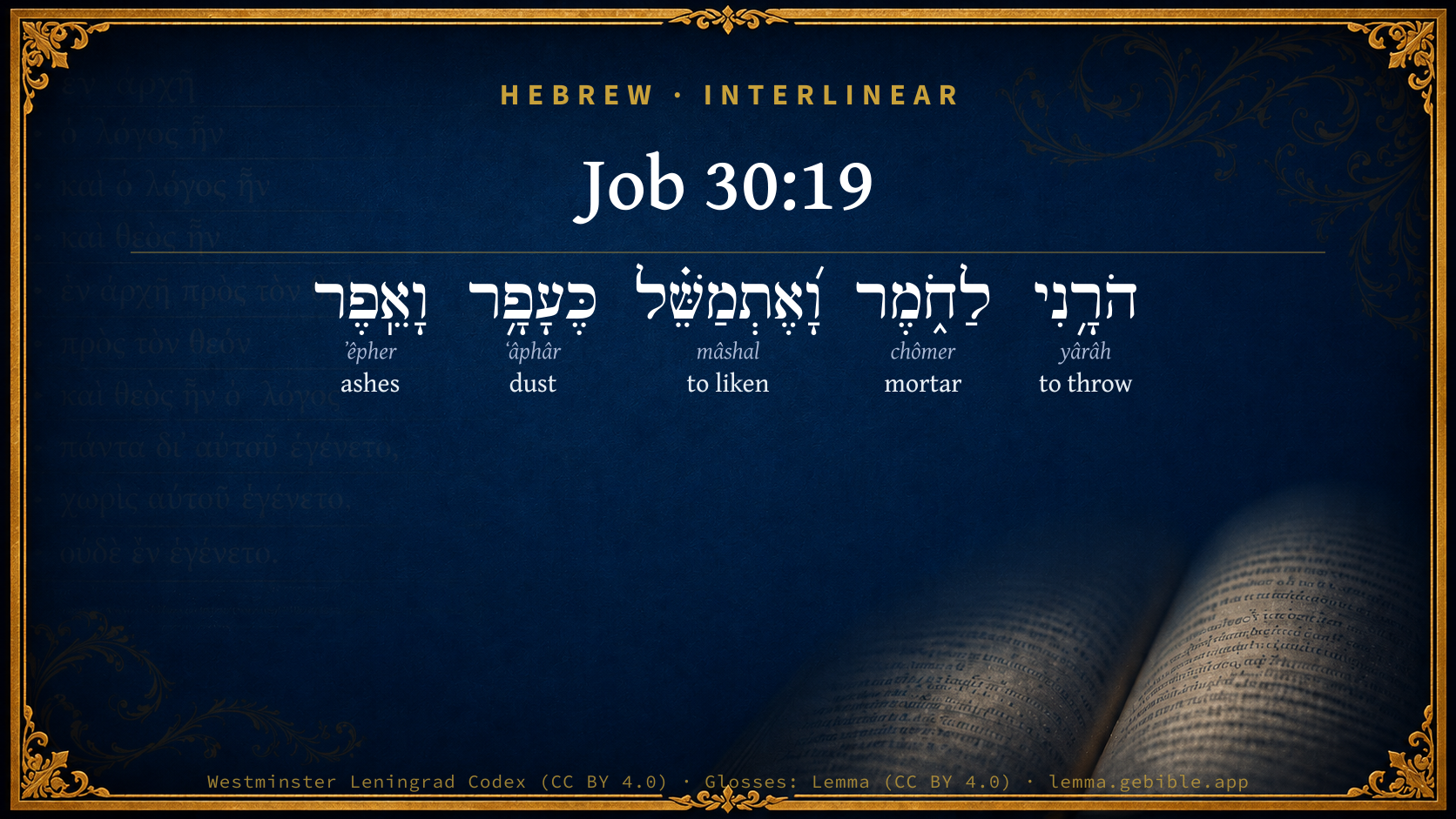
  1. הֹרָ֥נִי yârâh H3384 “to throw · me” Verb, Hiphil, Perfect, 3rd Person, Masculine, Singular + Suffix, Personal, 1st Person, Common, Singular
  2. לַחֹ֑מֶר chômer H2563 “to/for the · mortar” Preposition, Determined + Noun, Common, Masculine, Singular, Absolute
  3. כֶּעָפָ֥ר ʻâphâr H6083 “like/as the · dust” Preposition, Determined + Noun, Common, Masculine, Singular, Absolute
  4. וָאֵֽפֶר ʼêpher H665 “and · ashes” Conjunction + Noun, Common, Masculine, Singular, Absolute

About this verse

These counts appear in no published source. They are computed here, from the morphology-tagged text and Lemma’s own curated glosses. What Lemma adds →

5
words
5
distinct lemmas
Wisdom
section

Notable vocabulary

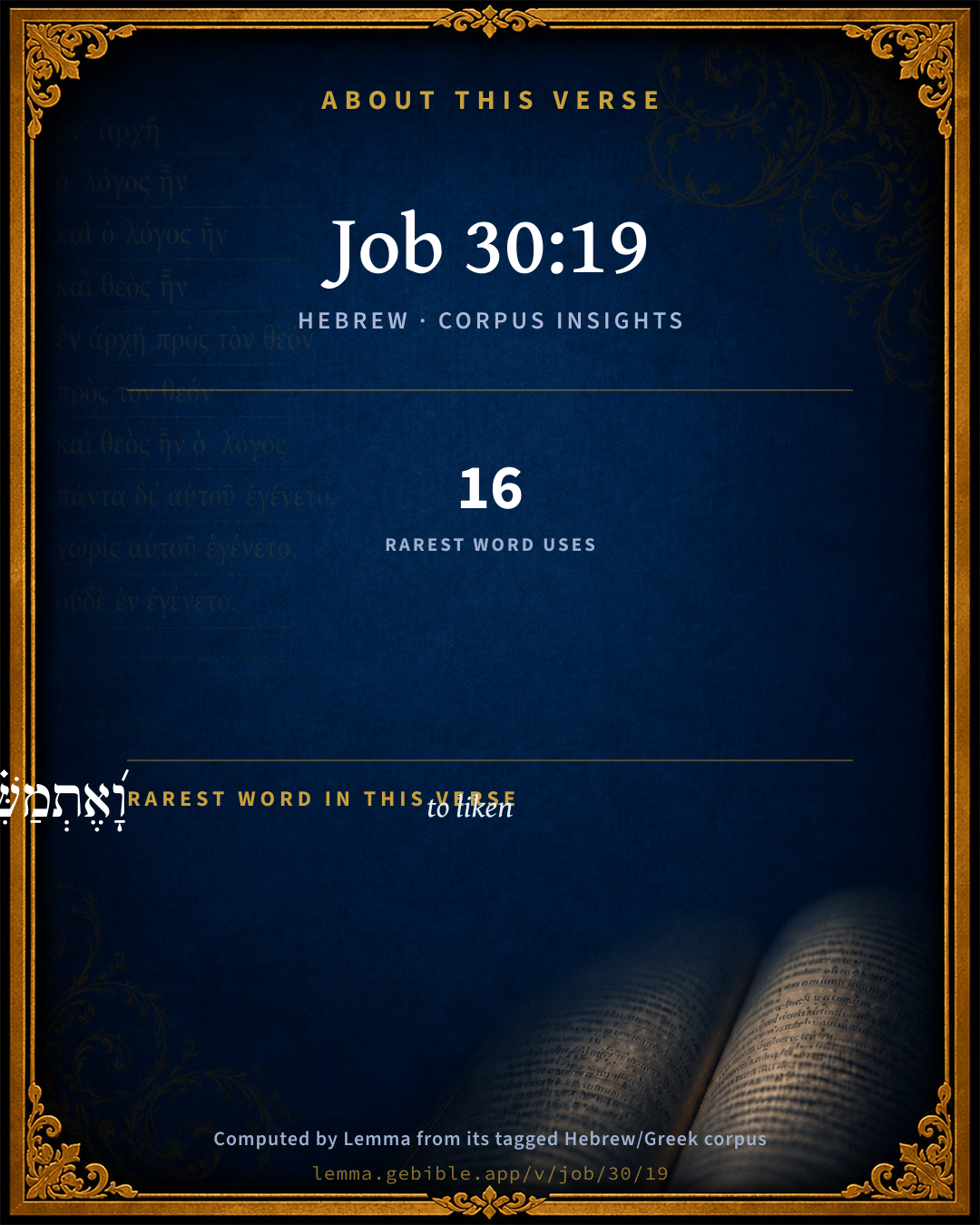
The rarest word here is וָ֝אֶתְמַשֵּׁ֗ל to liken H4911 — appearing just 16 times in the whole Hebrew Bible.

Shared distinctive vocabulary

וָ֝אֶתְמַשֵּׁ֗ל to liken H4911 occurs in 15 verses of the Hebrew Bible. Also found in:

Grammatical profile

  • 2 verbs
  • 3 nouns

Verb forms

  • הֹרָ֥נִי Hiphil · Perfect
  • וָ֝אֶתְמַשֵּׁ֗ל Hithpael · Sequential Imperfect

Hebrew & Septuagint length

In English translation the verse runs 14 words from the Hebrew and 13 from the Septuagint (LXX English) — closely comparable.

A rough comparison of the two English renderings, which tokenize alike — not a word-level alignment.

Word counts can differ between the Hebrew and the Greek without any difference in meaning — e.g. the Hebrew direct-object marker אֵת has no separate Greek word, and Greek often adds the article ὁ.

Cross-references

7

Topical passages linked to Job 30:19 in the Treasury of Scripture Knowledge — connected by theme and wording, ordered by reader-vote popularity; previews shown in the World English Bible.

  • Job 9:31 Yet you will plunge me in the ditch. My own clothes shall abhor me.
  • Genesis 18:27 Abraham answered, "See now, I have taken it on myself to speak to the Lord, who am but dust and ashes.
  • Job 42:6 Therefore I abhor myself, And repent in dust and ashes."
  • Psalms 69:14 Deliver me out of the mire, and don't let me sink. Let me be delivered from those who hate me, and out of the deep waters.
  • Psalms 69:1–2 Save me, God, For the waters have come up to my neck!
  • Jeremiah 38:6 Then took they Jeremiah, and cast him into the dungeon of Malchijah the king's son, that was in the court of the guard: and they let down Jeremiah with cords. In the dungeon there was no water, but mire; and Jeremiah sank in the mire.
  • Job 2:8 He took for himself a potsherd to scrape himself with, and he sat among the ashes.

Cross-references courtesy of OpenBible.info (CC BY 4.0).

Hebrew and Greek witnesses Masoretic Hebrew ↔ Greek Septuagint

The same verse in the two great witnesses to the Old Testament, shown verse-for-verse.

These are two independent witnesses, not word-aligned to each other, and the Septuagint is shown in lemma (dictionary) form.

Hebrew Job 30:19 Masoretic · Westminster Leningrad Codex

הֹרָ֥נִי לַחֹ֑מֶר וָ֝אֶתְמַשֵּׁ֗ל כֶּעָפָ֥ר וָאֵֽפֶר

He has cast me into the mire. I have become like dust and ashes.

World English Bible · Public Domain

Greek LXX Job 30:19 Septuagint · lemma form

ἡγέομαι δέ ἐγώ ἴσος πηλός ἐν γῆ καί σποδός ἐγώ ὁ μερίς

And you have counted me as clay; my portion in dust and ashes.

LXX2012 (modern English Septuagint) · Public Domain

Hebrew: Westminster Leningrad Codex (CC BY 4.0). Greek: Septuagint (public domain); English from LXX2012 (modern English Septuagint) (Public Domain). How the Septuagint differs from the Hebrew →

Commentary

Notes on Job 30:19 from classic Christian and Jewish commentators (each source and its license shown beneath its notes). The classic Christian expositions comment on the surrounding passage and are grouped to its opening verse, so a note may address several verses; the Jewish commentaries on the Tanakh (Rashi and others) are per-verse, so they appear only where the commentator wrote on this verse.

Lemma curates 59 commentaries, every one of them public domain or Creative Commons licensed, each selected and text-cleaned for this edition rather than reprinted as found. About our sources →

Trapp's Complete Commentary

John Trapp

Job 30:19 He hath cast me into the mire, and I am become like dust and ashes.

Ver. 19. He hath cast me into the mire] My disease hath, so Vatablus senseth it. Others, God hath as it were trampled me to dirt, thrown me into the kennel, and so done me the greatest disgrace that can be.

And I am become like dust and ashes] Like a dust head behind the door, cadaverosus et semimortuus, saith Mercer; being covered all over (saith Beza) with the scales and scrapings that fall from my scabs; I am become more like unto the unprofitable dust and ashes, than unto a living man. Dust and ashes are not more like one another than their names are in the original; sic κονις, cinis. See Gen 3:19; Gen 18:27.

John Trapp, A Commentary or Exposition upon All the Books of the Old and New Testament (1647–1656) — public domain. Text from a community e-Sword module.

Tyndale Open Study Notes

Tyndale Open Resources

30:19 dust and ashes: Earlier, Job was sitting “among the ashes” in anguish (2:8); later, he would “sit in dust and ashes to show . . . repentance” (42:6).

Tyndale Open Study Notes — © Tyndale Open Resources, licensed CC BY-SA 4.0. Text via the HelloAO Bible API.

Geneva Bible (1599)

Geneva Bible translators

That is, God hath brought me into contempt.

Geneva Bible (1599) marginal notes — public domain. Text via Bolls.life.

Jamieson, Fausset & Brown

Robert Jamieson, A. R. Fausset & David Brown

God is poetically said to do that which the mourner had done to himself (Job 2:8). With lying in the ashes he had become, like them, in dirty color.

Jamieson, Fausset & Brown — Commentary Critical and Explanatory on the Whole Bible (1871) — public domain (CC PDM 1.0). Text via the HelloAO Bible API.

Ellicott's Commentary for English Readers

(19) He hath cast me into the mire.—He now turns more directly to God, having in Job_30:16 turned from man to his own condition—dust and ashes. This latter phrase is used but three times in Scripture: twice by Job (here and Job_42:6), and once by Abraham (Gen_18:27).

A Bible Commentary for English Readers, edited by Charles John Ellicott (1878–1897) — public domain. Text from a community e-Sword module.

The Cambridge Bible for Schools and Colleges

gen. ed. J. J. S. Perowne

19. The verse probably refers to the appearance which Job’s body presented in its leprous condition; this was due to God, who is represented as causing it by plunging Job as it were into the mire.

19–23. God’s great severity.

The Cambridge Bible for Schools and Colleges (gen. ed. J. J. S. Perowne; Cambridge University Press, 1878–1918) — public domain. Text from a community e-Sword module.

John Gill's Exposition

He hath cast me into the mire,.... As Jeremiah was literally; here it is to be understood in a figurative sense; not of the mire of sin, into which God casts none, men fall into it of themselves, but of the mire of affliction and calamity; see Psa 40:2; and which Job here ascribes to God; and whereby he was in as mean, abject, and contemptible a condition, as if he had been thrown into a kennel, and rolled in it; and he speaks of it as an act of God, done with contempt of him, and indignation at him, as he apprehended it. Some Jewish writers (e) interpret it, "he taught me in the mire", or "it taught me"; his disease, his ulcers taught him to sit down in the mire, or in the midst of ashes, Job 2:8; but though this reading might admit of a good sense, as that Job was taught, as every good man is, many useful lessons in and by afflictions; yet it seems to be a sense foreign from the words:

and I am become like dust and ashes; a phrase by which Abraham expresses his vileness, meanness, and unworthiness in the sight of God, Gen 18:27; Job, through the force of his disease, looked like a corpse, or one half dead, and was crumbling and dropping into the dust of death and the grave, and looked livid and ash coloured; and even in a literal sense was covered with dust and ashes, when he sat among them, Job 2:8; though here it chiefly respects the miserable, forlorn, and contemptible condition in which he was.

(e) Vid. Jarchi & Bar Tzemach in loc.

John Gill's Exposition of the Whole Bible (1746–1763) — public domain (CC PDM 1.0). Text via the HelloAO Bible API.

Albert Barnes' Notes on the Bible

He hath cast me into the mire - That is, God has done it. In this book the name of God is often understood where the speaker seems to avoid it, in order that it may not be needlessly repeated. On the meaning of the expression here, see the notes at Job 9:31.

And I am become like dust and ashes - Either in appearance, or I am regarded as being as worthless as the mire of the streets. Rosenmuller supposes it means, “I am more like a mass of inanimate matter than a living man.”

Albert Barnes' Notes on the Bible (1834–1885) — public domain. Text from a community e-Sword/MySword module.

Haydock's Catholic Bible Commentary

I am. Hebrew, "He hat cast me into the mire;" (Protestants) or, "He regards me as dirt; my portion is on the earth and dust." (Haydock) --- All look upon me with horror and contempt. (Calmet)

George Leo Haydock (1774–1849), Haydock's Catholic Family Bible and Commentary, 1859 edition — public domain. Excludes Psalms (Douay-Rheims chapter numbering differs from Protestant) and Deuterocanonical books (Catholic canon only).

Matthew Poole's English Annotations

He hath made me contemptible and filthy, and loathsome for my sores, my whole body being a kind of quagmire, in regard of the filth breaking forth in all its parts;

and I am become like dust and ashes, like one dead and turned to dust; more like a rotten carcass than a living man.

Matthew Poole's English Annotations on the Holy Bible (1683–1685) — public domain. Text from a community e-Sword/MySword module.

Whedon's Commentary on the Bible

Daniel D. Whedon

19. As in Job_9:31. Like dust and ashes — In elephantiasis the skin is at first intensely red, and afterward black.

Daniel D. Whedon (gen. ed.), Commentary on the Old and New Testaments (1874–1909) — public domain. Text from a community e-Sword module.

The Pulpit Commentary

He (i.e. God) hath cast me into the mire. "The mire" here is the lowest depth of misery and degradation. (comp. Psa_40:2 Psa_69:2, Psa_69:14) Job feels himself cast into it by God, but nevertheless does not forsake him nor cease to call upon him (vers. 20-23). And I am become like dust and ashes; i.e. unclean, impure, offensive to my fellow-men, an object of dislike and disdain.

The Pulpit Commentary (1880–1919), ed. H.D.M. Spence-Jones & Joseph S. Exell — public domain. Text from a community e-Sword module.

Rashi

Rabbi Shlomo Yitzchaki (Rashi)

It directed me to the mud These boils directed me and taught me to sit in the mud, as we said above (2:8). “and he sat down in the ashes.” Another explanation: הוֹרַנִי means: it cast me, an expression of (Exod. 15:4), “He cast (ירה) into the sea.”

and I was compared Was likened. And in the Midrash of Rabbi Tanchuma (Buber, Vayishlach 8): Said Rabbi Berechiah, “Transpose the verse.” I was compared to Abraham in my righteousness, who called himself dust and ashes (Gen.18:27), and He judges me like the wicked of the Generation of the Dispersion (who rebelled against Him by building the tower), concerning whom it is written (Gen. 11:3): “and the mortar served them as clay.”

Rashi on the Tanakh — English translations: “The Judaica Press complete Tanach with Rashi, translated by A. J. Rosenberg” (CC BY 4.0); “Pentateuch with Rashi's commentary by M. Rosenbaum and A.M. Silbermann, 1929-1934” (public domain); “The Metsudah Tanach series, Lakewood, N.J” (CC BY 4.0); and “The Book of Joshua, Metsudah Publications, 1997” (CC BY 4.0). Text via Sefaria.

Lesson kit

Teaching starters — assembled from the data on this page, not authored interpretation. Every prompt links to the verse data it draws on. Edit before teaching.

Job, in the Wisdom, opens this verse with 5 words (5 distinct Hebrew lemmas). Its most distinctive word is mâshal (“to liken”). A historical commentator’s framing appears above. Read the whole chapter for the surrounding context.

Discussion questions

  1. What does “to liken” (mâshal) contribute to the verse as a whole?
  2. Numbers 21:27 shares the word «to liken» with this verse. How do the two illuminate each other?
  3. These translations render this verse differently. What is at stake in choosing one wording over another?
  4. The verb «הֹרָ֥נִי» is Hiphil Perfect. How does its form color the action?
  5. Reading how Trapp's Complete Commentary and Tyndale Open Study Notes read this verse, where do the two commentators agree and where do they part?

Things to notice

Reading settings

Reading text

Shown beneath each verse's original-language words.

Old Testament
Old Testament edition

Read the OT as the Masoretic Hebrew (MT) or the Greek Septuagint (LXX).

English shown for the Greek Septuagint (in the Hebrew ↔ Greek comparison).

Comparing translations? Open the Compare panel on any verse page to stack up to four side by side.