Job 14:19

Hebrew (Westminster Leningrad Codex) Job 14:19 appears in the Hebrew Old Testament. The text above is from the Westminster Leningrad Codex. Each word links to its Strong’s number, a concise gloss, and parsing drawn from the Open Scriptures Hebrew Bible morphology. Click any word for its full Brown-Driver-Briggs (BDB) entry.
Download image
Cite this verse

Job 14:19 (World English Bible). Public Domain. Lemma interlinear Bible study tool, https://lemma.gebible.app/v/job/14/19.

Show BibTeX & RIS
BibTeX
RIS
English Translation
The waters wear the stones; The torrents of it wash away the dust of the earth: So you destroy the hope of man.
World English Bible · Public Domain
Download a study sheet

One document with this verse’s original text, its word-by-word gloss line, the meaning frame, cross-references with their text, attributed commentary, and full source and license credits — printable, and it pastes into notes with its structure intact.

This verse Autodidact and up

Study sheet (.html) Plain text (.txt)

A passage Seminary Student

Up to 50 verses in one chapter. A passage sheet keeps up to 6 commentary sources and 12 cross-references per verse, in the order this page ranks them, and says so on the sheet whenever that leaves anything out. Ask for a single verse and you get the Autodidact verse sheet above.

Everything on this page stays free to read, with no account — the sheet is a download of what is already on screen, not access to it.

Want to remove ads? Support Godless Engineer
Compare translations 3

The same verse in 3 English versions, stacked beneath the original-language interlinear above. Click any original word for its lexicon entry.

Each is an independent rendering of the whole verse — the interlinear is not word-aligned to these translations.

Highlighted words mark where these versions differ — a whole-verse word diff, not a word-by-word alignment.

  • World English Bible Public Domain
    The waters wear the stones; The torrents of it wash away the dust of the earth: So you destroy the hope of man.
  • King James Version Public Domain
    The waters wear the stones: thou washest away the things which grow out of the dust of the earth; and thou destroyest the hope of man.
  • unfoldingWord Literal Text CC BY-SA 4.0
    waters wear down stones, its flooding washes away the dust of the earth, and you destroy the hope of man.

unfoldingWord Literal Text — © unfoldingWord, licensed CC BY-SA 4.0. Word-aligned USFM3 via Door43 (git.door43.org/unfoldingWord/en_ult).

Versions to compare (up to 4)

3 of 4 selected

Show all 18 translations

Every available English version of this verse, each an independent rendering of the whole verse.

  • World English Bible Public Domain
    The waters wear the stones; The torrents of it wash away the dust of the earth: So you destroy the hope of man.
  • Berean Standard Bible Public Domain
    as water wears away the stones and torrents wash away the soil, so You destroy a man’s hope.
  • Majority Standard Bible Public Domain
    as water wears away the stones and torrents wash away the soil, so You destroy a man’s hope.
  • King James Version Public Domain
    The waters wear the stones: thou washest away the things which grow out of the dust of the earth; and thou destroyest the hope of man.
  • American Standard Version (1901) Public Domain
    The waters wear the stones; The overflowings thereof wash away the dust of the earth: So thou destroyest the hope of man.
  • Revised Version (1885) Public Domain
    The waters wear the stones; the overflowings thereof wash away the dust of the earth: and thou destroyest the hope of man.
  • Geneva Bible (1599) Public Domain
    As the water breaketh the stones, when thou ouerflowest the things which growe in the dust of ye earth: so thou destroyest ye hope of man.
  • Douay-Rheims (1899) Public Domain
    Waters wear away the stones, and with inundation the ground by little and little is washed away: so in like manner thou shalt destroy man.
  • Young's Literal Translation Public Domain
    Stones have waters worn away, Their outpourings wash away the dust of earth, And the hope of man Thou hast destroyed.
  • Literal Standard Version CC BY-SA 4.0
    Waters have worn away stones, || Their outpourings wash away the dust of earth, || And You have destroyed the hope of man.
  • Unlocked Literal Bible CC BY-SA 4.0
    the waters wear down the stones; their flooding washes away the dust of the earth. Like this, you destroy the hope of man.
  • unfoldingWord Literal Text CC BY-SA 4.0
    waters wear down stones, its flooding washes away the dust of the earth, and you destroy the hope of man.
  • Darby Bible Public Domain
    The waters wear the stones, the floods thereof wash away the dust of the earth; and thou destroyest the hope of man.
  • World Messianic Bible Public Domain
    The waters wear the stones. The torrents of it wash away the dust of the earth. So you destroy the hope of man.
  • Webster's Bible Public Domain
    The waters wear the stones: thou washest away the things which grow out of the dust of the earth; and thou destroyest the hope of man.
  • Free Bible Version CC BY-SA 4.0
    as water wears away the stones, as floods wash away the soil, so you destroy the hope people have.
  • Bible in Basic English Public Domain
    The stones are crushed small by the force of the waters; the dust of the earth is washed away by their overflowing: and so you put an end to the hope of man.
  • JPS Tanakh (1917) Public Domain
    The waters wear the stones; the overflowings thereof wash away the dust of the earth; so Thou destroyest the hope of man.

Literal Standard Version (2020), Covenant Press — licensed CC BY-SA 4.0. Text via the HelloAO Bible API (eBible.org). Unlocked Literal Bible (unfoldingWord) — licensed CC BY-SA 4.0. Text via the HelloAO Bible API (eBible.org). unfoldingWord Literal Text — © unfoldingWord, licensed CC BY-SA 4.0. Word-aligned USFM3 via Door43 (git.door43.org/unfoldingWord/en_ult). Free Bible Version, Dr. Jonathan Gallagher — licensed CC BY-SA 4.0. Text via the HelloAO Bible API (eBible.org).

Word by word

More ways to search: Search by grammar → Find every occurrence → Compare this word →

Practice this passage: Drill this verse → Learn its vocabulary →

שָׁ֥חֲקוּ
shâchaq
H7833
“to pulverize”
Verb, Qal, Perfect, 3rd Person, Common, Plural
Part of Speech
Verb
Stem
Qal
Form
Perfect
Person
3rd Person
Gender
Common
Number
Plural
Full BDB Definition

Origin: a primitive root

TWOT: 2367

to rub away, beat fine, pulverise - (Qal) - to rub away - of incense, stones - of enemies (figuratively)
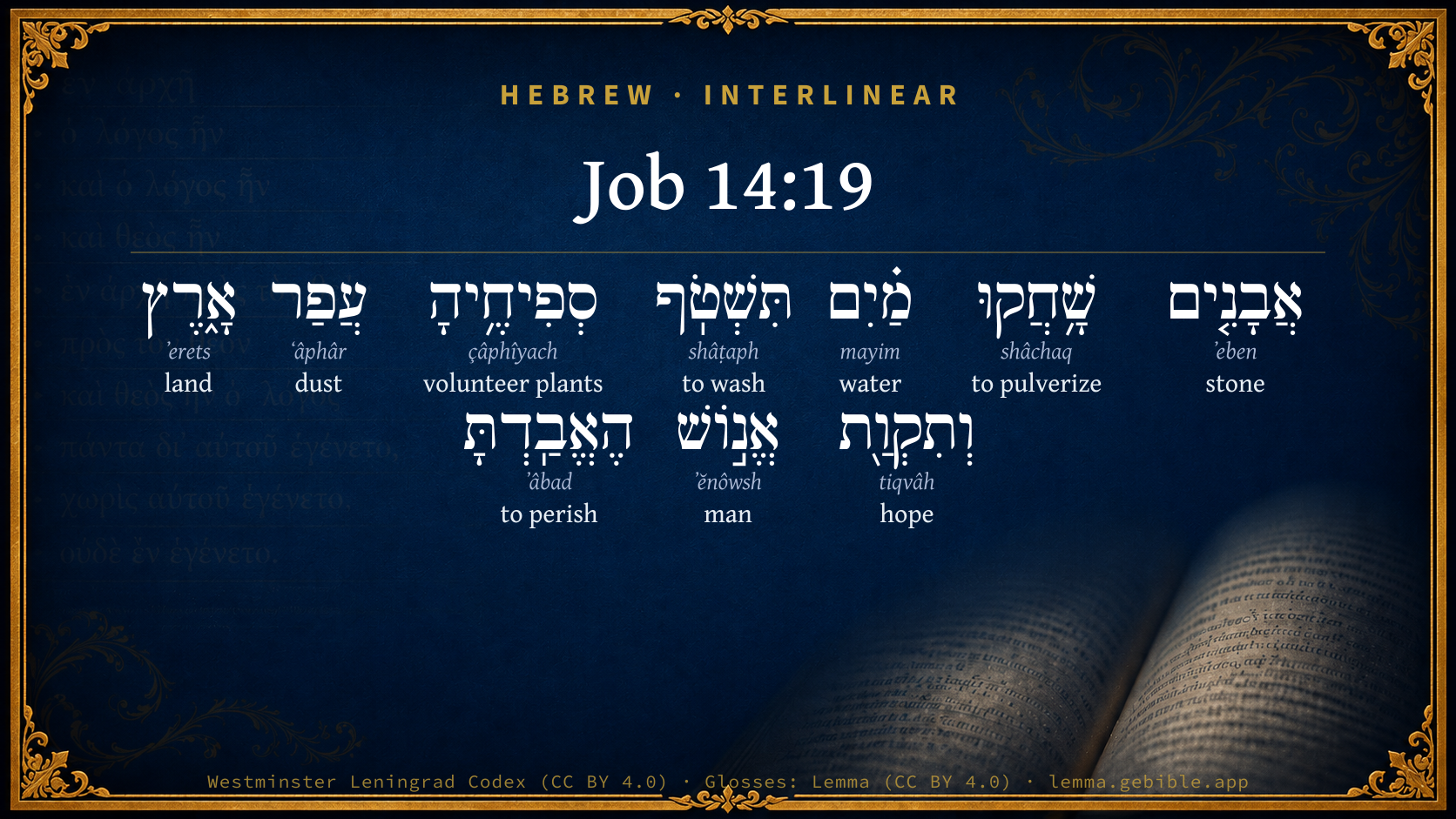
  1. אֲבָנִ֤ים ʼeben H68 “stones” Noun, Common, Feminine, Plural, Absolute
  2. מַ֗יִם mayim H4325 “water(s)” Noun, Common, Masculine, Plural, Absolute
  3. תִּשְׁטֹֽף shâṭaph H7857 “to wash” Verb, Qal, Imperfect, 3rd Person, Feminine, Singular
  4. סְפִיחֶ֥יהָ çâphîyach H5599 “volunteer plants · her” Noun, Common, Masculine, Plural, Construct + Suffix, Personal, 3rd Person, Feminine, Singular
  5. עֲפַר ʻâphâr H6083 “dust of” Noun, Common, Masculine, Singular, Construct
  6. אָ֑רֶץ ʼerets H776 “land” Noun, Common, Both, Singular, Absolute
  7. וְתִקְוַ֖ת tiqvâh H8615 “and · hope of” Conjunction + Noun, Common, Feminine, Singular, Construct
  8. אֱנ֣וֹשׁ ʼĕnôwsh H582 “man” Noun, Common, Masculine, Singular, Absolute
  9. הֶאֱבַֽדְתָּ ʼâbad H6 “to perish” Verb, Hiphil, Perfect, 2nd Person, Masculine, Singular

About this verse

These counts appear in no published source. They are computed here, from the morphology-tagged text and Lemma’s own curated glosses. What Lemma adds →

10
words
10
distinct lemmas
Wisdom
section

Notable vocabulary

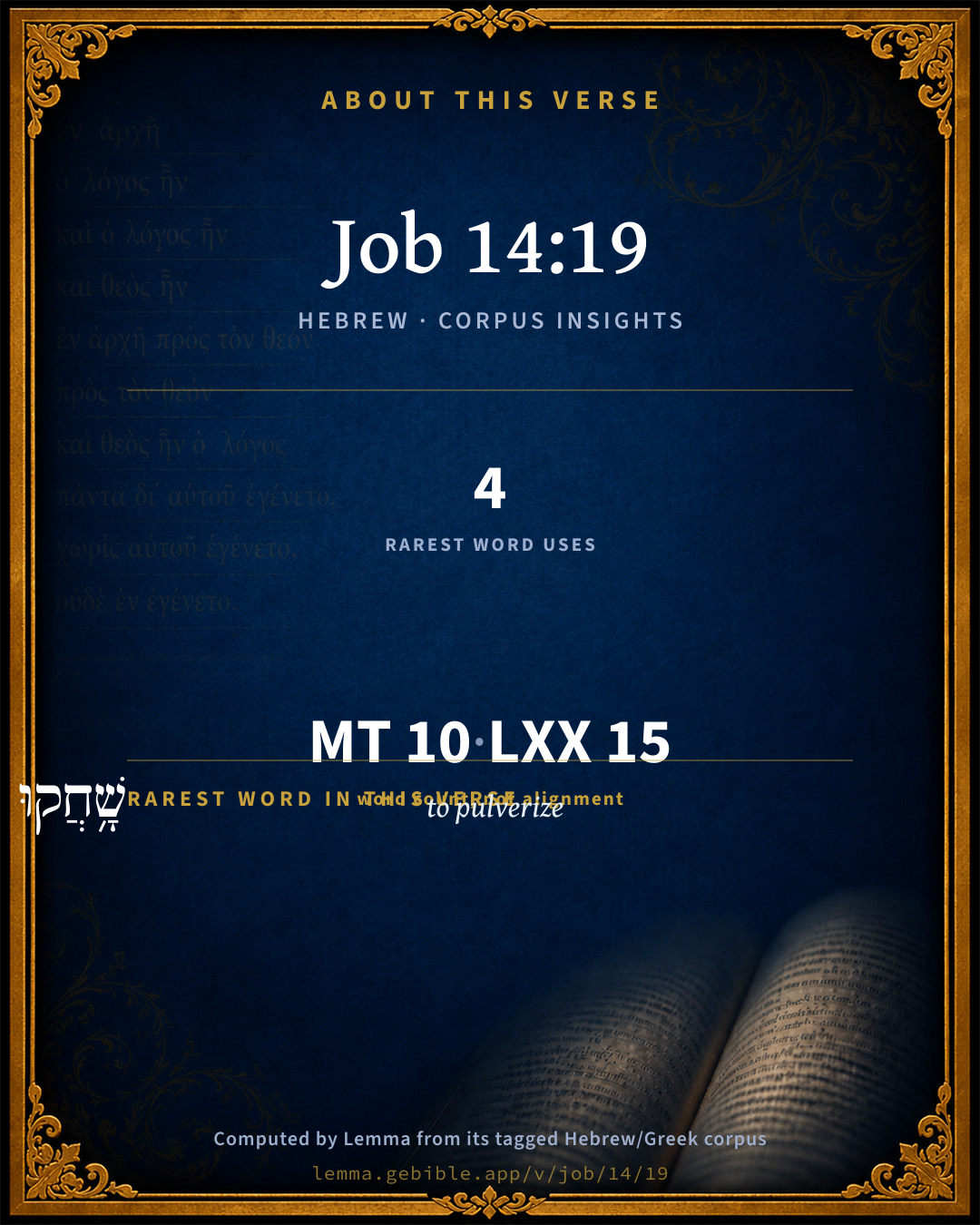
The rarest word here is שָׁ֥חֲקוּ to pulverize H7833 — appearing just 4 times in the whole Hebrew Bible.

Shared distinctive vocabulary

שָׁ֥חֲקוּ to pulverize H7833 occurs in 4 verses of the Hebrew Bible. Also found in:

Grammatical profile

  • 3 verbs
  • 7 nouns

Verb forms

  • שָׁ֥חֲקוּ Qal · Perfect
  • תִּשְׁטֹֽף Qal · Imperfect
  • הֶאֱבַֽדְתָּ Hiphil · Perfect

Hebrew & Septuagint length

In English translation the verse runs 23 words from the Hebrew and 22 from the Septuagint (LXX English) — closely comparable.

A rough comparison of the two English renderings, which tokenize alike — not a word-level alignment.

Word counts can differ between the Hebrew and the Greek without any difference in meaning — e.g. the Hebrew direct-object marker אֵת has no separate Greek word, and Greek often adds the article ὁ.

In the original languages it is 10 Hebrew tokens and 15 Greek tokens — but the two are counted differently (Hebrew bundles its prefixes and suffixes into one token; the Greek is in lemma form), so that isn’t a like-for-like length.

Cross-references

8

Topical passages linked to Job 14:19 in the Treasury of Scripture Knowledge — connected by theme and wording, ordered by reader-vote popularity; previews shown in the World English Bible.

  • Job 7:6 My days are swifter than a weaver's shuttle, And are spent without hope.
  • Job 19:10 He has broken me down on every side, and I am gone. My hope he has plucked up like a tree.
  • Job 27:8 For what is the hope of the godless, when he is cut off, When God takes away his life?
  • Genesis 6:17 I, even, I do bring the flood of waters on this earth, to destroy all flesh having the breath of life from under the sky. Everything that is in the earth will die.
  • Genesis 7:21–23 All flesh died that moved on the earth, including birds, cattle, animals, every creeping thing that creeps on the earth, and every man.
  • Psalms 30:6–7 As for me, I said in my prosperity, "I shall never be moved."
  • Ezekiel 37:11 Then he said to me, Son of man, these bones are the whole house of Israel: behold, they say, Our bones are dried up, and our hope is lost; we are clean cut off.
  • Luke 12:19–20 I will tell my soul, "Soul, you have many goods laid up for many years. Take your ease, eat, drink, be merry."'

Cross-references courtesy of OpenBible.info (CC BY 4.0).

Hebrew and Greek witnesses Masoretic Hebrew ↔ Greek Septuagint

The same verse in the two great witnesses to the Old Testament, shown verse-for-verse.

These are two independent witnesses, not word-aligned to each other, and the Septuagint is shown in lemma (dictionary) form.

Hebrew Job 14:19 Masoretic · Westminster Leningrad Codex

אֲבָנִ֤ים שָׁ֥חֲקוּ מַ֗יִם תִּשְׁטֹֽף סְפִיחֶ֥יהָ עֲפַר אָ֑רֶץ וְתִקְוַ֖ת אֱנ֣וֹשׁ הֶאֱבַֽדְתָּ

The waters wear the stones; The torrents of it wash away the dust of the earth: So you destroy the hope of man.

World English Bible · Public Domain

Greek LXX Job 14:19 Septuagint · lemma form

λίθος λεαίνω ὕδωρ καί κατακλύζω ὕδωρ ὕπτιος ὁ χῶμα ὁ γῆ καί ὑπομονή ἄνθρωπος ἀποὀλλύω

The waters wear the stones, and waters falling headlong overflow a heap of the earth: and you destroy the hope of man.

LXX2012 (modern English Septuagint) · Public Domain

On this verse, Haydock's Catholic Bible Commentary discusses the Septuagint’s reading. Read the note in Commentary ↓

Hebrew: Westminster Leningrad Codex (CC BY 4.0). Greek: Septuagint (public domain); English from LXX2012 (modern English Septuagint) (Public Domain). How the Septuagint differs from the Hebrew →

Commentary

Notes on Job 14:19 from classic Christian and Jewish commentators (each source and its license shown beneath its notes). The classic Christian expositions comment on the surrounding passage and are grouped to its opening verse, so a note may address several verses; the Jewish commentaries on the Tanakh (Rashi and others) are per-verse, so they appear only where the commentator wrote on this verse.

Lemma curates 59 commentaries, every one of them public domain or Creative Commons licensed, each selected and text-cleaned for this edition rather than reprinted as found. About our sources →

Trapp's Complete Commentary

John Trapp

Job 14:19 The waters wear the stones: thou washest away the things which grow [out] of the dust of the earth; and thou destroyest the hope of man.

Ver. 19. The waters wear the stones] Gutta cavat lapidem, &c. The weakest things wear out the hardest by often falling upon them, or continual running over them; so doth God’s wrath, though let out minimally, secretly, but surely consume. Hos 5:12, "I will be unto Ephraim as a moth, and to the house of Judah as rottenness," or that little worm ( teredo) that eats into the heart of wood, and rots it. Thus he plagued the Egyptians by lice and flies. There may be much poison in little drops.

Thou washest away the things that grow out of the earth] Or, Thou overflowest, as once in the general deluge (when the face of the earth was grown so foul, that God was forced to wash it with a flood), and frequently since, we see that after great rains there are huge floods that mar whole meadows and grain fields, not only discolouring, but drowning all their beauty and plenty. This is the fourth comparison used in this and the former verse; where a man would wonder, saith an interpreter, audire Iobum in mediis aerumnis philosophantem, to hear Job, in the midst of his miseries, making use of his philosophy, and travelling thus in his thoughts, for illustrations of his own case, over mountains and rocks, &c.

Thou destroyest the hopes of man] viz. In destroying the things above mentioned; or, so thou destroyest, &c.; though some reserve the reddition to the next verse, so thou prevailest against him, &c., i.e. So thou never ceasest with thy might to cast down sorry men, till such time as they, changing countenance, and departing with a heavy and sorrowful heart, thou violently throwest them out, their lives and hope ending together, if they have been wicked; as if godly, yet their vain and groundless hopes of prosperity and plenty, &c., come to nothing: though over the Red Sea, yet God’s people may be made to tack about two and forty times in the wilderness.

John Trapp, A Commentary or Exposition upon All the Books of the Old and New Testament (1647–1656) — public domain. Text from a community e-Sword module.

Jamieson, Fausset & Brown

Robert Jamieson, A. R. Fausset & David Brown

The Hebrew order is more forcible: "Stones themselves are worn away by water."

things which grow out of--rather, "floods wash away the dust of the earth." There is a gradation from "mountains" to "rocks" (Job 14:18), then "stones," then last "dust of the earth"; thus the solid mountain at last disappears utterly.

Jamieson, Fausset & Brown — Commentary Critical and Explanatory on the Whole Bible (1871) — public domain (CC PDM 1.0). Text via the HelloAO Bible API.

Adam Clarke's Commentary

Verse 19. The waters wear the stones] Even the common stones are affected in the same way. Were even earthquakes and violent concussions of nature wanting, the action of water, either running over them as a stream, or even falling upon them in drops, will wear these stones. Hence the proverb: -

Gutta cavat lapidem non vi sed saepe cadendo.

"Constant droppings will make a hole in a flint."

Εκ θαμινης ραθαμιγγος, ὁκως λογος, αιες ιοισας,

Χ' ἁ λιθος ες ρωχμον κοιλαινεται.

"From frequent dropping, as the proverb says, perpetually falling, even a stone is hollowed into a hole."

Thou washest away the things] Alluding to sudden falls of rain occasioning floods, by which the fruits of the earth are swept away; and thus the hope of man - the grain for his household, and provender for his cattle, is destroyed.

Adam Clarke's Commentary on the Bible (1810–1826) — public domain. Text from a community e-Sword/MySword module.

The Cambridge Bible for Schools and Colleges

gen. ed. J. J. S. Perowne

19. The turbulent waters wear away the stones of the brook by their constant action.

thou washest away, &c] Rather, the floods thereof (i. e. of the waters) do wash away the soil of the earth.

and thou destroyest] i. e. so thou destroyest. The “hope” of man which God destroys is not the specific hope of a renewed life (Job_14:7)—this idea is dismissed—but more general, the hope of life.

The Cambridge Bible for Schools and Colleges (gen. ed. J. J. S. Perowne; Cambridge University Press, 1878–1918) — public domain. Text from a community e-Sword module.

John Gill's Exposition

The waters wear the stones,.... Either by continual running in them, or constant dropping upon them (p); and the excavations or hollow places they: make are never filled up again, these impressions are never effaced, nor the stones reduced to their ancient form; so man, though he may have the strength of stones, yet the waters of afflictions will gradually wear him away, and bring him to the dust of death, and where he must lie till the heavens be no more:

thou washest away the things which grow out of the dust of the earth; herbs, plants, and trees, which a violent inundation of water tears up by the roots, and carries away, and they are never restored to their places any more. The word which we render "the things which grow out", the spontaneous productions of the earth, as in Lev 25:5. Aben Ezra interprets of floods of water; and so Schultens, from the use of the word (q) in the Arabic language, translates it, "their effusions"; that is, the effusions of waters before mentioned, the floods and inundations of them overflow, "and wash away the dust of the earth"; not only that which is on the surface of it, the soil of it; but, as the same learned man observes, they plough and tear up the earth itself, and carry it away, and it is never repaired; so men at death are carried away as with a flood, and are no more, see Psa 90:5;

and or "so" (r).

thou destroyest the hope of man, not the hope of a good man about his eternal state, and of enjoying eternal happiness; which is the gift of God's grace, which is without repentance, never revoked, called in, or taken away or destroyed; it is built upon the promise of God, who cannot lie; it is founded on the person, blood, and righteousness of Christ; and though it may be brought low, it is never lost; the hope of carnal men in an arm of flesh, in the creature and creature enjoyments, is indeed destroyed; and so is the hope of external professors of religion, that is formed on their own works of righteousness, and profession of religion; but of this Job is not speaking, but of the hope of man of living again in this world after death; for this is a reddition or application of the above similes used to illustrate this point, the irreparable state of man at death, so as that he shall never return to this life again, and to the same state and circumstances of things as before; and next follows a description of death, and the state of the dead.

(p) "Gutta cavat lapidem", Ovid. de Ponto, l. 4. (q) "effudit", Golius, col. 1182. Castel. col. 2590. (r) "Sic", Vatablus, Drusius, Mercerus, Schultens; "ita", Junius & Tremellius, Piscator; it answers to Aben Ezra, Gersom.

John Gill's Exposition of the Whole Bible (1746–1763) — public domain (CC PDM 1.0). Text via the HelloAO Bible API.

Albert Barnes' Notes on the Bible

The waters wear the stones - By their constant attrition they wear away even the hard rocks, and they disappear, and return no more. The sense is, that constant changes are going on in nature, and man resembles those objects which are removed to appear no more, and not the productions of the vegetable world that spring up again. It is possible that there may also be included the idea here, that the patience, constancy, firmness, and life of any man must be worn out by long continued trials, as even hard rocks would be worn away by the constant attrition of waters.

Thou washest away - Margin, “Overflowest.” This is literally the meaning of the Hebrew תשׁטף tı̂shâṭaph. But there is included the sense of washing away by the inundation.

The things which grow out of the dust of the earth - Herder and Noyes translate this, “the floods overflow the dust of the earth,” and this accords with the interpretation of Good and Rosenmuller. So Castellio renders it, and so Luther - “Tropfen flossen die Erde weg.” This is probably the true sense. The Hebrew word rendered “the things which grow out” ספיח sâphı̂yach, means properly that which “is poured out” - from ספח sâphach, to pour out, to spread out - and is applied to grain produced spontaneously from kernels of the former year, without new seed. Lev 25:5-11; 2Ki 19:29. See the notes at Isa 37:30. But here it probably means a flood - that which flows out - and which washes away the earth.

The dust of the earth - The earth or the land on the margin of streams. The sense is, that as a flood sweeps away the soil, so the hope of man was destroyed.

Thou destroyest the hope of man - By death - for so the connection demands. It is the language of despondency. The tree would spring up, but man would die like a removed rock, like land washed away, like a falling mountain, and would revive no more. If Job had at times a hope of a future state, yet that hope seems at times, also, wholly to fail him, and he sinks down in utter despondency. At best, his views of the future world were dark and obscure. He seems to have had at no time clear conceptions of heaven - of the future holiness and blessedness of the righteous; but he anticipated, at best, only a residence in the world of disembodied spirits - dark, dreary, sad; - a world to which the grave was the entrance, and where the light was as darkness. With such anticipations, we are not to wonder that his mind sank into despondency; nor are we to be surprised at the expressions which he so often used, and which seem so inconsistent with the feelings which a child of God ought to cherish. In our trials let us imitate his patience, but not his despondency; let us copy his example in his better moments, and when he was full of confidence in God, and not his language of complaint, and his unhappy reflections on the government of the Most High.

Albert Barnes' Notes on the Bible (1834–1885) — public domain. Text from a community e-Sword/MySword module.

Haydock's Catholic Bible Commentary

Man. Hebrew and Septuagint, "the hope of man." (Haydock) --- He must not expect to be more privileged than all other things, which time consumes. (Calmet) --- Job again deplores human misery. (Menochius)

George Leo Haydock (1774–1849), Haydock's Catholic Family Bible and Commentary, 1859 edition — public domain. Excludes Psalms (Douay-Rheims chapter numbering differs from Protestant) and Deuterocanonical books (Catholic canon only).

Whedon's Commentary on the Bible

Daniel D. Whedon

19. Washest away, etc. — Its floods (referring to “waters,” used collectively) wash away the dust of the earth, leaving desolation in their track. The gradation of the passage is peculiar — it follows the course of disintegration: from mountains to rocks, from rocks to stones, thence to the dust of the earth; and thus the mountain comes to nought. Nature and man alike decay away into dust.

Daniel D. Whedon (gen. ed.), Commentary on the Old and New Testaments (1874–1909) — public domain. Text from a community e-Sword module.

The Pulpit Commentary

The waters wear the stones. The power of the soft element of water, by continual washing or dripping, to wear away the hardest stone, has often been noticed, and is a frequent topic in poetry. Deep ravines have been worn in course of time, through broad and lofty mountain ranges by rivers, the stone yielding little by little to the action of the water, until at last a broad chasm is made. So the continual wearing action of calamity often lays low the prosperous. Thou washest away the things which grow out of the dust of the earth; rather, as in the Revised Version, the overflowings thereof wash away the dust of the earth; i.e. "overflows of water, inundations, floods, not only make a way through rocks, but often carry off great tracts of rich soil, hurrying the alluvium down to the sea, and leaving in its place a marsh or a waste." And thou destroyest the hope of man. Even thus from time to time does God ruin and destroy the hopes of a prosperous man.

Blighted hopes.

I A COMMON EXPERIENCE. It is not more true that man hopes, than it is that he sooner or later becomes acquainted with disappointment. Young and old, rich and poor, wise and unwise, have their unrealized expectations.

II A DIVINE ARRANGEMENT. Blighted hopes are no more accidents than are buds that never fulfil their promise, They form part of the great world-plan which has been devised by Infinite Wisdom.

III A SALUTARY DISCIPLINE. When God breaks a man"s earthly ideas, it is that he may find nobler ones in heaven; that, turning away his heart from mundane things, he may seek those things which are above.

LESSONS.

1. Thank God for earth"s disappointments.

2. Seek to be possessed of that hope which fadeth not away.

How waters wear the stones.

I THE PROCESS. Job compares the process of providence to the action of the winter torrents in the wadys of a desert region. Few phenomena in nature are more striking to those who examine them than those of erosion. A small trickling stream cuts through a great hill, and makes a deep winding valley. Water constantly flowing over granite rocks smooths the hard stone and wears it away, eating its course through the most solid cliffs. The falls of Niagara are receding, and in front of them is seen an ever-lengthening chasm as the river continually cuts away the rock over which it pours. This process is compared by Job to the friction of time anti trouble.

1. From apparently feeble causes. The water does not seem capable of effecting the marvellous results that are attributed to it. Slight causes may have great issues.

2. By slow degrees. The worst and the best things are both produced slowly. We cannot judge of the process by its immediate effects.

3. With irresistible force. We cannot resist time. The slow course of providence is a river that cuts through all opposition. It is impossible for man to succeed when he opposes God; for the very rock is worn by the waters that wash over it. Thus vain hopes perish. The worst troubles are not sudden blows, but wearing anxieties and gnawing griefs.

II ITS LESSONS. Job drew from the process only a conclusion of despair, or at best an expostulation with God for bringing his irresistible might to bear on so feeble a creature as man. But other and wider conclusions may be inferred.

1. It is foolish to trust in our own hopes. They may be solid as granite, and yet time and disappointment may wear them away. The robustness of the hopes is no guarantee of their permanence. The sanguine man is not kept secure by his self-confidence.

2. We should examine the character of our hopes. Low hopes fail first. The stream runs through the valley, sparing the crags on the mountain-top, though these are exposed to all the fury of the gale, and only wearing those that lie in its sunken course. There is safety in elevation of character.

3. The failure of earthly hopes is designed to turn our mind to heavenly hopes. God does not frustrate every hope of man. Job"s idea is the fruit of his despair. Foolish hopes are destroyed, and even innocent hopes, in some cases, in order that we may build higher and found our true hopes on the immovable rock of God"s truth. The Rock of Ages is never worn by the waters of time or trouble.

4. The destroying process carries away much that we are glad to lose. It does not select the rich treasures and pleasant experiences of life. Job thought that God carefully sealed up his sin in a bag (ver. 17), while he destroyed his hope as with the waters that wear the stones. But when a man truly repents, God washes away his sins, and gives him a good and enduring hope. Many troubles are worn away by the slow but sure erosion of the waters of time. Even while we fear them they are being lessened for us. God"s destructive agencies are all directed by his supreme goodness. We need not fear the wearing waters if we are reconciled to the God who directs their course, and says to the flood, "Hitherto shalt thou come, and no further, and here shall thy proud waves be stayed. W.F.A.

The Pulpit Commentary (1880–1919), ed. H.D.M. Spence-Jones & Joseph S. Exell — public domain. Text from a community e-Sword module.

Rashi

Rabbi Shlomo Yitzchaki (Rashi)

Stones which the water eroded by constantly passing over them.

it washes away i.e., the flood. its aftergrowth of the stone, to be transformed into dust so that something should grow in it. As the aftergrowths of the harvest grow, so will the aftergrowths of this earth be transformed to stone.

but the hope of man is not so, because as soon as he dies, it is lost forever.

Rashi on the Tanakh — English translations: “The Judaica Press complete Tanach with Rashi, translated by A. J. Rosenberg” (CC BY 4.0); “Pentateuch with Rashi's commentary by M. Rosenbaum and A.M. Silbermann, 1929-1934” (public domain); “The Metsudah Tanach series, Lakewood, N.J” (CC BY 4.0); and “The Book of Joshua, Metsudah Publications, 1997” (CC BY 4.0). Text via Sefaria.

Lesson kit

Teaching starters — assembled from the data on this page, not authored interpretation. Every prompt links to the verse data it draws on. Edit before teaching.

Job, in the Wisdom, opens this verse with 10 words (10 distinct Hebrew lemmas). Its most distinctive word is shâchaq (“to pulverize”). A historical commentator’s framing appears above. Read the whole chapter for the surrounding context.

Discussion questions

  1. How does “to pulverize” (shâchaq) shape what this verse is saying?
  2. Exodus 30:36 shares the word «to pulverize» with this verse. How do the two illuminate each other?
  3. These translations render this verse differently; the difference is in the English rendering, not the original. What questions does that raise?
  4. The verb «שָׁ֥חֲקוּ» is Qal Perfect. How does its form color the action?
  5. Reading how Trapp's Complete Commentary and Jamieson, Fausset & Brown read this verse, where do the two commentators agree and where do they part?

Things to notice

Reading settings

Reading text

Shown beneath each verse's original-language words.

Old Testament
Old Testament edition

Read the OT as the Masoretic Hebrew (MT) or the Greek Septuagint (LXX).

English shown for the Greek Septuagint (in the Hebrew ↔ Greek comparison).

Comparing translations? Open the Compare panel on any verse page to stack up to four side by side.