
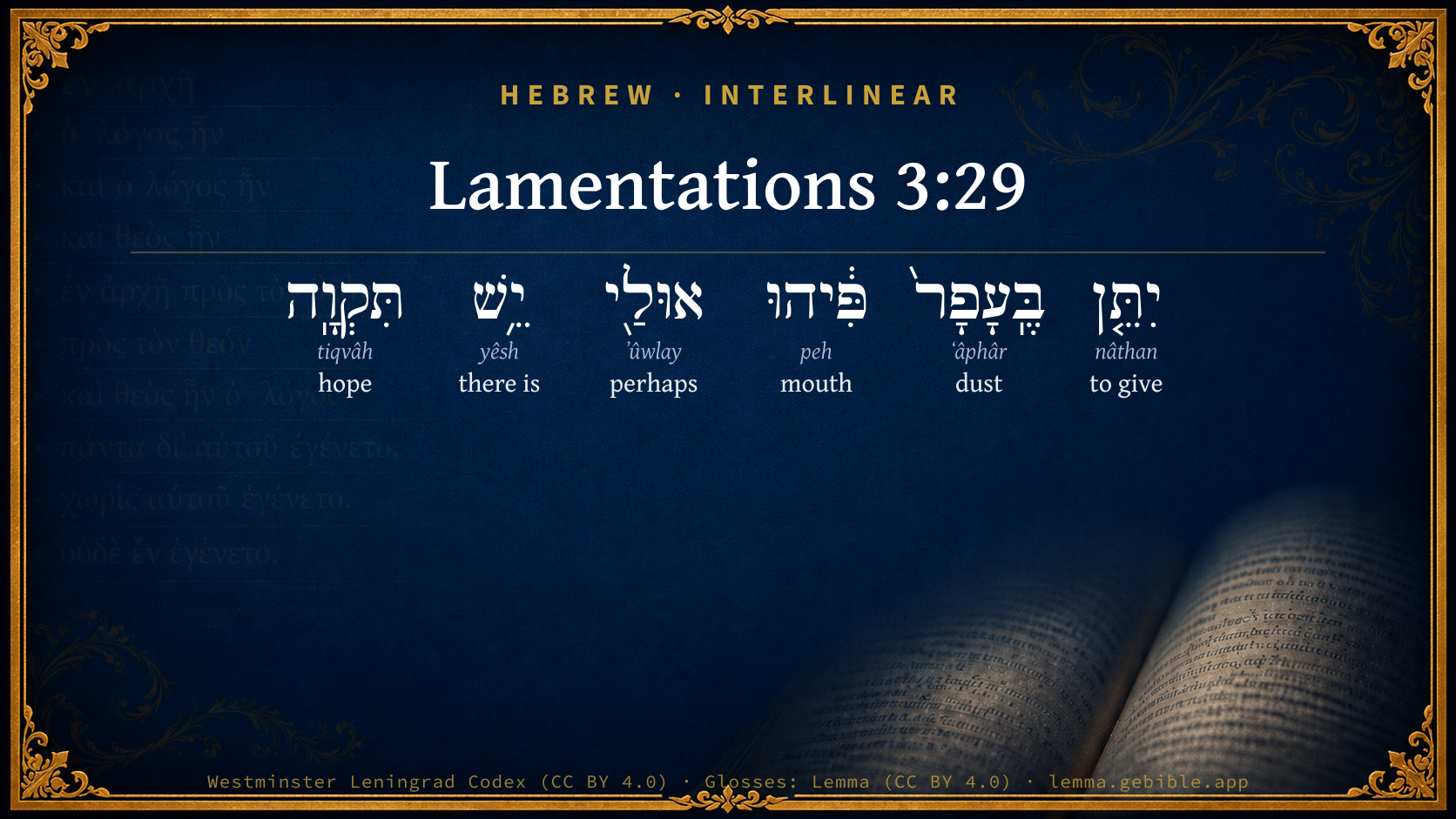
Lamentations 3:29

Hebrew (Westminster Leningrad Codex) Lamentations 3:29 appears in the Hebrew Old Testament. The text above is from the Westminster Leningrad Codex. Each word links to its Strong’s number, a concise gloss, and parsing drawn from the Open Scriptures Hebrew Bible morphology. Click any word for its full Brown-Driver-Briggs (BDB) entry.
Download image
Cite this verse

Lamentations 3:29 (World English Bible). Public Domain. Lemma interlinear Bible study tool, https://lemma.gebible.app/v/lamentations/3/29.

Show BibTeX & RIS
BibTeX
RIS
English Translation
Let him put his mouth in the dust, if so be there may be hope.
World English Bible · Public Domain
Download a study sheet

One document with this verse’s original text, its word-by-word gloss line, the meaning frame, cross-references with their text, attributed commentary, and full source and license credits — printable, and it pastes into notes with its structure intact.

This verse Autodidact and up

Study sheet (.html) Plain text (.txt)

A passage Seminary Student

Up to 50 verses in one chapter. A passage sheet keeps up to 6 commentary sources and 12 cross-references per verse, in the order this page ranks them, and says so on the sheet whenever that leaves anything out. Ask for a single verse and you get the Autodidact verse sheet above.

Everything on this page stays free to read, with no account — the sheet is a download of what is already on screen, not access to it.

Want to remove ads? Support Godless Engineer
Compare translations 3

The same verse in 3 English versions, stacked beneath the original-language interlinear above. Click any original word for its lexicon entry.

Each is an independent rendering of the whole verse — the interlinear is not word-aligned to these translations.

Highlighted words mark where these versions differ — a whole-verse word diff, not a word-by-word alignment.

  • World English Bible Public Domain
    Let him put his mouth in the dust, if so be there may be hope.
  • King James Version Public Domain
    He putteth his mouth in the dust; if so be there may be hope.
  • unfoldingWord Literal Text CC BY-SA 4.0
    Let him put his mouth in the dust; perhaps there is hope.

unfoldingWord Literal Text — © unfoldingWord, licensed CC BY-SA 4.0. Word-aligned USFM3 via Door43 (git.door43.org/unfoldingWord/en_ult).

Versions to compare (up to 4)

3 of 4 selected

Show all 18 translations

Every available English version of this verse, each an independent rendering of the whole verse.

  • World English Bible Public Domain
    Let him put his mouth in the dust, if so be there may be hope.
  • Berean Standard Bible Public Domain
    Let him bury his face in the dust—perhaps there is still hope.
  • Majority Standard Bible Public Domain
    Let him bury his face in the dust—perhaps there is still hope.
  • King James Version Public Domain
    He putteth his mouth in the dust; if so be there may be hope.
  • American Standard Version (1901) Public Domain
    Let him put his mouth in the dust, if so be there may be hope.
  • Revised Version (1885) Public Domain
    Let him put his mouth in the dust; if so be there may he hope.
  • Geneva Bible (1599) Public Domain
    He putteth his mouth in the dust, if there may be hope.
  • Douay-Rheims (1899) Public Domain
    Jod. He shall put his mouth in the dust, if so be there may be hope.
  • Young's Literal Translation Public Domain
    He putteth in the dust his mouth, if so be there is hope.
  • Literal Standard Version CC BY-SA 4.0
    He puts his mouth in the dust, if so be, there is hope.
  • Unlocked Literal Bible CC BY-SA 4.0
    Let him put his mouth in the dust—there may yet be hope.
  • unfoldingWord Literal Text CC BY-SA 4.0
    Let him put his mouth in the dust; perhaps there is hope.
  • Darby Bible Public Domain
    he putteth his mouth in the dust, if so be there may be hope;
  • World Messianic Bible Public Domain
    Let him put his mouth in the dust, if it is so that there may be hope.
  • Webster's Bible Public Domain
    He putteth his mouth in the dust; if there may be hope.
  • Free Bible Version CC BY-SA 4.0
    They should bow low with their faces to the ground, for there may still be hope.
  • Bible in Basic English Public Domain
    Let him put his mouth in the dust, if by chance there may be hope.
  • JPS Tanakh (1917) Public Domain
    Let him put his mouth in the dust, if so be there may be hope.

Literal Standard Version (2020), Covenant Press — licensed CC BY-SA 4.0. Text via the HelloAO Bible API (eBible.org). Unlocked Literal Bible (unfoldingWord) — licensed CC BY-SA 4.0. Text via the HelloAO Bible API (eBible.org). unfoldingWord Literal Text — © unfoldingWord, licensed CC BY-SA 4.0. Word-aligned USFM3 via Door43 (git.door43.org/unfoldingWord/en_ult). Free Bible Version, Dr. Jonathan Gallagher — licensed CC BY-SA 4.0. Text via the HelloAO Bible API (eBible.org).

Word by word

More ways to search: Search by grammar → Find every occurrence → Compare this word →

Practice this passage: Drill this verse → Learn its vocabulary →

About this verse

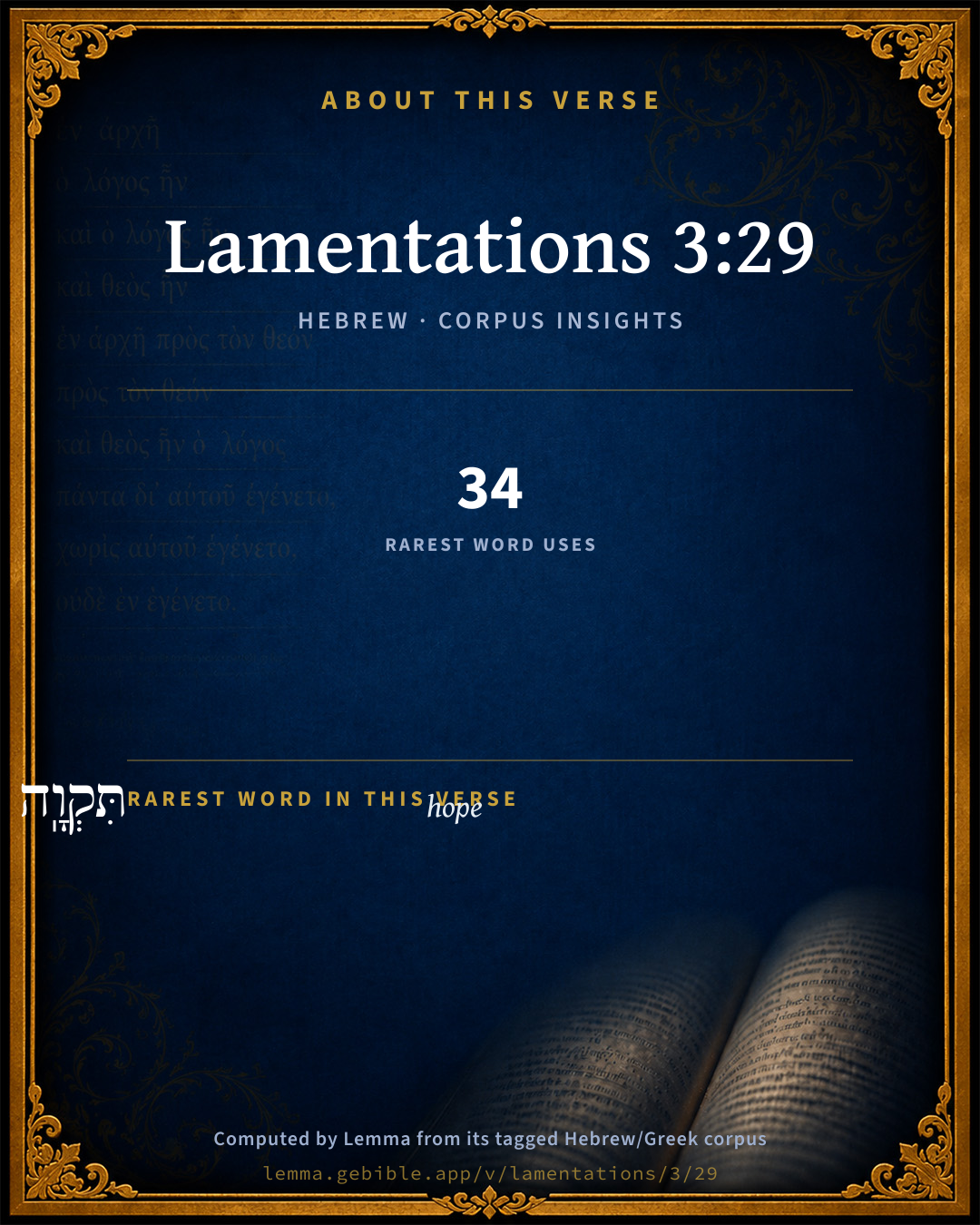
These counts appear in no published source. They are computed here, from the morphology-tagged text and Lemma’s own curated glosses. What Lemma adds →

6
words
6
distinct lemmas
Prophets
section

Shared distinctive vocabulary

תִּקְוָֽה hope H8615 occurs in 33 verses of the Hebrew Bible. Also found in:

Grammatical profile

  • 1 verb
  • 3 nouns
  • 1 adverb
  • 1 particle

Verb forms

  • יִתֵּ֤ן Qal · Imperfect

Cross-references

11

Topical passages linked to Lamentations 3:29 in the Treasury of Scripture Knowledge — connected by theme and wording, ordered by reader-vote popularity; previews shown in the World English Bible.

  • Job 40:4 "Behold, I am of small account. What shall I answer you? I lay my hand on my mouth.
  • 2 Chronicles 33:12 When he was in distress, he begged Yahweh his God, and humbled himself greatly before the God of his fathers.
  • Job 42:5–6 I had heard of you by the hearing of the ear, But now my eye sees you.
  • Jeremiah 31:17 There is hope for your latter end, says Yahweh; and [your] children shall come again to their own border.
  • Ezekiel 16:63 that you may remember, and be confounded, and never open your mouth any more, because of your shame, when I have forgiven you all that you have done, says the Lord Yahweh.
  • Joel 2:14 Who knows? He may turn and relent, And leave a blessing behind him, Even a meal offering and a drink offering to Yahweh, your God.
  • Jonah 3:9 Who knows whether God will not turn and repent, and turn away from his fierce anger, so that we might not perish?"
  • Zephaniah 2:3 Seek Yahweh, all you humble of the land, who have kept his ordinances. Seek righteousness. Seek humility. It may be that you will be hidden in the day of Yahweh's anger.
  • Luke 15:18–19 I will get up and go to my father, and will tell him, "Father, I have sinned against heaven, and in your sight.
  • Luke 18:13 But the tax collector, standing far away, wouldn't even lift up his eyes to heaven, but beat his breast, saying, 'God, be merciful to me, a sinner!'
  • Romans 3:19 Now we know that whatever things the law says, it speaks to those who are under the law, that every mouth may be closed, and all the world may be brought under the judgment of God.

Cross-references courtesy of OpenBible.info (CC BY 4.0).

Hebrew and Greek witnesses Masoretic Hebrew ↔ Greek Septuagint

The same verse in the two great witnesses to the Old Testament, shown verse-for-verse.

These are two independent witnesses, not word-aligned to each other, and the Septuagint is shown in lemma (dictionary) form.

Hebrew Lamentations 3:29 Masoretic · Westminster Leningrad Codex

יִתֵּ֤ן בֶּֽעָפָר֙ פִּ֔יהוּ אוּלַ֖י יֵ֥שׁ תִּקְוָֽה

Let him put his mouth in the dust, if so be there may be hope.

World English Bible · Public Domain

Hebrew: Westminster Leningrad Codex (CC BY 4.0). Greek: Septuagint (public domain); English from a public-domain English Septuagint. How the Septuagint differs from the Hebrew →

Commentary

Notes on Lamentations 3:29 from classic Christian and Jewish commentators (each source and its license shown beneath its notes). The classic Christian expositions comment on the surrounding passage and are grouped to its opening verse, so a note may address several verses; the Jewish commentaries on the Tanakh (Rashi and others) are per-verse, so they appear only where the commentator wrote on this verse.

Lemma curates 59 commentaries, every one of them public domain or Creative Commons licensed, each selected and text-cleaned for this edition rather than reprinted as found. About our sources →

Trapp's Complete Commentary

John Trapp

Lam 3:29 He putteth his mouth in the dust; if so be there may be hope.

Ver. 29. He putteth his mouth in the dust.] He lieth low at God’s feet: putting himself into the hands of justice, yet in hope of mercy. See 1Co 14:25.

If so be there may be hope.] Heb., Peradventure there is hope - q.d., doubtless there is; however, I will try, since I have lost many a worse labour.

John Trapp, A Commentary or Exposition upon All the Books of the Old and New Testament (1647–1656) — public domain. Text from a community e-Sword module.

Matthew Poole's English Annotations

If that may be supplied, or when, (as Pagnine translateth בי Lam 3:28, the connexion of these words with the former is very fair and easy, for then those words, Lam 3:27, It is good that must be repeated in the beginning of Lam 3:28 and Lam 3:29; however, both this and the former verses let us know the duty of persons under afflictions in order to their obtaining mercy at the hand of God, and admirably give us the character of persons under afflictions preparing for mercy. They hope and quietly wait for God’s salvation, Lam 3:26; they bear God’s yoke, Lam 3:27, because he hath laid it upon them; they sit alone and keep silence, Lam 3:28; and here, they put their mouths in the dust, that is, humble themselves to the feet of God, and to the will of God; not being too confident of deliverances in this life, but if peradventure

there may be hope.

Matthew Poole's English Annotations on the Holy Bible (1683–1685) — public domain. Text from a community e-Sword/MySword module.

Tyndale Open Study Notes

Tyndale Open Resources

3:29-30 In the ancient Near East, lying face down in the dust expressed submission (Gen 17:1-3; Lev 9:24; Josh 7:6; 1 Sam 5:4; 1 Kgs 18:39; 1 Chr 21:16; Matt 17:5-6). • To turn the other cheek also expresses submission. Jesus evidently had this verse in mind when he taught his disciples to submit to persecution (Matt 5:39). This response recognizes that God is sovereign even over our suffering.

Tyndale Open Study Notes — © Tyndale Open Resources, licensed CC BY-SA 4.0. Text via the HelloAO Bible API.

Geneva Bible (1599)

Geneva Bible translators

He humbleth himself as they that fall down with their face to the ground, and so with patience waiteth for succor.

Geneva Bible (1599) marginal notes — public domain. Text via Bolls.life.

Jamieson, Fausset & Brown

Robert Jamieson, A. R. Fausset & David Brown

(Job 42:6). The mouth in the dust is the attitude of suppliant and humble submission to God's dealings as righteous and loving in design (compare Ezr 9:6; Co1 14:25).

if so be there may be hope--This does not express doubt as to whether GOD be willing to receive the penitent, but the penitent's doubt as to himself; he whispers to himself this consolation, "Perhaps there may be hope for me."

Jamieson, Fausset & Brown — Commentary Critical and Explanatory on the Whole Bible (1871) — public domain (CC PDM 1.0). Text via the HelloAO Bible API.

Adam Clarke's Commentary

Verse 29. He putteth his mouth in the dust] Lives in a state of deep humility.

If so be there may be hope.] Because there is room for hope.

Adam Clarke's Commentary on the Bible (1810–1826) — public domain. Text from a community e-Sword/MySword module.

John Calvin's Commentaries

He continues the same subject; for he describes to us men so subdued to obedience that they are ready to bear whatever God may lay on them. He then says that the sitting and the silence of which he spoke, so far prevailed, that the children of God, though in extreme evils, did not yet cease to persevere in their obedience. For it sometimes happens that those who have made some progress in the fear of God, give proof of their obedience and patience in some small trial; but when they are greatly tried, then breaks forth the impatience which they had previously checked. Then the Prophet teaches us here, that the children of God do not sufficiently prove their patience, when they bear with a calm mind a moderate correction, except they proceed to a higher degree of perseverance, so as to remain quiet and resigned even when the state of things appears hopeless.

By saying that the faithful put their mouth in the dust, he means that they lie down humbly before God and confess themselves to be as dead. The import of what is said is this: In time of extreme affliction the wise will put his mouth in the dust, while seeing things in such confusion that all his thoughts vanish away on account of the atrocity of evils; and thus he intimates that the wise would have nothing to say. To put the mouth, then, in the dust is to become mute, as though he had said, that the faithful shut their mouth, when they do not murmur against God nor abandon themselves to complaints, when they do not expostulate that injury is done them, nor allege what the unbelieving usually do when God deals severely with them. In short, to put the mouth in the dust, means to bring no complaints, and so to check ourselves that no clamorous words proceed from our mouth. Thus another phrase is used to set forth the silence mentioned before.

And that the Prophet here speaks of extreme trials, may be easily gathered from the next clause, If so be that there is hope; not that the faithful doubt whether God would give them hope, for they have no doubt but that God, who shines in darkness itself by his word, would at length by, the effect prove that he is not unfaithful. But the particle אולי auli, as it is well known, expresses what is difficult; for when anything appears to be incredible, the Hebrews say, If it may be. But here, as I have said, it does not intimate a doubt; for when the mind of a godly man fluctuates or doubts, how is it that he puts his mouth in the dust? but the Prophet shews that those who are taught to obey God, persevere even in extreme trials, so that while nothing but despair appears, they yet lie down humbly before God, and patiently wait until some hope shines forth. And here hope is to be taken for the ground or occasion of hope. It afterwards follows, —

John Calvin's Commentaries (1540-1563) — public domain. Text from the Calvin Translation Society English edition (1840s-50s) via the Christian Classics Ethereal Library (ccel.org). Calvin's coverage is partial (roughly two-thirds of the Bible); uncommented books and verses are honest gaps, never fabricated. The 19th-century editor's footnotes and remarks are omitted so the notes are faithfully Calvin's own voice.

Ellicott's Commentary for English Readers

(29) He putteth his mouth in the dust . . .—The outward image is that of the prostration of an Eastern subject before a king: his very face laid in the dust, so that he cannot speak.

A Bible Commentary for English Readers, edited by Charles John Ellicott (1878–1897) — public domain. Text from a community e-Sword module.

The Cambridge Bible for Schools and Colleges

gen. ed. J. J. S. Perowne

29. Let him put his mouth in the dust] the Eastern way of expressing absolute submission by prostrating oneself.

The Cambridge Bible for Schools and Colleges (gen. ed. J. J. S. Perowne; Cambridge University Press, 1878–1918) — public domain. Text from a community e-Sword module.

John Gill's Exposition

He giveth his cheek to him that smiteth him,.... Either to God that afflicts him, and patiently bears it; see Isa 9:13; or rather to men. To be smitten on the cheek is always reckoned a very great affront; to turn the cheek to an injurious man is to give him an opportunity and leave to smite, and signifies the taking of it patiently, and agrees both with our Lord's advice and example, Mat 5:39;

he is filled full with reproach; has many reproaches, and the reproaches of many upon him; as such must expect, that take Christ's yoke upon them; see Psa 123:3; and yet revile not again, but esteem reproaches for Christ's sake great riches, and wear them as crowns, and bind them about their necks as chains of gold; esteeming it an honour and a happiness to suffer shame for his name.

John Gill's Exposition of the Whole Bible (1746–1763) — public domain (CC PDM 1.0). Text via the HelloAO Bible API.

Haydock's Catholic Bible Commentary

Hope. He does not doubt, but confides with great humility.

George Leo Haydock (1774–1849), Haydock's Catholic Family Bible and Commentary, 1859 edition — public domain. Excludes Psalms (Douay-Rheims chapter numbering differs from Protestant) and Deuterocanonical books (Catholic canon only).

The Pulpit Commentary

He putteth his mouth, etc. An Oriental manner of expressing submission. (comp. Mic_7:17 Psa_72:9)

The Pulpit Commentary (1880–1919), ed. H.D.M. Spence-Jones & Joseph S. Exell — public domain. Text from a community e-Sword module.

John Wesley's Explanatory Notes

In the dust - Both this and the former verses let us know the duty of persons under afflictions.

John Wesley, Explanatory Notes Upon the Whole Bible (1754–1765) — public domain. Text via the GEBible commentary corpus.

Lesson kit

Teaching starters — assembled from the data on this page, not authored interpretation. Every prompt links to the verse data it draws on. Edit before teaching.

Lamentations, in the Prophets, opens this verse with 6 words (6 distinct Hebrew lemmas). Its most distinctive word is tiqvâh (“hope”). A historical commentator’s framing appears above. Read the whole chapter for the surrounding context.

Discussion questions

  1. The word tiqvâh carries the sense “hope.” How does it shape the verse?
  2. How does Joshua 2:18, which shares the word «hope», read alongside this verse?
  3. These translations render this verse differently; the difference is in the English rendering, not the original. What questions does that raise?
  4. «יִתֵּ֤ן» is a Qal Imperfect verb. How does that grammatical form shape the action described?
  5. Compare how Trapp's Complete Commentary and Matthew Poole's English Annotations read this verse. Where do they agree or differ?

Things to notice

Reading settings

Reading text

Shown beneath each verse's original-language words.

Old Testament
Old Testament edition

Read the OT as the Masoretic Hebrew (MT) or the Greek Septuagint (LXX).

English shown for the Greek Septuagint (in the Hebrew ↔ Greek comparison).

Comparing translations? Open the Compare panel on any verse page to stack up to four side by side.