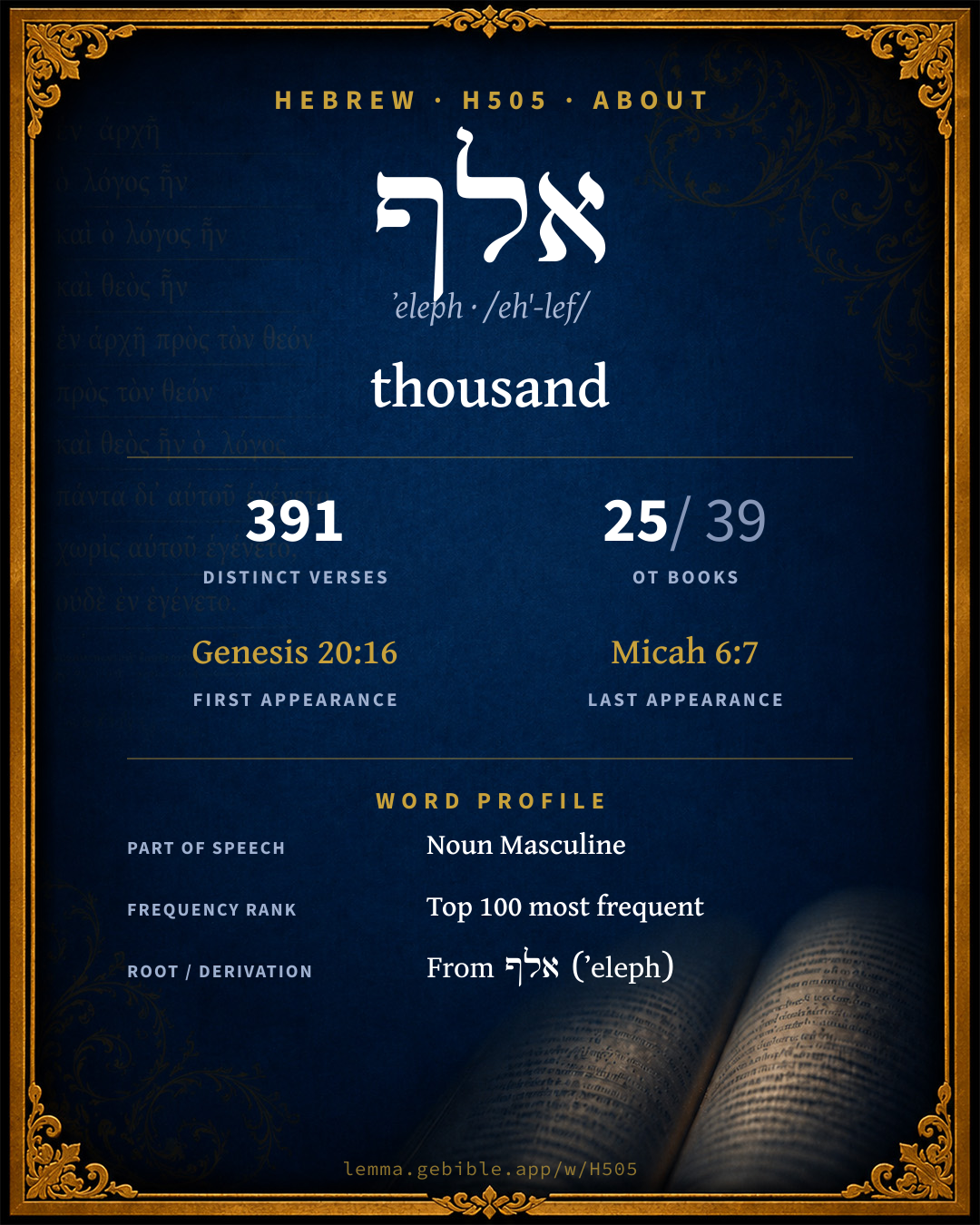
אֶ֫לֶף
thousand
‘thousand’ is one of 2 main senses fuller range ↓
Full lexicon entry — Brown-Driver-Briggs (BDB)
From Brown-Driver-Briggs (BDB)
Where this word appears
See every Absolute-state word in the Hebrew Bible →
Grammar key — what these labels mean
Part of speech
- Adjective
- A word that describes or qualifies a noun.
State
- Absolute
- The independent form of a noun, not bound to a following word.
- Construct
- A noun bound to a following noun in a possessive / “of” relationship (the construct chain).
Gender
- Both
- Attested as both masculine and feminine.
Number
- Singular
- One.
- Plural
- More than one (in Hebrew, generally three or more).
29 verses where H505 appears in the Absolute state in the Book of Judges. Filtered view — show all forms. Click any verse to open its interlinear word-by-word view. Verse text shown in the World English Bible for context — . Each verse’s Hebrew form is shown with its reference; the English is not keyword-highlighted, since the data carries no word-level English alignment. Use “Compare translations” on any verse to read it across multiple English versions. This concordance covers the Hebrew Bible; Septuagint (Greek Old Testament) occurrences are not indexed here.
Judges
- Judges 1:4 אֲלָפִ֖ים adj Cardinal number bp Judah went up; and Yahweh delivered the Canaanites and the Perizzites into their hand: and they struck of them in Bezek ten thousand men.
- Judges 3:29 אֲלָפִים֙ adj Cardinal number bp They struck of Moab at that time about ten thousand men, every lusty man, and every man of valor; and there escaped not a man.
- Judges 4:6 אֲלָפִים֙ adj Cardinal number bp She sent and called Barak the son of Abinoam out of Kedesh-naphtali, and said to him, Hasn't Yahweh, the God of Israel, commanded, [saying], Go and draw to Mount Tabor, and take with you ten thousand men of the children of Naphtali and of the children of Zebulun?
- Judges 4:14 אֲלָפִ֛ים adj Cardinal number bp Deborah said to Barak, Up; for this is the day in which Yahweh has delivered Sisera into your hand; hasn't Yahweh gone out before you? So Barak went down from Mount Tabor, and ten thousand men after him.
- Judges 5:8 אֶ֖לֶף adj Cardinal number bs They chose new gods; Then was war in the gates: Was there a shield or spear seen Among forty thousand in Israel?
- Judges 7:3 אֶ֔לֶף אֲלָפִ֖ים adj Cardinal number bs adj Cardinal number bp Now therefore proclaim in the ears of the people, saying, Whoever is fearful and trembling, let him return and depart from Mount Gilead. There returned of the people twenty-two thousand; and there remained ten thousand.
- Judges 8:10 אֶ֔לֶף אֶ֛לֶף adj Cardinal number bs adj Cardinal number bs Now Zebah and Zalmunna were in Karkor, and their hosts with them, about fifteen thousand men, all who were left of all the host of the children of the east; for there fell one hundred twenty thousand men who drew sword.
- Judges 8:26 אֶ֥לֶף adj Cardinal number bs The weight of the golden ear-rings that he requested was one thousand and seven hundred [shekels] of gold, besides the crescents, and the pendants, and the purple clothing that was on the kings of Midian, and besides the chains that were about their camels' necks.
- Judges 9:49 כְּ/אֶ֖לֶף prep + Adjective Cardinal number bs All the people likewise cut down every man his bough, and followed Abimelech, and put them to the stronghold, and set the stronghold on fire on them; so that all the men of the tower of Shechem died also, about a thousand men and women.
- Judges 12:6 אָֽלֶף adj Cardinal number bs then said they to him, Say now Shibboleth; and he said Sibboleth; for he couldn't manage to pronounce it right: then they laid hold on him, and killed him at the fords of the Jordan. There fell at that time of Ephraim forty-two thousand.
- Judges 15:11 אֲלָפִ֨ים adj Cardinal number bp Then three thousand men of Judah went down to the cleft of the rock of Etam, and said to Samson, "Don't you know that the Philistines are rulers over us? What then is this that you have done to us?" He said to them, As they did to me, so have I done to them.
- Judges 15:15 אֶ֥לֶף adj Cardinal number bs He found a fresh jawbone of a donkey, and put forth his hand, and took it, and struck a thousand men therewith.
- Judges 15:16 אֶ֥לֶף adj Cardinal number bs Samson said, With the jawbone of a donkey, heaps on heaps, With the jawbone of a donkey I have struck a thousand men.
- Judges 16:5 אֶ֥לֶף adj Cardinal number bs The lords of the Philistines came up to her, and said to her, Entice him, and see in which his great strength lies, and by what means we may prevail against him, that we may bind him to afflict him: and we will each give you of us eleven hundred [pieces] of silver.
- Judges 16:27 אֲלָפִים֙ adj Cardinal number bp Now the house was full of men and women; and all the lords of the Philistines were there; and there were on the roof about three thousand men and women, who saw while Samson made sport.
- Judges 17:2 אֶלֶף֩ adj Cardinal number bs He said to his mother, The eleven hundred [pieces] of silver that were taken from you, about which you did utter a curse, and did also speak it in my ears, behold, the silver is with me; I took it. His mother said, Blessed be my son of Yahweh.
- Judges 17:3 אֶֽלֶף adj Cardinal number bs He restored the eleven hundred [pieces] of silver to his mother; and his mother said, I most assuredly dedicate the silver to Yahweh from my hand for my son, to make an engraved image and a molten image: now therefore I will restore it to you.
- Judges 20:2 אֶ֛לֶף adj Cardinal number bs The chiefs of all the people, even of all the tribes of Israel, presented themselves in the assembly of the people of God, four hundred thousand footmen who drew sword.
- Judges 20:10 לָ/אֶ֨לֶף֙ וְ/אֶ֣לֶף prep det + Adjective Cardinal number bs conj + Adjective Cardinal number bs and we will take ten men of one hundred throughout all the tribes of Israel, and one hundred of one thousand, and a thousand out of ten thousand, to get food for the people, that they may do, when they come to Gibeah of Benjamin, according to all the folly that they have worked in Israel.
- Judges 20:15 אֶ֛לֶף adj Cardinal number bs The children of Benjamin were numbered on that day out of the cities twenty-six thousand men who drew the sword, besides the inhabitants of Gibeah, who were numbered seven hundred chosen men.
- Judges 20:17 אֶ֛לֶף adj Cardinal number bs The men of Israel, besides Benjamin, were numbered four hundred thousand men who drew sword: all these were men of war.
- Judges 20:21 אֶ֛לֶף adj Cardinal number bs The children of Benjamin came forth out of Gibeah, and destroyed down to the ground of the Israelites on that day Twenty-two thousand men.
- Judges 20:25 אֶ֛לֶף adj Cardinal number bs Benjamin went forth against them out of Gibeah the second day, and destroyed down to the ground of the children of Israel again eighteen thousand men; all these drew the sword.
- Judges 20:34 אֲלָפִ֨ים adj Cardinal number bp There came over against Gibeah ten thousand chosen men out of all Israel, and the battle was sore; but they didn't know that evil was close on them.
- Judges 20:35 אֶ֛לֶף adj Cardinal number bs Yahweh struck Benjamin before Israel; and the children of Israel destroyed of Benjamin that day twenty-five thousand one hundred men: all these drew the sword.
- Judges 20:44 אֶ֖לֶף adj Cardinal number bs There fell of Benjamin eighteen thousand men; all these [were] men of valor.
- Judges 20:45 אֲלָפִ֖ים אַלְפַּ֥יִם adj Cardinal number bp adj Cardinal number bp They turned and fled toward the wilderness to the rock of Rimmon: and they gleaned of them in the highways five thousand men, and followed hard after them to Gidom, and struck of them two thousand men.
- Judges 20:46 אֶ֥לֶף adj Cardinal number bs So that all who fell that day of Benjamin were twenty-five thousand men who drew the sword; all these [were] men of valor.
- Judges 21:10 אֶ֛לֶף adj Cardinal number bs The congregation sent there twelve thousand men of the most valiant, and commanded them, saying, Go and strike the inhabitants of Jabesh Gilead with the edge of the sword, with the women and the little ones.
About this entry
At a glance — auto-summarized from this page’s data, not written by a person. Every figure links to its source below. This summary describes the numbers; it doesn’t interpret them.
אלף — transliterated ʼeleph — is a Hebrew noun carrying the sense “thousand.” Older and newer Bibles part ways — “thousand” in the King James Version, “were” (unfoldingWord Literal Text) in modern versions. See the renderings breakdown. It appears 391 verses across 25 books of the Hebrew Bible, among its common vocabulary. Its earliest occurrence is Genesis 20:16. The lexicon spreads it across several senses; see its full sense range. See the sense tree, 391-verse concordance, and the renderings breakdown below.
Gloss history
Strong's 1890 vs modern scholarship
About this word
Strong's H505 catalogs a Hebrew word from the Hebrew Old Testament.
These counts are not copied from any lexicon or concordance. They are computed here, from the morphology-tagged Hebrew Old Testament. What Lemma adds →
- 391
- distinct verses
- The word appears in 391 distinct verses.
- 25 / 39
- OT books
- The word appears in 25 of 39 Old Testament books.
- #97
- by frequency
- Top 100 most frequent Hebrew words (rank 97 of 8,640 Hebrew words by occurrence).
View all 391 occurrences in the concordance →
Most concentrated in
- Numbers 82 verses 21%
- 1 Chronicles 60 verses 15%
- 2 Chronicles 38 verses 10%
By section of the Old Testament
By traditional corpus
Conventional, traditional groupings — biblical authorship is debated, so this is a traditional corpus grouping, not an authorship claim. Each share is this word’s portion of its verses in that division of the Hebrew canon. Each figure is a share of the word’s 391 distinct verses.
- Writings (Ketuvim) 156 verses · 40%
- Prophets (Nevi'im) 135 verses · 35%
- Torah (Pentateuch) 100 verses · 26%
How translations render this word
Counts come from each version’s own published word-to-Strong’s tagging or interlinear alignment — an approximate guide to how each version renders this word, not a word-level alignment the data otherwise carries. Because each total is that version’s own tagged count, the per-version totals vary from one another and need not match the appearance or distinct-verse counts above. These counts may also differ from a printed concordance because Lemma counts each distinctly tagged rendering and does not collapse phrase taggings into a single head-word total. This is a fixed set of word-tagged versions (KJV, ASV, BSB, ULT) and does not change with the reading translation you choose elsewhere. Each version’s license is shown beside its name below (and on Sources).
BDB lists this Strong’s number as 3 distinct words (homographs). Each count above pools all of them and is not split by sense — see the Senses section below. A low-frequency rendering may belong to a different one of those words, not the primary meaning.
- King James Version†: Thousand 406×, Thousands 32×, Two thousand 19×
- American Standard Version†: Thousand 389×, Thousands 35×, Two thousand 19×
- Berean Standard Bible†: Thousand 114×, Thousands 31×, Two thousand 9×
- unfoldingWord Literal Text†: Were 61×, Thousand 58×, And 35×
King James Version Public Domain
Renders H505 across 502† tagged occurrences — most commonly:
Plus 19 renderings that appear only once — usually multi-word phrases or single function words the recovered tagging swept in, not distinct renderings. Not rendered by a distinct English word in 3 further occurrences.
American Standard Version Public Domain
Renders H505 across 501† tagged occurrences — most commonly:
Plus 36 renderings that appear only once — usually multi-word phrases or single function words the recovered tagging swept in, not distinct renderings.
Berean Standard Bible Public Domain
Renders H505 across 200† tagged occurrences — most commonly:
Plus 22 renderings that appear only once — usually multi-word phrases or single function words the recovered tagging swept in, not distinct renderings. Not rendered by a distinct English word in 306 further occurrences.
unfoldingWord Literal Text CC BY-SA 4.0
Renders H505 across 294† tagged occurrences — most commonly:
Plus 22 renderings that appear only once — usually multi-word phrases or single function words the recovered tagging swept in, not distinct renderings. Not rendered by a distinct English word in 239 further occurrences.
Senses in the full BDB
What do BDB’s symbols mean?
BDB uses these scholarly abbreviations:
| Symbol | Meaning |
|---|---|
| 𝔊 | the Septuagint (the ancient Greek translation, LXX) |
| 𝔙 | the Vulgate (the Latin translation) |
| 𝔖 | the Syriac version (the Peshitta) |
| 𝔗 | the Targum (the Aramaic translation) |
| ψ | the Psalms |
| √ | root (the underlying root or stem) |
| ‖ | parallel passage (a synonymous or contrasted parallel) |
| † | the dagger: every passage where the word occurs is cited |
The 6 senses and sub-senses the full Brown-Driver-Briggs lexicon distinguishes for this word, in lexicon order (not ranked by frequency), with BDB’s own verbatim wording and sub-sense lettering. Shown in Hebrew script with BDB’s own scholarly abbreviations. The condensed entry is in the Lexicon Entry tab. See also the Forms in the corpus table below.
אלף I
- 1. numeral:
- a. used with noun alone; mostly before noun Nu 35:4 Jos 7:3 Ne 3:13 1 Ch 18:4 +; after noun (late) 1 Ch 12:35 + 6 times Ch Ezr Ne; א׳ בָּאַמָּה Nu 35:5(×4) Ez 47:3 (del. Co); the noun always pl. when preceding, sometimes when following, 1 S 25:2 1 K 3:4 2 K 18:23 = Is 36:8 2 Ch 30:24 ψ 90:4 Jb 42:12 Ec 6:6; elsewhere sg. אישׁ Ju 9:49; 15:15, 16 Jos 7:3 +; אַמָּה Nu 35:4 + (so SI); דּוֹר Dt 7:9 +, cf. 1 Ch 18:4; 19:6 2 K 15:19 Jb 42:12 Ct 4:4 Is 7:23, noun sometimes coll.; א׳ pl. cstr. Mi 6:7 ψ 119:72 Gn 24:60; noun not expr. (or not fully) Gn 20:16 Nu 31:5, 6 +; distrib. אֶלֶף … אֶלָף Nu 31:4; multipl. Dt 1:11 א׳ פְּעָמִים; indef. for great no. (pl.) Ex 20:6; 34:7 Dt 5:10 Je 32:18, (sg.) Dt 32:30 Ec 6:6 +. e.g. Numbers 35:4
- b. א׳ + other num. usually precedes it Ex 38:25 + often; but foll. רִבּוֹא Ezr 2:64 + 2 times; it follows also smaller no. Nu 3:50 1 K 5:12 (so SI); the noun foll. in sg. Ex 38:25 + 8 times; pl. 2 S 8:4 + 2 times; noun precedes, in pl. (late) Dn 12:12 + 2 times; noun not expr. Ex 38:28 + often e.g. Exodus 38:25
- c. א׳ × other no. always foll. Ex 12:37 +; usual order is no. × א׳ + additional no. (if any) + noun (ifexpr.) Nu. 31:52 Ju 20:35 cf. Ex 12:37 2 K 3:4(×2) +; less often noun + no. × א׳ Nu 31:33 1 K 8:63 +; (other combin. v. Ex 38:26 Nu 26:51; 31:32 Ez 48:30 1 Ch 29:7 etc.); א׳ usually sg. Nu 11:21 +; except after units, where pl. abs. Nu 1:46 Ju 20:34 + (so MI); seld. pl. cstr. Ex 32:28 Ju 4:10 Jb 1:3(×2); (noun mostly sg. when foll. Ju 4:10 1 K 12:21 +, yet pl. Jos 4:13 1 S 13:5 +; when preceding it is pl. 1 Ch 5:21 +, or coll. Nu 31:33 1 S 25:2 1 K 8:63 2 Ch 7:5 +); אֶלָף אֲלָפִים 1 Ch 21:5; 22:14 2 Ch 14:8; אַלְפֵי שִׁנְאָן ψ 68:18, cf. שִׁנְאָן; בְּהַרְרֵי אָ֑לֶף ψ 50:10, read אֵל cf. ψ 36:7, Ol Bi Che; yet v. Hup De.— e.g. Exodus 12:37
- 10,000 = עֲשֶׂרֶת אֲלָפִים etc. Ju 1:4; 3:29 1 K 5:28 1 Ch 29:7 +; less often רִבּוֹ, רְבָבָה etc. q.v. e.g. Judges 1:4
- 2. a thousand, a company of 1000 men, as united under one superior, or leader, hence שַׂר א׳ (שָׂרֵי) Ex 18:21, 25 cf. Nu 31:14 +; cf. רָאשֵׁי א׳ יִשְׂרָאֵל Nu 1:16; 10:4 Jos 22:21, 30 & v. infr.; cf. also 1 S 29:2; especially family, etc. Ju 6:15 1 S 10:19 (‖ שֵׁבֶט & cf. מִשְׁפַּחַת v 21); cf. Mi 5:1;—Nu 10:36 (רִבְבוֹת אַלְפֵי יִשְׂרָאֵל) 31:5 Jos 22:14 1 S 23:23 apparently shew transit. to this technical use. e.g. Exodus 18:21
אלף II loc. city in Benj., הָא׳ Jos 18
Senses from the full Brown-Driver-Briggs lexicon (Brown, Driver, Briggs; Oxford 1906 — public domain), digitized via Sefaria, supplemented by the OpenScriptures HebrewLexicon (CC BY 4.0). Full attribution on Sources.
Word origin
I. n.m. ψ 8:8; only pl. cattle (Ph. אלף, Assyrian alpu, COTGloss.)—אֲלָפִים Pr 14:4 Is 30:24 used in tillage; subject to man ψ 8:8 (‖ צֹנֶה); their increase שְׁגַר אֲלָפֶיךָ a blessing Dt 7:13; 28:4, 18, 51 (‖ all עַשְׁתְּרֹת צֹאנֶ֑ךָ).
II. n.m. Ju 6:15 thousand (אלף MI, SI, Sab. DHMZMG 1875, 615; Arabic أَلْفٌ, Aramaic ܐܳܠܶܦ, אֲלַף, אלפיא; cf. Ethiopic እልፍ mille, myrias)*.—(אָ֑׳)א׳ Gn 20:16 +; sf. אַלְפִּי †Ju 6:15; du. אַלְפַּיִם Nu 4:36 +; pl. אֲלָפִים Ex 18:21 +; cstr. אַלְפֵי Ex 32:28 +; אֲלָפֶיךָ Dt 7:13 + 2 times; אֲלָפָיו Qr 1 S 18:7 + 2 times (Kt ־פו)—a thousand.
III. n.pr.loc. city in Benj., הָא׳ Jos 18:28; perhaps Lifta NW. from Jerus. Surveyiii. 18.
— Brown-Driver-Briggs (Oxford 1906, public domain), digitized via Sefaria, supplemented by the OpenScriptures HebrewLexicon (CC BY 4.0). See Sources.
Derived from אלף (ʼeleph) (H504) — cattle.
Jastrow Dictionary
A second Hebrew/Aramaic lexicon for comparison, covering Aramaic and post-biblical (Talmudic, Targumic, Midrashic) usage that the biblical-Hebrew BDB does not. Matched by lemma rather than by Strong’s number, so a lemma may carry more than one Jastrow headword (shown separately below), and the entries cover usage well beyond the Bible.
אֶלֶף
- (b. h.) thousand. Du. אַלְפַּיִם.—Pl. אֲלָפִים.—א׳ אלפים a million. Gen. R. s. 8 שני א׳; a. fr.—Ex. R. s. 5 אַלְפַּיִם two thousand (men); a. e.
אֲלַף I
- Targ. O. Ex. XXXVIII, 25 אַלַּף ed. Berl. (Y. אלפא); a. fr.—Snh. 95ᵇ חד א׳ one thousand. Bekh. 8ᵇ מאה א׳ זוזי one hundred thousand zuz; a. fr.—Pl. אַלְפִין, אַלְפַיָּא. Targ. Ex. XXXVIII, 26; a. fr. Targ. I Sam. XVIII, 8; a. fr.—Y. Dem. VII, 26ᵇ bot.; a. fr.
אֲלַף II
- , √לף to join, be joined) to become used; to learn, study, train one’s self.—אֲלִיף accustomed, used to. Targ. I Sam. XVII, 39. Targ. O. Num. XXII, 30.—Targ. Deut. V, 1; a. fr. (v. also יְלֵיף).—Cant. R. to II, 2 צבי רבי דייליף would you like to study? B. Bath. 111ᵇ top גוד לית דין צבי למילף take me away from here, this man has no desire to learn (but only to argue). Taan. 4ᵃ man is bound למֵילַף נפשיה בניחותא [prob. למַלֵּיף, v. infra] to train himself to be gentle; a. fr.
- to train, teach. Targ. Ps. XVIII, 35 מַלֵּיף (= מְאַלֵּף). Targ. Prov. XI, 25; a. fr.—Koh. R. to IX, 10 thou didst emigrate למילף for the sake of studying, והוא גלי לאַלָּפָא but he emigrated for the sake of teaching. Y. Dem. I, 22ᵃ top ולא כן אַלְּפָן רבי (not איל׳) did you not teach us thus?—א׳ זכו, v. infra.
- as Pa. Lev. R. s. 30 (מַלֵּיף) מוֹלִיף עלי זכו offers arguments in my favor.
- to exercise, practice, exert one’s self. Targ. Is. II, 4; XXVI, 9.
A Dictionary of the Targumim, the Talmud Babli and Yerushalmi, and the Midrashic Literature (Marcus Jastrow; London, Luzac, 1903) — Public Domain. Digitized via Sefaria. Digitized via Sefaria. Full attribution on Sources.
Forms in the corpus
The 100 distinct written forms H505 takes in the Hebrew Bible, most frequent first — each parse links to that state’s occurrences in the concordance. Hebrew forms include their vowel points and cantillation, so a single lemma takes many written forms.
The 60 most common forms are shown; 40 rarer forms follow in the full concordance.
Same root — word family
Other BDB entries built from the same root as H505, grouped by Strong’s listed origin. These share a root / origin per the lexicon — not necessarily a shared meaning. Each links to that word’s own entry.
Derives from
Derived from this word
Proper names from this root
People and places named from this root — a name, not an additional meaning of the word.
Compare all same-root words → Showing 4 of 5 — not the complete family. 1 of the same-root words is a proper name (a person or place). They share a root, not necessarily a meaning.
Septuagint verse parallels
This word appears in 363 verses that also exist in the Greek Old Testament (Septuagint), out of the 391 Hebrew verses it occurs in. You can read those verses in Greek by switching the Old Testament edition to the Septuagint.
Read these verses in the Septuagint
- Genesis 20:16
- Exodus 12:37
- Numbers 1:16
- Deuteronomy 1:11
- Joshua 3:4
- Judges 1:4
- 1 Samuel 4:2
- 2 Samuel 6:1
- 1 Kings 3:4
- 2 Kings 3:4
- 1 Chronicles 5:18
- 2 Chronicles 1:2
This is a verse-level parallel only — the same verses exist in both the Hebrew and Greek Old Testaments. No word-level Hebrew↔Greek correspondence is claimed: the data carries no such alignment, so no Greek word is shown as this Hebrew word’s translation. Coverage is not total — the Septuagint omits the deuterocanon and renumbers the Psalms, so some Hebrew verses have no direct Greek parallel.