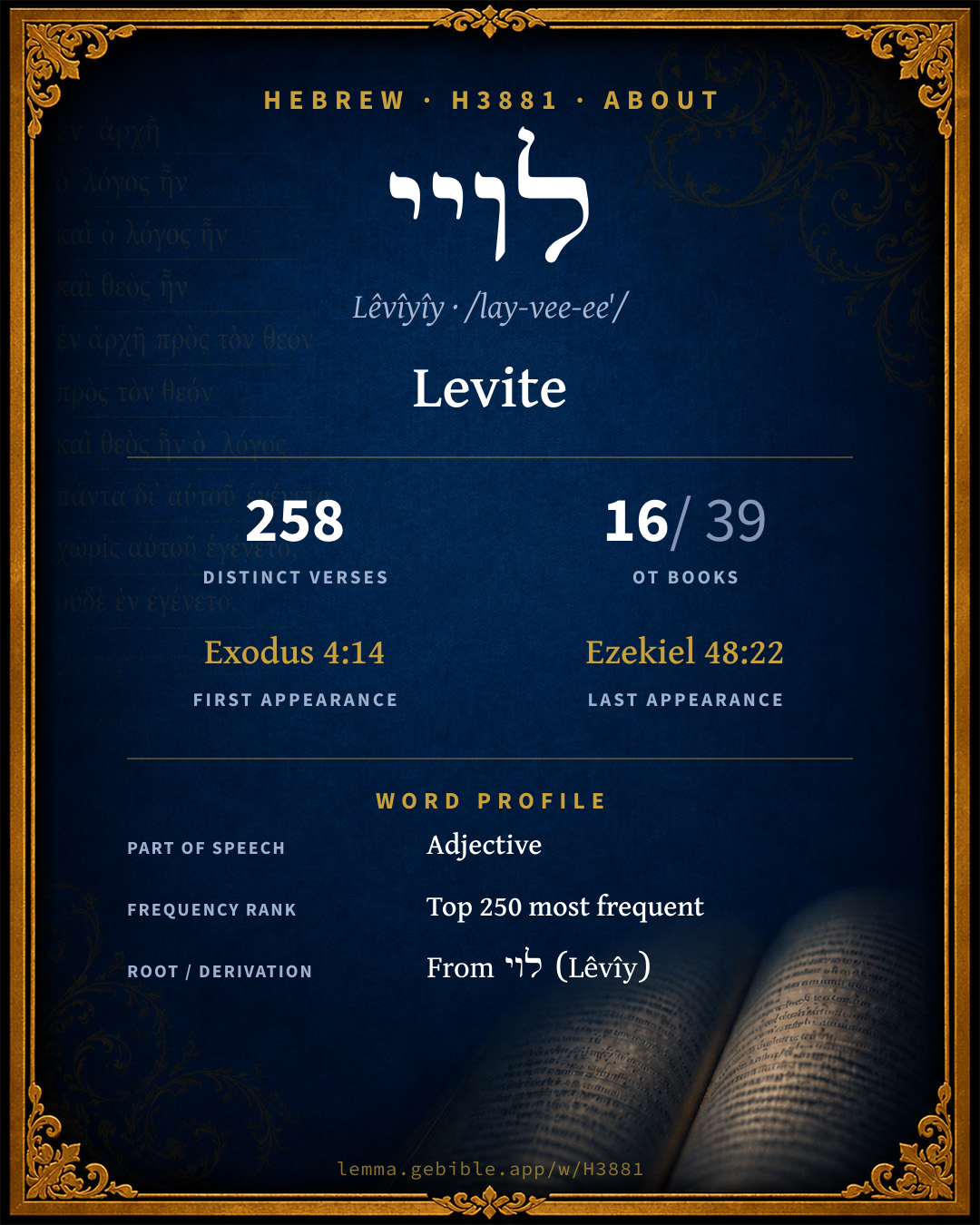
לֵוִי
Levite
BDB lists 2 entries for ‘Levite’ fuller range ↓
Full lexicon entry — Brown-Driver-Briggs (BDB)
From Brown-Driver-Briggs (BDB)
Where this word appears
Grammar key — what these labels mean
Part of speech
- Noun
- A naming word — a person, place, thing, or idea.
Noun type
- Gentilic
- A noun naming a member of a people, tribe, or region of origin (e.g. an Israelite, a Moabite).
- Proper
- A name of a specific person, place, or people (e.g. Abraham, Zion, Israel).
State
- Absolute
- The independent form of a noun, not bound to a following word.
- Construct
- A noun bound to a following noun in a possessive / “of” relationship (the construct chain).
Gender
- Masculine
- Grammatically masculine.
Number
- Plural
- More than one (in Hebrew, generally three or more).
- Singular
- One.
Every verse where H3881 appears in the Book of 1 Chronicles — 34 distinct verses. Click any verse to open its interlinear word-by-word view. Verse text shown in the World English Bible for context — . Each verse’s Hebrew form is shown with its reference; the English is not keyword-highlighted, since the data carries no word-level English alignment. Use “Compare translations” on any verse to read it across multiple English versions. This concordance covers the Hebrew Bible; Septuagint (Greek Old Testament) occurrences are not indexed here.
1 Chronicles
- 1 Chronicles 6:19 הַ/לֵּוִ֖י ptcl def.art + n Gentilic ms The sons of Merari: Mahli and Mushi. These are the families of the Levites according to their fathers' [houses].
- 1 Chronicles 6:48 הַ/לְוִיִּ֑ם ptcl def.art + n Gentilic mp Their brothers the Levites were appointed for all the service of the tent of the house of God.
- 1 Chronicles 6:64 לַ/לְוִיִּ֑ם prep det + n Gentilic mp The children of Israel gave to the Levites the cities with their suburbs.
- 1 Chronicles 9:2 הַ/לְוִיִּ֖ם ptcl def.art + n Gentilic mp Now the first inhabitants who lived in their possessions in their cities were Israel, the priests, the Levites, and the Nethinim.
- 1 Chronicles 9:14 הַ/לְוִיִּ֑ם ptcl def.art + n Gentilic mp Of the Levites: Shemaiah the son of Hasshub, the son of Azrikam, the son of Hashabiah, of the sons of Merari;
- 1 Chronicles 9:26 הַ/לְוִיִּ֑ם ptcl def.art + n Gentilic mp for the four chief porters, who were Levites, were in an office of trust, and were over the chambers and over the treasuries in the house of God.
- 1 Chronicles 9:31 הַ/לְוִיִּ֔ם ptcl def.art + n Gentilic mp Mattithiah, one of the Levites, who was the firstborn of Shallum the Korahite, had the office of trust over the things that were baked in pans.
- 1 Chronicles 9:33 לַ/לְוִיִּ֛ם prep det + n Gentilic mp These are the singers, heads of fathers' [houses] of the Levites, [who lived] in the chambers [and were] free [from other service]; for they were employed in their work day and night.
- 1 Chronicles 9:34 לַ/לְוִיִּ֛ם prep det + n Gentilic mp These were heads of fathers' [houses] of the Levites, throughout their generations, chief men: these lived at Jerusalem.
- 1 Chronicles 13:2 וְ/הַ/לְוִיִּ֖ם conj + ptcl def.art + n Gentilic mp David said to all the assembly of Israel, If it seem good to you, and if it be of Yahweh our God, let us send abroad everywhere to our brothers who are left in all the land of Israel, with whom the priests and Levites are in their cities that have suburbs, that they may gather themselves to us;
- 1 Chronicles 15:2 הַ/לְוִיִּ֑ם ptcl def.art + n Gentilic mp Then David said, None ought to carry the ark of God but the Levites: for them has Yahweh chosen to carry the ark of God, and to minister to him forever.
- 1 Chronicles 15:4 הַ/לְוִיִּֽם ptcl def.art + n Gentilic mp David gathered together the sons of Aaron, and the Levites:
- 1 Chronicles 15:11 וְ/לַ/לְוִיִּ֗ם conj + prep det + n Gentilic mp David called for Zadok and Abiathar the priests, and for the Levites, for Uriel, Asaiah, and Joel, Shemaiah, and Eliel, and Amminadab,
- 1 Chronicles 15:12 לַ/לְוִיִּ֑ם prep det + n Gentilic mp and said to them, You are the heads of the fathers' [houses] of the Levites: sanctify yourselves, both you and your brothers, that you may bring up the ark of Yahweh, the God of Israel, to [the place] that I have prepared for it.
- 1 Chronicles 15:14 וְ/הַ/לְוִיִּ֑ם conj + ptcl def.art + n Gentilic mp So the priests and the Levites sanctified themselves to bring up the ark of Yahweh, the God of Israel.
- 1 Chronicles 15:15 הַ/לְוִיִּ֗ם ptcl def.art + n Gentilic mp The children of the Levites bore the ark of God on their shoulders with the poles thereon, as Moses commanded according to the word of Yahweh.
- 1 Chronicles 15:16 הַ/לְוִיִּם֒ ptcl def.art + n Gentilic mp David spoke to the chief of the Levites to appoint their brothers the singers, with instruments of music, psalteries and harps and cymbals, sounding aloud and lifting up the voice with joy.
- 1 Chronicles 15:17 הַ/לְוִיִּ֗ם ptcl def.art + n Gentilic mp So the Levites appointed Heman the son of Joel; and of his brothers, Asaph the son of Berechiah; and of the sons of Merari their brothers, Ethan the son of Kushaiah;
- 1 Chronicles 15:22 הַ/לְוִיִּ֖ם ptcl def.art + n Gentilic mp Chenaniah, chief of the Levites, was over the song: he instructed about the song, because he was skillful.
- 1 Chronicles 15:26 הַ/לְוִיִּ֔ם ptcl def.art + n Gentilic mp It happened, when God helped the Levites who bore the ark of the covenant of Yahweh, that they sacrificed seven bulls and seven rams.
- 1 Chronicles 15:27 הַ/לְוִיִּם֙ ptcl def.art + n Gentilic mp David was clothed with a robe of fine linen, and all the Levites who bore the ark, and the singers, and Chenaniah the master of the song [with] the singers: and David had on him an ephod of linen.
- 1 Chronicles 16:4 הַ/לְוִיִּ֖ם ptcl def.art + n Gentilic mp He appointed certain of the Levites to minister before the ark of Yahweh, and to celebrate and to thank and praise Yahweh, the God of Israel:
- 1 Chronicles 23:2 וְ/הַ/לְוִיִּֽם conj + ptcl def.art + n Gentilic mp He gathered together all the princes of Israel, with the priests and the Levites.
- 1 Chronicles 23:3 הַ/לְוִיִּ֔ם ptcl def.art + n Gentilic mp The Levites were numbered from thirty years old and upward: and their number by their polls, man by man, was thirty-eight thousand.
- 1 Chronicles 23:26 לַ/לְוִיִּ֑ם prep det + n Gentilic mp and also the Levites shall no more have need to carry the tent and all the vessels of it for the service of it.
- 1 Chronicles 23:27 לֵוִ֑י n Proper For by the last words of David the sons of Levi were numbered, from twenty years old and upward.
- 1 Chronicles 24:6 הַ/לֵּוִ֗י וְ/לַ/לְוִיִּ֑ם ptcl def.art + n Gentilic ms conj + prep det + n Gentilic mp Shemaiah the son of Nethanel the scribe, who was of the Levites, wrote them in the presence of the king, and the princes, and Zadok the priest, and Ahimelech the son of Abiathar, and the heads of the fathers' [houses] of the priests and of the Levites; one fathers' house being taken for Eleazar, and one taken for Ithamar.
- 1 Chronicles 24:30 הַ/לְוִיִּ֖ם ptcl def.art + n Gentilic mp The sons of Mushi: Mahli, and Eder, and Jerimoth. These were the sons of the Levites after their fathers' houses.
- 1 Chronicles 24:31 וְ/לַ/לְוִיִּ֑ם conj + prep det + n Gentilic mp These likewise cast lots even as their brothers the sons of Aaron in the presence of David the king, and Zadok, and Ahimelech, and the heads of the fathers' [houses] of the priests and of the Levites; the fathers' [houses] of the chief even as those of his younger brother.
- 1 Chronicles 26:17 הַ/לְוִיִּ֣ם ptcl def.art + n Gentilic mp Eastward were six Levites, northward four a day, southward four a day, and for the store-house two and two.
- 1 Chronicles 26:20 וְֽ/הַ/לְוִיִּ֑ם conj + ptcl def.art + n Gentilic mp Of the Levites, Ahijah was over the treasures of the house of God, and over the treasures of the dedicated things.
- 1 Chronicles 27:17 לְ/לֵוִ֛י prep + n Proper of Levi, Hashabiah the son of Kemuel: of Aaron, Zadok:
- 1 Chronicles 28:13 וְ/הַ/לְוִיִּ֔ם conj + ptcl def.art + n Gentilic mp also for the divisions of the priests and the Levites, and for all the work of the service of the house of Yahweh, and for all the vessels of service in the house of Yahweh;
- 1 Chronicles 28:21 וְ/הַ/לְוִיִּ֔ם conj + ptcl def.art + n Gentilic mp Behold, there are the divisions of the priests and the Levites, for all the service of the house of God: and there shall be with you in all manner of work every willing man who has skill, for any manner of service: also the captains and all the people will be entirely at your command.
About this entry
At a glance — auto-summarized from this page’s data, not written by a person. Every figure links to its source below. This summary describes the numbers; it doesn’t interpret them.
לויי — transliterated Lêvîyîy — is a Hebrew name carrying the sense “Levite.” Its earliest occurrence is Exodus 4:14. Spanning 258 verses in 16 books, it ranks among the common words of the Hebrew Bible. Each statement above links to its evidence; the full detail follows below.
Gloss history
Strong's 1890 vs modern scholarship
About this word
Strong's H3881 catalogs a Hebrew word from the Hebrew Old Testament.
These counts are not copied from any lexicon or concordance. They are computed here, from the morphology-tagged Hebrew Old Testament. What Lemma adds →
- 258
- distinct verses
- The word appears in 258 distinct verses.
- 16 / 39
- OT books
- The word appears in 16 of 39 Old Testament books.
- #174
- by frequency
- Top 250 most frequent Hebrew words (rank 174 of 8,640 Hebrew words by occurrence).
View all 258 occurrences in the concordance →
Most concentrated in
- 2 Chronicles 59 verses 23%
- Numbers 48 verses 19%
- Nehemiah 37 verses 14%
By section of the Old Testament
By traditional corpus
Conventional, traditional groupings — biblical authorship is debated, so this is a traditional corpus grouping, not an authorship claim. Each share is this word’s portion of its verses in that division of the Hebrew canon. Each figure is a share of the word’s 258 distinct verses.
- Writings (Ketuvim) 147 verses · 57%
- Torah (Pentateuch) 72 verses · 28%
- Prophets (Nevi'im) 39 verses · 15%
How translations render this word
Counts come from each version’s own published word-to-Strong’s tagging or interlinear alignment — an approximate guide to how each version renders this word, not a word-level alignment the data otherwise carries. Because each total is that version’s own tagged count, the per-version totals vary from one another and need not match the appearance or distinct-verse counts above. These counts may also differ from a printed concordance because Lemma counts each distinctly tagged rendering and does not collapse phrase taggings into a single head-word total. This is a fixed set of word-tagged versions (KJV, ASV, BSB, ULT) and does not change with the reading translation you choose elsewhere. Each version’s license is shown beside its name below (and on Sources).
BDB lists this Strong’s number as 2 distinct words (homographs). Each count above pools all of them and is not split by sense — see the Senses section below. A low-frequency rendering may belong to a different one of those words, not the primary meaning.
- King James Version†: Levites 231×, Levite 22×, All the levites 4×
- American Standard Version†: Levites 214×, Levite 23×, ' houses of the levites 5×
- Berean Standard Bible†: Levites 208×, Levite 33×, Levitical 14×
- unfoldingWord Literal Text†: Levites 242×, Levite 28×, Levites were 3×
King James Version Public Domain
Renders H3881 across 286† tagged occurrences — most commonly:
Plus 22 renderings that appear only once — usually multi-word phrases or single function words the recovered tagging swept in, not distinct renderings.
American Standard Version Public Domain
Renders H3881 across 285† tagged occurrences — most commonly:
Plus 32 renderings that appear only once — usually multi-word phrases or single function words the recovered tagging swept in, not distinct renderings.
Berean Standard Bible Public Domain
Renders H3881 across 281† tagged occurrences — most commonly:
Plus 17 renderings that appear only once — usually multi-word phrases or single function words the recovered tagging swept in, not distinct renderings. Not rendered by a distinct English word in 10 further occurrences.
unfoldingWord Literal Text CC BY-SA 4.0
Renders H3881 across 286† tagged occurrences — most commonly:
Plus 7 renderings that appear only once — usually multi-word phrases or single function words the recovered tagging swept in, not distinct renderings.
15 senses and sub-senses in the full BDB
What do BDB’s symbols mean?
BDB uses these scholarly abbreviations:
| Symbol | Meaning |
|---|---|
| 𝔊 | the Septuagint (the ancient Greek translation, LXX) |
| 𝔙 | the Vulgate (the Latin translation) |
| 𝔖 | the Syriac version (the Peshitta) |
| 𝔗 | the Targum (the Aramaic translation) |
| ψ | the Psalms |
| √ | root (the underlying root or stem) |
| ‖ | parallel passage (a synonymous or contrasted parallel) |
| † | the dagger: every passage where the word occurs is cited |
The 15 senses and sub-senses the full Brown-Driver-Briggs lexicon distinguishes for this word, in lexicon order (not ranked by frequency), with BDB’s own verbatim wording and sub-sense lettering. Shown in Hebrew script with BDB’s own scholarly abbreviations. The condensed entry is in the Lexicon Entry tab. See also the Forms in the corpus table below.
לויי I m. Levi (√ and meaning dubious
- 1.
- a. Levi, son of Jacob and Leah, as individual, Gn 29:34; 34:25, 30; 35:23; 49:5 (all J); 35:23; 46:11; Ex 1:2; 6:16(×2) Nu 3:17; 16:1 (all P); 1 Ch 2:1; 5:22; 6:1, 4, 23, 28, 32; 23:6 Ezr 8:18; so בַּת־ל׳ [אֶת־] Ex 2:1 (E), Nu 26:59 (P). e.g. Genesis 29:34
- b. as head of a family of descendants, in phr. בֵּית לֵוִי Ex 2:1 (E), and (with ref. to tribe; late) Nu 17:23, מִשְׁפַּחַת בֵּית ל׳ Zc 12:13. e.g. Exodus 2:1
- c. often בְּנֵי(־)ל׳ Ex 32:26, 28 (E), Jos 21:10 (P), בְּנֵי(־)ל׳ with tribal ref. Nu 3:15; 4:2; 18:21 (charged with service of tabern., and hence to receive tithes; all P); as priests הַכֹּהֲנִים בְּנֵי לֵוִי Dt 21:5; 31:9, cf. Mal 3:3, and לֹא הָיוּ מִבְּנֵי ל׳ 1 K 12:31; from the בְּנֵי ל׳ the Zadokites are selected as priests Ez 40:46; according to 1 Ch 9:18 23:24, 27 בְּנֵי ל׳ are subordinate officials in temple (cf. v 28 f.), cf. 24:20; sharply disting. from priests Ezr 8:15, Ne 12:23 (cf. v 22); so also in later stratum of story of Korah’s revolt Nu 16:7, 8, 10 (P2). e.g. Exodus 32:26
- 2. as name of tribe, שֵׁבֶט ל׳ Dt 18:1 (priestly tribe), מַטֵּה ל׳ Nu 1:49 (in charge of tabern.), 3:6; 18:2 (ministers unto Aaron); לֵוִי alone = (tribe of) Levi Dt 27:12; 33:8 (earlier poem), Nu 26:58 (P), Ez 48:31; Mal 2:4 (priestly tribe, cf. v 1), 1 Ch 21:6; 27:17; מַטֵּה ל׳ = rod of (the tribe of) Levi Nu 17:18 (P); also (no inheritance, because charged with service of tabernacle) Dt 10:9. e.g. Deuteronomy 18:1
לויי II Levite
- 1. sg. of individual, אִישׁ ל׳ Ju 19:1 a certain Levite; pred. וְהוּא ל׳ Ju 17:1 and he was a Levite, so v 9; c. art. הַלּ׳ as subst. the Levite Ex 4:14 (J), Ju 17:10, 11, 12, 13 (as priest), Dt 18:6; 2 Ch 20:14; 31:12, 14, Ezr 10:15; הַנַּעַר הַלּ׳ Ju 18:3, 15; הָאִישׁ הַלּ׳ 20:4. e.g. Judges 19:1
- 2. c. art. הַלֵּוִי as subst. coll. the Levites: Ex 6:19; Nu 3:20, 32; 26:57 (all P); 18:23 (P; charged with service of tabern.); especially D, Dt 12:12, 18, 19; 14:27, 29; 16:1, 14; 26:10, 12, 13; also 1 Ch 24:6; Mal 2:8 (as priestly tribe), שֵׁבֶט הַלּ׳ Dt 10:8 tribe of the Levites (set apart for service), cf. Jos 13:14, 33; 1 Ch 23:14; בְּנֵי־הַלֵּוִי 1 Ch 12:27 (van d. H. v 26) sons of the Levites (i.e. of the tribe); so Ne 10:40 (as tithe-collectors); בֵּית הַלֵּוִי ψ 135:20 house (family, tribe) of the Levites e.g. Exodus 6:19
- 3. pl. לְוִיִּם chiefly Chr and P;—always c. art. הַֽלְוִיִּם except sf. לְוִיֵּנוּ Ne 10:1; the art. is om. by 𝔊𝔙 and most in Is 66:21; always = subst. Levites;— e.g. Nehemiah 10:1
- A.
- a. earlier usage:—as bearing the ark 1 S 6:15; 2 S 15:24; Dt 31:25, so (with priests) 1 K 8:4 = 2 Ch 5:5 (ℌ הכהנים הַל׳; read prob. וְהַל׳ as in K, 𝔊𝔖𝔙 cf. Öt VB); also 1 Ch 15:2, 26, 27; 23:26; 2 Ch 5:4 (for הכהנים ‖ 1 K 8:3). e.g. 1 Samuel 6:15
- b. not disting. from priests by D: הַכֹּהֲנִים הַל׳ Dt 17:9, 18; 18:1; 24:8; 27:9, Jos 3:3; 8:33 (both D; as bearing ark), also Je 33:18, 21 (הַל׳ הַכּ׳), Ez 43:19; 44:15; cf. Dt 18:7; 27:14 Je 33:22; הַכּ׳ הַל׳ likewise 2 Ch 23:18; 30:27 (but read prob. וְהַל׳ after 𝔊𝔖𝔙, cf. Öt and infr.) e.g. Deuteronomy 17:9
- c. as tribal designation, Ex 6:25; Nu 3:39; 4:18, 46; Jos 21:1 (all P), 1 Ch 9:33, 34; 15:12; 2 Ch 35:5; Ne 11:15, 16; 12:24; with ref. to share in land Lv 25:32(×2), 33(×2) (H), Nu 1:47; 2:33; Jos 14:3, 4; 21:3, 4, 8, 20, 27, 34, 38, 39 (all P), 18:7 (D), 1 Ch 6:49; cf. also 2 Ch 11:14†. e.g. Exodus 6:25
- d. set apart for service in tabern., Ex 38:21; Nu 1:50, 51(×2), 53(×2); 2:17; 7:5, 6; 8:6 + 18 times Nu 8 (all P), cf. 1 Ch 6:33; 16:4; ministers to Aaron and his sons Nu 3:9; 8:19; 18:6 (P); set apart for י׳ (as redemption for first-born) Nu 3:12(×2) + 7 times Nu 3 (P); with certain perquisites Nu 18:24, 26, 30 + 9 times Nu (P). e.g. Exodus 38:21
- B. in Chr. the tribal idea is in the background, and thought of Levites as official class is prominent:
- a. disting. from priests הַכּ׳ וְהַל׳ 1 Ch 9:14 (cf. v 10), 13:2; 15:4, 11, 14; 23:2; 24:6, 31 + 67 times Chr.; also Is 66:21 (according to Vrss., but dub.), Ez 44:10; 45:5 (cf. v 4), 48:11, 12, 13, 22. e.g. 1 Chronicles 9:14
- b. as porters, 1 Ch 9:26; 26:17, cf. 34:9; as in charge of music, 1 Ch 15:16, 17, 22 2 Ch 5:12; 29:25, 30; 34:12 Ne 12:27; yet disting. from porters and singers, Ne 7:1; 13:5, 10; disting. also from נְתִינִים 1 Ch 9:2; Ezr 8:20; Ne 10:29; further (with various official functions) 1 Ch 9:31 + 29 times Chr.; of groups of individuals, 2 Ch 17:8(×2); 29:12; 34:12 Ezr 2:40 = Ne 7:43, Ezr 8:33; Ne 3:17; 9:5; 10:10; 12:8, also 8:7 (om. וְ; 𝔙 BeRy Ryle). e.g. 1 Chronicles 9:26
- c. בְּנֵי־הַלְוִיִּם 1 Ch 15:15 (bearing ark), 24:30 (tribal designation).—See, on Levites, especially GfGesch. d. Stammes Levi in MeArchiv i. 68 ff. 208 ff. WeProl. Cap. iv RSOTJC. 435 f., 2nd ed., 360 f. BauPriesterthum 50 f., 68 f., and often e.g. 1 Chronicles 15:15
- A.
Senses from the full Brown-Driver-Briggs lexicon (Brown, Driver, Briggs; Oxford 1906 — public domain), digitized via Sefaria, supplemented by the OpenScriptures HebrewLexicon (CC BY 4.0). Full attribution on Sources.
Word origin
I. n.pr.m. Levi (√ and meaning dubious; Gn 29:34 (J) interpr. as joined, i.e. husband to wife; Nu 18:2, 4 (P; appar. in word-play) of Levites as joined to, attendant upon, Aaron; orig. as attached to, accompanying Isr. from Egypt, LagOr ii. 20 f.; as attached to, attending upon the ark, BauPriest. 74; in this case i. לֵוִי would be derived from ii. לֵוִי in priestly sense; HomA. u. A. 1890, 30 f. proposes Minaean לוא, lauʾân, priest, cf. Id.Süd-Arabic Chrest. 127; ag. all such views v. KauSK 1890, 771 f.; WeProl. ed. 5, 141; Hist. Isr. 145 StaZAW i (1881), 112 ff. GrayProp. Names, p. 96, cf. NöZMG xl (1886), 167, make לֵוִי n. gent. from לֵאָה (q.v.); cf. a further sugg. WeSkizzen iii. 114)—𝔊 Λευ(ε)ι(ν);—
II. adj.gent. Levite;—לֵוִי, 40 times; pl. לְוִיִּם 250 times; sf. 1 pl. לְוִיֵּנוּ Ne 10:1;—
— Brown-Driver-Briggs (Oxford 1906, public domain), digitized via Sefaria, supplemented by the OpenScriptures HebrewLexicon (CC BY 4.0). See Sources.
Derived from לוי (Lêvîy) (H3878) — Levi.
Forms in the corpus
The 77 distinct written forms H3881 takes in the Hebrew Bible, most frequent first — each parse links to that state’s occurrences in the concordance. Hebrew forms include their vowel points and cantillation, so a single lemma takes many written forms.
The 60 most common forms are shown; 17 rarer forms follow in the full concordance.
Same root — word family
Other BDB entries built from the same root as H3881, grouped by Strong’s listed origin. These share a root / origin per the lexicon — not necessarily a shared meaning. Each links to that word’s own entry.
Derives from
Proper names from this root
People and places named from this root — a name, not an additional meaning of the word.
Compare all same-root words → 2 of the same-root words are proper names (people or places). They share a root, not necessarily a meaning.
Bible dictionary
Public-domain dictionary articles matched to this entry by name (Levite). A biblical name can be shared by more than one person or place, so an article may treat several.
Easton's Bible Dictionary · M. G. Easton, 1897
A descendant of the tribe of Levi (Ex. 6:25; Lev. 25:32; Num. 35:2; Josh. 21:3, 41). This name is, however, generally used as the title of that portion of the tribe which was set apart for the subordinate offices of the sanctuary service (1 Kings 8:4; Ezra 2:70), as assistants to the priests.
When the Israelites left Egypt, the ancient manner of worship was still observed by them, the eldest son of each house inheriting the priest's office. At Sinai the first change in this ancient practice was made. A hereditary priesthood in the family of Aaron was then instituted (Ex. 28:1). But it was not till that terrible scene in connection with the sin of the golden calf that the tribe of Levi stood apart and began to occupy a distinct position (Ex. 32). The religious primogeniture was then conferred on this tribe, which henceforth was devoted to the service of the sanctuary (Num. 3:11-13). They were selected for this purpose because of their zeal for the glory of God (Ex. 32:26), and because, as the tribe to which Moses and Aaron belonged, they would naturally stand by the lawgiver in his work.
The Levitical order consisted of all the descendants of Levi's three sons, Gershon, Kohath, and Merari; whilst Aaron, Amram's son (Amram, son of Kohat), and his issue constituted the priestly order.
The age and qualification for Levitical service are specified in Num. 4:3, 23, 30, 39, 43, 47.
They were not included among the armies of Israel (Num. 1:47; 2:33; 26:62), but were reckoned by themselves. They were the special guardians of the tabernacle (Num. 1:51; 18:22-24). The Gershonites pitched their tents on the west of the tabernacle (3:23), the Kohathites on the south (3:29), the Merarites on the north (3:35), and the priests on the east (3:38). It was their duty to move the tent and carry the parts of the sacred structure from place to place. They were given to Aaron and his sons the priests to wait upon them and do work for them at the sanctuary services (Num. 8:19; 18:2-6).
As being wholly consecrated to the service of the Lord, they had no territorial possessions. Jehovah was their inheritance (Num. 18:20; 26:62; Deut. 10:9; 18:1, 2), and for their support it was ordained that they should receive from the other tribes the tithes of the produce of the land. Forty-eight cities also were assigned to them, thirteen of which were for the priests "to dwell in", i.e., along with their other inhabitants. Along with their dwellings they had "suburbs", i.e., "commons", for their herds and flocks, and also fields and vineyards (Num. 35:2-5). Nine of these cities were in Judah, three in Naphtali, and four in each of the other tribes (Josh. 21). Six of the Levitical cities were set apart as "cities of refuge" (q.v.). Thus the Levites were scattered among the tribes to keep alive among them the knowledge and service of God. (See PRIEST.)
Classic public-domain reference works; full attribution on Sources.
Septuagint verse parallels
This word appears in 220 verses that also exist in the Greek Old Testament (Septuagint), out of the 258 Hebrew verses it occurs in. You can read those verses in Greek by switching the Old Testament edition to the Septuagint.
Read these verses in the Septuagint
- Exodus 4:14
- Leviticus 25:32
- Numbers 1:47
- Deuteronomy 12:12
- Joshua 3:3
- Judges 17:7
- 1 Samuel 6:15
- 2 Samuel 15:24
- 1 Kings 8:4
- 1 Chronicles 6:19
- 2 Chronicles 5:4
- Ezra 1:5
This is a verse-level parallel only — the same verses exist in both the Hebrew and Greek Old Testaments. No word-level Hebrew↔Greek correspondence is claimed: the data carries no such alignment, so no Greek word is shown as this Hebrew word’s translation. Coverage is not total — the Septuagint omits the deuterocanon and renumbers the Psalms, so some Hebrew verses have no direct Greek parallel.